Tag: Kantar

  • SVOD sees 82% growth in urban India

    SVOD sees 82% growth in urban India

    KOLKATA: Contrary to popular belief that Indians don’t pay for content, Kantar’s ICUBE 2019 report has found that SVOD has seen a significant surge of 82 per cent in India over the last one year. Moreover, smaller towns have driven growth. 

    While total online video users count rose to 294 million in December 2019, online video usership in urban India grew by 25 per cent over the last one year compared to 11 per cent active internet user growth.  Notably, the growth of online video users in urban India is highest among 45 years and above age group. In addition to that, the proportion of this age group watching online video is higher among smaller cities than metros and large cities.

    Along with the surge in the number of users, the engagement of users has also gone up as 65 per cent of online video watchers watch video online daily. On-demand video content watchers are on the rise in urban India. Thanks to affordable internet and a wide range of curated content, on-demand video has seen significant growth over the last year. 

    While SVOD content has witnessed a significant surge over the last one year with users growing to the tune of 82 per cent in urban India over the last one year, AVOD has also marked growth in users by 29 per cent. The growth of social media video users has been slower compared to AVOD or SVOD growth rate. Although there is an increase in the number of social media video viewers by 18 per cent, the proportion of video users accessing social media video has dropped over the last year.

    The growth of SVOD is driven by smaller towns (less than five lakh population). SVOD users have witnessed a significant demographic change over the last one year. 37 per cent of SVOD users now belong to small towns compared to 10 per cent of 2018. SVOD users are more mature as the majority of them are already using both social media and AVOD content. 99 per cent of the SVOD users watch either AVOD or social media videos. 

    The report says that while SVOD has witnessed a huge surge in the last one year, AVOD will continue to be the most-watched video platform for foreseeable future due to its short format videos in comparison to long format videos of SVOD. It has also added that people watch AVOD content more frequently than SVOD content. But video watched on AVOD platforms is shorter than that of SVOD content. The majority of the AVOD content has a duration of lower than 10 minutes whereas the majority of the SVOD content has a duration of 15 minutes to up to one hour.

    Music and movies have emerged as the two most-watched online video content in urban India. YouTube dominates on-demand video usage across genre, from music videos to news, except live sports, which is dominated by Disney+ Hotstar. 

    Kantar Insights Division executive vice president  Biswapriya Bhattacharjee said, "The one line verdict on digital entertainment for the year is that of uninterrupted growth. There is good news, for both platforms and marketers.  The digital medium is way younger than its offline counter parts but we already see a very discerning audience base. The concept of specialisation is already in place and the platform allows the content creators to bring out their creative best on this platform.”
  • Chinese app ban leads to higher uptake of Facebook, Instagram: Kantar

    Chinese app ban leads to higher uptake of Facebook, Instagram: Kantar

    KOLKATA: In the wake of the government of India banning 59 popular Chinese Apps, Kantar, has released insights on the impact of this ban on consumers’ digital behaviour. The ban came into effect from 29 June 2020. 

    The app-ban impacted platforms with a sizeable following. Given that users were spending hours every week across these platforms, one would have expected to see a dip in the overall time spent online once these platforms were no longer accessible. However, the average time-spent dropped only marginally (-6 per cent), indicating that consumers were switching over to rival platforms much faster than anticipated. 

    Instagram and Facebook saw an immediate increase in engagement. Avg. Time/Day on Instagram more than doubled (2.3X), and Facebook too saw a significant 35 per cent jump in time-spent on the platform with the bulk of this additional engagement being driven by smaller town consumers. Among the youth audience aged below 24 yrs, average time/day on Instagram grew by 35 per cent.

    Sharechat, India’s very own video sharing platform which focuses content around regional languages also witnessed a 2.5X increase in time spent. This has primarily been driven by the younger faction of internet audience (aged below 24 yrs). It has more than tripled (3.4X) its average time/day on Sharechat since the ban came into effect.

    The most impressive gain was seen on YouTube. Already the most popular digital video platform in the country, it saw a further 25 per cent increase in time-spent. Other players also enjoyed their fair share of the rise in engagement levels. Hotstar, India’s leading video OTT player saw its daily time spent grow by over 25 per cent. Time spent in the video OTT space grew by 40 per cent overall once the ban was imposed.

    Summarising the learnings, Kantar vice president (Insights) Akhil Almeida said, “Although consumers lost access to some of their favourite short-form video sharing apps, the bulk of consumers switched over to alternate platforms in an almost seamless manner. We saw that overall time-spent online was not as strongly impacted as one might have expected, given the size and scale of the affected platforms.” 

  • Cash rules but urban Indian businesses record growth in digital payment: Kantar

    Cash rules but urban Indian businesses record growth in digital payment: Kantar

    NEW DELHI: Going contact-free is gradually becoming the new normal but Indian businesses still have a long way to go. Kantar, world’s leading data, insights and consulting company’s annual report on digital adoption and usage trends in India, ITOPSTM 2019 report indicate that about 42 per cent of urban businesses are aware of UPI/ eWallet as a means of receiving payments from their customers and about 29 per cent of them use UPI/ eWallet for receiving payments. The report further states that, given the size, close to half of the businesses using digital payments are in the retail segment and the ones relatively averse to digital adoption are travel, trade, transport, logistics and education. 

    However, in spite of the fact that about 29 per cent of businesses are accepting UPI/ eWallet, in terms of the share of total receipts of businesses, UPI/ eWallets account for only 6 per cent of the total receipts. Amongst businesses that adopt UPI/ eWallets users too, about 23 per cent of the total receipts are through UPI/eWallet.

    As per ITOPS 2019, cash continues to have the dominant share of the market. Across the entire market, the share of cash is currently 87%. However, amongst the users of UPI/ eWallet, the share of cash is much lower at 58 per cent. This indicates that businesses using UPI/ eWallet are also adopting other Digital Payment options in addition to UPI/ eWallets.

    Tier 1 cities of Delhi and Mumbai lead the adoption of UPI/ eWallets with about 45 per cent of businesses having adopted it. Interestingly, smaller cities like Rohtak, Haldia, etc. also show high adoption with more than one in every three businesses adopting UPI/eWallets though transaction volumes are low. This indicates the penetration of UPI/ eWallets goes beyond the larger cities and there is definitely a demand for merchant transactions in the smaller cities too which is driving businesses to adopt such services for their customers.

    Kantar executive vice president, insights division  Biswapriya Bhattacharjee stated, “UPI/eWallet and digital transaction has become almost a necessity in this pandemic-hit world. Indian businesses have started adopting UPI/ eWallets in a big way in recent times, having thrown into the deep end of the pool. Covid-19 is the worst of crises that our generation has witnessed and with no notes to refer to, Indian business entities are resorting to technology adoption, in order to stay afloat. Our idea of financial transaction has always been cash and that thought process has been very deep-rooted in our minds. We have seen the first round of adoption of digital payments post demonetisation. However, Covid-19 crisis has accelerated technology adoption amongst the urban businesses and digital payment receipts is at the core of this shift. Our data indicate that about a third of the urban businesses have started exploring the possibility of adopting digital payments for their business since the lockdown. We believe that this shift amongst businesses is here to stay as businesses realize the ease with which they can do their business, especially, in the urban cities.”

    ITOPSTM is an annual syndicated study of Kantar to determine the penetration, usage and profile of technology and digital products amongst Micro & Small businesses in Urban India. Launched in 1996, the study is in its 24th year. ITOPS 2019 covered about 7000+ businesses across 35 cities and urban locations.

    Follow Tellychakkar for the consumer facing news & entertainment

  • Covid2019 did not upset top brands’ growth: Kantar report

    Covid2019 did not upset top brands’ growth: Kantar report

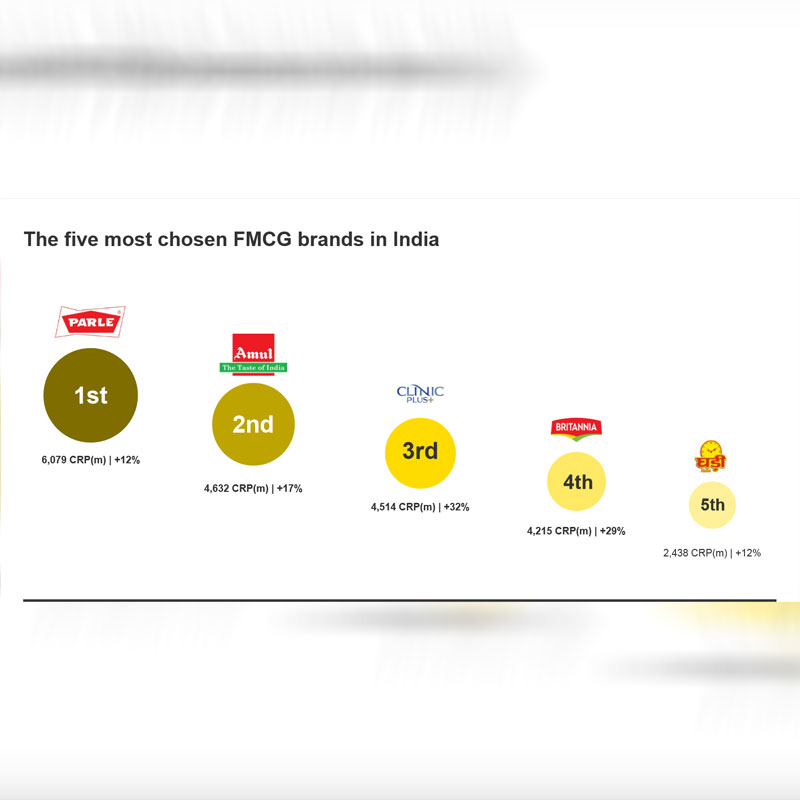
    NEW DELHI: According to Kantar’s Brand Footprint 2020 report, brands including Parle, Amul, Clinic Plus, Britannia and Ghadi emerged as the topmost chosen brands in the country in 2019. The report is an annual ranking of FMCG brands based on the Consumer Reach Points the brands scored in a year. The report is in its eighth edition this year.

    Brand Footprint 2020 follows CRP based ranking which considers the actual purchase made by the consumers and the frequency at which these purchases are made in a year.

    According to the report, scoring the highest CRP (million) at 6029 with a 12 per cent increase, Parle ranked first, which was followed by Amul at 4,632 CRP (million) and 17 per cent increase, Clinic Plus at 4,514 CRP (million) with 32 per cent increase, Britannia at 4,215 CRP (million) with a 29 per cent increase and Ghadi at 2,438 CRP (million) with a 12 per cent increase.

    The report further highlighted that this year five new brands made it to the Billion CRP Club including Dabur, Vim, Sunfeast, Brooke Bond and Patanjali and 21 brands joined this group in 2019 compared to 16 in both 2018 and 2017.

    Consumers made significantly more choices this year leading to a significantly better CRP performance by brands – 57 per cent brands record growing CRPs and bigger brands find better growth and follow the golden rule, brands grow faster by growing penetration. Colgate stands at the highest penetrated brand at 88 per cent, as per the report.

    In the foods category, Britannia is the second-most chosen brand, seventh-highest penetrated brand with a household penetration at 67.6 per cent. Aashirvaad saw a surge with 4 per cent penetration increase and +55 per cent CRP growth.

    Dabur as a brand came out strong in personal care and foods category with 34 per cent increase in CRP growth, making it the fifth-most chosen beauty and health brand in India with a 70 per cent per cent household penetration.

    “Consumer reach points are a great way to measure and rank brands as it is a measure of the number of opportunities a brand has, to interact with a consumer. It is great to see consistent validation for the fact that if you build penetration, frequency and growth follow. This has really been a year of global brands in terms of their higher growth than others. Like these, this year’s report has a lot of interesting nuggets to derive a lot of information and insights on top the behaviour of consumers towards brands in the last year,” Kantar MD- south Asia, worldpanel division K Ramakrishnan said. 

    The report concluded that 2020 is the year of global brands and for the brands that focused on reaching more targets were the clear winners. It also said that Covid2019 did not upset the top brands’ growth.

  • Value and innovation are essential for brands in the post-pandemic recession

    Value and innovation are essential for brands in the post-pandemic recession

    MUMBAI: Persistent safety concerns, financial pressures and sticky new behaviours mean consumers will not return to pre-pandemic behaviour any time soon. Marketers will need to pivot to finding growth in recession, delivering increasing value in the short-term to address growing economic concerns while innovating their way to sustained relevancy as behaviours and priorities change long-term. These are the findings from the fifth wave of Kantar’s COVID-19 Barometer,  global study tracking people’s attitudes, behaviours and expectations across more than 50 markets.  

    Post-pandemic recovery delayed

    Only one-third of people (37 per cent) expect to return to non-essential consumer behaviour before two to three months. Even as many countries relax lockdown laws and commercial businesses reopen, across the world, 66 per cent of people say they will continue to avoid busy places, meaning a drag on physical retail environments. 

    Beyond mandated hygiene and social distancing measures, 50 per cent of people want regular testing for all and 43per cent want mandatory facemasks, led by demand in Asia, but more reluctance in western markets. 

    Nearly everyone is experiencing increased anxiety over money. 56 per cent of households across the world have now experienced a loss of income due to Covid2019. In India, the impact is even more acute, with 74 per cent of households have experienced a loss of income due to Covid2019. This rises to 68 per cent of the millennial generation and 65 per cent of GenZ. A further 19 per cent expect an impact on their income in the future. 

    Brands and retailers need to prove their value

    As the financial impact of the crisis becomes increasingly apparent, across the world consumers consistently speak of a sense of pride in finding value, making smart decisions, and quietly enabling their own long-term success. 53 per cent of consumers are paying more attention to products on sale (vs 36 per cent in wave1). Offering discounts and promotions is now the third-highest expectation of brands, (vs 5th in wave 2). 69 per cent of consumers say a shopping list is more important now globally as well as in India. 

    Beyond pricing strategies, consumers expect brands to keep advertising and acknowledge the crisis; three in four (74 per cent) are happy with the volume of advertising, and only 14 per cent want to see pre-pandemic ‘normal’ advertising. Two-thirds of consumers are looking for help and advice – for themselves (64 per cent) and their communities (65 per cent) in the adverts they see and in actual brand behaviour. In India too, more than half of consumers would like to see a lot more of advertising which shows what brands are doing to help the community (57 per cent) and the people themselves (54 per cent).

    Grocery stores are recognised as delivering value in the short term. 40 per cent of consumers globally and 60 per cent in India perceive their grocery store experience to be more positive while 69 per cent perceive employees to be friendly and helpful and grocery stores to be acting on their promises; both metrics significantly outperforming CX benchmarks. 

    Ecommerce usage continues to soar. 40 per cent (vs 33 per cent in wave 3) of consumers now say they have increased or significantly increased their online purchasing, rising to 48 per cent for households with children and millennial households. India too shows a positive trend for Ecommerce usage (45 per cent vs 40 per cent in Wave 3). Low pricing and promotions rank as the biggest reasons.

    Innovate to align with the new rhythms of life

    People have started to like their lockdown habits. More than half believe they will maintain lockdown behaviours post-pandemic. In India too, people are likely to maintain behaviours adopted during the pandemic. Increased hygiene, healthier eating, spending time with the family and personal development are most likely to be maintained. More than half the world now claim to be trying to exercise more. 

    These changes all lead to different needs and spending patterns, and with more than half the world also feeling financial pressure, brands need to ensure their products make the cut in being considered vital in the new rhythms of life. This is amplified by the increase in willingness to switch. 45 per cent (rising to 50 per cent+ of households with kids,) of consumers say they are prepared to keep using products and online stores they found while in lockdown.  

    Kantar chief client officer South Asia insights division- Soumya Mohanty said, “Indians are still in the phase between a lockdown and unlock. Some habits are starting to stick – eating healthy, hygiene while new ones around social distancing are emerging. The way we shop and interact will change but in an emerging, aspirational market the meaning of sustainability and responsible consumption differs. Brands will need to move from emotional succour and social solidarity to fundamentals of value, functionality, innovative delivery and simple mental availability. Simplicity could well be the new mantra as we navigate an uncertain world.”

    Kantar chief innovation officer – Rosie Hawkins, observed, “Adapting to life post-pandemic, we’ve started to appreciate, and want to maintain our newly formed healthy behaviours, our more considered and purposeful personal connections and our online shopping habits. Brands and companies first and foremost need to ensure that their goods and services are safe to use and that precautions have been taken to guarantee this. As lock down restrictions lift, consumers' lives will continue to change and so brands will need to reassert their relevance in these new environments.”

  • BP, Milka and HSBC top the tables in Kantar’s Creative Effectiveness awards

    BP, Milka and HSBC top the tables in Kantar’s Creative Effectiveness awards

    London: BP's Blind Date(Spain),Milka’s Christmas adGive to those who give the most(Germany) and HSBC’s CSR Birmingham(UK) are the most effective adsfrom around the world in2019, according to Kantar’s inaugural Creative Effectiveness awards.These new awards celebrate theworld’s best performing ads across the three key media channelsbased on actual consumer feedback.

    Spanning three categories (digital,print/out of home and TV) andfrom 78different markets, the winners represent the most creative and effective work from over 10,000 ads tested with consumers in 2019 usingKantar’s Link creative testing, which measures any advert’s potential to deliver against short and long-term brand goals. Thesefirst award winners perform in the top 4% for short-term sales likelihood, and the top 1% for long-term brand building when measured against the Link database of over 200,000 ads analysed over the past 30 years. The winning ads are all at least twice as likely to drive sales than an ad that performs at the median evaluation score and ten times more likely than a weak ad.

    The winners show that distinctive creativeis central to advertising success, falling in the top 15% of ads for distinctiveness in Kantar’s database. In a world flooded with content, brands need to ensure their advertising captures people’s attention.

    Digitaleffectiveness: Engage don’t enrage

    Analysis ofthe digital category revealed the most effective ads reward the viewer with entertaining content that breaks through the ‘ad filter’ in consumers’ mindsand compels them to view it. Milka’s Christmas adGive to those who give the most tops the digital ad awards, demonstrating the power of storytelling for driving engagement by evoking strong emotions. The beautifully touching film, centred around a strong, seasonally relevant message of thoughtful gifting, was created in partnership with the European Union of the Deaf and promotes inclusion in a very moving way.

    Digital Ranking

    Brand

    Ad Name

    Agency

    Country

    1

    Milka

    Milka Christmas: give to those who give the most

    Wieden + Kennedy, Amsterdam

    Germany

    2

    Google App

    Search the lyrics with Google

    Zula Alpha Kilo

    Indonesia

    3

    Dulux

    Let’s colour experiment: escalator

    Road 381

    UK

    Print & Out of Homeads: Spark a response in seconds

    The winners here illustrate the power of creative to deliver an instant impression about the brand. Immediate impact is essential as consumers give just seconds of their time to print and out of home (OOH) ads, in which the content needs to communicate its message or hook the viewer in for longer.

    HSBC evokes an immediate emotional reaction through its winning OOH execution. The shocking statistic that 1 in 45 people living in Birmingham have no address, therefore can’t have a bank account, a job, or a home, helps highlight the work the bank is doing to support the local community.The impact of the message is heightened by delivering it in situ enabled by the medium of OOH.

    Print and OOHRanking

    Brand

    Ad Name

    Agency

    Country

    1

    HSBC

    HSBC CSR Birmingham

    Wunderman Thompson

    UK

    2

    Estrella Damm

    Silja

    &Rosàs

    UK

    3

    Camden Hells

    Juicer static

    Forever Beta

    UK

    Top-performing TV ads tell great stories

    TheTV winners demonstrate the continued sales-generating and brand-building ability of broadcast content, particularly whenstrong distinctive assets are weaved into great emotional story telling. Crowned as  Kantar’s most powerful TV ad of 2019 globally, BP’s Blind Date is a great example of how a distinctive approach to a category can create differentiation. The ad shows how a functional message can be intrinsically sewn into an amusing, brand-centric story that is quite different to what you would expect to see from the category.

    TV Ranking

    Brand

    Ad Name

    Agency

    Country

    1

    BP

    Blind Date

    Ogilvy&Mather

    Spain

    2

    Tim Hortons

    Ask a Timbits Kid

    Zula Alpha Kilo

    Canada

    3

    Unox

    Tijdenveranderen

    TBWA

    Netherlands

    The first ever Kantar Creative and Effective awards showcase some of the most impactfuladvertising workfrom around the world,” said Daren Poole, Global Head of Creative at Kantar. “The commonality across allthe winning ads is distinctiveness, and how strongly the brand is integrated into the narrative. Our winners – real consumers’ favourites – take on many forms and employ a range of creative tactics to convey their message; proving there is no ‘one-size-fits-all’ approach that can be employed to achieve great content. Interestingly, many of the winning ads in Kantar’s Creative Effectiveness awards are heart-warming stories or contain humour, in contrast to the broader industry trend, which is to incorporate humour less.” Just over one third (34%) of 2019’s adverts were intentionally light-hearted or funny, compared to more than half (54%) of ads evaluated by Kantar in 2000.

    Poole added. “For content to drive brand impact and deliver ROI, it must be created with the consumer in mind, by understanding what will translate best to the audience, and how. Weaving intelligent and iterative research into the creative development process ensures the strongest ideas, and most effective executions end up seeing the light of day. We know that in the era of the COVID-19 pandemic consumers want advertisers to have authentic empathy and to be useful. Achieving this creatively and sensitively is incredibly difficult, making pre-testing as important as ever”

    For more learnings about Link ad testing, advertising trends, and to review the full winners list, please visit :https://www.kantar.com/creative-effective.

  • Brands and consumer sentiments during Covid2019

    Brands and consumer sentiments during Covid2019

    The Covid2019 pandemic is something that has affected the entire globe. Since the initial spread of the pandemic in India, the announcement of lockdown, and the scenario in the present day, consumer behaviour has undergone a drastic shift and driven purely by the changing emotions that this pandemic is causing with each passing day.

    The sentiments of concern, safety and care for their near and dear ones are the most dominant ones. The fear of getting infected with the virus, having enough essential supplies, losing loved ones, the wavering economic conditions, or just job security is dominating everyone’s mind.

    There are two major emotions that have come out of the Covid2019: anxiety and hope.

    “You cannot control what happens to you, but you can control what you do about it.” A very old saying, but most apt for the given situation that the world is finding out. As communicators, we believe that this is true for brands as well.

    In times of crisis, misinformation and speculation get multiplied given the growth of the WhatsApp generation. This in itself is one of the biggest causes of anxiety that the consumers base as a whole is subject to. According to a recent study done by Kantar, 75 per cent of the respondents felt that brands should not exploit the health crisis to promote their products and brands. An equal number of people also speak about expectations from brands to be helpful and support in these times.

    It is our firm belief that in times of crisis such as this, a brand should simply go back to the drawing board and ensure that they do the basics right. This is also a time where all your stakeholders, external as well as internal, are looking to the brand for that ray of hope where they get the confidence that everything will eventually fall in place.

    Some thoughts that we are following and recommending our brands to follow as well.

    Redraw communication plans: The communication strategy and approach of brands is undergoing a radical change during these times. We believe that it is time for marketers to leave behind their focus towards selling and bring in basic values in their messaging. As a communication partner, we have been working with the brands under our custodianship to focus more on their purpose rather than their products.

    Reflection of values: The brand communication needs to have a reflection of values such as empathy towards others, sensitivity to the situation, relevance to the topic, show of care and compassion, and thorough transparency. This is also the time in communication when consumers are forming an opinion on the brands based on their ability to appreciate the hardships that the world faces.

    Be helpful: At this point of time, there are going to be a lot of frustrated souls out there. Those who are walking the 1000 miles or those who are locked up in their houses, no matter what their state, they are confused and troubled. Brands that are going to be helpful will be remembered for a long time even after this pandemic. These are times to earn loyal followers.

    Communicate only if required: It is essential for brands to understand that being relevant is the key. Push strategy will definitely not work in this hour. It is crucial to have minimal yet a powerful communication with your audiences.

    Communicate Internally: Crisis communication internally is as important as external. Don’t avoid communicating internally about risks and challenges faced by the business in these trying times. Ensure that the entire hierarchy understands the position and communicates the same across board.

    Educating consumers: Not every brand is going to be directly impacted with Covid2019, but at the same time no brand is going to stay untouched, either. Some industries will see a surge in demand while some face real hardships. The brands must act as an influencer and participate in relevant and necessary communication which educates the customer as well as helps them see through these times.

    We are going through uncertain times and the constant rising death numbers aren’t doing any good to our morale. However, this is also the time when the boys will turn into men, and brands will mature to super brands and communication will play a very big role in this journey.

    Be safe. Be responsible.   

    (The writer is managing director at IdeateLabs. The views expressed are his own and Indiantelevision.com may not subscribe to them.)

  • Kantar’s ‘new normal’ mantra for brands: Build brand equity, invest in multimedia

    Kantar’s ‘new normal’ mantra for brands: Build brand equity, invest in multimedia

    NEW DELHI:  Brand building acts as a multiplier of ROI and more than doubles the impact of media investment of sales, says Kantar CEO global media and digital practice in a webinar discussing how to grow brand and ROI in the ‘new normal’ of post-COVID world. He highlighted that on an average media investment helps to explain about 13 per cent of sales today while media impact considering the brand is 28 per cent on short-term sales plus long-term equity-driven sales.

    He insisted that brand equity and media investments combined together can act as a great driver of long-term and short-term sales.

    Kantar Singapore managing director, insights division, Jane Ng noted that it is important for brands to keep communicating with consumers to build brand equity. Sharing data, she highlighted that people want brands to take a larger role in society.

    “In essence, it is not just good for business or it will help us for recovery, the most important reason here is that consumer will be looking at brands as an important companion through this journey,” she said.

    Kantar NASEAP chief digital officer insights division Pablo Gomez added that brands, therefore, need to take a multi-channel approach of reaching out to consumers as synergies will be a major driver of ROI in the new world.

    He added that in addition to what message the brand wants to convey, it will also have to put increased emphasis on how it cuts that through. “Creativity is the queen as being creative with media drives half of the campaign impact reach.”

    Gomez also says that reusing previous successful ideas can also be used as it is relevant when one wants to remind the consumers why they should care about the brands.

  • Consumers don’t want brands to stop advertising despite COVID-19: Kantar study

    Consumers don’t want brands to stop advertising despite COVID-19: Kantar study

    MUMBAI:  Consumers don’t want brands to stop advertising and it must not be exploitative, says Kantar's new study. Majority also believe that coronavirus must not be exploited to promote a brand.  

    The study seeks to gauge urban India’s sentiments, behaviours and expectations from brands during the COVID-19 pandemic.

    As consumer behaviour shifts dramatically and an anxious India waits it out, the new study provides brand owners the answers to burning questions like:
    ·         What are people thinking, their major concerns, fears and expectations
    ·         How the current crisis is impacting purchase behaviour
    ·         Implications for brands and marketing

    In the wake of the COVID-19 pandemic, urban India has emerged deeply anxious with a strong need for reassurance and stabilisation. Some highlights of the study are: 

    Expectations from brands

    A “New Normal” is gradually forming. If you don’t build desire, we will learn to live with less, indicates the Kantar study.

    ·         Brands are expected to be a trusted source of accurate information (28 per cent)
    ·         Consumers don’t want brands to stop advertising and it must not be exploitative
    ·         71 per cent believe coronavirus must not be exploited to promote a brand
    ·         Brands must show how they can be helpful in the new everyday life (79 per cent) 
    ·         Inform about their efforts to face the situation (77 per cent) 
    ·         Offer a positive perspective (74 per cent)    
    Urban India sentiments and behaviour

    ·         Despite a significantly lower number of cases and death toll compared to many nations, India has a high score on the concern index at 57 per cent. 
    ·         Day-to-day disruption bothers India more 69 per cent when compared to:
    o   Health concerns at 48 per cent  
    o   Economic recession at 18 per cent  
    o   Financial preparedness of the nation at 47 per cent  

    ·         Standing at 54 per cent, India supersedes the global average of 34 per cent  when it comes to expecting a speedy recovery

    ·         We are optimistic    attitudinally, but behaviours are contrary. Driven by high concerns for scarcity, 51 per cent India is stocking up for worse, mainly essentials.

    ·         Going by the current scenario, shared mobility is likely to take a hit; the numbers are heavily skewed towards a complete stop on usage of public transport (55 per cent), taxis/ride-hailing apps (35 per cent), domestic air travel (58 per cent), domestic railway travel (57 per cent) as opposed to private vehicles (17 per cent).

    Kantar’s COVID-19 Barometer India study was conducted among 1100+ sample across 19 cities and 15 states. The respondents are men and women above 18 years and belong to NCCS A and B. The data collection was done through 19 – 22 March.

  • Time spent on OTT audio streaming apps goes up by 42%

    Time spent on OTT audio streaming apps goes up by 42%

    MUMBAI: The COVID19 crisis has changed the average Indian’s life. With schools and colleges being shut coupled with corporates and governments encouraging employees to work from home, Indians in the metropolitan cities are looking at ways to keep themselves entertained and/ or to find “companions”.

    Kantar – VTION’s passive OTT Audio Audience Measurement service data reveals that there was a 42 per cent increase (amongst consumers able to consume OTT / streaming audio platforms) in time spent on listening to OTT/ streaming audio apps. 

    What is driving this growth? 

    Social distancing is the new norm! with consumers being forced to be housebound in the current environment, a large number of “new users” (consumers who were not tuning into OTT / streaming audio apps in the previous period) have started using these services

    Amongst various demographic groups that were analysed, two segments display huge growth in the time spent on listening to OTT/ Streaming Audio apps:

    Over 50 per cent growth in the time spent on listening amongst the age group of 18-24 – a reflection of the closure of colleges and youngsters being housebound and looking for alternate entertainment options?

    Consumers in the age group of 25-34 have shown a 30 per cent growth in usage – perhaps driven by the fact that they are working from home (WFH) and using the OTT/ streaming apps as a companion medium 

    In terms of day-wise consumption behaviour, the study shows that new “peaks” are emerging as far as consumption of OTT/ streaming audio apps is concerned. The report reveals a 52 per cent growth in the incidence of listening in the afternoons – between noon to 6 pm. Late night (post-midnight till 6 am in the morning) registers an 80 per cent increase in the incidence of listening, compared to the last month.

    Will the current environment change the consumer behaviour? Will the consumers continue to avail of the OTT / Streaming Audio services? Will the medium grow? Only time will tell.

    The OTT Audio Audience Measurement offering brings together Kantar’s expertise in media measurement and consumer insights with VTION’s proprietary audience measurement technology and data management framework to provide a unique, comprehensive understanding of audience behaviour, insights for communication planning as well assessment of ROI for media investments across OTT Video platforms, OTT Audio Streaming & Podcasting and Broadcast Radio FM Platforms.  

    The study is based on a robust sample size of 9000+ stretching across top 9 cities (Delhi, Mumbai, Kolkata, Chennai, Bangalore, Hyderabad, Pune, Ahmedabad & Lucknow/Kanpur) among male and female of age group of 18+ and across SEC A, B & CDE.