Tag: Kantar study

  • Fortune calls for transparency with #SirfDaamNahiGramBhiDekho campaign

    Fortune calls for transparency with #SirfDaamNahiGramBhiDekho campaign

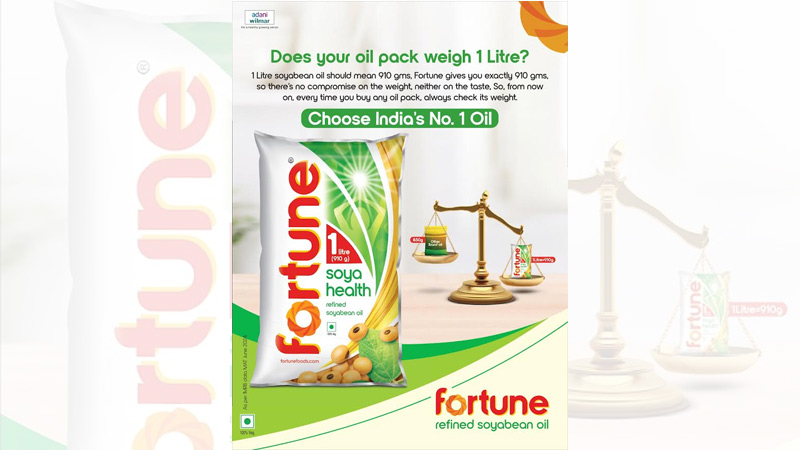
    Mumbai: Fortune, an edible oil and food brand, has launched the ‘#SirfDaamNahiGramBhiDekho’ campaign to raise awareness about some brands selling less than one litre (910 gm) of oil in a pack, only mentioning the weight but not the volume.

    This practice started after the government permitted non-standard edible oil packaging in 2022. While legal, it could mislead consumers into buying smaller quantities while assuming the pack holds one litre. For instance, some soybean oil brands sell packs of around 850 gm, which may appear similar to a 910 gm or one-litre pack. Fortune clearly displays both the weight (910 gm) and volume (one litre) on its packaging.

    A Kantar study shows only 15 per cent of consumers check oil weight when purchasing, often assuming packs hold 1 litre (910 gm) based on appearance. Additionally, 95 per cent of respondents believed oil pack weights range between 900 and 1000 gm, regardless of whether they check the grammage.

    Fortune Edible Oils group product manager Prashant Pandey said, “While cooking in our kitchens, we measure oil by volume, be it through the usage of spoons or ladles or the depth of oil in a kadhai while deep frying. It is misleading to mention only the grammage and not the volume of oil on a particular pack.”

    Fortune is stepping forward to highlight the non-disclosure of volume by certain oil brands on packs that look similar to one-litre packs. “You do not expect consumers to do a volume-weight calculation for edible oil when buying a product. We believe in full disclosure of both volume and weight of our edible oils and expect all brands to do so to help consumers make an informed decision. Not only weight, but there have also been concerns around the quality of edible oils. Our brand follows more than 100 stringent quality checks before a product reaches to the market,” Pandey added.

    Head of media & digital Jignesh Shah said, “Reaching and informing a wide base of consumers is increasingly challenging in today’s fragmented media landscape. To maximize our reach, we are utilizing TV, print, digital platforms, social media along with influencers. We also call on the media fraternity to support us in driving broader awareness and ensuring the success of this campaign.”

    With the festive season driving higher demand for edible oils, Fortune urges consumers to check the fine print on packaging to make informed choices. From Navratri and Diwali to Christmas and the wedding season, there will be a surge in festive cooking across India. Failing to check the details could lead consumers to realise later that they’ve been buying less oil for more money.

    Fortune’s commitment to transparency through clear labelling has earned consumer trust and recognition from Kantar. The brand continues to deliver high-quality products, reinforcing its position as a leader in the edible oil industry.

  • 16 per cent urban Indians currently own cryptocurrency: Kantar study

    16 per cent urban Indians currently own cryptocurrency: Kantar study

    Mumbai: The sentiment around cryptocurrency in India and the world over is volatile, with tweets or news around cryptocurrency seen to have an immediate effect on it. As per a recently concluded study by Kantar, it is learned that while 83 per cent of urban Indians are aware of cryptocurrency, the ownership is at a healthy 16 per cent for a product that has gained traction only recently.

    Out of the 16 per cent urban Indians who claim to currently own cryptocurrency, ownership is highest in the top four metros at 20 per cent, among private banking customers at 19 per cent and in the age group of 21-35 years at 18 per cent, found the study. The owners have a higher risk appetite, with their investment basket comprising shares at 31 per cent and mutual funds at 21 per cent over traditional choices like fixed deposits at 19 per cent and life insurance at 16 per cent.

    The survey by the evidence-based insights and consulting company was primarily conducted amongst males and females aged between 21-55 years across twelve key Indian cities such as Mumbai, Delhi, Chennai, Kolkata, Pune, Hyderabad, Bangalore, Ahmedabad, Indore, Patna, Jaipur, and Lucknow. Respondents were a mix of salaried and business owners- all with savings accounts across various banks, Kantar stated adding that the time frame of undertaking the social analytics was from January 2020 to June 2021.

    The study also found that cryptocurrency owners and intenders have a diversified financial portfolio. The average number of financial products owned is higher (6.6) among those who have currently invested in cryptocurrency as well as those who intend to (5.2). In comparison, the average number of financial products owned by non-crypto-owners stands at 4.6 and 3.6 for non-intenders.

    Interestingly, one in two consumers intending to invest in cryptocurrency are repeat investors. Out of the total sample surveyed, 19 per cent Indians intend to invest in cryptocurrency in the next six months. However, this is lower when compared with the intention to invest in mutual funds (49 per cent) and shares (33 per cent) in the next six months.

    Most Indians are currently trying to better understand how cryptocurrency works and if it’s worth the investment and risk, according to Kantar- Insights Division executive director Anand Parameswaran. “This is the first of its kind research study on cryptocurrency in India. We met close to 2,000 consumers and saw that awareness levels are clearly quite high,” he said about the study, adding that, “Consumers are willing to invest in the product and are looking at diversification of their portfolio among high-risk products. Engagement with various crypto exchanges also indicates that ownership numbers seem likely to increase in future.”

    In terms of ownership, the top five preferred currencies are Bitcoin which leads by far at 75 per cent, followed by Dogecoin at 47 per cent, Ethereum at 40 per cent, Binance Coin at 23 per cent and XRP at 18 per cent. Though Bitcoin leads on ownership; net sentiment is highest for Ethereum (41). Net sentiment for other cryptocurrencies like Dogecoin, XRP, and Binance coin is also higher compared to Bitcoin.

    Consumer intelligence from social data shows that the profile of those interested in cryptocurrency is most likely to be men in the age group of 25-44. The higher skew of the cryptocurrency interested audience is also seen towards the top metros with Delhi topping the charts at 21 per cent followed by Mumbai at 17 per cent, Bangalore at 12 per cent, Hyderabad at seven per cent and Pune at six per cent.

    Crypto exchanges like WazirX, Zebpay, Coinswitch, and Kuber are most used to purchase the currency for the most popular ones- Bitcoin (70 per cent), Dogecoin (78 per cent) and Ethereum (70 per cent).

    “While most perceive cryptocurrency currently as a digital currency, it is also perceived by the majority as an alternate form of investment. Cryptocurrency thus can be a potential competition to alternate investment instruments like gold,” said Frrole AI co-founder Amanpreet Kalkat.

    Earlier, Elon Musk’s tweet (about not accepting Bitcoin for the purchase of Tesla vehicles) gave cryptocurrencies a negative sentiment around May 2021. However, post a reassurance, these sentiments shifted back to positive post-June 2021.

  • Overall increase in media consumption on account of COVID-19: Kantar study

    Overall increase in media consumption on account of COVID-19: Kantar study

    MUMBAI: As the world struggles with the COVID-19 pandemic, there has been an increase in media consumption across all in-home channels, says a study by data, insights and consulting company Kantar.

    The study finds that WhatsApp is the social media app that has experienced the greatest gains in usage as people look to stay connected. Overall, the popular chat app has seen a 40 per cent increase in usage.

    In later stages of the pandemic, web browsing increased by 70 per cent, followed by an increase in (traditional) TV viewing by 63 per cent. Social media engagement increased by 61 per cent over normal usage rates.

    The largest global study into consumer attitudes, media habits and expectations during the COVID-19 pandemic surveyed more than 25,000 consumers across 30 markets. The first wave of COVID-19 Barometer research provides brand owners with clear direction on how to ensure their brands stay connected to their customers during the pandemic crisis.

    Key findings of the study are:

    Media habits

    Across all stages of the pandemic, WhatsApp is the social media app that is experiencing the greatest gains in usage as people look to stay connected. In the early phase of the pandemic, its usage increased 27 per cent.

    Spain experienced a 76 per cent increase in time spent on WhatsApp. Overall Facebook usage has increased 37 per cent. China experienced a 58 per cent increase in usage of local social media apps including Wechat and Weibo.

    Increased usage across all messaging platforms has been biggest in the 18-34 age group. WhatsApp, Facebook and Instagram have all experienced a 40 per cent+ increase in usage from under 35-year olds. 

    There is a crisis in trust. Traditional nationwide news channels (broadcast and newspaper) are the most trusted sources of information with 52 per cent of people identifying them as a ‘trustworthy’ source. Government agency websites are regarded as trustworthy by only 48 per cent of people, suggesting that government measures are not providing citizens around the world with assurances and security.  Also reflecting the loss of trust from recent election cycles, social media platforms are regarded by only 11 per cent of people as a source of trustworthy information

    Expectations of Brands

    There is very little expectation that brands should stop advertising with only eight per cent of respondents identifying it as a priority for brands. As many brands consider ‘going dark’ to save costs, Kantar estimates that a six-month absence from TV will result in a 39 per cent reduction in total brand communication awareness, potentially delaying recovery in the post-pandemic world.