Tag: Kantar IMRB

  • Internet user growth in India touches 566 mn

    Internet user growth in India touches 566 mn

    MUMBAI: India’s internet user growth continues with the estimated number reaching 566 million as of December 2018. Kantar IMRB today revealed the data in its ICUBE 2018 report on digital adoption and usage trends in India. The report also predicted double-digit growth in 2019 as well leading to 627 million users by the end of this calendar year.

    493 million Indians, 88 per cent of the total user base, are regular users, having accessed internet in the last 30 days. According to the report, 293 million active internet users reside in urban India and there are 200 million active users in rural India. 97 per cent of users use mobile phone as one of the devices to access the internet.

    Interestingly, rural India is now on the driver seat of this growth story. Rural India registered a 35 per cent growth in internet users over the past year while urban India witnessed 7 per cent growth reaching 315 million users in 2018. Currently, there are 251 million internet users in rural India that is expected to reach 290 million by the end of 2019.

    “The internet is transforming the way consumers and marketers interact with each other in today’s digital world. Kantar IMRB’s ICUBE, which has tracked the digital evolution in India for last 20 years, provides key measurement metrics necessary for planning any digital marketing or communication initiative. ICUBE continues to provide government, policy makers, digital businesses, marketers and communication specialists the intelligence necessary to stay on top of the developments across different facets of digital platforms and services,” Kantar South Asia CEO Preeti Reddy said.

    The gender digital divide is now reducing as the Kantar ICUBE 2018 reports that women today comprise 42 per cent of total internet users. Female users are not merely present on the internet but equally active on digital platforms.

    “The latest edition of Kantar IMRB ICUBE report shows that today the digital base in India is growing by over 75 million users each year – as much as the entire population of Germany! It is fascinating to note that the digital revolution is now sweeping small towns and villages perhaps driven by increased accessibility at affordable data costs. What is also particularly interesting, is the increase in the usage of digital in rural India, where more than two-thirds of active internet users are now accessing the internet daily to meet their entertainment and communication needs. Marketers have a big opportunity today where they can use digital to reach their consumers – both in urban and rural India,” Kantar IMRB media and digital managing director Hemant Mehta commented.

  • Amazon eyes another 100 mn users in India

    Amazon eyes another 100 mn users in India

    MUMBAI: E-commerce has not even scratched the surface of its growth potential in the country – this according to Amazon India head Amit Agarwal. The giant will not shy away from another round of aggressive investments in this market. 

    As per the reports, Agarwal said that the company is looking to add another 100 million users to its platform in India. He added that the company would transform the landscape of domestic e-commerce and take its prime subscription base in the country to 100 million. Earlier this year, the company said it has more than 100 million Prime users globally. Prime drives a significant part of its overall sales in India. 

    Repeating the words used by CEO Jeff Bezos, on the occasion of the US company’s fifth anniversary in India, Agarwal said that Amazon is not even in ‘Day1’ of e-commerce in India.

    As per the reports, Bezos had committed $5 billion investment for India since Amazon’s entry and  much of this has already been invested. The current numbers for Prime and the overall user base in India were not disclosed by Agarwal. He also didn’t reveal about the size of possible future investments. As per Kantar IMRB’s study of 32,000 online shoppers, 50 per cent of online shoppers chose to shop on Amazon India during the festive season sale this year. Moreover, Flipkart had claimed leadership over Amazon during the sale. 

  • Ipsos hires Sreyoshi Maitra for senior leadership position in Delhi

    Ipsos hires Sreyoshi Maitra for senior leadership position in Delhi

    MUMBAI: Ipsos, world’s third largest market research company has hiredSreyoshi Maitrain a senior leadership position,as part of its Delhi Cluster. Designated Executive Director, she will also lead the Shopper Practice for Ipsos India and will report to Krishnendu Duttawho leads the Delhi cluster for Ipsos.

    Maitra moves from MRSS and has previously held senior level positions with Nielsen, Kantar IMRB and Kantar Milward Brown. Her expertise coversa vast number of areas in both Consumer and Shopper behavior, and also ROI on Channel spends.

    Her remit is for key Ipsos clients in Delhi and NCR, though for Shopper Practice her repertoire of clients would extend across geographies of India. 

    Settling into her new role with one of the fastest growing MR companies in India, Sreyoshi says: “Ipsos isyoung and dynamic organization with a basket of compelling solutions. I look forward to partnering clients in their journey to uncover uncommon consumer insights and building stronger brands which are relevant to their audiences.”

    Krishnendu Dutta, Delhi Cluster Lead for Ipsos commented, “With her wealth of domain expertise and experience, Sreyoshi will play a key role in deepening our relationship with clients, further bolstering our position in the market.” 

    Maitra actively speaks at industry forums like Instore Asia, Asia Retail Congress, among others.

    She holds a PGDM degree in Marketing from IMI and is a BA Economics graduate from Jadavpur University. 

    Additionally, she has done a Digital Marketing Certification Program from MICA.
     

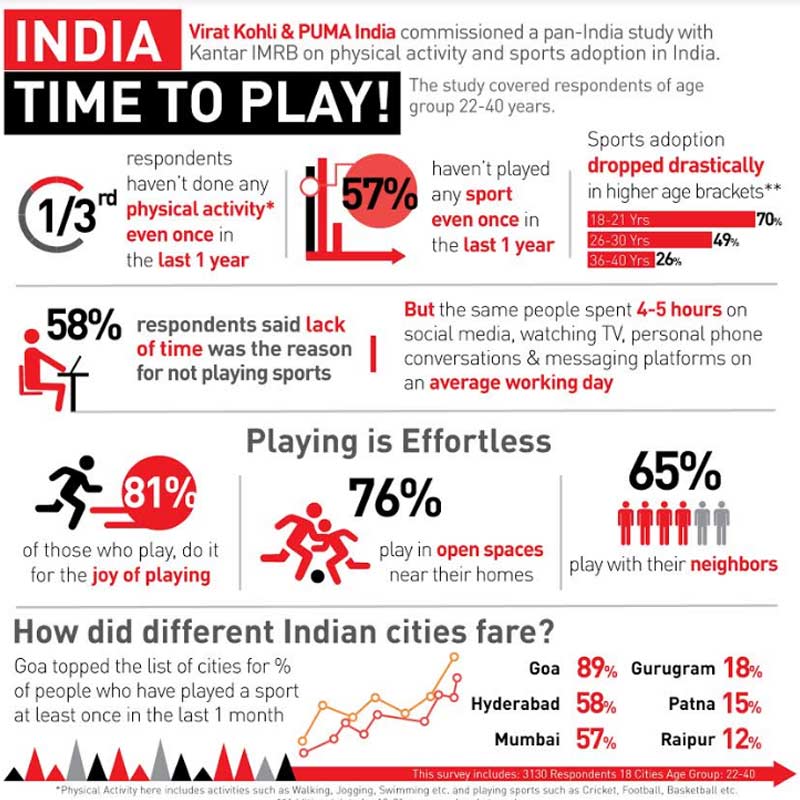
  • Study reveals that 1/3rd of India hasn’t done any physical activity even once in the last 1 year

    Study reveals that 1/3rd of India hasn’t done any physical activity even once in the last 1 year

    MUMBAI: India’s leading athlete Virat Kohli and sportswear brand PUMA commissioned a pan-India study with market research agency Kantar IMRB to understand the current state of physical activity and sports adoption in the country. The study also assesses the barriers to playing sport regularly. Additionally, it highlights that the biggest motivation for adopting play is the sheer joy it brings and how it can effortlessly be included in everyday life.

    Findings show that:

    ·  1/3rd of the total population surveyed had not done any physical activity even once in the last 1 year!*

    Physical activity here included any activity at home/outdoors/gyms/fitness centers such as Running/Walking/Zumba/Yoga/Swimming etc. as well as sports such as Cricket, Football, Badminton, Tennis, Table Tennis, Basketball, Volleyball, Hockey, Squash and local games such as Kabaddi, Kho-Kho etc.

    · 57% of the respondents have not played any sport for the last one year!*

    o   3/4th of this group last played a sport only in school or college

    o   While 70% of the respondents between 18-21 years had played a sport at least once in the last 1 year, this figure dropped drastically as individuals progressed in their occupations, and reduced to just 26% in the age bracket of 36-40 years.

    · 58% of those who don’t play any sport cited ‘Lack of time’ as the main reason *

    o   However, the research brought out that the same respondents also spent close to 4-5 hours on social media, watching TV, personal phone conversations and usage of various messaging platforms on a typical working day (all put together).

    o   In fact, the average frequency of uploading content on one’s social media handles was found to be 9 times in a month

    o   Additionally, the average number of working hours for those who don’t play was found to be lesser than those who do (4.8 hours vs. 5.4 hours)

    · Interestingly, 81% of those who do play said they did so simply because they ‘enjoyed playing’ *

    o   Other reasons for playing sport include ‘keeping fit’ and ‘relief from stress’

    o   76% percent of those who play stated that they play in any open spaces that they find near their homes and 65% play with neighbors. Both clearly showing that lack of infrastructure or unavailability of people to play with were not barriers to play.

    · Goa topped the list with 89% of the respondents playing a sport at least once in the last 1 month*

    o   This was followed by Hyderabad and Mumbai. 

    o   Gurgaon, Raipur and Patna rated low on this index with only 18%, 15% and 12% of the respondents from these cities playing at least once in the last 1 month.

    Responding to the findings Virat Kohli said, ““It is shocking to see that one-third of the country has not done any kind of physical activity in the last one year. When you are physically fit, you are more energized to take on challenges. I have experienced this personally, and therefore strongly believe in leading an active lifestyle.

    Technology and social media is gaining preference over health and fitness in our lives. This needs to change. Sports can be seamlessly integrated into our daily life – one can do it anywhere and at any time. Hence, I urge everyone to Come Out and Play. Its fun, relieves stress and helps us stay fit.”

    PUMA India, Managing Director, Abhishek Ganguly said “The study brings out alarming facts about India’s adoption of physical activity.  It is essential to take corrective steps to address this situation. Playing sports is a simple yet effective solution that can be implemented into everyday life.”

    He further added “Our endeavour has always been to encourage and promote an active lifestyle in the country. It is Virat Kohli’s personal mission to inspire India to get fitter, and we are delighted to partner with him in this journey.”

    The survey covered 3924 respondents from the age bracket of 18-40 years (both male and female). The respondents were spread across 18 cities – Bangalore, Mumbai, Delhi, Hyderabad, Chennai, Pune, Kolkata, Cochin, Ghaziabad, Goa, Gurugram, Guwahati, Jaipur, Lucknow, Ludhiana, Patna, Raipur, and Surat.  

  • India’s online retail market to hit $100 bn by 2020: Kantar IMRB report

    India’s online retail market to hit $100 bn by 2020: Kantar IMRB report

    MUMBAI: Kantar IMRB has launched a report on India’s shopping scenario in 2017 that provides comprehensive insights on buying behaviour of India’s online shoppers. The study is conducted among active internet users in urban India covering a vast range of categories.

    Dubbed as the fastest growing e-tail market in the world and with the online retail market in India expected to touch $100 billion by 2020, the space accommodates a vast array of players and complex market dynamics.

    It is an end-to-end environment scan of Indian e-tail landscape, with insights on consumer behaviour across demographic groups, market dynamics, online vs brick and mortar and other emerging trends. Furthermore, the report also offers a bird’s eye view of the changing landscape due to policy developments, lays down special focus on festive season and sector specific trends.

    Kantar IMRB head of digital Akhil Almeida says, “This comprehensive study will serve as a critical decision-making tool for both marketers as well as e-tail players. 2017, by all accounts, has been a landmark year for the Indian e-tail market with 4G-led mobile internet usage galloping and with an increasing presence of digital wallets. Despite the demonetisation shock, the whopping numbers recorded in the space both in terms of buyers and spends, stand testimony to the still-to-be-unleashed potential of e-tail in India’’.

    The report aims to answer critical questions about mapping the e-tail landscape, size of e-tail market, who is the buyer, how different are the buying pattern in large cities vs. small cities, how often do these consumers buy? And how much are they ready to spend, etc. 

    The report gives nuances of the online shopping space by slicing out shoppers for different categories, festival versus non-festival months, ticket size and frequency that can help brand formulate blueprint to craft their e-tail strategies.

    Insights for the report were derived from an exhaustive study of 50,000 online shoppers across urban India. Respondents across different age-groups, locations, socio-economic backgrounds and gender participated in this study.

  • TV also for info, 62% kids feel & 50% access Net independently: Kantar IMRB

    MUMBAI: In an attempt to delve deep into the Indian kid’s market and understand their interaction with their environment, Kantar IMRB has launched its annual property KidScan.

    The study draws up a holistic report on how kids consume brands – with a special focus on food, beverages and related categories. A segment on how media is consumed – with a special focus on television and emerging media also forms an integral part of the study. It also unearths the level of peer influence and its implications on the kids’ purchase & consumption, their ambitions, key drivers and barriers to choice, lifestyle, the amount of pester power they yield, parental pressure and much more. In a nutshell KidScan serves the purpose of a handbook for marketers relevant to the space.

    The quantitative study combines innovative approaches utilizing both face to face and self-filling questionnaires. The findings are derived from a robust sample size of 2500 kids in the age group of 5 years- 14 years and an equal number of parents, belonging to New SEC A, B & C households, spread across 14 cities in the country.

    The study also highlights the real time record of kid’s regular activities and analyzes the communication conundrum to get the brand message across. This study shows that kids act as brand consultant for categories that are targeted to them as well as for big ticket brands operating in categories like consumer electronics, automobiles, etc.

    To better understand the kids’ views on the outlook for retail industry, this study shares some insights like 69% of the kids thinks it is important to wear latest fashion. It also breaks the clutter in the market which helps brands to deliver the target message across.

    The study also seeks to understand the product trends of different industries. Advertising also plays a huge role to shape kids’ preferences and influence them to buy brands. 36% of the kids claim to definitely go and buy the product because they felt that the ad was nice. Same goes for the Digital and Television categories, where 62% of the kids feel that TV is not only for entertainment but also a source of information. For example, 63% of the kids watch English channels to improve their English. The study found that in Digital category, 17% of the Kids who use internet, have accounts on Facebook and they mostly use Facebook for Chatting (15%) and 55% of internet users feel internet is a close ‘buddy’.

    With the ability to demonstrate how kids act as brand consultants / active agents, Kantar IMRB’s KidScan is a marketers’ minefield of information.

    Key Learnings

    1. Wearing Latest Fashion is Important for 69% of the Kids
    2. Deciding what to wear evokes a feeling of confusion in 41% of the kids
    3. 62% of the Kids feel that TV is not only for entertainment but also a source of information
    4 77% of the Kids feel that it is important to save money for the future
    5. 1 in 2 Kids access Internet without anyone’s help
    6. 4 in 10 kids watch serials even when their mother is not watching
    7. 63% of the kids watch English channels to improve their English
    8. Kids spend 48 minutes on an average school day and 60 minutes on a holiday using a mobile phone/tablet
    9. 63% of the Kids spend their pocket money on biscuits
    10. 36% of the kids claim to definitely go and buy the product because they felt that the ad was nice

  • Kantar IMRB & Payback launch ‘shopper barometer’

    MUMBAI: Kantar IMRB and Payback have published a comprehensive report named Shopper Barometer that monitors the shoppers’ perceptions of the economy and their financial well-being that impacts their buying decisions. This is the first study to track sentiments among consumers thus providing a real-time view of validated spends and thereby create robust models to predict future spends.

    * Lower middle social classes (SEC B/C) i.e. petty traders, small shop keepers etc. showing signs of financial distress

    * Weakening of spend appetite in IT and Start-up hubs i.e. Delhi-NCR, Bengaluru, and Hyderabad while traditional manufacturing and trade hubs such as Mumbai and Chennai are more buoyant

    * Eating Out resilient even among those who have reduced spending overall

    * Fashion and Telecom to showing upward momentum despite above average change in relevant category CPI for urban markets

    * Contrary to expectations, the consumer market for Automotive is likely to be subdued this summer.

    Talking about the study, Kantar Shopper EVP Sushmita Balasubramaniam said, “Shopper sentiments are down but not out – the financial strain is more likely a response to the current economic environment rather than lack of cash or affordability. It is evident that they are prioritizing what they choose to spend on – some categories like fashion, dining out have shown an increase in spends. The sentiments also vary by cities; those which have a population less dependent on IT & IT enabled services are more buoyant. A Shopper Index is a valuable tool for marketers & retailers, especially since it provides inputs into category spends apart from the overall shopper sentiment. This can input into crafting strategies that will either ride the wave or address shopper concerns for specific categories.”

    Kantar IMRB’s Shopper Barometer surveys Payback’s (India’s largest Loyalty program) customers on two key areas i.e. spends and the disposition to spend – overall and by key categories. The study gives a complete read of the trendsetter urban markets and the consuming classes.

    Commenting on the study, Payback India VP and head of partner management Rijish Raghavan said, “Payback network spans over 50+ brands, primarily leaders across each of the consumer spend categories and more than 60 million members engaging across this network. This places us in a unique position to access and develop high level intelligence and insights on consumer behaviour and buying patterns. This partnership and recent study with Kantar is another step in this process to leverage the understanding of our network of consumers to create actionable insights for retailers across the country around consumer sentiments and spend patterns by understanding the pulse of the consumer. This study will enable marketers to develop strategies around personalised experiences and engagement customised to specific service categories and consumer choices.”

    Currently, the Shopper Barometer covers a strong panel of 1200 Payback customers drawn from the Upper to Middle Social Classes (SEC ABC) in the 8 leading metros of the country – Mumbai, Delhi- NCR, Kolkata, Chennai, Bengaluru, Hyderabad, Ahmedabad, and Pune.

    “Both Kantar IMRB and Payback track consumer spending across a large basket of categories. We have come together to combine our data strengths to create a bell weather indicator of Shopper Sentiments validated by spending patterns,” said Kantar IMRB senior ED – data alliance Puneet Avasthi.

    The study has been envisaged as a track with multiple waves over a period. The recently conducted first wave provides a good read on the Shopper sentiments post budget as a baseline. A follow-up wave is proposed later this year, to read shopper mood once GST starts settling in as also factors such as Monsoon etc.

  • YouTube 1.5x of FB, short-form popular, 65% in non-metros & 80% may pay premium: Kantar

    MUMBAI: In an attempt to understand the dynamics of mobile video consumption space in India, Culture Machine and Kantar IMRB presented an environment scan of consumption of video and OTT platforms.

    Highlights:

    – YouTube remains the king of online video consumption, with 1.5x the reach of second-ranked Facebook
    – Short-form video (<10 min.) remains the most popular format among mobile users, but it’s also gaining traction among PC users
    – Non-Metro consumers accounted for 65% of video views on smartphone
    – 1 in 3 mobile smartphone video viewers is accessing an OTT video Platform
    – 80% of OTT consumers would consider paying a premium to access exclusive content

    The advent of 4G services and subsequent reduction in mobile data costs have acted as significant catalysts for mobile video consumption. The video streaming landscape in India is being radically transformed, but information regarding viewership remains hard to come by. This report sheds light on the budding landscape of mobile video to enhance perspectives and drive decision-making for marketers interested in the mobile video phenomenon.

    Key Findings:

    – Short-form video remains the most popular format among smartphone users, with 85% of viewers preferring a video length of 10 minutes or less
    – YouTube leads the charge with maximum reach among online mobile video viewers
    – The average smartphone user devotes more than 3 hours a week, watching video content on their smartphones
    – 1 in 3 mobile smartphone video viewers is accessing an OTT video platform
    – 80% of OTT consumers would consider paying a premium to access exclusive content

    Facebook vs YouTube

    – YouTube remains the king of online video consumption, with 1.5x the reach of second-ranked Facebook. But this dominance has come under threat as Facebook is proving to be not just a platform that drives views but also delivers engagement for content
    – The frequency of accessing Facebook in a month is almost 2.5x times greater than YouTube
    – Entertainment/Comedy is the most popular genre on both platforms
    – Vernacular/Regional Content is the most engaging content across categories on YouTube
    Over-the-top (OTT) video services
    – Mobility factor and ability to consume content on-the-go emerges as the clear driver for growth
    – Women and those aged between 15-24 are most likely to be avid users
    – Weeknights are the most popular time slots for OTT consumption

    Culture Machine CEO Sameer Pitalwalla said, “Digital’s rapid growth continues and video is the fastest growing piece of that pie. This report was the result of Culture Machine’s proprietary technology platform Intelligence Machine which we used to understand the video landscape in India. Thereafter, the collaboration with Kantar IMRB was natural, given their global standing in creating reports and coming up with deep-dive analyses on data points.”

    Kantar IMRB MD Hemant Mehta said, “Mobile video has definitely come of age and is the new leveler. Over 40% of users are from the lower socio-economic groups (SEC C/D/E) and as many as 65% are from non-metros. Also, mobile video is not a youth phenomenon anymore – with over 25-year-olds contributing equally. For me, two things stand out: the strong engagement levels that women have with mobile videos and the fact that it’s not just about entertainment. We found that Education while being the third most watched genre, generated over a billion views; especially for the content-focused on toddlers and preschoolers.”

    The report combines Big Data and a deep understanding of smartphone consumer behaviour including –

    – Intelligence Machine – Culture Machine’s AI powered video intelligence platform that scans 3 billion videos daily.
    – Mobi Track: Kantar IMRB’s 8000-strong proprietary smartphone panel that tracks behavioural data.
    – Interviews with 1500 video OTT consumers across India.

  • Kantar IMRB sweeps three awards at MRSI seminar

    MUMBAI: Kantar IMRB has won all of the three prizes at the 26th Annual MRSI seminar, the marquee industry event held every year in the country. The Annual Market Research seminar titled “Looking Beyond” was held in Bengaluru on 20 & 21 February.

    This year’s theme focused on Technology & Data, and especially the role that big data plays in powering meaningful insights that impact marketers’ business decisions and strategy. Kantar IMRB’s win once again reaffirms its mark of excellence, the quality of thinking and insights that it brings to the industry.

    Kantar IMRB is a pioneer of market research services in Asia. Kantar IMRB’s suite of solutions is designed on frugal, agile innovation and adds value, real value, to help clients make impactful decisions.

    Kantar IMRB president  & Kantar Insights CEO – South Asia Preeti Reddy said, “A win at MRSI is particularly gratifying because it is a platform that showcases the best and the brightest minds in our industry. While I would like to congratulate all the winners, this year stands out for us for our robust participation as a Kantar family: Kantar TNS presented two invited papers, 11 of the 16 presenters in the session reserved for young researchers were from Kantar, and Kantar IMRB swept all the awards.”

    A panel of distinguished marketing executives and research experts judged and selected the best entries on the basis of comprehensive evaluation criteria.The panel shortlisted most innovative, cutting edge, modern and thought-provoking papers that showcased the forward thinking of market research fraternity.

    Kantar IMRB won all the three awards as follows:

    •  The Jury Award for Overall Best Paper was given to “Navigating the Net” presented by Debjyothi Sen Sharma and Abhinaba Neogi
    •  The Audience Award for Most Popular Paper went to Debjyoti Sen Sharma for “Reading Your Mind”
    • The Best Presentation – Brave New World titled “Taste the Test” by Adityo Sanyal

    The winners were felicitated at the event attended by over 350 professionals from India’s research fraternity, analytics companies and client partners. In addition, over 1000 delegates viewed the event through live streaming.

  • ‘Budget’ on mobile: Engagement highest among 20-24-yr olds, says Kantar IMRB & MMA study

    MUMBAI: Kantar IMRB, along with Mobile Marketing Association (MMA India), jointly studied the impact of Budget 2017 on mobile platforms. Kantar IMRB’s Mobi Track smartphone usage panel was used to analyse consumption of budget related content in the weeks leading upto and during the Budget 2017 presentation. 

    Coming in the wake of demonetisation, the 2017 Budget was an eagerly anticipated event. As a result, News platforms saw a surge in traction driven in large part by the budget related narratives. A steady diet of budget forecasts contributed to an increase in overall time-spent in the days leading up to the Budget presentation. This was followed by a massive spike in engagement on 1 February, the day of the Budget announcement. 

    A second spike in traction was witnessed over the weekend following the budget, as readers caught up on in-depth analyses and the long term implications of the budget announcements.  News aggregators drew the lion’s share of engagement among smartphone users — the top two aggregators accounted for almost 60 per cent of total time-spent on news related content. 

    http://www.indiantelevision.com/sites/drupal7.indiantelevision.co.in/files/styles/large/public/mma1.jpg?itok=ymntTNH3

    TOI was the most popular of the standalone platforms with twice the traction of its nearest competitor Zee News. Platforms such as Dainik Jagran, Inshorts, and Aaj Tak saw the highest gains in traffic during this time.

    “Looking at the data from Kantar IMRB’s Mobi Trak smartphone usage panel—the surge in budget-related news consumption confirms people’s attention and interest in the event. Engagement levels were expectedly highest among the digital generation i.e. 20-24 year olds — they accounted for the highest Reach and Time Spent  across all demographics. The desire for multiple points-of view was evident in the strong preference for news aggregators, a stark contrast to the behaviour of offline-readers who tend to limit their reading to a handful of print publications”, said Kantar IMRB MD – media | digital & chief strategy officer Hemant Mehta.

    http://www.indiantelevision.com/sites/drupal7.indiantelevision.co.in/files/styles/large/public/mma2.jpg?itok=2N6vRlml

    “News consumption is undergoing two fundamental shifts across the globe including India. One is the rise in the news audience accessing news via their mobile devices, the other is the increase in people who read or watch news through social platforms. The multiple spikes during 2017 budget showcases how fast Indians have adopted reading news not just in English but also in multiple languages (15+). It is important to note the second spike post budget day – the time spend is actually higher during the weekend and indicates that apart from short news Indians also reached out to various mobile news sources for longer in-depth analysis post the budget day. With rapid changes in the mobile landscape it is important to keep a continuous pulse on the way consumers interact and these passive probes and insights on mobile usage in India by MMA and Kantar IMRB are of critical importance to the modern day marketers as they acknowledge Mobile as the 3rd largest advertising medium in India, after TV and Print. Mobile Ad spends estimated to be Rs.4200 crore in 2016 are expected to grow to Rs.10,000 crore in 2018 [Source: Mobile Ecosystem and Ad-Sizing Report India 2016]”, said MMA India manager Preeti Desai.