Tag: Kamal Haasan

  • Shyam Benegal Committee: CBFC can only certify films, not recommend cuts

    Shyam Benegal Committee: CBFC can only certify films, not recommend cuts

    NEW DELHI: In recommendations that are bound to stir a major debate among moralists and others, a government-appointed committee has said that no alterations or changes in any film can be made by the Central Board of Film Certification (CBFC) only with the consent of the rights holder.

    The members of the Shyam Benegal Committee were of the ‘unanimous view that the rights owner has complete rights over his/her film.’

    In its report submitted to the Information and Broadcasting ministry on 26 April 2016 but placed on the ministry’s website now, the Committee has said that there should be no system of imposing excisions (as is practiced at present) and the CBFC must transition into solely becoming a film certification body, as indeed the name of the institution suggests.

    The Committee is of the view that it is not for the CBFC to act as a moral compass by deciding what constitutes glorification or promotion of an issue or otherwise. The scope of the CBFC should largely only be to decide who and what category of audiences can watch the depiction of a particular theme, story, scene etc., unless the film in question violates the provisions of Section 5B(1) of the Cinematograph Act 1952 or exceeds the limitations defined in the highest category of certification recommended by this committee.

    In both such cases, the CBFC would be within its rights to reject certification to a film, but not authorized to dictate excisions, modifications and amendments. The CBFC categorization should be a sort of statutory warning to audiences of what to expect if they were to watch a particular film once the CBFC has issued this statutory warning. ‘Film viewing is a consensual act and up to the viewers of that category,’ the Committee felt.

    The Committee had been constituted by the government on New Year’s Day this year to suggest a paradigm that ensures that artistic creativity and freedom do not get stifled /curtailed even as films are certified. Noting that “in most countries of the world there is a mechanism/process of certifying feature films and documentaries”, an official release had said that the attempt should also be that “the people tasked with the work of certification understand these nuances”.

    The Committee had been asked to recommend broad guidelines / procedures under the provisions of the Cinematograph Act 1952 / Rules for the benefit of the chairperson and other members of the Screening Committee. The staffing pattern of CBFC was also to be looked into in an effort to recommend a framework which would provide efficient / transparent user friendly services.

    The other members of the Committee include filmmakers Goutam Ghose, Kamal Haasan and Rakeysh Omprakash Mehra, creative director Piyush Pandey, media veteran Bhawana Somayya, Nina Lath Gupta who is managing director of the National Film Development Corporation, and Joint Secretary (Films) Sanjay Murthy as Member Convenor.

    This is not the first time that such a committee has been set up. After earlier attempts, the last committee that examined similar issues was headed by the eminent Mukul Mudgal. However, no action has been taken on that report submitted in 2013.

    The present Guidelines issued in 1991 are general in categorization and therefore prone to ambiguity in interpretation. The committee recommended that Guidelines need to be drafted for each category of certification. While doing so, the Committee has taken into consideration all the issues of concern listed in the 1991 Guidelines and included them in the recommended Guidelines as well.

    The committee said the principle objectives of guidelines should be to ensure that the content viewed by potentially vulnerable audiences (including children) is suitable for their viewing, and by making such categorizations, empower consumers to make informed viewing choices.

    Simultaneously, the guidelines are also aimed at ensuring that the artistic expression and creative freedom of filmmakers are protected through objectively laid down parameters for certification that do not attempt to act as a moral compass on what should or should not be shown to audiences, but endeavour to specify the category of audiences that are deemed fit to watch a film, given its content.

    The Committee therefore said that at least two of the objectives of censorship listed in the Guidelines – ‘clean and healthy entertainment’ and ‘of aesthetic value’ – are not within the ambit of the CBFC – as a film certification body, it is not responsible for ensuring the aesthetic composition of a film or for “clean and healthy entertainment”.

    The Committee believes that the objective that a film should be responsible and sensitive to the realms of society is a subjective clause and should be avoided, as there is no definition of what constitutes the values and standards of society at a given point of time. The insertion of clauses that are open to varying interpretations would only render the process of certification more difficult and open to controversy. As an alternative to this clause, an attempt has therefore been made by the committee to lay down a ceiling for the highest category of certification, beyond which the CBFC can refuse certification.

    The Committee examined the need for a separate rating for films with explicit scenes of sex, violence etc. While internationally there is no separate rating for such films, and they invariably get an R or 17+ rating, such films carry a line to the effect that the film has extreme nudity or violence, as the case may be.

    But since a similar approach would not be effective in India, the Committee was of the view that the categories need to be extended. This would release the current ‘pressure cooker situation’ of filmmakers needing to cater to the demands of a certain section of the audience for financial gain through insertion of such sequences but having no avenues to showcase the same except through suggestive sequences in films.

    The committee also agreed that in the present context, unlike in the past, there are no specific timings during which a certain kind of cinema would enjoy playtime. Thus, in contrast to previous times when adult-rated films with explicit scenes were normally showcased as late night shows, in the digital era nothing stops anyone from viewing any content at any time

    In this scenario, having an A-c rating (A with Caution) would help audiences to make distinct choices, prevent the insertion of suggestive sequences in films that would otherwise be classified as Universal viewing and also facilitate the business of film by being available for viewing at all times but restricted strictly to adult audiences.

    Under new guidelines framed by the Committee, a filmmaker would have to specify the category in which he feels the film would go.

    The objective of the guidelines framed by the Committee would be to ensure that:
    a. Children and adults are protected from potentially harmful or otherwise unsuitable content:
    b. Audiences, particularly parents and those with responsibility for children are empowered to make informed viewing decisions;
    c. Artistic expression and creative freedom are not unduly curbed in the process of classification of films;
    d. The process of certification by CBFC is responsive, at all times, to social change.

    In view of this, the Committee felt that the categories UA and A need to further sub-divided.

    The UA category should be divided into sub-categories of UA 12+ and UA 15+ under the CBFC Rules. The Committee recommended this in light of the sociological changes that have occurred since the introduction of the Cinematograph Act in 1952. While UA l2+ caters to young teenagers who are yet to be exposed to the adult world and can therefore be exposed to adult issues in only a minimal manner, UA 15+ seeks to keep in mind that young adolescents are at an age when they are being introduced to the adult world, and are ready to be exposed to various concerns and issues of the adult world, albeit in a moderate manner.

    It has also been recommended that the Adult category be further divided into A and A-C (Adult with Caution) sub-categories. The objective of this sub-categorization is to enable adults to make informed choices about the kind of film they would like to watch. Not all adults prefer to watch films that have explicit portrayals of various issues such as violence, sex, discrimination, use of language etc. The purpose of the A-C category is to warn audiences of the explicit depiction of various issues, thus enabling them to make a considered choice.

    Films that violate the provisions of Section 5B(1) of the Cinematograph Act, 1952 will not be considered for certification.

    Films submitted for telecast on television or for any other purpose should be re-certified.

    The committee has made it clear that any complaints received by the central government should be referred to the CBFC whose chairperson may, if he considers it necessary to do so, refer the film to a revising committee for examination once again in view of alleged violation of Section 5B(1) of the Cinematograph Act, 1952.

    In order to preserve Indian Cinema, the committee recommends that every applicant should deposit the Director’s Cut in the National Film Archives of India for preservation. At present, only the certified version is submitted but the committee felt that the original will ‘truly reflect the cinematic history of Indian cinema.


  • Shyam Benegal Committee: CBFC can only certify films, not recommend cuts

    Shyam Benegal Committee: CBFC can only certify films, not recommend cuts

    NEW DELHI: In recommendations that are bound to stir a major debate among moralists and others, a government-appointed committee has said that no alterations or changes in any film can be made by the Central Board of Film Certification (CBFC) only with the consent of the rights holder.

    The members of the Shyam Benegal Committee were of the ‘unanimous view that the rights owner has complete rights over his/her film.’

    In its report submitted to the Information and Broadcasting ministry on 26 April 2016 but placed on the ministry’s website now, the Committee has said that there should be no system of imposing excisions (as is practiced at present) and the CBFC must transition into solely becoming a film certification body, as indeed the name of the institution suggests.

    The Committee is of the view that it is not for the CBFC to act as a moral compass by deciding what constitutes glorification or promotion of an issue or otherwise. The scope of the CBFC should largely only be to decide who and what category of audiences can watch the depiction of a particular theme, story, scene etc., unless the film in question violates the provisions of Section 5B(1) of the Cinematograph Act 1952 or exceeds the limitations defined in the highest category of certification recommended by this committee.

    In both such cases, the CBFC would be within its rights to reject certification to a film, but not authorized to dictate excisions, modifications and amendments. The CBFC categorization should be a sort of statutory warning to audiences of what to expect if they were to watch a particular film once the CBFC has issued this statutory warning. ‘Film viewing is a consensual act and up to the viewers of that category,’ the Committee felt.

    The Committee had been constituted by the government on New Year’s Day this year to suggest a paradigm that ensures that artistic creativity and freedom do not get stifled /curtailed even as films are certified. Noting that “in most countries of the world there is a mechanism/process of certifying feature films and documentaries”, an official release had said that the attempt should also be that “the people tasked with the work of certification understand these nuances”.

    The Committee had been asked to recommend broad guidelines / procedures under the provisions of the Cinematograph Act 1952 / Rules for the benefit of the chairperson and other members of the Screening Committee. The staffing pattern of CBFC was also to be looked into in an effort to recommend a framework which would provide efficient / transparent user friendly services.

    The other members of the Committee include filmmakers Goutam Ghose, Kamal Haasan and Rakeysh Omprakash Mehra, creative director Piyush Pandey, media veteran Bhawana Somayya, Nina Lath Gupta who is managing director of the National Film Development Corporation, and Joint Secretary (Films) Sanjay Murthy as Member Convenor.

    This is not the first time that such a committee has been set up. After earlier attempts, the last committee that examined similar issues was headed by the eminent Mukul Mudgal. However, no action has been taken on that report submitted in 2013.

    The present Guidelines issued in 1991 are general in categorization and therefore prone to ambiguity in interpretation. The committee recommended that Guidelines need to be drafted for each category of certification. While doing so, the Committee has taken into consideration all the issues of concern listed in the 1991 Guidelines and included them in the recommended Guidelines as well.

    The committee said the principle objectives of guidelines should be to ensure that the content viewed by potentially vulnerable audiences (including children) is suitable for their viewing, and by making such categorizations, empower consumers to make informed viewing choices.

    Simultaneously, the guidelines are also aimed at ensuring that the artistic expression and creative freedom of filmmakers are protected through objectively laid down parameters for certification that do not attempt to act as a moral compass on what should or should not be shown to audiences, but endeavour to specify the category of audiences that are deemed fit to watch a film, given its content.

    The Committee therefore said that at least two of the objectives of censorship listed in the Guidelines – ‘clean and healthy entertainment’ and ‘of aesthetic value’ – are not within the ambit of the CBFC – as a film certification body, it is not responsible for ensuring the aesthetic composition of a film or for “clean and healthy entertainment”.

    The Committee believes that the objective that a film should be responsible and sensitive to the realms of society is a subjective clause and should be avoided, as there is no definition of what constitutes the values and standards of society at a given point of time. The insertion of clauses that are open to varying interpretations would only render the process of certification more difficult and open to controversy. As an alternative to this clause, an attempt has therefore been made by the committee to lay down a ceiling for the highest category of certification, beyond which the CBFC can refuse certification.

    The Committee examined the need for a separate rating for films with explicit scenes of sex, violence etc. While internationally there is no separate rating for such films, and they invariably get an R or 17+ rating, such films carry a line to the effect that the film has extreme nudity or violence, as the case may be.

    But since a similar approach would not be effective in India, the Committee was of the view that the categories need to be extended. This would release the current ‘pressure cooker situation’ of filmmakers needing to cater to the demands of a certain section of the audience for financial gain through insertion of such sequences but having no avenues to showcase the same except through suggestive sequences in films.

    The committee also agreed that in the present context, unlike in the past, there are no specific timings during which a certain kind of cinema would enjoy playtime. Thus, in contrast to previous times when adult-rated films with explicit scenes were normally showcased as late night shows, in the digital era nothing stops anyone from viewing any content at any time

    In this scenario, having an A-c rating (A with Caution) would help audiences to make distinct choices, prevent the insertion of suggestive sequences in films that would otherwise be classified as Universal viewing and also facilitate the business of film by being available for viewing at all times but restricted strictly to adult audiences.

    Under new guidelines framed by the Committee, a filmmaker would have to specify the category in which he feels the film would go.

    The objective of the guidelines framed by the Committee would be to ensure that:
    a. Children and adults are protected from potentially harmful or otherwise unsuitable content:
    b. Audiences, particularly parents and those with responsibility for children are empowered to make informed viewing decisions;
    c. Artistic expression and creative freedom are not unduly curbed in the process of classification of films;
    d. The process of certification by CBFC is responsive, at all times, to social change.

    In view of this, the Committee felt that the categories UA and A need to further sub-divided.

    The UA category should be divided into sub-categories of UA 12+ and UA 15+ under the CBFC Rules. The Committee recommended this in light of the sociological changes that have occurred since the introduction of the Cinematograph Act in 1952. While UA l2+ caters to young teenagers who are yet to be exposed to the adult world and can therefore be exposed to adult issues in only a minimal manner, UA 15+ seeks to keep in mind that young adolescents are at an age when they are being introduced to the adult world, and are ready to be exposed to various concerns and issues of the adult world, albeit in a moderate manner.

    It has also been recommended that the Adult category be further divided into A and A-C (Adult with Caution) sub-categories. The objective of this sub-categorization is to enable adults to make informed choices about the kind of film they would like to watch. Not all adults prefer to watch films that have explicit portrayals of various issues such as violence, sex, discrimination, use of language etc. The purpose of the A-C category is to warn audiences of the explicit depiction of various issues, thus enabling them to make a considered choice.

    Films that violate the provisions of Section 5B(1) of the Cinematograph Act, 1952 will not be considered for certification.

    Films submitted for telecast on television or for any other purpose should be re-certified.

    The committee has made it clear that any complaints received by the central government should be referred to the CBFC whose chairperson may, if he considers it necessary to do so, refer the film to a revising committee for examination once again in view of alleged violation of Section 5B(1) of the Cinematograph Act, 1952.

    In order to preserve Indian Cinema, the committee recommends that every applicant should deposit the Director’s Cut in the National Film Archives of India for preservation. At present, only the certified version is submitted but the committee felt that the original will ‘truly reflect the cinematic history of Indian cinema.

  • Zee Tamizh rebranded as Zee Tamil

    Zee Tamizh rebranded as Zee Tamil

    MUMBAI: Zee Entertainment Enterprises Ltd (Zeel) has rebranded its Tamil language channel Zee Tamizh as Zee Tamil.


    The channel recently sported an all new logo reflecting the color of Manjal (turmeric) and Kunkumam (kum kum), the two most auspicious colors and symbols in Tamil Nadu.


    With the re-branding, the channel plans to have a uniform communication across all platforms with better understanding and easy pronunciation of its name thereby enabling the brand building exercise. 


    Zee Tamil has in its kitty new content offerings like Genes 2Mella Thiranthathu Kathavu as well as the premiere of Kamal Haasan’s movie Uthama Villain.

  • Zee Tamil dons fresh look; lines up new content offering

    Zee Tamil dons fresh look; lines up new content offering

    MUMBAI: Zee Tamil is all set to don a fresh look and feel with its new packaging, which is aligned with its new content offering.


    The channel’s refreshed logo reflects the colour of Manjal (turmeric) and Kunkumam (kum kum), the two most auspicious colours and symbols in Tamil Nadu. The channel has positioned itself as people’s favourite channel with the new positioning statement “Ithu Namma Channel” (It is Our Channel).


    At the content level, new programmes include entertaining game shows, serials as well as reality and star-studded shows. The channel has recently launched two new serials namely Lakshmi Vanthachu and Annakodiyum Ainthu Pengalum in tune with the new positioning.


    The new upcoming serials will have differential and aspirational storylines appealing to the entire family. A new format game show Genes, is slated to launch in April. This will be the first of its kind show in Tamil GECs where celebrities play the game along with their relations. The show will be anchored by Suma, the most popular anchor in Telugu television, who is making her foray into Tamil Nadu market through this show.


    Tamil Nadu being a film market, movies play a key role in contributing to the overall television viewership. Zee Tamil has also expanded its movie library with the acquisition of blockbusters like Vikram Prabhu’s Vellaikara Durai, Kamal Haasan’s Uthama Villain, critically acclaimed Kayal and Sidharth’s Enakul Oruvan.


    Elaborating on the need for the new look, Zee Tamil business head Easwaran said, “Understanding the pulse of Tamil Nadu has been the strength of Zee Tamil. Every few years, a new set of audience come into television. The challenge lies in embracing the new audience into the existing one. The aim is to capture the hearts and minds of Tamil Nadu in its entirety and to make Zee Tamil the most watched general entertainment channel in Tamil Nadu.”

  • Eros International inks deal with Thirrupathi Brothers

    Eros International inks deal with Thirrupathi Brothers

    MUMBAI: Eros International Media has joined hands with N Lingusamy’s Thirrupathi Brothers Media. As part of the tie-up, Eros will release two of the most anticipated films in Tamil cinema with Telugu dub namely Kamal Haasan’s Uttama Villain and Shiva Karthikeyan’s Rajini Murugan.


    Uttama Villain, the first of the two films under this deal, also starring Anushka Shetty is a comedy written by Haasan and directed by Ramesh Aravind. The trailer of the film released on Pongal 2015 and the release is slated for 2 April.


    Rajini Murugan, is also a comedy, starring Sivakarthikeyan and directed by Ponram, whose last venture with the actor was the hit film Varuthapadatha Valibar Sangam.


    Eros International Media managing director Sunil Lulla said, “We are delighted to partner with ace director N. Lingusamy’s Thirrupathi Brothers on these exciting films with the legendary Kamal Haasan and upcoming talent like Sivakarthikeyan. The films will be high on the entertainment quotient and promise to connect with fans and audiences.”


    Thirrupathi Brothers Film Media managing director Lingusamy added, “We are extremely proud to associate with Eros, the most powerful and successful name in contemporary Indian cinema to co-produce our prestigious Uttama Villain starring Kamal Hassan and Rajini Murugan starring the emerging popular hero of Tamil Cinema Sivakarthikeyan only to mark the beginning of a long and successful journey with Eros.”

  • ‘When two work together towards a common goal, it helps both’: Bachchan

    ‘When two work together towards a common goal, it helps both’: Bachchan

    NEW DELHI: It is not right to equate a character he or she plays on screen to the person, and the film Shamitabh in many ways gives this message, according to megastar Amitabh Bachchan.


    Bachchan said that while Dhanush used his voice in the film, he took the character further by bringing his own originality to the character he enacted.


    Speaking at a press meet, Bachchan revealed that he recorded the entire voice-over of the film in the editing room under the supervision of the film’s director R Balki before the film was shot.


    Shamitabh, starring Bachchan and Dhanush, will see the debut of Akshara Haasan. The movie is about a journalist who comes across a good actor without a voice and then meets a decrepit haggard elderly man with a good voice, and tries to match the two. While she succeeds, the two men gradually are overcome by their respective ego problems, and she has to resolve that.


    Bachchan related a dialogue in the film to stress the fact that every person has his or her own value. He said there was a dialogue, which says whisky can be had with or without water. He said, “I do not drink. So, Dhanush is both whisky and water.” But when two people go together, they are bound to succeed, and the film also stresses this, he added.


    Asked about his writer-director Balki, Bachchan said he had worked with Balki in Cheeni Kum and then in Paa and had found the director gives a different touch to his style of filmmaking.


    Speaking about the difference between Bollywood and Tamil cinema, Dhanush said, “Except for the language, almost everything is the same. One difference however is that down in the South, we have to give just five interviews whereas here we have 523 interviews lined up for us.”


    Akshara, whose mother Sarika, father Kamal Haasan and sister Shruti are all part of the film industry, said, “It was a wonderful opportunity and an amazing experience for me.” She went on to say that she did not feel intimated because of any comparisons, since each of her family members have their own style.


    The song Piddly, rendered by Bachchan, which has become really popular, was brought in conversations frequently as it has been used to fight piracy.


    Bachchan also said that since the film is about the film industry, several other known personalities would be seen on screen. Answering a question about his stint in the industry, he said, “I have found that over the last forty-five years, filmmakers are becoming more impatient. However, they are more knowledgeable now about what’s happening all over the world, and this includes usage of new technologies.”


    Presented by Eros International, the film has music by Ilaiyaraaja and has been produced by Sunil Lulla, Rakesh Jhunjhunwala, R K Damani, Gauri Shinde, and Abhishek Bachchan. The lyricists are Swanand Kirkire, Kausar Munir for ‘Sha Sha Sha Mi Mi Mi’.


  • Activities galore at India Pavilion of the Cannes Film Festival

    Activities galore at India Pavilion of the Cannes Film Festival

    NEW DELHI: The India Pavilion at the 67th Cannes Film Festival saw an unprecedented presence this year.


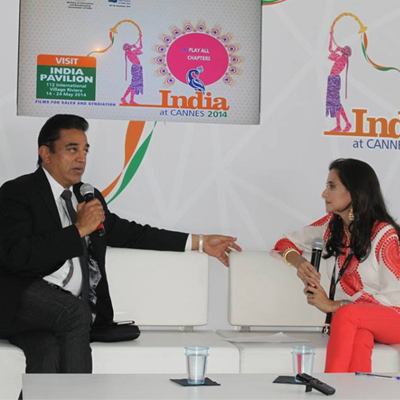
    Organised by the Information and Broadcasting Ministry in association with the Federation of Indian Chambers of Commerce and Industry (FICCI), the packed pavilion was inaugurated on 15 May by Indian Ambassador to France Arun K. Singh, I&B secretary Bimal Julka and Indian cinema legend Kamal Haasan.


    Others present were veteran filmmaker and producer Ramesh Sippy; renowned filmmaker Sudhir Mishra; YRF Entertainment CEO, actor and producer Uday Chopra; screenwriter Arash Amel; Cannes Film Market executive director Jerome Paillard,; FICCI secretary general A. Didar Singh and filmmaker and producer Bobby Bedi.


    The Indian presence at the India Pavilion also included film industry stalwarts such as Film Federation of India president Ravi Kottarakara, T.P. Aggarwal who is the first Indian vice president of FIAPF – the International Federation of Film Producers Associations, and Film and TV Producers Guild of India CEO Kulmeet Makkar.


    The pavilion saw a lot of interesting activity with hoards of people jostling for space as they watched the interactive sessions. The first day saw a session on ‘The Making of Grace of Monaco’ – featuring Uday Chopra and Jonathan Reiman from YRF Entertainment – one of the producers of the opening film at the festival – and Arash Amel, the writer of the film. Anchored by Patrick Frater, Asia Bureau Chief of Variety, the discussion hinted at interesting growth and expansion for Indian cinema in the international space by means of collaboration and co-production.

    A very special session, ‘The Journey to Cannes’, was organised at the pavilion for ‘Titli’, India’s official entry in the Un Certain Regard section of the festival. (The festival’s Critics Week section had also selected another Indian film, Gitanjali Rao’s ‘TrueLoveStory’.)


    The cast and crew of ‘Titli’ – director Kanu Behl; actors Ranvir Shorey and Shashank Arora; writer Sharat Katariya; editor Namrata Rao; Yash Raj Films VP international operations Avtar Panesar; Sikhya Entertainment founder Guneet Monga and CEO Anurag Kashyap Films were felicitated by the Ministry of I&B, and also spoke about their experience of making the film and being selected to be screened at the Cannes Film Festival.

    A feature of the activities at this year’s India Pavilion at the Cannes Film Market was exclusive networking receptions co-hosted by the Ministry and film bodies, producers and filmmakers from three countries: New Zealand, Australia and Germany.


    The New Zealand event was organised in coordination with the New Zealand Film Commission; the delegation was led by NZFC CEO Dave Gibson, and comprised filmmakers and producers from the country; Screen Australia CEO Graeme Mason led the Australia contingent; and German Films organised the third event.


    The Indian guest list saw representation from filmmakers, producers and industry body members at Cannes this year. This new initiative is aimed at promoting and forging ties for co-production and partnerships between India and these countries.


    On the sidelines of these events were structured B2B meetings between Indian delegates and international stakeholders in order to facilitate business promotion and explore opportunities for partnership between the Indian film community and the global one.

    Sessions were also held on co-production with representatives from India and six other countries, and a discussion on Single Window Clearance for promoting hassle-free film shooting for the global film community in India.


    Kamal Haasan was interviewed by critic and anchor Anupama Chopra; filmmakers Ramesh Sippy, Sudhir Mishra and Bobby Bedi were seen in conversation about Indian cinema today and going forward, and Indian films at Cannes over the years.

  • Kamal Haasan to open Indian Pavilion at 67th Cannes Film Festival

    Kamal Haasan to open Indian Pavilion at 67th Cannes Film Festival

    NEW DELHI: Versatile actor Kamal Haasan will inaugurate the Indian pavilion – 112 Village International Riviera with a terrace overlooking the Meditarranean Sea – at the 67th Cannes Film Festival commencing on 14 May.


     Being set up by the Federation of Indian Chambers of Commerce and Industry (FICCI) in coordination with the Information and Broadcasting Ministry (I&B), it will be inaugurated by Haasan who is chairman of the FICCI Media and Entertainment Business Conclave on 15 May in the presence of Indian Ambassador to France Arun K Singh, I&B secretary Bimal Julka, and Marche du Film (the Cannes Film Market) director Jerome Paillard.


    The inaugural addresses will be followed by a discussion on ‘The Making of Grace of Monaco’, the inaugural film of the 2014 Cannes Film Festival. The interactive session anchored by veteran journalist Patrick Frater who is Asia Bureau Chief of Variety, will witness a discussion amongst key personnel from YRF Entertainment led by its head Uday Chopra – the Hollywood arm of the Bollywood powerhouse Yash Raj Films, and one of the producers of ‘The Grace of Monaco’, and the writer of the film; Development and Production at YRF Entertainment head and executive producer Jonathan Reiman and British-Iranian writer Arash Amel.


    The afternoon will see a discussion and felicitation of ‘Titli’, India’s official selection at the festival (Un Certain Regard section) along with the cast and crew including director Kanu Behl. The other Indian film selected at the Festival is Gitanjali Rao’s 19-minute animated romance ‘True Love Story’ which is the only Asian film in the Critics’ Week of the Festival. Titled ‘The Journey to Cannes’, this session will feature ‘Titli’ director Kanu Behl, YRF VP international operations Avtar Panesar, Sikhya Entertainment founder Guneet Monga, Anurag Kashyap and actor Ranvir Shorey.


    The India Pavilion will showcase 100 years of Indian cinema across linguistic, cultural and regional diversity with the aim of forging an increasing number of international partnerships in the realms of distribution, production, filming in India, script development and technology and promoting film sales and syndication.


     In particular, the area of focus at this year’s Cannes Film Festival is establishing India as a global film shooting destination and highlighting initiatives such as Single Window Clearance and co-production agreements with various countries that will enable this.


    The Ministry has ensured that the space available for Indian delegates is probably the biggest in the Cannes village (126 sq metres). To ensure optimum utilization of this coveted space, the Ministry and FICCI have worked to make a schedule of pre-structured B2B meetings for delegates.


    For the first time, the Ministry is releasing the “India Film Guide for Cannes” at the inaugural ceremony with exhaustive descriptions of the policy initiatives of the Ministry, its affiliated bodies; details of all India’s co-production agreements; all Indian films at Cannes and all visiting India delegates; key databases pertaining to the sector and the winners of this year’s national awards.


    FICCI, in association with the Ministry will be organising interactive sessions with Indian and international film industry stakeholders at the India Pavilion.


     Speakers at these sessions will include New Zealand Film Commission CEO Dave Gibson; Telefilm Canada CEO Carolle Brabant; Toronto Film Festival’s Artistic director Cameron Bailey; Rotterdam International Film Festival’s Cinemart manager Marit van den Elshout; Lighthouse Productions, China, CEO Cindy Shyu; John Penotti of Ivanhoe Productions in the United States; Special Treats Productions CEO Colin Burrows and crew members from Grace of Monaco.


    The India Pavilion will be showcasing trailers of recent Indian films and displaying brochures and other literature of Indian film companies. FICCI will be facilitating structured B2B meetings between Indian and international delegates at the festival, and coordinating for exclusive networking events. Alongside, the ‘India Film Guide’, which will list all film related initiatives undertaken by the Government of India and information about all Indian films and delegates at Cannes this year, will be distributed to key international stakeholders.


    India will be represented at Cannes by Julka as well as industry stakeholders such as Uday Chopra, Dibakar Banerjee, Bobby Bedi, Ravi Kottarakara and Supran Sen, president and secretary general respectively of the Film Federation of India; Film & Television Producers Guild of India CEO Kulmeet Makkar, and actors Mallika Sherawat and Ranvir Shorey among others.


     The India Pavilion will see the presence of Indian filmmakers whose films have been selected at Cannes this year – filmmakers Kanu Behl and Gitanjali Rao and other industry veterans and stars.


    “We are honoured and privileged to be working with and on behalf of the Ministry at the prestigious Festival,” FICCI secretary general Dr A. Didar Singh. “It is the next step in FICCI’s continual efforts to bring Indian entertainment to the global forefront.”

  • Incredible India launches short-film contest for travellers

    Incredible India launches short-film contest for travellers

    MUMBAI: Incredible India, an initiative by the Ministry of Tourism in association with content-based digital solutions provider Trivone, Bangalore-based digital media and content services company, has launched a short film contest for travelers.

    The aim of the contest is to promote tourism by depicting pristine destinations within the country. It is open to both Indians and foreign nationals. Anyone who loves traveling and capturing those moments can upload travel videos of less than 3 minutes’ duration, on the Pixel13 (www.pixel13.in) website to showcase the best of their experiences.

    Trivone founder and CEO L Subramanyan said “We are happy to join hands with Incredible India to promote Indian tourist destinations globally. Our aim is to get tourists to document and articulate their experience through a short video film that can be accessed by anyone who visits the website. We also think that such a venture can create awareness of little known places within the country which have thus far remained unexplored.”

    The jury is headed by filmmaker Singeetham Srinivasa Rao and actor Kamal Haasan. 
    The short-film adjudged as the ‘Best Film’ based on the online poll and jury will receive a prize worth Rs 50,000.

  • Kamal Haasan inaugurates Bengaluru International Film Festival

    Kamal Haasan inaugurates Bengaluru International Film Festival

    MUMBAI: The sixth Bengaluru Inter­national Film Festival (BIFF­ES) kicked off at the Jnana Jyothi Auditorium at the Central college campus recently. The festival started with a melodious rendition of Saraswati Vandana by Poornima Kulkarni followed by a cultural dance performance.


    The event was inaugurated by Karnataka chief minister Siddaramiah and renowned cine actor, Kamal Haasan and was presided over by minister of State for food and civil supplies Dinesh Gundu Rao. The chief guests of the event were home minister K.J. George and minister of state for Kannada and Culture Umashree.


    The guest of honour for the event were Iranian cine director, Pouran Derakh­shandeh and the festival director of Hof Film festival, Germany Heinz Georg Badewitz.  Other guests witnessed at the event included P.C. Mohan (Bangalore Central MP), B.S. Satya­nara­yana (Mayor, BBMP), H.D. Gangaraju (President of Karnataka Film and chamber of commerce) and ren­owned film actor, Sudeep.


    Chief Minister Siddaramaiah, while wishing the film festival a grand success, also congratulated the people who made it possible for an attractive week-long screening of international films.


    At the event CM of Karnataka Siddaramiah, welcomed all the delegates saying, “It is a privilege to be a part of such a grand event.” He further asked everyone present to “rejoice relax and remember the film festival,” and was pleased to see such a huge crowd. AT the event Kamal Haasan remembered his early days of being a part of cinema saying that he used to travel all the way from Madras to this city and watch movies at ‘Baal Bhavan’.


    The festival that opened with the film A long and Happy Life on 27 December will be on till 2 January and the films to be screened will be divided in to different sections as Cinema of the World; Asian Cinema; Chitrabharathi (Indian Cinema); Kannada cinema; Retrospectives; Country Focus; NETPAC award winners;


    FIPRESCI award winner; and Special genre: Train films.