MUMBAI: Whether it was the first time or even the third time, there was pride as well as a commitment that they would be back on the winning podium again for the Telly Awards 2004 among those who walked away with the coveted trophy.
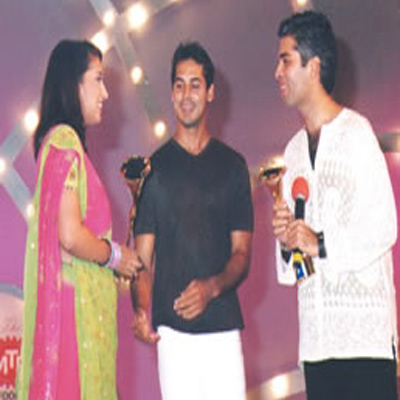
Karan Johar & Dino Morea giving the TV Actor of the year (female) award to Smriti Z Iraani
As far as Star value is concerned, the MTR Foods Telly Awards 2004 belonged without doubt to Smriti Z Iraani. She won in two categories of TV Actor Of The Year (Female) as also in the biggest individual prize for the night as far as performers go – the TV Personality Award. Iraani was also one of the all-woman presenter cast on the night. Said a suitably modest Iraani: “I didn’t expect the Best Actress of the Year Award. But of course, I am glad that I got it. As for the Best Personality of the Year Award, I am very surprised that I got it. I thought that the award should have gone to someone who has really changed the face of television.”
According to Star India CEO Peter Mukerjea who won the TV CEO Of The Year award for the third straight time (as too his channel Star Plus), “It’s great to be nominated and get the award for the third year.” Now that we have the award, we have to work harder.”
Mukerjea, while expressing his delight at having got the award said, ” We have to keep the spirit going and hope that next year we are as good.” Mukerjea also hoped that the Star Network would win the award next year too “as we are reaping the harvest of what we had sowed earlier.”
On phone from Hyderabad, TV Today Network CEO G Krishnan said after Aaj Tak won the Television News Channel Of The Year award, “We would like to keep the lead going and the award is an impetus for us to stay ahead.” According to Krishnan, having seen the growth “we’d like to keep the lead going and are in the process of introducing new features in the news.”
Krishnan also said that the channel would win the award next year too.
A happy vice-chairman of Sri Adhikari Brothers Markhand Adhikari said toeing the “comic line” had paid off after his channel. Adhikari was speaking after SAB TV’s hit comedy
According to Adhikari, “One has to work towards the goal without thinking whether one one would score a goal.”
Having won the award, Adhikari said that it would be the channel’s endeavour to “continue with the format that is being followed now.”
Shaan receiving his award from VJ Gaurav
Shaan, who received the Best TV Music Director Award of the year for Lipstick, thinks this is a good opportunity for him to consider composing as a vocation too. “I never thought of myself as a composer till now. I just wrote and composed my own songs without judging them as good or bad. But winning an award is fantastic because it tells me what an outsider thinks about my songs. The entire credit for the award goes to Goldie Behl. He suggested that I compose and write the song. It was just an informal process where I did the scratches, which Goldie approved instantly. Probably if it was some other producer, the process wouldn’t have been so much fun.”
Winner of Best Single Episodic Series and Best Programme With A Social Message, Suhail Tatari, producer, director of Kadam on Sahara says, “I’m happy that this programme has won an award. That’s because it is one of the few that has serious content and doesn’t depend entirely on TRPs. People have always been doing women’s stories. But we wanted to do something with a different but realistic approach. With the award, we know that it has worked.”
While talking of Achanak 37 Saal Baad, that won the Best Horror serial, Anupama Mandloi of Sony says, “When the production house came with the concept of Achanak, we immediately approved it because it had a good span of story telling. We even put up a set, Gahota, which was like a village in itself. The premise of good vs. evil was fairly complex and soon we changed it from a weekly to a daily.”
Farooque Shaikh receiving the Best TV Anchor award from Madhur Bhandarkar
Farooque Shaikh, winner of Best TV Anchor award says, “The feeling of winning is always great. But with Jeena Isi Ka Naam Hai, it feels even better because the show is shot in such informal surroundings and naturally relaxed fashion that the entire process becomes a lot of fun. I have had lot of fun moments on the show. It’s great to participate in the celebration of a successful person’s accomplishments. The challenge in anchoring such a show is to keep it simple. The trick is to drive the show without bringing attention to yourself. I think that’s what clicks with the audience.”
On BBC World Service Trust and Doordarshan’s Jasoos Vijay winning the Best Thriller Award, a DD official said, “Social communication with reference to the issue of HIV/AIDS has always been a difficult challenge. Jasoos Vijay has been innovative in that manner to telecast it on DD1 on prime time. The consolation is in knowing that it is reaching a much wider audience. The good news is that we are extending Jasoos Vijay for another 24 new episodes after December 2003.”
Ashwini Dheer, who won the Best Continuing Sitcom Award for Office Office, had this to say. We had tried hard to make something real. It’s been long since we’ve been crying over the problem. Office Office takes a tongue-in-cheek look at it and that’s why I guess we are the best sitcom. “
Creative director of Miditech Anil Jha, whose show Kuch Yaadein Kuch Baatein on Star Gold won The Film Based Show Of The Year award, said: “It’s just about a film star’s story. It’s straight from the heart.”
Mohnish Behl & Manoj Joshi jointly shared the best actor in a negative role award
Best Actor in Negative role (Male) Mohnish Behl for his performance in Sony Entertainment Television’s Devi says, “I was motivated to do the role because the character Vikram is not pure black. He has shades of grey as well. He is motivated with a purpose. That’s why people like it and I have won this award.”
When asked how Bhel, who began his career with positive roles, perfected himself in a negative role, he said, “I don’t look at it as a positive character or a negative one. I just comprehend my role and try play it will.”
On a more general note, Bhel said, “An award function like this has always been essential for the television fraternity because people in the business meet here, socialize and exchange ideas. This leads to progress in the industry. That’s why Indian Telly Awards is so valued.”
Co-winner in the negative category Manoj Joshi as Mayorsahab of Star Plus’ Kehta hai Dil said, “My character Mayorsahab is not your regular villain. He is sadistic and yet has an impeccable comic timing. Perhaps that’s why this six-week’s role was fleshed out into a full-fledged role. It has worked and how! It has landed me an award!”
TV18 executive director Vandana Malik whose show Storyboard on CNBC-TV18 won The Business Programme Of The Year award: “Ten years ago we started out with little money and a big dream. This award is recognition for the fulfilment of that dream. We are not one of a clutter but one of a kind. Of course hard work and honesty have also helped us reach where we are today.”
“Storyboard is not your typical business programme. It is an innovative advertising programme backed by very strong editorial. What was significant about last year was that the number of programming hours went up. We also became a majority stakeholder so our name TV18 became branded. We have the first mover advantage.”
Synergy Communications’ Mastermind for BBC World was honoured with the Game Show of the Year award. Deepti Sethi said, “The advantage of mastermind is the BBC format it has adopted. The style of the show is all drama…the dark surroundings, the spotlight” that itself makes the show a winner.” Sethi says, “I am very happy that Mastermind won the best game show award. I think we deserved it. It doesn’t matter whether we are different from other game shows, it doesn’t matter that we are most watched. What matters are the accolades we have received. That’s most memorable.”
Hansika with her mother after receiving the TV Child Artiste of the year
TV Child Artiste Of The Year award winner Hansika Motwani was visibly excited by her achievement. “All along the way to the venue, my mother and I were debating whether I would get the award or not. I was terribly nervous and excited when the winner was about to be announced. I am thrilled to bits. Getting an award before such a huge capacity crowd has added to my thrill. I don’t hink that I can precisely explain what I am feeling.”
Another very satisfied face on the night was Aroona Irani who walked away with the Best Weekly and Best TV Programme Of The Year awards for her show on Star Plus Des Mein Niklla Hoga Chand: “Since I have been in films, I am used to awards and limelight. But yes, television has taken me to places where cinema could not. I am loving every moment of my stint on the small screen. I owe this award to the increasing twists and turns in the Des Mein… plot. Every Monday, people are very anxious to know what will happen next Monday. There are more interesting and shocking turns in store. Wait and watch.”
What she was happiest about though, was the TV Director Of The Year Award that she jointly won with Sourabh Narang For Haqeeqat on Sahara Manoranjan. “I think that I owe this award to my actors. Their team work and ability to understand what I want to extract from them makes the direction a pleasing and non-taxing job. Once this is achieved, the rest follows automatically.”
There were no surprises meanwhile that Ekta Kapoor and Balaji Telefilms won its share of the awards. Speaking about the best production house trophy (again jointly won along with Ronnie Screwvala’s UTV, “This award is for one and all at Balaji Telefilms. Our passion to excel has seen us come to the top. We will continue to work hard and give you the best.”
Balaji also won in the Best Daily and Continuous Serial trophies. “It’s always great to win awards. This moment is no exception. It’s really a great feeling to see that the people continue to love Kyunki…,” said Kapoor.
Urvashi Dolakia receiving the Best Actress in a negative role award from Poonam Dhillon
Another excited winner meanwhile, was Urvashi Dolakia who won for Best Actress In A Negative Role: “I didn’t expect to win it. My joy cannot be put in words. This award is ample proof to realise that the Komolika character has become a household name. I will cherish it always.”