Tag: KA Srinivasan

  • Amagi expands TV ad network to international markets

    Amagi expands TV ad network to international markets

    Indian advertisers can reach more than 200 million viewers worldwide on B4U Network and Zee Bangla across to US, Europe, Asia, GCC, Canada, Africa and Australia.


    MUMBAI: Amagi has expanded its India ad network to key international markets like North America, Canada, Africa, Australia and Asia. Amagi will now offer an advertising platform to Indian advertisers with B4U Network and Zee Bangla in these international markets. The company’s move will now enable Indian advertisers to reach more than 200 million viewers on these channels.


    The company’s ad network will be extended to Zee Bangla and the entire B4U network including B4U Movies, B4U Music, B4U Plus and B4U Aflam. This opens up doors for several brands within India to expand their advertising footprint across the globe in markets of their choice. While this will instantly help in expanding the consumer base of Indian brands, television networks will also benefit from increased ad revenues.


    Amagi co-founder and head of global operations KA Srinivasan said, “Our endeavor is to serve as a global TV ad platform for brands within India, helping them to penetrate and capture international markets essential for business growth; and collaborating with widespread networks like B4U and Zee Bangla, who are our long-standing partners, allows us to do just that. Indian advertisers, who were earlier restricted to Indian audiences alone can now advertise worldwide and reap the benefits of global exposure. Amagi hopes to see more such partnerships with TV channels and continue to bring more Indian brands on board for international advertising.”


    Amagi’s global ad network allows advertisers to target audiences across regions, while optimising ad budgets and increasing their return on investments. Advertisers can buy ad spots through Amagi across its international network and target consumers across markets.

  • ‘The more local digital advertising gets, the more effective it will be:’ Amagi co-founder KA Srinivasan

    ‘The more local digital advertising gets, the more effective it will be:’ Amagi co-founder KA Srinivasan

    In this era of digitisation, the advertisement ecosystem has taken a big leap with digital advertising entering the fray. There was a time when people used to read advertisements, and then with the advent of television came visual ads, which could only be shared by word of mouth. Now with access to internet, ads can be read, seen and shared with help of just one device.


    With brands choosing the digital platform to announce launches of new products with help of email marketing, search engine marketing mobile and web marketing, have now given ads a new dimension to reach people. Digital advertising has broken the limitation of time slot for ads and has increased reach by leaps and bounds.


    Amagi co-founder KA Srinvasan spoke to  Indiantelevision.com about geo-targeted marketing, brands shifting towards digital marketing and much more.


    Excerpts:


    Many channels are tying up with Amagi for geo targeting. Property Now from Times Network is one of them. Do you think split broadcasting will be the way forward?


    Hyper local advertising will be the future of broadcast and television; in general it is going to be more geo targeted. Customised content created as per consumer’s preference is going to have a lot of impact. With the concept of geo generic mass content, as content becomes more local, the ad’s visibility for viewers will increase. Nowadays, content is created based on country, city and regional level not just in India but across the globe. The original goal for over-the-top (OTT) in digital world is to personalise lifestyle and provide content depending on consumer’s interest, preferences and their past watching behavior.


    What do you think will define the new era of effective advertisement?


    The change that we have observed is the more local advertisements get, the more effective it will become. Many of our advertisers are targeting specific local audience. It is effective from both advertising and communications perspective. Viewers will identify the product and advertisers will have a much better brand name at regional levels. From a content owner’s perspective, more advertisers will be able to reach out and from a broadcaster’s perspective, the future is all about getting local in terms of content.


    Now after installation of your technology in multiple system operators’ (MSO) headend, how do you plan to seize digital?


    Keeping that in mind, we launched a product called Thunderstorm, which allows television content owners and television networks to provide personalised advertising in the digital space. Our customers will be able to deliver their content over mobiles, tablet, and television screens and on web. However, there is one problem with monetising the content as the ads, which are telecast on television and which go on the sites are the same. The same goes with handsets. Everyone is watching the same ad on mobile but it is not giving any revenue. We have built a platform that allows advertising networks to have completely different advertising depending on the targeted audience and geographical area.


    Is Amagi focusing more on the digital space now?


    We are enabling content on advertising for television and helping local network owners to ‘hyper local’ the ad content. As content viewing shifts more towards digital, we are trying to bring the product in a more personalised way in digital. Our aim is to personalise and localise cable, television and digital.


    From many years the ten second ad slot has been ruling television and continues to do so. What more will the digital medium adapt?


    Today, the digital media is used as a distribution platform by television networks. What we are trying to do is, using the same content in different versions and using the digital platform for distribution of these ads. In terms of distribution, digital can do much better experimentation and inter-activity than what traditional television offers. Many advertisers are not only creating one commercial but creating multiple versions of it. On the digital platform, attention time span is going to be very limited as compared to traditional television. And because of this broadcasters and advertisers are experimenting. They are trying to create content, which can get the brand name in just five seconds, so that the user does not skip it.

    Digital allows fine grain targeting and that is the reason why we are able to do a lot more interesting stories. It is going to evolve and shift the platform from television to digital. We will then see more of digital specific content. 


    How many broadcasters do you have on board right now?


    We have around 20 plus broadcasters and multiple television channels across many countries. And at the end of this financial year we will have 40 plus channels. And many of them are from traditional satellite and television that are shifting towards the digital platform.


    You talked about the product Thunderstorm for creating personalising content for advertising. What are the new innovations that Amagi is currently focusing on?


    We have partnered with television networks to conceptualise content better. Geo targeting is focusing on satellite to help advertisers in creating personal advertising. We aim to eliminate satellite completely and move to digital where they can use closed bar internet technology. By using that platform, they can deliver their content in fraction of the cost to operators and consumers not only in India but around the world. Many big platforms are leveraging ahead from traditional television and satellite. We see rapid growth in terms of digital advertising in future.

  • Amagi wins IBC 2015 Innovation Award

    Amagi wins IBC 2015 Innovation Award

    MUMBAI: Cloud-based broadcast infrastructure and targeted TV advertising company, Amagi has bagged the IBC Innovation Award 2015 in the ‘Content Delivery’ category.


    Winners were honoured on 14 September during an awards ceremony at the RAI Amsterdam during IBC2015, Europe’s largest electronic media and entertainment conference and exhibition.


    Amagi co-founder KA Srinivasan said, “Winning the IBC Innovation Award signals a new era for content regionalisation where TV networks can deliver localised channels in an affordable and efficient manner than traditional satellite and fiber-based delivery methods. As television viewers around the world continue to demand more personalised content, Amagi’s advanced cloud and watermarking technologies will make it a cinch for broadcasters to address viewer preferences on a global scale.”


    Amagi’s solution was given the IBC Innovation Award based on its unique ability to replace key content on Sundance Channel Global’s Latin American feed with content specifically geared toward the Brazilian audience, without using separate satellite feeds or degrading audiovisual quality.

  • Amagi and Zee expand partnership for geo-targeted ads

    Amagi and Zee expand partnership for geo-targeted ads

    MUMBAI: Amagi Media Lab and Zee Entertainment Enterprise Limited (Zeel) have furthered their partnership by adding Zee Cinema to their list of channels that serve geo-targeted TV ads. 


    A significant development, Zee Cinema will now give advertisers targeted access to over 158.6 million viewers and coverage across 16 markets where Amagi has the capability to deliver geo-targeted content. 


    The 16 markets are: Delhi-NCR, UP, Punjab, Rajasthan, Gujarat, Bihar, Jharkhand, West Bengal, North-east, J&K, Mumbai, Rest of Maharashtra, MPCG, Bangalore, Hyderabad, and All India- direct-to-home (DTH). 


    Zee Cinema gets added to the list of high-viewership channels, which are already on Amagi platform that includes: Zee News, Zee TV, Zee Marathi, Zee Kannada and Zee Bangla (for Bangladesh).


    In a diverse market such as India, Amagi’s platform offers advertisers the benefits of targeted reach and increased relevance in key markets. Advertisers can use Amagi’s platform to market region-specific products, communicate regional offers and promotions and to increase share of voice in target markets. 


    Zee’s partnership with Amagi is reflective of the company’s commitment to driving incremental value for advertisers.


    Zeel chief sales officer Ashish Sehgal said, “We are confident of the value that Amagi’s platform offers our advertisers. Geo-targeted TV ads will add greater direction and specificity to media planning, especially in the Indian market. Our partnership with Amagi will significantly boost our efforts to offer greater return on investment (ROI) to advertisers.”


    Amagi co-founder KA Srinivasan added, “We are extremely pleased to announce the launch of geo-targeted TV ads for Zee Cinema. We feel there is tremendous scope for the growth of geo-targeted TV ads in a country as varied as India. It is our endeavour to be India’s central advertising platform that offers advertisers a reliable and cost-effective solution to TV advertising. The addition of Zee Cinema to our bouquet of channels is a step forward in this direction.” 

  • Itochu Cable Systems inks partnership with Amagi

    Itochu Cable Systems inks partnership with Amagi

    MUMBAI: Itochu Cable Systems has inked a partnership with cloud-based TV broadcast infrastructure and targeted advertising Amagi, offering overseas distribution of Japanese TV content through advanced cloud technologies.

    ICS general manager Kenichi Yamagata said, “Content licensing and distribution across multiple geographies can get quite complex. In Amagi, we have found the perfect content localization platform that can safeguard the interests of Japanese content owners. Amagi’s technology solutions are highly innovative and truly world-class.”

    Using cloud technologies, Amagi enables both large and niche broadcasters to not only operate channels but to also localize content without creating new satellite feeds. Amagi has installations in more than 10 countries, and holds patents in the area of TV content watermarking for geo-specific localization.

    Amagi co-founder KA Srinivasan added, “Amagi has deployed its STORM platform in many countries to cater to content licensing, viewer preferences, and regulatory compliance challenges for TV networks. ICS being the leading video system integrator in Japan, we are very proud to partner with them, and offer our technology innovations and best-in-class TV broadcast platforms to their customers.”


  • Targeted advertising is the way forward for news channels

    Targeted advertising is the way forward for news channels

    MUMBAI: In a tough environment how can news channels monetise better from brands? Well, speaking at the Seventh Indian News Television Summit 2014 organised by indiantelevision.com, Amagi co-founder KA Srinivasan answered the big question.


    He began his keynote by giving the number of brands and advertisers on print and television. “Print media today has about 1.2 lakh or 1.5 lakh advertisers as compared to a paltry 11,000 on television.  When we look at brands there are about 17,000 brands on television compared to 2 lakh brands on print,” he said referring to a study conducted by Amagi from 13 October to 14 September.


    News as a genre, specifically English and Hindi channels, has 600 advertisers and about 1,000 to 1,400 brands advertising for the entire year. He then compared these numbers to print readership, which has a penetration of 20 per cent. “In any market outside India, print advertising is typically half of TV advertising size. While in India, a market where print is dramatically under penetrated compared to TV, we are seeing equal, if not more, advertising revenue generated by print,” said Srinivasan.


    He added, “As per the study, regional advertising consisting of only local brands on print, radio and outdoor is at least Rs 6,500 crore. The print classified size market is Rs 1,300 crore and is expected to grow to Rs 3,600 crore in the next two years.”  


    He then suggested ways by which news channels could tap into this market. A national channel which delivers substantial audience in various markets can monetise better by going after regional brands which is what Amagi has been doing. “In the US such targeted marketing was worth Rs 30,000 crore,” he informed.


    Srinivasan stated the example of how a television channel being watched at the same time in four different geographies can potentially showcase four different ads at the same time. By creating ad inventory regionally to address more advertisers and brands, news channels can increase revenue dramatically. The model can be utilised by local advertisers and large national advertisers while launching a brand specifically for one region and can save on spillage.


    “Hyundai ran an ad for different regions of Maharashtra like Baramati, Kolhapur, Sangli, Nasik etc simultaneously. Each of these ads ran with the local contact detail of the local dealer in each of these local cities,” he said. The study also presented a case study about the Telugu news classifieds market. “The market includes non FCT scrolls, tickers, ashton bands and brand builders predominantly scroll driven with local matrimonial, property deals that is worth Rs 20 crore and just in one market. Can it be replicated across India?” he asked.


    Another monetisation opportunity for news channels is by aggregating a number of channels together as advertisers find it attractive since this presents them a substantial chunk of viewership. “We believe that there are umpteen number of opportunities today that are completely untapped in terms of targeting geographically from a pure FCT perspective,” Srinivasan said in his closing remarks.

  • Star India gets AdSharp; targets regional advertisers

    Star India gets AdSharp; targets regional advertisers

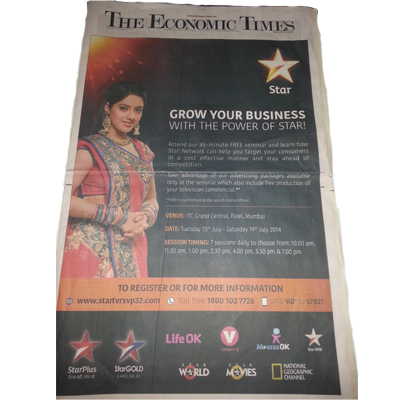
    MUMBAI: The Modi sarkar promised acche din aane wale hai. If one saw the full page advertisement by India’s leading TV network Star India in The Economic Times on 3 July then it looks like good days could be coming the way of regional, small and medium advertisers which have been looking at advertising on the mainline GEC but have found the sticker price too high.


    The who’s who of the advertising industry took notice of the path-breaking step initiated by Star network CEO Uday Shankar.


    The network’s advertisement says, “Grow your business with the power of Star!” and invites marketers, planners and advertisers to attend  free  45-minute seminars through which they can get familiarised with the art of targeting their customers in a cost-effective manner to stay ahead of the competition.


    The target advertiser is  those businesses which are still not advertising on television. Media observers believe that India is a land of opportunity and various small and medium sized businesses have an opportunity to grow by advertising their products on TV, but have been loath to do so because they don’t have agencies, TVCs and also find the cost exorbitant. They cite the example of CavinKare’s Chik shampoo which began as a small regional player, but went on to challenge even the MNCs successfully. 


    The Star India seminars are likely to give more details for its, soon-to-be launched offering, AdSharp, which marks the network’s plunge into geo-targeted advertising in an organised manner. Through it, advertisers can target customers region specifically, as the ads will be local.


    The network which has advertising revenues of around Rs 5,000 crore annually is hoping to increase those top line numbers by luring the small and medium advertiser.


    The first of such seminars will start from Mumbai (15-19 July), followed by Pune (24-26 July), Delhi (5-9 August) and the last will be in Ahmedabad (21-23 August). Registration began almost a month back.


    The invitees can choose from the seven sessions offered in each day-long seminar. The day will not be just about selling and buying of geo-targeted air time by its ad sales team; attending advertisers will also get a chance to get a TV commercial produced free for them by Star India on taking up a package.


    HDFC Life senior executive vice president – head marketing, product, digital & e-commerce Sanjay Tripathy believes that Star India’s first of its kind initiative is laudatory and “will help the network increase its client base.”


    Rivals also expressed appreciation.  Zee’s chief sales officer Ashish Sehgal believes that Star’s seminar campaign  will educate advertisers who have been sitting on the periphery on how to market locally and eventually help expand the overall TV ad market.


     “We have been offering geo-targeted advertising for more than a year now with Amagi. We are part of almost every geo-targeted advertising plan that Amagi does for smaller regional advertisers, and this has worked well for us,” says Sehgal while highlighting that technology plays an important role here. “Broadcasters can choose to outsource geo-targeting to a third party or do it in-house; we have chosen the former so far.”


    Similarly, Amagi’s co-founder KA Srinivasan says that if the largest Indian broadcast network starts pushing geo-targeted advertising then it validates what he and some others have been doing for years now. “It is a good move for the industry and geo-targeting will only pick up in the coming years.”


    Star’s Adsharp which was scheduled to launch by June end, will now be launched by next week or so. It has opted for Cisco as its technical partner for the geo-targeting service.