Tag: K Ramakrishnan

  • Parle rules the roost as Britannia bags snack crown in Brand Footprint 2025

    Parle rules the roost as Britannia bags snack crown in Brand Footprint 2025

    MUMBAI: Looks like Parle still has India eating out of its hand. The biscuit-to-snack giant has once again topped the charts as the most chosen in-home FMCG brand, retaining its #1 spot for the 13th year running with a whopping 8,605 million Consumer Reach Points (CRPs), according to Worldpanel by Numerator’s Brand Footprint India 2025. Right on its heels was Britannia at 8,241m CRPs, while dairy heavyweight Amul secured third place with 6,517m CRPs. Clinic Plus held steady at #4, but the real climber was Surf Excel, which finally scrubbed its way into the Top 5 in-home brands with 3,438m CRPs, rising from #8 in 2023 to #5 this year.

    Haldiram’s pulled off a masala move, breaking into the Top 10 in-home list for the first time, climbing from #19 in 2023 to #10 this year with 2,513m CRPs. Other standout performers included Balaji, which expanded its rural snack pack reach adding 10 million shoppers ( plus 22 per cent CRP growth), and Godrej Expert Crème, which boosted its shopper base by 15 million (plus 37 per cent CRP growth).

    When it comes to out-of-home (OOH) snacking, Britannia kept its crown with 655m CRPs, but it was Balaji that made the biggest crunch, jumping to #2 with 510m CRPs, followed by Haldiram’s (460m), Cadbury (458m), and Parle (299m). Amul also rose to #6, riding a creamy plus 19 per cent CRP growth.

    While FMCG brand choices in India grew in 2024, the pace was slower, dragged by a food and beverage sector slowdown. Yet, India continues to outpace global averages: 60:40 odds of growth here, compared to 50:50 worldwide. Interestingly, smaller brands are punching above their weight, showing higher CRP growth, while big players slow down.

    “Growth comes from expanding the shopper base, whether through innovation, new formats or deeper rural reach. India remains a vibrant market with challenger brands steadily gaining ground,” said Worldpanel by Numerator MD for South Asia K. Ramakrishnan.

    With 414 brands across foods, home care, beauty, beverages and dairy in the study, the 2025 report confirms what Indians have always known whether at home or out, their brand loyalties are built bite by bite.

  • The Script Room appoints K. Ramakrishnan as an independent director

    The Script Room appoints K. Ramakrishnan as an independent director

    MUMBAI: The Script Room, an independently owned, bespoke creative agency, founded by Ayyappan Raj & Rajesh Ramaswamy (Ramsam), onboards K. Ramakrishnan (Ramki), managing director – South Asia at Kantar Worldpanel, as an independent director on its board. With over three decades of experience in marketing, branding, and business strategy, he has held leadership roles at companies like Lenovo, Café Coffee Day and TVS Motor Company. In his new role, Ramakrishnan will participate in the strategic business decisions of The Script Room bringing his deep market knowledge, experience and thought leadership to the table.

    Known for its commitment to enjoyable scripts across formats, The Script Room has always championed storytelling that connects. With Ramki’s mentoring, the company takes a significant step forward in its journey of shaping their business with both soul and structure.

    Reflecting on the decision, The Script Room co-founder Ayyappan Raj shared, “Two years ago, when I first conceived the idea of establishing a Board of Directors and shared it with Ramsam, Ramki was the very first name on the list. I had the privilege of meeting Ramki in 2005 when he was a client at TVS Motor Company, and since then, he has played a significant role in both my professional and personal journey. It is with great pleasure that we announce his appointment as an Independent Director on our Board. Ramki is widely regarded as a trusted advisor and mentor – his innate capacity for leadership and guidance, coupled with his expanding sphere of influence, make him a valuable addition to our governance and strategic thinking.”

    K. Ramakrishnan shared, “It is a pleasure and honour to be able to serve as an independent director on the board of The Script Room. I am happy to work with bright and creative professionals such as Ramsam, Ayyappan and the others. I hope to provide professional counsel and promote a lot of dialectic thinking as The Script Room continues to scale up in its Creative Business journey”.

    Now in its sixth year of operations, The Script Room is excited about the future with Ramki joining as an Independent Director and will soon announce its full board of directors. With this guidance, the company is poised to continue delivering outstanding stories across all formats while building a cheerful and inspiring environment for its team and partners alike.

  • Parle tops charts as the most chosen in-home FMCG brand for 12th year in a row: Kantar Brand Footprint India 2024 report

    Parle tops charts as the most chosen in-home FMCG brand for 12th year in a row: Kantar Brand Footprint India 2024 report

    Mumbai: Kantar has released the twelfth edition of its annual Brand Footprint India report. The report ranks the most chosen (in-home & out-of-home) FMCG brands based on consumer reach points (CRP’s). CRP considers the actual purchase made by consumers and the frequency at which these purchases are made in a calendar year.

    Key findings: In-home segment:

    1.    With a CRP score of 7980 million, Parle holds the top spot for a record twelfth year in a row, followed by Britannia, Amul, Clinic Plus and Tata Consumer Products.

    2.    Consumer reach points (CRP’s) continue to grow, however is slightly lower than last year. Overall, CRP’s have increased almost 33 per cent in the last five years.

    3.    All sectors have seen a CRP growth slow down, except dairy:

    4.    Brands chosen more often have greater probability of growing in CRP:

    5.    Haldiram’s and Balaji are the only two brands in the 2024 top 25 in-home brand list to grow by more than 30 per cent in CRPs in 2023.

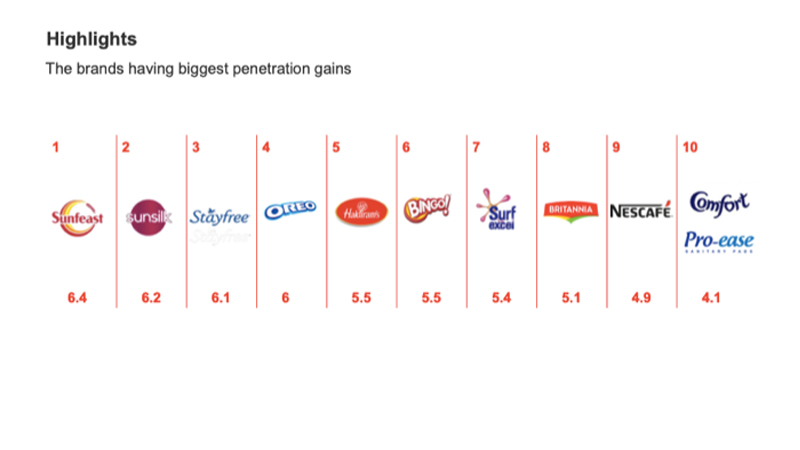
    6.    Sunfeast leads the way in biggest penetration gains in 2023 at 6.4. The following brands make it to the top 10 list:

    7.    Seven brands in the top 25 in-home rankings show more than 20 per cent penetration increase in the last decade. Britannia leads the way, followed by Surf Excel, Sunfeast, Haldiram’s, Patanjali, Brooke Bond and Vim.

    Key findings: Out of home segment:

    1.    Britannia leads the way in the second edition of OOH brand rankings with 628Mn CRP’s. It is followed by Haldiram’s, Cadbury, Balaji and Parle. The top five rankings are all snacking brands and remain the same as 2023.

    2.    The five most chosen OOH beverage brands in India are Thums Up, Frooti, Amul, Maaza, & Bisleri.

    Speaking about this year’s report and rankings, Kantar MD – South Asia, worldpanel division, K. Ramakrishnan said, “Consumer choice is very reliable strength test for a brand across market conditions and Brand Footprint has been a widely acclaimed ranking system to measure this for over a decade now. As we see over the years, consumers are making increasing trips for purchase and that adds their options and in-turn, their choice. This is reflected in the constant increase in CRP’s. We also introduced an out of home rankings last year as OOH consumption is on the rise and has different choice triggers.”

  • Kantar launches FMCG out of home consumer panel in India

    Kantar launches FMCG out of home consumer panel in India

    Mumbai: Marketing data and analytics company Kantar has launched a FMCG panel that tracks out of home purchases in India. The panel has already been up and running across ten countries around the globe before finding its way to India in June 2022.

    This in-depth panel will track and report purchases made for a total of 13 out of home (OOH) categories which include 11 F&B and two QSR categories. Within the QSR categories (pizzas and burgers) not only out of home, but in-home orders/consumption will also be captured.

    The panel will cover 11,000 individuals aged between 15-49 years across both genders, covering NCCS A, B, and C amongst 10L+ population Indian towns.

    The data will be captured in real time at the purchase occasion itself through a 100 per cent self-filling application. Since the consumer will fill the survey live, it will be actual purchases being recorded and not re-called ones. The reporting of the data will however be done at a monthly level to keep it in line with Kantar’s already existing and successful in-home panel. Eventually, the panel will be able to provide a 360-degree view of the consumer purchases- both from an in-home and OOH perspective.

    Important key highlights from the inaugural leg: Firstly, the out of home chocolate market is worth Rs 1.1 billion with more than 40 per cent of the population buying in a quarter. The quantity purchased over a quarter of 370 grams is purchased per person. Secondly, two-third of individuals purchasing salty snacks consumed out of home opt for potato chips and lastly, chocolate and not vanilla is the dominant flavor consumers opt for ice creams, with 25 per cent volumes being contributed for out of home consumption.

    Speaking on this launch, Kantar managing director – Worldpanel division K. Ramakrishnan said “We are very excited at the launch of India’s only robust FMCG OOH panel. This panel will collect consumer data in real time and provide extremely actionable insights to the FMCG companies who operate in India and help them make informed marketing decisions.”

  • Premium category growth double that of entire FMCG sector

    Premium category growth double that of entire FMCG sector

    MUMBAI: Even though the FMCG sector in rural India is facing a slow down for the past few quarters, the number of households buying more than 20 categories in a year saw a jump of nearly 50 per cent in the past year, Kantar managing director for Worldpanel Division south Asia K Ramakrishnan told Indiantelevision.com as he highlighted the key findings from the Consumer Connection 2019 report, which is based on the buying habits of around 8200 households in India across 95 categories.

    Ramakrishnan said, “Rural India is in a conundrum. On the one hand, there is a slowdown (for FMCG) and on the other hand, they are trying more categories. Rural aspirations are just like urban consumers’ right now. So, they are trying newer things by cutting on staples like atta, oil, salt, etc. They are rationing it in such a way that they avoid the wastage of these staples and also the stocking.”

    One of the reasons behind this increase in categories that the rural consumers buy from are actions taken by various brands in making products available at cheaper price points in the form of trial packs.

    Ramakrishnan highlighted that along with Indian consumers’ move towards bigger packs—as compared to their affinity to sachets like earlier—increasing, there has been a substantial jump in the sale of premium category products across the country. “The growth of premium category is twice that of the FMCG category as a whole,” he said.

    He further noted, “We see it as a result of several things like there have been strong pricing actions by manufacturers for promoting larger packs; strong promotional actions to popularise these larger packs; and interesting innovations like Kissan’s ketchup sachets with a nozzle.”

    Ramakrishnan added, “The premiumisation is showing tremendous growth not just because the base is small, but also because a lot of premium brands are offering trial packs. For example, Surf Excel is a premium brand but it has grown, largely, on its Rs 10 pack.”

    He also mentioned that after a slowdown in the FMCG sector, that started from the second quarter from 2018, the industry is now looking towards a revival. The first quarter of 2019 has shown improvements, and Ramakrishnan believes that the worst is over.

    Ramakrishnan also elaborated on the increased penetration of e-commerce in the Indian market. He shared that though the category has witnessed 3-time increase in its penetration, it is largely because the base is small. He attributed this growth to the increasing smartphone penetration and cheaper data prices.

    Some other key findings of the Consumer Connections 2019 include a dip, of about 50 per cent, in the success rate of newly launched products, a 15 per cent volume drop in the sale of baby foods, and loss of volumes for unbranded products.

  • Madison to handle CCD’s media account

    Mumbai: Café Coffee Day (CCD) has awarded its media mandate to Madison Media for its chain of coffee Cafés.

    The account size is estimated to be around Rs 400 million and will be handled by Madison Media Omega in Bangalore.

    Madison Media Group CEO Gautam Kiyawat said, “We are delighted to have India’s premier and leading café chain, Café Coffee Day, to our roster of clients and are confident of helping it grow and gain further market share in the country.”

    CCD president marketing K. Ramakrishnan said, “Café Coffee Day being a brand for the young and the young at heart, we needed a partner who would be passionate about the brand, to be able to understand the category in depth and the varying dynamics to enable us to move along at a fast pace. We are confident of Madison Media’s thought leadership and competence in executing the campaigns. We are delighted to have them on board”.

    Café Coffee Day as a brand has never advertised in mass media in the last 16 years of its existence. It has been built on different marketing initiatives, coffee category building activities, public relations and social media.

    The brand has just launched its first ever television commercial titled ‘Sit Down’ that has been created by Creativeland Asia.

    For the record, Madison Media Group handles media mandate for clients including Airtel, Godrej, Cadbury/Kraft, ITC, General Motors, Marico and McDonald’s.

  • Creativeland Asia conceptualises first ever CCD TVC

    Mumbai: Coffee shop chain Café Coffee Day (CCD) has launched its first ever television commercial in its 16 years of existence, conceptualised by Creativeland Asia.

    CCD aims to reach every single household through the television commercial. The TVC titled ‘Sit Down’ is part of a 360 degree campaign. It is built on the premise that ‘standing up’ often doesn’t really yield results, but a lot of things can happen when you ‘sit down’.

    Creativeland Asia founder and creative chairman Sajan Raj Kurup said, “We wanted CCD‘s first ever TVC to be a little more than an Advert. Something that CCDgoers identify with, something that is neither too heavy nor too frivolous. In the whole idea of ‘Sit-down’, we eventually found all these and more. A powerful thought which is socially relevant in India at this juncture.”

    The TVC is produced by Equinox Films and directed by Ram Madhvani.

    According to the company, the campaign will be integrated across media with digital and social playing an important role. The agency has planned many campaign specific acts over the last year and will be executed phase-wise.

    CCD president marketing K. Ramakrishnan said, “CCD as a brand has never advertised in mass media in the last 16 years of its existence. It has been built solely through unique and pioneering marketing initiatives, coffee category building activities, public relations and more recently through social media. We believe it is the right time to get deeper into our customers lives, possible only through television.”

    The craft of the TVC combines two contrarian cultures – the café space and the social media space. The storyline of the TVC shows how a bunch of youngsters started a movement call sit-down by self recording videos across various CCDs across the country to the self anthem and then posting it via various avenues on social media. The central message of the TVC being to stop creating morchas or standing up against things, and instead Sit-down talk over a cup of coffee and find a way forward. Over 130 social-media profiles were used. Live posts were diligently crafted and created to become the frame-work of the TVC, the company said.

    There are a series of shorter tactical films planned as well. The ads have first been released on the social media space on Facebook, Twitter and Youtube. It will be released on air across all major television networks on 8 December.

  • Kerala to have Rs 1.5 bn ‘Cochin Media City’

    MUMBAI: God’s own country Kerala seems to be on an overdrive when it comes to media initiatives. The state, which already is home to about 13 television channels, will soon have a group of entrepreneurs entering the virgin space of converged media solutions.

    Christened Cochin Media City or CMC, the Rs 1.5 billion project revolves around the basic idea of tapping the immense commercial potential in television and allied services under one roof.
    CMC will kick off in the first half of September 2006 with its first project, a media school. According to CMC VP marketing B. Pratap Chandar, the media school project will be followed by a commercial teleport initiative.

    “CMC’s media school would focus on media education, advance research in media studies and critical thinking. We want to make it a premium training ground for those aspiring for a career in electronic media, in particular, and the media in general. Our second project, which is a teleport facility, will launch in 2007”, says Chandar, while revealing a bunch of media initiatives that CMC aspires to come up with in due course.
    What are the initiatives that CMC is looking for? In short, the following:

    # Technical consultancy services to electronic media.

    # Content Production and management.

    # Production and post-production facilities for the entertainment media.

    # Television channel and FM radio station.

    # Digital cinema project.

    # IT-enabled services, which in India is booming.

    # Media marketing, research & information services.

    # Publishing.

    “The basic idea to bring the entire media activity under one umbrella comes from the emergence of various channels in the slow growth visual media market. Today, there is a proliferation of TV channels in the Malayalam TV industry. By the middle of 2007, Kerala will have the unique distinction of having 20 regional (Malayalam) TV channels addressing a population of 33 million Keralites and a TV advertisement market of Rs 2.4 billion (with an expected annual growth rate of 15 to 20 per cent),” adds Chandar.

    CMC’s board of directors comprises popular Malayalam actor Suresh Gopi, noted film director Shaji Kailas and cinematographer Rajeev Ravi.

    The corporate affairs of the company will be managed by a team of professionals lead by former Kerala director-general of police Rajagopalan Nair in the capacity of managing director. Former chairman of Malabar Cements K Ramakrishnan has been roped in as the corporate advisor.

    By setting up its base in Kochi, CMC attempts to utilise coastal town’s technological advantages.

    “The city offers 15 GBPS bandwidth support at India’s lowest cost, ‘SEA-ME-WE-3’ and ‘SAFE’ submarine cable connectivity and VSNL’s primary international gateway connectivity, plus Reliance, Bharti, VSNL and (government-controlled) BSNL’s fibre optic backbone connectivity,” says Chandar.

    Kochi is also rated as the second best IT enabled services destination in Nasscom’s survey, with operational costs less than 50 per cent when compared to other major cities.

    The full-fledged project will be based at the Hi-Tech Park of Kinfra at Kalamassery and permission for land has been sought.