Tag: K Madhavan

  • Star India completes integration of Maa Television’s broadcast business

    Star India completes integration of Maa Television’s broadcast business

    MUMBAI: Star India has successfully completed the integration of the Maa Television Network’s broadcast business.


    With this, Star India strengthens its offering in the Telugu speaking markets of South India.


    Star India CEO Uday Shankar said, “We are pleased to announce the completion of the integration of the broadcast business of Maa Television Network, a journey that we had embarked upon in February, earlier this year. We are very impressed by the solid creative core and quality and depth of the management team at Maa Television Network and are delighted to welcome them to the Star family.”


    “The acquisition fills a critical gap in our portfolio and will allow our advertisers targeted access to the large Telugu speaking population. We plan to invest further in this important market to fundamentally change the content quality paradigm. I am confident that team Maa under the leadership of K. Madhavan will transform the content experience for Telugu viewers,” Shankar added.


    The acquisition of Maa TV also opens up a significant opportunity for major content innovation in the Telugu television market, which is extremely important given that the Telugu TV market is the second largest regional market in India in terms of revenue potential.


    Maa Television’s bouquet of four channels includes Maa, Maa Music, Maa Movies and Maa Gold.


    With the completion of the necessary formalities, the broadcast business of Maa TV will now be integrated with the business of Star India.


    With the expansion into the Telugu market, Star looks to continue its tradition of innovation in content, building on the strong track record established by the team at Maa Television Network.

  • Regional audiences are not second class

    Regional audiences are not second class

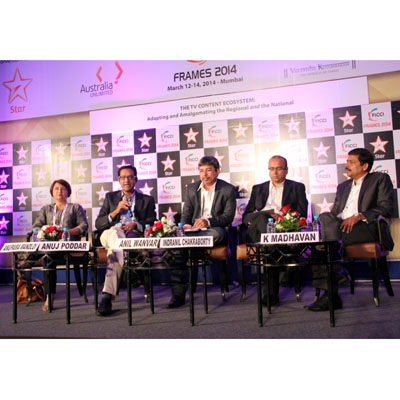
    MUMBAI: Two big regional broadcasters and two big production houses got together to discuss ‘TV content ecosystem: Adapting and amalgamating the regional and the national’ at FICCI Frames 2014. The session started with a keynote by Asianet Managing director K Madhavan and was followed by a discussion among panelists that included Viacom18 regional channels EVP Anuj Poddar, Fremantle India MD Anupama Mandloi and BIG Synergy COO Indranil Chakraborty on the opportunities in the regional entertainment space. The discussion was anchored by indiantelevision.com Founder, CEO and editor-in-chief Anil Wanvari.


    Madhavan started off by predicting that in three years, the ad revenue coming from regional channels will be equal to that of the national channels. He also highlighted that the biggest problem for regional broadcasters is carriage fees.


    “The regional market is about Rs 5,000 crore in terms of advertising revenue and we are the second largest in ad revenue as well as viewership after the Hindi GEC genre,” said Poddar. He also stated that there is a misconception that regional means language while it actually is a reflection of the culture. “Even Hindi television has its stories based on regions – for instance Ballika Vadhu was based in Rajasthan but adapted for national Hindi television.”


    Chakraborty said BIG Synergy entered the regional space five years ago and found that the regional audience was considered as second class as against the Hindi GEC audience. But that mindset is changing. “The word ‘adaptation’ is wrong. You need to redefine content to make it relevant to that audience,” he said. 


    He said he was happy that regional viewership that TV channels generate is getting its due in terms of ad rupees. “Earlier, regional TV channels had higher share of the overall  national viewership but the advertising expenditure on them was much less than that share. In 2013, ad expenditure on regional has gone up and and share of viewership is matching with share of advertising if you check out the latest Ficci report.”


    Added Poddar:  “This change clearly shows that advertisers and media agencies have understood the value of regional television and are willing to pay more for air time as they get targeted viewers. Even the coming elections are seeing a large amount of political advertising expenditure being shifted towards regional TV.”


    Regional channels seem to have taken the 12 minute ad cap very happily. “Sun raised its ad rates by 60 per cent and we (Asianet) raised it by about 20 per cent,” said Madhavan. He revealed that while earlier the ad rates of regional channels were one tenth of a national (read Hindi GEC) player, today they are up to about  25 per cent.


    The good part about regional television is that budgets for shows are rising, explained Chakraborty. An example of this is the regional adaptation of Kaun Banega Crorepati, which saw its budget going up 10 times as compared to what was being invested in other regional non-fiction shows.  This happened at a time when the Hindi version was being subject to budget cuts.


    As far as regional contributing to national and vice-versa in terms of show concepts, formats and storylines is concerned, Wanvari cited several instances where this has taken place in the Indian context.


    Said he: “Dance India Dance that super franchise from the Zee Entertainment stable began from Dance Bangla Dance produced for Bengali audiences. Today it has spawned several sub-franchises – Dance India Dance Lil Champs, Dance India Dance Super Moms, Dance Maharashtra Dance. Similarly with Big Boss which began on Colors and has since then been produced on its sister ETV channels in  Bengali and Kannda. KBC gave birth to editions on Tamil, Telugu, Malayalam on the Star network even as it aired in Hindi on Sony Entertainment TV and in Marathi on ETV Marathi. Ballika Vadhu was remade by the Network 18 group in Tamil, Telugu and Kannada, even as Uttaran has been remade in Marathi.”


    Wanvari pointed out that the reverse has also happened with shows from regional television being adapted to Hindi TV. “The Telugu soap Shravanti came on air as Dil Se Di Dua Saubhagayvati Bhava; Tami serial Kolangal was remade as Maayke Se Bandhi Dor; Tamil soap Thirumathi Selvam gave birth to the long running Pavitra Rishta; Idhayam turned into Dil Se Diya Vachan; Telugu show Ratha Samptamai  resurfaced as Rakht Sambandh; Bengali series Khela as Badalte Rishtey Ki Dastaan and then of course  the Ravi Ojha produced super successful show Sasural Genda Phool which emerged from the Bengali series Ogo Bodho Sundari,” highlighted Wanvari.


    He went on to further state that Star India has been working on reaching out its Hindi productions  to regional audiences, by dubbing shows such as Satyamev Jayate, Mahabharat and Mahadev in other languages such as Tamil, Telugu, Bengali, Marathi, and Malayalam and airing them on its regional language channels under the Asianet group and Star Pravah.


    “Taking a national product to regional is called revenue optimisation,” said Chakraborty talking about dubbing of national shows to regional languages.”For an adapted  show to work it needs to be locally adapted to suit the culture. “


    Poddar emphasised that it is not enough to dub regional shows, regional adaptations of Hindi national shows requires a lot of research and localisation to suit  cultural tastes and emotions. “When we had to remake Ballika Vadhu which is about a child bride for our Kannada channel, we looked around for a district in Karnataka where child marriage is prevalent and based our story there as the rest of the state does not have it as a practice as it is in Rajasthan. Also the pacing of the storyline in the Kannada version was faster.  Similarly, for the Marathi adaptation of KBC we went for a couple participant concept in the show and had Sachin Khedakar host it. “


    Chakraborty highlighted that there are benefits which accrue from Hindi show adaptations to regional languages and the other way around too. “Initially, we had to instill best practices and skillsets we had picked up while producing the Hindi version when we decided to go regional. Now the best practices and skillsets we got while producing the regional shows are being brought to Mumbai and  instilled in our crew while producing the Hindi version.”


    Fremantle Media India MD Anupama Mandloi confessed that her production house – which produces the successful formats Indian Idol and India’s Got Talent – has not yet taken the plunge into regional television but it is something which would be of great interest to her. “We have the experience of producing an international format and localising it in several countries, languages, cultures,” she said. “And we have done it successfully. We would like to  make some further inroads in regional television soon.”


    Madhavan added that Star Plus’ show Satyamev Jayate had realised the potential of regional which is why it was dubbed in so many languages and regional stars were roped in to promote it. He pointed out that Mahabharat dubbed in different languages has not proved as popular as Mahadev. But he revealed that even then the show has been a profit generator for his network. 


    “Simulcast is driven by commercial imperatives as a business model,” said Poddar.


    When prompted by Wanvari as to why don’t regional channels add subtitles to their shows, he said it is an option he is willing to consider.

  • Star India paid $160 mn for added 12% interest in Asianet Communications

    Star India paid $160 mn for added 12% interest in Asianet Communications

    MUMBAI:  Star India’s equity interest in Asianet Communications in June 2013 increased by 12 per cent to 87 per cent from the earlier 75 percent. The price the India subsidiary of 21st Century Fox paid for the additional interest in the south Indian general entertainment television network was approximately $160 million.


    The price paid by Star India for the additional interest values Asianet Communications at $1.33 billion.


    According to 21st Century Fox, in June 2013, it acquired the 19 per cent stake in Vijay Television that it didn’t own and, as a result, it now owns 87 per cent interest in Asianet Communications.


    Star India holds its interest in Asianet Communications through Vijay Television. The 19 per cent equity stake in Vijay Television that it bought in June 2013 was held by Rajeev Chandrasekhar and K Madhavan.


    In January 2009, Star India and Asianet TV Holdings formed a venture Star Jupiter and the Asianet Communication’s general entertainment channels were brought under the joint venture. Star India’s Tamil channel, Star Vijay was also consolidated with the Asianet channels but the shareholding structure of Asianet Communications is not clearly known as it is a closely held company.


    In 2009, Star India paid approximately $235 million in cash and assumed net debt of approximately $20 million for a controlling interest in the four channels owned by Asianet. The price Star India paid for the 51 per cent stake in 2009 meant Asianet Communications was then valued at $500 million.


    Asianet Communications broadcasts Malayalam language channels Asianet and Asianet Plus, Kannada language channel Suvarna and Telugu channel Sitara.


    In July 2010, Star India increased its stake in Asianet communications to 75 per cent from 51 per cent, for which it paid approximately $90 million in cash.


    Asianet Communications was founded in 1991 by Reju Menon and Shashi Kumar. Rajeev Chandrasekhar acquired a 51 per cent stake in the company in 2006 for a reported price of Rs 150 crore (about $25 million at the current exchange rate) and also became its chairman.

  • Asianet switches from GlobeCast to Dish in US; adds a new channel to US bouquet

    Asianet switches from GlobeCast to Dish in US; adds a new channel to US bouquet

    BENGALURU: Dish, a leading pay-TV provider in the US announced the launch of Asianet, Asianet Plus, Asianet News and Asianet Movies to its lineup. Additionally, Dish‘s broadcast of Asianet Movies marks the US premiere of the Malayalam film channel. Earlier, three of Asianet‘s channels were available in the US on the France Telcom subsidiary GlobeCast.

    Industry sources reveal that Asianet‘s agreement with GlobeCast ends on June 30 and the association will be terminated. “Dish is a one stop shop for the Indian, no, Asian diaspora. Be it Vijay TV or the Star Network channels, or other bigwigs of Indian television broadcasting like the channels of Zee or Sony, all are on Dish, so it makes sense for Asianet to be on the Dish platform. It‘s a win-win situation for all,” explained the source about Asianet‘s shift.

    Asianet Communications MD K. Madhavan statement in a press release seems to endorse this fact, “When Asianet entered the US market in 2003, our overarching goal was to expand the presence of our special programming. Partnering with Dish to launch the Asianet channels allows us to realize this dream of providing yet another incredible addition to the lineup of Malayalam content in the United States”.

    “We are pleased to exclusively offer this programming on satellite and proud to debut Asianet Movies for the first time in the U.S. Dish has long offered an impressive South Asian channel lineup, and we are dedicated to the consistent pursuit of the best news and entertainment tailored to a variety of language groups,” said Dish director of international programming Sruta Vootukuru.

    As the US leader in international programming with more than 280 ethnic channels in 29 languages, Dish is the exclusive satellite pay-TV platform to offer this leading Malayalam-language content.

    The Malayalam Asianet programming package is now available to customers for $24.99 per month. Effective June 20, all Malayalam: Mega Pack or Surya a la carte customers will be eligible to subscribe to Asianet as an add-on package for a monthly price of $15.

  • ‘Asianet Television Awards 2013’ on Asianet Channel  ~Awards Rs. 25 Lakhs to the winner~

    ‘Asianet Television Awards 2013’ on Asianet Channel ~Awards Rs. 25 Lakhs to the winner~

    MUMBAi :Asianet Television Awards 2013 were distributed at a glittering function was held recently at the Nehru Stadium, Kottayam.The show was witnessed by 20,000 strong crowd. Several prominent persons from the film industry and socio-cultural spheres were present on the occasion.

    Asianet Managing Director K.Madhavan, Jayaram, Manoj K.Jayan,Ashokan,Suresh Krishna, jishnu, Surekha, Akku Akbar, Mahesh, Sankar Ramakrishnan, Sona Nair, Bhagyalakshmi, G.K.Pillai, Kottayam Nazeer, Ranjan Pramod , Raveendran are some of the personalities who attend the function.

    'Sthreedanam' won the award for the best serial, which was accepted by its producer Ramesh and Krishnamoorthy won the award for the best director for the serial ' Sthreedhanam.' Sajan Suirya won the best actor award for his role in ' Kungumapoo' and Shelly ( Serial : Kungumapoo ) & Divya ( Serial : Sthreedhanam) share the best female actress award. Actor Rajeev Roshan & Actress Chithra Shenoy was on hand to collect the popular award for their outstanding performance.

    Others who won awards include Asha Sarath ( Golden Star Award ), Pradeep Panikkar( script writer- Kungumapoo), Vishnu Prakash (best character artiste- male), Sudha Chandran(best character artiste-female), Devendranath, Sonu & Aswathy (best Negative Character) ). Midhun & Dr.Divya (best newface), Lakshmi Priya (child artiste), Shobi Thilakan & Devi( Dubbing artiste ), Krishna Kodanade (cameraman ), Karthikeyan( Mythological Serial – Sabarimala Dharma Sasthavu), Murugan ( Popular Serial :Amma) , Rohith Roshan (editor ), Aneesh J.( Sound Recordist) , Kottayam Rasheed ( best comedian ), Sanand George ( best back ground scorer), Maya Viswanath, Ambareesh, Valicode Vikraman, Gireesh Konni (Special Jury awards) .

    Other cine Stars such as Rahasya,Sudha Chandran, Asha Sarath, Archana, Shamna Khasim,Kadhal Sandhya, Divya, Sonu, Sini George , Tosh, Jaya Krishnan, Anjana, ,Steffi, Mylachi team and other comedy artistes from TV/ Film industry entertained the viewers numbering in thousands.

    Asianet is all set to telecast "Asianet Television Awards 2013 "on May 25th , 2013 (Saturday) from 6.30PM onwards.


  • Asianet looking to launch educational channel

    Asianet looking to launch educational channel

    MUMBAI: The Thiruvananthapuram-headquartered media house Asianet Communications Ltd is planning to launch two more channels in the Malayalam television space. One of these two projects will deal with a television channel covering the education genre.

    Speaking on the occasion of the second anniversary celebrations of the media firm’s youth-oriented entertainment channel Asianet Plus, Asianet chairman Reji Menon revealed the company’s long term plans. “Asianet targets to have a total of five television channels and one of these will be an educational channel,” he said, without offering any time frame on the plans.

    “Asianet will be launching India’s first ever educational channel. We are still working out the plan and the project is presently in its preliminary stage,” Asianet managing director K Madhavan told indiantelevision.com.

    According to market sources, Asianet is seriously looking at expanding its presence in the Southern television space by entering the non-Malayalam (Kannada, Telugu and Tamil) market. “The fifth channel might possibly target one of these three languages,” says a source.

    Flagship entertainment channel Asianet, the youth channel Asianet Plus and the news channel Asianet News constitute Asianet’s television force at present.