Tag: Joy Sengupta

  • Colors Bangla Cinema presents “Bidaay Byomkesh” on TV

    Colors Bangla Cinema presents “Bidaay Byomkesh” on TV

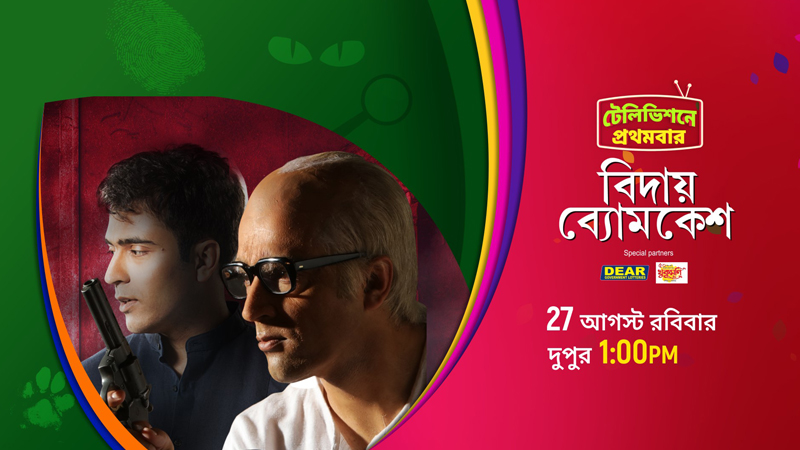
    Mumbai: Colors Bangla Cinema is about to bring to the viewers the much-acclaimed film “Bidaay Byomkesh” for the first time on television. The film is set to air on 27 August at 1:00 pm, exclusively on Colors Bangla Cinema.

    “Bidaay Byomkesh” weaves an enthralling tale centred around an aged Byomkesh Bakshi, a name synonymous with mystery and intrigue, intricately weaving a narrative showcasing him at a crossroads. He takes a momentous decision to relinquish his role as a ‘Satyanweshi’ (Truth Seeker) and passes the mantle to his grandson, Satyaki Bakshi. Will this decision mark the end of an era for the celebrated detective, or will it herald the dawn of a new and equally riveting chapter?

    Colors Bangla and Colors Bangla Cinema business head Sagnik Ghosh said, “We are delighted to bring the acclaimed film ‘Bidaay Byomkesh’ to our viewers for the first time on television, as we believe diverse content resonates with our audiences’ preference. The film’s engaging storyline and stellar cast are sure to create a memorable viewing experience.”

    The film provides a unique and insightful perspective into director Debaloy Bhattacharjee reimagining the revered character, one that has consistently captivated generations of readers and viewers alike. “Bidaay Byomkesh” unravels the complexities of Byomkesh Bakshi’s character, taking audiences on a journey that probes the depths of family dynamics and legacy.

    The film boasts a stellar ensemble cast, each contributing their exceptional talents like Abir Chatterjee, Sohini Sarkar, Rahul Banerjee, Joy Sengupta, and Bidipta Chakraborty among others, to bring the characters to life.

  • Popular web series – Hello returns with Season 3 on popular demand

    Popular web series – Hello returns with Season 3 on popular demand

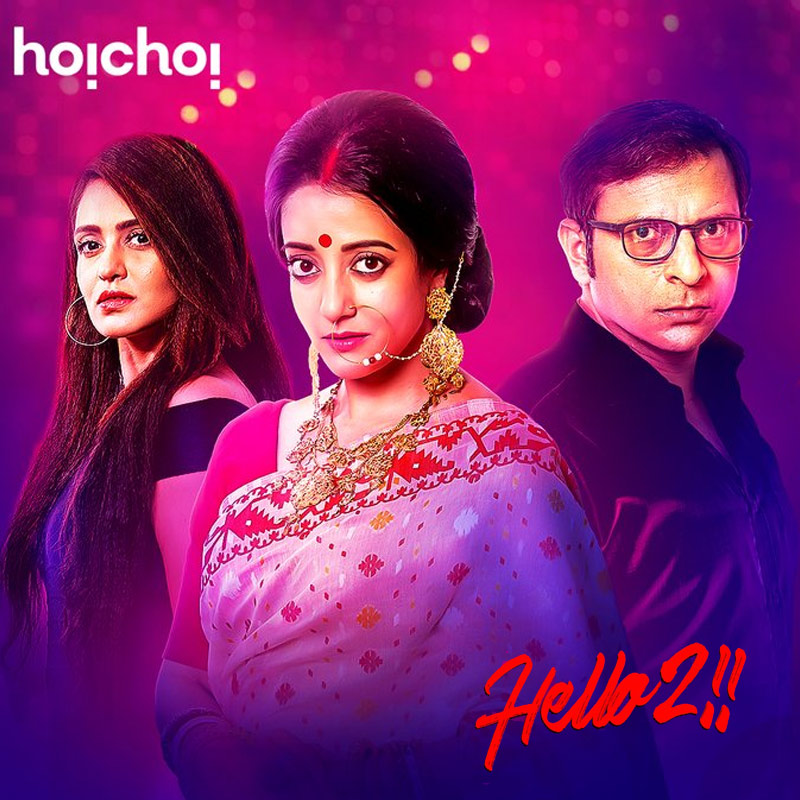
    MUMBAI: Rejoice hoichoi fans! One of their top Original shows – Hello, starring eminent actors Raima Sen, Priyanka Sarkar and Joy Sengupta in lead roles will be returning with its 3rd season sooner than fans expected.

    The first season of Hello started streaming in September 2017, and it was hoichoi’s first Original content to start streaming on the app and website. After continuous requests from fans for the next season, hoichoi lavishly announced on their first birthday on 20th September 2018 that they will be renewing the Hello for a 2nd season, which will start streaming around end of December. 

    With tons of anticipation and presumption, fans waited eagerly to see how season 2 will progress. Judging from the immense positive response which poured in, hoichoi can humbly retort that they were not disappointed. However, the audience worried that they would again have to wait for another year to be treated to this drama-thriller. hoichoi decided to break all shackles and proclaim their return with the season 3 of Hello as soon as Puja 2019! 

    Co-Founder of hoichoi & SVF, Mahendra Soni stated “As storytellers, creators and distributors of the best of Bengali entertainment content, our primary mission of hoichoi is to provide quality content. Hello is one of our best Originals which is also an audience favourite. Even though we wish to experiment and want to churn out new kind of shows and films for the customers to consume, the continuation of a classic-drama story which resonated to them, has to be replenished.” 

  • Hoichoi to launch ‘Hello’ S2

    Hoichoi to launch ‘Hello’ S2

    MUMBAI: Hoichoi began its journey with its first original web series titled – Hello and became an instant hit with audience giving raving reviews. Thus, began the string of numerous requests flowing in for season 2 which will start from December, directed by Soumik Chattopadhyay.

    Hoichoi on its first anniversary this year announced 30 original shows and 12 original films for 2018-2019 which included the most-anticipated season 2 of all shows – Hello.

    The official trailer starts off from where the first season ended, Anonyo (Joy Sengupta) is at the doorstep of his girlfriend Nina (Priyanka Sarkar), ramming hard on the door and demanding her to let his wife Nandita (Raima Sen) out. Once the door opens, the drama begins with judgements flooding round and about as he accuses both of having a lesbian relationship behind his back.

    The official teaser of Hello, which was released a week earlier, was trending No. 1 on YouTube for 72 hours straight.

  • Curry Nation to consolidate creative biz in 2013

    MUMBAI: For Priti Nair and Naggesh Pannaswami, it wasn‘t the best of times to start their entrepreneurial journey. The Indian economic growth story was getting stained by a slowdown and harsh winds were blowing from Europe, the US and other parts of the world.

    A contrarian mood was, however, ruling the agency world. Media professionals were chucking their jobs and taking the plunge to become masters of their destinies. Agnello Dias and Santosh Padhi had started Taproot while Manish Bhatt, Raghu Bhat and Joy Sengupta had set up their own agency Scarecrow and Raj Kurup had flown solo with Creativeland Asia.

    The infection spread to Nair and Pannaswami and they founded Curry Nation in January 2011. “It is always scary when you start on your own. But we knew we had to do it,” Nair recalls as we settle for a chat in the conference room of the new office at Mahim.

    For the duo, there was no need to get the early frights. They had a founding client in Emami and they were clear that they could tap the small and medium-sized Indian clients.

    “Yes, we were fortunate in having Emami right from the start,” says Nair.

    Then the whole thing was about drawing in talented people. “Fortunately for us, we had a good bunch of people joining us in the first year itself. Even before we went into a formal proper office, we already had three people on board apart from Naggesh and I,” says Nair.

    Along the journey, Emami‘s other brands got added and so did other personal care brands. Today, Curry Nation lends its creative services to brands like Borosil, 18 Again, Emami (personal care brands) and Himani.

    Having completed two years, the homegrown advertising agency Curry Nation is where its wants to be – in the thick of things, doing the kind of work it always wanted to.

    The team at Curry Nation has also grown to 18 people working out of a new office in Mahim. Happy to talk about her team, Nair says “they are a bunch of happy people doing the kind of work they like and believe in”.

    Curry Nation ended 2012 with one of the most visible and controversial campaigns of 2012 – the ‘18 Again‘ project. The communication about 18 Again, a brand of vaginal tightening cream, attracted a lot of attention and the campaign was pulled out by ASCI following complaints regarding its social effect.

    Nair describes ‘18 Again‘ as one of the highlights and challenges of the year. “As a product, there was always going to be a challenge considering the client wanted to market a vaginal tightening cream as just that and not under the veil of anything else. As far as the communication goes, I am very proud of it. It is something that will stay in our show reel for long. I am proud that we did not succumb to clichés while charting out the communication and made the ads about celebration instead of showing the Indian woman as downtrodden and distressed till the product came along,” she explains.

    About the controversy that surrounds the ad, Nair believes that even a 10 second placement with the term ‘vaginal tightening cream’ would have evoked the same reaction. “We have been in the business long enough to know that you have to be sensitive with these kind of products. It’s a country that is still hidden under morals and notions like that and it is hypocritical at times. We have gone through the whole process of doing Balbeer Pasha and Liril. Increasingly now the case is that people jump to conclusions and start having issues with everything. If you see the kind of commercials that have been pulled up, even chocolates and sauces commercials are pulled up. All because somebody wakes up and objects because now they have the right to voice their opinion,” she points out.

    The year 2012 also saw Curry Nation start its own media division with their first client Weikfield. The agency also handled the media duties for ‘18 Again‘.

    Looking ahead at the year 2013, Nair and Pannaswami have their eyes set on two goals – consolidate the creative business and enhance and grow the media division.

    Explaining further, Pannaswani says, “It will be a phase of consolidation for us and for organic growth. Most of our growth has been organic. What has happened is that our existing clients have been giving us more business while we have added few clients. We do want to spread ourselves into other categories as well. But, again, there are only so many categories that are opening up in terms of ad spends. So this year, we would like to consolidate the brands that we have and focus on the media division which needs support and growth.”

    Looking at Curry Nation’s client roster, one observes two things – most of the clients are from the personal care/ health care category and all the clients are Indian companies.

    Nair explains that while neither has been a conscious occurrence, Curry Nation as a creative force lends itself well in both cases. “The DNA of Curry Nation is Indian-ness. We are very clear that we want to create communication that is relevant to contemporary India. India is a bit of a macro country and the people are very dimensional in their emotions. It is not like a single layer, there are multiple nuances to our culture. We always look for an Indian insight to employ in our communication and this is what makes us a good fit with Indian brands which is evident in our roster of clients.”

    On the acquisition front, Curry Nation is happy going solo as of now. “We are happy to be in a new and bigger office. It gives a feeling of growing. And it is satisfying. We are where we wanted to be as of now,” signs off Nair.

  • Vicky Donor is a thoroughly entertaining fare

    Vicky Donor is a thoroughly entertaining fare

    MUMBAI: Vicky Donor is a brave effort. The makers take up a contemporary subject of sperm donors, which very few would be familiar with, and knit it around a normal day-to-day family and romance stories in a middle-class Delhi Punjabi household. Many films are touted as contemporary but this one really is and what is more, it is a thoroughly entertaining fare.

    Vicky (Ayushmann Khurana) is 25-year-old man from Lajpat Nagar, Delhi, a locality identified as that of post-partition settlers. While his widowed mother runs a beauty parlour, Vicky generally loafs around till a job drops into his lap. He is a typical loud Delhi Punjabi but has his way with people as he charms his way through life. While he is sleeping, his room has been robbed clean by thief.

    Vicky‘s reaction to this is to go sell off his dog to a neighbourhood kid. This sets the tone of what is to follow.

    But this ‘transaction‘ of selling off an idle dog to a kid is observed by Annu Kapoor, a doctor specialising in finding solutions for couples who can‘t have children. In Vicky he sees an ideal sperm donor.

    But it takes a while before Vicky agrees to the deal. These scenes are not only funny but on the way also explain the concept of sperm donation to a layman. For Vicky, money is the main attraction and his reports liken him to someone close to Aryan breed!

    Vicky‘s life is set to change as yet another event happens in his life: while running errands for his mother, he visits a bank to open a new account and deposit money where he meets Yaami Gautam, a Bengali executive at the bank and after some boisterous, Delhi-brand of stalking, love blossoms. It is a tightrope walk for the hero to keep his secret from his family as well as his lady love and he often finds it hard to explain where he earns hordes of money from and how costly gifts keep pouring into his house.

    What make Vicky Donor more fun to watch are the relationships between its various characters: between Ayushmann and Yaami Gautam, between him and Annu Kapoor, between him and his mother (Dolly Ahluwalia) as well as grandmother (Kamlesh Gill), between Annu Kapoor and his assistant and between Yaami Gautam and her father, Jayanta Das.

    The most hilarious is the one between his mother and grandmother; these give a perfect foil to the film‘s casting. After a joyous debate between virtues (or lack of them) in Punjabis and Bengalis, the families agree to the marriage of Ayushmann and Yami Gautam. But soon the fun is over for Ayushmann as his secret is revealed and his love walks out on him.

    Vicky Donor has been instrumental in siring 53 children in five years and now his wife is yearning for one of her own. The joy ride does get an agreeable and plausible ending.

    Vicky Donor‘s triumph is in its well scripted story and dialogue. Nowhere is the comedy forced nor made to look cheap; the pace is fast. Performances are excellent from just about every character in the film.

    Ayushmann and Yaami Gautam may be new to films but both are veterans of television and do their part most convincingly. Annu Kapoor reminds of his role in Mr India where he made his mark; his vocabulary is not complete without using the word sperm. Dolly Ahluwalia and Kamlesh Gill bring to life the lonely middle-class women. Their interactions are hilarious. Jayanta Das as the Bengali father is very good. Songs, though without lip-sync, blend with the mood of the film without hindering the tempo.

    Cinematography is good. However, the ultimate praise should go to story-screenplay-dialogue writer Juhi Chaturvedi for her work.

    With new names in credits, Vicky Donour may not have opened well but the word of mouth will surely help it improve its prospects.

    Hate Story borders on banal

    The phrase “Hell has no fury like a woman scorned” has its origins in the 17th Century. It has often been the source of a story for films. In Hate Story, this theme is a mere excuse to sell a titillating drama.

    Normally, however, even before the story starts the woman scorned should look vulnerable, win over the viewers‘ hearts and sympathies and the revenge should be honourable. Hate Story does not really care for such norms.

    Paoli Dam is a reporter with a business publication who, along with her photographer colleague-cum-silent admirer, exposes a cement company‘s scam. The heir to the cement empire, Gulshan Devaiya, is infuriated and singles her out to avenge the defamation of his company‘s name. Taking revenge on the male photographer would not make an interesting story and provide no scope for nude scenes!

    So, Devaiya offers Pauli Dam a job in his company at triple her present salary. She accepts and he takes her on a jaunt abroad. Celebrations starts come evening and after one swig of wine, Paoli Dam is not only ready to be seduced, she has also fallen deeply in love with her boss! Back in Delhi she finds her access to office denied. She has been dumped unceremoniously; the cement tycoon has had his revenge. This is cause enough for Pauli Dam to be scorned and to want to destroy her ex-boss and his empire.

    For this story based on an old phrase, she chooses to take up the world‘s oldest profession, prostitution, to take her revenge. She even takes a crash course in prostitution from a local top-rated veteran in the trade.

    What follows is a script of convenience as the protagonist goes on seducing first the cement empire‘s CEO and later the minister who favours the company. Nobody seems to care that she is not looking desirable as long as she is available. The CEO reveals to her all his company secrets while the minister not only bails her out of jail but even appoints her as a bank nominee director on the board of the cement empire!

    The story and script in Hate Story border on banal. The makers seem to count on Paoli Dam‘s frequent exposure as the draw. No matter that the viewer finds no identification with either the woman‘s plight or her approach to revenge. The positive aspects of the film are its cinematography and few good dialogues.

    Direction is clichéd. As for its casting, the makers seem to have chosen to opt for day-to-day faces rather than looks and personality. Gulshan Devaiya does well; Paoli Dam can‘t carry her role except when stripping. Nikhil Dwivedi and Joy Sengupta are okay. Saurabh Dubey is the one who does justice to his character.

    Hate Story is aimed mainly at the single screen mass that will follow the film‘s posters to the cinema and come out mentally fatigued.