Tag: JioMart

  • Q1 FY26: Reliance Retail charges ahead with Rs 84,171 crore revenue blitz as profit surges 28 per cent

    Q1 FY26: Reliance Retail charges ahead with Rs 84,171 crore revenue blitz as profit surges 28 per cent

    MUMBAI: Reliance Retail has delivered a commanding first quarter performance, posting revenues of Rs 84,171 crore—an 11.3 per cent year-on-year surge—whilst profits catapulted 28.3 per cent to Rs 3,271 crore as the retail behemoth continued its relentless expansion across India’s consumer landscape.

    The company’s earnings before interest, taxes, depreciation and amortisation climbed 12.7 per cent to Rs 6,381 crore, with margins expanding 20 basis points to an industry-leading 8.7 per cent—cementing its position as India’s most profitable large-scale retailer.

    Reliance Retail’s physical footprint swelled with 388 new store openings during the quarter, taking the total count to 19,592 stores spanning 77.6 million square feet. The registered customer base hit 358 million, reinforcing the company’s claim as one of India’s most preferred retailers.

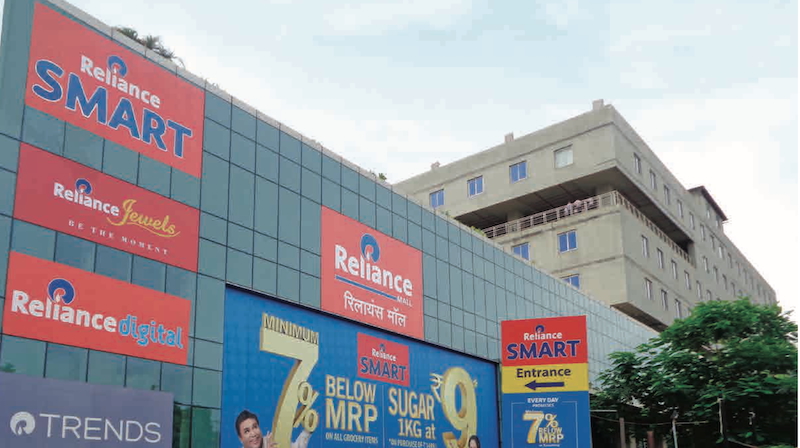
    The star performer was JioMart, which the company  described as “India’s fastest scaling digital grocery platform.” The hyperlocal delivery service registered explosive growth with daily orders surging 175 per cent year-on-year and 68 per cent quarter-on-quarter, now serving 4,290 pin codes through 2,200-plus stores across 1,000-plus cities.

    JioMart’s rapid-fire expansion included launching AJio Rush, a four-hour delivery service now live in six cities with 130,000-plus options. The initiative is delivering superior unit economics driven by higher average bill values and lower returns, according to the company.

    Fashion and lifestyle delivered robust growth, with emerging formats Gap, Azorte and Yousta registering 59 per cent year-on-year growth across 170 stores. Ajio’s new customer revenue share reached 18 per cent, up 150 basis points year-on-year, whilst average bill values jumped 17 per cent. The platform expanded its catalogue to 2.6 million options—44 per cent growth year-on-year.

    Consumer electronics faced headwinds from early monsoon onset impacting air conditioner sales, though average bill values surged 26 per cent with conversions up 200 basis points. The company bolstered its own-brand strategy by acquiring Kelvinator brand intellectual property for India.

    Grocery maintained its market leadership with broad-based growth across categories. Home and personal care grew 15 per cent year-on-year, as did fruits and vegetables, whilst packaged foods expanded 13 per cent. The Metro format delivered standout performance with home and personal care categories growing 25 per cent year-on-year.

    The quarter also saw strategic brand expansions including Shein crossing two million app downloads with 20,000 live options, whilst AJio Luxe grew its portfolio to 875 brands. Premium brands continued segment leadership with Hamleys expanding geographically and launching its Green Club sustainability programme.

    “Reliance Retail delivered resilient performance during this quarter driven by our relentless focus on operational excellence, geographical expansion and sharper product portfolio,” said executive director Isha M. Ambani “Our continued investments in cutting-edge technologies and differentiated product offerings have enabled us to serve our customers better and scale with agility.”

    The results underscore Reliance Retail’s dominance in India’s Rs 70 trillion retail market, with the company now processing 389 million transactions quarterly—a 16.5 per cent year-on-year increase—as it continues reshaping India’s retail landscape through aggressive digitisation and expansion.

  • Reliance hits record Q1 FY26  EBITDA as Jio and retail fire on all cylinders

    Reliance hits record Q1 FY26 EBITDA as Jio and retail fire on all cylinders

    MUMBAI: Reliance Industries has kicked off FY26 with a blockbuster first quarter, posting its highest-ever consolidated quarterly EBITDA of Rs 58,024 crore ($ $6.8 billion), a sharp 35.7 per cent leap over last year, fuelled by robust performances across digital, retail and energy verticals.

    Group net profit soared 76.5 per cent year-on-year to Rs 30,783 crore ($3.6 billion), aided by operational gains and a Rs 8,924 crore windfall from its stake sale in Asian Paints. Total revenue rose 6 per cent to Rs 2.73 lakh crore ($31.9 billion), with EBITDA margins improving by a stellar 460 basis points to 21.2 per cent.

    Reliance Jio continued to dominate the digital landscape, crossing a jaw-dropping 200 million 5G subscriber milestone and 20 million home broadband connections. Jio Platforms’ revenue jumped 19 per cent to Rs 35,032 crore, while EBITDA climbed 24 per cent to Rs 18,135 crore, with margins expanding 210 basis points to a best-in-class 51.8 per cent.

    ARPU rose to Rs 208.8, driven by premium subscriber additions and deepening data consumption, which reached 54.7 billion GB this quarter. Jio also unveiled its next-gen tech stack—JioGames Cloud, JioPC, and the proprietary UBR fixed wireless platform—taking a firm aim at India’s AI and home computing future.

    Reliance Retail cemented its pole position, clocking Rs 84,171 crore in revenue (up 11.3 per cent), and EBITDA of Rs 6,381 crore (up 12.7 per cent), marking an industry-leading margin of 8.7 per cent. The business added 388 new stores, taking the total footprint to 19,592 outlets spanning 77.6 million sq ft.

    JioMart’s hyper-local push paid off with daily order volumes exploding 175 per cent year-on-year. AJIO continued to thrive in the online fashion segment with its new 4-hour delivery service and strong traction for Shein, while the FMCG arm doubled revenue to Rs 4,400 crore.

    Reliance’s Oil-to-Chemicals (O2C) segment, despite a 1.5 per cent drop in revenue due to crude price softness and planned shutdowns, posted a solid 10.8 per cent EBITDA gain at Rs 14,511 crore. Jio-bp’s aggressive retail fuel push contributed significantly, with volumes of petrol and diesel up 38.6 per cent and 34.2 per cent respectively.

    With net debt remaining flat at Rs 1.17 lakh crore and capital expenditure of Rs 29,875 crore this quarter, the group is doubling down on its “golden decade” growth strategy across tech, consumption, and energy. Chairman Mukesh Ambani said, *“Reliance will continue its stellar track record of doubling value every four to five years.”

    From superfast data to doorstep delivery and clean fuels, Reliance is firing on all fronts—and showing no signs of slowing down.

  • Reliance Retail cashes in: revenues, stores, and smiles on the rise

    Reliance Retail cashes in: revenues, stores, and smiles on the rise

    MUMBAI: Reliance Retail Ventures Limited (RRVL) is showing no signs of slowing down, posting a robust quarterly revenue of Rs 88,620 crore, up 15.7 per cent year-on-year, while EBITDA climbed 14.3 per cent to Rs 6,711 crore. Profit after tax soared 30.4 per cent to Rs 3,519 crore, fuelled by operating muscle and clever brand plays.

    The retail titan opened a staggering 1,085 new stores in 4Q FY25, nudging its total footprint to 19,340 stores across 77.4 million square feet. The registered customer base swelled to 349 million — almost the population of the United States — with transactions hitting a record 361 million for the quarter.

    EBITDA margins remained healthy at 8.5 per cent despite a slight dip, while depreciation eased 3.4 per cent, and finance costs stayed flat. Digital and new commerce channels kept humming, contributing 18 per cent of total revenues.

    Quick commerce via JioMart recorded a jaw-dropping 2.4x quarter-on-quarter growth in gross daily orders, with 4,000+ pin codes now covered. Meanwhile, the consumer brands unit clocked Rs 11,450 crore in revenue, staking its claim as the fastest-growing FMCG outfit in India.

    Consumer electronics stayed hot, thanks to an early summer and cooling deals, while JioMart Digital expanded its merchant partner base and racked up a 76 per cent year-on-year revenue spike.

    Fashion and lifestyle flexed with the launch of Trends 3.0 and the splashy arrival of Shein on AJIO, offering “global fashion at affordable prices” to Indian shoppers. Premium brands got an omni-channel boost, with ‘out-of-store’ sales now contributing 8 per cent to luxury turnover.

    Grocery stores continued to punch above their weight, boosted by FreshPik, GoFresh, and a strong showing from Metro’s wholesale business, which posted a 37 per cent jump in HoReCa sales.

    JioMart pushed the pedal on quick deliveries, scaling to 2,100+ stores and introducing slick “Quick” and “Scheduled” tabs. Subscription services also boomed, with app visits up 37 per cent. 

    For the full financial year ended 31 March 2025, gross revenue rose 7.9 per cent year-on-year to Rs 330,870 crore, while EBITDA nudged up 8.6 per cent to Rs 25,053 crore — a steady climb powered by store expansion, customer growth, and bold new bets in e-commerce and brands.

    Despite the noise around rising costs elsewhere in the economy, RRVL tightened its margins, improving EBITDA margin by 20 basis points to 8.6 per cent on revenue from operations — a small but significant win in a cut-throat retail landscape.

    Profit after tax stood at Rs 12,392 crore, up a healthy 11.6 per cent from last year, even as finance costs dipped 4.1 per cent, and depreciation rose modestly by 7.7 per cent, reflecting investments into expanding and upgrading its footprint.

    * Store expansion: RRVL opened 2,659 new stores in FY25. After accounting for rationalisation and consolidation, total stores stood at 19,340 across 77.4 million sq ft.

    * Customer base: Registered customer base expanded 14.8 per cent to 349 million — practically one in every four Indians.

    * Transactions: Total transactions hit 1.39 billion, up 10.6 per cent year-on-year — a clear sign of rising basket sizes and growing loyalty.

    * Digital Commerce and New Commerce: Now contributing a strong 18 per cent of total revenues, signalling that Reliance’s “phygital” strategy — physical plus digital — is working.

    * Consumer Brands: Emerging as India’s fastest-growing FMCG arm, notching up revenues of ~Rs 11,450 crore in just its second full year. New launches like Spinner (sports drink) and the acquisition of Velvette (personal care) added fresh fizz.

    * JioMart: Quick commerce went into hyperdrive, with daily order volumes climbing 2.4x quarter-on-quarter by the end of the year.

    * Fashion and Lifestyle: AJIO kept its cool, onboarding trendy brands, launching Shein, and expanding its same-day delivery service across 26 cities. Own brands like Netplay and Avaasa saw strong growth.

    * Consumer Electronics: Helped by heatwaves and heavy promotions — AC and cooler sales soared, while service brand resQ expanded into 300 cities.

    * Grocery: Metro acquisition turbocharged staples and beverage sales, while FreshPik and GoFresh catered to the rise of premium tastes.

    A few headwinds to watch:
    * Area shrinkage: Operated area fell slightly by 2.1 per cent year-on-year, suggesting a tightening of low-performing outlets.
    * Margin pressures: Though margins are healthy, the retail battlefield (especially online quick commerce) is brutal and will test profitability resilience.
    * Luxury sales: Omni-channel initiatives helped bridge-to-luxury and luxury sales, but “distance selling” models will need constant tweaking to match evolving customer behaviours.

    RRVL executive director Isha M. Ambani  said: “Reliance Retail delivered strong growth in revenue and profits, powered by improved efficiencies, innovative formats, a sharper product mix, and continued investments in technology and customer experience. We remain focused on shaping the future of retail with agility and purpose.”

  • We have exciting plans for international expansion: Whiskers India CEO Neeja Shah Goswami

    We have exciting plans for international expansion: Whiskers India CEO Neeja Shah Goswami

    Mumbai: Whiskers India specialises in unisex grooming products, offering a wide range of beard care, skincare and bodycare items. The brand has also announced its retail collaboration with Fashion Factory. Through this partnership, the brand gets a consumer base and all India reach whereas Fashion Factory has entrusted this partnership with products at the right price with its brand ambassador and also a partner at Whiskers India, Rannvijay Singha.

    Within a short amount of time, the brand established a significant presence in the national market scene thanks to the efforts of a group of people who are driving the brand, its expansion plans, and its strategies. The brand has rapidly expanded its presence in Delhi, Ahmedabad, Mumbai, Pune, Goa, Chennai, Bangalore, Cochin, Kolkata, Siliguri and other major cities of India. Its products are available on both offline as well as online platforms including various e-commerce platforms like Amazon, Flipkart, BigBasket, and JioMart. Furthermore, the brand has an expanding offline presence in over 3000 stores nationwide collaborating with retail chains across India such as Fashion Factory, Spar, Spencer’s, Frank Ross, Modern Bazaar, Style Bazaar, M Bazaar, V2, Reliance Smart, Ushodaya, Dus Minute, Noble Plus, Wellness Forever and Planet Health.

    Neeja has played a key role in elevating Whiskers India from a regional entity to a nationally recognised brand, steering the development of sales, marketing, and distribution strategies. Her innovative approaches in media and market targeting have broadened Whiskers India’s presence across diverse demographics in India. Neeja actively engages with Rannvijay Singha, ensuring a continuous drive for the brand’s advancement. Moreover, she also holds responsibility for deciding on the introduction of various new product lines for the brand. Additionally, Neeja duly performs her role at Whiskers India alongside the brand’s founder Aakash Goswami, and its co-founder Anup Goswami.

    Indiantelevision.com’s Rohin Ramesh caught up in an interaction with Whiskers India CEO Neeja Shah Goswami. She shared valuable insights into various facets of the Whiskers India brand, offering a glimpse into its journey and future direction.

    Edited excerpts

    On the recent collaboration between Whiskers India and Reliance’s Fashion Factory, Spencer’s and Tata 1mg.

    Whiskers India has recently formed strategic collaborations with Reliance’s Fashion Factory, Spencer’s and Tata 1mg to expand its reach and enhance its brand presence in the market. These partnerships were developed to target a shared consumer base, primarily young, aspirational Indians.

    Through our collaboration with Fashion Factory, Whiskers India gets the consumer base and all India reach whereas Fashion Factory has entrusted this partnership with superior quality products at the right price with a star-studded brand ambassador, Rannvijay Singha of Whiskers India. Whiskers India’s products such as its entire range of 9 perfumes, 3 deodorants and entire White range of Aloe Vera Face Wash, Face Scrub and Mud Pack along with Beard Oil, Beard Wash and Hair Serum are initially available in the top 30 Fashion Factory outlets with plans to expand to all their 100 + outlets.

    With its established presence in urban centers, Spencer’s will also carry the complete range of Whiskers India products. This includes Whiskers India’s huge range of beard care and unisex skin care, body care and tattoo care products along with fragrance ranges such as deodorants and perfumes across its 40 stores in major cities, providing an opportunity for consumers to explore these unisex personal care items in-store.

    Additionally, Tata 1mg will feature Whiskers India products both online and in its offline stores across 40 cities. This partnership allows for greater accessibility, as key products available through Tata 1mg include its three fragrance ranges which include deodorants and perfumes of Ronin, Satan and Blood. Additionally, it will feature its skincare range which includes Aloe Vera Face Wash, Aloe Vera Face Scrub, Charcoal Face Wash and Walnut Face Scrub.

    Overall, these collaborations not only enhance the accessibility of Whiskers India’s products but also align with its aim to cater to a large segment of lifestyle consumers.

    We want to be a household brand. This would need a solid presence and building trust with the consumer. Hence, we chose modern trade chains which has taken us a lot of hard work and strategic human resources, but we are proudly present in 3000 modern trade outlets across India. We have had close communication with our partners and on-ground team to know what the consumer wants and that has helped the brand’s steady development.

    On strategies you implement to ensure this growth, especially in a competitive market.

    In my role at Whiskers India, I have seen the brand transform from a regional player to a nationally recognised brand. I have focused on developing effective sales, marketing and distribution strategies that align with our growth trajectory. By implementing innovative media approaches and targeted marketing, I’ve successfully broadened our presence across diverse demographics in India.

    I actively collaborate with Rannvijay Singha, our partner and a well-known public figure to drive continuous advancement for Whiskers India. Additionally, I am responsible for introducing various new product lines where we introduced fragrance ranges for the men, women and unisex categories, ensuring they meet our strategic goals. Working closely with our founder, Mr. Aakash Goswami and co-founder, Mr. Anup Goswami, I strive to position Whiskers India for ongoing success.

    On steering the development of sales, marketing, and distribution strategies to align with the company’s growth trajectory

    It was a learning experience for us. We surely failed a few times and made bad choices, but we did not take or have much time to figure it out as we had big orders pending. So first we tried national distribution channels when we were just in Tier 1 cities and then we slowly figured warehouses and distributors as we grew in tier two and three cities. One strategy does not work for all, it depends on how one wants to position the brand and where one wants to grow it. Eventually, one will have to go back to the board several times.

    On leveraging the reach of retail giants like Spencer’s and Tata 1mg for distribution

    We plan to leverage the reach of retail giants like Spencer’s and Tata 1mg to significantly enhance our distribution strategy. Partnering with these established retailers allows Whiskers India to tap into their extensive networks and customer bases, particularly among young, aspirational consumers who are increasingly looking for quality personal care products.

    With Spencer’s, we benefit from their presence in major urban centres, where our products can be prominently displayed and easily accessible to consumers. This visibility is crucial for brand recognition and allows us to connect with customers directly in a retail environment.

    Similarly, Tata 1mg’s robust offline and online presence provides us with a unique opportunity to reach a diverse audience across various regions. By offering our products through their platforms, we can cater to consumers who prefer the convenience of online shopping, as well as those who enjoy the in-store experience.

    On Rannvijay Singha involvement in shaping the brand’s identity and appealing to a wider audience

    Rannvijay Singha has been a part of Whiskers India since the beginning. He has a big fan following and he is an extremely nice and disciplined person and that fan following also kind of gives a big boost to the brand. By being a partner of our brand, he ensures a continuous drive for Whiskers India’s advancement and future growth.

    Rannvijay’s involvement does add value for sure because for us he is more than a celebrity. How he conducts himself as a person and as a celebrity, the kind of work that he does, the kind of image that he has that also speaks a lot about who we are as a brand.

    On the importance of celebrity endorsement in the personal care space, especially in an age where digital influencers also play a key role in brand promotion

    Celebrity endorsement is quite important in the personal care space, especially in an age where digital influencers also play a significant role in brand promotion. While celebrity endorsements can boost visibility and credibility, their impact is most effective when the celebrity is genuinely committed and loyal to the brand. Authenticity resonates with consumers, making them more likely to trust and engage with the product. In contrast, influencers can offer a more relatable and personalized connection, often leading to strong engagement. Ultimately, a combination of both can create a powerful promotional strategy.

    On the rise of e-commerce and digital platforms

    At Whiskers India, we have embraced a dual approach to our marketing strategies, integrating both offline and digital methods to reach a broader audience.

    For our offline marketing, we utilise channels such as cinema advertisements, cabs and bus shelters to engage with consumers in everyday settings. This helps us capture attention in high-traffic areas and connect with potential customers directly which also builds brand recall.

    On the digital front, we have adopted targeted strategies that include Meta ads and Google ads to effectively reach and engage with a wider audience online. By leveraging data analytics, we tailor our campaigns to specific demographics and interests, ensuring that our messaging resonates with potential consumers.

    This comprehensive strategy allows us to maximise our visibility across various platforms, driving brand awareness in the evolving e-commerce landscape.

    On the role platforms like Tata 1mg playing key role in Whiskers India’s e-commerce strategy

    Platforms like Tata 1mg will play a crucial role in Whiskers India’s e-commerce strategy by enhancing our visibility and accessibility to consumers. Our goal is to be available on all possible platforms that have a high reach, and Tata 1mg provides an established marketplace with a vast audience.

    By partnering with Tata 1mg, we not only ensure broader reach but also benefit from their strong brand reputation. This association helps build trust with consumers, as they often prefer purchasing from recognised platforms. The credibility of Tata 1mg can reassure potential customers about the quality and authenticity of our products.

    Additionally, Tata 1mg’s user-friendly interface and customer-centric services can facilitate a seamless shopping experience. This is essential in attracting and retaining customers, as well as encouraging repeat purchases.

    Leveraging Tata 1mg as part of our e-commerce strategy allows Whiskers India to maximize reach, build consumer trust and enhance the overall shopping experience, ultimately driving growth in our sales and brand loyalty.

    On steps you are taking to ensure eco-friendly and sustainable production processes

    Sustainability is indeed a crucial factor in the personal care industry, and we are committed to implementing eco-friendly and sustainable production processes. One of our primary steps is ensuring that waste is effectively recycled. We actively seek to minimise waste at every stage of production.

    As part of our sustainability initiative for our Rakhi hamper for brother and sister products, we included a unique note that transforms into a basil plant. This thoughtful addition reflects our commitment to eco-friendly practices and enhances the overall gifting experience.

    On challenges you face in scaling Whiskers India nationally, and how did you overcome them

    Scaling Whiskers India nationally came with its challenges, particularly in building long-term relationships with consumers. Today’s consumers are diligent and particular with what we provide them, they expect transparency and clear communication about what a brand stands for and what it offers. Unlike earlier times, when people relied on just a few brands, today’s market is saturated with options, both international and domestic.

    One significant challenge we faced was positioning our products in a way that resonated with a diverse audience. When we began our modern trade initiatives, such as partnerships with Reliance, we ensured that beauty advisors were available at the shelves to gather consumer feedback. We quickly learned that many customers were confused about our products being labelled as men’s grooming products. They expressed to our beauty advisors that they, along with family members, found our face wash effective regardless of gender. This insight led us to expand our unisex product range.

    By listening to our consumers and adapting our offerings based on their feedback, we have been able to better align our brand with their expectations, fostering stronger connections and driving growth in the process.

    On emerging trends in personal care you believe will shape the future of Whiskers India and plans for international expansion

    I believe that innovation in product development is crucial for Whiskers India’s continued growth and success. In today’s competitive personal care market, we must constantly evolve our offerings to meet the changing preferences of consumers, especially the youth who gravitate towards unisex personal care products. We are committed to researching and developing new formulations that incorporate the latest trends such as gender-inclusive products as it is our core identity as a brand. Our focus on innovation also extends to packaging design, where we aim to create user-friendly and gender-neutral solutions. By fostering a culture of creativity and responsiveness within our team, we can ensure that Whiskers India remains at the forefront of the industry, delivering products that resonate with our customers and meet their diverse needs.

    We have exciting plans for international expansion. Next year, we will begin exporting, primarily focusing on the Middle East and MENA regions. Our team is actively building the necessary platform for this initiative and initial discussions with various distributors and channels have shown promising responses. Additionally, in online marketplaces, we are seeing positive engagement and responsiveness which bodes well to reach a larger audience.

  • Mark Zuckerberg expects Meta to return to healthier revenue growth trends next year

    Mark Zuckerberg expects Meta to return to healthier revenue growth trends next year

    Mumbai: In a conference call with analysts to discuss the third quarter 2022 results, Meta CEO Mark Zuckerberg said that in terms of the business, total revenue grew slightly this quarter on a constant currency basis. “We’re still behind where I think we should be, but we believe that we will return to healthier revenue growth trends next year. That said, it’s not clear that the economy has stabilised yet, so we’re planning our budget somewhat more conservatively.”

    He noted that the company in the quarter had launched JioMart on WhatsApp in India. “It’s our first end-to-end shopping experience that shows the potential for chat-based commerce through messaging.” He said that beyond Reels, messaging is another major monetisation opportunity. “Billions of people and millions of businesses use WhatsApp and Messenger every day, and we’re confident we can connect them in ways that create valuable experiences.”

    For the record, Meta’s share price fell by 20 per cent in after-hours trading after it reported its fourth straight quarterly decline in profit. Analysts want Meta to cut costs. Some analysts describe Meta’s investments as being confusing and confounding.

    Zuckerberg also said that Meta’s product trends look better than what the commentary that he has seen suggests.

    “Our community continued to grow this quarter. We now reach more than 3.7 billion people monthly across our family of apps. And while we continue to navigate some challenging dynamics—a volatile macroeconomy, increasing competition, ad signal loss, and growing costs from our long-term investments—Iq have to say that our product trends look better from what I see than some of the commentary I’ve seen suggests.”

    He said that three of the areas that Meta is very focused on are the AI discovery engine, the ads and business messaging platforms, and the future vision for the metaverse. “I believe the tougher prioritisation, discipline, and efficiency that we’re driving across the organisation will help us navigate the current environment and emerge an even stronger company.”

    Reels, which is its short-form video platform, continues to grow quickly across apps—both in production and consumption. “There are now more than 140 billion reels played across Facebook and Instagram each day. That’s a 50 per cent increase from six months ago. Reels are incremental to time spent on our apps. The trends look good here, and we believe that we’re gaining time spent on competitors like TikTok.”

    While analysts are unsure about whether the big bets on areas like the Metaverse will pay off, Zuckerberg expressed confidence in the work being done in the Metaverse space. “We just had our Connect conference and announced Quest Pro, which we just started shipping. It’s our new high-end VR headset that delivers high-resolution mixed reality so you can blend virtual objects into the physical environment around you. It’s pretty amazing when you see it, and it’s going to enable all kinds of new experiences in socializing, gaming, fitness, and work. I’m really looking forward to seeing what people build with this new capability.

    Working in the metaverse is a big theme for Quest Pro. There are 200 million people who get new PCs every year, mostly for work. Our goal for the Quest Pro line over the next several years is to enable more and more of these people to get their work done in virtual and mixed reality, eventually even better than they could on PCs.”

    He dwelt on the importance of partnerships. “To deliver a great work and productivity experience, I’m excited about the partnerships we announced with Microsoft bringing their suite of productivity and enterprise management services to Quest, Adobe and Autodesk bringing their creative tools, Zoom bringing their communication platform, Accenture building solutions for enterprises, and more.

    “There’s still a long road ahead to build the next computing platform, but we are clearly doing leading work here. This is a massive undertaking, and it’s often going to take a few versions of each product before they become mainstream. But I think our work is going to be of historic importance and create the foundation for an entirely new way that we will interact with each other and blend technology into our lives, as well as a foundation for the long term of our business.”

  • Meta and Jio Platforms team up to launch JioMart on WhatsApp

    Meta and Jio Platforms team up to launch JioMart on WhatsApp

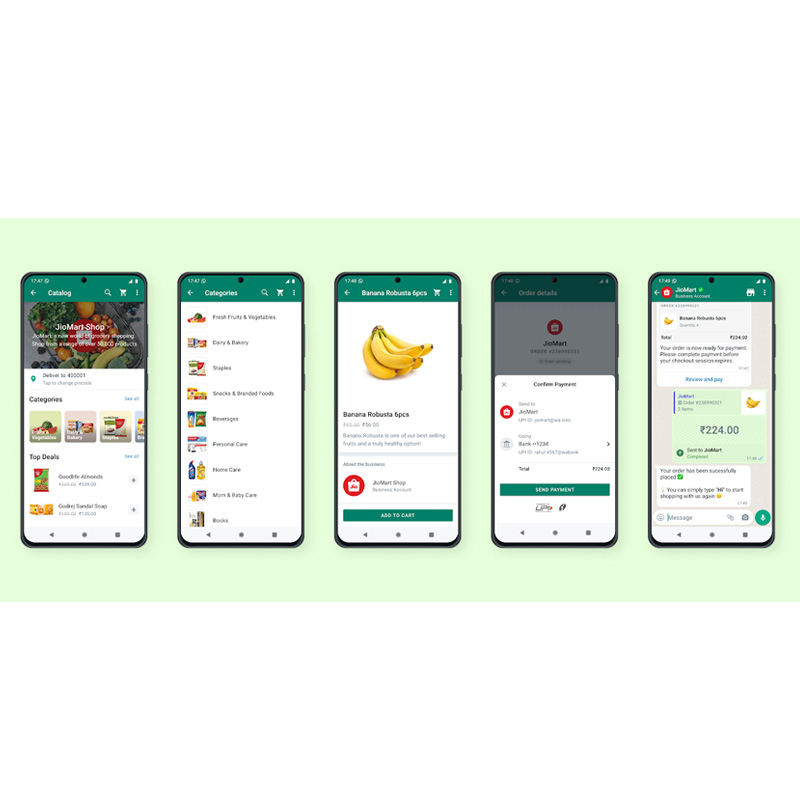
    Mumbai: In a global first, Meta has partnered with Jio Platforms to launch an end-to-end shopping experience on WhatsApp, where consumers can shop from JioMart right within their WhatsApp chat. JioMart on WhatsApp will enable users in India, including those who have never shopped online before, to seamlessly browse through JioMart’s entire grocery catalogue, add items to their cart, and make the payment to complete the purchase – all without leaving the WhatsApp chat.

    Meta founder and CEO Mark Zuckerberg said in a Facebook post, “Excited to launch our partnership with JioMart in India. This is our first-ever end-to-end shopping experience on WhatsApp—people can now buy groceries from JioMart right in a chat.”

    “Business messaging is an area with real momentum, and chat-based experiences like this will be the go-to way people and businesses communicate in the years to come,” he added.

    Making the announcement, Reliance Industries chairman and managing director Mukesh Ambani said, “Our vision is to propel India as the world’s leading digital society. When Jio platforms and Meta announced our partnership in 2020, Mark and I shared a vision of bringing more people and businesses online and creating truly innovative solutions that will add convenience to the daily lives of every Indian.”

    “One example of an innovative customer experience that we are proud of developing is the first ever end-to-end shopping experience with JioMart on WhatsApp. The JioMart on WhatsApp experience furthers our commitment to enabling a simple and convenient way of online shopping for millions of Indians,” he further said.

    The launch is part of a strategic partnership between Meta and Jio Platforms to accelerate India’s digital transformation and provide people and businesses of all sizes opportunities to connect in new ways and fuel economic growth in the country, the company said in its statement.

    Consumers can start shopping on JioMart via WhatsApp by simply sending ‘Hi’ to the JioMart number on the networking app, it added.

  • Facebook’s Ajit Mohan & the new world order

    Facebook’s Ajit Mohan & the new world order

    KOLKATA: The SARS Cov2 virus has drastically changed consumer behaviour. Facebook India vice-president & managing director, Ajit Mohan believes that digital influence is not just limited to online buying but offline too.

    Speaking at IAMAI's Marketing Conclave, Mohan said that digitally influenced purchases have gone up by 15-20 per cent for some of the largest consumer goods categories in India such as apparel, mobile phones, packaged consumer goods that traditionally had offline chains. Citing a study by Nielsen, he said that before the pandemic, digital marketing was one of the most effective ways to drive offline sales for Mondelez’s chocolates in kirana stores.

    “The Covid2019 pandemic has crunched a few years of consumer behaviour change into a few months and weeks. Adtech is one sector that has grown during the pandemic,” he added. 

    As the festive season nears, Mohan predicted that a huge chunk of purchases is likely to happen online. According to him, video and virtual experiences are going to be at the heart of festive buying this year.

    He also shared that voice and video calls across all Facebook apps have doubled while live from Facebook page in India has grown three times in June year-on-year. These consumer trends have led to the launch of products like Reels on Instagram and Room on Facebook.

    Speaking about the economic impact, Mohan highlighted that the pandemic is just not a public health emergency but also an economic crisis, which has particularly impacted small businesses across the country. Most of them have shut shop, some are working with reduced workforces, while others are experiencing lower sales.

    Mohan said that he believes Facebook has an important role to play in the recovery of small businesses and the economy. And a lot of its energy is focused on how it works not just with MSMEs but with the entire ecosystem that helps in rejuvenating the economy

    “It’s very clear that the fundamental behaviour of consumers is in a transition mode. And as marketers, I genuinely believe it will be a mistake on our part to look over the next few months in India as growth returns aggressively. It will also be incorrect to replicate marketing models and playbooks that are no longer relevant. The only way forward is to look at models relevant to the world that is coming out of the crisis,” he concluded. 

    (It maybe recalled that earlier this year, Facebook invested $5.9 billion for a 9.9 per cent stake in Reliance Jio Platforms. It had announced that it planned to work with the company to empower 60 million small businesses, including mom-and-pop stores in India. A little later JioMart, a joint venture between Reliance Jio Platforms and Reliance Retail (India’s largest retail chain), started to allow customers to track shipments through WhatsApp.)

  • Zuckerberg promises better shopping experience through JioMart-WhatsApp

    Zuckerberg promises better shopping experience through JioMart-WhatsApp

    MUMBAI: It seems Facebook has great ambition for e-commerce and small business in India. While speculations have been rife on the scope of the social media giant’s investment in Mukesh Ambani’s Jio, Facebook CEO Mark Zuckerberg keeps emphasising on small businesses and a better shopping experience.

    “One aspect of online commerce I want to mention is the partnership we just announced with Jio Platforms in India. The largest Facebook and WhatsApp communities in the world are in India, and we think there's an especially important opportunity to serve small businesses and enable commerce there over the long term. By bringing together JioMart, which is Jio's small business initiative to connect millions of shops across India, with WhatsApp, we think that we’re going to be able to create a much better shopping experience. There's a lot more we can do here and I'm looking forward to making progress with the team at Jio,” he commented in an earnings call after announcing q1 results.

    He also mentioned that there are millions of small businesses and shops across India and they want to try to help them get on a single network to communicate through Whatsapp and make online payment through WhatsApp. The Facebook CEO added that it is a great example of how they can wire up and help small businesses in the country where they have the largest WhatsApp community.

    “But certainly all the products and technology that we’re building to enable that partnership are going to be things we’re going to want to do around the world,” he added.

    Recently, Facebook made an investment of Rs 43,574 crore into Jio Platforms, translating into a 9.99 per cent equity stake in it on a fully diluted basis. Now, along with a strong local ally, it becomes one of the largest contenders in the e-commerce battle with Amazon and Flipkart. While Jio disrupted the telecom industry, it is unsure yet as to how the JioMart- Whatsapp force will unravel. 

  • JioMart goes live on WhatsApp in some areas in Mumbai

    JioMart goes live on WhatsApp in some areas in Mumbai

    MUMBAI: JioMart, Reliance Retail's e-commerce, has gone live on WhatsApp in Navi Mumbai, Thane and Kalyan in Mumbai within days of announcing a tie-up with Facebook’s WhatsApp. This enables grocery shopping easier for people in these regions. JioMart seeks to leverage WhatsApp’s unrivalled reach of more than 400 million users.

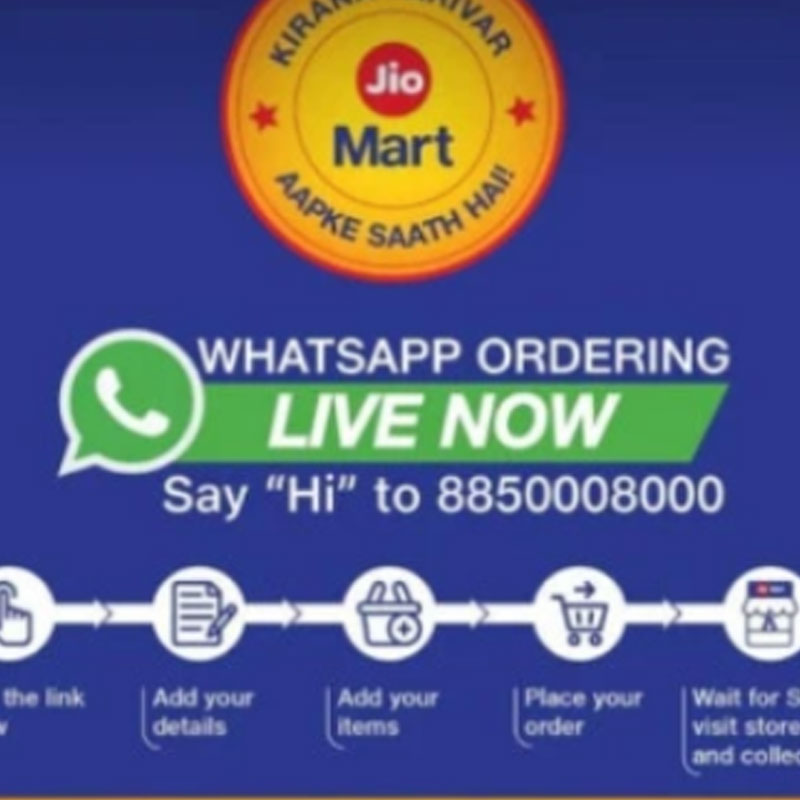
    As part of the collaboration, users can find local stores around them on WhatsApp, talk to shop owners and place orders from WhatsApp. People can initiate an order by texting “Hi” to +91-8850008000, which prompts a link that opens a mini store on the browser. The order details are then shared by JioMart with local stores over WhatsApp. The customer then has to pick up the order from the store.

    JioMart, a joint venture between Reliance Retail and Reliance Jio Platform, seeks to test the novel ordering system on WhatsApp, as a consequence of its association with Facebook. Last week, Facebook announced it was investing $5.7 billion in Reliance Jio Platforms to secure a 9.9 per cent stake.

    WhatsApp, however, is yet to get approval from the government for a pan-India rollout.

    The company is replicating O2O model, (online-to-offline marketplace), which was pioneered by China’s Alibaba. This model enables a customer to search online for products and then buy through an offline channel.