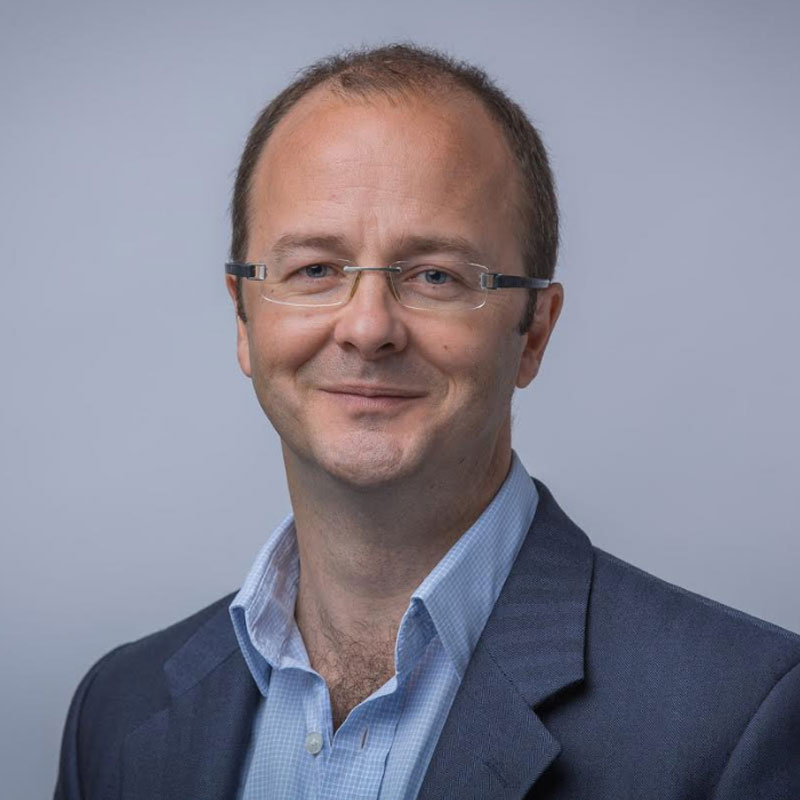
Tag: Jim Egan

  • BBC Global news Appoints Charlie Villar as new COO

    BBC Global news Appoints Charlie Villar as new COO

    MUMBAI: BBC Global News Ltd, the BBC’s commercially funded international news arm, has announced the appointment of Charlie Villar to its newly-created Chief Operating Officer position.

    Villar, who is currently the BBC’s Director of Tax, Treasury and Corporate Finance, will start with immediate effect and will be responsible for the financial and operational leadership of the company, bringing together  finance, engineering, internal and external communications, HR and legal and business affairs.  

    He will join the management team and will be one of two directors of the company, reporting to CEO Jim Egan. The appointment comes as the company expands to incorporate the advertising sales arm of the BBC.

    Speaking about the appointment, Egan said, “I am delighted to be welcoming Charlie to BBC Global News Ltd as our first COO. As we complete the expansion of the business and embark on a new phase for BBC World News and BBC.com, Charlie brings the ideal mix of private and public sector experience to the leadership team. High quality commercially funded journalism has never been more important but it has also never been under greater pressure. Charlie’s appointment will bring expertise, energy and a fresh perspective to our enduring mission of staying true to the BBC’s unique editorial values and running a business which continues to be commercially successful.”

    Villar added, “This is a hugely exciting time to be joining BBC Global News, especially as the business comes together with BBC Advertising. External market forces and changing consumer behaviours are resulting in the rapid evolution of how people across the world consume news on TV, online and mobile devices; ‘fake news’ and social media are causing audiences to seek out reliable, trusted sources; and media companies are looking for new business models to be fit for purpose in a demanding environment. Global News Ltd benefits from the BBC’s outstanding reputation for high quality, together with its deep experience of responding to changes in technology and audience behaviour. I am really looking forward to joining the team to guide the business as we respond to the challenges and opportunities that lie ahead.”

    In his role as the BBC’s Director of Tax, Treasury and Corporate Finance,Villar developed the BBC’s long-term financial plan following last year’s renewal of the BBC’s Royal Charter and he was also responsible for managing the relationship of the BBC’s commercial subsidiaries with the BBC Public Service.

    Villar spent the first part of his career in the commercial sector. He is a qualified accountant, having trained with Arthur Andersen.  He then moved onto Deloitte where he worked in Audit and Corporate Finance, advising clients across the Financial Services, Media and the Telecoms sectors. 

    Prior to joining the BBC in 2010, he was a Director at the Shareholder Executive – HM Government’s in-house corporate finance and shareholding arm – where he led high profile restructurings of Northern Rock, The Royal Mint, and Ordnance Survey.

  • India most aware about global affairs, 52% tune in to social media for news: BBC Survey

    India most aware about global affairs, 52% tune in to social media for news: BBC Survey

    MUMBAI: Close to 84 per cent Indians are aware about world events amongst all the countries as per a British Broadcasting Corporation (BBC) global survey. The percentile secured by India is way over the global average of 69 per cent.


    On average, in the countries polled, the main areas of concern were news stories about terrorism with 70 per cent, war or conflict 59 per cent of the surveyed population whereas health was an issue for 55 per cent and the environment had 52 per cent followers. Terrorism was the main concern in five of the eight countries, including India, where 71 per cent of people surveyed saying it is something they are concerned about. People from India were more likely than any of the other nations polled to be concerned about the environment (62 per cent). Health (63 per cent), corruption 60 (per cent) and human rights (52 per cent) also scored strongly in the country. Only one per cent of respondents in India said they were not concerned about any global news stories.


    Nearly 64 per cent of respondents globally said that news stories from other parts of the world felt more relevant to them than they had in the past. In India this rose to more than 76 per cent.


    The study suggests that global news plays an important role in making people feel informed about what’s going on in the world (68 per cent) and understanding it (62 per cent). It shows that Indians feel particularly strongly about the importance of global news, with figures considerably higher than the global average – 73 per cent and 70 per cent respectively.


    Globalisation is driving interest and behavioural change, with more than half of those surveyed globally saying that they pay more attention to global news (55 per cent) and that they discuss international news with friends and family as a result of seeing global news stories (58 per cent). Again, India polled higher with 69 per cent saying they had spoken to friends and family about a global news story, considerably higher than the all market average.


    Across all markets, around a third of people (36 per cent) use global news coverage to make decisions about how to protect their family but, in India, this rose to more than half (58 per cent), which was more than any other country surveyed. Globally, around a quarter (28 per cent) find it useful for making financial choices but 46 per cent of Indians use it for this purpose.


    Globally, over 26 per cent said that they have given advice to others as a result of seeing coverage of global stories but the figure was doubled in India 51 per cent. Close to 52 per cent of Indians said they have turned to social media to read about news stories, compared to a global average of just 38 per cent.


    BBC Global News CEO Jim Egan said, “These results show the increasing impact and relevance of news events to people across the world. At a time when many news providers are cutting their international coverage and opinion and propaganda are being touted as fact, audiences want to cut through the noise in search of information they can use to inform their understanding and decisions. As the world becomes increasingly interconnected, access to accurate, impartial news, whether on TV, radio, online or social media, is more important than ever.”

  • “If ban is lifted, secondary rights become available, BBC would like to air ‘India’s Daughter’ in India”: Jim Egan

    “If ban is lifted, secondary rights become available, BBC would like to air ‘India’s Daughter’ in India”: Jim Egan

    MUMBAI: The just concluded Cricket World Cup 2015, the infighting amongst Aam Aadmi Party (AAP) members and Deepika Padukone’s recently launched #Mychoice video has kept the Indian media busy for the past few days. And this, in a country, which has to deal with a number of bans, both of content and beef. But, what had once taken substantial screen space, is now dead.


    However, when BBC Global News chief executive officer Jim Egan visited India, the very first question, which popped in people’s mind was that of his take on the ban of the documentary India’s Daughter, a co-production between BBC and documentary filmmaker Leslee Udwin.


    India’s Daughter fits the category of the documentary strand we have on BBC Global News calledStoryville Global. So, as and when the secondary rights become available and if the ban is lifted in India, then we would like to broadcast it here, but that would not be for many months,” Egan tells Indiantelevision.com.


    Internet has made banning of content difficult now. “Many people have already watched India’s Daughter on YouTube and so the one thing I believe in is that it’s harder to ban things now,” he said.


    BBC, according to Egan, is happy to produce a documentary like India’s Daughter, which touches upon a very sensitive topic. “It was a programme, which was made in a very careful and sensitive way. But of course it touches on some of the most delicate issues, not just in India, but around the world, and that’s why I think it’s a programme, which audiences should be able to watch,” added Egan.


    Egan hopes that in time people will have the opportunity to watch it. “Women’s rights and role in a society is one of the major issues across the world and I think, the programme has done a wonderful job in bringing that aspect out,” he opined.


    The channel, which reaches to approximately 400 million homes, recording a viewership of 76 million per week globally, is looking at a better traction from the country, which currently stands at around 10 per cent.


    BBC has been operating in India for more than 20 years. Talking about his relation with the regulator here, Egan said, “We have a very good relation with the regulatory authorities here, both at the level of the regulator and also at the Ministerial level. Being a global broadcaster, while it is quite a difficult process, being global broadcasters, since we have to comply with different regulatory regimes right across the world, but India is not the country, which is problematic to do business.”


    The curb on freedom of speech is becoming a major concern across the globe. “Although the world is becoming more connected and globalised, it is also becoming a bit of less tolerant.”


    On the future plans for India, Egan said that while they aren’t increasing the number of bureaus but they are investing in people on the digital multimedia side. “Delhi is BBC’s single biggest bureau, outside the UK, that signifies the importance we show to the country and the Indian news agenda. Our endeavour is to bring international news and events to Indian audiences while telling the story of India from political and social point of view to international audiences who are interested in knowing what’s going on here. India is an important market and so we are investing to continue to grow,” concluded Egan.


  • Indian pubcaster needs to re-invent in era of digital advancement

    Indian pubcaster needs to re-invent in era of digital advancement

    MUMBAI: While the general consensus on the role of a public service broadcaster (pubcaster) is that it provides not much “newsy” content, the BBC definitely remains a role model, even for private news channels.


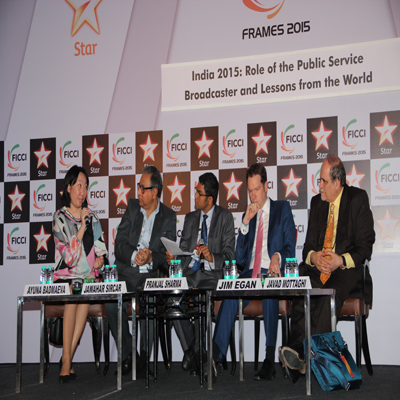
    This was the underlying theme that was discussed on a panel discussion titled ‘India 2015: Role of the Public Service Broadcaster and Lessons from the World’ at FICCI Frames 2015.


    The panel comprised Prasar Bharati CEO Jawhar Sircar, BBC Global News CEO Jim Egan, ABU secretary general Javad Mottaghi and VGTRK Digital Television Russia deputy CEO Ayuna Badmaeva. The session was moderated by Zee Network’s The Appointment host and FICCI advisor Pranjal Sharma.


    The session began with Sircar speaking on the role of Prasar Bharati in the country so far. According to him, the pubcaster had been able to streamline the entire country’s emotional unity together in a multi culture nation. It also played the heritage aspect role as it broadcast mythological shows like the Ramayana. “Show me a single broadcaster, who covers every island of the country across its geographical spectrum. India’s cultural unity was achieved because of a public service broadcaster,” he emphasised.


    Elaborating on how her network functions in Russia and on its role, Badmaeva informed that the network had 18 brands under its umbrella. “We started in 2009 with a factual entertainment channel. We work across Russia and our role is to fill the gap where other networks do not cover its citizens,” she said.


    Egan added, “What is most important for a public service broadcaster is to make the good popular and make the popular good. It is very important that a pubcaster reaches out to every citizen.”


    Posing a question, Sharma asked whether the government should decide what’s good for the public? Mottaghi replied saying that the first word “public” of Public Service Broadcaster referred to all groups of society. Hence its duty was to serve the public. “It has to be public oriented content versus commercial oriented content. We talk about issues such as health, culture, education and what society needs, which is not so much part of commercial news channels,” he opined.


    On being questioned by Sharma as to how Doordarshan ensures that it gets viewers to watch its content, Sircar conceded the fact that DD’s content was definitely not at par as compared to what the BBC was known for world over.


    For Sircar, the issue was related to both creativity and funding. “If the BBC could use 75 per cent of its funding on content, India could use only 10 per cent,” he said.


    Throwing an insightful statistic, which governed the theme of the discussion that followed, Sircar said, “While internationally, double digits dollars were spent per person for creating content. However, in India only 40 cents per person is spent on creating content. If you spend 40 cents, you get content worth 40 cents too.”


    Badmaeva then spoke on how the pubcaster tried remaining relevant in Russia in the ever-evolving digital age. She said, “While linear TV ratings are going down, people consumed content via smartphones and tablets. People also bought their content from cable operators. For us, our network is driven by both profit and reach.” She went on to add the Russian pubcaster has in recent time produced a documentary, which delivered the same rating as the Winter Olympics.


    Egan informed on how the BCC stayed relevant in a dynamic media space. “Every household is driven by a $20 subscription. The idea is about universality. While a part of it to remain relevant is about content, it is also about access, technology and reach. We innovate based on demand. In the digital age, it is how audiences engages with the content,” he said. He then added that around 270 million of the BBC’s audiences was out of the United Kingdom.


    Speaking on the now banned documentary India’s Daughter, which was a joint co-production between various production houses and the BBC, Egan said, “It had the highest values of journalism and the challenge is to avoid being ghettotised as just a pubcaster.”


    Sircar added that DD Sahayadri too had much of its content produced by private production houses. “Own it, don’t stone it,” he said. He also mentioned that when the pubcaster decided to air the Aamir Khan-helmed show Satyamev Jayate, he was questioned by ministers if a show where people washed their dirty linen in public was good for the channel. Sircar was of the opinion that because the show touched public issues, the pubcaster should air it.


    Touching upon the case of Star Sports, which went to court over the pubcaster airing the ICC Cricket World Cup, Sircar said that the pubcaster just followed a court order, which stated that in addition to profit making, the people of India are to be allowed to watch games via cable through terrestrial means. “Because of a very small cartel, which has a few channels, it will lead to monopolising of sports events,” he highlighted.


    Sircar informed that his goal was now focussed on two things. Firstly, increasing the number of channels on Free Dish from the current 50 to 112 and secondly, to use DD’s 1400 transmitters to create FM bands. “If FM has to reach mobiles, smaller circles of 50 kilometers will be created,” he said.


    He went on to add that a process was underway where 15 out of 20 channels could be auctioned. However, he refused to share details.


    Touching upon Sircar’s “40 cent” remark, Egan concluded the session saying, “In a country like India with a large population, 40 cents could add up to $500 million a year. It is a question about a national strategic choice. In some countries a pubcaster would weep tears of joy with this amount of money.”

  • FICCI Frames: The roadmap for success in broadcasting

    FICCI Frames: The roadmap for success in broadcasting

    MUMBAI: In its three decades of existence, the promising broadcast narrative in India continues to be challenged on issues such as transparency, pricing, taxation, consumer choice and lack of a coherent regulatory and policy framework.


    To find a solution to these and similar questions, a panel anchored by media analyst, author and columnist Vanita Kohli Khandekar highlighted a session on the Future of Vision 2020 – laying a transformative roadmap for Indian broadcasting. The panelists stressed issues for unlocking value in Indian broadcasting on the first day of the FICCI Frames convention held on 25 March in Mumbai.


    Speakers who shared their opinion and views were I&B Ministry additional secretary JS Mathur, TRAI principal advisor SK Gupta, BBC Global News CEO Jim Egan, Siti Cable CEO VD Wadhwa, Star India COO Sanjay Gupta, Tata Sky CEO Harit Nagpal, Viacom 18 Group CEO Sudhanshu Vats and Discovery Networks Asia-Pacific south Asia and southeast Asia GM and executive VP Rahul Johri.


    According to Wadhwa, in order for the media and entertainment sector to grow, digitisation should be completed. “Digitisation must be completed and that will bring in transparency. Secondly, we need to work together to see how can we monetise the business far better.”


    It may be recalled that in phase I and II of digitisation, average revenue per user (ARPU) had witnessed a significant jump in places where people were consuming cable broadband. In response to that, Nagpal said, “We can either have monopolies or regulations but one has regulation where there are monopolies. I believe that I am digging my own grave if I am not serving my customers and as a regulator, we need to make sure that he is getting adequate infrastructure to do his job well.”


    Sharing his views on the media and entertainment sector, Star’s Gupta said that today the industry size is close to Rs 30,000 crore and the big challenge going forward will be on how to make it a Rs 300,000 crore industry. Gupta opined that the one fundamental issue that plagues the industry is that they have regulated the industry from a wrong perspective. “You need to get the capital to invest high, while creating innovation for consumers. That’s how industries have grown. However, that is the challenge for the M&E industry.”


    When on the one hand broadcasters believe that regulation is not required, on the other hand TRAI’s Gupta had a different opinion. “If regulation is not required then what is required? Is it that we are required to keep quiet on the customer front if they are not getting any choice?” he questioned.


    He went on to add that the country has 30 million DTH customers, 30 million DAS customers and 10 million addressable systems. However, the question was how many consumers have the choice of individual channels? “If I ask a consumer if he/she is watching all the channels given to them, the answer will be a big no. Therefore the price can be deregulated and total selection of the channel should be given to the consumer at the desired price. And for this to happen certain broad guidelines should be created and this should be done soon.”


    Picking up points from Sanjay and S K Gupta, Vats said that in order to drive the size of the pie, pricing is the difficult thing. “If we focus on the price of the analogue cable, in some way, we are constraining the ‘X’ to increase and my request is that if we become open to it, we will allow the ‘Y’ to increase. The moment we allow the ‘Y’ to increase, I think we will define the problem collectively better between LMOs, MSOs, broadcasters etc.”


    Vats was of the view that competition needs to be encouraged, even though there is enough competition in the media and entertainment industry. “Competition itself will ensure that we are reaching out to every possible Indian, outside India as well. It happens in every industry, why has it not happened here?”  A firm believer of  a free market, Vats is confident that it will drive the industry and take it to the next level.

  • FICCI FRAMES: Prasar Bharati CEO Jawhar Sircar to speak on pubcaster & revenue

    FICCI FRAMES: Prasar Bharati CEO Jawhar Sircar to speak on pubcaster & revenue

    NEW DELHI: Prasar Bharati chief executive officer Jawhar Sircar will be addressing the annual FICCI FRAMES convention commencing in Mumbai on how a public broadcaster can still earn revenue.


    Sircar’s talk is on “India 2015: Role of the Public Service Broadcaster and Lessons from the World.”


    The three day convention from 25 – 27 March will extensively cover discussions on various issues related to the media sector centred around the theme – how to make India a Global Entertainment Superpower.


    Sircar said, “There is no nation in the world that does not have a decent public broadcaster and some of them like BBC or NHK Japan or the Korean Broadcasting System are legends, mainly because their nations, people and their governments wanted them to be so and help them succeed. India cannot be an exception as it is the only public broadcaster, which operates from the icy peaks of Kargil to our lonely borders in Arunachal, right down to Andaman and every possible corner of India: without ever looking at short-term commercial gains.”


    This panel discussion is scheduled on the second day of the entertainment and media conclave and will be moderated by business journalist Pranjal Sharma featuring BBC Global News CEO Jim Egan and Russia’s largest media corporation and public broadcaster – VGTRK deputy CEO Ayuna Badmaeva.


    The other key participant is Asia Pacific Broadcasting Union (ABU) secretary general Javad Mottaghi, who is a special invitee at FICCI FRAMES 2015.


    FICCI secretary general Dr A Didar Singh said, “The discussion would provide greater clarity on how to maximise the efforts of public service broadcasting, and also how institutions like Prasar Bharati can balance their programming mandate with effective revenue generation, and remain relevant in the digital era.”


    The session will explore the relevance, importance and space for Public Service Broadcasting in today’s ‘always connected’ world which offers a multitude of choices by way of content, delivery platforms and engagement channels.


  • BBC Advertising gets two new sales heads

    BBC Advertising gets two new sales heads

    MUMBAI: UK’s pubcaster BBC has done some reshuffling for better revenue generation from one of its upcoming key markets-India. One such is the appointment of two new sales heads- Abhijeet Dhar and Siddharth Bhatnagar for BBC Advertising.


    Dhar was earlier BBC Advertising regional manager- News for north and east India while Bhatnagar was heading the same for west and south India. Both of them will handle sales for the network’s news platforms including television, online, mobile, apps, video on demand and Lonely Planet along with a team of seven others.


    In his new role, Dhar will handle sales for travel, IT, telecom, government, PSUs and corporate while Bhatnagar will look after auto and BFSI (Banking, financial services and insurance). They will report to BBC Worldwide sales director (news) for south Asia Taranjeet Singh who was elevated to the position in 2012 but was handling the sales for India as well.


    BBC is increasing its focus on India, which BBC World News CEO Jim Egan had highlighted in his visit late last year. It is also looking at a big thrust in the digital space in the country. In an earlier interview to indiantelevision.com Egan had said, “One thing particularly exciting about India is that in the other markets digital penetration is nearing saturation point but in India there is a lot of room for growth in the mobile sector and it is one of the biggest growth markets for mobile.”


    The sales revenue push will be for digital medium with a broad based clientele list including education and real estate. The broadcaster claims to have nearly two million visitors a month from India for its website out of which most of it is unique and exclusive.


    Dhar has been with BBC for six years. Prior to this, he was with Viacom 18 as senior business manager for Viacom Brand Solutions, Radio City and the Times of India. Bhatnagar started his career at BBC in 2010 before which he was with SET India as sales manager, UTV World Movies as regional head for north and west, Radio Mirchi and Am sales and marketing.

  • BBC retains title as #1 choice for Asia Pacific’s premium audience

    BBC retains title as #1 choice for Asia Pacific’s premium audience

    MUMBAI: The BBC’s international news offering has cemented its leadership position amongst Asia Pacific’s high income earners. The Ipsos Affluent Survey Asia Pacific for Q3 and Q4 2013 reveals that the BBC’s cross-platform news brand, which includes 24 hour global news channel BBC World News, and bbc.com, which offers up-to-the minute international news and in-depth analysis, is the top choice for premium audiences for the fourth year running.  The survey shows that the BBC has extended its lead over its competitors in the past 12 months.  It also reveals that BBC World News is most effective for reaching the top tier of earners as it has more viewers from this much-coveted demographic than any other news channel.


    The new research also shows that the BBC has reinforced its reputation as the most trustworthy and insightful news brand in Asia, and that it is recognised for offering the highest quality journalism of any news channel or print title.


    Jim Egan, CEO of BBC Global News Ltd, says, “In the past 18 months we have implemented an ambitious strategy to bring our international news operations together into an integrated offer for global audiences. These latest results show that our strategy is yielding rewards and that our target audience has welcomed the increased investment across TV, online and mobile, together with our ongoing commitment to providing the most comprehensive news and current affairs content for the Asia Pacific market.”


    He added, “In terms of overall reach we’ve made great gains within our competitive set but, even more importantly, these figures show that we are way ahead in terms of the coveted premium audience.  As the leader in global breaking news, with bureaux across the region, we welcome the confirmation that the BBC remains the brand of choice for discerning audiences looking for a trusted and truly global perspective on the world’s most important stories.”


    The popularity of BBC World News is further reflected in the finding that, for the first time, it is the most popular channel for frequent business travellers watching from their hotel rooms.


    The survey also reveals that mobile has played an important role in the recent results.  It shows that the BBC was the number one news brand across apps and mobile for premium audiences.  These IASAP findings support a recent BBC World News and bbc.com global mobile study into the usage of mobile devices by affluent consumers which emphasises the growing trend for news consumption on mobile platforms.


    The IASAP study surveys pan-regional and local media consumption and product consumption among affluent adults and business professionals in main cities in the Asia Pacific region. The latest survey covers Q3-Q4 2013.


    Source: Ipsos Affluent Survey Asia Pacific, Q3-Q4 2013, Q1-Q4 2012, Q1-Q4 2011, Q1-Q4 2010. Based on monthly reach % to one-decimal point unless otherwise specified. Cross-platform news brand/total brand reach: TV/website/mobile reach.  Premium audience/high income earners: personal monthly income US $10K+ (N=405; projected universe of 232,600).  Frequent business travellers: taken international business trips 3+/6+ last year (N=941/339; projected universe of 618,312/183,679). 

  • BBC Global News appoints Naveen Jhunjhunwala as India COO

    BBC Global News appoints Naveen Jhunjhunwala as India COO

    MUMBAI: Last month, indiantelevision.com broke the news that BBC Global News India COO Preet Dhupar had decided to move out of her 14 year stint with the company. Now, the global broadcaster has found a person to fill the space in Naveen Jhunjhunwala.


    Jhunjhunwala was previously with Turner International India for 15 years as vice president for corporate finance and administration, looking after the financial functions for distribution, ad sales and marketing of CNN International, Cartoon Network, POGO and HBO in India, Pakistan, Sri Lanka, Maldives, Bangladesh, Nepal and Bhutan.


    Speaking on his new role Jhunjhunwala said, “I am delighted to be joining the BBC. I am looking forward to taking up my new role and to being part of the talented team at one of the world’s most renowned news operations. The BBC is an iconic brand and carries a special position for the Indian audience and in today’s dynamic market place, with digitisation, growing online penetration and the BBC’s special focus on India, it has exceptional potential for growth in both television and online space.”


    At Turner, he helped launch the company’s India operatons including the CN subscription business, launch of new channels like HBO, POGO and WB. He also helped set up the Zee Turner distribution JV, including MediaPro as well as CNN-IBN. Prior to Turner, he was with Ernst & Young in New Delhi.


    The role of COO for India was created last year to better organise the company’s business operations in a growing Indian market. Apart from looking at finance, Jhunjhunwala will also be responsible for determining BBC’s commercial priorities and targets for news across the country as well as ad revenue, content distribution and audience growth.


    “I’m pleased to welcome Naveen on board at such an exciting time for the BBC’s news interests in India.  Naveen brings with him a wealth of experience and will be a real asset to the BBC, building on the successful work to date of our teams in Delhi and Mumbai,” said BBC Global News CEO Jim Egan.


    “India is a country we are proud to have been broadcasting to and from for more than seven decades and we remain committed to our audiences here. We have featured India in two dedicated programming seasons on BBC World News already this year, have recently launched a new Indian edition of bbc.com/mobile and are mid-way through our most comprehensive coverage ever of the Indian general election. I am sure Naveen will be invaluable as we work to develop even further in this exciting and dynamic market,” he added.


    Naveen will take up his position in Delhi on 1 May. He replaces Preet Dhupar who left the organisation earlier this month.

  • Now BBC trains its lens on Indian elections

    Now BBC trains its lens on Indian elections

    MUMBAI: Not only political parties but news channels of every hue are gearing up for what is being billed as the mother of all general elections witnessed by this country.


    The latest to hit the 2014 election trail is BBC World News, a broadcasting network that needs no prior introduction. For the first time, BBC will be broadcasting live from India with three of its best-known anchors flown into the country to present their shows from the subcontinent – Jon Sopel with Global, Mishal Hussain with Impact, and Babita Sharma with Newsday.


    A week of special programming will lead into the main programming starting on the first day of polling on 7 April. This will continue for a week with the three anchors, along with special editions of India Business Report and Talking Business with Linda Yueh. Thereafter, it will rely on the expertise and knowledge of BBC teams in Delhi and Mumbai and the BBC Hindi service.


    Alongside the television programming, an Indian version of the bbc.com mobile site will be created for users to land directly on the India page upon clicking the main url. The online content will be trilingual, with predominantly English content along with some in Hindi and Tamil. Among others, the shows will explore angles such as what the election means for India’s neighbours like Pakistan and China and what it means for the rupee.


    “India is a massive market. The mobile penetration here is close to 200 million users. Our mobile traffic is up by 350 per cent in three years and there are profound changes going on here. The new India mobile edition will provide a tailored experience, including top India news stories along with global news headlines, video, business, sport and the best from our features content,” says BBC Global News CEO Jim Egan. “It’s a very big editorial undertaking for us. We haven’t taken the channel on the road like this. Topics that interest world audiences such as politics, economy, defence and culture, will be covered. We won’t do it superficially or trivially but bearing in mind that a majority of our viewers are outside India, we won’t do in-depth analysis like local channels.”


    BBC correspondent-anchor Sopel is excited to be covering elections live in India. “Election in India is important because India is important. We have a polling day and you have a polling month! That’s because your total electorate is 840 million and the UK just has 48 million,” he says.


    While adding a local flavour to its programming, the global broadcaster will ensure it serves BBC values such as impartiality, fairness and balance. “No other international channel has the network of specialist language correspondents that we have,” says Sopel.


    On the cards is a marketing campaign in major metros like Delhi, Mumbai, Bangalore and Chennai to let audiences know about BBC’s election coverage both on- and off- air. As of now though, BBC is busy figuring out whether to place the satellite dish in Mumbai or the national capital, depending on costs and feasibility.