Tag: Jeetendra Kapoor

  • Balaji Telefilms posts Rs 90 crore profit after last year’s Rs 22 crore loss

    Balaji Telefilms posts Rs 90 crore profit after last year’s Rs 22 crore loss

    MUMBAI: It’s not just the daily soaps serving plot twists Balaji Telefilms just delivered one of its own, posting a dramatic turnaround from loss to profit in its latest annual results. Balaji Telefilms Ltd., one of India’s most iconic television and content production houses, has posted a stunning financial comeback, reporting a standalone net profit of Rs 90.59 crore for the financial year ending March 31, 2025. This is a significant leap from a net loss of Rs 22.52 crore the previous year, a turnaround worthy of prime-time applause.

    According to the audited results filed with stock exchanges and published in leading dailies on 5 July, the company’s total standalone income from operations stood at Rs 45,306.92 crore for FY25. On a consolidated basis, it reported a net profit of Rs 84.57 crore, recovering sharply from a loss of Rs 26.08 crore in FY24.

    This reversal comes despite a notable dip in revenue for the final quarter ending March 2025, where standalone income dropped to Rs 8.63 crore, down from Rs 13.46 crore in the same quarter last year. Still, profits surged in the final stretch, with the company posting Rs 99.31 crore in Q4 profit, a complete U-turn from the Rs 22.52 crore loss in the comparable quarter.

    The earnings per share (EPS) rose to Rs 6.68 basic for the year, up from negative territory last year signalling restored investor confidence.

    The company, led by Chairman Jeetendra Kapoor, published the results in Financial Express and Mumbai Lakshadeep and noted that detailed financials are available on its website as well as on BSE and NSE portals.

    With flagship shows still ruling the ratings and digital spin-off ventures gaining traction, Balaji seems to have re-scripted its business drama into a tale of fiscal finesse. Whether this rebound is a one-season wonder or the start of a long-running hit remains to be seen but for now, the curtains have risen on a new chapter of profitability.

    (If you are an Anime fan and love Anime like Demon Slayer, Spy X Family, Hunter X Hunter, Tokyo Revengers, Dan Da Dan and Slime, Buy your favourite Anime merchandise on AnimeOriginals.com.)

  • ABP Majha  unveils ‘Majha Sanman Puraskar 2023’

    ABP Majha unveils ‘Majha Sanman Puraskar 2023’

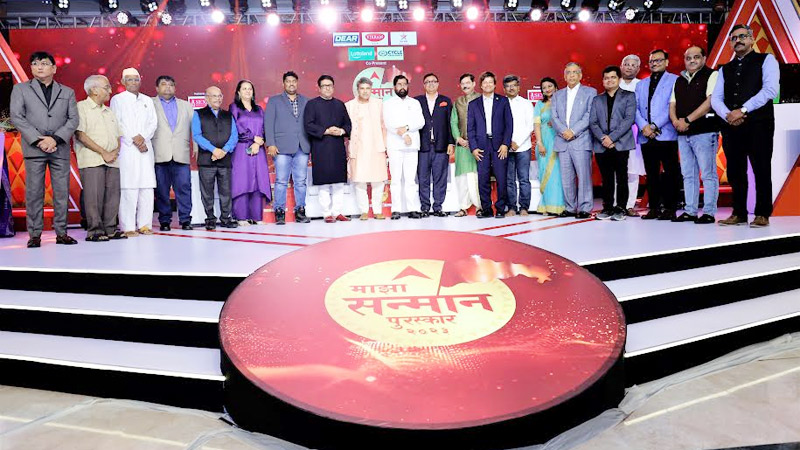
    Mumbai: ABP Majha, a leading news channel of Maharashtra hosted the prestigious ‘Majha Sanman Puraskar 2023’ on Monday, 21 August at the elegant ITC Grand Central in Mumbai. The ‘Majha Sanman Puraskar’ serves as a distinguished tribute to individuals who have made noteworthy contributions across various domains.  

    The event was graced by distinguished chief guests, including chief minister Eknath Shinde, chief of the Maharashtra Navnirman Sena (MNS) Raj Thackeray, and the veteran actor Jeetendra Kapoor.

    Beyond being mere awards, the ‘Majha Sanman Puraskar’ from ABP Majha symbolizes gratitude towards those who have significantly enriched the well-being, growth, and sense of accomplishment of the state of Maharashtra. The evening radiated with distinction and glamour, as it acknowledged the achievements of exceptional individuals who have left an indelible mark on Maharashtra’s cultural, social, and artistic landscape.

    The recipients of the 2023 Majha Sanman Puruskar are as follows:

    Pt. Suresh Wadkar, renowned singer

    Dr Shri Thanedar, Indian-American congressman

    Ashok Patki, accomplished music director and composer

    Ashok Jain, chairman, Jain Irrigation

    Shraddha Kapoor, a celebrated actress

    Shardul Thakur, a prominent Indian cricketer

    Kedar Shinde, esteemed film director

    Ware Guruji, celebrated teacher

    Satyapal Maharaj, a devoted social activist

    Suresh Waghe, a notable author

    For the past 15 years, the ‘Majha Sanman Puraskar’ has stood as a symbol of appreciation for the state’s pride, paying homage to luminaries such as Sachin Tendulkar, Dr Rani Bang, Ashutosh Kotwal, Nagraj Manjule, Pt. Suresh Talkwalkar, Rahul Dravid, and many more. This year’s edition marked an unforgettable evening celebrating Maharashtra’s vibrant heritage of talent, creativity, and excellence.

    The broadcast of the show is scheduled for Saturday, August 26th, at 8 PM, with a repeat episode airing on Sunday, 27 August at 7 PM, ensuring a wider audience can partake in the celebration of Maharashtra’s remarkable individuals.

    Majha Sanman Puraskar 2023 was co-presented by Dear Government Lottery, Vikram Tea, Star Parvah, Lottoland, and Cycle Agarbatti. It was co-powered by Akkuda’s Dhudhkandi, Senco Gold & Diamonds, and Gokul Dudh. The Drive-in partner for the event was H’ness CB350, and it was partnered by Tata Play. The digital partner was ABP Live.

  • Q1-17: Low programming and low realisation lower Balaji Telefilms standalone topline

    Q1-17: Low programming and low realisation lower Balaji Telefilms standalone topline

    BENGALURU: Balaji Telefilms Limited (Balaji) reported 23 percent year-over-year (y-o-y) decline in standalone total revenue from operations (TIO) for the quarter ended 30 June 2016 (Q1-17, current quarter). The company reported standalone revenue for Q1-17 at Rs 53.59 crore and Rs 69.38 crore for the corresponding year ago quarter.

    Revenue from Balajis’ Commissioned Programs segment in Q1-17 was Rs 52.64 crore, while for Q1-16 it was Rs 68.44 crore. Programming hours for Q1-17 were 225.5 hours, lower than the 257 hours reported for the corresponding year ago quarter. Net realisation per hour was also lower at Rs 23.33 lakh in the current quarter as compared to Rs 26.6 lakh in Q1-16. The company says that the previous quarter included Nach Baliye and Jodha Akbar resulting in higher revenue as compared to the current quarter. The company says that Q2-17 will have two new shows Mazaak Mazaak Mein on Life Ok and Bhramarakshas on Zee TV. Margin was lower in the current quarter due to launch of a new show Kawach on June 11, 2016 which will improve in the subsequent quarters

    The company’s Films segment reported operating revenue of Rs 53.44 crore in Q1-17 as compared to Rs 1.04 crore in Q1-16. The segment’s operating profit in the current quarter was Rs 2.53 crore as compared to an operating loss of Rs 0.45 crore. The company says that revenue growth in the current quarter is due to release of Azhar and Udta Punjab. The company expects revenue of approximately Rs 18.61 crore for satellite, digital and other rights of Azhar and Udta Punjab in Q2-17. It says further that piracy of two of its movies led to a lower profit on Udta Punjab and loss on Great Grand Masti (released in July 2016) resulting into an approximate loss of revenue of Rs 36 crore.

    Balaji’s consolidated TIO increased 54.9 percent y-o-y to Rs 117.38 crore in Q1-17 as compared to Rs 75.80 crore in Q1-16. The company reported negative consolidated EBIDTA of Rs 3.01 crore for the current quarter as compared to a consolidated operating profit of Rs 4.76 crore in Q1-16.

    Total comprehensive income in the current quarter was lower at Rs 0.66 crore as compared to a comprehensive income of Rs 4.28 crore in Q1-16.Balaji reported a consolidated net loss of Rs 0.2 crore in the current quarter as compared to a profit after tax of Rs 4.4 crore in Q1-16. The company says that net loss has been incurred in the current quarter after accounting for income tax of Rs 2.72 crore which relates to its television segment.

    Total Expenditure in the current quarter was Rs 120.35 crore (102.5 percent of TIO) which was 64.5 percent more as compared to Rs 73.16 crore (96.5 percent of TIO) in Q1-16. Cost of Production/Acquisition and Telecast Fees in Q1-17 was Rs 83.92 crore (71.5 percent of TIO), 5.7 percent lower than Rs 89 crore in the corresponding year ago quarter.

    Marketing and distribution expense in Q1-17 increased to Rs 13.26 crore as compared to Rs 0.30 crore in Q1-16. Employee Benefit Expense in the current quarter increased 54.1 percent y-o-y to Rs 6.46 crore (5.5 percent of TIO) as compared to Rs 4.19 crore (5.5 percent of TIO) in Q1-16. Other expenditure in Q1-17 increased 17.3 percent y-o-y to Rs 7.82 crore (6.7 percent of TIO) as compared to Rs 6.67 crore (8.8 percent of TIO).

    Balaji says that it has so far invested Rs14.3 crore in its digital foray ALT Digital, which is currently in a prelaunch phase with expenses mainly on account of content, technology, salaries and other business overheads.

    Note: The unit of currency in this report is the Indian rupee – Rs (also conventionally represented by INR). The Indian numbering system or the Vedic numbering system has been used to denote money values. The basic conversion to the international norm would be:

    (a) 100,00,000 = 100 lakh = 10,000,000 = 10 million = 1 crore.

    (b) 10,000 lakh = 100 crore = 1 arab = 1 billion.

  • Q1-17: Low programming and low realisation lower Balaji Telefilms standalone topline

    Q1-17: Low programming and low realisation lower Balaji Telefilms standalone topline

    BENGALURU: Balaji Telefilms Limited (Balaji) reported 23 percent year-over-year (y-o-y) decline in standalone total revenue from operations (TIO) for the quarter ended 30 June 2016 (Q1-17, current quarter). The company reported standalone revenue for Q1-17 at Rs 53.59 crore and Rs 69.38 crore for the corresponding year ago quarter.

    Revenue from Balajis’ Commissioned Programs segment in Q1-17 was Rs 52.64 crore, while for Q1-16 it was Rs 68.44 crore. Programming hours for Q1-17 were 225.5 hours, lower than the 257 hours reported for the corresponding year ago quarter. Net realisation per hour was also lower at Rs 23.33 lakh in the current quarter as compared to Rs 26.6 lakh in Q1-16. The company says that the previous quarter included Nach Baliye and Jodha Akbar resulting in higher revenue as compared to the current quarter. The company says that Q2-17 will have two new shows Mazaak Mazaak Mein on Life Ok and Bhramarakshas on Zee TV. Margin was lower in the current quarter due to launch of a new show Kawach on June 11, 2016 which will improve in the subsequent quarters

    The company’s Films segment reported operating revenue of Rs 53.44 crore in Q1-17 as compared to Rs 1.04 crore in Q1-16. The segment’s operating profit in the current quarter was Rs 2.53 crore as compared to an operating loss of Rs 0.45 crore. The company says that revenue growth in the current quarter is due to release of Azhar and Udta Punjab. The company expects revenue of approximately Rs 18.61 crore for satellite, digital and other rights of Azhar and Udta Punjab in Q2-17. It says further that piracy of two of its movies led to a lower profit on Udta Punjab and loss on Great Grand Masti (released in July 2016) resulting into an approximate loss of revenue of Rs 36 crore.

    Balaji’s consolidated TIO increased 54.9 percent y-o-y to Rs 117.38 crore in Q1-17 as compared to Rs 75.80 crore in Q1-16. The company reported negative consolidated EBIDTA of Rs 3.01 crore for the current quarter as compared to a consolidated operating profit of Rs 4.76 crore in Q1-16.

    Total comprehensive income in the current quarter was lower at Rs 0.66 crore as compared to a comprehensive income of Rs 4.28 crore in Q1-16.Balaji reported a consolidated net loss of Rs 0.2 crore in the current quarter as compared to a profit after tax of Rs 4.4 crore in Q1-16. The company says that net loss has been incurred in the current quarter after accounting for income tax of Rs 2.72 crore which relates to its television segment.

    Total Expenditure in the current quarter was Rs 120.35 crore (102.5 percent of TIO) which was 64.5 percent more as compared to Rs 73.16 crore (96.5 percent of TIO) in Q1-16. Cost of Production/Acquisition and Telecast Fees in Q1-17 was Rs 83.92 crore (71.5 percent of TIO), 5.7 percent lower than Rs 89 crore in the corresponding year ago quarter.

    Marketing and distribution expense in Q1-17 increased to Rs 13.26 crore as compared to Rs 0.30 crore in Q1-16. Employee Benefit Expense in the current quarter increased 54.1 percent y-o-y to Rs 6.46 crore (5.5 percent of TIO) as compared to Rs 4.19 crore (5.5 percent of TIO) in Q1-16. Other expenditure in Q1-17 increased 17.3 percent y-o-y to Rs 7.82 crore (6.7 percent of TIO) as compared to Rs 6.67 crore (8.8 percent of TIO).

    Balaji says that it has so far invested Rs14.3 crore in its digital foray ALT Digital, which is currently in a prelaunch phase with expenses mainly on account of content, technology, salaries and other business overheads.

    Note: The unit of currency in this report is the Indian rupee – Rs (also conventionally represented by INR). The Indian numbering system or the Vedic numbering system has been used to denote money values. The basic conversion to the international norm would be:

    (a) 100,00,000 = 100 lakh = 10,000,000 = 10 million = 1 crore.

    (b) 10,000 lakh = 100 crore = 1 arab = 1 billion.

  • FY-16: Higher tax, lesser films release lowers Balaji Telefims revenue, profit

    FY-16: Higher tax, lesser films release lowers Balaji Telefims revenue, profit

    BENGALURU: Balaji Telefilms Limited (Balaji) reported 15.5 percent decline in consolidated total revenue from operations (TIO) for the year ended 31 March 2016 (FY-16, current year). The company’s consolidated profit after tax (PAT) in the current year declined to less than half as compared to the previous year. Balaji attributes the decline in consolidated TIO to release of just one film in the current fiscal as compared to five in the FY-15. Further, the company had to pay more than a five-fold (5.6 times) increase in income tax in the current year as compared to FY-15.

    Balaji’s reported consolidated TIO in FY-16 at Rs 292.76 crore as compared to Rs 342.65 crore in the previous year. PAT in FY-16 was Rs 2.74 crore (1 percent PAT margin) as compared to Rs 5.63 crore (1.6 percent PAT margin) in FY-15. 

    Note: The unit of currency in this report is the Indian rupee – Rs (also conventionally represented by INR). The Indian numbering system or the Vedic numbering system has been used to denote money values. The basic conversion to the international norm would be:
    (a) 100,00,000 = 100 lakh = 10,000,000 = 10 million = 1 crore.
    (b) 10,000 lakh = 100 crore = 1 arab = 1 billion.

    EBIDTA in the current year declined 2 percent to Rs 5.95 crore (2 percent EBIDTA margin) as compared to 6.06 crore (1.7 percent EBIDTA)

    For the quarter ended 31 March 2016 (Q4-16, current quarter), Balaji reported 6 percent year-over-year (y-o-y) growth in consolidated TIO at Rs 83.23 crore as compared to Rs 77.81 crore in Q4-15, and a 12 percent quarter-over-quarter (q-o-q) growth from Rs 73.15 crore in Q3-16.

    Revenue for the quarter from commissioned programs (including Nach Baliye) declined to Rs 55.64 crore as compared to Rs 59.51 crore in Q1-15 and Rs 71.27 crore in the immediate trailing quarter. The company says that the decline in revenues for Q4-16 was due to Meri Aashiqui Tum Se Hi, Itna Karo Na Mujhe Pyaar and Pyar Ko Ho Jane Do going off air during the quarter.

    The company created lesser hours of programming in Q4-16 as compared to during the corresponding year ago quarter and during the immediate trailing quarter. Total programming hours in Q1-16 were 247 as compared to 258 in Q1-15 and 294.5 hours in Q3-16. Net realisation per hour in Q4-16 increased to Rs 22.5 lakh as compared to Rs 22 lakh in Q1-15, but declined when compared to Rs 24.2 lakh in Q3-16.

    Balaji reported a net loss of Rs 13.28 crore in the current quarter as compared to PAT of Rs 9.61 crore in Q1-15 and  PAT of Rs 6.64 crore in Q3-16.


  • FY-16: Higher tax, lesser films release lowers Balaji Telefims revenue, profit

    FY-16: Higher tax, lesser films release lowers Balaji Telefims revenue, profit

    BENGALURU: Balaji Telefilms Limited (Balaji) reported 15.5 percent decline in consolidated total revenue from operations (TIO) for the year ended 31 March 2016 (FY-16, current year). The company’s consolidated profit after tax (PAT) in the current year declined to less than half as compared to the previous year. Balaji attributes the decline in consolidated TIO to release of just one film in the current fiscal as compared to five in the FY-15. Further, the company had to pay more than a five-fold (5.6 times) increase in income tax in the current year as compared to FY-15.

    Balaji’s reported consolidated TIO in FY-16 at Rs 292.76 crore as compared to Rs 342.65 crore in the previous year. PAT in FY-16 was Rs 2.74 crore (1 percent PAT margin) as compared to Rs 5.63 crore (1.6 percent PAT margin) in FY-15. 

    Note: The unit of currency in this report is the Indian rupee – Rs (also conventionally represented by INR). The Indian numbering system or the Vedic numbering system has been used to denote money values. The basic conversion to the international norm would be:
    (a) 100,00,000 = 100 lakh = 10,000,000 = 10 million = 1 crore.
    (b) 10,000 lakh = 100 crore = 1 arab = 1 billion.

    EBIDTA in the current year declined 2 percent to Rs 5.95 crore (2 percent EBIDTA margin) as compared to 6.06 crore (1.7 percent EBIDTA)

    For the quarter ended 31 March 2016 (Q4-16, current quarter), Balaji reported 6 percent year-over-year (y-o-y) growth in consolidated TIO at Rs 83.23 crore as compared to Rs 77.81 crore in Q4-15, and a 12 percent quarter-over-quarter (q-o-q) growth from Rs 73.15 crore in Q3-16.

    Revenue for the quarter from commissioned programs (including Nach Baliye) declined to Rs 55.64 crore as compared to Rs 59.51 crore in Q1-15 and Rs 71.27 crore in the immediate trailing quarter. The company says that the decline in revenues for Q4-16 was due to Meri Aashiqui Tum Se Hi, Itna Karo Na Mujhe Pyaar and Pyar Ko Ho Jane Do going off air during the quarter.

    The company created lesser hours of programming in Q4-16 as compared to during the corresponding year ago quarter and during the immediate trailing quarter. Total programming hours in Q1-16 were 247 as compared to 258 in Q1-15 and 294.5 hours in Q3-16. Net realisation per hour in Q4-16 increased to Rs 22.5 lakh as compared to Rs 22 lakh in Q1-15, but declined when compared to Rs 24.2 lakh in Q3-16.

    Balaji reported a net loss of Rs 13.28 crore in the current quarter as compared to PAT of Rs 9.61 crore in Q1-15 and  PAT of Rs 6.64 crore in Q3-16.


  • 20 years of Balaji Telefilms’ dominance

    20 years of Balaji Telefilms’ dominance

    MUMBAI: “My company works on two principles. One, nothing is bigger than the programme, not even the company. Two, if you believe in me and really want to share my goal and vision, please join me; else don’t show me your face. I have never told this to anybody before, but seriously, the company needs an attitude. No company which does not have an attitude can ever be successful,” are the words of the woman who turned the small screen into big!


    India’s largest fiction TV producer Balaji Telefilms which  redefined  Indian television and made Ekta Kapoor a household name can be credited for the satellite boom in the country as well. 


    Like many of her counterparts, she too started her career very young. From being just yesteryear’s superstar Jeetendra’s daughter, today Ekta Kapoor is the woman who rules the hearts and the minds of many. She started off at 17 and since then, has loved, eaten and slept only television. Always thinking about concepts, casting, styling, selecting technicians, shooting and scheduling, marketing and acquiring the new skills required to succeed.


    Set up in 1994, the powerhouse has completed 20 years of entertainment. It all started with a comedy show on Zee TV, ‘Hum Paanch’, in 1995 and today it has an array of shows to its name.


    Satellite television began in the early nineties with the launch of Zee TV, followed by Sony Entertainment Television later in the decade and finally Star Plus as the millenium ended. It wouldn’t be unreasonable to say her TV shows have played a pivotal role in each one of their successes at some time or the other. Even the latest major entrant Colors – from Viacom18 – is relying on her new show Meri Aashiqui Tum Se Hi to give it an injection of TRPs. One after the other, the production house has created blockbusters on the small screen. ‘Kyunki Saas Bhi Kabhi Bahu Thi’ and ‘Kahaani Ghar Ghar Ki’ made everyone switch on to Star Plus every night from 10pm to 11 pm; people cried and laughed with the characters. So much so that the death of the character Mihir Virani on ‘Kyunki Saas Bhi Kabhi Bahu Thi’ lead to fan protest marches to bring back him back. The shows also garnered unheard of TRPs for eight long years.


    Then, came another slew of superhit drama series  like ‘Kabhi Souten Kabhie Saheli’ (Star Plus), ‘Kutumb’ (Sony), ‘Kuch Jhuki Palkein’ (Sony) and ‘Kohi Apna Sa’ (Zee), ‘Kahin To Hoga’ (Star Plus), ‘Kasautii Zindagi Kay’ (Star Plus), ‘Kkusum’ (Sony) which took the company miles ahead from its competitors.


    Some of the company’s on-going popular shows like ‘Jodha Akbar’ (Zee TV) ‘Bade Acche Lagte Hai’ (Sony), ‘Pavitra Rishta’ (Zee TV), ‘Ye Hain Mohobbatein’ (Star Plus), and ‘Kumkum Bhagya’ (Zee TV) hold strong in their time band.


    Balaji, which possesses 23 modern sets and 37 editing suites in India, also helped enhance the primetime slot on GECs.


    The company has produced more than 15,000 hours of television content since its inception, including content in Hindi, Tamil, Telegu, Kannada and Malayalam.


    Filmy business


    If television dominance wasn’t enough, the company soon entered the Indian motion picture business in 2002.  


    Till 2009, the company through its wholly-owned subsidiary, Balaji Motion Pictures, had produced and/or acquired 12 films, including hits like Bhool Bhulaiyaa and Sarkar Raj.


    It set trends here as well when it co-produced and distributed India’s premiere digital film Love, Sex aur Dhokha, released in March 2010 under its ALT Entertainment banner. The film emerged as a sleeper hit receiving critical and commercial acclaim from audiences, worldwide.


    The company continued the LSD success story with its second production, Once Upon A Time In Mumbaai, which broke ground at the worldwide box office. Other films to its credit are Kuku Mathur Ki Jhand Ho Gayi, Main Tera Hero, Ragini MMS 2, Shaadi Ke Side Effects, Once Upon A Time In Mumbai Dobaara, Kya SuperKool Hai Hum, Dirty Picture and Shootout at Lokhandwala.


    With an impressive slate like that, she has earned Balaji a position amongst the major film studios in India.


    Other ventures


    But that hasn’t stopped her or the company from venturing into other spaces.


    Over the years, from a television content provider, Balaji Telefilms has evolved into a media conglomerate with organisational divisions responsible for television, motion pictures, internet and mobile.


    Being the largest player in the industry and after having creating larger-than-life characters, it understands the skill sets required to be successful.


    Balaji Telefilms took an initiative to bridge the gap between demand and supply of professionals/actors, by launching its ICE Institute of Creative Excellence. The institute trains tomorrows’ players by teaching them the various skills needed to make a career in the Media and Entertainment industry.


    What next for Ekta and Balaji? She is going back to her roots: television. For the past three to four years she has been absolutely focused on making Balaji a force in the film industry, leaving the running of the television productions to mother Shobha Kapoor, Tanusri Dasgupta, Ketan Gupta, among many other professionals. But just last month she was quite clear when she said: “I am a TV producer who works 24 *7. It’s just that I am focusing more on television as I am getting a chance to explore myself.”

    As one philosopher said: “Life is a journey, not a destination.”  And for Balaji and Ekta, it seems like a never ending dream journey.