Tag: Jawhar Sircar

  • News broadcasters’ expectations from the Union Budget 2016

    News broadcasters’ expectations from the Union Budget 2016

    MUMBAI: As another budget looms ahead of us, expectations are high riding especially amongst the Indian news broadcasters. The budget will be presented by the Finance Minister on 29 February, 2016 and almost every segment has a set of expectations. To get a better perspective of what news broadcasters’ aspirations are from this year’s allotment, Indiantelevision.com spoke to a few stalwarts from the industry.

    Times Network MD and CEO MK Anand says, “Digitisation in general and the rollout of Digital Addressable System (DAS) in the Phase III and IV markets will be perhaps the biggest game changer for Media & Entertainment. We’re looking at addressability and millions of undeclared TV households coming into the radar and huge corrections in the subscription ad revenues anomalies in India. Between Phases III and IV, we are talking around 110 million TV homes. So my biggest budget wish for the industry is that the operators in the distribution chain be empowered, financially, to be able to afford or access, and offer the mandated technically superior digital setups to take their analog TV homes digital. This will become easier if the government accords infrastructure status to the broadcast industry. The cable industry is expected to invest some Rs 40,000 – 45,000 crore on STBs. The government can really help accelerate and optimise the roll-out of DAS to a great extent with this one step.”

    As the press is often considered to be the fourth pillar of democracy in India, it is constantly observed that the fraternity has not been benefited much by the budget.

    Shedding some light on it, News Broadcasters Association honorary treasurer and News24 chairperson cum managing director Anurradha Prasad says, “First, according to me the government should include media industry in the infrastructure sector. Second, the fruits of digitisation should now come to media. It should positively come into news broadcasting. Media is the fourth pillar of democracy and it’s high time that it gets treated differently.”

    However Prasar Bharati CEO Jawhar Sircar is of the opinion that their requirements are being met by the Ministry’s budget. “We don’t seek much from the national budget,” he adds.

    CNN-IBN managing editor Radhakrishnan Nair says, “There is an opportunity available as the global oil prices have come down majorly, so we are sitting on a lot of money. We have not reduced excise on the fuel prices for consumers. There is a lot of tax money that the government has got in. One major thing is that GST, which has not yet been implemented. The budget should look towards the tax structure in which we will make ourselves ready for GST whenever it comes. There could be a possible increase in the taxes or some excise adjustments for different commodities but this year’s budget will not be a great people’s budget or a populist budget. It will be a budget that will try to reserve money for the economy and the government. I do not expect too many freebies rather I am expecting many improvements in the agriculture sector as the sector is facing a lot of stress due to various reasons. I would also like a lot of things for the benefit of the start-ups as they are young and willing to start their own businesses. So I expect a lot of tax allowances or policy allowances in this year’s budget.”

    With the budget round the corner, we journalists are often worried about different ways to cover it with a unique peg to the story. Speaking as a true journalist, NDTV Group CEO Vikram Chandra scorns, “I am not expecting anything from the budget. I am more worried about how I will cover it.”

  • News broadcasters’ expectations from the Union Budget 2016

    News broadcasters’ expectations from the Union Budget 2016

    MUMBAI: As another budget looms ahead of us, expectations are high riding especially amongst the Indian news broadcasters. The budget will be presented by the Finance Minister on 29 February, 2016 and almost every segment has a set of expectations. To get a better perspective of what news broadcasters’ aspirations are from this year’s allotment, Indiantelevision.com spoke to a few stalwarts from the industry.

    Times Network MD and CEO MK Anand says, “Digitisation in general and the rollout of Digital Addressable System (DAS) in the Phase III and IV markets will be perhaps the biggest game changer for Media & Entertainment. We’re looking at addressability and millions of undeclared TV households coming into the radar and huge corrections in the subscription ad revenues anomalies in India. Between Phases III and IV, we are talking around 110 million TV homes. So my biggest budget wish for the industry is that the operators in the distribution chain be empowered, financially, to be able to afford or access, and offer the mandated technically superior digital setups to take their analog TV homes digital. This will become easier if the government accords infrastructure status to the broadcast industry. The cable industry is expected to invest some Rs 40,000 – 45,000 crore on STBs. The government can really help accelerate and optimise the roll-out of DAS to a great extent with this one step.”

    As the press is often considered to be the fourth pillar of democracy in India, it is constantly observed that the fraternity has not been benefited much by the budget.

    Shedding some light on it, News Broadcasters Association honorary treasurer and News24 chairperson cum managing director Anurradha Prasad says, “First, according to me the government should include media industry in the infrastructure sector. Second, the fruits of digitisation should now come to media. It should positively come into news broadcasting. Media is the fourth pillar of democracy and it’s high time that it gets treated differently.”

    However Prasar Bharati CEO Jawhar Sircar is of the opinion that their requirements are being met by the Ministry’s budget. “We don’t seek much from the national budget,” he adds.

    CNN-IBN managing editor Radhakrishnan Nair says, “There is an opportunity available as the global oil prices have come down majorly, so we are sitting on a lot of money. We have not reduced excise on the fuel prices for consumers. There is a lot of tax money that the government has got in. One major thing is that GST, which has not yet been implemented. The budget should look towards the tax structure in which we will make ourselves ready for GST whenever it comes. There could be a possible increase in the taxes or some excise adjustments for different commodities but this year’s budget will not be a great people’s budget or a populist budget. It will be a budget that will try to reserve money for the economy and the government. I do not expect too many freebies rather I am expecting many improvements in the agriculture sector as the sector is facing a lot of stress due to various reasons. I would also like a lot of things for the benefit of the start-ups as they are young and willing to start their own businesses. So I expect a lot of tax allowances or policy allowances in this year’s budget.”

    With the budget round the corner, we journalists are often worried about different ways to cover it with a unique peg to the story. Speaking as a true journalist, NDTV Group CEO Vikram Chandra scorns, “I am not expecting anything from the budget. I am more worried about how I will cover it.”

  • Creation of good content vital with advent of new media: Rathore

    Creation of good content vital with advent of new media: Rathore

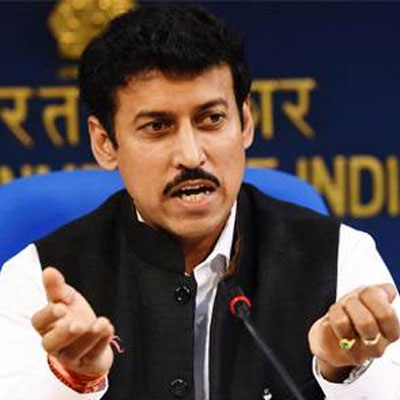
    NEW DELHI: Minister of State for Information and Broadcasting, Col. Rajyavardhan Rathore said today that the challenge as well as the opportunity would be to develop content and services for different platforms and consumers in view of the rapid changes in the information and communication technology and increasing number of smartphone users in India. 

    He said the public broadcaster Prasar Bharati was aware of the new challenges and would be constantly striving to keep pace with the new age technologies. The Minister also said the laws of the land should learn to keep pace with changing technology. 

    He complimented the Broadcast Engineering Society (BES) for their efforts and initiatives in bridging the gap between educational institutions and professional bodies.

    Inaugurating the 22nd International Conference & Exhibition on Terrestrial and Satellite Broadcasting BES EXPO 2016, he said it provided a unique platform and opportunity for participants and concerned stakeholders from across the world to share their ideas and experiences on the opportunities and challenges of the new age of digital broadcasting. He said that an idea would not be revolutionary if it remains dormant and BES EXPO 2016 provided an excellent forum to discuss these ideas and learn from each other. 

    Prasar Bharati Chairman A. Surya Prakash, CEO Jawhar Sircar, and I&B Special Secretary J S Mathur were also present on the occasion.

    Mathur said BES EXPO, which is amongst the top five exhibitions in the Knowledge Hub category provided an excellent opportunity for the whole of the broadcasting industry to witness the new technology from across the world in India.
     The winners of the awards instituted by the Broadcast Engineering Society in various categories such as training and innovation were felicitated. 

    The lifetime achievement award was conferred on M S H Baig for his outstanding contributions to the broadcasting industry. This year the society also conferred two special category awards to All India Radio for its Mobile App- ‘AIR Live’ and Doordarshan for its impactful coverage of Republic Day Parade, Independence Day, International Yoga Day and Ekta Diwas.

  • Creation of good content vital with advent of new media: Rathore

    Creation of good content vital with advent of new media: Rathore

    NEW DELHI: Minister of State for Information and Broadcasting, Col. Rajyavardhan Rathore said today that the challenge as well as the opportunity would be to develop content and services for different platforms and consumers in view of the rapid changes in the information and communication technology and increasing number of smartphone users in India. 

    He said the public broadcaster Prasar Bharati was aware of the new challenges and would be constantly striving to keep pace with the new age technologies. The Minister also said the laws of the land should learn to keep pace with changing technology. 

    He complimented the Broadcast Engineering Society (BES) for their efforts and initiatives in bridging the gap between educational institutions and professional bodies.

    Inaugurating the 22nd International Conference & Exhibition on Terrestrial and Satellite Broadcasting BES EXPO 2016, he said it provided a unique platform and opportunity for participants and concerned stakeholders from across the world to share their ideas and experiences on the opportunities and challenges of the new age of digital broadcasting. He said that an idea would not be revolutionary if it remains dormant and BES EXPO 2016 provided an excellent forum to discuss these ideas and learn from each other. 

    Prasar Bharati Chairman A. Surya Prakash, CEO Jawhar Sircar, and I&B Special Secretary J S Mathur were also present on the occasion.

    Mathur said BES EXPO, which is amongst the top five exhibitions in the Knowledge Hub category provided an excellent opportunity for the whole of the broadcasting industry to witness the new technology from across the world in India.
     The winners of the awards instituted by the Broadcast Engineering Society in various categories such as training and innovation were felicitated. 

    The lifetime achievement award was conferred on M S H Baig for his outstanding contributions to the broadcasting industry. This year the society also conferred two special category awards to All India Radio for its Mobile App- ‘AIR Live’ and Doordarshan for its impactful coverage of Republic Day Parade, Independence Day, International Yoga Day and Ekta Diwas.

  • DD confident of achieving 112-channel target on FreeDish by March-end

    DD confident of achieving 112-channel target on FreeDish by March-end

    NEW DELHI: Indian pubcaster Doordarshan is now confident that it will acquire the capacity of carrying 112 channels on its free-to-air (FTA) direct to home (DTH) service FreeDish by March-end.
     
    DD director general C Lalrosanga told Indiantelevision.com that a meeting had been held recently by the engineering team in FreeDish and Doordarshan with experts from the Bangalore based ByDesign India.
     
    DD is acquiring ByDesign’s conditional access system (CAS) so as to increase its channel offerings from the current 64 by the end of March 2016.
     
    The meeting was primarily aimed at assessing the requirement of CAS-enabled set top boxes (STBs) that will be needed to cover all regions of the country.
     
    Lalrosanga said the DTH player will switch over to MPEG4 from the current MPEG2 in two phases. “The first phase may begin this month,” he informed.
     
    Late last year, the Department of Electronics and Information Technology (DeitY) approved a proposal by ByDesign India to develop an Indian conditional access system. ByDesign was to receive a support amount of Rs 19.79 crore from DeitY to develop the new system in association with Centre for Development of Advanced Computing (C-DAC).
     
    The ByDesign model is totally indigenous and built for DVB-C setup. This CAS solution will enable broadcasters to control access to their services by viewers, and thereby enabling them to extend their business models to subscription based schemes.
     
    This will mean that the FreeDish will become encrypted but will remain FTA. In addition to helping increase the number of channels on the platform, this will enable FreeDish to gauge the exact number of households relying on FreeDish as encrypted STBs will only be available with authorised dealers.
     
    Lalrosanga went on to add that many homes were gradually switching over to FreeDish as they could then get their entire entertainment for a one-time fee of purchasing a dish, which costs as low as Rs 700 to Rs 1200.
     
    Prasar Bharati CEO Jawhar Sircar had said early last year that FreeDish’s aim was to reach 112 channels within a year or so.
     
    At present, there is no vacant slot on Freedish since all channels that were on the platform and whose licences had expired have come back through the 24 e-auctions conducted over the past year.
     
    Interestingly, two new entrants on the platform – Aaj Tak and Big Magic – are pay channels, which are being run as FTA on FreeDish.
     
    DD sources said that the reference interconnect agreement signed by these two channels no longer carries any non-discriminatory clause as it refers to FreeDish.

  • DD Freedish to acquire ByDesign’s CAS technology for MPEG4 expansion

    DD Freedish to acquire ByDesign’s CAS technology for MPEG4 expansion

    NEW DELHI: Doordarshan’s free-to-air (FTA) direct to home (DTH) service Freedish is planning to acquire Bangalore based ByDesign India’s conditional access system (CAS) so as to increase its channel offerings to 112 from the current 64 by the end of March 2016.


    In conversation with Indiantelevision.com, DD Director General C Lalrosanga said that the DTH player will switch over to MPEG 4 from the current MPEG 2 in two phases. “The first phase may begin by early next month,” he informed.


    Late last year, the Department of Electronics and Information Technology (DeitY) approved a proposal by ByDesign India to develop an Indian conditional access system. ByDesign was to receive a support amount of Rs 19.79 crore from DeitY to develop the new system in association with Centre for Development of Advanced Computing (C-DAC).


    The ByDesign model is totally indigenous and built for DVB-C setup. This CAS solution will enable broadcasters to control access to their services by viewers, and thereby enabling them to extend their business models to subscription based schemes.


    This will mean that the Freedish will become encrypted but will remain FTA. In addition to helping increase the number of channels on the platform, this will enable Freedish to gauge the exact number of households relying on Freedish as encrypted set top boxes (STBs) will only be available with authorised dealers.


    Lalrosanga said that collection of rural data by the Broadcast Audience Research Council (BARC) India had shown that the claims made by Doordarshan about its reach were not erroneous. He said the BARC ratings had shown that both DD and Freedish had a tremendous reach in semi-urban and rural areas all over the country.


    Lalrosanga went on to add that many homes were gradually switching over to Freedish as they could then get their entire entertainment for a one-time fee of purchasing a dish, which cost as low as Rs 700 to Rs 1200.


    Prasar Bharati CEO Jawhar Sircar had said earlier this year that Freedish’s aim was to reach 112 channels within a year or so.


    At present, there is no vacant slot on Freedish since all channels that were on the platform and whose licences had expired have come back through the 24 e-auctions conducted over the past year.


    Interestingly, the two new entrants on the platform – Aaj Tak and Big Magic – are pay channels, which are being run as FTA on Freedish. DD sources said that the reference interconnect agreement signed by these two channels no longer carries any non-discriminatory clause as it refers to Freedish.


    Lalrosanga also added that DD was working towards bringing regional language films to the prime time slots over the weekend. Additionally, the pubcaster was actively thinking on the lines of a dedicated channel for children and young people. 

  • Government plans to increase funds for M&E industry: CII

    Government plans to increase funds for M&E industry: CII

    MUMBAI: Minister of State for Information & Broadcasting (I&B) Rajyavardhan Singh Rathore assured the media and entertainment (M&E) industry that the government policies would be supportive and calibrated to enhance the modernisation and monetisation of the sector.


    Addressing the fourth edition of the CII Big Picture Summit 2015 in New Delhi, Rathore said, “In phase II of the auction of the frequencies for the radio, there was no provision for broadcasting news. This was changed during the phase III auction, when private radio was allowed to broadcast the news of the All India Radio (AIR) for a specified time.”


    Rathore mentioned that a lot of initiatives were being taken by the government to support the M&E industry in the country, such as channelising more advertisements to the digital media like YouTube, outsourcing some of the creative works of Doordarshan and AIR to the industry. More such steps would be taken in due course.


    In this regard, plans are underway to revamp the terrestrial broadcast of DD to couple it with internet and DTH so that there would be opportunities for making local programs based on events happening in smaller towns and rural areas. This would also give a boost to creation of contents, which have local flavour and relevance. 


    Acknowledging the industry demand that the monetisation of the M&E segment had not kept pace with the requirements, Rathore disclosed that the government had proposed to set up a university to develop soft skills needed for the industry.


    This university would specialise in providing skills to students in areas like gaming, animation and other avenues of creative pursuits relevant to the industry. He wanted industry to take a lead in this endeavour and create centers of excellence, which would enable the M&E industry to reach $100 billion by 2025. He also said that industry support was imperative to improve the content and appeal of the programs and for training media professionals.


    Responding to a suggestion made by the industry to bring down high incidence of tax levied on the M&E industry, the Minister said that the Good and Services Tax (GST), which the Government wanted to enact would have subsumed various taxes incidental on the industry. He hoped that the bill would be passed soon in the interest of the nation.


    Rathore observed that the Government was keen to create a single window clearance for shooting films in India, which could enhance the monetisation and profitability of the industry. He wanted CII to come out with a plan for creating a dynamic eco system for the film industry to flourish. At the same time, he said that inadequate number of cinema halls in India as compared to countries like the US and China could be more to do with real estate prices.


    Ministry of I&B special secretary J S Mathur said, “The process of digitisation in the M&E sector was at a higher pace and would show results in the coming years. He was of the opinion that smart phones, which could carry large quantum of data including films, news bulletins etc. would redefine the digital space in India.”


    He also mentioned that the Government was in the process of finalising the draft of the Intellectual Property Rights (IPR), which would enable more and more people to invest in India in various segments like content creation, production, animation, and gaming. 


    Prasar Bharati CEO Jawhar Sircar opined that a consortium approach should be followed by the industry and the Government to promote the convergence in the M&E industry to realise its potentials. He suggested that a shared approach should be there among the players to make use of the vast infrastructure of the government through innovative schemes that would put to use smart phones as carriers of innovative contents.


    CII National Committee on Media and Entertainment and Group CEO, Viacom 18 Group CEO and CII National Committee on Media and Entertainment chairman Sudhanshu Vats pitched for easing of doing business and greater application of convergence of technology to tap the potentials of the industry. Monetisation of the industry can be enhanced through proper government support to the industry.


    Narrating the problems being faced by the M&E sector, Star India COO Sanjay Gupta said that bandwidth problems, high cost, high taxes etc were adversely affecting the growth of M&E industry. He wanted a supportive policy regime to help the industry reach $100 billion mark by 2025.

  • Prasar Bharati & Digital TV Russia ink alliance to exchange programmes & technology, initiate co-productions

    Prasar Bharati & Digital TV Russia ink alliance to exchange programmes & technology, initiate co-productions

    NEW DELHI: Prasar Bharati and Russia’s top pay television broadcaster Digital TV Russia (DTR) have collaborated on high quality production, marketing and distribution of content related to art, culture, trade and science, research and technology.


    The memorandum of understanding on cooperation between the two broadcasters will also entail joint production and exchange of TV programmes and related services, which will give audiences in both countries an unprecedented access to a rich variety of thematic entertainment and factual content.


    The MoU was signed by Prasar Bharati CEO Jawhar Sircar and DTR representatives Dmitry Mednikov along with Ayuna Badmaeva. Prasar Bharati chairman Surya Prakash was also present.


    The joint productions will particularly be in the areas of music, opera, theatre, film-based programmes, cartoons and animation based on epics of both countries, literary classics, folk tales, science fiction, circus and so on. In addition children’s programmes, tourism promotion, sports and gymnastics will also be covered.


    The MoU will include re-packaging, re-purposing and dubbing popular or iconic TV programmes produced by one party for use by the other party.


    There will be unique exchange of programmes between the two broadcasters and cooperation in research and development for technical modernization and capacity building in the areas of TV programming.


    There will also be cooperation in manpower training by augmenting each other’s training facilities through mutual cooperation. 


    Marketing of each other’s programming will be another area, and this will include the rich archival programmes.


    Digitization of audio-visual materials of rich value for preserving them for posterity by sharing technical and scientific knowhow and best practices is another field of concentration.


    The two broadcasters will cooperate in promoting consumer products and ad sales of respective countries through their TV channels.


    Prakash said the MoU was a natural corollary of the ancient ties between the two countries. He also referred to the fact that Bollywood was the only answer to Hollywood, even though productions in India cost one-tenth of those in Hollywood.


    Jawhar said this partnership will cross-promote each nation’s unique culture and traditions through cooperation in all areas in the media arena. From adaptation of iconic TV programmes in each broadcaster’s library, right up to the sharing of best practices, this coming together will not only benefit viewers in India and Russia, but will also inspire media executives in both countries to explore new and exciting ways of communicating their stories.  


    He added that the tie-up had tremendous potential for developing synergies between the two broadcasters.


    He said, “A new vibrant India looks forward to a robust partnership with Russian Television and Radio, as represented by VGTRK and DTR. India and Russia have a long tradition of mutual respect and have enjoyed decades of meaningful partnership in many industrial, scientific and cultural domains. Through this new MoU, we look forward to a reassertion of our historic bonds and seek to know each other’s country, people and advancements even better. We intend to come even closer through better appreciation of our positions.”


    Russia TV and Radio Deputy CEO Dmitry Mednikov said DTR is committed to developing local content in India for distribution by local players, and will re-invest their revenues into local content. He said, “We are here to launch and build meaningful business in partnership with India’s programmers, content producers’, distribution platforms. Our key principle is to invest into local content production, state-of-the-art technologies and to develop local talents.”


    Answering questions, he said there was no problem about dubbing or sub-titling programmes in English. He also said DTR being a pay channel did not create any problems as it also had some FTA channels. 


    Doordarshan’s Lalrosanga said that this MoU was one of many new initiatives being taken by the public broadcaster.


    Russia’s leading journalists will be in India next month to produce TV programmes on Indian economy, technology and culture. This series will be aired in Russia’s highly rated FTA channels Russia 1 and Russia 24.


    DTR deputy CEO and GM of International Networks Ayuna Badmaeva said, “We provide smart and innovative programs that entertain, educate audiences across all demographics and on all platforms. Our philosophy in creating local brands and local formats ensures that these channels will resonate with the local viewers. Especially with a market like India where there are many regions and languages.” 


    Veena Jain who heads DD News said the channel would like to educate viewers about Russian arts and culture. DD ADG Deepa Chandra who is in charge of the national channel said music and dance always attracted viewers.

  • Doordarshan partners SBI to launch payment gateway for ad agencies

    Doordarshan partners SBI to launch payment gateway for ad agencies

    NEW DELHI: In a pioneering move, Doordarshan today became the first Indian television channel to introduce an online payment gateway for advertisers that will ensure greater efficiency and transparency.


    Under the system, each advertiser dealing with Doordarshan will have its own page through which it will not only be able to know its status of payments but also make these payments. 


    Although set up in collaboration with the State Bank of India, the system permits advertisers to transfer the payments through their own banks using the gateway. 


    Doordarshan automated its commercial operations for DD National channel in the Phase-I in January this year. The process for DD’s other channels is under implementation. The move has helped integrate various steps involved in executing commercials from booking to scheduling and billing. 


    However, the last step of payment receipt is still manual. Doordarshan has integrated the payment gateway and with its traffic and billing system would facilitate all clients and agencies to make online payment by directly going to Doordarshan’s portal from the place of their convenience at any time of the day. 


    The new system was inaugurated today by Prasar Bharati member (finance) Rajeev Singh in the presence of DD director general C Lalrosanga, Engineer-in-Chief CBS Maurya, ADG (CRD) Mukesh Sharma, ADG (commercial & sales) Inderjeet Kaur, ADG Deepa Chandra, ADG PA Naidu, and DDG (commercial) CK Jain, who also explained the system along with State Bank of India main branch chief manager (e-banking) DN Sharma.


    Jain said the first phase would cover Delhi and Mumbai, whereas the second phase will cover other centres. It will also facilitate an Online Deal and Release Order Booking System (ODROBS).


    Sharma said the multi-operating payment system could be used for sending payments from other banks as well. Each ad agency would have a name and password to log on through the DD portal and then go on with checking status or making payments. This facilitates collection of fees from ad agencies and is completely automated with options of NEFT, RTGS, and draft with provision for updating etc. 


    Doordarshan has so far been facing huge problem of reconciling its accounts because of entire manual operations, which leave a lot of agencies and clients dissatisfied. This has also resulted in several disputes and also in arbitrations with agencies. 


    It was pointed out on the occasion that Prasar Bharati CEO Jawhar Sircar has also been emphasising on use of IT in both Doordarshan and AIR for bringing efficiency into the system. 

  • Prasar Bharati CEO Jawhar Sircar pooh-poohs ‘budget hike’ reports

    Prasar Bharati CEO Jawhar Sircar pooh-poohs ‘budget hike’ reports

    NEW DELHI: The Indian pubcaster has been a soft target since time immemorial. In the light of media articles citing ratings data by the Broadcast Audience Research Council (BARC) India, which say that Doordarshan’s viewership has been poor despite a hike in budget and hiring of expert consultants, Prasar Bharati CEO Jawhar Sircar pooh-poohs it all. 


    In an exclusive interaction with Indiantelevision.com, Sircar informs that the pubcaster has not even received full reimbursement of government salaries for employees recruited prior to October 2007.


    Sircar goes on to point out that as per a decision by the then Group of Ministers (GoM), which was looking into the financial status of Prasar Bharati, it had been decided during the tenure of the previous government that the Central Government will bear the salaries and other allowances of all employees in service as on 5 October, 2007.


    Sircar says, “As a result, our own revenue funds that are meant for ‘Content’ have gone to meet this salary gap.” He said that Prasar Bharati had been stressing this fact for the past three years. However, it seems like its voice fell on deaf ears.


    At the outset, Sircar says, “I still cannot understand why some people are always raising this question of “hike in budget”? What budget? All the money we get is for paying salaries of 29,000 government servants, who were recruited by the Information and Broadcasting Ministry some 30 to 35 years ago. The government has to pay their salaries as long as they are in service and Prasar Bharati is mainly their administering body and the Ministry passes this salary bill on to Prasar Bharati, who had to engage these persons to disburse their government-scale salaries, without any leeway or choice.”


    He added that while the Ministry used to set aside a sum of approximately Rs 80 – 100 crore for several years for creating content for “special areas,” this funding had also stopped, leaving behind several liabilities. 


    With the choked fund pipeline for content, Sircar asks, “How does content improve? One way out is to offer our ‘time bands’ to external producers provided they cover our costs.” 


    “We are waiting patiently for our funds to be returned. Since these issues are coming out publicly through vague terms like ‘an I&B Ministry official said,’ I would welcome an open debate on this question though we prefer to discuss these matters across the table. But after all, DD is a public institution and it is ready to face any public scrutiny,” Sircar opines.


    No longer in a mood to take things lying down, Sircar posed a few pertinent questions:


    1) Can we cut down costs on the huge infrastructure, some of which appears to be meaningless?


    2) Do we really need to have analogue TV transmission in this satellite age?


    3) Why do we spend so much to strengthen short wave and medium wave radio, when it is FM that is in demand?


    “I have raised these questions as no one was raising them and many in this organization are not happy at all,” he adds.


    Specifically referring to the media reports, he says, “If the programmes that DD has paid for (‘Commissioned’ or ‘SFC’ in DD’s language) do not appear to be attracting enough eyeballs, then we have to reach out to better producers like we used to do for MahabharatRamayan and Buniyaad, etc. DD did not produce its own programmes then or did not decide to pay or commission producers to make programmes for DD. We are seriously thinking about it. But we will have to go over this option very carefully.”


    Drawing a comparison between the British Broadcasting Corporation (BBC) and the Indian pubcaster, Sircar says, “There is a box in the news that advises DD to stay out of the numbers game and become a popular brand distinction like BBC. Do you have any idea of what this means? Every British citizen pays Rs 15,000 per year for the BBC’s quality programmes. But in India, Prasar Bharati struggles to earn its ‘content funds’ through content generated revenue against fierce competition.”


    According to Sircar, as per calculations done by the Sam Pitroda Committee, in India the cost per person works out to a mere 31 cents or approximately Rs 20 by way of support to Doordarshan and All India Radio (AIR). “BBC gets Rs 35,000 crore per year from the exchequer,” he adds. 


    Signing off, Sircar says, “So why do we make such meaningless comparisons and indulge in wishful thinking?”