Tag: Jawaharlal Nehru

  • Advertorial edges out editorial: State intervention crucial in public interest, says Veep

    NEW DELHI: Vice President M Hamid Ansari has stressed the need for a responsible press in an open society to hold power to account.

    This is why freedom of press under Article 19 (1)(A) of the Constitution, is subject only to reasonable restrictions in the interest of the sovereignty and integrity of India, the security of the state, public order, decency, contempt of court, defamation and incitement to an offence.

    The Supreme Court has held that ‘freedom of speech and of the press is the Ark of the Covenant of Democracy’ because public criticism is essential to the working of its institutions.

    He was addressing an event to launch the commemorative edition of National Herald, in Bengaluru, Karnataka today. Karnataka Governor Vajubhai Rudabhai Vala, Chief Minister K Siddaramaiah, Congress Vice President Rahul Gandhi and other dignitaries were present on the occasion.

    The Vice President said the history of journalism in India is closely linked to the history of our freedom struggle. The Press played an important role in educating, convincing and mobilizing people, he added.

    The Vice President said that Jawaharlal Nehru – who conceived National Herald – envisioned a free, unfettered and honest press and he watched over the interests of media persons in independent India. The Working Journalists Act, which tried to give a degree of protection to journalists, to ensure freedom of press, was largely his doing, he added.

    Ansari said in this age of ‘post-truths’, and ‘alternative facts’, where ‘advertorials’ and ‘response features’ edge-out editorials, there was need to recall Nehru’s vision of the press playing its role of a watchdog in democracy and looking at the ethos and principles that powered his journalism.

    He added that while the Constitutional framework provides for required intervention by the State to ensure smooth working of the press and the society, it provides that such intervention should only be in the interest of the public at large.

    Referring to the role of the media in the freedom movement, he said the Press emerged as a tool for national awakening. It became a medium of nationalist political participation for the masses. The Press was a medium for propagation of modern ideas of democracy, freedom and equality. The English Press emerged as a medium of communication between nationalists across the country and played a role in welding India into a single nation and in giving the Indians a sense of national identity. This was crucial in mobilising the masses for various nationalist and social causes.

    A free media is not only beneficial but necessary in a free society. If press freedom is attacked, it will result in the jeopardising of citizen’s rights. When faced with unjust restrictions and the threat of attack, self-censorship in the media can have the opposite effect, aiding the covering up of abuses and fostering frustration in marginalized communities.

  • Reliance Jio may be fined for using PM’s pic in ad sans permission

    Reliance Jio may be fined for using PM’s pic in ad sans permission

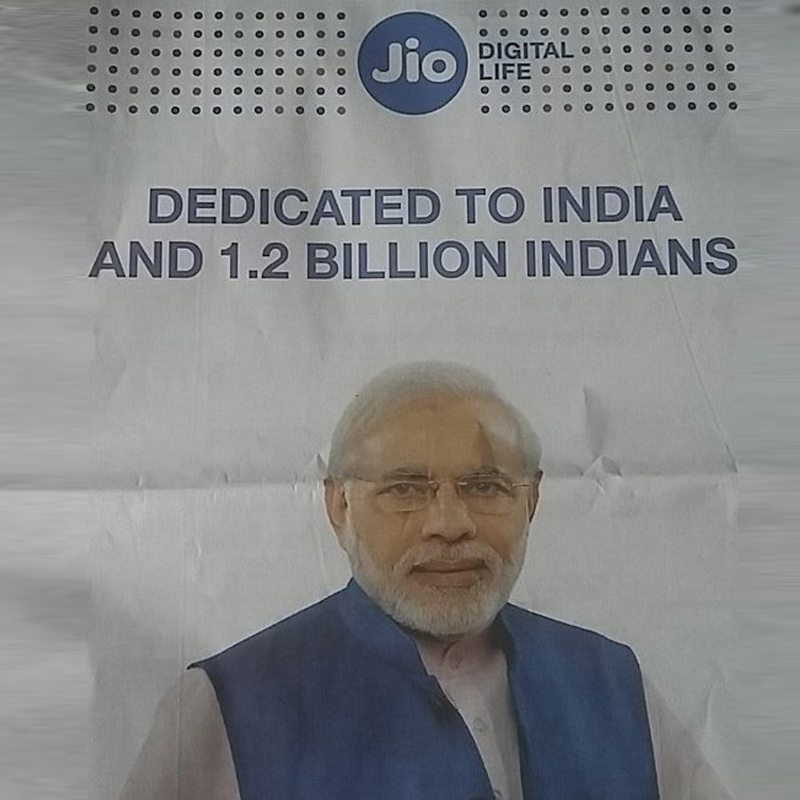
    NEW DELHI: The Government has denied that it gave permission for publication of a full-page photograph of the prime minister Narendra Modi in advertisements in newspapers about Reliance Jio.

    Minister of state for information and broadcasting Rajyavardhan Rathore said: “No permission was granted by the Prime Minister’s Office.”

    Rathore told the Parliament that the Act, ‘The Emblems and Names (Prevention of Improper Use) Act, 1950’ is administered by the Consumer Affairs, Food & Public Distribution Ministry.

    He also said that the directorate of advertising and visual publicity (DAVP) of his ministry releases Government advertisements only and does not release advertisements of any private body.

    Reliance Jio may have to pay only Rs 500 as fine for using Modi’s picture in advertisement, without permission from the government. Newspapers reported that the minor penalty could be charged from Jio.

    Rathore, in a written reply, admitted that it was aware that Reliance Jio used the PM’s photographs in the advertisement. About the actions that can be taken against Jio, he replied that the (DAVP) unit was responsible for it is the Emblems and Names (prevention of improper use) Act 1950.

    Section-3 of the Act states that no person shall use any “specified” name or emblem for the purpose of any trade, business or any such activities without the “previous permission of the central government” or officers authorised by the government. The list of names and emblems that cannot be used without prior permission from the government includes the president of India, the PM, governor of a state, the government of India or any state, Mahatma Gandhi, Indira Gandhi, Jawaharlal Nehru, United Nations Organisation, Ashok Chakra or Dharma Chakra.

  • Reliance Jio may be fined for using PM’s pic in ad sans permission

    Reliance Jio may be fined for using PM’s pic in ad sans permission

    NEW DELHI: The Government has denied that it gave permission for publication of a full-page photograph of the prime minister Narendra Modi in advertisements in newspapers about Reliance Jio.

    Minister of state for information and broadcasting Rajyavardhan Rathore said: “No permission was granted by the Prime Minister’s Office.”

    Rathore told the Parliament that the Act, ‘The Emblems and Names (Prevention of Improper Use) Act, 1950’ is administered by the Consumer Affairs, Food & Public Distribution Ministry.

    He also said that the directorate of advertising and visual publicity (DAVP) of his ministry releases Government advertisements only and does not release advertisements of any private body.

    Reliance Jio may have to pay only Rs 500 as fine for using Modi’s picture in advertisement, without permission from the government. Newspapers reported that the minor penalty could be charged from Jio.

    Rathore, in a written reply, admitted that it was aware that Reliance Jio used the PM’s photographs in the advertisement. About the actions that can be taken against Jio, he replied that the (DAVP) unit was responsible for it is the Emblems and Names (prevention of improper use) Act 1950.

    Section-3 of the Act states that no person shall use any “specified” name or emblem for the purpose of any trade, business or any such activities without the “previous permission of the central government” or officers authorised by the government. The list of names and emblems that cannot be used without prior permission from the government includes the president of India, the PM, governor of a state, the government of India or any state, Mahatma Gandhi, Indira Gandhi, Jawaharlal Nehru, United Nations Organisation, Ashok Chakra or Dharma Chakra.

  • News channels to focus on Modi this Independence Day

    News channels to focus on Modi this Independence Day

    MUMBAI: News channels, during the general elections had gone all out to cover the mega event. With the new BJP government coming to power, it hardly comes as a surprise that during India’s 68th Independence Day, the focus of news channels will be on the newly elected Prime Minister of India Narendra Modi who will be addressing the nation for the first time after assuming power. News channels have also come up with special programmes and bulletins to celebrate the day.

    CNN-IBN

    In the run up to the Independence day, CNN-IBN had initiated a month long campaign Clean up India’, where the channel appealed to the viewers to identify areas in their cities that are eyesores and unhygienic due to filth and garbage. People from cities like Delhi, Varanasi, Kolkata, Mumbai, Bengaluru, Chennai, Trivandrum, Hyderabad, Jaipur, Puri, Srinagar and Ahmedabad reached out to the channel and shared their experiences about the lack of civic sense amongst common people and their thoughts on the inadequacies of the waste management system in the country.  At 12 pm the show will have its final telecast which will take a close look at what it would take to bring sanitation, waste management and hygiene to rural and urban areas.

    NDTV India

    The channel will begin its line up at 6 am. Panelists on the channel will be seen discussing what they could expect the focus of Modi’s maiden speech to be. It has also prepared two special shows; one called Lal Kila which will include the important highlights of former Prime Minister’s of India like Morarji Desai, Indira Gandhi and Jawaharlal Nehru.  The other show titled Colours Of India will unravel the colourful diversity and unity of India’s people. In the evening, the channel will focus on the highlights of the PM’s speech and the importance given to the different cabinet ministries.

    IBN-7

    The programming will commence early morning with the live coverage of Modi’s address to the nation from the Red Fort. The long 7 hours of programming will highlight the plight of the holy river Ganga. IBN7’s OB vans will be stationed at various banks of Haridwar, Kanpur, Varanasi and Ganga Sagar in West Bengal. The channel’s reporters will do on-ground reporting from there and will be joined by local activists, environmentalists, priests along with a panel of guests. At 7:30 pm, the last episode of Saving the Ganga series will culminate with a half hour special. From 9 pm onwards, the channel will discuss the PM’s speech and its significance in detail.

    News Express

    News Express will be launching a new show Kamal Prajapati Ke Saath Aankhein Kholo India. Kamal Prajapati is a 21 year old visually challenged journalist who through the show will try instilling civic sense among India’s citizens. In five minute specials, he will be visiting the streets of Delhi and questioning citizens who are seen breaking traffic rules while at the same time explaining the importance of maintaining traffic discipline. “For the channel, Independence Day was the best opportunity to come with a show that will help contribute towards the nations,” says News Express executive editor Jacob Mathew. The daily show will see the boy travelling to other cities later on. Besides this, the channel will also be covering the Prime Minister’s Independence Day speech.

    NewsX

    The channel will be focusing on the PM’s speech and have defense and foreign policy experts along with politicians. Special shows include Patriotic Songs –Flash back Special at 2:30 pm, Campus Connect Independence day Special at 6:30 pm followed by Young MPs Dream for India  at 7:30pm

    Zee News

    Zee News launched a media campaign called ‘My Earth My Duty’, under which a symbolic plantation will be done at office and also at locations like Wagah Border, Lucknow, Udhampur and Delhi. While it will be focusing on the PM’s speech, it will also showcase various programs under the theme ‘Jashn-e-Azadi’ during Independence Day.

  • NBA imposes rules for channels on terror coverage

    NBA imposes rules for channels on terror coverage

    NEW DELHI: After facing criticism that their live TV footage helped militants in the Mumbai terror attacks, Indian news broadcasters have produced a set of rules on how to cover such events.

    Under the six-point guidelines framed by the umbrella body NBA (News Broadcasters Association), the channels shouldn’t be telecasting details of identity, number and status of hostages. Nor should they provide information of pending rescue operations or details on the number of security personnel involved or the methods employed by them.

    The News Broadcasting Standards Disputes Redressal Authority, constituted by the NBA, today said television TV channels should avoid any “live contact with the victims or security personnel or other technical personnel involved or the perpetrators during the course of any incident.”

    Addressing a press meet, Authority Chairman Justice JS Verma also said media should avoid “unnecessary repeated or continuous broadcast of archival footage that may tend to re-agitate the mind of the viewers. Archival footage, if shown, should clearly indicate ‘file’ and the date and time should be given where feasible.”

    The Authority said “no live reporting should be made that facilitates publicity of any terrorist or militant outfit or its ideology or tends to evoke sympathy for the perpetrators or glamourises them or their cause or advances the illegal agenda or objectives of the perpetrators.”

    The dead should also be treated with dignity and their visuals should not be shown. Special care should be taken in the broadcast of any distressing visuals and graphics showing grief and emotional scenes of victims and relatives which could cause distress to children and families.

    At the outset, the Authority said all telecast of news relating to armed conflict, internal disturbance, communal violence, public disorder, crime and other similar situations should be tested on the touchstone of ‘public interest’.

    Furthermore, the media had the responsibility to disseminate information which was factually accurate and objective.

    Noting that these were broad guidelines and were not meant to be exhaustive, Justice Verma urged the channels not to comment individually on them as these had been drawn up at their initiative. However, he said in reply to questions that he could not prevent anyone from speaking if he so wished. He urged the media to “keep your conduct and do not fall into traps.”

    He said in reply to questions that nothing should be telecast which hampers the operation of justice. When it was pointed out that similar guidelines had been submitted to the Delhi High Court and the Government had also drawn up its own Self-Regulations Guidelines, he said all these would generally be in tune with each other.

    Replying to a question on whether action was being taken by the Authority against any channel vis-a-vis coverage of Mumbai terror attacks, Verma said, “It is too early and the media should give the Authority some more time.” Asked to specify details, he said, “wait and watch.”

    He said similar guidelines had also been issued in 1997 but had to be revised as some channels differed with the earlier guidelines. He also pointed out that an advisory had been issued by the Authority on 27 November, a day after the Mumbai terrorist attacks.

    During a meeting convened by Minister of State for Information and Broadcasting and External Affairs on 10 December when he reprimanded the channels for their continuing broadcasts of the Mumbai terror attacks, the NBA had informed him that it was working on an Emergency News Protocol.

    Justice Verma, a former Chief Justice of India and former Chairperson of the National Human Rights Commission, was accompanied at the press meet by Professor Deepankar Gupta of the Jawaharlal Nehru University and Annie Joseph of the NBA.

    Verma said he had been working upon drawing up the Guidelines for telecast of news relating to sensitive matters for some time but the tragic episode of the Mumbai terror attack made it extremely urgent that such guidelines be immediately circulated at least in relation to episodes akin to the Mumbai terror attack.

    Clearly alarmed by the cascading effect of what it terms as the unending coverage of the Mumbai terror attacks, the Government had on 10 December decided to set up a coordination committee with broadcasters to ensure some self-regulation to ensure balanced coverage.

    Meanwhile, the Government reiterated in Parliament today that it had constituted an Inter-Ministerial Committee (IMC) to look into the specific violations of Programme and Advertisement Codes by the satellite channels at national level and to recommend action against them for such violation.

    Orders for constitution of the State and District Level Monitoring Committees have been issued so as to keep a close watch on content carried by the local cable TV channels at district or State level.

    Under the Cable Television Networks (Regulation) Act, 1995 and rules framed thereunder, the District Magistrate, Sub Divisional Magistrate or Police Commissioner have been designated as authorized officers who can immediately take action against the local cable TV channels in case of violation. As separate committees/authorities take cognizance of complaints against National or local TV channels as the case may be, complaints do not have to be routed from District to State to National level before action is taken.

  • Radio Mirchi gets ‘kiddie’ fever

    Radio Mirchi gets ‘kiddie’ fever

    MUMBAI: Commemorating Pt. Jawaharlal Nehru’s birthday and a day that has come to be popularly called ‘Children’s Day’, Radio Mirchi 98.3 FM has lined special programming for Delhi and Mumbai dedicated to Indian kids.

    In Delhi, Radio Mirchi will kick off a contest where kids opinions on “the one thing they would want to change in their parents” could win them prizes and an opportunity to be on-air with the station’s RJs. From among the callers that day, the five best responses will be selected.

    In a Children’s Day capsule titled Baccha Party, celebrity parents will share their experiences on parenthood. While on the evening show Bumper-to-Bumper Radio Mirchi will invite underprivileged kids to the studio and give them an opportunity to share their dreams and aspirations of the city. The kids will also get an opportunity to display their talent through singing, mimickery and games with RJ Naved.

    In Total Filmi RJ Anmol will rope in celebrities who started their career as child artists and get them to narrate their experiences, states an official release.

    Similarly, Mumbai also has something special lined up for their ‘little listners’. Hello Mumbai and Bumper-to-Bumper will be co-hosted by child achievers, including Mumbai finalist from the talent hunt Lil Champs Sameer Mohammed and participants Aman Mallik, Abrokanti and Adil. The children will share their views on issues concerning Mumbai city while interacting with other children from the city.

    The radio station has also tied up with the NGO – Smile, whereby kids from this organisation will be invited to Radio Mirchi to celebrate Children’s Day. These children will also get an opportunity to be on air with the Lil Champ participants.

    All the kids will get to point out a child’s view on various subjects that affect Mumbai city such as security, the education system and traffic, in addition to their their personal thoughts and dreams.

    The Mirchi studios in Mumbai will also be kept open between 10 am to 6 pm inviting kids to come in and share their views.

    In preparation for the Children’s Day celebrations, the station in Delhi will also host Hello Delhi on 13 November where the cities socialites, fashion designers and politicians will share their most memorable moments of their childhood. Also, RJ Anu and Dr. Chug will provide parents an understanding into child psychology and grooming tips for children on a show called Khubsoorat.