Tag: Jawahar Kanjilal

  • DD to start mobile TV trials in tie-up with Nokia

    DD to start mobile TV trials in tie-up with Nokia

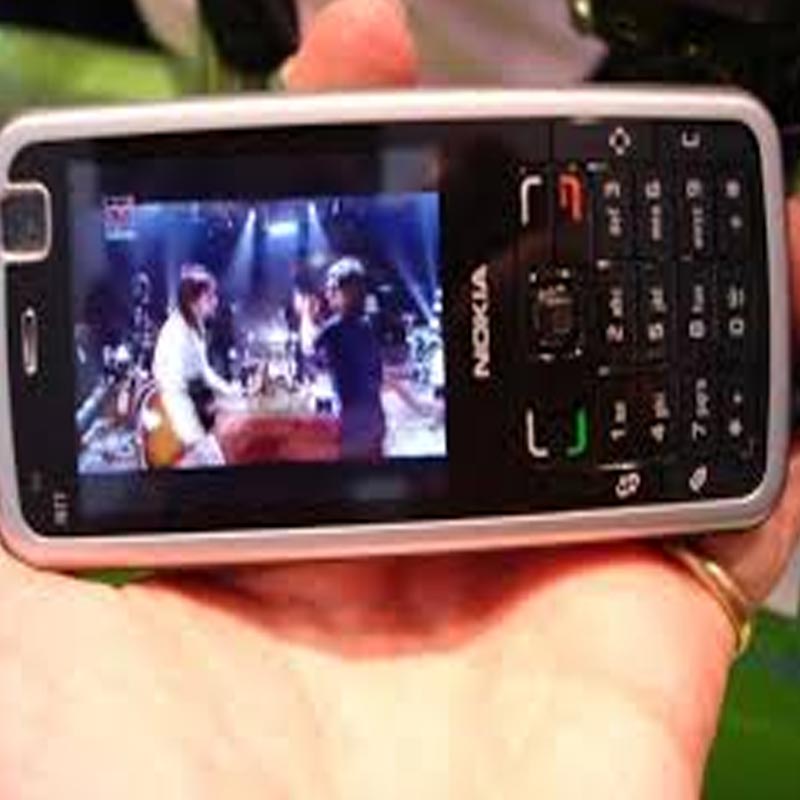
    MUMBAI: Nokia has announced its latest digital video broadcast-handheld (DVB-H) broadcast mobile TV pilot with national television broadcaster Doordarshan, using Nokia’s open standards based DVB-H solution.

    The Nokia Mobile Broadcast Solution will be delivered to Doordarshan via SHAF Broadcast in early 2007.

    During this pilot, Doordarshan will test the reception quality of the broadcast coverage, and explore the options of supporting different service schemes, such as advertising and interactive services. The pilot will also enable Doordarshan to gauge consumer expectations of the service going forward, informs an official release.

    The pilot will use DVB-H technology, a broadcast technology now used to support several field pilots globally, chosen based on its merit to support mobility, small screens, indoor coverage, optimised use of battery and in-built antenna that are specific to handheld devices such as mobile devices.

    Doordarshan director-general LD Mandloi said, “Doordashan has taken a lead in adopting DVB-H standards and this was a logical extension of our DVB-T services. DVB-H over IP based on open standards will provide a discerning mobile broadcast experience to Indian consumer and we are confident of its success in our country which has historically been on the leading edge of broadcast technology and content creation.”

    “India becomes one of the leading countries in Asia to deploy live broadcast mobile TV bringing Indian consumers a step closer to watching their favourite programmes on their mobile devices,” said Nokia Asia Pacific director multimedia Jawahar Kanjilal. “We are excited to collaborate with Doordarshan to enable their mobile TV services. This is a great opportunity for the vibrant content industry in India to take advantage of bringing television into the pockets of the Indian consumers.”

  • Nokia launches first live DVB-H mobile TV service in Asia

    Nokia launches first live DVB-H mobile TV service in Asia

    MUMBAI: Mobile communications firm Nokia and Vietnam Multimedia (VTC) have inked a deal to launch commercial mobile broadcast TV services based on Digital Video Broadcast-Handheld (DVB-H) technology in two Vietnamese cities by the end of the year.

    The agreement is Nokia’s first commercial mobile TV service rollout in the Asia Pacific region. It is also among the first of Nokia’s commercial rollouts globally. Nokia is currently spearheading several trials in the Asia Pacific, Europe and North American countries.

    VTC is a broadcaster and operator in digital broadcasting. It will make available its mobile PayTV services to consumer subscribers in Hanoi and Ho Chi Minh City. Consumers in both cities will be able to enjoy seven digital TV channels as well as a video-on-demand service from a catalogue of selected titles offered by VTC.

    The service is available on Nokia’s Nseries DVB-H enabled multimedia devices, delivered by the Nokia N92 which will make its debut in Vietnam for this purpose.

    For the uninitiated DVB-H, is a broadcast-to-mobile technology which provides reception of the ordinary television broadcasting in digital format on mobile phones and television screens mounted on-board public and private means of transportation. DVB-H was chosen based by Nokia on its merit to support mobility, efficient power management, and DVD quality audio and video services without disturbance.

    Up to 50 TV channels can be delivered with low cost, over one network. With extensive pilots of broadcast mobile TV currently taking place across the globe, involving leading broadcasters, mobile
    operators, broadcast network operators and handset manufacturers, the market for commercial broadcast services is expected to grow throughout this year.

    Mobile TV broadcasting works by receiving a digital TV broadcast signal optimized for mobile devices from the air in much the same way as televisions at home do. Channel guides will also be broadcast allowing users to keep abreast of the latest programmes on air. Broadcast Mobile TV is not the same as a streaming video service over 3G or GPRS where each recipient gets a separate copy of the programme stream. Rather, one simultaneous TV stream can be received at any time by any number of users enjoying high picture quality and low battery power consumption.

    VTC director Le Doan Quan said, “The open technology platform solution provided by Nokia resonates with VTC’s vision of increasing choice and participation for consumers and other technology providers. Nokia implementation uses the OMA DRM approach for services and content delivery protection thus enabling many additional possibilities such as delivery of ringtones, logos, music, videoclips, games and large file applications, in addition to the ordinary TV programmes.”

    “This equips VTC with a cost-effective and future-proof platform for driving the development of the vibrant multimedia ecosystem in Vietnam.”
    Nokia Multimedia Asia Pacific director, experiences Jawahar Kanjilal said, “We are delighted to be part of this great development in Vietnam. This marks the beginning of exciting times in the Asia Pacific broadcasting industry, bringing digital television to consumers’ pockets and ushering in a new era of personal interactive entertainment.

    “The Nokia N92 multimedia computer will be a key element of this consumer offering, and we look forward to the continuing development of mobile TV services in the region.”
    Under the agreement, Nokia and VTC are committed to jointly propel the consumer adoption of mobile entertainment services in Vietnam. After taking mobile TV services commercial in Hanoi and Ho Chi Minh in 2006, VTC plans to extend the coverage to a national level over a two-year period.

    In the Asia Pacific, Nokia claims to have spearheaded several mobile TV technology showcases in countries such as Singapore (with Mediacorp & M1), Malaysia (Astro & Maxis), as well as in India and Taiwan. Nokia also participated in many industry-wide events demonstrating simulcast mobile TV content together with players in the media and entertainment industries in Australia.

    Nokia is also in the midst of a DVB-H trial first started last July 2005 with the Bridge Networks & Telstra consumers in Sydney. In Europe, Finland, Digita, supported by Nokia, has been awarded an operator license and is working to debut DVB-H mobile TV services soon. Italy has also launched a DVB-H service, while many other regions in the world are expected to follow suit with the commercialisation activity once their own trials are concluded.

  • Players in mobile entertainment value chain need to work together to grow business

    Players in mobile entertainment value chain need to work together to grow business

    MUMBAI: One of the sessions on the last day of Frames dealt with Mobile Entertainment. The session was moderated by Hungama.com CEO Neeraj Roy. The speakers were Mauj CEO Arun Gupta, Indiagames CEO Vishal Gondal, Qualcomm’s Vishal Gupta, Nokia Asia Pacific director rich media, music and games Jawahar Kanjilal, Tata Teleservices VP content and applications Pankaj Sethi and Mobile Entertainment Forum Asia chairman Stefan Rust.

    Rust says that for the mobile business to fulfill its potential the various stakeholders – the network infrastructure providers, the content aggregators, gaming publishers – must work together. Engineering resources must work with studios to figure out the best devices to reach consumers.

    Kanjilal said that while Nokia is known as a provider of mobile phones, to enable communication, it has developed a phone that can store 3000 songs and has a three mega pixel camera. In India, the company will introduce Visual Radio in the coming months . This allows a user to listen to radio stations. In this way there is a convergence of electronics and communication.

    Sethi points out that Tata Indicom caters to both the premium segment and the lower end of consumers. “On the high end side, we have introduced audio and video streaming capabilities. We are looking by the end of the year to have a full length music delivery service.

    Digital video delivery on the mobile will come to pass. Our low end customers have voice and SMS capabilities. So, we have introduced a voice station. Here, we take content from films, the stock exchange and reconfigure it in such a way that it sounds like a radio station. Gaming is a huge area. Even Tata Indicom’s prepaid customers download games like hell.”

    Gondal stressed on the role that gaming will play on the mobile platform. “People from the Indian entertainment industry underestimate the potential of gaming. Every month a million games are downloaded in the country. Contrary to perception in some quarters, price is not the determining factor. In fact, users perceive a high priced game better. That is why our new Harry Potter game at Rs15 a play did so well. Gaming is being more in the smaller towns compared to the major metros. It is played during office time, college time and dinner time. The fact that it is played during dinner means that it is taking away time from television, movie viewing and internet surfing.

    “The problem is that Bollywood movies are not conducive to making games from their films. We need to work out a creative way for this. India has an opportunity to provide services for international firms looking for ideas and execution of them. Our low cost and talent gives us an edge.”

    Arun Gupta pointed out that the mobile is slowly becoming the third screen. It is a Rs 6 billion business. It is expected to grow to around Rs 45 billion in 2010. However, there are challenges. One of them lies in the fact that outside the CDMA network the number of handsets that provide ruich media content is limited. On the GSM side, the data network is weak. So it takes time to download a game. Another important area that needs improvement is customer care and customer education. In the UK, a study said that 60 per cent of mobile users want to access mobile content but do not know how to go about it. In India, the problem can be multiplied many times over.

    Therefore mobile service providers and content publishers need to come out with ad campaigns to spread awareness. “I don’t know if a game has ever been pushed. In South Korea, due to clever marketing some game developers are celebrities.”

    Rust says that there are issues to be sorted in the arena of digital rights management (DRM). “I do not think of DRM as an anti-piracy measure. I think of it as enabling consumers to purchase music digitally. I don’t see why a person who has bought a piece of music digitally cannot play it on his iPod, computer and other devices. If it can be done with a hard copy then, why not with a digital one? Music companies needed to go beyond selling an album of 20 songs. They need to see how they can sell single songs and maximize each song’s revenue potential.”

    Gondal said that Indian mobile firms are more intent on pushing the consumer. “We must focus on pulling the consumer in through killer content. That is what Apple did with its iPod and iTunes. It got killer content and did innovative marketing. The iPod is seen as cool to have. If this pull factor is not created then there is no incentive for the consumer to go in for handset that enables rich media features. When the photo scam came about there was a sudden demand for Bluetooth.

    Pull will help the customer to go beyond just using the mobile as a voice tool”

    As far as mobile TV is concerned, Kanjilal pointed out that DVB-H trials being done abroad by Nokia show that television on the mobile is often consumed at home. This helps channels to be seen. In the future, one might have a situation where there are five television screens at home. He noted that standardisation on the DVB-H system has helped. It is an open system. Therefore it is cost effective as a distribution medium.