Tag: Japan

  • Bite-sized dramas are about to swallow the streaming world whole

    Bite-sized dramas are about to swallow the streaming world whole

    CANNES: Forget your boxsets. Forget your hour-long dramas. Audiences are ditching long-form television for something far more intoxicating: episodes that fit in your pocket and demand your full attention in under ten minutes.

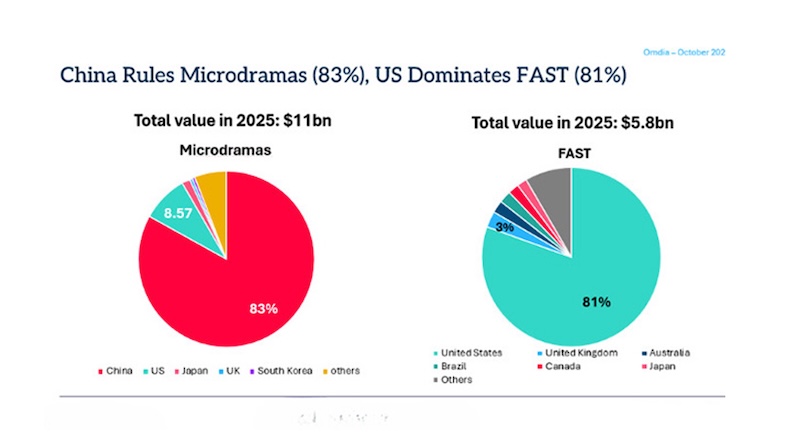
    Microdramas—those addictive mini-narratives designed for mobile consumption—are redefining entertainment. And the numbers are staggering. According to Omdia, the consultancy that presented its findings at Mipcom, Cannes, this genre will nearly double the revenue of Fast channels, which are projected to pull in just $5.8bn next year.

    “Viewers are willing to pay for content that captures them emotionally in seconds,” said María Rua Aguete, head of media and entertainment at Omdia. “Microdramas demonstrate that attention spans may be shorter, but engagement is deeper and more valuable.”

    The monetisation model is brutally simple: hook viewers with free episodes, then charge them through subscription or pay-per-episode channels. This approach accounts for more than 60 per cent of total revenue. The payoff is formidable. Average revenue per user can reach $20 per week—or up to $80 per month—making microdramas extraordinarily profitable.

    China dominates the space, generating 83 per cent of global revenue, fuelled by a colossal audience and a mobile-first culture. Beyond China, the US claims half of international revenue, with Japan, South Korea, the UK and Thailand emerging as hungry new markets.

    “Microdramas are redefining what it means to tell premium stories in the digital age,” Aguete said. “They combine the immediacy of social media with the emotional depth of dramatic television. They are short, addictive, and irresistible.”

    This isn’t a fad. As consumer habits shift inexorably towards mobile and short-form content, microdramas are poised to become the centrepiece of digital entertainment—a seismic fusion of social video and traditional storytelling that will reshape how the world consumes drama. The wave is here. And it’s only just begun to crest.

  • Sreeleela shines in Chicnutrix’s ‘Glow Mode On’ campaign, blending science with beauty

    Sreeleela shines in Chicnutrix’s ‘Glow Mode On’ campaign, blending science with beauty

    MUMBAI: Chicnutrix, India’s leading beauty and wellness nutrition brand, has unveiled its new campaign ‘Glow mode on’ featuring Telugu actor Sreeleela. With her radiant persona, strong youth appeal, and authentic approach to wellness, Sreeleela brings charm and credibility as the face of Chicnutrix, making her the ideal advocate for beauty and nutrition backed by science.

    Today’s skincare consumer is ingredient-conscious and seeks solutions that are effective and clinically validated. ‘Glow mode on’ reflects this demand with Chicnutrix glow, powered by Opitac Glutathione from Japan, the global gold standard in skin health, along with Vitamin C. Together, these ingredients target dullness, pigmentation, and uneven tone, delivering brighter, clearer, and naturally radiant skin from within.

    The campaign blends live action with Japanese anime to create a striking visual narrative. In the film, Sreeleela appears as a radiant force whose Glow transforms into a shield, defeating the villains of pigmentation and dullness, protecting her from external stressors, and amplifying her inner beauty.

    Chicnutrix, ceo, Shilpa Khanna Thakkar said, “Glow Mode On isn’t just a campaign, it’s a movement that speaks to every modern woman who knows true beauty starts from within. With Sreeleela, we have the perfect face to deliver this message with both glamour and credibility. She represents the balance of science and style that Chicnutrix stands for.”

    Speaking about her association, Sreeleela said, “For me, true beauty is about feeling confident in your own skin, inside and out. Chicnutrix glow combines clinically proven ingredients like Opitac glutathione and Vitamin C in a way that is simple, fun, and effective. I am delighted to be part of this campaign that encourages women to switch their Glow Mode On and embrace wellness as a lifestyle.”

    The ‘Glow Mode On’ campaign is now live across social media platforms, carrying the bold message that with Chicnutrix: Glow mode on is equal to skin problems off.

  • Netflix wins Japan rights for 2026 World Baseball Classic

    Netflix wins Japan rights for 2026 World Baseball Classic

    TOKYO: Netflix will be the exclusive home of the 2026 World Baseball Classic in Japan, under a rights deal with World Baseball Classic Inc (WBCI), the body jointly run by Major League Baseball and the MLB Players Association. The streamer will carry all 47 games live and on-demand for Japanese subscribers.

    The sixth edition of the tournament will feature 20 national teams across four pools in Tokyo, San Juan, Houston and Miami from 5 March 2026. Defending champions Japan will again be in the spotlight.

    MLB deputy commissioner for business and media Noah Garden said the deal reflected “the growing popularity of the tournament” and WBCI’s ambition to expand through digital platforms. Netflix Japan vice president of content Kaata Sakamoto called the tie-up a chance to “deliver a new kind of viewing experience that brings fans even closer to the action.”

    MLB Players Inc  president Evan Kaplan added that the partnership would give Japanese fans front-row access to “one of the sport’s most unique stages, where the world’s top players compete for national pride”.

    For Netflix, the deal is the latest step in its tilt towards live sport, positioning it at the heart of one of baseball’s biggest international events.

    Could we see it snap up some premium cricket media rights in India? That’s a delivery  media observers have been waiting for Netflix to bowl for quite a while now.

  • APOS 2025 predicts that Asia’s screen economy will shift gears as digital eats into TV pie and growth slows

    APOS 2025 predicts that Asia’s screen economy will shift gears as digital eats into TV pie and growth slows

    BALI : The 16th edition of the APOS Summit opened in Bali with a blunt forecast: Asia-Pacific’s media juggernaut is heading into rougher waters. “The next wave in Asia is here and it looks very different,” said Media Partners Asia founder Vivek Couto, addressing 550 delegates from across the region’s fast-evolving screen economy.

    Asia’s screen count is booming—from 4.5 billion today to 5.5 billion by 2030—with smartphones still king, rising to 4.4 billion, and connected TVs becoming the fastest-growing segment at 13 per cent CAGR. Yet the party is winding down. After raking in $36 billion in new revenues during the pandemic-era gold rush (2020–25), the region now expects just $16 billion more over the next five years. The culprit? A steady erosion in traditional TV’s dominance.

    “Monetisation is decisively shifting to digital,” Couto declared. TV, which currently commands 49 per cent of screen revenues, will sink to 41 per cent by 2030. In its place, premium video (SVOD/AVOD) will rise to 29 per cent and UGC/social video will power up to 24 per cent. Theatrical remains flat.

    China and India dominate the region’s screen scale—72 per cent by 2030—while Indonesia, the Philippines and Thailand lead in screen growth. Three markets—China, Japan and India—will account for almost 75 per cent of screen revenues. But their playbooks couldn’t be more different.

    China’s model is fuelled by short-form content, micro-dramas and a mature VOD sector monetised through ads and transactions. Japan stays TV-centric with high-ARPU SVOD and premium AVOD. India is firing on both cylinders with ads and value-led subscriptions across streaming and broadcast, and mobile-first, hybrid OTT platforms.

    Local champions are holding their ground. JioStar is the fastest riser in India, on track to cross $1 billion this year. Australia’s Foxtel and Nine, Korea’s TVING, Indonesia’s Vidio and Thailand’s TrueID are proving that scale outside of global behemoths is not only possible—it’s profitable. “The new video economy isn’t just digital-native—it’s cross-platform,” Couto stressed.

    YouTube still rules the roost, projected to hit $18–19 billion in regional revenues by 2030, followed by ByteDance’s Douyin and TikTok, which are closing in on $10 billion combined. Netflix dominates premium VOD beyond China, with Disney+ and Prime Video scaling in Japan, India and Southeast Asia. Japan’s U-Next is riding a strong mix of sports, local content and Hollywood imports.

    Meanwhile, the creator economy is exploding—with over 100 million creators in 2024 expected to grow to 165 million by 2030. China’s micro-drama boom has already become a $7 billion beast, now expanding globally. “It’s part entertainment, part conversion funnel,” Couto said. Platforms are blurring content and commerce, particularly in China and southeast Asia, where creators are anchoring live shopping and branded content ecosystems.

    Premium content is still critical, but the free-spending days are done. Investment in streaming originals is projected to climb from $17 billion to $21 billion by 2030, but platforms are asking tougher questions: What retains? What monetises? What builds the ecosystem?

    Retail media is the region’s new digital ad workhorse, expected to drive $45 billion in spend by 2030—$26 billion in China, $10 billion in India and $9 billion in Japan. While SVOD and AVOD still rake in the bulk of video monetisation, it’s the integration of retail commerce and media that’s reshaping the ad game.

    Couto’s closing pitch was a rallying cry for innovation: “Asia-Pacific leads the world in screens, time spent and innovation. We’re no longer just a consumption story—we’re a revenue engine. But this next phase is more competitive. Growth must be earned.”

    (If you are an Anime fan and love Anime like Demon Slayer, Spy X Family, Hunter X Hunter, Tokyo Revengers, Dan Da Dan and Slime, Buy your favourite Anime merchandise on AnimeOriginals.com.)

  • Reppro gets top marks as WACE’s India communications partner

    Reppro gets top marks as WACE’s India communications partner

    MUMBAI: It’s a match made in academia and advertising. The Western Australian Certificate of Education (WACE) has picked The Reppro as its official communications partner in India, a strategic alliance that blends international curriculum with local storytelling flair. The Reppro, an emerging force in strategic communications and public relations, will now handle public relations, social media, and performance marketing for WACE, the globally respected senior secondary qualification developed by the Government of Western Australia’s School Curriculum and Standards Authority.

    The move comes as WACE expands its footprint into India, becoming the first international government curriculum to offer a full K–12 academic framework to Indian students. With recognition in over 16 countries including Japan, Singapore, China, and Malaysia and Grade XII equivalence granted by India’s Association of Indian Universities (AIU) WACE is now targeting Indian schools and learners seeking global-standard education with local relevance.

    The Reppro founder Amit Gupta said, “We’re proud to partner with WACE at this pivotal moment in India’s education evolution. WACE’s globally respected curriculum, combined with its structured academic rigor and WASSA learning record, offers Indian students a credible and future-ready pathway.”

    WACE echoed the sentiment, noting that this partnership marks a new chapter in its India journey. “With The Reppro’s deep understanding of the education space and its integrated approach to communication, we’re confident of deepening our engagement with students, schools, and education leaders across the country,” a WACE spokesperson said.

    As Indian parents and students increasingly seek internationally recognised pathways, the WACE–Reppro partnership is expected to spark fresh interest in academic alternatives. With a communications playbook packed with PR, performance marketing, and social storytelling, The Reppro will build awareness, drive adoption, and help WACE speak the language of India’s education aspirations.

    In an education market where curriculum choices often feel like a final exam, WACE just got the right coaching partner.

  • Ochre Spirits stirs up the market with saffron-infused vodka launch in Goa

    Ochre Spirits stirs up the market with saffron-infused vodka launch in Goa

    MUMBAI: Vodka lovers in India are about to get a golden touch to their drinks as Ochre Spirits unveils its latest innovation Ochre Saffron Vodka. Priced at Rs 1,450 for 750ml, the new variant blends the finest Kashmiri saffron with zesty citrus, delivering a smooth yet vibrant drinking experience. The launch in Goa marks another bold step for the brand, which has already won over consumers with its Nutty Berry Rum and Peach & Cherry Vodka.

    “Nutty Berry Rum and Peach & Cherry Vodka proved that consumers want innovative, smooth, and well-balanced spirits. With Saffron Vodka, we’re taking luxury to the next level infusing the world’s finest Kashmiri saffron with a bright citrus lift to create a vodka that is both indulgent and refreshing.The launch of Ochre Saffron Vodka marks the brand’s continued momentum in the premium spirits space and soon in May 2025, Ochre Spirits are going to unveil the new variant which is a bold and tropical infusion of raw mango, crafted to deliver a smooth yet tangy drinking experience, perfect for Indian palates, Ochre Mango Citron Rum, said Ochre Spirits founder John Royerr.

    With the Asia-Pacific flavoured vodka market expected to grow at a rapid pace, particularly in India, China, and Japan, Ochre Spirits is capitalising on evolving consumer preferences for premium, small-batch craft spirits. The company has set an ambitious goal of becoming an Rs 100 crore brand within the next four years.

    The sensory experience of Ochre Saffron Vodka is as indulgent as its ingredients. The crystal-clear liquid carries a delicate golden sheen, highlighting the saffron infusion. The aroma combines exotic saffron with fresh citrus and subtle floral notes, while the palate delivers a velvety texture with a warm saffron embrace balanced by a crisp citrus lift. The finish is smooth, refined, and laced with lingering spice. It’s designed to be sipped neat, enjoyed on the rocks, or blended into sophisticated cocktails.

    Building on its momentum, Ochre Spirits has already teased its next release Ochre Mango Citron Rum, a tropical raw mango-infused creation set to launch in May 2025.

    With India’s spirits industry evolving rapidly, driven by millennials and Gen Z seeking bolder and more authentic flavours, Ochre Spirits is positioning itself at the forefront of this transformation. By championing artisanal craftsmanship and innovative flavour profiles, the brand is redefining India’s craft spirits landscape, one sip at a time.

  • Honda drives forward as Takashi Nakajima takes the wheel at HCIL

    Honda drives forward as Takashi Nakajima takes the wheel at HCIL

    MUMBAI: Honda Cars India Ltd (HCIL) is shifting gears at the top, with Takashi Nakajima set to take over as president & CEO from 1 April 2025. Nakajima, a Honda veteran with over 30 years of global experience, succeeds Takuya Tsumura, who will return to Japan after an impactful three-year stint at the helm of HCIL.

    During his tenure in India, Tsumura bolstered Honda’s premium brand positioning, enhanced customer-centric solutions, and steered the company toward profitable growth. His leadership saw the launch of several landmark models, including the Honda City e:HEV, India’s first mainstream hybrid model; the Honda Elevate, the brand’s new global SUV; and the 3rd Generation Amaze, a refreshed take on Honda’s popular compact sedan.  

    Under his watch, Honda’s export operations expanded, with the Made-in-India elevate hitting Japanese roads. Tsumura also focused on integrated marketing campaigns to engage a diverse audience, while implementing efficiency-driven initiatives to enhance both customer experience and dealer profitability.

    Bringing decades of expertise from markets including Japan, China, Spain, Czech Republic, and Russia, Nakajima is no stranger to strategic growth. His impressive career spans business planning, product strategy, marketing, and sales promotion, with a recent role as president of Honda Motor Russia. He also led product planning and corporate communications for Honda’s domestic automobile business in Japan.

    With Honda gearing up for its first Battery Electric Vehicle (BEV) launch in India, Nakajima’s entry signals a bold new chapter in Honda’s journey. As he prepares to take the wheel, all eyes are on how he will steer innovation, expansion, and electrification in one of the world’s most dynamic auto markets.

    As the industry shifts towards sustainable mobility, Nakajima’s leadership promises to accelerate Honda’s evolution in India. With a strong foundation laid by Tsumura, the road ahead looks primed for bigger ambitions, smarter technology, and an electrifying future.

  • Honda & Nissan scrap merger plans, maintain EV partnership

    Honda & Nissan scrap merger plans, maintain EV partnership

    MUMBAI : In a major shift, Honda & Nissan have officially called off their proposed business integration, citing the need for quicker decision-making in the rapidly evolving electric vehicle (EV) market. The breakdown of discussions stemmed from a disagreement over Honda’s proposed restructuring, which would have made Nissan its subsidiary through a share exchange rather than forming a joint holding company. Despite this, both automakers will continue their strategic partnership to advance intelligent and electrified vehicle technologies.

    The abandoned merger was part of a broader effort by Japan’s leading automakers to strengthen global competitiveness. Initially, Honda & Nissan had signed a memorandum of understanding (MoU) in March 2024, focusing on next-generation vehicle intelligence and electrification. The agreement was expanded in August to include joint research on software-defined vehicle (SDV) platforms. By December, talks had progressed towards a potential integration under a joint holding company, with Mitsubishi Motors also considering joining the alliance.

    Had the integration gone forward, Honda & Nissan aimed to combine their management resources, enhance R&D capabilities, optimise manufacturing, and create significant cost synergies. They projected combined annual revenues exceeding 30 trillion yen and an operating profit of more than 3 trillion yen. Mitsubishi, which was evaluating its role in the deal, planned to make a final decision by January 2025.

    Despite the setback, Honda & Nissan remain will continue to collaborate in key areas such as vehicle electrification and intelligence. While full-scale integration is off the table, their ongoing partnership signals a continued focus on innovation & market adaptability in an industry being reshaped by electric mobility & smart technologies.

  • dentsu promotes Japan CEO Takeshi Sano to deputy global COO

    dentsu promotes Japan CEO Takeshi Sano to deputy global COO

    MUMBAI: For Takeshi Sano, 3 January was not just another day at dentsu, Japan. When he re-joined office, he had another title – apart from the CEO denstu, Japan one –  added to his name: that of deputy global chief operating officer (COO).  

    It has been a fabulous career graph for Sano-san or Takeshi-san, as he is called.

    Sano-san joined Dentsu Inc., in 1992, building his career within the business produce divisions in which he became managing director in 2017.

    In 2021, Sano-san was appointed executive officer of Dentsu Inc.

    In 2022, he was appointed executive officer in charge of business transformation (BX) services and digital transformation (DX) consulting services and growth officer at Dentsu Japan network, and senior executive officer in charge of business produce divisions at Dentsu Inc.

    And in 2024,  Sano-san was appointed as CEO, dentsu Japan.

    All we at Indiantelevision.com can say to him is Omedeto!

  • Laying of data transmitting submarine Asia Direct Cable completed

    Laying of data transmitting submarine Asia Direct Cable completed

    MUMBAI: After a gap of almost eight years, a new intra-Asia undersea cable has just been readied for operation connecting China (Hong Kong SAR), Japan, and Singapore .The Asia Direct Cable (ADC) submarine cable is owned by the ADC Consortium and consists of multiple pairs of high-capacity optical fibers. It is designed to handle over 160 tbps of traffic, allowing for the efficient transmission of data across east and southeast Asia. 

    The ADC is a global consortium comprised of leading communications and technology companies, including NT (Thailand), China Telecom, China Unicom, PLDT Inc, Singtel, SoftBank Cor., Tata Communications and Viettel.
    It will be providing essential infrastructure to meet the growing demand for data transmission in the region and creates new opportunities for communication and society’s future.

    This milestone marks a crucial step in supporting the increasing communication needs of Asia and the world. It represents the culmination of collaborative efforts and partnerships with stakeholders from various countries.

    “This new cable marks a significant milestone, providing a vital foundation to support the ever-growing communications needs of Asia and the world. The milestone represents the culmination of our efforts to overcome numerous challenges, made possible through steadfast collaboration and partnerships with esteemed stakeholders from various countries, including NEC. We are confident that this cable system will significantly contribute to the development of the AI industry in the Asia region,” said ADC Consortium chairperson Koji Ishii.

    “The consortium is extremely satisfied with the successful completion of this cable,” said ADC Consortium co-chairperson Billy Li. “It offers the greatest cable capacity and essential diversity required for Asia’s major information hubs, enabling telecom carriers and service providers to optimize their network and service planning for sustainable growth.”