Tag: James McDonald

  • WARC ad forecast: Digital giants to gorge on global bonanza in 2025

    WARC ad forecast: Digital giants to gorge on global bonanza in 2025

    MUMBAI: Global advertising expenditure is set to surge by 7.4 per cent this year to $1.17trn, according to WARC’s latest forecast—the first upward revision in more than a year. The research firm has boosted its projection by 1.2 percentage points since June, driven by what it calls a “social media windfall” and frenetic pre-tariff spending.

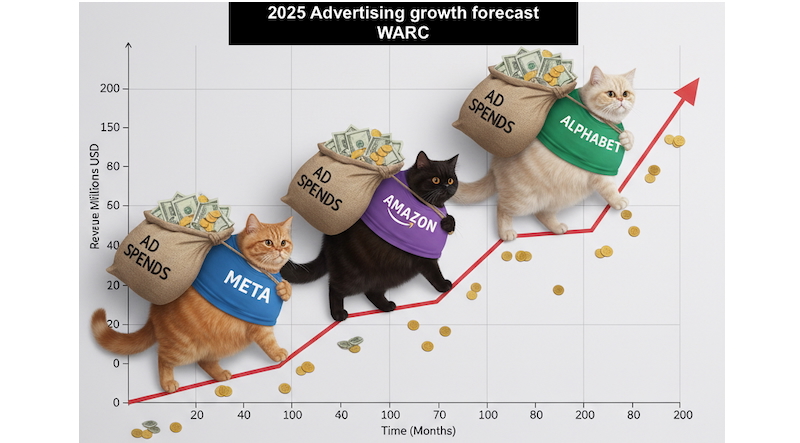
    The bonanza is heavily skewed towards a handful of technology titans. Meta, Alphabet and Amazon are forecast to hoover up nearly two-thirds of all advertising growth in 2025, cementing their stranglehold on the global marketing purse strings. Outside China, the trio already commands 55.8 per cent of all advertising spend—a share set to exceed 60 per cent by 2030.

    Digital platforms are cannibalising traditional media with ruthless efficiency. Nine in every ten new advertising dollars are flowing to online-only platforms, leaving legacy media owners—even those with digital arms—to scrap over what WARC likens to “the equivalent of Facebook’s monthly revenue.”

    Social media has emerged as the single largest advertising medium globally, gobbling up 40.6 per cent of new marketing dollars. Spending on the channel is projected to rocket by 14.9 per cent to $306.4bn this year, representing more than a quarter of total global advertising expenditure. Meta remains the chief beneficiary, capturing 60 per cent of all social media advertising spend.

    The spending spree was particularly pronounced in the second quarter, when social media expenditure jumped 20.2 per cent year-on-year—well above WARC’s initial projection of 12.4 per cent growth. The surge was driven by retailers rushing to stockpile inventory and promote value ahead of expected price hikes, with retail now the largest category on both Instagram and TikTok.

    Search advertising is attracting around 22 per cent of new dollars, while retail media platforms are capturing another 21.5 per cent. Amazon is poised to claim over a third of the retail media pie, which is forecast to grow 13.7 per cent to $175bn in 2025.

    The momentum is expected to accelerate further, with global advertising spend projected to rise 8.1 per cent to $1.27trn in 2026 and 7.1 per cent to $1.36trn in 2027. The market is on track to nearly double in value since the pandemic, underscoring advertising’s remarkable resilience despite economic headwinds.

    “This includes disruption to global trade and reduced purchasing power among consumers, brands are doubling down on Meta, Alphabet and Amazon,” said WARC director of data, intelligence and forecasting James Mcdonald. “The global market is set to nearly double in value since the pandemic, underscoring the resilience of advertising in a tougher economic climate.”

    The rosy outlook contrasts sharply with some other industry forecasts. eMarketer recently slashed its projections for American digital advertising spending, citing the impact of trade wars on automotive and retail sectors. But WARC’s global perspective suggests the digital advertising juggernaut shows no signs of slowing.
  • Global ad market to be hit by trade wars, tariffs, and turmoil, says Warc

    Global ad market to be hit by trade wars, tariffs, and turmoil, says Warc

    MUMBAI: The global advertising industry is set for a bumpier ride than expected thanks to Donald Trump’s recent trade pronouncements and the retaliatory measures by the countries  affected and the continuing conflicts in certain parts of the world. 

    With this background in mind, Warc has slashed its ad spend growth forecast for 2025 by almost a percentage point to 6.7 per cent. The revised estimate pegs global ad spend at $1.15 trillion, down $20 billion over the next two years, thanks to economic stagnation, trade tariffs, and regulatory upheaval. The outlook for 2026 has also taken a hit, with growth now expected at 6.3 per cent.

    Warc director of data, intelligence & forecasting James Mcdonald put it bluntly: “The ad market is feeling the squeeze from tariffs, economic stagnation, and regulatory crackdowns, prompting brands to rein in budgets. Despite the volatility, digital ad spend remains robust, with Alphabet, Amazon and Meta set to control over half the market by 2029.”

    Automakers are slamming the brakes on ad budgets, cutting spend by 7.4 per cent as manufacturing stalls and supply chain woes deepen. Key players like General Motors and Ford have already slashed marketing budgets, focusing more on digital and social channels over traditional TV spots. Meanwhile, tariffs on Mexican, Canadian, and Chinese car imports threaten to worsen the crunch, with 40.7 per cent of the industry at risk, per the European Automobile Manufacturers Association.

    Retailers, too, are tightening belts. The sector, the biggest spender in global advertising, is set to cut ad budgets by 5.3 per cent this year, as rising costs and trade barriers squeeze margins. Chinese disruptors like Temu and Shein, which fuelled a retail ad boom in 2024, are expected to dial back their spending due to new trade restrictions.

    Tech brands, once the ad market’s golden child, are now facing a slowdown. The sector’s projected growth has been halved, down to 6.2 per cent, as new tariffs on semiconductors hit supply chains. Warc had previously forecast a 13.9 per cent jump in tech ad spend—now it’s looking at a much cooler landscape.

    Despite the broader slowdown, digital advertising remains a money-spinner. Search advertising will grab 21.7 per cent of global ad spend this year, rising eight per cent to $250 billion. Social media, the biggest single advertising channel, will rake in $286.2 billion—almost a quarter of all ad spend—powered by TikTok (+23.6 per cent), Instagram (+17 per cent) and Facebook (+8.6 per cent).

    Retail media, the rising star, is set to be one of the fastest-growing advertising formats, with a 15.4 per cent surge this year. However, trade barriers could dent ad receipts from consumer goods brands that rely on global supply chains. 

    Yet, there are storm clouds ahead. The EU has slapped Apple and Google with Digital Markets Act violations, putting billions in ad revenues at risk. UK courts could soon allow consumers to opt out of personalised ads, threatening the backbone of search and social media advertising.

    The US remains a bright spot, with ad spend expected to rise 5.7 per cent to $451.9 billion. But that’s a far cry from the 13.1 per cent growth seen in 2024. Warc predicts a stronger 2026, with a 6.5 per cent uptick, thanks to the FIFA World Cup and US midterms.

    China’s ad market, however, is losing steam. Growth is slowing to 5.3 per cent this year to $205.5 billion – compared to growth of 7.1 per cent recorded in 2024 – as weak domestic demand takes its toll. This year’s growth rate equates to a 3.5 per cent rise in real terms.

    Europe’s major economies, meanwhile, are teetering. The UK’s ad market is still growing—up 7.1 per cent to $52.6 billion—but inflation-adjusted figures tell a less rosy story, with real growth at just 5 per cent. Germany, bogged down by economic sluggishness, is heading for a 2.1 per cent decline in ad spend, while Japan is bracing for a 2 per cent drop. Japan’s market is set to grow 3.3 per cent this year when measured in local currency, demonstrating the current strength of the greenback against the yen.

    Trade wars, tariffs, and economic turmoil are reshaping global ad spend, forcing brands to rethink strategies. The digital giants remain dominant, but regulatory pressures are mounting. In a market full of uncertainty, one thing’s clear—advertisers will need to stay agile to keep ahead of the curve.

  • Advertisers to spend $66 bn on sponsorship this year: WARC report

    Advertisers to spend $66 bn on sponsorship this year: WARC report

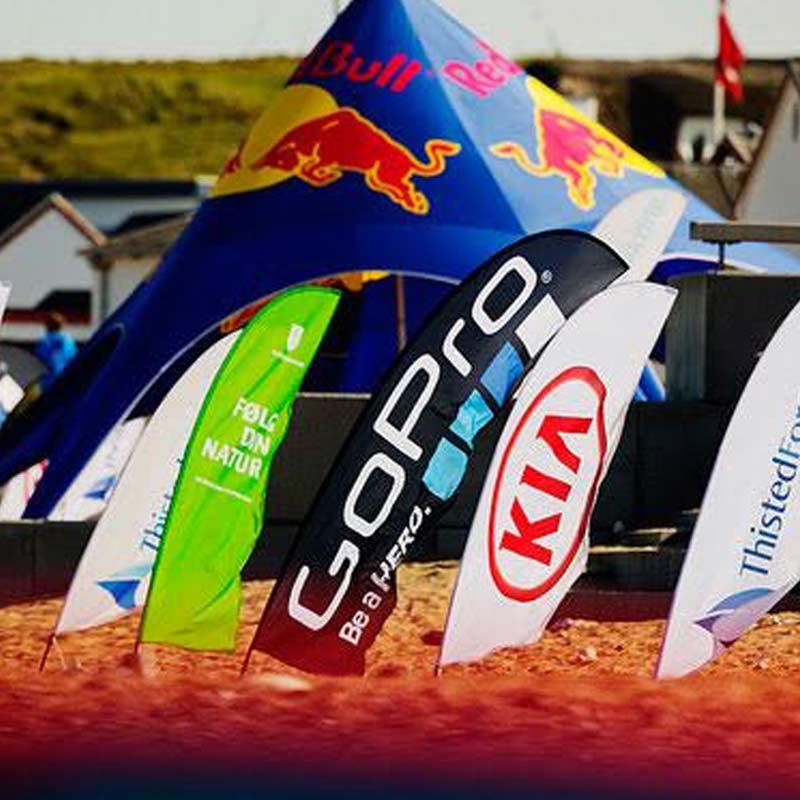
    MUMBAI: Advertisers are expected to spend a combined $66 billion on sponsorship this year, though fewer than one in five are confident that they can actually measure the business value return of the sponsorships they undertake.
    According to WARC’s recent report on global ad trends, sponsorship growth is trending ahead of most paid media, and $66 billion is expected to be invested this year which will mostly be on sports properties.
    Brand spend on sponsorship which is inclusive of rights but excluding activation is expected to rise by 4.9 per cent to reach $65.8 billion worldwide this year.
    Sponsorship is growing faster than all paid media channels excluding internet formats.
    North America makes up the greatest share of spend at 36.8 per cent or $24.2 billion, followed by Europe at 26.7 per cent or $17.6 billion, Asia-Pacific at 25.2 per cent or $16.6 billion, Latin America at 7.0 per cent or $4.6 billion, and then the Middle East and Africa at 4.3 per cent or $2.8 billion.

    Most of this money is going to sports properties. Among these are the FIFA World Cup in Russia, which is thought to have attracted $1.7billion worth of deals. At a time of fragmentation, sport offers large, engaged, multiscreen audiences. By volume of data, the 2018 FIFA World Cup was the most-streamed sporting event in history. TV is still king for live sporting events, with World Cup matches reaching 44 per cent of the global population via television.
    Sponsorships are principally used to drive brand metrics and reach.
    Generating brand awareness is the most important objective for sponsorship campaigns. This mirrors separate WARC research in this year’s WARC 100 that found 61 per cent of successful campaigns counted brand awareness as a core objective. This suggests sponsorship plays the same role as mass-reach media, fitting into the ‘upper-funnel’ of a marketing plan (generating awareness and consideration).
    Sponsors rely on intermediate metrics; true ROI remains a challenge.
    Only 19 per cent of sponsorship professionals are confident that they can actually measure the business value return of the sponsorships they undertake. Further, only 37 per cent of practitioners have a standardised process for measuring sponsorship.
    The top two named tools used for evaluation are digital and social media metrics. However, the Association of National Advertisers (ANA) states that social media metrics often provide a distracting noise due to their weak relationship to sales.
    Social Media and live events power sponsorship activation.

    Social is considered the number one activation channel for sponsorships by 83 per cent of marketers. However, the prevailing sentiment is that authentic engagement of sponsorship, through digital and social activation, remains a challenge.
    Possibly by way of remedy, the share of marketers activating sponsorships through experiential live events has risen to two-thirds (65 per cent) over the last year.
    WARC data editor James McDonald said, “As brands continue to jostle for a finite amount of consumer attention, the changing way in which media is consumed has led to the fragmentation of audiences. Yet sports generate an engaged, mass audience which sponsors can reach, before amplifying their campaigns via social media and experiential events.”
    Sponsorships facilitate the upper part of the sales funnel – driving brand awareness and consideration – in much the same way as TV. This can present challenges, however, such as the knowledge gap between brand impact and sales impact.