Tag: Jai Singh Rathod

  • Getting Dolby 5.1 audio into Anil Kapoor’s ’24’

    Getting Dolby 5.1 audio into Anil Kapoor’s ’24’

    While the Indian television industry is no stranger to 5.1 Dolby surround sound, the recently concluded season of Anil Kapoor’s 24 on Colors garnered much appreciation for skilful use of this technology, while setting a benchmark for television shows to follow. 

    As most readers would be aware, Dolby  5.1 (five point one) surround sound is the common name for six channel surround sound multichannel audio systems, using five full bandwidth channels and one low-frequency effects channel (point one). Dolby Digital, Dolby Pro Logic II and DTS  are all common 5.1 systems, and use the same speaker channels and configuration, having a front left and right, a centre channel, two surround channels and a subwoofer.

    I wanted the experience to be exactly the same as when viewers spend Rs 100-200 on a ticket to watch a film in a cinema hall, says Abhinay Deo

    So how was a technology commonly associated with commercial cinema incorporated to create a more immersive experience for viewers within the comfort of their homes?

    Says Dolby India country manager Pankaj Kedia: “We started the dialogue with 24 quite early when everything was in the pre-production stage. We supported and worked closely with them right through the entire production and post-production. I think 24 is unique because the promise that we have been talking about, the possibilities we have been talking about for 5.1 and HD, 24 has made it all possible. Because consumers watch the content; they are not watching a channel or a particular operator. I think 24 as content is a new genre from an Indian broadcast perspective, and it has taken this experience to an altogether different level, which has never been possible before.”

    For 24 director Abhinay Deo, sound was one of the stars of 24. “Sound for me is a very important aspect. A film or emotion cannot be complete without the right sound. We started with the show, and looked at it both as a television product and as a feature film. I wanted the experience to be exactly the same as when you spend Rs 100-200 on a ticket to watch a film in a cinema hall,” says Deo.

    “I didn’t care about what it is that television viewers are used to, and I was warned about it time and again… ‘This won’t work in television… we are not used to this… and so on…’ But we went out with what we believed in. Forget about who is used to it and who isn’t, who used it and who didn’t. We gave them the experience we feel they should have had,” he adds.

    With only LCDs, LEDs and Plasma TVs supporting HD, how did the team ensure that HD viewers with home theatre systems and those without and those with plain vanillas TVs with normal stereo sound have an equally enjoyable experience?

    Replies Deo: “That was the biggest challenge in sound for us. We did a lot of pre-production. We didn’t do anything majorly radical in either of these parts. We did a lot of R&D and made a standard so that people on both sides of the fence could enjoy that experience. We kept the volume at a level it should be at; not more, not less. And that is great because of the Dolby experience.”

    Coming to the technology itself, sound designer for 24 Nimish Chheda goes on to explain the nitty-gritty. “We gave it a cinematic approach, right from the start; our studio had speakers behind a perforated screen equipped with a digital projector, making you feel like you are sitting in a theatre,” he says. “We had layers of all the elements – dialogues, sound effects, and music. We mixed it, keeping in mind what was important for a particular shot. We highlighted what was important in every shot and moved onto the next shot and thus, ensuring a smooth flow.”

    To keep the sound as ‘real’ as possible, ambiences were used more than sound effects. For the purpose, the team scouted the city at particular times, recording four-channel or ‘quad’ sounds. Usually in 5.1 surround sound, dialogues are always in the centre speaker and sound effects are in the left and right speakers, while ambiences are in the front left and right and the rear left and right channels. Hence, a viewer seated in the centre gets a surround sound experience.

    To keep the sound as _real_ as possible, ambiences were used more than sound effects, says Nimish Chheda

    Recording location sound proved to be an uphill task throughout as each episode took at least seven to eight days to shoot. For example for episode No 3 which is supposed to happen between 2 am and 3 am. Since the filming of that specific episode was done over eight days, ambient sound kept changing every night. 

    Unlike the norm on TV wherein the camera audio with its two channels is used, for 24, the team opted for eight dedicated channels. Specific microphones were assigned to Kapoor as the main protagonist Jai Singh Rathod, and film sync sound set up was used for the rest of the cast.

    Approximately 60 per cent of the filming was outdoors as compared to a general TV series; and Deo was extremely rigid about filming locales with natural environments. “Hence, we had to be extremely particular about ambient sound interference like a lorry honking or a dog barking when sound was being recorded,” says Cheddha.

    Another requirement that they had to keep in mind was that of the title sponsor Tata Motors. There was a commitment from the team to ensure that each and every Tata car sounds as real and distinct as it does on the streets. Hence, all these sounds were recorded on location. 

    The five-member strong post-production team comprised a dubbing engineer, foley artist, foley recordist, sound editor, and the sound designer, who also served as the mixing engineer for the entire series. The background score was done by two music professionals – Mark and Gaurav – while a team of post-production coordinators made sure the entire process between sound and video was smooth.

    No particular servers were used for audio though there were dedicated two 2TBa Enterprise Edition internal drives (10,000 rpm) for the purpose. This apart, they were backed up on two 2 TB drives each; thus three back-ups happened simultaneously at the end of each day.
    Standard Avid and Protools software were used for designing, clean-ups, mixing and so on.

    According to Pankaj Kedia, the biggest challenge for Dolby during the making of 24 was to preserve the content creator_s intent

    First the dialogues recorded on the eight track location sound recorder (Deva), were cleaned up and in unfortunate cases, where the ambient levels were too high, they were marked for dubbing. In the episode which had Richa Chaddha and Anil Kapoor on a construction site, despite all efforts to do live noise reduction of ambient sound; the team had to dub almost 80 per cent of it.

    Then, the location ambience tracks were listened too very closely…as well as the sound design and sound effects. In the sound design process, we used certain sounds which were generated using Kyma Pacarana. The rest of the sound effects were used from the library or recorded live to ensure that the sound is as real as possible. The music tracks from the music composers were then layered into the session, and making it ready for the 5.1 Dolby mix. 70 per cent of the background score used in the Indian series was that used in the US, and the Indian music composers had to work with the two stereo tracks that the music came down in to add their elements and nuances.

    The challenge was to make sure all the elements worked well in TV 5.1 for which the team did a lot of R&D. All the tracks were mixed as per the Dolby Mix Level of -23dBfs.

    General television shows comprise of just dialogue and music; the challenge here was to keep the overall mix i.e. the sound effects, music and dialogue proportionately loud enough, yet crystal clear when listened to separately, giving you a complete cinematic feel out of your general tv speakers.

    It may come as a shock but on an average, 70 hours were spent on post-production per episode to deliver 42 minutes of content. Of these, 30 hours were devoted to cleaning up and leveling of dialogues, 25 hours to sound designing and the remaining 15 hours to the final mix. “Time was always a challenge, we had to give unmix’s, Dolby 5.1 mix & a stereo mix version for every episode to the channel for their Promos and the HD and SD platforms respectively” says Cheddha. “But it was fun, which generally TV is not.”

    The dogged focus on getting it right ensured that Colors’ technical and quality control team gave it the go ahead for almost every episode. The only exception was the first in the series, which had a problem that got clearance after corrections from the production house. 

    The show is a refreshing change to Indian television, believes Resul Pookutty
    Deo points that the sound and technical standards used in the original US version of 24 became the gold standard for Dolby audio in TV shows worldwide. And the desi version too toed the same line. “I think the US 24 in its time, reinvented TV there, which is what our intent was as well,” he says. “Hence, we were clear when we said that whatever they had, we must have. There is standardisation in terms of treatment of sound, as Dolby did with the original. But having said that, Los Angeles and Mumbai are totally different and the way they sound is totally different. We needed to hear Mumbai at a particular hour. In that sense, the original US version is pretty clean whereas ours is noisy and that is great.”

    According to Kedia, the biggest challenge for Dolby during the making of 24 was to preserve the content creator’s intent. “We wanted to deliver the content exactly in the same way it was meant to be and not in any different way. The bullet sound, the explosion and the whisper had to all sound exactly the same that they’d been designed to,” he says.

    That’s a sound way of looking at things. And it worked if one goes by the kudos the entire sound team has been getting. Hear out what Oscar winning sound designer Resul Pookutty has to say.  “I haven’t seen it much on TV; I was supposed to do the sound for the same. But my schedules didn’t allow me to work on it, what I’m hearing is a lot of good things about the show, which in a way is a refreshing change to Indian television.”

    Indeed. And may the tribe pushing the envelope on sound in Indian television increase.

  • And now a 3D mobile game for Colors’ 24

    And now a 3D mobile game for Colors’ 24

    MUMBAI: It has been three weeks since Indian audiences have been introduced to a new fictional TV format in the form of real time story telling through the first international adaptation of the American hit 24. With a 360 degree marketing campaign – almost like that used for full length feature films – to help create the buzz around the series, host channel Colors has decided to perk it up by throwing in a sparkling digital ingredient for viewers.

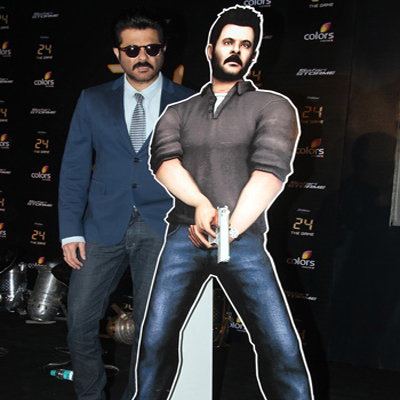
    And it’s coming in the form of a 3D interactive mobile game for iOS and Android phones. Developed by Gameshashtra Solutions, it is targeted at those who want to have the thrill of playing Jai Singh Rathod (Anil Kapoor) – the main protagonist of the show – while on the go. Called ‘Safari Storme 24 – The Game’, it is available for download only in India. It will allow gamers to go through three maps of Worli, Dadar and Parel with 30 levels of two minutes each. As of now only the Worli route is available while the other two will be launched in the coming weeks.The first map of Worli is a rooftop setting.

    Four and a half months went into creating the 3D game. Fans will keep going through levels, scoring points, winning ammunition and then checking scores with others on the ‘leaderboard’ through their Facebook or Twitter accounts.

    “The three locations in the game are also there in the series,” says Colors digital head Vivek Srivastava. “We kept the game in the spirit of the show by taking the concept ‘race against time’ rather than the political drama in it,” he adds.

    Explaining the game technique Srivastava says that players have two ways of surviving – hit and survive or duck and survive. As the game levels progress, the enemies come in hordes and ammunition also stacks up.

    Coming up with a 3D game has probably cost sack fulls of money, apart from what has already been invested in the expensive show. But the channel seems to not be too worried about it.

    Vivek Srivastava is targeting a million downloads of the game

    “For the first season it is not about making money,” says Srivastava who is aiming at getting 1 million downloads for the free game. However, advertisements will be inserted into the game that would give them some amount of revenue.

    24 is Colors biggest fiction property created by Anil Kapoor Productions and Ramesh Deo Productions (RDP). Delly Belly director Abhinay Deo is the series director while Rensil D’Silva is the scriptwriter.

    The show is presented by Safari Storme while Next is one of the associate sponsors. The launch day saw it garner 3.4 million viewers with most of it coming from the urban areas while the second week saw it get an average of 2.6 million viewers.

    “Television executives in India are increasingly understanding that you can take a TV show into other experiences for viewers. Look at KBC which has a game which allows fans to test their general knowledge skills online and on the mobile. And now Colors has developed a 24 game which will allow youngsters and old alike to shoot, and kill while rising up in levels,” says a media observer. “The fact that it is primarily for the mobile will bring in a lot of fans who will play the game when they have a few minutes to spare, whether in the bus or the train or in between meetings. It’s a great move. Hopefully, some of the gamers who are not viewers of the series will be lured to watch it after playing the game.”

    Another media observer says that there is little hope of 24 ever becoming a massy series along the lines of soaps and dramas. “It’s great to flog the horse, but the horse only has that many backers,” says she. “Colors has gambled with 24 and it is to be lauded for the effort especially in terms of taking TV production and narrative to a different level. But it should bear in mind that 24 is going to be a niche affair for some time. So it should not expect too many incremental gains from the game as well.”