Tag: Jagbir Singh

  • Calling the shots TCS and Vodafone Idea dial up AI for customer delight

    Calling the shots TCS and Vodafone Idea dial up AI for customer delight

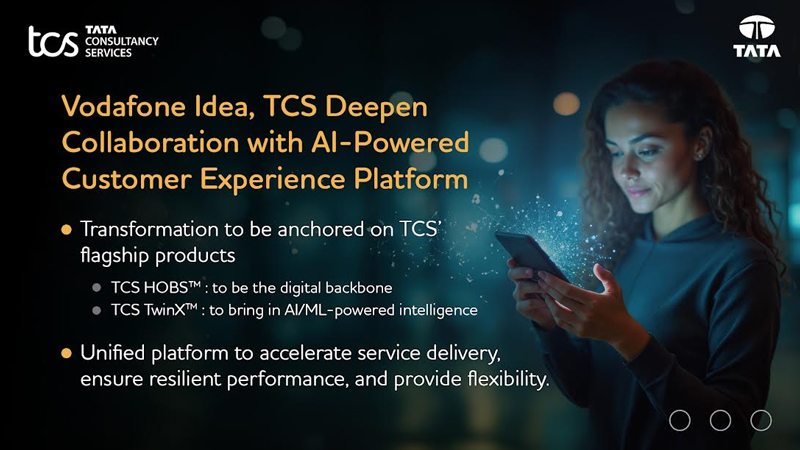
    MUMBAI: Hello, future calling! Tata Consultancy Services (TCS) has struck a five year deal with Vodafone Idea (Vi) to rewire the telecom giant’s business support system (BSS) with an AI driven digital backbone designed for speed, smarts and seamless service.

    At the heart of this transformation are TCS’ flagship platforms Hobs and Twinx. While HOBS will serve as the agile, stable and integrated foundation for Vi’s customer touchpoints, TwinX will inject intelligence with AI/ML driven analytics and scenario simulations. Together, the duo aims to fast track product launches, personalise interactions and deliver resilient performance in an industry where milliseconds matter.

    For Vi, the stakes are high. The new platform promises to help the operator launch new products faster, adapt to evolving customer needs, and elevate service responsiveness. “With this partnership Vi is embarking on a transformative journey to redefine customer experience,” said Vodafone Idea Limited CTO Jagbir Singh adding that AI infused BSS will set a “new standard” in digital experiences.

    The partnership builds on a 15 year relationship between TCS and Vi, anchored in TCS’ 25 plus years of expertise in the communications, media and information services sector. Operating out of 105 delivery centres, TCS supports over one billion telecom subscribers across 45 countries, a scale that few IT majors can match.

    “By leveraging our advanced AI capabilities and flagship products, we are committed to transform customer engagement and operational efficiency for Vodafone Idea,” said TCS president & country head for India Business Ujjwal Mathur.

    Beyond customer delight, TCS has positioned the programme as part of its larger “Made in India, for India and ready for the world” vision, with sustainability, sovereignty and security woven in.

    As India’s telecom sector braces for the next digital leap, this tie up underscores how technology heavyweights and telcos are dialling up AI not just to connect millions, but to reimagine what a call, a click or a customer interaction should feel like.

  • Vi finally gets its 5G groove on in Mumbai

    Vi finally gets its 5G groove on in Mumbai

    MUMBAI: After watching rivals race ahead, beleaguered telecom operator Vodafone Idea (Vi) has finally unleashed its 5G services in Mumbai. The struggling carrier is betting its fashionably late entry will turn heads with unlimited data packages starting at a wallet-friendly Rs 299.

    Vi’s arrival to the 5G party comes after the company raised a whopping Rs 26,000 crore in the past year, including India’s largest follow-on public offer worth Rs 18,000 crore and Rs 4,000 crore coughed up by its increasingly patient promoters.

    The cash injection has enabled Vi to dust off ambitious expansion plans, with Rs 50,000-55,000 crore earmarked for network upgrades over the next three years. The company aims to blanket roughly 90 per cent of Indians with 4G coverage while rolling out 5G in “key geographies”—corporate speak for “where the money is”.

    “Our focus is on introducing 5G meaningfully for our users,” said Vi  chief technology officer Jagbir Singh. The firm has partnered with Nokia to deploy energy-efficient equipment that’s supposedly both leaner and greener.

    Not content with merely catching up to competitors Reliance Jio and Bharti Airtel, Vi claims to have embraced artificial intelligence with an AI-based self-organising networks system. This whizzy bit of tech reportedly optimises network performance continuously, though sceptics might suggest the carrier focus on basics like keeping calls connected first.

    The move comes as welcome news for Vi’s dwindling subscriber base, who have watched their chosen network struggle with debt while rivals hoovered up market share. OpenSignal reportedly ranks Vi’s 4G network as Mumbai’s best, though this will come as news to many of the city’s residents.

    For videogamers, binge-watchers, and those who simply enjoy browsing the internet without mysterious disconnections, Vi promises its unlimited 5G data will enhance experiences across streaming, gaming and real-time cloud access. The company has yet to announce when other Indian cities might join Mumbai in the 5G fast lane, saying only that expansion will happen “in a phased manner.”

    Mumbai’s mobile users can check whether their devices are compatible with Vi’s newfound speed at myvi.in/5g-networK.

  • Vodafone Idea chooses HCLSoftware to automate 4G & 5G Networks

    Vodafone Idea chooses HCLSoftware to automate 4G & 5G Networks

    MUMBAI:   It’s getting future ready. Telecom service provider Vodafone Idea (Vi) has partnered with HCLSoftware, a division of HCLTech, to enhance the efficiency and performance of its 4G and 5G networks. Using HCL Augmented Network Automation (HCL ANA), a cutting-edge AI-powered platform, Vi aims to streamline network operations, optimise energy usage, and deliver an improved customer experience.

    The HCL ANA platform, a multi-vendor self-optimising network (MV-SON) system, enables seamless integration of Vi’s Ericsson and Samsung networks while ensuring future readiness with SMO (ORAN) compatibility. The platform’s open architecture allows Vi to independently manage and automate its networks, reducing reliance on OEM-specific tools and enhancing sustainability.

    The key benefits include improved network reliability and speed for Vi customers,  reduced energy consumption and operational costs and enhanced scalability for network expansion.

    Vodafone Idea CTO Jagbir Singh highlighted:  “This partnership reflects our commitment to leveraging advanced Made-in-India technologies to improve services, reduce costs, and prepare for telecom innovations.”

    HCLSoftware  SVP/GM  Neeraj Purandare  stated: “This collaboration will benefit Indian telecom users and boost local technology development and innovation.”

  • CTOs of telecom giants Airtel and Jio quit

    CTOs of telecom giants Airtel and Jio quit

    MUMBAI: Two top executives from the Indian telecom behemoths, Airtel and Jio, have resigned. Jagbir Singh and Shyam Mardikar were working as chief technology officers in Jio and Airtel respectively, according to a Press Trust of India report.

    Jagbir Singh joined Reliance Industrial Ltd’s (RIL) telecom venture Jio in May 2015 before the soft launch of 4G services. He also worked with Jio’s rival Airtel and Korean multinational conglomerate Samsung. His experience spans over 28 years.

    Shyam Mardikar who joined Airtel six years back has also put in papers. Since January 2017 he was working as the CTO of the company. However, before this stint also Mardikar worked with Airtel for almost a decade from 2001-2010.

    While Jio did not respond to the development, the report says an Airtel spokesperson has confirmed the development. It also claims Mardikar has resigned for further growth in career.

  • Delhi hosts the first ‘Mobile Security India 2007’ seminar

    MUMBAI: For the first time, the mobile majors, government officials and legal experts across the telecom industry, came together at Mobile Security India 2007 seminar, to discuss the issues related to mobile theft. Supported by Indian Cellular Association, sponsored by Samsung Telecommunications India and organized by Bharat Exhibitions, this seminar brought forth the critical issues and challenges faced by Indian mobile industry and discussed the legal and technical ways to retrieve the lost phones.

    Mr. H.C.Ryu, Managing Director, Samsung Telecommunications India delivered the key note address at the inaugural session. Other panellists in the inaugural session were Shri S.D.Saxena, Director – Finance, BSNL; Mr. Jagbir Singh, CTO – Mobility, Bharti Airtel Ltd; Mr. D.P.S. Seth – Former Member, TRAI and Mr. T.R. Dua, Sr. Director, Cellular Operators Association of India. Vote of thanks was delivered by Mr. Pankaj Mohindroo, National President, Indian Cellular Association.

    With the explosion in mobile industry, the Mobile thefts and misplacement are becoming a very common occurrence. This not only affects the consumer financially but also exposes their personal data, videos and official presentations for misuse.

    Speaking on this occasion Mr. Ryu Managing Director Samsung Telecommunication India said, “Close to Rs. 500 crores worth of Mobile phones are lost or stolen annually. To compound matters, it is next to impossible for general consumers to locate or retrieve their stolen handsets. Samsung identifies this as a significant issue in mobile phone usage and believes that mobile phone consumers rightfully deserve security and tracking of the handsets through associated features.”

    Elaborating the work undertaken by Samsung on mobile security, Mr. Ryu said “Secured mobile phone is the right of every consumer. Through Samsung’s secured feature phones, we tried to address three larger issues of mobile security i.e., securing your mobile phones and preventing any untoward usage or incident through that phone, securing the safety of near and dear ones through emergency SOS and securing the confidential data’s that are stored in that phone.”

    Addressing the gathering Mr. Pankaj Mohindroo, National President of Indian Cellular Association, said, “ICA has always supported consumer welfare and will continue doing so. We have recommended registry of stolen / lost mobile phone in closed cooperation with police stations , police headquarter & mobile careers. I’m happy to note that companies are coming up with innovative applications which will make consumers feel more secure and will also help companies to track their misplaced handsets.”

    Mr. Sudhir Gupta, Advisor – Mobile Networks TRAI chaired the technical session titled “Identifying and Mitigating Threats to Mobile Handset Security” which was attended by Mr. Rajat Mukarji, Vice President – Corporate Affairs, Idea Cellular Limited; Mr. Pavan Duggal, Advocate – Supreme Court of India & Cyberlaw Consultant and Mr. Mohan Rao, Head Protocol, Samsung India Software Operations.

    Over 100 delegates comprising of Reliance communications, Nortel, Airtel, BSNL, Delhi Police, Hutch, Idea, Ministry of Communications and IT, MTNL, Tata Teleservices, Telecommunication Engineering Centre, TRAI, ICA, Samsung Telecommunications India and leading media houses attended the event.

  • Content remains major issue for IPTV providers: seminar

    NEW DELHI: The industry is hyping IPTV in India as the next revolution, but has actually done little on the content side, said former member of Telecom Regulatory of India (Trai), DPS Seth.

    Speaking here today at IPTV India 2006 conference, organised by Bharat Exhibitions, Seth disagreed with some of the speakers before him saying that people who have been talking about IPTV have “failed to address the issue of content,” which could be delivered through IPTV.

    A certain section of the industry, especially the telecom companies have touted IPTV as a technology ready to ready to change the way Indians have been watching television.

    With its advantages over the current cable and satellite TV technologies, IPTV can be typically bundled with other services like video-on-demand (VOD), voice over IP (VoIP), or digital phone, and Web access, which are collectively called triple play.

    But, asked Seth, not many have given a thought to the type of content that should be generated to be delivered over this triple play platform.

    Seth¡’s argument was that unless the content issue is addressed — especially as in this segment content has to be customized — IPTV may languish.

    A report by Multimedia Research predicts that IPTV adoption worldwide will grow from 1.9 million users in 2004 to 25.3 million in 2008 and that the service provider revenue from IPTV is likely to jump from $ 635 million to 7.2 million by 2008.

    Various speakers at today’s IPTV seminar harped on strategies to tap this opportunity in India as the consumer is getting increasingly demanding.

    Some of the pertinent questions that were raised during the day-long conference were the following:

    What should be the policy framework that will govern IPTV in India?
    How will the interdependence between various service, technology and hardware providers work?
    Will it require further expansion of broadband spectrum?
    What are the operational challenges that would be faced by service providers in transforming their existing businesses models to the one suiting IPTV?

    Key panelists included Airtel CTO (mobility) Jagbir Singh, Sun Microsystems director (telecom) Kapil Sood, URStarcom director sales K K Peringhat, Alcatel South Asia Ltd vice president and head of sales, India, Fixed Communications Group Anuj Kapur, BSNL director (planning and new services) RL Dube and Siemens Public Communication Networks (Pvt.) Ltd MD Michael Kuehner.