Tag: ITU

  • International Conference of Telecom Regulators begins in New Delhi

    International Conference of Telecom Regulators begins in New Delhi

    Mumbai: Minister of state for communications, Chandra Sekhar Pemmasani inaugurates the International Conference of Telecom Regulators, setting the stage for pivotal discussions on the future of telecom regulation. The one-day conference, organised by the Telecom Regulatory Authority of India (TRAI), takes place alongside the ITU World Telecom Standardisation Assembly (WTSA-24) and India Mobile Congress (IMC-24), bringing together global industry leaders, policymakers, and technology partners in New Delhi.  

    Pemmasani emphasises the rapid growth of India’s ICT sector, particularly the swift deployment of 5G services and the widespread adoption of digital technologies. “The growth of the digital economy and a favourable regulatory environment have played significant roles in this transformation,” he states.  

    The event also features remarks from prominent industry figures, including International Telecommunication Union (ITU), secretary-general, Doreen Bogdan-Martin and GSMA, director-general, Mats Granryd. TRAI chairman Anil Kumar Lahoti notes TRAI’s active participation in global telecom forums such as ITU and regional organisations like APT, SATRC, and ASEAN.  

    In a message read by TRAI secretary Atul K. Chaudhary, minister of communications Jyotiraditya Scindia highlights the role of regulators in protecting consumer interests while adapting to evolving technologies. He urges regulators to “craft frameworks for OTT communication” and explore the potential of non-terrestrial networks (NTNs) in expanding communication capabilities to support the United Nations Sustainable Development Goals (UN SDGs).  

    The conference focuses on “Emerging Trends in Regulation,” covering critical topics such as regulatory perspectives in standardisation, satellite communication, and OTT communication services.  

  • UN agency ITU to set up area office for South Asia in New Delhi

    UN agency ITU to set up area office for South Asia in New Delhi

    Mumbai: The International Telecommunication Union (ITU) – United Nations specialised agency for information and communication technologies (ICTs), is set to open in New Delhi by mid-2022. The planned area office, funded by the government of India, will enhance regional initiatives for sustainable and inclusive digital transformation in South Asia.

    The ITU area office and innovation centre aims to strengthen technology cooperation and boost regional telecommunications development. Through a closer presence, ITU hopes to advance shared regional priorities, such as reducing disparities between developing and developed countries in terms of Internet access, digital skills, and other socio-economic indicators after the Covid-19 pandemic.

    From India’s national capital, the new office will implement ITU initiatives and provide technical assistance and policy guidance on information and communication technologies (ICTs) in South Asia.

    “Today’s agreement is an important step in the enduring partnership between ITU and the Republic of India, and between ITU and the South Asia sub-region,” said ITU secretary-general Houlin Zhao. “I’m confident that the establishment of an ITU area office for South Asia in New Delhi will help to push the boundaries of innovation and accelerate digital transformation for all people and communities across India, the region and beyond.”

    India’s minister of communications Ashwini Vaishnaw welcomed the opportunity for closer regional and international engagement through the signing of a host-country agreement for the office.

    “India is proud to partner with ITU on this progressive initiative for the region, which will advance shared regional priorities, help reduce disparities with developed countries, and strengthen South Asia’s post-Covid recovery. India is determined to bridge the digital divide and help address the ensuing inequalities in digital access affecting the entire region,” he said.

    ITU promotes inclusive connectivity for all as a key part of global sustainable development. Governments, companies, research institutes, and civil society organisations from around the world, gathered at the last ITU Plenipotentiary Conference in Dubai in 2018, noted the need for an upgraded regional presence to conduct programmes and projects harnessing technologies for sustainable development.

    ITU regional and area offices report to the director of ITU’s telecommunication development bureau, currently Doreen Bogdan-Martin, who said she was excited about the opening of the South Asia area office in New Delhi.

    “This new office will allow ITU to broaden partnerships, building upon current work and facilitating digital innovation,” she said. “ITU will work, together with the Government of India, to ensure that the new office strengthens ITU’s regional presence, by bringing ITU closer to member countries, and further enhances ITU’s capability to help them recover from the Covid-19 pandemic, accelerate the achievement of sustainable development, and at the same time advance digital transformation.”

    ITU’s South Asia team will focus specifically on setting up an innovation centre for exchanges of ideas, success stories, innovative solutions, and global endeavours, promoting the introduction of advanced technologies, contributing to the development of ICT/telecommunication networks and services in South Asia, providing technical assistance in relation to infrastructure, e-governance, and cross-sectoral ICT applications, assisting with human resources and capacity development and conducting other activities related to ITU’s mandate to connect the world and support the UN sustainable development goals.

  • Broadcasters huddle up, as 5G roll-out plan gathers pace

    Broadcasters huddle up, as 5G roll-out plan gathers pace

    Mumbai: Just as the industry was gearing up to welcome 2022, the Telecom Regulatory Authority of India (Trai) set the ball rolling on the 5G roll-out in India. The next wave of disruption in the telecom sector is set to hit 13 cities in the first phase: Gurugram, Bengaluru, Kolkata, Mumbai, Chandigarh, Delhi, Jamnagar, Ahmedabad, Chennai, Hyderabad, Lucknow, Pune, and Gandhi Nagar.

    The auctions are likely to be held in mid-2022 following the Telcom department’s request for a recommendation on modalities such as reserve price, band plan, block size, and the quantum of spectrum. But amid all this, the broadcasters’ concerns continue to escalate, with apprehensions regarding a potential spectrum clash with 5G.

    5G Vs Broadcasters

    Airwaves in several bands including 526-698 MHz, 700 MHz, 800MHz, 900 MHz, 1800 MHz, 2100 MHz, 2300 MHz, 2500 MHz, 3300-3670 MHz, and 24.25-28.5 GHz have been identified for 5G auctions in India, whereas downlinks by all broadcasters intended for reception by MSOs are in the band of 3700-4200 MHz as prescribed by the International Telecommunication Union (ITU), and are also governed by the downlink policy by the government. Over 600 licensed satellite channels in India operate in this band.

    Ever since the 5G trials started in India in June 2021, broadcasters who claim to have faced interference on downlink frequencies during that period have been raising the issue with the MIB, DoT, and WPC (Wireless Planning and Coordination Wing of DoT), and the Trai. There are concerns regarding potential interference due to the larger C band allocation to 5G and the limited guard band of 30 MHz between the two services.

    The current upper limit of the National Frequency Allocation Plan 2018 is 3600 MHz. “A guard band of 100 MHz is ideal,” broadcasters say. They further contend that the proposed revision of NFAP-18 to include new bands for 5G use by DOT’s arm WPC may even stretch beyond 3670 MHz to 3800 MHz. This could lead to serious disruption of satellite services for media and broadcast in the 3700-4000 MHz band.

    Prasar Bharati joins the chorus against 5G

    Joining the chorus, Prasar Bharati recently raised objections to the auctioning of the 526-582 MHz frequency band that is being used by Doordarshan for providing terrestrial TV broadcasting. According to media reports, the public broadcaster argued that airwaves in this frequency range are required for expansion and modernisation of its services. Prasar Bharati has told Trai that “availability of spectrum is very crucial for planning DD TV Transmitters. Thus, the decision to use frequency band 470-698 for IMT purpose can be taken only after finalisation of terrestrial TV services by Doordarshan or other private broadcasters.”

    “Many analogue, digital-ready and digital terrestrial TV transmitters are operating in the band. Also, digital-ready transmitters are under installation in the Union Territory of Jammu & Kashmir for which the wireless planning & coordination wing (WPC) has provided for in this band only,” it added.

    Another hurdle on the way: Field trials

    Private broadcasters have also expressed displeasure about field trials of 5G services without notifying the framework – specifically the study of emission and interference on already existing C Band satellite service, non-involvement of incumbent users of the C-band who have been using the satellites for over 30 years in the trials, lack of study on the use of band pass filters at cable headends as well as no consideration of their funding, non-determination of emission safeguards and monitoring architecture for 5G emitting towers, and absence of potential options which can be implemented immediately.  

    As a solution, they have suggested the use of alternative bands for 5G – an option unavailable for C&S services. Based on trial information available with the regulator and DoT, they have further urged the authorised bodies to recommend and publish the specifications for appropriate Band Pass Filters to be used by MSOs, IPTV, and HITs operators per downlink chain for receiving satellite TV signals.

    In order to compensate for the lower availability of C-band transponder capacity, the regulators have been requested to allow broadcasters to use foreign satellites without seeking any clarification from them. Fast track approval for newer compression technologies such as HEVC or H.265 that use lower transponder capacity in comparison to present MPEG4 bandwidth recommendation without any reduction in the quality of the television channels has also been sought. The minimum bandwidth recommended for approval by all regulatory bodies for HEVC is 4Mbps per HD channel and 1.5Mbps per SD channel.

    The television broadcasting and distribution industries in India are facing major disruption under the new tariff regime. Even though they welcome the launch of 5G, which holds great opportunity for the M&E sector in the era of convergence, the smaller players have argued for government intervention in the form of subsidies if they have to move to a higher or alternative frequency.

  • TRAI organises international training programme on ‘Emerging Trends in Broadcasting’ with ITU

    TRAI organises international training programme on ‘Emerging Trends in Broadcasting’ with ITU

    MUMBAI: The   Intemational  Telecommunication Union (ITU) and the Telecom Regulatory Authority of India (TRAI) are jointly organizing an Intemational Training Program during 9th -11th October 2019 in New Delhi on "Emerging Trends in Broadcasting".

    This training program was  inaugurated today by the Chairman TDSAT, Hon'ble Mr.  Justice Shiva Kirti  Singh, in  a well  attended opening session. Delivering the inaugural  address, he emphasised the importance &  benefits of  converged networks  and  emerging technologies in   broadcasting  sector. Dr.   R.S.   Sharma,  Chairman TRAI  while   delivering his  keynote address, presented an   overview of  the  existing broadcasting sector, new   trends & technologies and the challenges arising out of  convergence. The  inaugural function was  graced by Shri Amit  Khare, Secretary, Ministry of Information & Broadcasting   (MIB)   besides   Authority   and   senior   officers  of    TRAI. Shri Amit  Khare, Secretary, MIB gave  his  perspective on  the  main theme of the event. Shri Sunil Kumar Gupta, Secretary, TRAI delivered the welcome address. He  spoke about  the  training programme and  on   joint initiative between ITU & TRAI in organizing such events. Shri Sameer Sharma, Regional Director of Asia Pacific Region,  ITU spoke about the  mandate of ITU in conducting these training programmes and he also thanked TRAI for hosting this in  New Delhi,  India.

    This  training  programme  is   being attended   by   delegates  from  17 countries,  mainly from   Asia-Pacific region. Besides,  there  will  be  a large number of  domestic participants at this programme, representing various stakeholders such as government departments, broadcasters, distributors of DTH & cable industry, variou s OTT players, academia etc

    With advent of new  technologies and imminent convergence of devices & service provisioning, the broadcasting sector in India is  in  a high growth phase.  The  broadband penetration is also on  the  rise in  the  country.  With more private players rolling out their OFC  networks, the availability of Triple Play and Quadruple play services is becoming a reality. Stakeholders such as

    Broadcasters,  TSPs, ISPs, Multi  system Operators, DTH  operators etc. are adopting innovative business models to  enhance their service offerings. The emerging convergence and new  services are   presenting new  regulatory and policy  challenges for  regulators of telecom and broadcasting sectors. In  this context, this ITU-TRAI International Training Program 2019 aims to address the policy  and regulatory issues which are  emerging.

    This  training program will  have several sessions spread over  3 days dealing with   technology related topics such  as 'Business Models for  OTT', 'Broadband over  Cable TV network', 'Broadcast off-load technologies', 'AI, ML and Cyber Security' etc.

    The training programme will address several pertinent issues related to present  status,  trends,  new    technologies  in    broadcasting  sector,  ITU assistance in  the APAC region on  digital broadcasting transition. Also,  how broadcasters   and  telcos  could  embrace  OTT   while  carrying out  their traditional broadcasting over  the air  and IPTV delivery on  their networks respectively  while   deploying  or  offering  CDN  services and  their business model.

    The  program will  also cover   the emerging trends and developments happening in  the  area of media consumption devices, how  it is effecting the delivery and pattem of consumption of media and also how  to introduce the latest developments in  the  field  of  rating and measurements of viewership delivered through different means and platforms.

    This training programme will assist in building institutional capacity by sharing experiences and successful case studies for  potential collaboration in all   these emerging areas. The   Program  will  highlight  the   building blocks required to ensure that regulatory measures remains relevant and appropriate for the new  environment. It will bring together international experiences with a focus on  Indian's experience and the  lessons learnt.

    TRAI has collaborated with  ITU in conducting many such international training programmes in  the past on  various telecom subjects.  However, this is the first of its kind of event on  emerging trends in  broadcasting by ITU and TRAI with  the focus on  the subject of OTT.

  • TRAI clears path for broadband, voice services aboard planes

    TRAI clears path for broadband, voice services aboard planes

    NEW DELHI: Broadband connectivity and making voice calls from 32,000 feet above sea level while flying may soon become a reality over Indian space if broadcast and telecom regulator TRAI’s recommendations are accepted by some other government organisations, including ISRO.

    TRAI, while giving an in-principle green signal to in-flight connectivity (IFC), has suggested use of both domestic and foreign satellite systems for providing such services onboard airplanes and has dangled as an incentive levying of a token annual license fee of Re 1 on the service provider that could be reviewed at a later stage.

    TRAI has also recommended that the gateway for providing the IFC be located in India and that such a deployment will provide an effective mechanism to lawfully intercept and monitor the in-cabin internet traffic while the aircraft is in Indian airspace.

    Pointing out that onboard Internet traffic’s routing must be made obligatory via a satellite gateway on Indian soil, TRAI on Friday in a series of guidelines said, “The IFC service provider should be permitted to use either (Indian) INSAT systems or foreign satellite capacity leased through Department of Space (DOS) or foreign satellites outside INSAT systems in the Indian airspace (coordinated by ITU).”

    The Telecom Ministry had requested TRAI to furnish recommendations on licencing terms and conditions for provision of IFC for voice, data and video services, including those related to entry fee, licence fee and spectrum allocations.

    Making a case for creating and registration with the government a “separate category” for IFC service provider, TRAI said the operation should be permitted with minimum height restriction of 3,000 meters in Indian airspace for its compatibility with terrestrial mobile networks. Internet services through wi-fi onboard should be made available when electronic devices are permitted to use only in flight/ airplane mode, it added highlighting the IFC provider need not necessarily be an Indian entity.

    According to TRAI, the IFC service provider should be permitted to provide services after entering into an arrangement with unified licensee(s) having appropriate government authorisation.

    “If IFC service provider partners with… the licencee (that) also has commercial VSAT CUG service authorisation, it can provide the satellite links also. Alternatively, unified licencee with national long distance service authorisation can provide the satellite links,” the regulator suggested, adding, the regulatory requirements should be same for both India and foreign-registered airlines for offering IFC services in Indian airspace.

    https://ssl.gstatic.com/ui/v1/icons/mail/images/cleardot.gif

    Some of the other recommendations include the following:

    — Spectrum neutral approach should be adopted, subject to the condition that the frequency bands have been harmonized and coordinated for their use at the ITU.

    — It would facilitate the IFC services in all the bands (L, Ku and Ka) in which IFC services are currently being provided.

    — The framework recommended for IFC services in Indian airspace should be made applicable to all types of aircrafts such as commercial airlines, business jets, executive aircrafts etc.

    — There should not be any difference in the charges to be levied for domestic and foreign airlines in Indian Airspace

    — Satellite operators should be permitted to use of bandwidth already assigned to satellite operators for the use of IFC services also.

    — In case of multiple spot beam satellite, an aircraft may pass through many beams. In such a scenario, DOS should consider not charging for individual beams, but evolve the charging mechanism based upon the actual usage of the bandwidth.

    Also Read:

    TRAI says all stakeholders responsible to protect user data

    Trai to make recommendations on net neutrality today 

    TRAI releases recommendations on net neutrality 

  • Training programme on collaboration among digital societies commences in capital

    Training programme on collaboration among digital societies commences in capital

    NEW DELHI: Delegates from 24 countries are participating in a training programme on “Collaborative Regulation for Digital Societies” being hosted by the Telecom Regulatory Authority of India (TRAI).

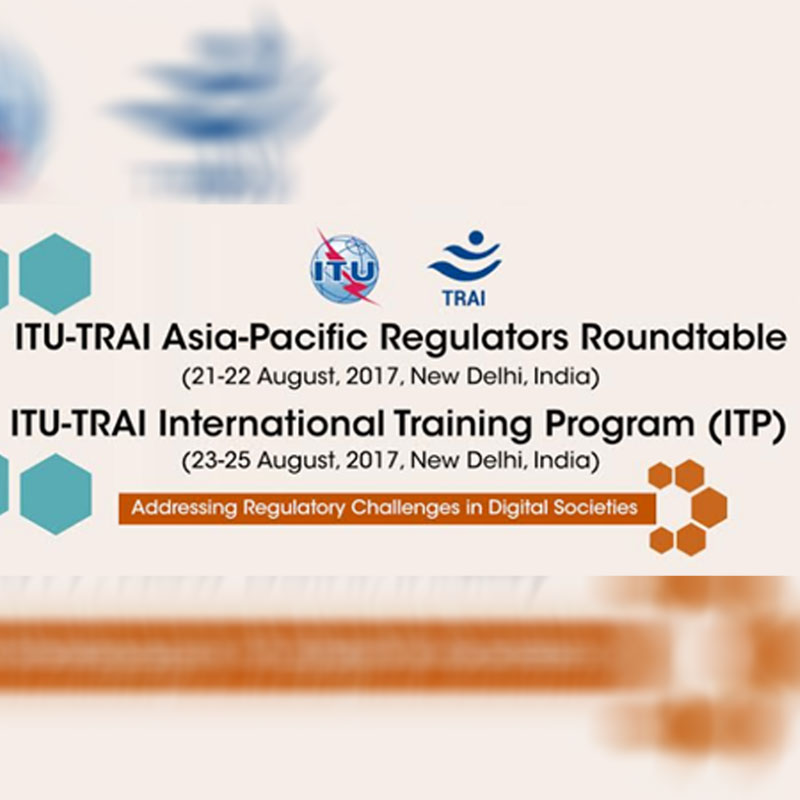
    Teleom Disputes Settlement and Appellate Tribunal Chairman Justice Shiva Kirti Singh inaugurated the programme organized between 23 and 25 August 2017 by TRAI jointly with International Telecommunication Union (ITU) on ‘Collaborative regulation for digital societies.’

    The delegates are particularly from the Asia-Pacific region. Besides, this training programme is being attended by large number of domestic participants representing various stakeholders such as government departments, telecom service providers, telecom vendors, academia etc.

    This ITU-TRAI International Training Programme 2017 aims to build skills to address the policy and regulatory issues in the emerging era beyond convergence of telecommunications and information technology. The Programme will highlight the building blocks required to ensure that regulatory measures remain relevant and appropriate for the new environment. It will bring together international experiences in this area with a focus on India’s experiences and the lessons learnt.

    The theme of this training programme is extremely relevant for all the economies worldwide. Collaborative regulation in ICT sector has various facets. In the converged ICT era, the physical boundaries would cease to exist. The seamless communication would transcend across geographical boundaries and therefore requires fine tuning of existing regulations. The Cloud computing technologies has made revolutionary trends in data storage and management.  The need for developing ecosystems for launch of new services has become inevitable.   With ever increasing subscriber base, there is a great need for optimum utilization of available spectrum through harmonization. With technological development, the task of harmonization of spectrum has become much easier and has become important.

    Cross sectoral collaboration is one of the most important aspects of regulating ICT sector. Governments should aim to improve coordination across regulators for the ultimate benefit of consumers and for coherent and consistent economic regulations across different sectors. Collaboration of regulators with researchers and academicians is another aspect of ICT regulations. Collaborative regulations can result in significant benefits for competition and the economy as a whole if working synergies are created through ongoing dialogue and regulatory cooperation.

    This three day training programme has been divided into 12 sessions and each session will be dealing with pertinent issues related to regulation of digital societies. The sessions will deal with topics such as ‘Regulatory approaches for smart societies’, ‘Converged Licensing Regime’, ‘Spectrum Planning and Management – Strategies for SG’, ‘Building Trust in Digital World’,  ‘Internet  of Things (loT)/Machine  to Machine (M2M) Communications’ etc. This training programme will assist in building institutional capacity by sharing experiences and successful case studies for potential collaboration in all these areas.

  • HD broadcast to propel switchers market to $ 2.47bn by ’24, A-Pac may surpass N. America

    MUMBAI: As the world transitions from analogue content to digital broadcasting, it is in dire need of broadcast switchers. This trend has created a remarkable demand for broadcast switchers in the developing countries of India, Japan, Africa, Ukraine, and Russia amongst others as they are working towards changing their content and conforming to ITU guidelines.

    According to a report published by Transparency Market Research, the opportunity in the global broadcast switchers market will be worth US$2.47 bn by 2024, rising from US$1.45 bn in 2015. The market is expected to expand at a strong CAGR of 6.1 per cent between 2015 and 2024.

    The complicated issues of broadcasting ultra-high definition (UHD) and high-definition (HD) is the foremost reason why users and service providers are adopting broadcast switchers. The growth this market is also being supplemented by the stiffening competition between production houses that has translated into a need for improved production automation technologies for broadcasting content on television. The broadcast switchers market is also being augmented by the rise in the number of sports events being streamed live that require excellent automation for transmitting seamless visuals. In the coming years, the insurmountable penetration high-definition televisions sets will also propel the use of these switchers.

    Sports Broadcasting to Surpass all Application Segments: The historical analysis of the market indicates that the studio production segment was the largest application segment in the overall market. As of 2015, this application segment held a share of 24.9 per cent. The unique ability of studio production segment with adapt to HD and SD content has made it a popular choice amongst business owners. In the forecast period, the new production segment and sports broadcasting are also likely to make their presence felt in the global market as viewers demand live broadcasts of important events.

    Asia Pacific Shows Promise of Remarkable Growth: As of 2014, North America held the largest share in the global market mainly being driven by upgradation of outdated switchers. During the forecast period, North America will continue its dominance in the overall market due to an influx of HD channels. Furthermore, remarkable growth in studio production and sports broadcasting is also anticipated to play a crucial role in the rise of this geographical segment. However, analysts predict that Asia Pacific will surpass the revenue share of North America in the foreseeable future as the region is on the threshold of a serious transition from analogue to digital broadcasting.

    The top players operating in the global broadcast switchers market are For-A, Ross Video, Ltd, Grass Valley USA LLC, Evertz Corporation, Sony Electronics Inc., Snell Ltd., Panasonic Corporation, New Tek Inc., Blackmagic Design, and others. According to research analysts, several companies in the market are looking at developing IP-based 4K resolution broadcast switchers to tap the unmet demand for high-quality content in the market. In addition to this, these players will also strive to cater to the varied and unique demands of developing countries to win bigger shares in the overall market dynamics.

  • Could India blocking ABS’ FTA TV signals lead to breach of ITU norms?

    MUMBAI: Government of India, it seems, could find itself in a Catch-22 situation over a directive to Department of Space (DoS) to block free-to-air channels available in India broadcast through Asia Broadcast Satellite (ABS)-2, a foreign `bird’ not licensed to provide KU-band or DTH services in India. Reason: such a blockade may breach international laws relating to spillover of satellite signals.

    Signals of ABS-2 satellite —hosting on its South Asian beam a Nepalese and a Bangladeshi DTH service licensed in their respective countries — have been spilling over into India and a mix of Indian, Nepalese and Bangladeshi TV channels are available to Indians as a FTA service that can be accessed via some plain vanilla hardware (read set-top boxes and an antennae) at a nominal cost. This has raised the heckles of India authorities over possible national security.

    While last week junior minister for Ministry of Information and Broadcasting (MIB) Rajyavardhan Rathore informed Parliament that his ministry has requested DoS to block the “unauthorized” DTH or KU-band ABS-2 service, the foreign satellite operator feels it has not broken any Indian regulations.

    ABS source claimed that the issue is of “natural spillover” of satellite signals into neighboring countries that are outside the service area of the countries offering licensed DTH services, but falling within the coverage area of the satellite. Such issues have been debated by the International Telecommunications Union (ITU) where it was concluded that such a spillover or overlap of coverage areas (countries) is in “full compliance” with ITU provisions. “Consequently, ABS is not in violation of any existing provisions/guidelines stipulated by the government of India,” a company source explained.

    ITU is the United Nations specialized agency for information and communication technologies or ICTs. It allocates global radio spectrum and satellite orbits, develops technical standards that ensure networks and technologies to seamlessly interconnect and strives to improve access to ICTs to underserved communities worldwide. Originally founded in 1865 as the International Telegraph Union, ITU is one of the oldest existing international organizations. India is also a member of the organization and Indian satellites’ slots too are co-ordinated by ITU.

    Categorically denying that the company has “been providing” a DTH service in India, ABS sources said ABS-2 satellite has two customers on its South Asian beam. The customers are Bangladeshi DTH service provider marketing under brand name Realvu and Nepalese Humro TV platform. Both these services are licensed in their respective countries, the sources claimed, adding there was a “natural spillover” of these services into India that is being lapped up by Indian viewers as it has a mix of regional content in an un-encrypted format.

    ABS also clarified that it does not sell any hardware in India, nor does it advertise or provide any service to the Indian TV channels within the country. The ABS series of satellites are owned by the Bermuda-based Asia Broadcast Satellite, a comparatively young global satellite operator with offices in the United States, UAE, South Africa, Philippines, Indonesia and Hong Kong.

    Of course, this ABS-2 service is available to Indian consumers at no monthly charge and all they need to do is install a standard STB, easily available in the open electronics hardware market, which also means that the TV channels on the platform stand to gain from additional eyeballs that can be used for marketing purposes by the TV channels.

    According to an estimate, presently there are approximately 20 satellites broadcasting over the Indian skies beaming channels into India and viewers wanting to watch those channels can watch via an ordinary STB and pointing the antenna to the desired satellite’s geo-stationary location. Though this synchronization of antennae with a specific satellite’s position may be technical in nature, there would be hordes of service providers in India with adequate knowledge to do so for a small price.

    Free to view platforms have an advantage over paid DTH services like Dish TV or Tata Sky or Videocon d2h or Reliance BIG TV in the rural areas of the country where consumers may not be too quality conscious. This FTA phenomenon is evident from the considerable reach of pubcaster Doordarshan’s KU-band or FTA DTH service, FreeDish, and a clamour amongst private TV channels too to be on the platform that has a limited shelf capacity.

    Rathore, while responding to queries from three Members of Parliament last week, had said the move to block ABS-2 signals was being done keeping in view any threat to national security via a service not licensed in India. He said MIB was the licensing authority for DTH services in India and it had not received any application or reference from ABS regarding ABS-2 services. However, the minister also admitted that there was no violation of downlinking guidelines by licensed Indian channels on the ABS-2 platform.

    ALSO READ:

    Block illegal DTH FTA, space dept. told


  • China, India world’s largest Internet markets

    China, India world’s largest Internet markets

    NEW DELHI: India has overtaken the United States to become the world’s second largest Internet market, with 333 million users, trailing China’s 721 million.

    A new report released by the UN Broadband Commission for Sustainable Development also confirms that just six nations – including China and India – together account for 55% of the total global population still offline.

    While Internet access is approaching saturation in richer nations, connectivity is still not advancing fast enough to help bridge development gaps in areas like education and health care for those in poorer parts of the world, according to the 2016 edition of The State of Broadband report.

    Globally, an estimated 3.9 billion people are not using the Internet. But, the report estimates that, between them, China, India, Indonesia, Pakistan, Bangladesh and Nigeria account for 55% of all unconnected people, while 20 countries – including the US – account for a full 75% of those not using the Internet.

    These findings suggest that targeted efforts in just a few key markets could help enormously in redressing the gaping ‘digital divide’ between those who are online and those still offline.

    India also recently overtook the US to become the world’s second-largest smartphone market, with an estimated 260 million mobile broadband subscriptions.165 countries have deployed ‘4G’ high-speed mobile networks. As smartphone penetration reaches near-saturation in the US, Europe and mature markets in Asia like Japan and Korea, India and Indonesia in particular are expected to drive future growth.

    According to latest ITU figures, by end 2016 3.5 billion people will be using the Internet, up from 3.2 billion last year and equating to 47% of the global population. The top ten developing countries for household Internet penetration are all located in Asia or the Middle East.

  • China, India world’s largest Internet markets

    China, India world’s largest Internet markets

    NEW DELHI: India has overtaken the United States to become the world’s second largest Internet market, with 333 million users, trailing China’s 721 million.

    A new report released by the UN Broadband Commission for Sustainable Development also confirms that just six nations – including China and India – together account for 55% of the total global population still offline.

    While Internet access is approaching saturation in richer nations, connectivity is still not advancing fast enough to help bridge development gaps in areas like education and health care for those in poorer parts of the world, according to the 2016 edition of The State of Broadband report.

    Globally, an estimated 3.9 billion people are not using the Internet. But, the report estimates that, between them, China, India, Indonesia, Pakistan, Bangladesh and Nigeria account for 55% of all unconnected people, while 20 countries – including the US – account for a full 75% of those not using the Internet.

    These findings suggest that targeted efforts in just a few key markets could help enormously in redressing the gaping ‘digital divide’ between those who are online and those still offline.

    India also recently overtook the US to become the world’s second-largest smartphone market, with an estimated 260 million mobile broadband subscriptions.165 countries have deployed ‘4G’ high-speed mobile networks. As smartphone penetration reaches near-saturation in the US, Europe and mature markets in Asia like Japan and Korea, India and Indonesia in particular are expected to drive future growth.

    According to latest ITU figures, by end 2016 3.5 billion people will be using the Internet, up from 3.2 billion last year and equating to 47% of the global population. The top ten developing countries for household Internet penetration are all located in Asia or the Middle East.