Tag: ITC

  • ITC’s Fabelle debuts on Metaverse with a 3D wedding

    ITC’s Fabelle debuts on Metaverse with a 3D wedding

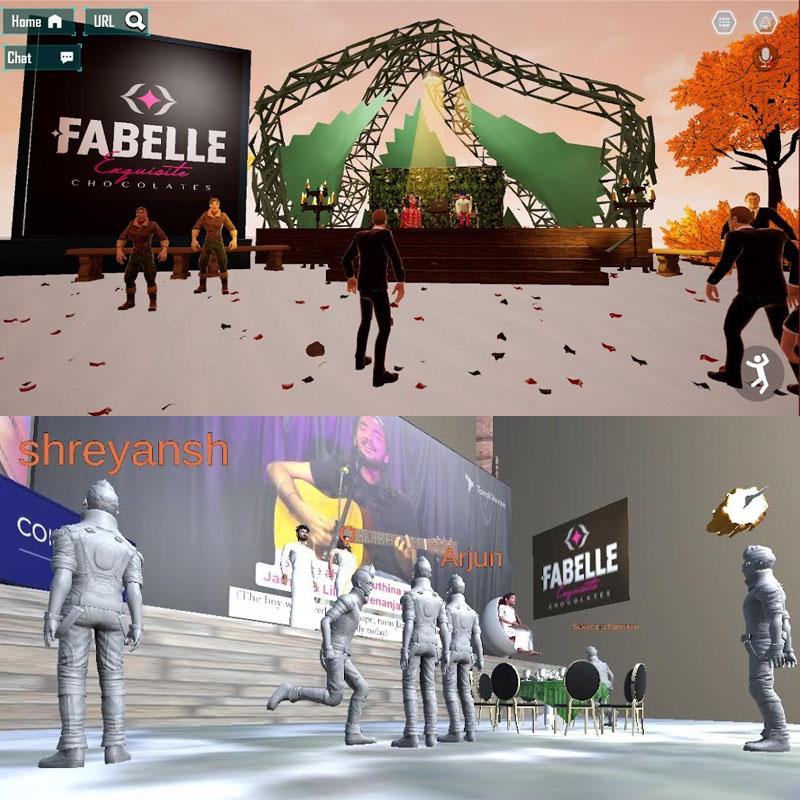
    Mumbai: With the new normal setting in, platforms like Metaverse are bringing people closer than ever before. ITC’s luxury chocolate brand Fabelle Exquisite Chocolates made its debut in Metaverse over this weekend.

    Fabelle was an integral part of two weddings hosted on the Yug Metaverse and the TardiVerse (metaverse wedding partner – CoinSwitch Kuber) platforms.

    In a ‘first-of-its-kind’ wedding event, the groom gifted the bride a metaverse version of Fabelle Trinity Truffles Extraordinaire. The brand further integrated a metaverse version of the Fabelle Chocolates cart, where guests could choose from an array of luxurious chocolates that would be delivered to their doorstep for a delightful experience even after the wedding. The elements of brand integration were conceptualised and deployed in association with Wavemaker India, agency partner of ITC.

    “Metaverse is sure to elevate the bar of virtual gathering and meetings in the next few years, and we were one of the first off the block to transition to this platform. We are delighted to make our debut into the metaverse universe, and stand by our promise of delivering unparalleled experiences,” said ITC chocolates, confectionery, coffee, and new categories – food division chief operating officer Anuj Rustagi.

    The couple- Abhijeet and Sansrati tied the knot on 5 February on a Made in India platform called Yug Metaverse.  The digital avatars of the couple had their ceremony hosted on a scenic beachside venue where the guests also joined in via their digital avatars. The wedding on Saturday coincided with the physical event held in Bhopal.

    “Marketing on Metaverse platform is the next wave in digital marketing,” said Wavemaker CEO- South Asia Ajay Gupte. “We have built an in-house team of experts to help our clients navigate better in this domain and find the right fit to associate with metaverse events. Metaverse is still at its nascent stage and offers us a huge opportunity to shape the platform that we really believe in. This is the future of consumer experience and we are all excited to ride this wave.”

    Wavemaker India also crafted partnerships with Matrimony.com for the wedding. Talking about the 3D wedding, Matrimony.com chief marketing officer Arjun Bhatia said, “We feel excited about collaborating in a virtual world wedding experiment that opens up immense possibilities of engagement and immersion at YUG metaverse.”

    Metaverse is a kind of virtual world where people can enter the digital world through virtual identity. In this virtual space, people also get a chance to hang out, shop, and meet friends. “Metaverse is a new concept and its adoption is still at an early stage worldwide. The team is excited to explore the possibilities that emerging technologies like metaverse, blockchain & cryptocurrency will open up in the future,” said Yug Metavers creator Utkarsh Shukla.

  • TV Brand Fest 2021: Marketers relook at TV ad spends in times of disruption

    TV Brand Fest 2021: Marketers relook at TV ad spends in times of disruption

    Mumbai: The media industry and the economy saw an unprecedented level of disruption post-lockdown phase. As marketers went back to the drawing board to scrutinise their media spend, TV advertising moved from strength to strength commanding the highest share of advertising spends.

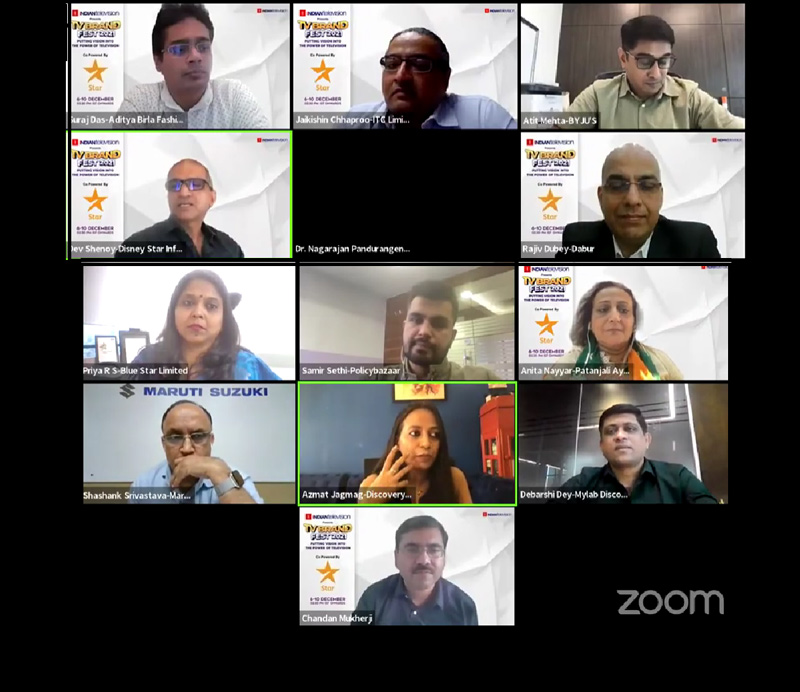
    “Television will continue to command the majority share of ad-spends in the next five to seven years,” asserted ITC head of media Jaikishin Chhaproo, as he began the discussion at the ‘TV Brand Fest 2021’ – a five-day event being organised by Indiantelevision.com, and co-powered by Star India. Day one of the event saw marketers and prominent TV advertisers discuss ‘The power of television in times of disruption’ and ways of ‘Using TV + digital strategy’.

    Maruti Suzuki India executive director – marketing and sales Shashank Srivastava noted that out of the Rs 700 crore spent on advertising, the brand spent 34 per cent on TV and 27 per cent on digital. “In terms of building brand imagery, especially in the auto category, there’s no substitute for TV,” he noted.

    Most industries were impacted by the pandemic. However, the edtech sector was one of the few that saw an increase in demand during the lockdown. Byju’s head of marketing Atit Mehta observed that this was an important moment for the edtech industry to build top of the funnel awareness. “One of the categories that increased their advertising spends during lockdown was edtech,” he said.

    The fast-moving-consumer-goods (FMCG) category remains the largest advertiser on TV. Despite the impact of the pandemic on the bottom line of most consumer goods companies, this category remained visible on TV. “FMCG cannot do without TV because you need the reach, frequency and eyeballs,” said ITC’s Chhaproo.

    “A significant number of categories operate around the magic price point of Rs 10. Due to the impact of the pandemic on the supply chain, continuing to offer this price point to consumers became a challenge”, said Chhaproo. “We had to constantly communicate to consumers to drive them to our products.”

    The category which usually invests on general entertainment channels, shifted media spends on other genres on TV. “We shifted our spends on TV to the news genre because consumption had gone up significantly,” remarked Dabur head of media Rajiv Dubey.

    Covid was a timeout for the entire world and when the normal choices were unavailable to consumers they began experimenting with different modes of consumption. When fresh content returned to GECs last year, Dubey observed that there was a significant consolidation of viewership in the eight regional markets that Dabur looked at including South (Karnataka, Andhra Pradesh/Telangana, Tamil Nadu and Kerala), West Bengal, Maharashtra, Orissa and Bihar.

    “The viewership has been on the upswing in these regional markets with consolidation of viewership in fewer programs and channels,” said Dubey. “We’ve seen that if you speak to a consumer in Maharashtra, in Marathi, using a Star of his choice, it works better.”

    There are 40-50 million homes that watch only free-to-air channels on Prasar Bharati’s free DTH platform DD Free Dish, Dubey said. “The FTA channels work like magic if you want to advertise products with smaller price points. Unfortunately, the major FTA channels only cater to Hindi-speaking audiences and no other language audiences.”

    In terms of consumer behaviour, there is a key overlap in terms of audiences on TV and digital. Audiences are watching both these media at different points in time. For Policybazaar.com’s vice president and head of brand marketing Samir Sethi it became important to map these audiences to optimise ad spends.

    He said, “The attention is now divided between a TV and mobile phone. Earlier, people watched TV undivided but now they’re also multitasking on a mobile phone. We’ve seen that there are times when people are influenced enough by your communication on TV that they respond by checking out your website or downloading your app on mobile.”

    A lot of digital and direct-to-consumer brands have understood and leveraged this behaviour. When it comes to achieving their growth targets, “all the major D2C brands have come on our platform (TV) to reach audiences at scale,” remarked Disney and Star India head of sales for infotainment, kids and regional cluster Dev Shenoy.

    In the last 18 months, ad spends have inevitably shifted to digital media platforms. For example, with retail spaces closed, certain category spends have completely moved to e-commerce. Maruti Suzuki’s Srivastava said, “At the top end of the funnel there is no substitute for TV. Digital becomes more important at the lower end. In the consideration stage of the brand, there’s an overlap.”

  • ITC Kitchens of India to feature on Inox’s menu

    ITC Kitchens of India to feature on Inox’s menu

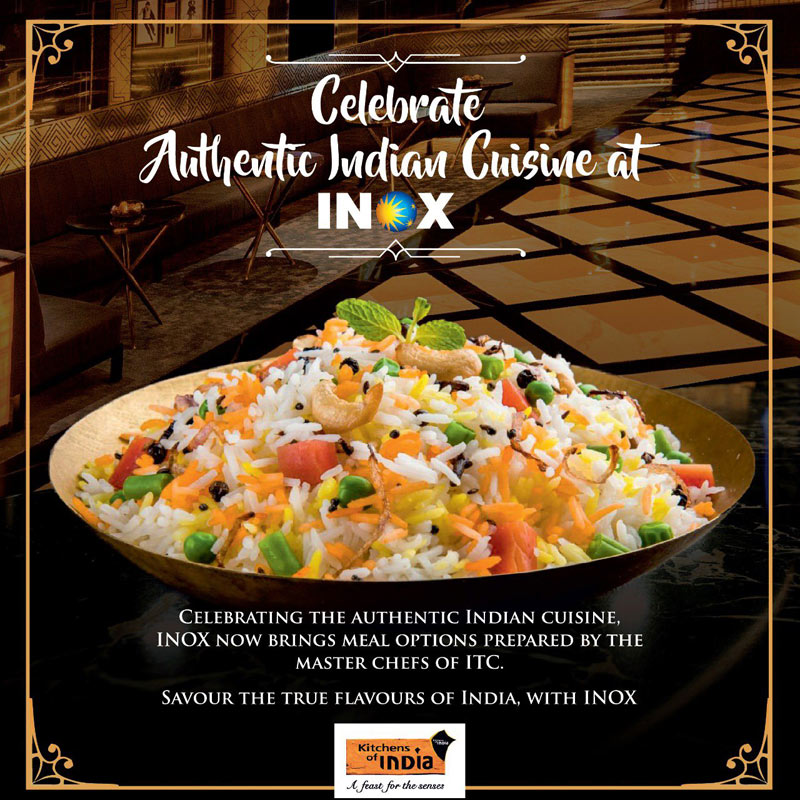
    Mumbai: Multiplex chain Inox Leisure Ltd on Wednesday announced its partnership with ITC Ltd’s Ready-to-Eat gourmet brand Kitchens of India to introduce a redefined, innovative F&B experience across all multiplexes of Inox in India.

    With this partnership, Inox aims to add a new experience in the cinema halls through a trusted range of 100 per cent natural, Indian gastronomical delights. The new additions to the menu will provide more options to Inox customers, whether ordering at cinemas or from the comfort of their homes through food-ordering apps, said the statement.

    Effective 29 September, customers across the country can have access to authentic Indian cuisine including Vegetable Pulao, Hyderabadi Vegetable Biryani, Dal Makhani, Rajma Masala, Pindi Chana and Steamed Basmati Rice as part of the service, it added.

    “With the addition of Kitchens of India range we are expanding the choices for our patrons by offering an aromatic and flavourful dining experience with their loved ones while watching the movie,” said Inox Leisure Ltd vice president food & beverages operations Dinesh Hariharan. “Consumers will greatly benefit from this collaboration by receiving an array of authentic local culinary delights across the country, served in premium spill and leak proof packaging.  This collaboration is a critical stepping stone in our endeavors to strengthen Inox’s F&B service brand as well as our bond with our patrons, by offering them newer preferred choices.”

    Inox’s new F&B roadmap also includes introducing new processes and innovations including making their food available on online food ordering platforms Swiggy and Zomato. Recently, Inox became the first cinema chain in India to get listed on the table reservation and food discovery platform EazyDiner. Inox sells food under three brands – Café Unwind, Insignia and Delights. Intending to extend the hospitality to new audiences, Inox plans to position these into full-service restaurant brands to target non-cinema consumers.

    “Through this partnership with Inox, Kitchens of India will aim to help redefine and shape a new horizon of cinema and food experience for movie-goers,” said ITC Ltd VP of marketing services (foods division) Shuvadip Banerjee. “As citizens gradually resume out-of-home leisure, entertainment experiences and activities, food safety and hygiene continue to be of paramount importance to consumers. With Kitchens of India featuring on Inox’s menu hereon, consumers will not only enjoy the benefits of convenient indulgences in regal Indian delicacies while enjoying their movie, but will do so with a safe, hygienic and a reliable brand.”

  • ITC and Britannia resolve packaging feud

    ITC and Britannia resolve packaging feud

    Mumbai: FMCG majors Britannia and ITC have reached a resolution over the nine-month long case in which the former had dragged ITC to the Delhi high court alleging infringement of product packaging.

    The judgement, dated 4 August, considered the matter resolved after ITC changed the packaging (pillow and box) scheme for its ‘Sunfeast Farmlite 5-Seed Digestive’ and ‘Sunfeast Farmlite Veda Digestive’ biscuits which was challenged by Britannia Industries in December, last year as being “deceptively similar” to that of its NutriChoice Digestive biscuit brand.

    “The respondents have modified the packaging of their products ‘Sunfeast Farmlite 5-Seed Digestive’ and ‘Sunfeast Farmlite Veda Digestive’ which are already in the market. The Appellant has no objection to the use of the modified packaging of the Respondents as depicted hereinabove,” the judgement read.

    In view of the above settlement, Britannia Industries has withdrawn all claims for rendition of accounts, damages, and costs.

    Hearing the matter in April, a single judge bench of the Delhi high court had ruled that the impugned packaging cannot be called “deceptively similar” because in both the cases the name of the product is abundantly clear. Britannia appealed against the judgement on the grounds that ITC’s promotion of April order is causing harm to its goodwill. “It is averred that the impugned judgment is being publicised heavily and is therefore causing immense harm and injury leading to loss of goodwill and reputation of the appellant,” it said.

    Responding to Britannia’s appeal in an order dated 8 July, the Delhi high court had asked the two parties to reach a consensus on the matter within four weeks.

  • National brands gauge the Bangla TV market on Tele-wise Bangla summit

    Mumbai: There is little doubt about television as a far-reaching instrument of viewership connecting masses pan India. It remains the medium of choice to build reach and brand salience. However, as the second wave of the pandemic swept through the country, it also impacted the overall TV viewership across regions. This, in turn led the advertisers and brands to reflect on the way they leveraged TV to reach out to their target audience.

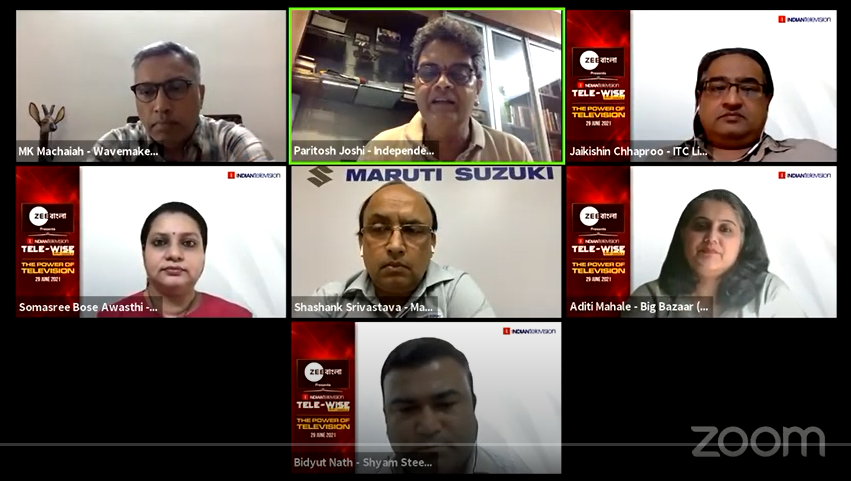
    As a part of the inaugural edition of the Tele-wise Bangla Summit 2021 organised by Indiantelevision.com in partnership with Zee Bangla, industry experts and stakeholders from across sectors weighed in on the strength of the West Bengal TV market and the disruption caused by Covid-19 on people’s lives, their consumer spending, and TV viewing habits.

    In an informative discussion ‘Gauging the Might of the Market’ –  moderated by independent media consultant Paritosh Joshi, marketers debated on how the Bangla market remains highly relevant for national brands looking to make their presence felt in the state when it comes to TV ad spends.

    The session kicked off with Joshi observing that, although the pandemic has largely resulted in an overall bleak economic environment, FMCG remained the sole bright spot. Godrej Consumer Products Limited marketing head (homecare category) Somasree Bose Awasthi pitched in that it was true specifically with regards to essential items, which have been driving the growth in the sector. The premium or discretionary categories like grooming or hygiene products have suffered a setback in the last year. She added, however, that the reverse migration due to the pandemic had led to a revival in the rural economy across the country, including West Bengal.

    Shyam Steel India, head of brand marketing, Bidyut Nath corroborated this by saying that, while the pandemic had brought most large-scale construction activity in the cities to a standstill, with workers going back to their villages, it had continued almost uninterrupted in the rural areas as people did not cease to build houses for themselves, irrespective of the pandemic. So while there was little positive growth in the sector, it did reflect a steady growth with nearly 69 per cent of the populace constructing homes, he said.

    The panellists discussed how the pandemic also caused people to become risk-averse when it came to buying decisions, due to which market leaders in a particular sector and trusted brands gained.

    According to Maruti Suzuki India’s marketing & sales executive director Shashank Srivastava in such times, the trusted brands become the anchor for consumers. “That trust helped us, and our market share went up in most segments, despite Automobiles being a discretionary, high-value purchase. In general, the retail sales were better in 2020 than the previous year for Maruti, mainly because of the change in consumer perception towards public transport, resulting in more people becoming inclined towards owning private vehicles,” he said.

    However, the fall in incomes did show in the “telescoping of demand”, whereby the demand for a higher segment shifted towards a lower segment vehicle, he added.

    Future Group’s Big Bazaar marketing head Aditi Mahale shared that while the group had 15 to 20 stores across the state, nearly eight to ten of them were based out of Kolkata.

    “We had to cut back on TV ad-spend last year, mainly due to lack of fresh content, and we focused more on the news genre and digital,” said Mahale, but the group continues to use television as part of its marketing strategy, especially during regional festivals, for “retail is, by nature, always local” with even their competition being largely local in the genre.

    For ITC, which has its roots in West Bengal, the state is “priority #1 market”, said ITC’s Media & PR head Jaikishin Chhaproo, largely because of the unparalleled distribution strength that it provides.

    When it came to the media mix in the state, panellists shared that television had a regional reach of more than 70 per cent in the state. Hence brands try to capitalize on the richness of the regional content by preparing creatives with local flavour and by going “hyper-local”.

    “Becoming hyper-local is the need of the hour. Doing local TVCs with local actors really pays off. But brands face challenges in terms of talent & cost,” said Wavemaker India’s ITC lead and special initiatives president MK Machaiah.

    In West Bengal, like most other markets- there is an innate attachment to sports. So while Shyam Steel India did see great brand engagement post onboarding Virat Kohli and Anushka Sharma as brand ambassadors, Bidyuth Nath agreed that going hyper-local by engaging with local celebrities is also indispensable. All panellists agreed on the value that localised content brings to brand promotions in the state, regardless of the medium – print, television, or digital.

  • ITC records Q4 net profit of Rs 3,817 cr

    ITC records Q4 net profit of Rs 3,817 cr

    New Delhi: ITC Ltd on Tuesday reported a consolidated net profit of Rs 3,816.84 crore for the fourth quarter ended March 2021.

    The cigarette-FMCG-to-hotel major had posted a net profit of Rs 3,926.46 crore during the January-March quarter of the previous fiscal, according to the regulatory filing. The revenue from operations rose to Rs 15,404.37 crore during the quarter under review. It was Rs 12,560.64 crore in the corresponding period of 2019-20.

    However, ITC said its results for this quarter are not comparable with the earlier period as it also includes the revenue of Sunrise Foods, which it had acquired on 27 July last year. “The financial results of the group and ‘FMCG Others’ of the quarter and the financial year ended on 31 March 2021 include those of Sunrise from 27 July 2020 and consequently are not comparable with previous periods,” it said in the filing.

    The total expenses of ITC stood at Rs 10,944.64 crore in Q4 FY 2020-21.

    The sale of cigarettes recorded significant improvement during the quarter under review, while the ITC hotel business was severely impacted by the pandemic. Revenue from its cigarette business rose nearly 14.2 per cent to ₹5,859 crore for March quarter, compared with ₹5,130 crore in the corresponding period. On the other hand, the revenue from the hotel business reported a 38 per cent year-on-year decline to ₹287.77 crore in Q4FY21. Revenue of the remaining FMCG business fell 1.5 per cent to Rs 3,694.8 crore.

    For the full fiscal year 2020-21, ITC’s net profit was at Rs 13,389.80 crore, with a net profit of Rs 15,584.56 crore in FY20. Revenue from operations came in at Rs 53,155.12 crore, compared to Rs 51,393.47 crore in 2019-20.

  • Amid pandemic, GECs take lion’s share of brands’ TV advertising budget

    Amid pandemic, GECs take lion’s share of brands’ TV advertising budget

    As the entire country is battling the second wave of coronavirus outbreak, advertisers asserted that they will continue advertising on television as it is the most effective medium to flaunt their product before Indian audiences. In the recent Tele-Wise Kannada panel discussion organised by Indian Television Group in association with Colors Kannada, industry experts debated whether regional channels were the next frontier for Indian advertisers to advertise their products. The discussion was moderated by Indiantelevision.com’s founder, CEO & editor-in-chief Anil Wanwari. 

    Television continues as the most preferred medium

    During the event, ITC head of marketing Aishwarya Pratap Singh stated that his company trusts television as the most effective medium of advertising, as it offers 96 per cent penetration rate. According to him, television and print are ITC’s most preferred mediums to advertise their products, especially in Karnataka. 

    “As long as the market is there, lockdown or no lockdown, we will continue to invest in TV,” added Singh. 

    Airtel vice president – media Archana Agarwal said, “Television remains the highest reach medium. We may look at other options if we are to focus on specialised local markets, but for the entire state, TV is the medium.” 

    Parle Products sr category head Krishnarao Buddha revealed that they did not have much chance to experiment on advertisements, as their stocks were shrinking due to increased demand. However, the consumer goods major trusted television as its primary advertising medium, and advertised their products across channels. 

    “Last year, there was not much possibility for us to advertise. But, we stitched a new creative from our old creatives. We also went out of our way to support broadcasters, like Star Sports and news channels,” he said. 

    Setbacks faced during pandemic times

    Krishnarao admitted that Parle had faced a setback, especially in the confectionery segment due to the Covid2019 pandemic. 

    “We have deferred some of our launches due to the pandemic. Overall, the confectionery category has been impacted. Children always buy confectionaries in mono packs. As schools remain closed, the sale of mono packs has been impacted. But we have seen an increase in the sale of salty snacks as people now confined to their homes,” he elaborated. 

    ITC’s Pratap Singh said, “Noodle businesses are stable, in fact, a little more, as people tend to eat more while being at the home. We were able to grow even in Covid times. During these pandemic times, we focus more on quick selling products rather than spending time on slow-moving products.”

    Challenges faced by advertisers in Karnataka

    Industry experts who attended the virtual summit unanimously agreed that the multifaceted culture in Bengaluru is one of the main challenges they face while delivering region-specific ad campaigns. 

    “In Karnataka, 60 per cent of TV viewership comes from Kannada channels, and 15 per cent from Hindi speaking channels, so a lot depends on the language. But when it comes to Bengaluru, only 53 per cent of TV viewership comes from Kannada channels. For advertising, a drop of seven per cent cannot be ignored. So, instead of creating region-centric ad campaigns, we always roll out national ad campaigns in Karnataka too,” detailed Airtel’s Agarwal. 

    Pratap Singh further explained why exclusively Kannada campaigns may not work in Bengaluru. “There is a lot of Tamil and Telugu-speaking population in Bengaluru. Due to the staggering amount of Tamil-speaking people in Bengaluru, Tamil channels are also faring big in Bengaluru.” 

    “We have not experimented a lot with Karnataka specific campaign. We typically use an entire south Campaign or an all India campaign,” remarked Krishnarao when asked about Parle’s marketing strategy for the region. 

    Favourite genres for advertisers 

    The overarching consensus among the talking heads at the Tele-Wise Kannada panel discussion was that general entertainment channels (GEC) are the best option to reach consumers. The reason is simple – it’s the category that offers the biggest reach.

    “In most cases, we prefer GECs and sports. Movies play a big role, especially when there’s no fresh content on TV during the lockdown. News channels do not give us high reach somehow. Sports, yes, we are on IPL. We strongly believe in the power of cricket. It is quite expensive but it’s worth investing there,” said Pratap Singh. 

    Agarwal revealed that Airtel has not invested much in reality shows. 

    “Most of the reality shows are on similar lines. But, we haven’t sponsored any show in the last two or three years in any market, except for Kerala,” she said. 

    Krishnarao explained, “The reality shows come at a premium. So we have to evaluate our needs. But, we have associated with a few channels, and we are continuously on the lookout for more impact.” 

  • How brands view television advertising in 2021

    How brands view television advertising in 2021

    New Delhi: Television has been one of the most resilient and strongest mediums of communication, especially in India. Unlike other countries, where an increasing number of people are cutting the cord with pay-TV, India’s reach in television is only growing. Around 210 million households in India now own a TV set, an increase of 6.9 per cent from 197 million in 2018, according to the latest estimates released by TV monitoring agency Broadcast Audience Research Council (BARC) on Thursday.

    But the fast adoption of video streaming services has no doubt changed the dynamics of advertising on television. So, what are the factors that brands now take into consideration when they choose to advertise on general entertainment channels? Does the content matter or is it just the reach? What is the perspective on sports content? Other than cricket what sports content are brands looking at?

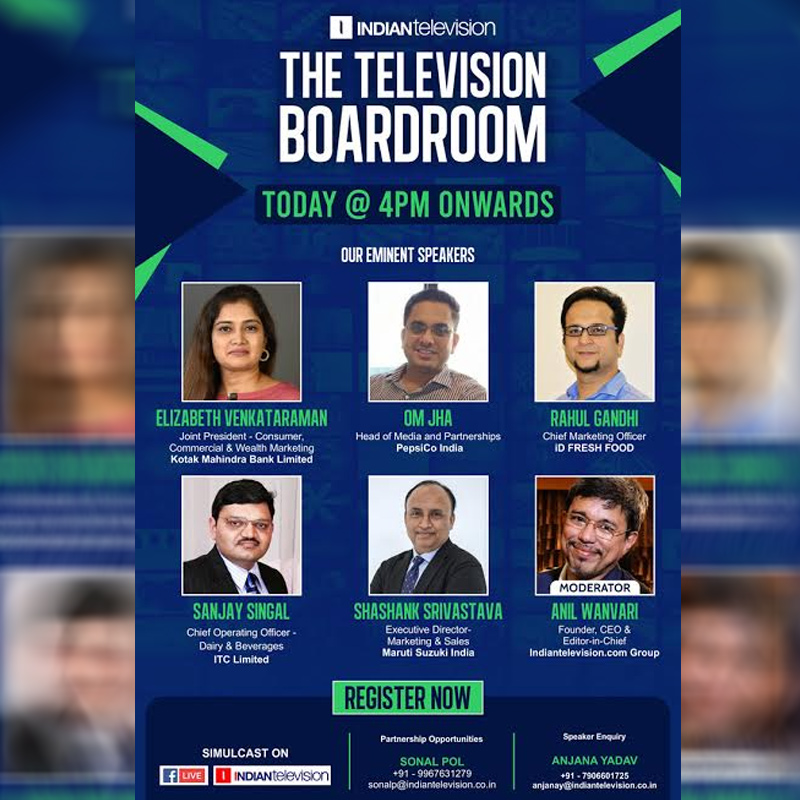
    Some of these questions will take centre stage at The Television Boardroom- a virtual panel discussion being organised by Indiantelevision.com at 4 pm on Friday, where some leading brands and advertisers will talk about the different genres of television (movies, infotainment, GEC, news, kids) and their thoughts on them. The event will explore various issues related to the future of television and how the expectations of advertisers from TV have evolved over the years.

    The panel will comprise esteemed representatives from the industry – Kotak Mahindra Bank joint president-consumer, commercial & wealth marketing Elizabeth Venkataraman, PepsiCo India head media and partnerships Om Jha, id Fresh Food chief marketing officer Rahul Gandhi, ITC chief operating officer- dairy and beverages Sanjay Singal, Maruti Suzuki India executive director – marketing and sales Shashank Srivastava and Indiantelevision.com's founder, CEO and editor-in-chief Anil Wanvari.

    The event will be streamed LIVE on the social media platforms of Indiantelevision.com. To join us for stimulating conversations and interesting insights on the issue, register at https://www.indiantelevision.com/television-boardroom/login-system/registration.php

  • ITC’s Classmate encourages kids to DIY with Origami notebooks

    ITC’s Classmate encourages kids to DIY with Origami notebooks

    NEW DELHI: ITC Classmate has launched Origami notebooks, the first in the series of engagement-based notebooks under its Classmate Interaktiv series. Aimed at encouraging students to learn through Do It Yourself (DIY) activities, these Origami notebooks will enhance their creativity and imagination through experiential learning.

    The Interaktiv series notebook marks ITC Classmate’s commitment towards augmenting students’ learning through constant engagement, learning, and interactivity. The Origami notebooks include specialized DIY Origami sheets and would focus on enhanced consumer engagements through videos, contests and so on. This will be followed by more unique product offerings and collaborations in the months to come, which will enable learning and creativity amongst young consumers.

    As part of the launch, Classmate is running the Origami Champions contest where anyone who collects all eight designs and shares the same on Classmate’s Facebook or Instagram handle stands a chance to win exclusive gifts from the school supplies brand. 

    https://www.youtube.com/?feature=youtu.be

    ITC Ltd chief executive – education and stationery products business division Vikas Gupta said, “ITC Classmate has at its core the driving commitment to ensure consumer delight with its high-quality, innovative and visually appealing products. In accordance with ITC’s focus on continuous innovation, we believe in encouraging children to learn through experiential knowledge. Classmate through its Interaktiv series wants to ensure that kids enjoy the process of learning through curiosity and imagination.”

    This journey of Classmate notebooks from a physical notes-taking tool to a more meaningful 360-degree engagement tool marks a strategic shift by the brand to make learning more exciting and interactive.