Tag: Italy

  • Keshet International has Asia Singing

    Keshet International has Asia Singing

    MUMBAI: Keshet International has sold its trailblazing interactive talent format RISING STAR and its high-rating children’s singing format MASTER CLASS into Asia. The deals mark a first for each format in terms of geographical reach.


    RISING STAR will air on Indonesia’s largest private broadcaster RCTI (Indonesian Idol, Masterchef) which reaches a gigantic potential audience of 180 million viewers. An initial 24 x 2 hr episodes have been commissioned and will be produced by RCTI to air in late Summer/early Fall 2014. ABC’s US version of the show will air on June 22 and is available to buyers at MIPTV as a finished 10 episode tape.


    Keshet International has closed deals for RISING STAR in more than 25 territories since its launch at MIPCOM 2013, making it the fastest-selling talent format on record (source: The WIT). Sales include the US (ABC), UK (ITV), Argentina (Telefe), Brazil (Rede Globo), Spain (Atresmedia), Portugal (TVI), Italy (Toro), France (M6 Group) Russia (Rossiya1), Germany (RTL), the Nordics (Nordisk), Hungary (TV2), Ukraine (1+1), Greece (MEGA) and Turkey (Acun Medya). Interest in the format continues to grow worldwide following unprecedented ratings for the show’s original series in Israel, the season finale of which peaked with a 58% share of the total domestic audience.


    MASTER CLASS will find a home in China on Jiangsu Satellite TV, launching in the last quarter of 2014 with a first season of 12 x 90’ episodes. The show is being adapted into a local version done through a co-development deal with Beijing-based production company 3C Media.  


    The original Israeli version of MASTER CLASS is a show in which children sing all-time classics with only positive reviews and no eliminations. It is currently the highest performing talent show on Keshet’s Channel 2. It has also performed extremely well in Hungary where its ratings exceeded TV2’s average for the timeslot by 250%.


    Kanti Mirdiati, Managing Director of RCTI, said, “It is an honor for RCTI to cooperate with Keshet International and be the first TV Station in Asia that will telecast Rising Star. This is a singing talent search program with a very interesting concept and totally interactive format, where the audiences at home can vote at a real time and decide who will stay or who will leave. We can’t wait to see how great this program will be. It will bring a new reality and voting sensation through the new platform called Mobile App.”


    Mr. Liu, CEO of 3C Media, said “We are very happy to be working with Keshet in co-developing this format into a version that’s more suitable to the Chinese audience and market. The core elements of the show remains intact while we bringing in a special local twist to it. We hope to establish a long-term relationship with Keshet in co-developing many future hit shows for China.”


    Keshet International CEO, Alon Shtruzman, said, “We’re delighted to see two more jewels in the Keshet crown airing in Asia. Having a strong presence in such rapid growth regions feels like a great frontier to have conquered.”


    Elsewhere in Asia, Keshet International has sold its hidden camera game show Deal With It to Mediacorp Channel 5.


    RISING STAR is a trailblazing interactive talent format which hails a new era in home entertainment. It enables the first real-time voting by viewers via an innovative free app ‘TV app to you’ which is fully integrated into the show. Making their debut on stage alone, behind a giant wall of TV screens, a performer can only make his or her entry to the studio by securing more than 70% of the viewers’, judges’ and live audiences’ vote. If the bar is met, the screen (which lights up with the face of each voting viewer in real-time) will slowly rise to expose the hopeful to their new fans and the judging panel. From the very first minute of the very first episode, viewers will play an integral role in every decision made on the show and continue to do so throughout the entire season.


    RISING STAR, produced by Tedy Productions for Keshet Broadcasting, marked a record-breaking debut on Keshet’s Channel 2 from September to December 2013, maintaining its audience throughout the full first season as the highest-rated show in 10 of its 15 weeks on air. Over 10 million votes were cast through the app during season one, which has been downloaded more than 1.5 million times. RISING STAR has far outperformed all second screen data ever recorded in Israel, with an activity rate 10 times higher than its nearest competitor. It maintained high ratings and conversion rates (i.e. viewers to second screen participation), in excess of 30%, throughout the series.


    MASTER CLASS is a talent show full of heart, and no heartbreak! It is a music talent show for children singing old classics with only positive reviews and without elimination. It has become a critically acclaimed program that taps into the global trend of family viewing because of its warm and humane approach. MASTER CLASS avoids the intrigue and harsh judgment of a ruthless competition, focusing on the nurturing relationships formed between the teachers and their young students, as they become familiar with the country’s rich musical history and cultural heritage.


    The sixteen stars of the show are children aged 8-14, with the most promising voices in the country. Four teachers – leading artists in the music industry – train them to make the most of their potential and become the best singers they can. The program is set at the music school and its auditorium, where the weekly performances take place. Towards the end of the season the best student in each performance is awarded a place in the graduation show. In this way, the six will sing for the last time in front of the committee, where one will be selected as the best in the class. Still, all the students continue their studies and perform at every show, including the final one.


    Entitled School of Music in Israel, MASTER CLASS became a breakthrough hit oh Keshet Broadcasting Channel 2 – it was the 2nd highest rated show in in 2011, with a season average of 48.1% share and 32.5% rating.

  • Sony Six to broadcast 2014 six nations rugby

    Sony Six to broadcast 2014 six nations rugby

    ?MUMBAI: SONY SIX, India’s premier sports and entertainment channel has won the exclusive broadcast rights to the RBS 6 Nations Rugby tournament which commences on 1stFebruary. Taking on its global viewing spectrum, the 2014 edition of the RBS 6 Nation’s Rugby tournament will be shown on aprime time slot between 8.00pm to 11.00pm on Sony Six and Sony Six HD for Indian audiences.

    The 2014 RBS 6 Nation’s Rugby tournament beginson 1stFebruary and will conclude on 15thMarch. The tournament consists of a league of 6 European nations – England, Scotland, Wales, Ireland, Italy and France. Each teamplays every other team once, with home field advantage alternating from one year to the next. Two points are awarded for a win, one for a draw and none for a loss. Defending Champions Wales take on Italy in the opening game.

    The Six Nations is the successor to the Five Nations Championship (1910–31 and 1947–99) which in turn succeeded the Home Nations Championship (1883–1909 and 1932–39). The Home Nations Championship, played between teams from England, Ireland, Scotland and Wales, was the first international rugby union tournament.

    Sony SIX has also has broadcast rights to other premier rugby tournaments such as the Super Rugby League and the Rugby Championship.


  • India’s The Good Road out of the Oscar race

    India’s The Good Road out of the Oscar race

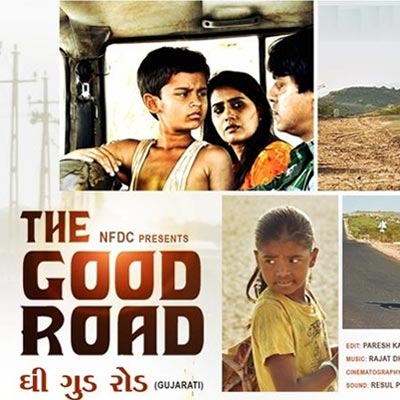
    MUMBAI: Gyan Correa’s much publicised The Good Road is out of the race for the Foreign Language Oscars. Nine features will advance to the next round of voting in the Foreign Language Film category for the 86th Academy Awards. Seventy-six films had originally been considered in the category.


    Even earlier, The Good Road, Correa’s directorial debut that intertwines three stories in the hostile and remote Kutch in Gujarat, had a bumpy ride – when it invited the wrath of The Lunch Box team, which felt that Correa’s work stood little chance at the Oscars.


    The films, listed in alphabetical order by country, are: Belgium, The Broken Circle Breakdown, Felix van Groeningen, director; Bosnia and Herzegovina, An Episode in the Life of an Iron Picker, Danis Tanovic, director; Cambodia, The Missing Picture, Rithy Panh, director; Denmark, The Hunt, Thomas Vinterberg, director; Germany, Two Lives, Georg Maas, director; Hong Kong, The Grandmaster, Wong Kar-wai, director; Hungary, The Notebook, Janos Szasz, director; Italy, The Great Beauty, Paolo Sorrentino, director; Palestine, Omar, Hany Abu-Assad, director.


    Foreign Language Film nominations for 2013 are being determined in two phases. The Phase I committee, consisting of several hundred Los Angeles-based Academy members, screened the original submissions in the category between mid-October and December 16. The group’s top six choices, augmented by three additional selections voted by the Academy’s Foreign Language Film Award Executive Committee, constitute the shortlist. The shortlist will be winnowed down to the five nominees by specially invited committees in New York and Los Angeles.  They will spend 10 January to 12 January viewing three films each day and then casting their ballots.


    The 86th Academy Awards nominations will be announced live on16 January, 2014, Thursday in the Academy’s Samuel Goldwyn Theater.

  • Bing releases the top search trends of 2013

    Bing releases the top search trends of 2013

    MUMBAI: Women are on top, literally! The 2013 search trends released by Bing that includes search data from Australia, Brazil, Canada, China, France, Germany, India, Italy, Japan, Spain, the U.K. and the U.S, reveal that women ruled and were in the top searches. In eight of the 12 participating countries around the world, women were the most searched. Beyoncé reigned in the US, while Miley Cyrus’s highly publicised twerking made her the top-searched person in both Australia and Canada.

    Former flames Justin Bieber and Selena Gomez were the most-searched people in the U.K. and Germany, respectively. Actress and actors Bruna Marquezine, Wen Zhang and Salman Khan were the most-searched people in Brazil, China and India, while singers Rihanna and David Bisbal ranked at the top for France and Spain, and gorgeous TV personalities Danmitsu and Belen Rodriguez were favorites in Japan and Italy.

    It was also a year of American songs, superhero movies, Facebook love, high-end designer brands, controversial sports stars, European getaways and fierce women.

    Bing search trends, found at  www.BingTrends.com, indicate what has most captivated people around the world in 2013.

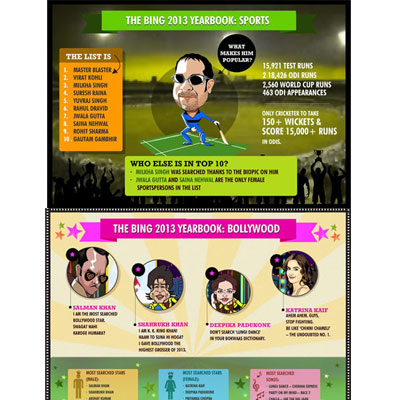
    However, when it came to the top searches in India, surprisingly, it was not the master blaster Sachin Tendulkar, who bid adieu to international cricket in 2013, who was searched the most. He was at number four, only after Salman Khan, Shah Rukh Khan and Katrina Kaif. 

    While he may have led the search among actors, Salman’s films did not feature in the top ten most searched films. The fast paced action flick Race 2 bagged top honours followed by Shahrukh starrer Chennai Express. And the surprise package among the top 10 Hindi movies was Nasha, starring Poonam Pandey. And Shah Rukh Khan may have missed top spot in the most searched actor and film, but his Lungi Dance from Chennai Express made it to the top of charts as the most searched song in India. This was followed by Party on My Mind from Race 2 and Challa from Jab Tak Hai Jaan.

    Sports stars too were popular. While Sachin Tendulkar was the most searched among sports stars, young and feisty Virat Kohli too made it to the top ten. However, the surprise entry was sprinter Milkha Singh, proving that the biopic on him did arouse curiosity about him in the country. Shuttlers Jwala Gutta and Saina Nehwal made sure that their sport was represented in the top ten dominated by cricketers.

  • CareerBuilder Releases Striking Differences in Typical Workdays Around the World

    CareerBuilder Releases Striking Differences in Typical Workdays Around the World

    MUMBAI :  A new global study from CareerBuilder shows that a typical day in the office is not so typical across the globe: When you look at the average workday in the 10 largest economies around the world, you begin to see how alike workers can be—and also where they differ the most. The global survey, conducted online by Harris Interactive© from May 9 to June 5, 2013, included more than 5,000 hiring managers and human resource professionals in countries with the largest gross domestic product.

    INFOGRAPHIC:http://cb.com/1gnMhxK

    Driving vs. Public Transportation

    While the 10 countries surveyed have the largest economies on the planet, they also have some of the largest populations, but instead of taking public transportation or using other ways of getting to work, the majority of workers indicate they drive themselves to work every day,
    •    U.S. 82%
    •    Brazil: 74%
    •    China: 69%
    •    Germany: 63%
    •    France: 62%
    •    Italy: 60%
    •    Russia: 60%
    •    U.K.: 58%
    •    India: 52%
    •    Japan: 44%

    Suit and tie optional

    Of the 10 surveyed countries, India is the only place you’ll see the majority of workers in business formal attire (50 percent), such as suits. In every other surveyed country, business casual (e.g., slacks, button-down shirts, sweaters) is the standard dress code as below
    •    U.S. 64%
    •    Brazil: 57%
    •    Italy 51%
    •    UK: 51%
    •    Russia: 50%
    •    China: 49%
    •    France: 45%
    •    Germany: 45%
    •    Japan: 42%
    •    India: 36%

    Communication preference

    Although everyone might seem to be glued to their smartphones, tablets and laptops these days, face-to-face conversations still rule the workplace. In all 10 surveyed countries, in-person communication beat electronic messages such as emails, texts and instant messages by large margins, with phone conversations being the least used.

    •    U.S.: 
    o    Face-to-face: 59%
    o    Digital: 30%
    o    Phone: 10%
    •    UK:
    o    Face-to-face: 68%
    o    Digital: 20%
    o    Phone: 11%
    •    France:
    o    Face-to-face: 79%
    o    Digital: 15%
    o    Phone: 6%
    •    Germany:
    o    Face-to-face: 73%
    o    Digital: 15%
    o    Phone: 13%
    •    Italy:
    o    Face-to-face: 66%
    o    Digital: 23%
    o    Phone: 11%
    •    Russia:
    o    Face-to-face: 80%
    o    Digital: 10%
    o    Phone: 9%
    •    India:
    o    Face-to-face: 60%
    o    Digital: 23%
    o    Phone: 17%
    •    China:
    o    Face-to-face: 81%
    o    Digital: 16%
    o    Phone: 2%
    •    Japan:
    o    Face-to-face: 42%
    o    Digital: 32%
    o    Phone: 27%
    •    Brazil:
    o    Face-to-face: 45%
    o    Digital: 32%
    o    Phone: 23%

    Socializing with coworkers

    Socializing with coworkers outside of office hours can be a good way to learn about your colleagues or relax after a hard day at work. Yet, not everyone is eager to participate. Workers in China and India are more than twice as likely to attend social events than workers in Germany and the U.S.When asked do you socialize with coworkers, the following said yes,
    •    China: 98%
    •    India: 93%
    •    Brazil: 76%
    •    Russia: 68%
    •    Japan: 66%
    •    France: 64%
    •    UK: 55%
    •    Italy: 53%
    •    US: 41% 
    •    Germany: 38%

    Hours spent at work each week

    The number of hours workers spend at work is pretty consistent around the world, but while Chinese workers spend slightly less time at work each week, they report (29 percent) bringing work home with them at least once a week, higher than the other countries.
    How many hours do you work each week?
    •    31-40: U.K. (47%), China (46%)
    •    41-50: Japan (48%), U.S. (47%), India (46%), Germany (44%), Brazil (43%), Italy (42%), Russia (40%), France (37%)


    How often are youbringing work home?
    •    US: 
    o    1 Day a week: 18%
    o    Never: 26%
    •    UK:
    o    1 Day a week: 17%
    o    Never: 30%
    •    France:
    o    1 Day a week: 19%
    o    Never: 32%
    •    Germany:
    o    1 Day a week: 19%
    o    Never: 39%
    •    Italy:
    o    1 Day a week: 25%
    o    Never: 43%
    •    Russia:
    o    1 Day a week: 25%
    o    Never: 39%
    •    India:
    o    1 Day a week: 26%
    o    Never: 29%
    •    China:
    o    1 Day a week: 29%
    o    Never: 30%
    •    Japan:
    o    1 Day a week: 18%
    o    Never: 59%
    •    Brazil:
    o    1 Day a week: 22%
    o    Never: 30%

    Taking vacation

    When asked how many days they took off from vacation, workers had strikingly different answers depending on where they live. Italian workers took off the fewest days, with the nearly two-thirds majority taking 7 days or fewer (64%). Forty-six percent of Japanese workers took more than 35 days off, more than workers in any other countries.
    •    0-7 days:
    o    Italy: 64%
    o    UK: 29%
    o    Brazil: 20%
    •    8-14 days:
    o    India: 34%
    o    U.S.: 27%
    •    15-21 days:
    o    China: 28%
    •    22-28 days:
    o    Russia: 35%
    o    France: 25%
    •    29-35 days:
    o    Germany: 30%
    •    35+ days: 
    o    Japan: 46%

    Survey Methodology

    This survey was conducted online within the U.S., Brazil, China, France, Germany, India, Italy, Japan, Russia and the U.K. by Harris Interactive©on behalf of CareerBuilder among400 to 2,279 hiring managers and human resource professionals (employed full-time, not self-employed, government and non-government) in each country between May 9 and June 5, 2013 (percentages for some questions are based on a subset, based on their responses to certain questions). With pure probability samples ranging from 400 to 2,279, one could say with a 95 percent probability that the overall results have a sampling error between +/- 4.9 and +/-2.05 percentage points. Sampling error for data from sub-samples is higher and varies.

  • Creating a global footprint for Indian cinema

    Creating a global footprint for Indian cinema

    MUMBAI: At the inauguration of the Mumbai Film Mart, it looked like that the Indian film community is all set to go global. So, while it had invited delegations from other countries like Spain to partner for co-productions, the Indian film community also made an extra effort to promote films that have been made in collaboration with other countries. Like, Qissa: The tale of a Lonely Ghost that premiered on the first day of the festival is an Indo-German-Dutch-French co-production.

    NFDC GM, executive producer & head marketing Vikramjit Roy at the inauguration of the Mumbai Film Mart on 18 October, said that to take Indian cinema beyond the confines of the country, NFDC is making many efforts. “We are primarily looking at co-production with seven or eight odd countries that India has treaties with in the near future. These include the likes of Germany, France, UK, Brazil, Italy, New Zealand and I hope Spain, Canada and Australia as well very soon.”

    Roy further went onto explain how global collaboration helps a local Indian story like Qissa to team up with local funding bodies of Europe. “For example, if you do an Indo-European co-production with any of the European countries mentioned earlier, you will get to access funds from the central European funding body and the co-producer also gets an access to various regional funds,” Roy explained.

    Qissa got funding from NRW that is located in Germany; it had funding from NFF that is a Dutch film fund and also from France. “Besides, when the film goes on floor and gets a certain positioning, you get a sales agent on board. Like, we had the Match Factory join hands with Qissa. Something like this allows for a certain positioning and global footprint.”

    We have a film called ‘Arunoday’ with France and we are hoping to do one with New Zealand soon, says Vikramjit Roy

    In fact, to widen its horizon, the festival had invited the official Spanish delegation, Spanish Federation of Producers (FAPAE) for co-productions along with senior decision makers from the Spanish Ministry, Tourism and Film Commission, who are eager to partner with the Indian film community.

    Talking about it, Institute of Cinematography and Audiovisual Arts (ICAA) Spain director general Susana de la Sierra, said: “This is the first visit from the series of visits that we have planned in the time to come. This is to strengthen our relationship with India and also possibly look at making co-productions between the two countries.”

    What makes the Spain delegation more interested in partnering with India is that both the countries are similar in terms of their cultural diversity. “Spain is far smaller than India in terms of landscape and population, but there are a lot of similarities. We both have cultural diversity. We have 17 regions within the country and apart from the national film fund, we too have regional film funds,” she added.

    I feel this is not only a really good opportunity for us to work together but also help find Spanish and Indian films their audiences believes Susana De La Sierra

    Susana looks at this as a great opportunity, not only for working together but also helping Spanish and Indian films find their audiences. “Going forward, I do see more work travelling from India to Spain and vis-?-vis, as it’s a fact that after the Indian representatives visited Spain there are several projects that have been lined up to be shot in and around Spain.”

    There are also plans to import Indian films into Spain and Spanish movies into India and this practice will only intensify further as both the countries will work hand in hand to help each other. The Spanish ministry keeps aside a fixed budget to help nurture and push the film industry to take that creative freedom and showcase the Spanish culture in all its glory.

    The Indian film community has already witnessed the popularity and profit that foreign collaborations bring. In Toronto, NFDC positioned Qissa as a global film, which helped it in achieving the Best Asian Film Award by Net pack. “We are hoping that Qissa turns out to be a trendsetter as now we have a film called Arunoday – directed by Partho Sengupta – with a French collaboration and we are hoping to do one with New Zealand soon too,” Roy added.

    Looks like Indian film community is all set to make an international footprint.

  • Timex launches new range of IQ watches

    Timex launches new range of IQ watches

    MUMBAI : Timex, the leading watch manufacturer in the US has introduced its latest range of revolutionary Intelligent Quartz (IQ) watches. Known for its sophistication and charm Timex designs watches for every occasion. From the boardroom to the filed Timex has a watch for everyone. Timex has focused on quality, value and timeless style creating masterpieces along its way.Timex Group India Limited, one of India’s leading watch makers introduced the ‘Intelligent Quartz’ technology in India with its IQ timepieces.


    The unmatched success of the brand can be ascribed to its passion for delivering only the most exquisite pieces that are built from relentless hard work and the demand for excellence.   Known for creating technological marvels, Timex showcases the revolutionary IQ watches across the globe. This is a pioneering technology that allows watches to tell more than just time on a classic analog dial. An additional fourth center hand and independent sub-dials add advanced functionality and unique complications to each watch driven by the Intelligent Quartz technology. The result is accurate information and a sophisticated look at a value that only comes from Timex.


    Beneath the sophisticated exterior, Timex’s proprietary Intelligent Quartz Technology drives independent motors and digital sensors to give you the world’s smartest analog watch.


    Timex Intelligent Quartz technology capitalizes on expertise across the globe. The technology was developed by Timex in Pforzheim, Germany. The iconic, sophisticated case designs were crafted by Timex in Milan, Italy.


    The watch major is known for creating masterpieces that appeal to a large audience across the globe. Keeping up to their conviction, Timex Group introduced the revolutionary Intelligent Quartz (IQ) watches. The IQ range has a variety of marvelous watches to offer. The IQ World Time, Fly-Back Chronograph Compass Movement, Perpetual Calendar Movement, Fly Back Chronograph Movement, Tide Temp Compass Movement, Compass Movement­, Altimeter Movement and IQ Depth Gauge to mention just a few.

  • Weekends in Italy to start from Thursday this week hence

    Weekends in Italy to start from Thursday this week hence

    MUMBAI: Exhibition of films in Italy is set to change with ANICA, the Italian audiovisual industry association, announcing that soon the weekend will begin early for film lovers when films will open nationwide on Thursday rather than Friday, this week onwards.
    That means starting this week, distributors and most exhibitors have agreed to start the weekend rollout of films a day early. According to Richard Borg, ANICA president and the head of Universal Studios-Italy, the reasoning was to give a longer lead-in to the weekend that could help ticket sales on Friday and Saturday.
    “We made this decision to boost ticket sales for Thursdays in a way that could contribute to growing the overall market by creating what amounts to a longer weekend,” Borg said in a statement.
    In addition to moving the release date forward, the plan also calls for tickets for Wednesday screenings to be sold at reduced rates.
    It is not immediately clear how the new changes will impact the scheduled Italian releases for international films already on the calendar to take place on Fridays. In many cases, those releases are coordinated with releases in other countries months in advance.
    The changes come as Italy‘s moribund film sector is starting to show new signs of life. After declining all year compared to the same months in 2010 and 2011, ticket sales in September were 37 percent higher than in the year ago period, with 8.3 million tickets sold compared to 6.2 million in September 2011.

  • With no fight Journey 2 stands high

    With no fight Journey 2 stands high

    MUMBAI: Devoid of any serious competition, Warner Bros.’ Journey 2: The Mysterious Island maintained its No. 1 box office position for the third consecutive weekend by collecting $18.5 million from 8,500 screens in 48 offshore territories.

    A No. 1 opening in Italy, the film contributed $2.4 million from 418 screens and edged out French comedy blockbuster Intouchables that also made its debut in the market. The New Line/Walden Media family adventure has till yet grossed $159.2 million, $16.2 million more than foreign gross of the film’s 2008 predecessor Journey To The Center of the Earth.
     
    Foreign grosses for best-picture nominees at the Oscar like The Artist ($48 million versus $29 million domestic); The Help ($42 million versus $169.7 million domestic); The Tree of Life ($49 million versus $13.3 million domestic); Midnight in Paris ($98 million versus $56.5 million domestic); War Horse ($62.7 million versus $79 million domestic); Hugo ($46 million of which Paramount-handled markets account for $39.9 million, versus $69.4 million domestic); Moneyball ($34 million versus $75.6 million domestic); The Descendants ($77.7 million versus $79 million domestic); and Extremely Loud & Incredibly Close ($8.5 million versus $31.2 million domestic).

    No.2 on the weekend was Safe House, Universal’s thriller starring Denzel Washington, opened in 11 territories and roped in $13.6 million on the weekend overall from 3,389 sites in 46 markets. Standing out was the film’s No. 3 bow in the U.K., which drew $3.6 million from 425 locations. Openings in Italy, Korea, Mexico, Panama and Indonesia are on tap this week.

  • Persistence Resistance to showcase 46 documentaries

    Persistence Resistance to showcase 46 documentaries

    NEW DELHI: A total of 46 documentaries including 15 film premieres are being showcased at the fifth Persistence Resistance, which has this year moved to multiple venues across the capital.

    The annual festival is showcasing films from the United States, Italy, Germany, the Netherlands, Estonia and India.

    Organised by the Magic Lantern Foundation, the Festival is being held in the British Council, India International Centre, Delhi University, North Campus and Max Mueller Bhavan.

    Magic Lantern Foundation director Gargi Sen, said films are being screened in auditorium, as installations, in video parlours in circular loops and in a multi-hub film library.

    At the inauguration of the festival, Sen paid homage to Greek filmmaker Lucia Rikaki, Bangladeshi filmmaker Tareque Masud, and Homai Vyarawalla, (the first woman photographer in India). The festival is screening a special package of five films from the archives of the erstwhile German studio, DEFA and never-seen-before animation films by the graphic novelist, Sarnath Banerjee.

    Fried Fish, Chicken Soup and a Premiere Show by Mamta Murthy would be screened as well as the IDPA-Green Screens Winner, Bitter Seeds, by Micha Peled.

    Six in-depth conversations with filmmakers are a highlight of the festival as well as 13 filmmakers will be present for Q&A after the screening of their films.

    Renowned environmentalist Vandana Shiva led the discussion after the screening of Bitter Seeds at the British Council this evening, and the director Micha X. Peled would join in via Skype from San Fransisco.

    Homages are being paid Sabeena Gadihoke for Homai Vyarawalla and by Shohini Ghosh for Tareque Masud.