Tag: IT Rules 2021

  • PIB’s fact check unit to track fake news for central govt (updated)

    PIB’s fact check unit to track fake news for central govt (updated)

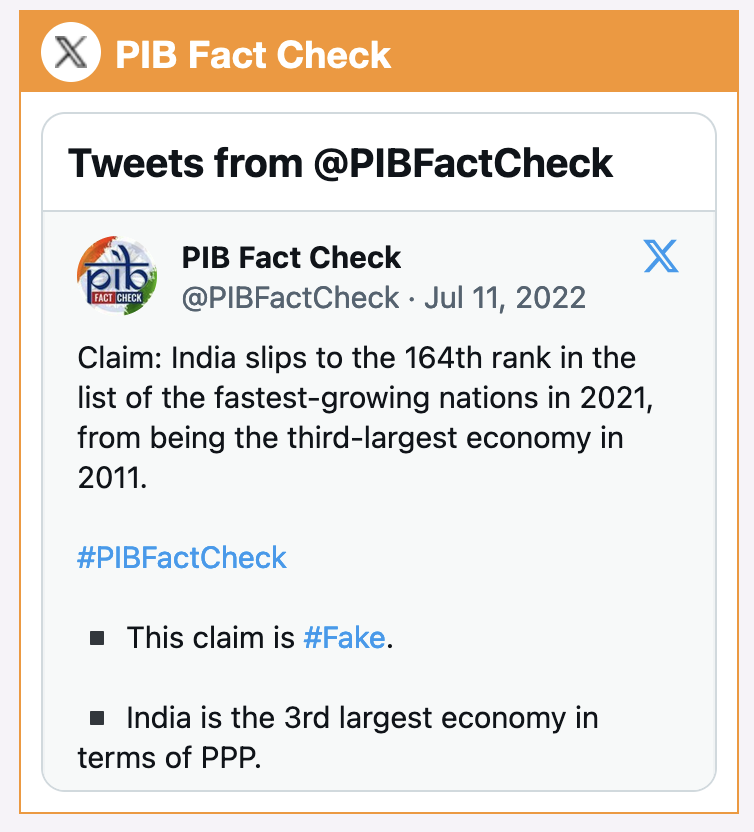
    MUMBAI:  Fake news perpetrators against the government in Delhi – whether on television, online or in print – had better watch out. The ministry of electronics and information technology (MeitY) along with the ministry of information and broadcasting has notified that the fact check unit (FCU) under the Press Information Bureau (PIB) shall be the central government’s watch dog. This has been done so under rule 3(1)(b)(v) of the of the Information Technology (Intermediary Guidelines and Digital Media Ethics Code) Rules, 2021 (IT Rules 2021). 

    Since November 2019, the FCU established under PIB has been effectively working with the purpose of tackling fake news pertaining to government policies, schemes, rules and regulations, programmes, initiatives, etc. Through an established rigorous fact-checking procedure, the PIB FCU’s goal is to help in dispelling myths, rumours and false claims, and provides accurate and reliable information to the public.

    Meanwhile in an update, the chief justice of India today stayed the notification of the FCU, stating that a challenge to the impugned rule involves serious constitutional questions. “The impact of rule on freedom of speech and expression will fall for analysis by the high court.” 

    (updated at 3:43 pm on 21 March 2024.)

  • WhatsApp bans 1.75 million Indian accounts in November 2021

    WhatsApp bans 1.75 million Indian accounts in November 2021

    Mumbai: Instant messaging and voice-over-IP service WhatsApp has banned more than 1.75 million accounts in India, while it received 602 grievance reports, according to its compliance report for November 2021. An Indian account is identified by a +91 phone number.

    The social media intermediary has published its sixth monthly report in accordance with the IT Rules 2021 which contains the details of the users’ complaints received and the corresponding action taken by WhatsApp, as well as the messaging service’s preventative actions to combat abuse on the platform.

    The company had previously stated that 95 per cent of the account bans are due to unauthorised use of automated or bulk messaging (spam), according to a report by PTI. In October, the messaging service banned over two million accounts and registered 500 grievance reports.

    In its latest report, the company revealed that out of 602 grievance reports, 149 users requested account support, 357 were ban appeals, 21 were other support, 48 were product support and 27 were for safety. Based on the reports received, the company took remedial action against 36 accounts that were flagged under ban appeals.

    The IT Rules 2021 which came into effect in May 2021 require digital platforms with over five million users to publish compliance reports every month, detailing complaints received and action taken.

  • No case has gone to tier-3 so far for Digital Media Ethics Code violation: SC justice Arjan Sikri

    No case has gone to tier-3 so far for Digital Media Ethics Code violation: SC justice Arjan Sikri

    Mumbai: Publishers of online curated content have successfully implemented the three-tiered redressal mechanism for addressing grievances regarding violations of the Digital Media Code of Ethics as set forth by the IT Rules 2021, said former Supreme Court justice Arjan Kumar Sikri. “No case has gone to tier-3 so far for Digital Media Ethics Code violation,” he noted.

    Sikri was addressing the Pixels conference organised by Internet and Mobile Association of India (IAMAI). He chairs IAMAI’s grievance redressal board formed as a part of the digital publisher content grievances council (DPCGC).

    “All complaints directly addressed to MIB/Inter-departmental Committee (level-3) should be pushed by the committee to be addressed by the platform (level-1) and then by the self-regulating body (level-2) before being taken by level-3. The exercise of adjudicatory powers by the executive branch of the Government, if not done judiciously, will jeopardize the freedom of digital entertainment in India,” he said.

    He further stated that the main concern of the industry is protecting intellectual rights in the digital entertainment space as well as addressing questions about data privacy. He added that ultimately when these issues come to regulators or courts, it is to be examined from the prism of – democracy, dissent, and the Constitution of India which guarantees freedom of speech under Article 19 (1) (a). He emphasized the need for an equilibrium between all the stakeholders, with minimal governmental control and maximum self-regulation to seamlessly regulate emerging sectors.

    The conference was also addressed by the Government of Telangana principal secretary for the industries and commerce department and information technology, electronics, and communications department Jayesh Ranjan.

    He stated that the Telangana government is looking to strengthen infrastructure for the sector. “We are setting up a facility of 1.4 million square feet in Hyderabad called image tower, which would be a hub of animation and VFX. We are confident that once the image tower is up and running this would be the new face of Hyderabad,” Sikri said.

  • MeitY releases FAQs to address queries on IT rules 2021

    MeitY releases FAQs to address queries on IT rules 2021

    Mumbai: The minister of state for electronics and information technology Rajeev Chandrasekhar has released a document clarifying the doubts and explaining the nuances of the due diligence to be followed by intermediaries as part of Information Technology (Intermediary Guidelines and Digital Media Ethics Code) Rules, 2021 (IT rules 2021).

    The FAQs are limited to part II of these rules to be administered by MeitY.

    “The government is committed to providing open, safe and trusted, and accountable internet to all users whose number is increasing both in urban and rural areas,” said Chandrasekhar.

    The FAQ consists of four sections, namely – Section I: Basic Information; Section II: Basic Terminology and Scope of the Rules; Section III: Due Diligence by an Intermediary; Section IV: Additional Due Diligence by Significant Social Media Intermediaries (SSMI); Section V: Non-Compliance to Intermediary Rules.

    Section I comprises of the basic information like- the objective of these rules; effective date; process followed in evolving these rules; major changes over the erstwhile Intermediary Guidelines Rules 2011; how these rules can be leveraged for enhancing the safety of women and children from potential harms; how these rules are also consistent with the requirement of safeguard against user’s privacy, freedom of speech and expression being fundamental rights; how a user can be benefitted, etc.

    Section II comprises the basic terminology and scope of the rules like – which entities can qualify as ‘intermediary,’ which intermediaries qualify as a ‘social media intermediary,’ and ‘significant social media intermediaries’ (SSMI), etc.

    Section III comprises the nuances of the due diligence to be followed by intermediaries like- information to be provided by the appropriate government, what and how much user information to be retained by an intermediary, prominently publishing of grievance officer details, adherence to various prescribed timeframes by an intermediary, etc.

    Section IV comprises the nuances of the additional due diligence to be followed by SSMI like- modalities in appointing designated manpower resources based in India, details of monthly compliance reports and their level of granularity, etc.

    Section V comprises the grounds of non-compliance to intermediary rules.