Tag: iSuppli

  • 63 mn IPTV subscribers by 2010: Study

    MUMBAI: California-based market research firm iSuppli has released a study that predicts that the number of subscribers to Internet Protocol Television (IPTV) services worldwide is expected to nearly triple in 2007.

    This will help drive a strong increase in sales of wired communications equipment and related semiconductors for the year.

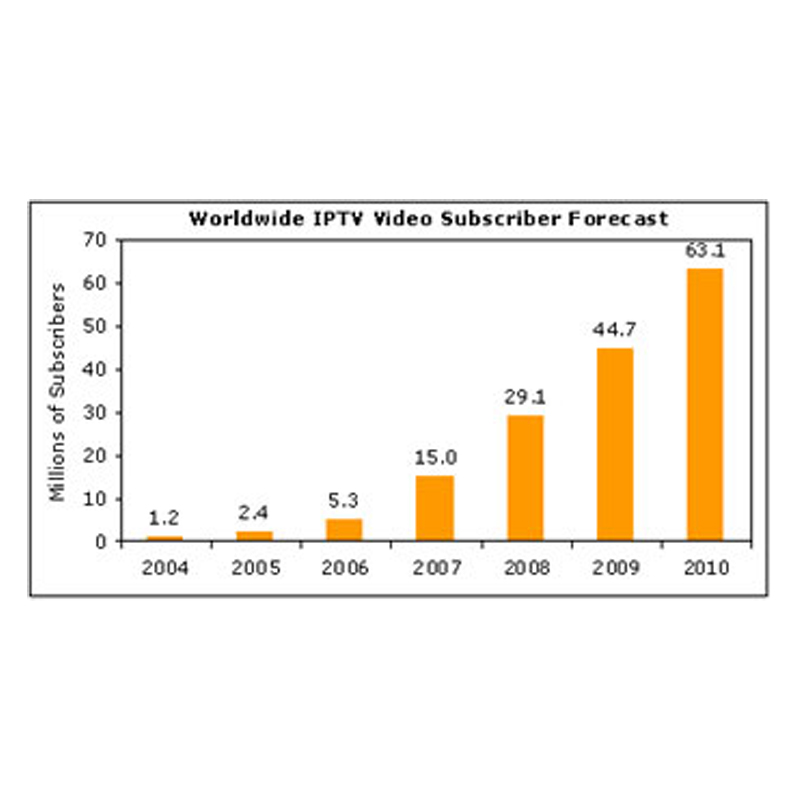
    Global IPTV subscribers will reach 14.5 million in 2007, up 192.4 per cent from 4.9 million in 2006, iSuppli predicts. By 2010, worldwide IPTV subscribers will amount to 63 million

    The study notes that in the long run, the Asia Pacific region will lead the global revolution in IPTV in terms of subscribers, service revenue, infrastructure etc. The region’s broadband penetration, supportive regulatory framework, will fuel the growth.

    China has potential; The US will be a difficult market for IPTV: Worldwide IPTV service revenue is forecast to reach $ 38 billion in the year 2009. The worldwide IPTV subscribers are forecasted to reach 53 million in the year 2009. The Americas and Western Europe are expected to be the biggest markets in terms of revenue per user basis.

    IPTV market potential varies highly across the world depending upon the local Pay-TV market and regulatory conditions. China will be the future IPTV dragon due to rapid urbanisation, fast growing economy and expanding middle class.

    The US will be a more difficult market for IPTV, due to high existing pay-TV penetration, and stiff price and service competition that is likely to come from the entrenched operators in the cable and satellite sectors. Consumer familiarity with IPTV service is very low although youth today are much more aware of it when compared with people belonging to other age groups. In terms of the principal barriers to IPTV adoption, the cost is by far and away the most significant factor across all countries and age groups.

  • IPTV subscriber base set for explosive growth: iSuppli

    IPTV subscriber base set for explosive growth: iSuppli

    MUMBAI: The worldwide subscriber base for Internet Protocol Television (IPTV) services is expected to expand by a factor of more than 26 from 2005 to 2010, spurring a competitive battle between video providers both old and new, iSuppli Corp. predicts.

    Global IPTV subscribers will grow to slightly more than 63 million in 2010, rising at a stunning Compound Annual Growth Rate (CAGR) of 92.1 per cent from 2.4 million in 2005, as presented in the figure below.

    The IPTV subscriber base will generate more than $27 billion in overall IPTV services revenue in 2010. While video services will account for the largest portion of these dollars, value-added media services and IPTV operator advertising will combine to represent more than 14 per cent of IPTV services revenue in 2010. Furthermore, across all IPTV services, the corresponding content licensing revenue will reach $11 billion in 2010.

    “The fight to capture the expanding base of IPTV subscribers will put telecom operators on a collision course with existing pay-TV market competitors and with a new class of broadband video portals as they roll-out progressively more sophisticated offerings,” said iSuppli vice president multimedia content and services Mark Kirstein.

    iSuppli categorises market deployment of IPTV services in three phases. The current global IPTV market is early in its first phase: basic service deployment. The second phase will add an array of value-added and interactive services. Phase three will bring dramatic improvements in integration and interactivity.

    Thus, in this pending battle for subscribers, providing a competitive video offering is merely the cost of entry for IPTV operators. Differentiation of IPTV services will be essential to bringing new capabilities to TV-based entertainment and attracting subscribers.

    Areas of differentiation will include:

    Interactivity, such as communication, community, voting, interactive advertising and television commerce (t-commerce).

    Integration across multiple platforms, across voice and data services and across content types, i.e. video, voice, music, gaming, data services and user content.
    Personalisation, including intelligent TV recommendations, individualised advertising and non-linear video programming, such as Video on Demand (VoD) and Digital Video Recording (DVR).

    Value-added services, including on-demand gaming, music, media applications, home networking management, security and data.

    Beyond the video service providers themselves, an array of companies will benefit from new opportunities arising from their roles as the “arms suppliers” for the battle over the next generation of television distribution. These companies include infrastructure gear manufacturers, set-top box makers, software vendors and semiconductor suppliers, iSuppli predicts.

    On a geographic basis, the European market has taken the early lead in the global IPTV market, both for subscribers and for revenue. However, Asia will generate faster growth than the other regions and will achieve the largest subscriber base by the end of this year. The Americas region will lead the world in terms of IPTV dollars starting this year because it will yield the highest Average Revenue Per User (ARPU).

  • Texas Instruments strengthens India presence; to set up new R&D center

    Texas Instruments strengthens India presence; to set up new R&D center

    MUMBAI: At a meeting with the press today hosted by Communications & IT minister Dayanidhi Maran, Texas Instruments Inc. (TI) outlined how continued support of open technology standards would enable India to reach its goal of 500 million mobile phone subscribers by 2010.

    TI Wireless Terminals Business Unit SVP Gilles Delfassy also announced that TI is increasing its wireless design presence in India with a new research and development (R&D) center in Chennai. TI’s history in India began with a research and development center in Bangalore more than 20 years ago, states an official release.

    “Mobile phone growth in India is nothing short of a phenomenon, and the wireless industry waits for India’s next move because of the impact it will have on the future of mobile phones,” says Delfassy. “Today, there is a huge opportunity to connect the unconnected as the majority of India’s population does not have access to communications services. TI has been committed to India for over 20 years, and I’m pleased to say that we are escalating our existing wireless design presence in recognition of the importance of India to the global wireless market.”

    Choosing efficient, cost-effective mobile technology will be critical to meet India’s burgeoning wireless growth, as will be the ability to stay at the forefront of innovation. Two open technologies that offer great promise for India are GSM and DVB-H. “Open standards such as GSM and DVB-H technologies for mobile phones will provide the market with greater choice, better value and more opportunities for innovation. Based on our 17 years experience as a leader in the wireless industry, working to make our customers successful, we believe the best way to enable growth is through open standards,” Delfassy adds.

    According to market research corporation iSuppli, GSM is the predominant technology in India. This year, the GSM growth rate in India is outpacing all other competing technologies. With a natural 3G migration path to GPRS/EDGE/UMTS, GSM offers an inherent advantage in driving this growth, points out the release.

    “GSM has proven to be a great fit for India because it offers choice in terms of products and services available. GSM not only offers entry-level phones for those who have never owned a mobile phone, it also provides mid- range feature phones and smartphones for the growing middle class. GSM stimulates innovation and open competition and ensures that consumers have easy access to a broad choice of operators, seamless roaming and billing across networks and the most cost-efficient handsets on the market,” says Delfassy.

    Delfassy noted that TI is committed to driving down handset costs with its “LoCosto” family of single-chip mobile phone solutions, which will accelerate wireless penetration in emerging high-volume markets like India. Low-cost handsets based on TI’s “LoCosto” platform are expected on the market in India later this year.

    Delfassy also addressed live broadcast TV on the mobile phone, a technology which is stirring interest in India, and the importance of open industry standards such as DVB-H to drive adoption of mobile DTV. DVB-H technology is an open industry standard that has become the predominant technology used to deploy mobile TV services around the world. More than 100 companies are developing or deploying services, components and devices based on DVB-H, and more than 300 million users have access to DVB-H.

    “Like GSM technology, DVB-H has a competitive environment, which fosters lower costs and spurs innovation. It’s no longer difficult to imagine watching a cricket game or a ‘Bollywood’ movie anywhere, anytime, right on your mobile phone — that vision is now a reality,” he says.

    Closing his remarks, Delfassy reiterated TI’s commitment to India and continued support of open standards.

    “TI has long believed India offers huge potential — as a market, as an innovator, and as a global provider of mobile phone technology and services. It is this belief that led us to build a development center in Bangalore over 20 years ago and to expand our presence with a new research and development center in Chennai. TI remains committed to providing products and services that open up the possibilities for mobile technology in India and that help operators and manufacturers here be successful. And we are determined to do all we can to help India realize its vision of 500 million mobile phone users within the next four years,” Delfassy concluded.

    Providing views on the benefits of GSM technology, India’s Cellular Operators Association drector general T.V. Ramachandran, said, “GSM continues to be the predominant driver of mobile growth, both internationally as well as in India. This standard is growing from strength to strength having recently crossed 2 billion subscribers worldwide. GSM’s global predominance is due to its several advantages which include open standards, interoperability, economies of scale, seamless global roaming, widespread prepaid solutions, rich and versatile value-added services. This standard is committed to bringing the benefits of connectivity to the common man and also fulfilling their aspirations for feature rich services that are available on the GSM platform. The single-chip solution by Texas Instruments is another important innovation that will further improve the affordability of the service and drive access.”

    TI is one of the leading manufacturers of wireless semiconductors, and provides a breadth of silicon and software and over 15 years of wireless systems expertise that spans handsets and base stations for all communications standards, wireless LAN, Bluetooth, A-GPS, mobile TV and Ultra Wideband.