Tag: ISTRAC

  • Indian, French space agencies sign pact; team up on moon mission, space launchers

    Indian, French space agencies sign pact; team up on moon mission, space launchers

    MUMBAI: Indian Space Research Organisation and French Space agency (CNES) have signed a partnership agreement in satellite launch technology. The pact was inked between ISRO chairman Kiran Kumar and CNES president Jean-Yves Le Gall in the presence of the visiting French Minister of Foreign Affairs Jean-Marc Ayrault.

    Space cooperation between India and France spans over 50 years and is a cornerstone of the Indo-French strategic partnership. Joining forces with Team Indus on this maiden private mission to land a rover on the moon, CNES is sending the French technology for the first time on lunar terrain.

    With the new pact, India and France will improve cooperation on an upcoming lunar rover and future space launchers. Strengthening the CNES-ISRO partnership will enable France to benefit from the Indian model of streamlining the costs of space programmes.

    Ayrault, accompanied by the French delegation, was given a guided tour of ISTRAC (ISRO Telemetry Tracking and Command Network) by the Kumar, according to a French Consulate release, PTI reported.

    ISTRAC monitors Indian space missions, including the two Indo-French satellites currently in orbit for collecting data to track climate change. ISRO is the second partner of CNES, in terms of volume, after NASA. Of comparable size and sharing similar objectives, the space programmes of both countries are complementary, it was noted.

    Later, Ayrault met Indian “NewSpace” start-up CEO Rahul Narayan. This start-up put forward TeamIndus, the only Indian team competing for the Google Lunar XPRIZE, a global competition for engineers and entrepreneurs to develop low-cost methods of robotic space exploration.

    Also Read:

    ISRO to launch 103 satellites early Feb


  • Indian, French space agencies sign pact; team up on moon mission, space launchers

    Indian, French space agencies sign pact; team up on moon mission, space launchers

    MUMBAI: Indian Space Research Organisation and French Space agency (CNES) have signed a partnership agreement in satellite launch technology. The pact was inked between ISRO chairman Kiran Kumar and CNES president Jean-Yves Le Gall in the presence of the visiting French Minister of Foreign Affairs Jean-Marc Ayrault.

    Space cooperation between India and France spans over 50 years and is a cornerstone of the Indo-French strategic partnership. Joining forces with Team Indus on this maiden private mission to land a rover on the moon, CNES is sending the French technology for the first time on lunar terrain.

    With the new pact, India and France will improve cooperation on an upcoming lunar rover and future space launchers. Strengthening the CNES-ISRO partnership will enable France to benefit from the Indian model of streamlining the costs of space programmes.

    Ayrault, accompanied by the French delegation, was given a guided tour of ISTRAC (ISRO Telemetry Tracking and Command Network) by the Kumar, according to a French Consulate release, PTI reported.

    ISTRAC monitors Indian space missions, including the two Indo-French satellites currently in orbit for collecting data to track climate change. ISRO is the second partner of CNES, in terms of volume, after NASA. Of comparable size and sharing similar objectives, the space programmes of both countries are complementary, it was noted.

    Later, Ayrault met Indian “NewSpace” start-up CEO Rahul Narayan. This start-up put forward TeamIndus, the only Indian team competing for the Google Lunar XPRIZE, a global competition for engineers and entrepreneurs to develop low-cost methods of robotic space exploration.

    Also Read:

    ISRO to launch 103 satellites early Feb


  • PSLV-C34 successfully launches 20 satellites in a single flight

    PSLV-C34 successfully launches 20 satellites in a single flight

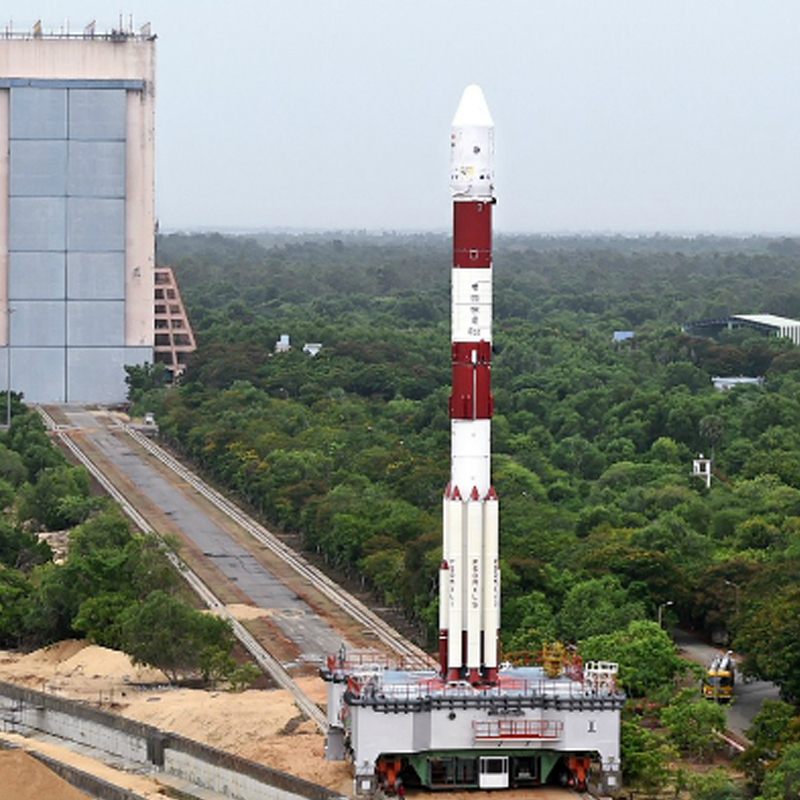
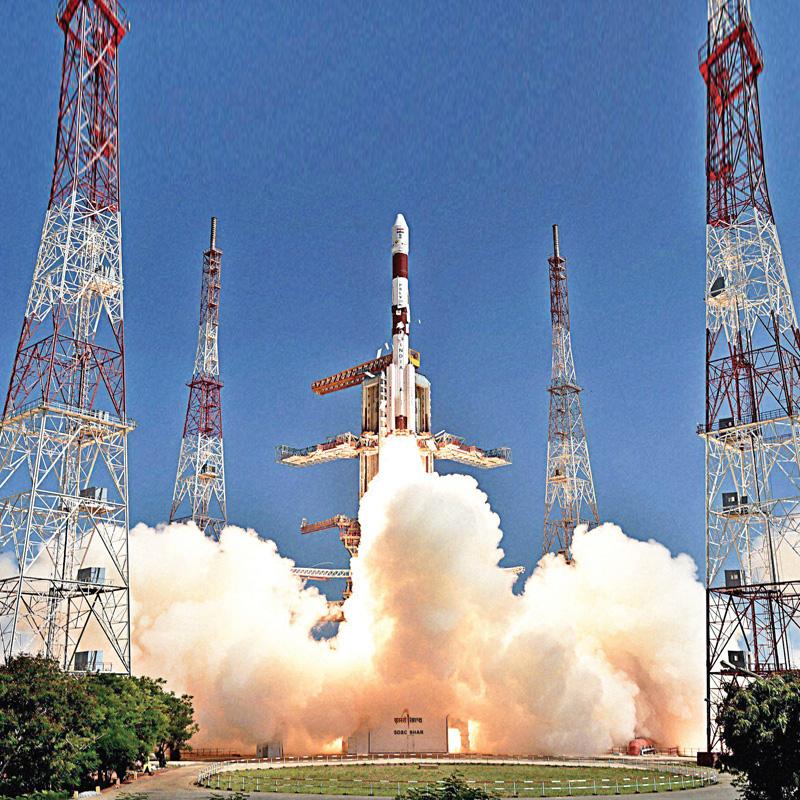
    MUMBAI: In its thirty sixth flights (PSLV-C34), ISRO’s Polar Satellite launch Vehicle successfully launched the 727.5 kg Cartosat-2 Series Satellite along with 19 co-passenger satellites today morning (June 22, 2016) from Satish Dhawan Space Centre SHAR, Sriharikota. This is the thirty fifth consecutively successful mission of PSLV and the fourteenth in its ‘XL’ configuration.  The total weight of all the 20 satellites carried on-board PSLV-C34 was 1288 kg.

    After PSLV-C34 lift-off at 0926 hrs (9:26 am) IST from the Second Launch Pad with the ignition of the first stage, the subsequent important flight events, namely, strap-on ignitions and separations, first stage separation, second stage ignition, heat-shield separation, second stage separation, third stage ignition and separation, fourth stage ignition and cut-off, took place as planned. After a flight of 16 minutes 30 seconds, the satellites achieved a polar Sun Synchronous Orbit of 508 km inclined at an angle of 97.5 degree to the equator (very close to the intended orbit) and in the succeeding 10 minutes, all the 20 satellites successfully separated from the PSLV fourth stage in a predetermined sequence.

    After separation, the two solar arrays of Cartosat-2 series satellite were deployed automatically and ISRO’s Telemetry, Tracking and Command Network (ISTRAC) at Bangalore took over the control of the satellite. In the coming days, the satellite will be brought to its final operational configuration following which it will begin to provide remote sensing services using its panchromatic (black and white) and multispectral (colour) cameras.

    The imagery sent by the Cartosat-2 series satellite will be useful for cartographic applications, urban and rural applications, coastal land use and regulation, utility management like road network monitoring, water distribution, creation of land use maps, precision study, change detection to bring out geographical and manmade features and various other Land Information System (LIS) and Geographical Information System (GIS) applications.

    Of the 19 co-passenger satellites carried by PSLV-C34, two – SATHYABAMASAT weighing 1.5 kg and SWAYAM weighing 1 kg – are University/Academic institute satellites and were built with the involvement of students from Sathyabama University, Chennai and College Of Engineering, Pune, respectively.

    The remaining 17 co-passenger satellites were international customer satellites from Canada (2), Germany (1), Indonesia (1) and the United States (13). 

    With today’s successful launch, the total number of satellites launched by India’s workhorse launch vehicle PSLV has reached 113, of which 39 are Indian and the remaining 74 from abroad.

  • PSLV-C34 successfully launches 20 satellites in a single flight

    PSLV-C34 successfully launches 20 satellites in a single flight

    MUMBAI: In its thirty sixth flights (PSLV-C34), ISRO’s Polar Satellite launch Vehicle successfully launched the 727.5 kg Cartosat-2 Series Satellite along with 19 co-passenger satellites today morning (June 22, 2016) from Satish Dhawan Space Centre SHAR, Sriharikota. This is the thirty fifth consecutively successful mission of PSLV and the fourteenth in its ‘XL’ configuration.  The total weight of all the 20 satellites carried on-board PSLV-C34 was 1288 kg.

    After PSLV-C34 lift-off at 0926 hrs (9:26 am) IST from the Second Launch Pad with the ignition of the first stage, the subsequent important flight events, namely, strap-on ignitions and separations, first stage separation, second stage ignition, heat-shield separation, second stage separation, third stage ignition and separation, fourth stage ignition and cut-off, took place as planned. After a flight of 16 minutes 30 seconds, the satellites achieved a polar Sun Synchronous Orbit of 508 km inclined at an angle of 97.5 degree to the equator (very close to the intended orbit) and in the succeeding 10 minutes, all the 20 satellites successfully separated from the PSLV fourth stage in a predetermined sequence.

    After separation, the two solar arrays of Cartosat-2 series satellite were deployed automatically and ISRO’s Telemetry, Tracking and Command Network (ISTRAC) at Bangalore took over the control of the satellite. In the coming days, the satellite will be brought to its final operational configuration following which it will begin to provide remote sensing services using its panchromatic (black and white) and multispectral (colour) cameras.

    The imagery sent by the Cartosat-2 series satellite will be useful for cartographic applications, urban and rural applications, coastal land use and regulation, utility management like road network monitoring, water distribution, creation of land use maps, precision study, change detection to bring out geographical and manmade features and various other Land Information System (LIS) and Geographical Information System (GIS) applications.

    Of the 19 co-passenger satellites carried by PSLV-C34, two – SATHYABAMASAT weighing 1.5 kg and SWAYAM weighing 1 kg – are University/Academic institute satellites and were built with the involvement of students from Sathyabama University, Chennai and College Of Engineering, Pune, respectively.

    The remaining 17 co-passenger satellites were international customer satellites from Canada (2), Germany (1), Indonesia (1) and the United States (13). 

    With today’s successful launch, the total number of satellites launched by India’s workhorse launch vehicle PSLV has reached 113, of which 39 are Indian and the remaining 74 from abroad.

  • Space capsule recovered

    Space capsule recovered

    MUMBAI: The Space capsule Recovery Experiment (SRE-1) that was launched by Polar Satellite Launch Vehicle (PSLV-C7) from Satish Dhawan Space Centre (SDSC) SHAR Sriharikota on 10 January, was successfully recovered today after being maneuvered to reenter the earth’s atmosphere and descend over Bay of Bengal about 140 km East of Sriharikota.

    Since its launch, SRE-1 was going round the earth in a circular polar orbit at an altitude of 637 km. In preparation for its reentry, SRE-1 was put into an elliptical orbit with a perigee (nearest point to earth) of 485 km and an apogee (farthest point to earth) of 639 km by issuing commands from the Spacecraft Control Centre (SCC) of ISTRAC at Bangalore on January 19, 2007. The critical de-boost operations were executed from SCC, Bangalore supported by a network of ground stations at Bangalore, Lucknow, Mauritius, Sriharikota, Biak in Indonesia, Saskatoon in Canada, Svalbard in Norway besides shipborne and airborne terminals.

    The recovery operations were supported and carried out by the Indian Coast Guard and Indian Navy using ships, aircraft and helicopters.

    During its stay in orbit for the last 12 days, the two experiments on board SRE-1 were successfully conducted under micro gravity conditions. One of the experiments was related to study of metal melting and crystallizations under micro gravity conditions. The second experiment, designed by National Metallurgical Laboratory, Jamshedpur, was intended to study the synthesis of nano-crystals under micro gravity conditions. This experiment can help in designing better biomaterials having closest proximity with natural biological products. The experimental results will be analysed in due
    course by the principal scientific investigators of the two experiments.

    The successful launch, in-orbit operation of the on board experiments and reentry and recovery of SRE-1 has demonstrated India’s capability in important technologies like aero-thermo structures, deceleration and flotation systems, navigation, guidance and control. SRE-1 is an important
    beginning for providing a low cost platform for micro-gravity experiments in space science and technology and return specimen from space.