Tag: ISRO

  • Doordarshan’s regional services to shift to new satellite

    Doordarshan’s regional services to shift to new satellite

    NEW DELHI: The regional language channels of Doordarshan will be off air for about five hours on 10 December to enable a shift to a new satellite.


    The Regional services, currently being beamed from INSAT-3A are being shifted to INSAT-4B with effect from 10 December.


    This is being done in view of End of Life (EOL) of INSAT-3A as declared by Indian Space Research Organisation (ISRO).


    Four new transponders have been provided for these channels on INSAT-4B by ISRO.


    The services will remain off air from 00:00 to 05:00 hrs on 10 December.

  • Arianespace launches GSAT-15 successfully

    Arianespace launches GSAT-15 successfully

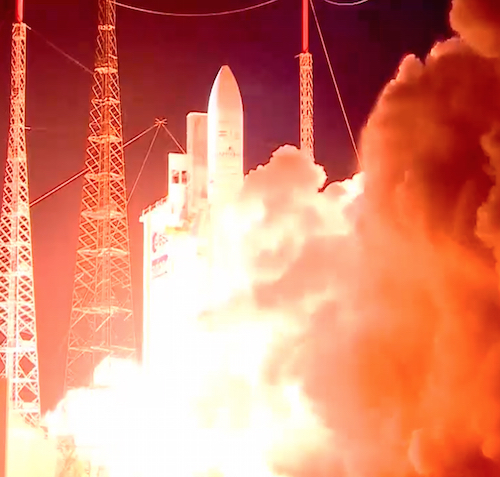
    MUMBAI: At 3:04 this morning, Arianespace’s A5 rocket blasted off from its launch pad in Kouru, French Guiana with its payload of two satellites Arabsat 6B (BADR7) and GSAT-15. The former found its slot in space 27 minutes later, while the latter attained its Geosynchronous Transfer Orbit (GTO) 43 minutes after launch.  It was a flawless launch on a perfect evening, said officials from ISRO and Arianespace.


    India’s satellite control centre at Hasan in Karnataka is in control of the satellite  at the time of writing and maneuvres over the next three days will see it attaining its geo-stationary orbit at 93.5 degrees East. It will be replacing two ageing satellites Insat3A and Insat 4B.


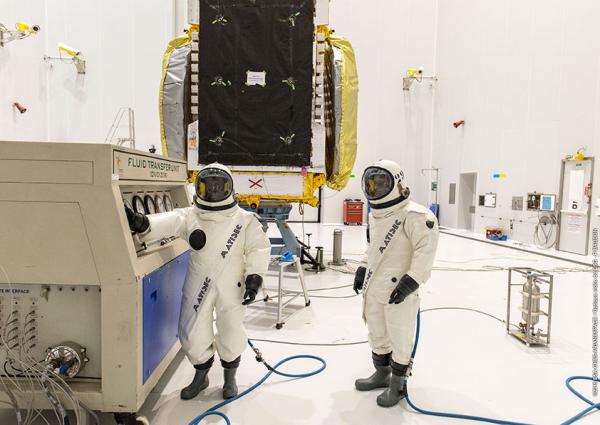
    GSAT-15 has 24 Ku-band transponders to serve the needs of DTH and satellite TV operators over India as well as  VSAT operators who provide DSNG operations to news channels. It  also carries the  GPS-Aided GEO Augmented Navigation (GAGAN) payload operating in L1 and L5 bands,  to enable communications for civil aviation and other location-based services.


    Speaking from Kouru ISRO Satellite Centre (ISAC) Director M Annadurai said two other  communication satellites GSAT-17 and GSAT-18 are getting ready for launch by an Ariane vehicle in the next year. “The realisation of both the satellites is in a very advanced stage,” he said.


  • ISRO’s GSAT-15 launch on 11 November; DTH to benefit

    ISRO’s GSAT-15 launch on 11 November; DTH to benefit

    NEW DELHI: Even as Indians are celebrating the festival of lights, a new bird  from the Indian Space Research Organisation (ISRO) is set to be blasted off into geostationary orbit come early 11 November from Kouro in French Guiana.  The satellite GSAT-15 – with its 24 Ku-band transponders – is going to provide a lifeline to India’s DTH television operators.


    It is currently waiting at the launch pad as a payload of an Ariane 5 Rocket  – launch firm Arianespace’s trusted launcher – in launch complex No 3 in Kouru. The satellite cost – including the launch fee – is at Rs 860 crore.


    The GSAT-15 will replace two older birds – INSAT-3A and INSAT-4B – both are which are at the fag end of their lives. INSAT 3A will expire in November while 4b will cease functioning later next year.


    Most of the transponder capacity on these two satellites is being utilized by Prasar Bharati’s DD and  DTH operators FreeDish and  Sun Direct, according to satellite TV tracker Lyngsat.


    GSAT-15 will thus see these services being shifted to its transponders, which will also serve the needs of VSAT operators who offer Digital satellite news gathering operations to India’s news channels. It will also be carrying as a GPS-Aided GEO Augmented Navigation (GAGAN) payload operating in L1 and L5 bands as  a backup service for airlines and other users of augmented GPS-based system.  According to ISRO, it has a design life of 12 years and its weight will be 3,164 kg at lift-off


    The Ariane-5 VA-227 launch vehicle, which will launch GSAT 15, will also carry Arabsat-6B for Arabsat, Saudi Arabia. Arabsat-6B, to be renamed BADR-7 once in orbit, will be the ninth satellite orbited by Arianespace for use by the operator Arabsat, based in Riyadh, Saudi Arabia. It is the initial sixth-generation satellite for Arabsat’s fleet, providing broadcast, broadband and telecommunications services over the Middle East, Africa and Central Asia.


    The Ariane 5 mission will have a total payload lift performance of 9,810 kg, Arianespace said. This includes the two satellites’ mass at liftoff – 5,798 kg for Arabsat-6B and 3,164 kg for GSAT-15 – along with launcher integration hardware and Ariane 5’s dual-passenger deployment system, it added.


    The launch is planned to take place during a launch window of 21:34 and 22:17 pm coordinated universal time (around 03:04 am IST).


    Interested viewers can watch it live on http://www.arianespace.tv.

  • Miditech’s Pria Alva films Mangalyaan’s journey for Nat Geo

    Miditech’s Pria Alva films Mangalyaan’s journey for Nat Geo

    MUMBAI: Detailed interviews, extensive research, narrations, advanced animation and modeling will orchestrate Miditech executive director Pria Somiah Alva’s documentary on India’s Mars triumph Mangalyaan. The successful landing of Mangalyaan drove Alva to document the voyage.


    “India is the first country to succeed in the first attempt and just news headlines were not enough to describe such a great journey. So we decided to film a documentary on the entire journey,” Alva tells Indiantelevision.com.


    The research started in 2014 when Alva and her associate director Shivani Muthanna approached the Indian Space Research Organisation (ISRO) with the proposition. ISRO’s reaction was fascinating for Alva and her team at Miditech. “Normally private bodies don’t get permission to film in ISRO, it’s always Doordarshan. But we got superior cooperation from them and we accessed many important properties of the research organisation,” says Alva.


    The project was commissioned by National Geographic Channel and will be aired on 5 November, 2015 – exactly two years after the entire mission was actually successful.

    Working on a tight budget, Alva and her team did the best they could with the means available to them for the Mangalyaan documentary.


    With ISRO’s nod, Miditech received access to archival footage, which Alva used in the documentary to explain the journey. “This is a post launch documentary so we had to narrate and create the dramatics of how it all came together and happened. In the documentary we have used archival footage as well as some live footage, which we shot,” informs Alva.


    The camera that was attached with the spaceship only had features of clicking imageries of its surroundings and not itself. Hence there were no images available of the scientific vehicle that travelled the distance and that’s where Alva made use of Computer Generated Imagery (CGI).

    “We went for CGI, special effects and 3D modelling to give viewers an idea of how it was. We imagine the space vehicle to be a something humongous in size, but in reality it’s not even as big as an auto-rickshaw. We have left no stones unturned to make the images look as exquisite as possible,” Alva emphasises.

    Through the course of the hour long documentary, interviews with various stakeholder will narrate the on screen occurrences more often than not. However, wherever required, Andre Williams’ voice will chip in to educate the viewers.


    Alva had her share of memorable moments while directing the  documentary. Describing one of them she narrates, “I has asked the ISRO spokesperson if there were any women involved in the entire journey. He replied saying please don’t ask us stupid questions. We are scientists and we do not discriminate between genders.”


    It is said “We be what we see” and hence it was important to showcase women involvement. When asked if there are substantial presence of women in the documentary, Alva says, “We will see the Eves working in the background throughout the documentary, be it navigations, communications or in any other depertments their presence is prominent. Moreover, we have a few women in the list of people that we interviewed. We did not interview them because they are women but because of their noteworthy role in the success.”


    When a documentary is created on scientific projects, it becomes a presentation, which only people with immense knowledge in the field can interpret. And therein lay the biggest challenge for Alva and her team. Making the documentary easy to follow for people with basic knowledge of the happenings and at the same time factually correct and scientifically perfect was what kept Alva and her team on their toes.

    “We have kept it in such a way that people from across the stream can understand and enjoy the documentary. The dramatics will get people involved with the documentary and we have engineered a suitable sound to back that,” she informs.

    In recent times people flocked to the theatres in India when Christopher Nolan’s Interstellar and Alfonso Cuarón’s Gravity were screened. Now it remains to be seen how the nation reacts to this one of a kind documentary – Mangalyaan – filmed on a one of a kind voyage marking India’s first venture into the interplanetary space.

  • Nat Geo partners ISRO to showcase Mangalyaan: India’s Mission to Mars

    Nat Geo partners ISRO to showcase Mangalyaan: India’s Mission to Mars

    MUMBAI: With a view to increase its focus original productions in India, National Geographic Channel has partnered with the Indian Space Research Organisation (ISRO) to celebrate the successful space mission to Mars – Mangalyaan or Mars Orbiter Mission (MOM).


    The channel will premiere an exclusive one-hour special documentary on India’s first interplanetary mission – Mangalyaan: India’s Mission to Mars on 5 November at 10 pm, which also happens to the date when the mission was launched two years back. Mangalyaan entered the Martian orbit on 24 September, 2014.


    Nat Geo will capture Mangalyaan’s journey of over 650 million km through live action visuals, graphic representations and expert interviews. The documentary will feature all the excitement, last minute preparations, the countdown and the successful launch of the mission.


    Commenting on the success of Mangalyaan, ISRO chairman A S Kiran Kumar said, “It was a proud moment for our team, and in fact for the entire country, when Mangalyaan successfully entered the Martian orbit. We are glad that a brand like National Geographic Channel has partnered us in showcasing not only this historic journey, but also the science and technology behind it. This documentary will give viewers an exquisite glimpse into the Mangalyaan journey, the salient features of the mission, and the major milestones accomplished by the team behind it.”


    Fox International Channels (India) business head Swati Mohan added, “Nat Geo is pleased to be associated with ISRO in showcasing the success of Mars Orbiter Mission. Nat Geo has been a pioneer in showcasing landmark events and ‘Mangalyaan: India’s Mission to Mars’ is another breakthrough production that underlines our focus on original productions in India. To showcase the scale of this mission, our special episode will feature the subject experts who will not only explain the nuances behind this delicate technology, but also demonstrate the subtle nature of this inter planetary mission.”

  • ISRO’s Antrix directed to pay $670+ million as damages to Devas

    ISRO’s Antrix directed to pay $670+ million as damages to Devas

    NEW DELHI: Indian Space Research Organisation’s (ISRO) commercial arm Antrix has been ordered to pay compensation and damages totalling $672 million to Devas Multimedia.


    The directive was given by the International Chamber of Commerce’s International Court of Arbitration, which was wholly in favour of Devas.


    The Bangalore-based Devas argued that ISRO/Antrix were liable for “unlawfully terminating [an] agreement in February 2011.”


    The Court’s decision was unanimous and stated that ISRO/Antrix “had no legal justification for terminating the agreement.”


    The 11-year old Devas deals with innovation and services in satellite communications.


    The agreement provided for Devas securing 70 MHz of S-band capacity from ISRO by means of leasing 90 per cent of the capacity aboard GSat-6 and GSat-6A satellites. Devas was to pay $300 million to ISRO over the following 12 years.


    The $672 million award to Devas will grow at a rate of 18 per cent per annum until paid, the International Court said. 


    In a statement, Devas said, “Devas Multimedia and its shareholders, including highly regarded international investors, are pleased that the ICC Tribunal unanimously ruled in its favour and found that Antrix is liable for unlawfully terminating the Devas-Antrix agreement in February 2011. The ICC Tribunal also awarded damages and pre-award interest totalling $672 million to Devas with post-award interest accruing at 18 per cent per annum on that sum until the award is fully paid.” 


    “Devas is hopeful that Antrix will now live up to its legal obligations and pay the award so that this dispute that arose during the prior government can be brought to a swift close,” the company added.

  • ISRO successfully launches Astrosat along with six foreign satellites

    ISRO successfully launches Astrosat along with six foreign satellites

    MUMBAI: The Indian Space Research Organisation (ISRO) has been having a swell 2015. Just a few days after its Mars Orbiter completed a successful one year around the Red planet, ISRO has now launched its first dedicated multi wavelength space observatory along with six foreign customer satellites.


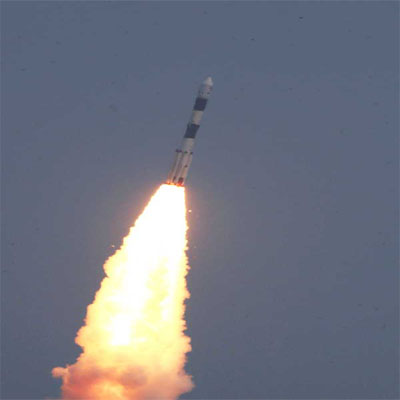
    In its 31st flight (PSLV-C30) conducted today (28 September, 2015), India’s Polar Satellite Launch Vehicle (PSLV) successfully launched Astrosat – multi wavelength space observatory and six foreign customer satellites into a 644.6 X 651.5 km orbit inclined at an angle of 6 deg to the equator. The achieved orbit is very close to the intended one. This was the thirtieth consecutive success for PSLV.


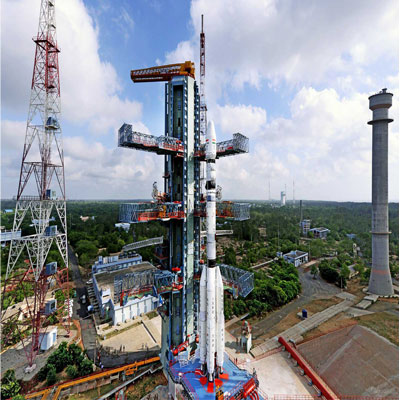
    PSLV was launched in its heaviest ‘XL’ version with six strap-on motors of the first stage. The launch took place from the First Launch Pad at the Satish Dhawan Space Centre SHAR (SDSC SHAR), Sriharikota, the spaceport of India.


    The 320 tonne, 45 m tall PSLV-C30 carrying seven satellites including the 1513 kg Astrosat, lifted off at 10:00 Hrs IST. About 22 minutes after lift-off, Astrosat was successfully placed in orbit and separated from the fourth stage of PSLV-C30. The separation of all the six co-passenger satellites was completed in the subsequent three minutes. The seven satellites carried by PSLV-C30 together weighed about 1631 kg at lift-off. 


    After a 50 hour smooth count down, the 320 ton PSLV-C28 was launched with the ignition of its first stage. The important flight events included the ignition and separation of the strap-ons, separation of the first stage, ignition of the second stage, separation of the payload fairing after the vehicle had cleared the dense atmosphere, second stage separation, third stage ignition and third stage separation, fourth stage ignition and fourth stage cut-off.  


    Through 30 successful flights during 1994-2015 period, PSLV has launched a total of 84 satellites including the seven satellites successfully launched today. The vehicle has repeatedly proved its reliability and versatility by successfully launching satellites into a variety of orbits including polar Sun Synchronous, Geosynchronous Transfer and Low Earth orbits of small inclination thereby emerging as the workhorse launch vehicle of India. 


    So far, 51 satellites have been launched by PSLV for customers from abroad. Today’s launch of six co-passenger satellites by PSLV-C30 was facilitated by Antrix Corporation Limited, the commercial arm of ISRO, a government of India Company under the Department of Space (DOS). 


    Soon after its separation from PSLV-C30, the two solar arrays of Astrosat were automatically deployed and the Spacecraft Control Centre at the Mission Operations Complex of ISRO Telemetry, Tracking and Command Network (ISTRAC) at Bangalore took control of Astrosat.


    Astrosat is India’s first dedicated multi wavelength space observatory. This scientific satellite mission endeavours for a more detailed understanding of our universe. Astrosat is designed to observe the universe in the Visible, Ultraviolet, low and high energy X-ray regions of the electromagnetic spectrum simultaneously with the help of its five payloads. 


    Astrosat was realised by ISRO with the participation of all major astronomy institutions including Inter University Centre for Astronomy and Astrophysics (IUCAA) of Pune, Tata Institute of Fundamental Research (TIFR) at Mumbai, Indian Institute of Astrophysics (IIAP) and Raman Research Institute (RRI) of Bangalore as well as some of the Universities in India and two institutions from Canada and the UK.


    In the coming days, Astrosat will be brought to the final operational configuration and all its five scientific payloads will be thoroughly tested before the commencement of regular operations.

  • ISRO to receive Gandhi Peace Prize for 2014

    ISRO to receive Gandhi Peace Prize for 2014

    NEW DELHI: The Indian Space Research Organisation (ISRO) will receive the Gandhi Peace Prize for the year 2014.


    The prize will be presented by President Pranab Mukherjee at a function at Rashtrapati Bhavan. 


    The Gandhi Peace Prize was instituted by the Government in 1995 on the occasion of the 125th birth anniversary of Mahatma Gandhi.


    This annual award is given to individuals and institutions for their contributions towards social, economic and political transformation through non-violence and other Gandhian methods. 


    ISRO works with the vision to “harness space technology for national development, while pursuing space science research and planetary exploration.”


    Formed in 1969, ISRO superseded the erstwhile Indian National Committee for Space Research (INCOSPAR), which was established in 1962 by the efforts of independent India’s first Prime Minister Jawaharlal Nehru and his close aide and reputed scientist Dr. Vikram Sarabhai. The establishment of ISRO thus institutionalised space activities in India. 


    ISRO built India’s first satellite, Aryabhata, which was launched by the Soviet Union on 19 April in 1975. In 1980, Rohini became the first satellite to be placed in orbit by an Indian-made launch vehicle, SLV-3. ISRO subsequently developed two other rockets: the Polar Satellite Launch Vehicle (PSLV) for launching satellites into polar orbits and the Geosynchronous Satellite Launch Vehicle (GSLV) for placing satellites into geostationary orbits. These rockets have launched numerous communications satellites and earth observation satellites. Satellite navigation systems like Gagan and IRNSS have been deployed. In January 2014, ISRO successfully used an indigenous cryogenic engine in a GSLV-D5 launch of the GSAT-14.


    On 22 October, 2008, ISRO sent its first mission to the Moon, Chandrayaan-1. On 5 November, 2013, ISRO launched its Mars Orbiter Mission (MOM), which successfully entered Mars orbit on 24 September, 2014, making India the first nation to succeed on its first attempt, and ISRO the fourth space agency in the world and first Asian space agency to reach Mars orbit. 


    The space agency’s future plans include development of GSLV Mk III (for launch of heavier satellites), development of a reusable launch vehicle, human spaceflight, further lunar exploration, interplanetary probes, a solar spacecraft mission, etc.


    ISRO has conducted a variety of operations for both Indian and foreign clients. It has several field installations as assets, and co-operates with the international community as a part of several bilateral and multilateral agreements. As many as 41 foreign satellites have been launched by ISRO’s launch vehicles.

  • ISRO successfully launches communication satellite GSLV-D6

    ISRO successfully launches communication satellite GSLV-D6

    MUMBAI: The Indian Space Research Organisation (ISRO) has successfully launched the communication satellite GSLV-D6. 


    GSLV-D6 will launch 2117 kg GSAT-6, an advanced communication satellite, into a GTO. GSAT-6 will provide S-band communication services in the country. After reaching GTO, GSAT-6 will use its own propulsion system to reach its final geostationary orbital home and will be stationed 0 at 83 East longitude.


    This is the ninth flight of India’s Geosynchronous Satellite Launch Vehicle (GSLV). It is also the fifth developmental flight of GSLV. This is the third time the indigenously developed Cryogenic Upper Stage (CUS) is being carried on-board during a GSLV flight.


    GSLV-D6 flight is significant since it intends to continue the testing of CUS. GSLV is designed to inject two ton class of communication satellites into Geosynchronous Transfer Orbit (GTO).


    GSLV-D6 was launched from the second launch pad at Satish Dhawan Space Centre SHAR (SDSC SHAR), Sriharikota.


    GSLV-D6 vehicle is configured with all its three stages including the CUS similar to the ones successfully flown during the previous GSLV-D5 mission in January 2014. GSLV-D5 successfully placed GSAT-14 satellite carried on-board in the intended GTO very accurately.


    The metallic payload fairing of GSLV-D6 has a diameter of 3.4 m. The overall length of GSLV-D6 is 49.1 m with a lift-off mass of 416 t.


    The CUS being flown in GSLV-D6 is designated as CUS-06. The main engine and two smaller steering engines of CUS together develop a nominal thrust of 73.55 kN in vacuum. During the flight, CUS fires for a nominal duration of 720 seconds.


    S-band telemetry and C-band transponders enable GSLV-D6 performance monitoring, tracking, range safety/flight safety and Preliminary Orbit Determination (POD).

  • ISRO to increase transponder capacity for Indian DTH players to use INSAT

    ISRO to increase transponder capacity for Indian DTH players to use INSAT

    NEW DELHI: With five Direct-to-Home (DTH) service providers using transponder capacity leased from foreign satellites, the Indian Space Research Organization (ISRO) is taking measures to augment satellite capacity in India so that these users have the option to migrate to the INSAT system. 


    Giving this information, Space Department Minister Jitenda Singh told the Lok Sabha today that ISRO has given a proposal for pricing of satellite transponders for public and non-government users.


    A proposal for continuing the existing method of transponder pricing, which is based on type of services, band of operations, coverage area, power level is under consideration. 


    There are 13 INSAT/GSAT satellites in orbit, out of which 11 are communication satellites and two are meteorological satellites. In INSAT/GSAT communication satellite systems, there are about 37 Government users and about 49 non-Government users. 


    The transponder characteristics in terms of power, coverage, frequency band, etc., vary according to the type of service, which requires differential pricing.