Tag: ISP

  • Cisco powers Siti Cable’s DOCSIS 3.0 technology for broadband

    Cisco powers Siti Cable’s DOCSIS 3.0 technology for broadband

    MUMBAI: Siti Cable, that controls nearly 4.3 million digital cable TV subscribers, has chosen Cisco to boost its broadband. The tech company will provide DOCSIS 3.0 technology for its broadband service in the country.

    Through this, the MSO will be offering speed of up to 100 mbps. DOCSIS 3.0 can offer download speed of upto 300 mbps per subscriber and the upload capacity up to 100 mbps. As earlier reported by indiantelevision.com, this technology has been launched in Delhi and NCR.

    Speaking on the association, Siti Cable CEO VD Wadhwa said, “It is an absolute pleasure to be introducing our broadband service. We plan to accelerate the deployment to capitalise on the enormous business potential this market currently holds. With the deployment of this technology, we are uniquely positioned to offer superior Internet browsing, video streaming, video surveillance and rich media content on the same coaxial cable that delivers high-quality digital cable TV signals. We will offer much higher speed at highly competitive price. We are confident that Cisco’s technological expertise will help us in the achievement of this goal.”

    Cisco India and SAARC service provider sales managing director Sanjay Kaul said, “It is commendable to see Cisco’s vision, to be the leading enabler of ICT (Information and Communications Technology) and broadband acceleration in India, coming closer to reality. We believe that the cable TV industry has the potential to transform the broadband industry in India and would like to congratulate Siti Cable for marking an important milestone on this roadmap.”


  • Cancel all Reliance Jio Spectrum licences, says CAG

    Cancel all Reliance Jio Spectrum licences, says CAG

    NEW DELHI: The nationwide broadband spectrum allocated to Infotel Broadband Services, now a Reliance Industries company, should be cancelled for allegedly rigging the auction and violating rules, says the Comptroller and Auditor General (CAG).

    In a draft report sent to the Department of Telecom for comments, CAG said, “The DoT failed to recognise the tell-tale sign of rigging of the auction right from beginning of the auction” in which a small ISP, Infotel Broadband Services (IBSPL) emerged winner of pan-India broadband spectrum by paying 5,000 times of its networth.

    The draft report says IBSPL which is ranked 150th in the list of ISP submitted an earnest money deposit of Rs 252.50 crore “through the covert and overt assistance of third party/private bank”, bid for Rs 12,847.77 crore (5000 times of its networth) for pan-India spectrum and then sold the company on the day of completion of the auction.

    According to the draft report, these “indicated IBSPL’s collusion and sharing of the confidential information with a third party in violation of auction conditions/rules.”

    According to news agency reports, the Mukesh Ambani-promoted RIL, which acquired IBSPL within hours of it winning the spectrum and later renamed it Reliance Jio, outrightly rejected any suggestion whereby spectrum was acquired in any manner other than through a transparent bidding process duly supervised by the Government. It also noted that this was not the final report as the DoT had not sent its comments.


    An RIL spokesperson said the auction for the BWA spectrum was one of the most competitive auctions in the Indian telecom history which fetched final bid price more than six times the reserve price for the pan-India spectrum.


    On bank guarantee, the spokesperson said according to the NIA, bidders were required to submit bank guarantee for desired amount as earnest money deposit (EMD) along with its application. “EMD was based on specific deposit requirement for each telecom circle. Accordingly, IBSPL submitted a bank guarantee of Rs 253 crore in format as prescribed in NIA. Since no money was deposited as EMD, the question of source of deposit does not arise,” the spokesperson said.


    The draft CAG report said, “Due to inclusion of inadequate eligibility criterion for participation in the auction, the promoters of the IBSPL enriched themselves and made unfair gain.” 


    CAG rejected DoT’s response that the eligibility criterion for participation in the auction was finalised after due diligence and on sector regulator TRAI’s recommendations saying it was the department’s responsibility to ensure that only serious ISPs participated in the auction.


    DoT in its response admitted that there was no eligibility criterion with respect to minimum net worth or paid up capital for participation in the auction.


    “Neither the top management of the DoT nor the important committees could detect these tell tale signs of collusion and sharing of confidential information by the biggest bidder, a tiny Internet Service Provider (ISP).


    “The IMC (inter-ministerial committee) did not satisfy itself as to how the IBSPL, a company with a networth of Rs 2.5 crore, would be able to pay the bid amount of Rs 12,847.77 crore within ten days,” it said.


    CAG in the report said, “The government should get the matter investigated even at this juncture, fix responsibilities on the bidders, which violated the auction conditions/rules prescribed and cancel the allotment of the BWA spectrum along with exemplary punishment on the colluding firms.”

    The CAG estimated that the decision of the government to allow an ISP licence holder having BWA spectrum to provide voice services against payment of Rs 1,658 crore resulted in undue advantage worth Rs 22,842 crore to Reliance Jio.

    The DoT has said the auction rules allowed all kinds of telecom operators to participate in auction and there were no inherent limitation in providing voice service using BWA spectrum.

    “Had the successful bidder of pan-India BWA spectrum obtained UAS licence (permits held by mobile phone service providers), he would have become eligible to use BWA spectrum to provide any of the service permitted under UASL including full mobile service,” the official source said.

    Telecom operators like Bharti Airtel, Idea Cellular, Vodafone, Aircel etc hold unified access service licence (UASL) that allows them providing full mobile phone services as well.


    The BWA auction rules gave option to participants to procure BWA spectrum under UASL against payment of Rs 1,658 crore as paid by other operators but there was no guarantee of giving them initial spectrum as was given to incumbents.


    CAG has rejected logic of DoT saying that auction guidelines linking of BWA spectrum with UASL is “unfair and highly inappropriate.” 


    According to the draft audit report, the IBSPL promoter director went on electronic media on June 11 2010 to confirm that they had been in talks with RIL during the course of auction process.

    The report said it was in ‘gross violation of the confidential clause of NIA which had prohibited bidders and insiders from conveying any confidential information to any other person, including any other bidder or its insiders.’


    The CAG has also indicted telecom regulator Telecom Regulatory Authority of India (TRA) for not giving clear recommendation and remaining a passive observer when changes were made in its suggestion to reduce quantum of spectrum in auction.


    TRAI in 2006 had recommended to make available spectrum for entry of 12 players but finally only two blocks of spectrum were put for auction that restricted scope for entry to only two pan-India players. 

  • MCOF-MicroScan broadband package for Maharashtra LMOs

    MCOF-MicroScan broadband package for Maharashtra LMOs

    MUMBAI: We have often heard broadband delivered over cable TV is pure moolah. Now, last mile operators (LMOs) in the western state will also be able to pocket some of that courtesy the Maharashtra Cable Operator Federation (MCOF) and Mumbai-based MircoScan Computers which signed a proposal on 17 December to promote a special purpose vehicle (SPV) under the name SCOPE.

    “This is a joint venture with Microscan which will help provide high speed broadband service to all LMOs,” says MCOF president Arvind Prabhoo. Microscan is an ISP and fibre infrastructure provider to telcos in Mumbai and Pune.

    “Broadband until now wasn’t well structured in the LMO universe,” points out Prabhoo, who had earlier, in September during the India Digital Operators Summit 2013 (IDOS) organised by Indiantelevision.com in Goa mentioned about the huge pipeline lying with the LMOs which was being unutilised. “We needed an internet service provider to partner with us to provide high speed internet to serve consumers in a better way,” he reveals.

      
    Microscan provides fiber to the homes under an arrangement with Sterlite Technologies and MCOF has pooled in LMO fibre rings for optimising mutual resources. “SCOPE will offer true high speed broadband services under BOLT, the trade mark announced by it a few weeks ago,” says Prabhoo. 

    The deal was signed between Prabhoo and Microscan managing director Sandeep Donde on Tuesday. “This is set to alter the broadband service space in a major way,” adds Prabhoo.

    Microscan, which was established in 1996, by engineer turned entrepreneur Donde has more than 450 km of underground fibre. “The partnership will help us provide standardised broadband services to the existing 1500 MCOF members and also those who join later,” he informs.

    Microscan will provide an internet speed ranging between 2 mbps-50 mbps to the end user with a compression ratio of 1:1 or 1:8 as per their choice. “We have our own infrastructure across Maharashtra. This is a strategic partnership with MCOF, through which we will provide internet connection to all its members,” says Donde.

    According to Prabhoo, it is the broadband service that will give a push to the ARPUs for cable TV operators. “Broadband will help LMOs monetise customers.”

    Donde assures that the internet speed available will be standardised and at a lower price. “The rates could vary from Rs 300 to Rs 2,000 to the end customer,” informs Donde.

    Says Prabhoo, “Though the service tariff is low in comparison to other players providing the service, the LMOs will make more money than in any other arrangement they would have entered into.” 

    Not disclosing the revenue share model, Donde says, “We are still working on it.”

    The LMOs through Microscan can enjoy services like, ‘thin client internet connections’, ‘local area cloud’ and ‘content anywhere.’ “We will also be providing value added services like video-on-demand,” informs Donde. 

    Microscan, which has MSO DigiCable as one of its clients, incidentally holds a DAS license in 38 cities and an IPTV license for Mumbai. 

    “What we are offering is certainly a treat for cable TV subscribers and which may be a threat for legacy players,” concludes Prabhoo.

  • Marginal growth in broadband connectivity between August and September 2013

    Marginal growth in broadband connectivity between August and September 2013

    NEW DELHI: The total broadband subscriber base increased from 15.28 million at the end of August to 15.36 million at the end of September 2013, thus showing a monthly growth of 0.52 per cent.

    The yearly growth in broadband subscribers is 1.90 per cent during the last one year (September 2012 to September 2013).

    As on 30 September, there are 158 internet service providers (ISPs) which are providing broadband services in the country. 

    Out of these, 95 ISPs have provided broadband subscription data for the month of September 2013, for the rest of the ISPs data from previous month has been retained.

    The top five ISPs in terms of market share (based on subscriber base) are: BSNL (9.98 million), Bharti Airtel (1.44 million), MTNL (1.10 million), Hathway (0.37 million) and You Broadband (0.33 million).

  • Google teams up with US, UK govt. agencies to bring internet to the common man

    Google teams up with US, UK govt. agencies to bring internet to the common man

    NEW DELHI: Government agencies in the UK and US along with Google have announced a joint venture by the name of “Alliance for Affordable Internet” to bring internet to the population of billions on planet earth.

    The initiative is a joint venture by Google, US agency for International Development and its British Counterpart and philanthropic company run by eBay Founder Omidyar, Omidyar Network.

    Other helping firms include Yahoo, Microsoft, Intel, Cisco, Ericsson and African ISP MainOne. Alliance is going to work to pursue the governments to regulate and policy formation for better internet access.

    “A4AI has a specific goal in mind: to reach the UN Broadband Commission target of entry-level broadband access priced at less than five per cent of monthly income worldwide,” said Jennifer Haroon, Principal Executive of Google’s access programme, in a blog post.
    Group is working to contact 10 countries till 2015 to negotiate on easing of import of technology and resources to kick start the internet revolution in those countries. This envisaged goal can have far reaching impact not only in those countries but on whole global scenario. It can help reshape the social, corporate and political outlook which is visible by the part played by Social Media in Arab spring.

  • Hinduja Ventures investments PAT up for Q1-2014

    Hinduja Ventures investments PAT up for Q1-2014

    BENGALURU: IndusInd Media & Communications Limited’s (IMCL) holding company Hinduja Ventures Limited (HVL) reported Rs 18.74 crore profit for Q1-2014, 10.41 per cent higher as compared to the Rs 16.97 crore for Q1-2013 and 16.43 per cent more as compared to the PAT for Q4-2013. Profit from HVL’s investments and treasury segment was eroded by losses from its media and communications segment, real estate segment and the others segment.


    Let us look at HVL’s results for Q1-2014


    HVL reported a net income from operations for Q1-2014 of Rs 26.62 crore for Q1-2014 which was 25.98 per cent higher than the Rs 21.13 crore for Q1-2013 and 32.72 per cent more than the Rs 20.05 crore for Q4-2013.


    HVL’s total expense for Q1-2014 at Rs 6.92 crore was almost triple (more by 189 per cent) the Rs 2.39 crore for Q1-2013 and 72.09 per cent higher than the Rs 40.22 crore for Q4-2013.


    Revenue from media and communications segment fell by 25 per cent from Rs 1.46 crore in Q1-2013 Rs 1.09 crore. Loss from this segment more than quadrupled (went up by 308.01 per cent) from Rs (-1.08) crore in Q1-2013 to Rs (-4.40) crore in Q1-2014. This segment had reported a profit of Rs 0.6952 crore in Q4-2013.


    Capital employed by this segment increased 1.1 per cent in Q1-2014 to Rs 97.44 crore from Rs 96.36 crore in Q1-2013 and was 1.8 per cent more than the Rs 95.75 crore for Q4-2013.


    Revenue from investment and treasury segment recorded an increase of 29.75 per cent to Rs 25.52 crore in Q-2014 as compared to the Rs 19.67 crore for Q1-2013 and was 27.3 per cent more than the Rs 20.05 crore for Q4-2013.


    HVL’s investment and treasury segment posted a profit of Rs 24.43 crore which was 32.92 per cent more than the Rs 18.38 crore for Q1-2013 and 36.36 per cent more than the Rs 17.92 crore for Q4-2013.


    As mentioned above HVL’s real estate and ‘Others’ segment posted small numbers to erode the profits from the investment and treasury segment as mentioned above.


    HVL estimates that it has 8.5 million subscribers across 36 major cities. The company offers over 350 channels in the digital mode. It claims to have a backbone of over 10,000 kms of hybrid fiber optic network through which it also offers broadband services with its national ISP license. IMCL has gone ahead with the first two phases of the digital revolution being ushered in by government mandated policy of digitising the cable networks. The Digital Addressable System (DAS) was introduced by the government on 1 November, 2012 in phases and offers a unique opportunity to IMCL to make all its subscribers addressable and monetise its subscription revenues manifold. HVL says that IMCL has planned new services for the digital cable foray, apart from the broadband services like HD services, hybrid STBs for cable and internet value added services for digital cable.


    HVL says that its real estate projects are taking off in Bangalore. Its subsidiary M/s IDL Specialty Chemicals has land in Hyderabad.

  • BSNL continues to top the list of ISPs in country with share of over 60%

    BSNL continues to top the list of ISPs in country with share of over 60%

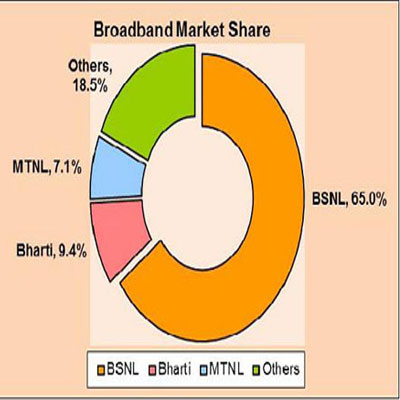
    NEW DELHI: The Bharat Sanchar Nigam Limited (BSNL) continues to top the list of broadband service providers in the country with a market share of 60.74 per cent in the first quarter of 2013.

    The state-run BSNL has 13.12 million internet subscribers at the end of March 2013, according to the report for the first quarter by the Telecom Regulatory Authority of India (TRAI).

    Reliance Communications is the second highest provider with 2.49 million internet users followed by MTNL with 1.96 million.

    TRAI says the total number of internet subscribers including internet access by wireless phone subscribers at the end of March 2013 was 164.81 million. This telecom statistics does not include internet accessed by mobile phones

    There were 21.61 million internet subscribers excluding those subscribers accessing internet through wireless phone at the end of March 2013 as compared to 21.57 million at the end of December 2012, registering a quarterly growth of 0.16 per cent.

    In the internet subscription (excluding internet access through wireless phone), the share of broadband is 69.65 per cent and share of narrowband subscription is 30.35 per cent at the end of March 2013.

    TRAI says the number of broadband subscribers increased from 14.98 million at the end of December 2012 to 15.05 million at the end of March 2013, registering a quarterly growth of 0.45 percent and year-on-year growth of 8.98 percent.

    The number of narrowband subscribers decreased from 6.59 million to 6.56 million.

  • IPTV worldwide subscribers reach 3.6 million

    IPTV worldwide subscribers reach 3.6 million

    MUMBAI: The latest worldwide IPTV research from research firm Canalys shows how the number of commercial IPTV launches escalated in 2006, and suggests that IPTV services are now moving into the mainstream.

    Worldwide subscribers have reached 3.6 million Western Europe leads, with growth expected in emerging markets this year.

    Most major incumbent telecoms providers have launched commercial services and the market is becoming increasingly competitive with the entry of alternative operators, such as ISPs and energy companies.

    Canalys senior analyst Nadia Griffiths says, “2007 will see the competitive landscape become even fiercer as IPTV services from established service providers will be challenged by aggressively priced alternatives from Web TV, cable, satellite and content companies. These are all contenders for a share of the limited wallet of most consumers”.

    Western Europe has 2.4 million IPTV subscribers. The sheer number of operators in the region provides its IPTV scale, and major investments in backbone infrastructure are being made as providers rush to build substantial subscriber bases. The IPTV market is highly fragmented. The top five providers account for over 60 per cent of all subscribers, but the rush of service launches by new entrants in 2006 means that there are numerous companies with only a few thousand subscribers each.

    The top three providers globally according to Canalys are PCCW on 18.2 per cent share, France Telecom with 16.8 per cent and Free Telecom on 14 per cent. These are joined in the top five by Telefonica and Fastweb.

    Threats One of the major threats for many IPTV service providers is the quality of networking once IPTV services become fully fledged. Canalys VP Alessandra Fitzpatrick says, “IPTV networks will quickly become the most complex and bandwidth intensive that have ever existed. Many service providers have invested millions of euros on network upgrades, but it remains unproven whether IPTV networks can scale into the millions without performance degrading and response times slowing, or even collapsing altogether.

    “Another infrastructure challenge is that service providers will quickly have to learn how to manage multiple billing systems and content across large server farms and SANs, while maintaining the highest quality of service.”

    The future, however, looks promising. In 2007, Canalys predicts significant uptake of IPTV in the Asia Pacific region. Hong Kong is already a mature IPTV market, and growth will come from emerging markets such as India and China, following large investments into IPTV deployments there. Australia is also finally moving into the commercial phase of its IPTV offerings, which will lead to fast roll-outs of services in 2007. North America will be another major growth area, with AT&T and Verizon already pushing nationwide roll-outs of IPTV services. Western Europe though will continue to lead and set the pace globally for the IPTV industry in the year ahead.
     

  • Digital music sales estimated to double to around $2 bn in 2006

    Digital music sales estimated to double to around $2 bn in 2006

    MUMBAI: Record labels have become digitally literate companies, selling an estimated S$2 billion worth of music online or through mobile phones in 2006 (trade revenues), almost doubling the market in the last year.

    The International Federation of the Phonographic Industry (IFPI) has come out with a report that states that digital sales now account for around 10 per cent of the music market as record companies experiment and innovate with an array of business models and digital music products, involving hundreds of licensing partners.

    Among new developments in 2006, the number of songs available online doubled to four million, thousands of albums were released across many digital formats and platforms, classical music saw a “digital dividend” and advertising-funded services became a revenue stream for record companies.

    However, despite this success, digital music has not yet achieved the “holy grail” of compensating for the decline in CD sales. Meanwhile, digital piracy and the devaluation of music content are a real threat to the emerging digital music business.

    Research suggests that legal actions against large-scale P2P uploaders – some 10,000 of which were announced in 18 countries in 2006 – have helped contain piracy, reducing the proportion of internet users frequently file-sharing in key European markets. Yet actions against individual uploaders are only the second best way of dealing with the problem. IFPI is stepping up its campaign for action from ISPs and will take whatever legal steps are necessary.

    IFPI’s report shows how the record industry is combining digital technology with its traditional skills of discovering and marketing music. It also sets out where the music sector needs action by government and its industry partners to tackle piracy and prevent the undermining of its intellectual property rights.

    Digital is empowering the music consumer: Consumers are finding that digital technology is helping to change their purchasing habits. They are taking advantage of the unlimited ‘shelf space’ in online stores, buying recordings that would have long vanished from the shelves of even the largest offline stores.

    Recent months have also seen digital music distribution channels diversify. A-la-carte download services, led by iTunes, remain the dominant digital format, but they compete in a mixed economy with subscription services, mobile mastertones and more recently new advertising-supported models and video licensing deals on sites like YouTube and MySpace.

    Mobile music accounted for about half of global digital revenues in 2006, but the split between mobile and online varies sharply by country. In Japan around 90% of digital music sales are accounted for by mobile purchases. 2007 could prove to be a landmark year in the mobile music market, as handset makers such as Nokia and Sony Ericsson develop their music phone series. Meanwhile, Apple has announced the launch of the much anticipated iPhone.

    Portable players are one of the major drivers of growth in the digital sector. New figures show that the proportion of portable player owners who source mainly from paid downloads is roughly the same as the proportion who source mainly from unauthorised P2P and free websites (14 per cent). Yet there is still concern at the relatively low levels of digitally purchased music that is stored on devices.

    There is mixed news for the industry when it comes to digital piracy. Independent research analysts Jupiter suggest that record number of high-profile lawsuits against large-scale uploaders in 2006 did have a deterrent effect on illegal file-sharers. As broadband penetration across Europe doubled to 40 per cent between 2004 and 2006, the proportion of users regularly file-sharing fell from 18 per cent to 14 per cent. In the US, lawsuits were the most cited reason by computer users for changing from unauthorised P2P to legal downloading (NPD Group, June 2006).

    Key successes against illegal operators were recorded in 2006; including Kazaa in Australia, Bearshare in the US, ZoekMP3 in Netherlands and Kuro in Taiwan.

    Yet digital piracy is still a massive problem for the music industry and one of the major reasons that the surging legitimate digital market is not expected to make up the shortfall in the decline of the physical market in 2006.

    IFPI chairman and CEO John Kennedy said, “The record industry today has evolved into a digital thinking, digitally literate business. Revenues in 2006 doubled to about $2 billion and by 2010 we expect at least one quarter of all music sales worldwide to be digital. This is a market combining evolution and revolution, where the learning curve is changing direction on a regular basis.

    “The chief winners in the rise of digital music are consumers. They have effectively been given access to 24-hour music stores with unlimited shelf space. They can consume music in new ways and formats – an iTunes download, a video on YouTube, a ringtone or a subscription library.

    “Yet the market remains a challenge. Other industries, such as film and newspapers, are struggling with the same problems that we have had to live with. As an industry we are enforcing our rights decisively in the fight against piracy and this will continue. However, we should not be doing this job alone. With cooperation from ISPs we could make huge strides in tackling internet piracy globally. It is very unfortunate that it seems to need pressure from governments or even action in the courts to achieve this, but as an industry we are determined to see this campaign through to the end.”

  • VSNL to buy Indian ISP for Rs 750 million

    MUMBAI: Videsh Sanchar Nigam Ltd (VSNL) is strengthening its broadband presence in the Small and Medium Enterprises (SME) segment. The telecommunications giant has agreed to buy out Direct Internet Ltd (DIL) and its wholly owned subsidiary Primus Telecommunications India Ltd (PTIL) for Rs 750 million ($16.7 million).

    US-based Primus Telecommunications Group Inc will exit from India, selling its entire 85 per cent stake in DIL. VSNL is also buying out the remaining 15 per cent held by an Indian partner. The deal is expected to be completed in a few weeks, VSNL said in a statement.

    PTIL provides fixed broadband wireless internet services to SMEs in several Indian cities. The company has close to 1,000 SME and 10,000 retail customers. Out of a total revenue of around Rs 550 million in FY 2006, nearly 80 per cent came from the SME segment. Retail business accounted for 15 per cent while Voice-over-Internet Protocol (VoIP) contributed to around seven per cent of the company‘s income.


    The retail customers are likely to be rehomed in VSNL while DIL will focus entirely on the SME segment. The company‘s operations will continue to be run with the old management. “The huge infrastructre of VSNL will allow DIL an opportunity to expand in the SME segment. VSNL has massive bandwidth which will offer DIL‘s operations greater efficiencies. In the past, we were buying bandwidth on a leased basis and this was consuming 60 per cent of our costs,” says DIL and PTIL founder-CEO Tilak Sarkar.


    This will be VSNL‘s first SME-specific acquisition in the internet space. VSNL had earlier acquired DishnetDSL for Rs 2.7 billion and Tata Power broadband for Rs 2.39 billion which gave it broadband subscribers in the retail as well as the SME segments. DIL, on the other hand, has mostly SME subscribers.


    “The SME segment is a lowly penetrated but growing market. VSNL sees this as an opportunity to expand its presence in the broadband space,” says an analyst.


    VSNL has been aggressive in acquisitions over the last one year. While it bought Tyco International‘s global under-sea fibre optic cable network unit in July 2005, recently it acquired telecoms network service firm Teleglobe International Holdings Ltd.


    Nasdaq-listed Primus Telecommunications, an integrated communications services provider offering international and domestic voice, VoIP, internet, wireless, data and hosting services to business and residential retail customers, had reported a net revenue of $1.19 billion in the 2005 fiscal.