Tag: IRS

  • Madison Media’s Vikram Sakhuja takes over as chairman of MRUC

    Madison Media’s Vikram Sakhuja takes over as chairman of MRUC

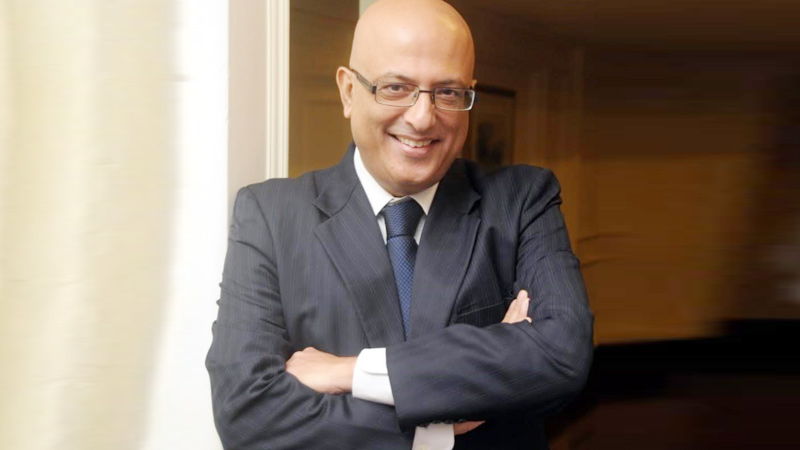
    MUMBAI: Madison World, partner group ceo, Madison Media & OOH, Vikram Sakhuja has been elected chairman of the MRUC (Media Research Users Council of India). The MRUCI board approved his appointment at its annual general meeting, with Sakhuja succeeding Shailesh Gupta of Jagran Media. He had been vice-chairman of the body since 2024.

    Joining him on the new leadership slate, Dhruba Mukherjee, director at ABP Network, has been elected vice-chairman, while Shashi Sinha, executive chairman of IPG Mediabrands, will head the IRS technical committee, a role Sakhuja previously held.

    An alumnus of IIT Delhi and IIM Calcutta, Sakhuja brings nearly four decades of experience across marketing, media and advertising. He has held leadership roles at P&G (Procter & Gamble), Coca-cola, Star TV, Mindshare, Groupm and Maxus Worldwide, before taking over at Madison in 2015. 

  • Mruci strengthens India leadership; appoints S Sinha & S Gupta as new members on the board

    Mruci strengthens India leadership; appoints S Sinha & S Gupta as new members on the board

    Mumbai: Media Research Users Council India (Mruci) held its 28th annual general meeting (AGM) on Tuesday via video conferencing.

    Mediabrands CEO – India Shashidhar Sinha and Jagran Prakashan director Shailesh Gupta will continue in their respective roles as chairman and vice chairman of Mruci. 

    The leadership duo was unanimously re-elected at Mruci’s board meeting, which was held shortly after its AGM.

    Maruti Suzuki India’s senior executive director of marketing & sales Shashank Srivastava and TV Today Network group chief marketing officer & COO of consumer revenue Vivek Malhotra have also been added to the board of governors as new members.

    Speaking of his appointment, Sinha stated, “With Covid behind us and the industry back to normal, we should hopefully start work on the new IRS shortly.”

    Adding to this, Gupta commented, “These are interesting times for research. With markets and businesses returning to normalcy, research will play a huge role in enabling business decisions. Mruci is well poised to enter the next phase of research, which will be increasingly powered by better use of technology that will power business, media, and marketing decisions.”

  • MRUC adds Andhra Pradesh data to IRS Q3 2019 report

    MRUC adds Andhra Pradesh data to IRS Q3 2019 report

    MUMBAI: Media Research Users Council (MRUC) on Monday released an updated report of Indian Readership Survey (IRS) for the third quarter of 2019 that includes data from Andhra Pradesh too. The quarter three report was already published on 27 December 2019 sans Andhra Pradesh’s data in the view of the sample short.

    The report mentioned that Andhra Pradesh has sustained its level at 16 per cent in Q3, same as that in Q2 2019, in the category 'To Understand and Read the English Language Content', whereas it had marginally increased in Q1.

    With respect to total readership and average issue readership, Andhra Pradesh reported a decreased performance at 26 per cent and 11.1 per cent respectively in Q3 against 28 per cent and 12.5 per cent in quarter two of 2019.

    Since the southern state’s data was yet to incorporate in the Q3 report, the industry had to refrain from the comparative analysis and from publishing their all India numbers/rankings.

    The IRS 2019 Q3 report is rolling average of the last quarter of 2017 and subsequent three quarters of (Q1+Q2+Q3) of 2019. The fieldwork covers between August 2019 and November 2019.

    The report earlier had also failed to add the fieldwork data from Jammu and Kashmir affected because of administrative and political developments in the region.

    The IRS Q3 report includes data of all India ranking for dallies, magazines and radio stations.

  • MRUC report: Traditional media strong despite internet proliferation

    MRUC report: Traditional media strong despite internet proliferation

    MUMBAI: Media Research Users Council (MRUC) has released an India Readership Survey (IRS) for the third quarter of 2019, which is a rolling average of the last quarter of 2017 and subsequent three quarters (Q1+Q2+Q3) of 2019.

    The IRS 2019 Q3 fieldwork covers between August 2019 and November 2019.

    According to the IRS Q3 report, “All media hold on to their loyal consumers in spite growth in internet consumption. Total reach across all media continues to grow.”

    The report further said, the data for Andhra Pradesh is not included in the current release and will be updated shortly. Meanwhile, Jammu & Kashmir fieldwork affected because of administrative and political developments in the state.

    The readership pattern also proves that more Indians read in (L1M TR) across three segment of all India, urban and rural prefer English dailies than Hindi and regional in Q3 that to Q1 and Q2 of 2019.

    Similarly, the Hindi dailies readership (L1M TR) in Q3 of 2019 has been as same as Q1 and Q2 of 2019, whereas it has been marginally increased and decreased in urban and rural segments respectively in Q3 compared to Q1 and Q2 of 2019. Meanwhile, the regional dailies are being less preferred in all India, rural and urban parameters (L1M TR).

    There has been marginal rise in New Consumer Classification System (NCCS) in ABC category in Q3. A category reported 17.1% in Q3 compared to 15.4% and 16.2% in Q1 and Q2 respectively. B category reported 21.42% Q3 vs 20.0 % and 20.6 % in Q1 and Q2 each. And, C category reported 27.91 % Q3 to consecutive quarter in Q1 and Q2 is 26.9 % and 27.8 % each.

  • TV homes continue to grow post new tariff order implementation

    TV homes continue to grow post new tariff order implementation

    MUMBAI: The recent IRS study revealed that TV homes have continued to witness growth in the post-implementation period of TRAI’s new tariff order (NTO). According to the IRS study that was conducted, post NTO period shows that in Q2 2019 TV homes grew to 194 million from 192 million TV homes in Q1 2019.

    As per IRS study in 2017, there were 183 million TV homes. According to BARC India in 2016 there were 183 million TV homes and in 2018 there were 197 million TV homes.  

    The NTO was implemented on 1 February 2019 with an aim to allow customers to select and pay only for the channels they want. Many companies also witnessed a bad quarter during the transaction period of NTO.

    After the few months of implementation of NTO, TRAI released a consultation paper to review the issues of pricing of the channels. The paper primarily discusses issues related to discounts in the formation of bouquets, ceiling price of channels for inclusion in bouquet, need for formation of bouquet by broadcasters and DPOs, variable NCF and discounts on long term plan, etc.

  • TV ownership increased by 14% in 2017: IRS

    TV ownership increased by 14% in 2017: IRS

    MUMBAI: After a gap of four years, the Indian Readership Survey (IRS), which documents the growth of the media industry, has been released for 2017. The survey methodology was criticised in 2014 and, therefore, was halted for an upgrade. This time, the sample size has been increased by 34 per cent to 3.2 lakh households. The entire process was audited by E&Y.

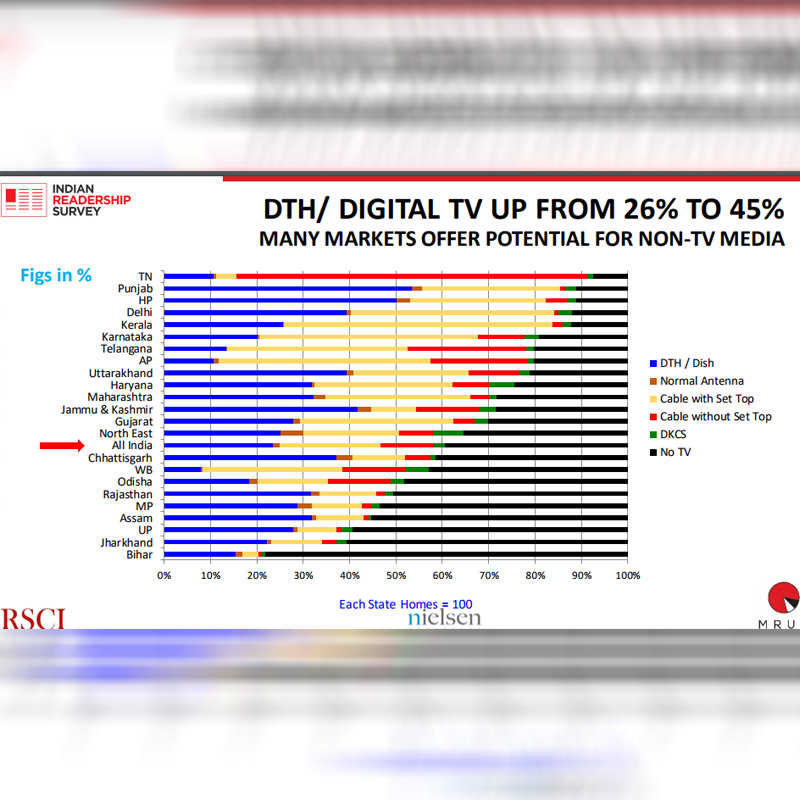
    The study found that there has been an overall 14 per cent increase in TV ownership in Indian households. TV ownership, according to the 2011 census, stood at 47 per cent but the IRS study found it to be 61 per cent in 2017. Tamil Nadu had the highest TV penetration with 93 per cent followed by Kerala at 90 per cent. Punjab and the National Capital Region of Delhi tied at third position with 88 per cent. The census numbers for these states were 87 per cent, 77 per cent, 83 per cent and 88 per cent, respectively. The lowest reach, as per the IRS, was of Bihar with 22 per cent and 15 per cent as per census.  TV ownership was lowest in Tamil Nadu with less than 10 per cent. The number of no TV homes was highest in Bihar with more than 75 per cent.

    The percentage reach for TV in the last one month in the age group of 12 + (L1M) was 75 per cent, 10 per cent higher than IRS’ 2014 study. In this, urban reach was 88 per cent, 3 per cent higher than 2014 and rural reach was 68 per cent, 14 per cent higher.

    The DTH or digital TV market was up from 26 per cent to 45 per cent. Punjab leads with close to 55 per cent homes with DTH followed by Himachal Pradesh with 50 per cent.

    Colour TV ownership stood at 61 per cent in 2017 up from 55 per cent in 2014.

    Also Read:

    BARC sets a deadline for IRS

    BARC gets IRS data, to start installation of peoplemeters soon

  • Indian Media Review: Shashi Sinha addresses the elephant in the room — common measurement

    Indian Media Review: Shashi Sinha addresses the elephant in the room — common measurement

    MUMBAI: All eyes were trained on this year’s media review by The Advertising Club, what with the stalwarts of the industry repeatedly endorsing it on the social media weeks before the event took place. And indeed, the topic that the session addressed hit close to to every stakeholder in the industry alike — be it publishers from across media, advertisers or media agencies. It was on having a common currency of measuring the effectiveness of media for advertising across platforms.

    IPG Mediabrands CEO was one of the key speakers at the review. Shashi Sinha started off on a more comfortable note of how agencies can help businesses grow with an effective measurement.

    According to him, “Instead of complaining that clients are demanding more accountability from the media they bought, agencies need to understand that better measurement gives CMOs better rationale for justifying better budgets.”

    This ‘better measurability’, as per Sinha, is being achieved in several ways at present, primarily — introduction of BARC’s measurement system for broadcasters, revival of the Indian Readership Survey (IRS) by next year, and digital.

    The issue, Sinha emphasised, came down to whether the fraternity wanted to take a few more steps further to improve the system of measurement across media after understanding the need of the hour or whether they wanted to stall the progress and delay the combined measurement system.

    Speaking specifically of the digital measurement system, Sinha shared that it was wrong to expect a panel of digital platforms or ‘OTT’ players to be self regulators of their measurement systems, given that the category is extremely fragmented. Therefore, he openly asked if “digital publishers are willing to be measured by third parties and be transparent with their numbers?”

    Highlighting how the IRS, which Sinha expects to be fully functional in eight months, will increase the sample size of print publishers by 40 per cent, he added that multimedia evaluation was also being considered by the board.

    Sinha expressed his welcome surprise at the Audit Bureau of Circulation (ABC) testing the measurement possibilities in the publishing side of digital (as BARC only caters to video consumption measurements). “Unlike video measurement, it is relatively cheap and is actually already functional for the last three to four months. We just need the heavyweights in the medium to come to a consensus for it to be fully rolled out,” Sinha added.

    After addressing and updating the audience about the different scopes of measurements in each media, Sinha quickly moved on to emphasise the need to have a common source of truth or ‘a single view of truth’

    This brings him to suggest the ambitious idea of Media Research Users Council (MRUC), the IRS, BARC and ABC to come together to contribute to a common pool of data that can be further sliced and diced in accordance with each media based on the clients requirement, although Sinha agreed that currently major challenges were in making that thought become a reality.

    Instead, one could start with thinking along the lines of a measurement currency that each media can be compared in, and according to Sinha, it is CPT,

    “Television measurement needs to move from CPRP to CPT format, and that’s a good starting point of having some commonality of currency between mediums. Publishers need to understand that moving from one currency system to the other doesn’t bring any difference in the buying and selling equation with clients. That will always be based on the demand-supply ratio,” assured Sinha, adding that the current CPT of channels is actually an opportunity to drive growth.

    CPT or Cost Per Thousand is basically the advertising cost of reaching a certain number of viewers in a defined target group on television, while CPRP or Cost Per Rating Point is the cost of advertising time on television based on the price of time for a single rating point generated by the channel.

    More mature markets such as the US, the UK and Germany have already switched to CPT as a currency when buying and selling television media.

  • Indian Media Review: Shashi Sinha addresses the elephant in the room — common measurement

    Indian Media Review: Shashi Sinha addresses the elephant in the room — common measurement

    MUMBAI: All eyes were trained on this year’s media review by The Advertising Club, what with the stalwarts of the industry repeatedly endorsing it on the social media weeks before the event took place. And indeed, the topic that the session addressed hit close to to every stakeholder in the industry alike — be it publishers from across media, advertisers or media agencies. It was on having a common currency of measuring the effectiveness of media for advertising across platforms.

    IPG Mediabrands CEO was one of the key speakers at the review. Shashi Sinha started off on a more comfortable note of how agencies can help businesses grow with an effective measurement.

    According to him, “Instead of complaining that clients are demanding more accountability from the media they bought, agencies need to understand that better measurement gives CMOs better rationale for justifying better budgets.”

    This ‘better measurability’, as per Sinha, is being achieved in several ways at present, primarily — introduction of BARC’s measurement system for broadcasters, revival of the Indian Readership Survey (IRS) by next year, and digital.

    The issue, Sinha emphasised, came down to whether the fraternity wanted to take a few more steps further to improve the system of measurement across media after understanding the need of the hour or whether they wanted to stall the progress and delay the combined measurement system.

    Speaking specifically of the digital measurement system, Sinha shared that it was wrong to expect a panel of digital platforms or ‘OTT’ players to be self regulators of their measurement systems, given that the category is extremely fragmented. Therefore, he openly asked if “digital publishers are willing to be measured by third parties and be transparent with their numbers?”

    Highlighting how the IRS, which Sinha expects to be fully functional in eight months, will increase the sample size of print publishers by 40 per cent, he added that multimedia evaluation was also being considered by the board.

    Sinha expressed his welcome surprise at the Audit Bureau of Circulation (ABC) testing the measurement possibilities in the publishing side of digital (as BARC only caters to video consumption measurements). “Unlike video measurement, it is relatively cheap and is actually already functional for the last three to four months. We just need the heavyweights in the medium to come to a consensus for it to be fully rolled out,” Sinha added.

    After addressing and updating the audience about the different scopes of measurements in each media, Sinha quickly moved on to emphasise the need to have a common source of truth or ‘a single view of truth’

    This brings him to suggest the ambitious idea of Media Research Users Council (MRUC), the IRS, BARC and ABC to come together to contribute to a common pool of data that can be further sliced and diced in accordance with each media based on the clients requirement, although Sinha agreed that currently major challenges were in making that thought become a reality.

    Instead, one could start with thinking along the lines of a measurement currency that each media can be compared in, and according to Sinha, it is CPT,

    “Television measurement needs to move from CPRP to CPT format, and that’s a good starting point of having some commonality of currency between mediums. Publishers need to understand that moving from one currency system to the other doesn’t bring any difference in the buying and selling equation with clients. That will always be based on the demand-supply ratio,” assured Sinha, adding that the current CPT of channels is actually an opportunity to drive growth.

    CPT or Cost Per Thousand is basically the advertising cost of reaching a certain number of viewers in a defined target group on television, while CPRP or Cost Per Rating Point is the cost of advertising time on television based on the price of time for a single rating point generated by the channel.

    More mature markets such as the US, the UK and Germany have already switched to CPT as a currency when buying and selling television media.

  • Nikhil Rangnekar is Lodestar UM’s new media consultant

    Nikhil Rangnekar is Lodestar UM’s new media consultant

    MUMBAI: IPG Mediabrands’s Lodestar UM has appointed Nikhil Rangnekar as its media consultant. Based out of Lodestar UM Mumbai, Rangnekar will be reporting to the CEO Nandini Dias.

    Rangnekar has moved from Spatial Access where he was the CEO of the Media Audit and Advisory business.

    “Nikhil is an industry veteran and we are delighted to have him on board. He has a varied background having worked in various capacities driving strategy, business and audits. He brings in a lot of experience and strategic thinking which we intend to leverage,” said Dias.

    Armed with over 19 years of experience in the advertising and the media industry, Rangnekar started his career with Starcom in 1997 where in 14 years he climbed the ranks from a management trainee to executive director. In 2011, he quit Starcom to join Spatial Access. He is also the chairman of the marketing committee of IRS at MRUC.

    Talking about his new role, Rangnekar said, “I am extremely happy to join Lodestar UM in the role of a strategy consultant. For me, it’s a prestigious assignment working with one of the largest groups in the world and in India.”

    He further added, “I will be working with the individual brand teams in helping them take our strategy product to the next level. I will also be working closely with the Labcentre team on the various proprietary researches and tools that IPG Mediabrands has and aim to evolve them in line with the changes happening in the media environment in India. If my last role was more about driving efficiency, the new role is more about driving effectiveness. Lastly, I am proud to have got this opportunity to work with industry stalwarts like Shashi and Nandini.”

  • Nikhil Rangnekar is Lodestar UM’s new media consultant

    Nikhil Rangnekar is Lodestar UM’s new media consultant

    MUMBAI: IPG Mediabrands’s Lodestar UM has appointed Nikhil Rangnekar as its media consultant. Based out of Lodestar UM Mumbai, Rangnekar will be reporting to the CEO Nandini Dias.

    Rangnekar has moved from Spatial Access where he was the CEO of the Media Audit and Advisory business.

    “Nikhil is an industry veteran and we are delighted to have him on board. He has a varied background having worked in various capacities driving strategy, business and audits. He brings in a lot of experience and strategic thinking which we intend to leverage,” said Dias.

    Armed with over 19 years of experience in the advertising and the media industry, Rangnekar started his career with Starcom in 1997 where in 14 years he climbed the ranks from a management trainee to executive director. In 2011, he quit Starcom to join Spatial Access. He is also the chairman of the marketing committee of IRS at MRUC.

    Talking about his new role, Rangnekar said, “I am extremely happy to join Lodestar UM in the role of a strategy consultant. For me, it’s a prestigious assignment working with one of the largest groups in the world and in India.”

    He further added, “I will be working with the individual brand teams in helping them take our strategy product to the next level. I will also be working closely with the Labcentre team on the various proprietary researches and tools that IPG Mediabrands has and aim to evolve them in line with the changes happening in the media environment in India. If my last role was more about driving efficiency, the new role is more about driving effectiveness. Lastly, I am proud to have got this opportunity to work with industry stalwarts like Shashi and Nandini.”