Tag: Iran

  • Kho-Khoaching class act sets sport on global fast track

    Kho-Khoaching class act sets sport on global fast track

    MUMBAI: Kho Kho, the homegrown Indian game of agility and grit, just got a high-speed upgrade on and off the mat. As the sport stretches beyond its traditional roots to stake its claim on the global stage, the Kho Kho Federation of India (KKFI) is playing tag with the future by launching its most advanced training initiative yet.

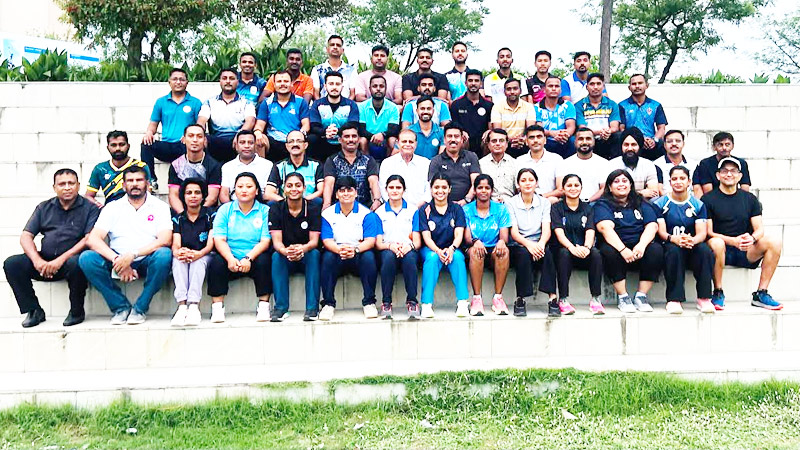
    The Advanced Level III-A Training Course for coaches and technical officials kicked off on June 2, 2025, at SGT University, Budhera, and will run till June 15. Organised by KKFI under the aegis of the International Kho Kho Federation (IKKF), the course is no ordinary classroom drill, it’s a knowledge sprint featuring 20 international coaches and officials from Sri Lanka, Bangladesh, Iran, Australia, England, Korea and Malaysia, alongside 50 Indian coaches and 65 technical officials.

    From biomechanics to sports psychology, recovery techniques to anti-doping awareness, the curriculum mirrors a sport in metamorphosis. With morning fitness sessions and rigorous classroom modules, participants are being immersed in a next-gen playbook designed to take Kho Kho from kabaddi’s countryside cousin to a globally recognised sport.

    5 June was a masterclass in modernisation with sessions on sports science by Pooja Bhati, anti-doping education by Vikas Tyagi and Anurag, and tactical training by legendary coach H. V. Nataraj. The day began with a sweat-inducing physical drill by Ashwani Sharma, reinforcing the discipline behind the dash.

    “This course reflects our commitment to preparing a new generation of coaches and officials who are equipped with the knowledge, tools, and international exposure to take Kho Kho to the next level,” said KKFI president Sudhanshu Mittal. He also underlined how the sport is evolving with mat-based gameplay, a Decision Review System (DRS) and even the strategic ‘Wazir’ role.

    The training for coaches wraps up on June 11 with a practical exam and reflective session, before the officials’ segment begins from 12–15 June.

    With 135 participants in total and a syllabus as sharp as the game’s signature sprints, this course is more than just a seminar, it’s Kho Kho’s statement of intent. The message is clear: India isn’t just where the game began. It’s where the global future of Kho Kho is being written one pivot, one pass, and now, one world-class coach at a time.

  • J&K operators in a quandary, claim banned channels have GEC & all-religion content

    MUMBAI: The Indian Government’s directive to the Jammu and Kashmir Government to stop the transmission of 34 television channels from Muslim countries including Iran, Pakistan, and Saudi Arabia has put the cable operators in a quandary. Several foreign channels went off air in most parts of the Valley on Sunday after the Indian government order.

    Most of these channels broadcast programmes about sports, religion and lifestyle and none incites violence, Kashmir Cable Operators Association stated. The ban comes around a month after the state blocked social media web sites throughout the Valley.

    The Indian government had asked the J&K administration to take stern action against private cable operators airing illegal Pakistani and Saudi Arabian channels. Union minister M. Venkaiah Naidu has reportedly directed the J&K government to submit a report at the earliest. www.indiantelevision.com could not speak to the director (BP& L) in the ministry on the concrete plan of action in spite of several attempts.

    Operators reportedly broadcast around 34 channels illegally such as Peace TV, Ary QTV, Saudi Sunnah, Karbala, Saudi Quran, Al Arabia, Paigham, Hidayat, Sehar, Hadi TV, Sehar, Noor, Madani, Bethat, Ahlibat, Falak, Dawn News, Geo News, Ary News, TV One, ARY Masala, PTV Sports, A TV, Abb Tak News, 92 News, Duniya News, Waseb TV, Samaa News and Express News.

    According to the operators, they could neither defy the ban order nor could they afford to stop telecasting channels which are highly popular among the masses in the Valley. Kashmir Cable Association stated that there were around 300 channels in the Valley which include 22 channels for the Sikh community, 15 for Hindu and 25 Islamic.

    The Cable Operators Association stated that it has decided to defy the order as their business heavily depends on these channels. Asked about the consequence, it stated that they were prepared if the authorities seize their equipment and close down their business.

    Channels such as ARY Musik telecasts Sufi music, ARY Zauq or Ham Masala are cooking channels from Pakistan while Saudi 1 airs live feed from Haram Sharif in Makkah 24×7 as does Karbala TV from the shrine of Imam Hussain, a TV viewer said.

    An order issued by the principal secretary, home department, R K Goyal, to all the deputy magistrates (deputy commissioners) of the state said. “It needs being noted that transmission of non-permitted TV channels apart from attracting the violation (of the law), has the potential to encourage or incite violence and create law and order disturbances in the Kashmir Valley.”

    Some cable operators alleged that the Delhi-based communal media, motivated by anti-Islam and anti-Pakistan politics of Hindutva, is behind the closure of Pakistani and religious channels in the territory. The operators said that they were showing all the religious channels belonging to every faith, which includes Hinduism, Islam, Sikhism and others.

    Meanwhile, prominent Islamic scholars on Monday expressed serious concern over the ban, saying the curbs on religious teachings would have repercussions. They said that channels such as Saudi Al-Quran and Saudi Sunnah only telecast Islamic teachings.

    While Delhi has banned the channels, operators in Kashmir cite the Ranbir Penal Code, a separate law in Kashmir, according to which the ban is not applicable.

  • India among partly-free countries as far as Freedom on the Net goes

    India among partly-free countries as far as Freedom on the Net goes

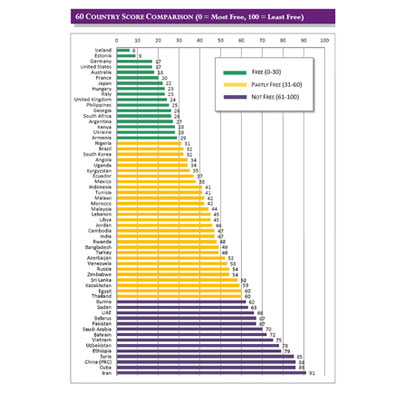
    NEW DELHI: India is 35th among sixty countries in the Freedom on the Net 2013 report.
    The annual report is carried out by Freedom House, an independent watchdog organization, and measures the level of internet and digital media freedom in 60 countries.

    In the new report, each country received a numerical score from 0 (the most free) to 100 (the least free), which serves as the basis for internet freedom status.

    India with 47 points is 18th in the list of the countries listed as partly free (31 to 60 points). There are seventeen countries in the most internet-free countries (0 to 30 points), 29 in the partly free countries, and fourteen in the ‘not free’ list (61 to 100 points).

    Iceland with six points tops the list of the free countries with the United States at the fourth place with 17 and the United Kingdom with 24 points, while Iran (91 points) is at the bottom with China (86 points) at the third place from the bottom of the countries which are not free of control. Pakistan has 67 points and is the fifth among the not-free countries. 

  • Iranians access Facebook, Twitter accounts for a day – albeit by error

    Iranians access Facebook, Twitter accounts for a day – albeit by error

    NEW DELHI: Facebook and Twitter, which are taboo in Iran, accidentally became available to users on 16 September – only to be shut off the next day with the government blaming a technical glitch for this sudden freedom.

    The two social sites had been shut off in Iran in the summer of 2009 after riots erupted following a disputed win of Mahmoud Ahmadinejad.

    A number of Facebook and Twitter users said on Monday that that they could access the social networking sites without bypassing the firewall which Iranian government had imposed for monitoring the social media.

    Correspondents of almost every western newspaper tweeted that they were able to access their accounts using regular internet services.

    Reuters reported that not only Facebook and Twitter was being accessed, but other blocked sites were also opening.

    But then Secretary of a State Committee Abdolsamad Khoramabadi said it was a technical glitch by a few internet service providers and there were no plans yet to lift the ban. An inquiry has been ordered.

    However, media sources said that the Iranian government may be testing the intensity of response if the ban is lifted. This is borne out by the fact that Iranian Foreign Minister Mohammad Javed Zarid created his Facebook and Twitter accounts during this period.

    Newly-elected President Hassan Rouhani is believed to be more liberal and has already hinted earlier that he would tackle the social media differently.

  • Iran slams Hollywood for giving top honour to hostage drama Argo

    Iran slams Hollywood for giving top honour to hostage drama Argo

    MUMBAI: Iran has criticised Hollywood for awarding its top honour to the Iran hostage drama Argo.

    “This anti-Iran movie lacks artistic value,” said Culture and Islamic Guidance Minister Mohammad Hosseini. “It was awarded the top honour through a massive financing and advertisement campaign … so that it attracts more attention worldwide,” he added.

    Iran‘s state television earlier slammed the 85th Academy Awards saying that this year‘s Oscars was the most political Oscar ever, no sooner the news of Argo winning the coveted best film Oscar award broke out.

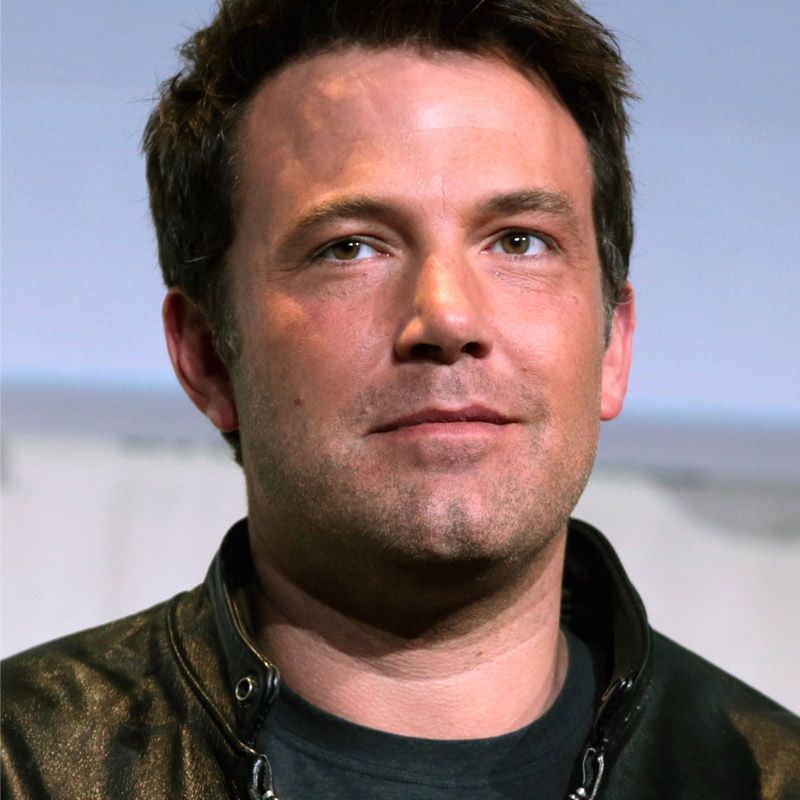
    The broadcaster accused director Ben Affleck of specialising in exaggeration, blowing things out of proportion and creating false scenes.

    Argo recounts the long-classified CIA plot to extract six US hostages out of revolutionary Iran, who managed to evade Islamist students storming the US embassy in Tehran on 4 November 1979. The other 52 hostages were held for 444 days in an action that caused the rupture of diplomatic ties between Washington and Tehran.

  • BBC’s show ‘Spooks’ to examine the relationship betweeen the US, UK and Iran

    MUMBAI: UK pubcaster the BBC has announced that its spy show Spooks will return later this year on BBC One. The complex relationship between the UK, Iran and the US is put under the spotlight … but who can really be trusted under this new world order? In India the show airs on BBC Entertainment which is carried on Tata Sky.

    Over the course of 10 hour-long episodes, Adam, Harry and the team are immersed in their most intricate operation to date. The broadcaster says that the distinction between friend and foe becomes ever more blurred. Rupert Penry-Jones, Hermione Norris and Peter Firth return as officers Adam, Ros and Harry of Section D, MI5.

    Raza Jaffrey, Miranda Raison and Hugh Simon also reprise their roles as Zaf, Jo and Malcolm, and welcome new arrival Connie played by Gemma Jones. In the drama, Iran’s covert scheme to become a nuclear power leads to growing mistrust between the British, American and Iranian governments, who all nurse their own agendas to help or hinder the Middle Eastern state in its efforts.

    The volatile climate culminates in a series of high risk operations both at home and abroad. The opening episode sees Zaf, undercover in Tehran, attempt to place a bomb on a civilian train in an effort to flush out a key Iranian spy, an act which could have dangerous ramifications not only for Zaf but for the whole team.

    Meanwhile, the electric atmosphere between Adam and Ros comes to a head, but things are complicated further by Adam’s dangerous ongoing affair with a key asset inside the Iranian embassy.

    Spooks producer Katie Swinden says, “For the first time ever, we’ve chosen to explore one theme throughout the series, and one which is an ongoing concern in today’s world affairs agenda. The relationship between Britain, Iran and the US is such a delicate and topical issue that it opens up a wealth of new storyline possibilities to us.

    “Audiences will be able to follow Adam, Harry, Ros and the team as they take on their most challenging operation to date, and will get to see them in a whole new range of dangerous and exciting situations.”

    The BBC executive producer Sarah Brandist says, “Spooks, one of the autumn highlights for both BBC Drama and BBC One and this year, takes on a more global feel by telling bigger, bolder stories across a wider landscape.

    “BBC One viewers, who are already eagerly awaiting the gang’s return, will be treated to an explosive opening two-parter and, from then on, the action flows from beginning to end. Spooks has returned in style.”

  • Iran launches English news channel

    MUMBAI: Iran’s state broadcaster has launched an English news channel Press TV, aiming to break the stranglehold of the West over the world’s media. Its competition ioncludes BBC, CNN, France 24 and AL Jazeera.

    The channel will focus on Middle East news. Iranian President Mahmoud Ahmadinejad has been quopted in reports saying that the network should stand behind oppressed nations but not make up news in their favour.

    The channel would, thus, pave the way for people’s acquaintance with an alternative voice and view. Press TV programmes hover on half hour news bulletins, reports, live talk shows and documentaries.