Tag: IPTV

  • ‘Broadcast India 2006’ begins 26 October

    ‘Broadcast India 2006’ begins 26 October

    MUMBAI: The 16th Broadcast India 2006 Exhibition and Symposium will be held from 26-28 October 2006 at the World Trade Centre, Mumbai.

    Broadcast India 2006 will present the latest technology of newsgathering and telecasting of programmes live through a mobile phone.

    From film making to television production and post production, from content creation in all formats to its management and finally to its delivery, the Broadcast India show will cover all the technologies, said an official release.

    More than 400 companies from 31 countries will be at Broadcast India to showcase their latest products and services in Broadcast, Television, Audio, Radio, Film, Computer Graphics, Satellite, Special Effects and Multimedia. This year’s show will throw light on IPTV, Mobile TV, Digital Cinema and High Definition.

    The Broadcast India 2006 Symposium sponsored by Cisco Systems will be held on 25 October 2006 at YB Chavan Centre, Mumbai. The keynote address is by Dan Scheinman, senior VP for corporate development, Cisco Systems.

    Broadcast India Awards for Excellence in Film & Television will also be held at YB Chavan Centre on 25 October 2006 from 7 pm onwards.

  • Industry tuned to CAS; pricing still vexed issue

    Industry tuned to CAS; pricing still vexed issue

    NEW DELHI: From “let there be voluntary CAS” to “if you must mandate CAS stay out of the pricing mechanism”. That could well sum up how the view of the broadcast sector in general to the prospect of the rollout of addressability has changed from the situation that existed back in 2003. 

    That was a recurring theme during the informed discussions that went on in the post-lunch session of the Indian Broadband Digital Networks Forum organised by Indiantelevision.com and Media Partners Asia in the capital yesterday. The two sessions – The Strategic Imperative: Consolidation & Convergence and Ground Realities: Content Distribution & Technology flowed seamlessly from one to the other taking further the cues that had been provided in the morning’s keynotes.

    Unless pricing was elastic, it was a non-sustainable business model not just for the pay channels but for the cable service providers as well, was the view expressed by Raghav Sahgal, CBO, Converse. Speakiing during the morning keynote, John Malone-controlled Liberty Media board member Shane O’Neill suggested that a better formula for the government to consider might be that the baseline or lifeline service (basic tier?) be given maximum spread while the rest should be left to the market to determine.

    Interestingly, that was the sentiment off the Orissa-based MSO Ortel Communications’ Jagi Mangat Panda as well. Said Panda, “CAS is important and necessary. But the regulator entering into pricing issues is unviable for long.” Mandate CAS but stay away from pricing, she offered. Panda also spoke of the need for a level playing field on issues like foreign investment similar to what the telcos enjoyed for all players in the broadcasty sector.

    ADAPT OR PERISH:

    Speaking on the issue of the shift to digital, HSBC Securities’ Sandeep Pahwa pointed out that “consolidation and building of scale is important but not a necessary recipe for success.” The ability to innovate according to the dynamics as determined by Indian situation was the critical factor, according to Pahwa. “Adapt or perish. The mantra is continual innovation,” Pahwa said.

    Another point that came through in the discussions was that in the move towards digital delivery, the real battle in the short to mid term would be between cable and DTH. “IPTV is a real challenge in an emerging market like India,” said Comverse CBO Raghav Sahgal.

    According to Pahwa, DTH will compete on reach (cable dark areas in particular) and service. However, where cable service providers have got it right, there is a clear advantage in their favour.

    WWIL’s JS Kohli said, “CAS is the trigger that will actually facilitate the move towards convergence.”

    Tata Sky’s Vikram Kaushik said while in the medium term quality of service would be the key differentiator that DTH offered, going forward, once transponder limitations haad been overcome some element of exclusivity would come into play. 80 per cent of programming will be across platform and 15 per cent will be exclusive, Kaushik said.

    Speaking on the content provider’s side Star India’s Paritosh Joshi said, “Star’s content for the mass audiences will remain the primary focus. We will look for opportunities – mobile in particular is something we’re particularly gung ho about. That’s something we’re already actively looking at.”

    “A marginal higher value consumer may exist and these we will address,” Joshi said.

    Speaking about the impact CAS would have Hathway MSO’s K Jayaraman said, “CAS is going to be painful in terms of investments required. If the first phase of CAS goes well then the funding is going to be a challenge.”

    Incable’s Ashok Mansukhani offered, “We need to put in a lot of money to upgrade ourselves as well as LCOs. We believe in 100 per cent transparency.”

    On the scope for IPTV, Tandberg Television’s Alan Delaney said, “There is plenty of space in the market for everybody.”

    Bharti Televentures’ Sriram TV was clear that staying out of content creation was the way to go for telcos. Said Sriram, “Focus on what you’re best at. Bharti has taken its learnings from the experiences of Singtel / Vodafone in the UK as examples of networks that went into too many areas and lived to regret the decision. Network convergence, device convergence and industry convergence is what we are looking at. Bharti has content tie-ups with all the pay channels.”

    HFCL’s Surendra Lunia, however, said, “We will evaluate according to opportunity.”

    Another problem for broadband is that technical skill sets need to be sorted out before value added services can be rolled out, said Jayaraman. This statement coming from the head of a cable MSO who has 100,000 registered users reflects on the difficulties that lie ahead for introduction of IPTV in particular.

    However, Mansukhani was more optimistic on that front: “It is a dynamic growth oriented business. Broadband adding significantly in the next three years.”

  • DTV, IPTV growth to boost Set-Top Box, Chipsets & Flat Panel industries

    DTV, IPTV growth to boost Set-Top Box, Chipsets & Flat Panel industries

    MUMBAI: The anticipated growth of digital television (DTV) and high-definition television (HDTV) is expected to positively influence the development of a range of support industries. These include those of flat panel displays, broadcasting, telecommunications, chipset design and production, set-top box manufacturing, and software or middleware development, according to a Frost & Sullivan – Technical Insights study.

    The flat panel display industry, in particular, has recorded huge revenue growth since the launch of DTV and HDTV services. Moreover, emerging display technologies such as organic light-emitting diodes (OLED) and field emission displays (FED) are being seen as a challenge to the market dominance of liquid crystal displays (LCDs) and with the recent advances in manufacturing techniques, the future for both OLED and FED look promising.

    With regard to the set-top box (STB) technology, new STB chipsets are steered toward the direction of providing a single-chip solution. The introduction of advanced compression standards such as Moving Pictures Expert Group (MPEG)-4 AVC has highly enhanced the video streaming capability of the high-end STBs, and future STBs will have more programmability and advanced functions such as a personal digital recorder. Future chipset designs are likely to focus on the convergence of TV and computer networks and the concept of a multimedia home platform (MHP).

    “Determined to lead the broadcast technologies, the Information Society Technologies (IST) and European Union (EU) have been funding numerous projects in the field of digital and high-definition television, driving the European companies and universities in this area,” notes technical insights (www.technicalinsights.frost.com) research analyst Dr. Jayson Koh.

    “While countries such as Greece are laying infrastructures for the digital switch over, terrestrial DTV services are already well developed in Germany and France, and Britain has also recently introduced many DTV and IPTV services.”

    In Asia, South Korean, Japanese and Taiwanese companies are leading the flat panel display industries, catering to the increasing demands for LCD and plasma discharge panel (PDP) TV from Europe, North America, and notably, China. Also there have been a significant number of IPTV and DTV deployments in Asian countries such as Hong Kong, Taiwan, China, Singapore and South Korea.

    Amidst these positive trends, the high entry barrier and the lack of cost-effective techniques for mass production are the most critical issues that the new companies and technologies in the flat panel display industry face. Other obstacles that add to the entry barrier include competing with the low average selling price of LCD, high cost of investment, lack of customer awareness, availability of raw materials and components suppliers, and the distribution networks, the study notes.

    “The prolonged format war between HD-DVD and Blu-ray is expected to delay the integration of new DVD standard in high-end STBs and manufacturers would prefer to wait till a common format arises,” says Koh. “In the case of new video compression standard, the H.264 would slowly take over the MPEG-2 market but face competition from both AVS and VC-1.”

    In the near term, STB manufacturers have to decide whether to support a certain new generation DVD format or to provide a multiple format drive. Although chipset companies are providing more multiple video compression supports in their products, the high licensing fee arises from this kind of chipsets may not be encouraging.

    Global Advances in Digital TV and HDTV Chipsets, a part of the Electronics Device Subscription, provides informative insights on the progress and development of flat panel display, chipsets, compression and broadband television technologies. In this research service, Frost & Sullivan’s analysts thoroughly examine the following technologies: flat panel display, set-top box and its chipsets, compression coding and broadband television technologies. Analyst interviews are available to the press.

    Technical Insights is an international technology analysis business that produces a variety of technical news alerts, newsletters, and research services. Frost & Sullivan, a global growth consulting company, has been partnering with clients to support the development of innovative strategies for more than 40 years.

  • Granada International looking at IPTV, Vod opportunities in India

    Granada International looking at IPTV, Vod opportunities in India

    MUMBAI: Television and film distributor Granada International is looking topwards building its presence in Asia.

    It has appointed Ting Wai Ho as senior sales executive based in its new Hong Kong office. The announcement was made by Granada International MD Nadine Nohr.

    He will also work closely with regional director in Asia James Ross on the media opportunities offered by the way of VOD and IPTV in India.

    Ho will also be responsible for sales of Granada International programming into South East Asian countries including Vietnam, Malaysia, Indonesia, Thailand and the Philippines.

    Ting Wai Ho was formerly BBC Worldwide senior sales executive, South East Asia. Based in Hong Kong he was in charge of TV programme distribution in Asian countries.

    Ross says, “I am very pleased to have Ting on board at the new Granada International office in Asia. As we continue to expand Granada International and ITV Worldwide’s presence in Asia, I am sure his wealth of experience in selling programming to the Asia region will be a great asset to us.”

  • Siemens to showcase potential of IPTV, mobile TV at Berlin trade show

    Siemens to showcase potential of IPTV, mobile TV at Berlin trade show

    MUMBAI: When the international consumer electronics trade show IFA opens its doors in Berlin on 1 September, 2006, visitors will experience the look and feel of the new world of television at the Siemens Communications booth.

    Siemens says that with its mobile TV service via DVB-H, customers of communications companies can be more than just passive viewers of TV programs on their mobile phones. The company says that with services such as music voting, it is easy to let consumers have a say in shaping what they watch. IPTV in HDTV will mean a new era of home media use.

    The living room media center is supplied with programming from the Internet via DSL and has an intuitive user interface. At IFA Siemens will be using the example of the Dutch carrier KPN to show how an IPTV interface works.

    Traditional television Siemens says is entering a new era. Mobile TV and IPTV offer network operators a way to compensate for the drop in revenue stemming from falling prices for voice connections in wireless and fixed networks and to win customers with new media offerings. At IFA 2006 Siemens Communications will show how the new offerings can be structured and how the technology behind them works.

    Mobile TV via the DVB-H standard enables mobile operators to offer services. They include interactive television programs that let viewers participate in votes and surveys, access to information in the Internet at a click of the mouse, interactive games for several players and real-time traffic reports that integrate navigation systems are just a few examples.

    While the market for Mobile TV is still in its infancy, market researchers at Informa believe that by 2011 some 210 million people around the world will be using their portable devices as interactive TV sets and that around ten percent of all mobile handsets will have a TV receiver integrated in them.

    At IFA, Siemens will show that its own mobile TV solution already runs on a wide range of common mobile phones (e.g. BenQ-Siemens, LG, Samsung), on PDAs with special SDIO cards and on state-of-the-art UMPCs from Samsung with Intel technology – perfectly and in high quality. Siemens will be showing programs from various broadcasters in Berlin, including RTL Television, nt-v and Super RTL.

    Stefan Schneiders who is an expert for Mobile TV at Siemens says, “One thing is sure – carriers are very interested in tapping new revenue streams and winning their customers for trendy services that offer added value. Initial results from field trials, for example in Spain, show that Mobile TV has what it takes to fulfill the expectations of carriers and their customers.”
    Siemens will be showcasing the IPTV offering of its Dutch customer KPN at IFA 2006. KPN customers in the Netherlands who have a DSL connection can receive TV from their phone socket and use numerous additional services such as a personal video recorder or TV of Yesterday. In Berlin, visitors will be able to try out KPN’s user interface, as well as getting an impression of how intuitive and simple the user guidance is from other examples, and discover that PC expertise is by no means a must.

    They can also see what TV via DSL in high-definition quality using the compression standard H.264 looks like. Siemens says that it is committed to open standards for IPTV via HDTV. That also goes for the set-top boxes that are required for receiving IPTV and of which a selection will be shown in Berlin.

  • MTNL in IPTV deals with Aksh Optifibre, IOL Broadband

    MTNL in IPTV deals with Aksh Optifibre, IOL Broadband

    MUMBAI: Mahanagar Telecom Nigam Ltd (MTNL) has signed content delivery network affiliation contracts with Aksh Optifibre Ltd and IOL Broadband Ltd, which would allow the state-owned telecom major to offer IPTV services to its subscribers.

    With this, MTNL has selected three franchisees for developing the content delivery platform. Time Broadband Services Pvt Ltd, India (TBSPL) was the first to have won the contract for both Delhi and Mumbai and has a seven-year non exclusive deal with MTNL.

    While MTNL has ensured a bank guarantee of Rs 5 million from Aksh Optifibre, IOL Broadband has guaranteed Rs 2.5 million. Aksh Optifibre has expressed intent to operate in Delhi and Mumbai while IOL’s interest is restricted to Mumbai at this stage.

    IOL Broadband plans to use US-based SeaChange for the IP video servers, storage and middleware, says a senior company executive. The digital set-top boxes (STBs) will be provided by UK-based Amino while the digital rights management solution will be from US-based Widevine.

    “We plan to invest $25 million in the early phase of the project. We have also an eye on extending to Delhi,” says the executive.

    Aksh Optifibre plans to use UTStarcom technology for its content delivery network, an MTNL official says. Bharti, which is conducting test runs in Gurgaon on the outskirts of Delhi with multiple vendors, had also used UTStarcom technology, including the headend and the digital STBs.

    “The idea of having multiple franchisees is to provide content flexibility to our subscribers,” says the MTNL official.

    Time Broadband, meanwhile, has tested 560 STBs and is ready for commercial launch. Says TBSPL managing director Sujata Dev, “We have already deployed 150 STBs in the subscriber homes. We are increasing the number of channels from 30 to 100 on the test run by the end of this month. Star and Zee have agreed to offer the pay channels for this as our content protection system in place.”

    Time Broadband, which has US-based Kasenna as its middleware vendor, while Verimatrix Inc is providing content protection solutions, has so far invested $3 million in the project.

    MTNL is employing ADSL 2+ technology for running its IPTV services. For the video part, the telecom giant will be using MPEG-4 compression technology.

  • Americans’ love affair with TV & net flourishes

    Americans’ love affair with TV & net flourishes

    MUMBAI: Americans’ love affair with the television continues. Almost 60 per cent have three or more TVs in their homes and a flat screen TV is first on consumers’ wish list, according to a survey of 1,000 US consumers released by RBC Capital Markets.

    Just over half of Americans are watching the same amount of television as ever (53 per cent), plus they’re increasing their time spent on the internet (42 per cent).

    RBC Capital Markets director of US Equity Research Marc Harris says, “We are spending more time at work on a computer, then going home to our TVs and home computers at night.

    “Technology is dramatically changing the way we work, our choices during personal time, and the way we communicate with others.” For example, Americans are communicating more via e-mail (versus the phone) than they did a year ago (six out of ten) and they e-mail and instant-message friends and family more now than a year ago (56 per cent).

    The survey also found that three in five US consumers are interested in Internet Protocol Television Service (IPTV), with price and choice about what and when to watch being the top two drivers in consumer buying decisions.

    RBC Capital Markets analyst Mark Sue says, “Technology and broadband innovations will dramatically change the TV viewing experience over the next several years. Not only will consumers be able to view content when and where they want, they will be able to enjoy customized programs which feature high levels of interactivity.”

    Thus far, the traditional TV screen remains a powerful lure, as compared to the much-hyped alternative of watching TV programs on computer monitors. Fifty per cent of respondents said they don’t have a flat screen TV, but want one. Nine out of ten respondents said they still do not watch television programs on their personal computer or laptop, and more than three-quarters said they did not anticipate doing so. Asked if they watched movies on their personal computer more than they did last year, 83 per cent said no.

    45 per cent of Americans are now using time that was spent watching TV with time on the internet. Interestingly, these consumers are well represented across all age groups, indicating that internet usage is increasingly mainstream. More than half (54 per cent) of all respondents said they were spending more time on the Internet for personal entertainment and much more time than they were a year ago (58 per cent), including 86 per cent of respondents between the ages of 18 to 24.

    The Potential of IPTV: Respondents were told that IPTV allowed them to get television, video on demand and broadband access, all through one telecom service provider. Asked what would cause them to cancel their cable or satellite subscription service and switch to IPTV, the top three reasons were: cheaper price than existing provider; the ability to watch what they wanted when they wanted; and the ability to watch more content of specific interest.

    Television from Telecom Providers: Four out of ten respondents said they would be interested in buying cable TV services from their telecom company, indicating the potential for continued convergence of communications technology. As consumers move up the comfort curve with new technologies, this interest increases: for the 73 per cent who said they owned or wanted to own a flat-screen television, almost half (48 per cent) said they would buy cable TV services from their telecom company; and for respondents who said they had TiVo or wanted it, 52 per cent said they would be interested in buying cable TV services from their telecom company.

  • Next-Gen technologies drive growth in consumer telecom market: Study

    Next-Gen technologies drive growth in consumer telecom market: Study

    MUMBAI: As Internet Protocol (IP) technology becomes more pervasive in the telecommunications industry, next-generation services is increasingly driving growth in the consumer market. Although regulatory constraints and dwindling fixed-line revenues are key challenges for service providers, renewed focus on 3G (Third Generation) services, convergence and multimedia should enable them to stay ahead of competition.

    New analysis from global growth consulting company Frost & Sullivan, Service Providers’ Consumer Strategies Revealed in Asia Pacific, reveals that 3G, VoIP (Voice over Internet Protocol) and WiMAX (worldwide interoperability for microwave access) are perceived as key revenue generators for service providers. In fact, most service providers have invested heavily into deploying these technologies, states an official release.

    “Growth in the Asia Pacific consumer telecommunications market will revolve around wireless, IPTV (Internet Protocol television), and other multimedia services,” explains Frost & Sullivan research analyst Aravind Venkatesh. “Moving forward, service providers will continue to leverage on key next-generation technologies such as WiMAX, IPTV and VoIP to offer innovative service packages to customers.”

    Due to declining fixed-line revenues, service providers in developed markets have to consider next-generation technologies such as 3G, wireless broadband access, IPTV and VoIP to drive revenue growth. While service providers in China and India are anxious to deploy 3G services, their counterparts in South Korea, Singapore and Hong Kong are looking at media-rich 3G applications to boost revenues.

    The key challenge for all service providers in the consumer space is to maximize voice revenue and increase ARPU (average revenue per user) in the midst of increasing competition.

    Intense competition and product commoditization have resulted in service providers finding it difficult to increase ARPU and reduce customer churn. Regulatory barriers delaying the deployment of 3G services in markets like India and China have also fettered service providers. Fixed-line service providers face the dual challenge of declining fixed-line revenues and increasing fixed-to-mobile substitution, the release adds.

    “Regulatory barriers and spectrum allocation issues have been major hindrances to the rapid deployment of 3G services in some developing markets in Asia,” explains Venkatesh. “Delays in introducing regulatory frameworks have hampered the launch of innovative services based on new access technologies.”

    Innovative value-added services and lower price points are key differentiators in the fixed-line telephony segment. Fixed-line service providers should add value to their core services by offering bundled applications at competitive prices. Service providers in high growth markets such as India, China, Thailand and the Philippines can also explore new revenue streams by exploiting the largely untapped rural segment.

    The service providers’ consumer strategies revealed in Asia Pacific study is part of the Communications Services subscription. It evaluates the competitive landscape, including key partnerships and alliances, service portfolio and product strategies, and marketing and pricing strategies of seven leading telecom service providers in the region. The study also offers an in-depth analysis of the service providers’ growth strategies in the consumer segment. The leading service providers examined as part of the study are: Bharti Airtel, Chunghwa Telecom, KT, PCCW, StarHub, Telstra and True Corporation.

  • ‘Our aim is to give history a more broad based appeal, which is why we are focussing on entertainment’ : Nikhil Mirchandani – The History Channel India MD

    ‘Our aim is to give history a more broad based appeal, which is why we are focussing on entertainment’ : Nikhil Mirchandani – The History Channel India MD

    Live the Story! With the aim of competing better in the English entertainment space The History Channel is pursuing a new strategic direction in India. The aim is to spread the appeal of the channel to more viewers and increase the stickiness level through a variety of shows. These include television movies, documentaries, mini series and long running series.


    Indiantelevision.com’s Ashwin Pinto caught up with The History Channel India MD Nikhil Mirchandani to find out about the plans and what lies in store.


    Excerpts:

    Could you talk about The History Channel’s new direction?

    I would like to point out that we have not changed our positioning. We own the theme of history and will continue to do so. Our aim is to give history a more broad based appeal, which is why we are focussing on entertainment. Over the last three years we did a few things that set the stage for what we are trying to do today.


    We established our positioning of history that no other channel has. History is our middle name so to speak.


    In a scenario of over 300 channels distribution is very important. We are the 16th best distributed channel in the country. We managed to do that since we are a part of the Star family.


    We established a loyal viewer and advertiser base. We have also marketed ourselves well like getting Diana Hayden to host Biography. Moving towards entertainment is the next logical stage of evolution in our product lifecycle. Our aim is to attract more viewers and advertisers.

    In what way has the programming strategy been embellished?

    We begin our primetime with factual content at 8 pm. Then there are drama series at 9 pm There will be classic product from our library at 10 pm. At 11 pm there will be a thriller band. On the weekends you have a television movie on Friday at 9 pm For example Hitler The Rise of Evil.


    There will also be a combination of fact and fiction. For instance you could see a biography of Marilyn Monroe followed by a drama or a television movie. We are also targeting women in the afternoon with programming that we are confident will appeal to them.


    The primetime moves from a youngish factual content to drama to thriller. That evolution of our programming blocks is logical.

    According to research how do viewers perceive the channel?

    Viewers perceive us as a well respected credible authority on the subject of history. They have constantly expected that of us and we will not dilute that offering. They find us interesting as we deal with personalities like Hitler, Helen of Troy.


    The great thing about the History Channel is that it is not restricted by formats. That is not the case with a movie channel that focuses on blockbusters. If they deviate one immediately notices that. Our only concern is whether the story is historically relevant. I would say that English movie channels are undifferentiated from each other.


    We have a wide basket from the lifestyle genre, to thrillers to even perhaps stories on 9/11. It will be in terms of formats. By this I mean documentaries, movies, series, one off biopics, long series. The topics have also grown. We will also showcase concerts like Woodstock. History is never going to be the same again and we take advantage of that.

    ‘The new stories we are telling are universal. Also with our dubbing initiative in Hindi we see the appeal spreading beyond the current TG that we have

    Is it fair to say that the audience has become more sophisticated and demanding in the last three years as their exposure has grown?

    They have more options today. A time will come not far from today when they will have options to choose how they watch content whether it is through cable or IPTV or DTH. He will also have the choice of when he wants to watch it. The environment is also getting more sophisticated in terms of addressability.

    What is the viewer mix like on the channel?

    It is pretty equally distributed between male and female. While our core audience is male-female SEC A, B 25-44 Metros and mini Metros we do realise that there are viewers coming in from other demographics.


    The new stories we are telling are universal. Also with our dubbing initiative in Hindi we see the appeal spreading beyond the current TG that we have. Having said that our acquisition and scheduling strategy is governed by the SEC A,B TG in the Metro cities.

    To what extent have acquisition costs gone up?

    Significantly! The drama content are all epic big budget productions. We will leave no stone unturned.


    Over a million dollars has been invested in the acquisitions and also on dubbing and marketing activities.

    Could you talk about the strategy The History Channel has followed to debunk the theory that history is boring and staid?

    We have done focus groups to find out what our viewers think. We tested the entertainment initiative out. Previously they might think that history is boring and what they remember from school as in being a textbook, black and white.


    However when we shown them our content where history is brought to life then they want to immerse themselves in the story, the cultural setting. Production values also help a lot. One viewer even told us that our television movie Spartacus reminded him of Gladiator. Their minds open up and their imagination works overtime. It becomes a great story that they want to know more about which they may have only read about previously.

    Apart from Biography which of your other shows have proven to be popular?

    Conspiracy, Crusades, Secret Agents, Breaking Vegas were appreciated. The last one was about MIT graduates who cracked the codes in Vegas and made history. They were able to fool the casinos. That is what I mean by becoming more broad based. This is about the glamour of Las Vegas and not dull black and white.

    We think that we should be close to the English movies and English entertainment space. This is between 0.4 – 0.6% of the total C&S viewership

    What are the major property acquisitions that have been made in the past couple of months?

    There are many. There is Marilyn and Me. There is Nero, Augustus, Saint Peter. We have formed alliances with BBC, Disney, Granada, Universal, Warner Bros.

    There are two major media events coming up. One is the release of the film The Da Vinci Code. The other is the Fifa World Cup. Will you be showcasing any specials around these two events?

    In June you will see interstitial on the World Cup. June will a Rome month. We will debut the show Rome: Engineering an Empire. This is to coincide with the film release with Tom Hanks. For Fifa there will be short form programming like biographies.

    What targets have been set in terms of viewership?

    We think that we should be close to the English movies and English entertainment space. This is between 0.4 – 0.6 per cent of the total C&S viewership. Our dubbing will help here.

    Who does the dubbing for you?

    UTV does the work for us. Drama dubbing is more difficult than documentary. There is a lot more dialogue, emotion involved with fiction shows. The drama has to be put forth succinctly.


    When you dub emotions the talent involved needs to be far better We already offer a parallel feed. In the North and West regions we find that a lot of people prefer the Hindi feed. But down South they would rather have English.

    One challenge for the English entertainment genre is to create a 360-degree environment. This means interacting with the consumer through other mediums besides on air. What plans does The History Channel have in this regard?

    As I pointed out earlier when we exposed out content in our focus groups their minds opened up. This showed us that we need to constantly expose our content to viewers at different outlets. They need to sample us more. So we will use the Star network.


    Cinema halls will be important as an audio visual medium best brings out our offerings. We will also use Internet auditoriums. Here you can download links and watch clips, promos. This lets people touch and feel us. This will help us break the myth that history cannot be entertaining.


    We are looking to have a presence in malls as they have high footfalls. We also realise that History Channel aficionados also watch movies and read books. So we are trying to tap into them at bookstores and DVD rental libraries. We are looking to expose our content through them through posters.

    Is The History Channel taking a cue from the success NGC has had with its mission property in terms of on ground initiatives?

    We are exploring available opportunities. It wouldn’t be fair though to compare the History Channel to NGC as the content is different.

    Is The History Channel looking to localise? Kindly elaborate.

    We will shortly be airing a show on the Mughals. Next year is the 150th anniversary of the 1857 uprising. We will be doing something around that. We have in the past aired biographies on Gandhi. We constantly talk to production houses to do work. This will unfold over the next couple of years.

    Are you planning initiatives like maybe school and college contact programmes to create awareness about your product?

    This will depend on the show. Most of our audience as I mentioned earlier is in the 25-44 age bracket. If however there is a property that demands that we go to a school then we will.


    For example if ninth class students are reading about Mein Kamph or are studying about Hitler then it makes sense for us to show themHitler the Rise Of Evil. That will give them a perspective. As Mein Kamph was written by Hitler a complete perspective is not present. This I am sure will make the subject more exciting for them.

    On the advertising front how is The History Channel being sold to clients? What targets have been set?

    We are looking to double our revenues in the next fiscal. We have a transparent rate card. We are looking to allow the advertiser to pick and choose the content he wants to be associated with. This marks a change in how television channels are sold.


    It is not clubbed with NGC. The History Channel has a separate dedicated team and they have their own set of targets. Nokia, L’Oreal, Samsung are some of our major clients. We have received positive feedback from them on our new initiatives.

  • IPTV subscriber base set for explosive growth: iSuppli

    IPTV subscriber base set for explosive growth: iSuppli

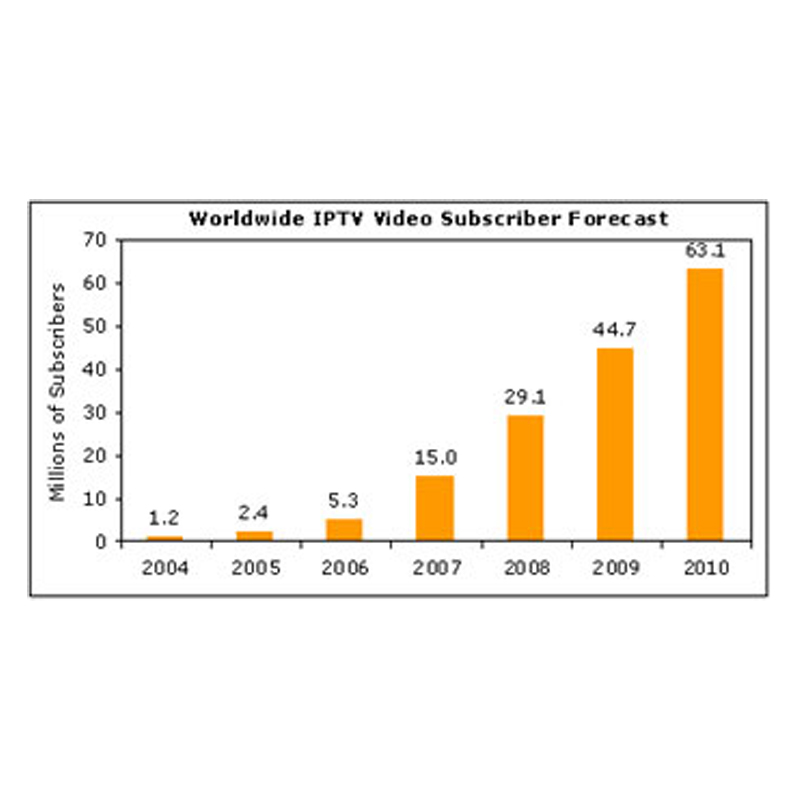
    MUMBAI: The worldwide subscriber base for Internet Protocol Television (IPTV) services is expected to expand by a factor of more than 26 from 2005 to 2010, spurring a competitive battle between video providers both old and new, iSuppli Corp. predicts.

    Global IPTV subscribers will grow to slightly more than 63 million in 2010, rising at a stunning Compound Annual Growth Rate (CAGR) of 92.1 per cent from 2.4 million in 2005, as presented in the figure below.

    The IPTV subscriber base will generate more than $27 billion in overall IPTV services revenue in 2010. While video services will account for the largest portion of these dollars, value-added media services and IPTV operator advertising will combine to represent more than 14 per cent of IPTV services revenue in 2010. Furthermore, across all IPTV services, the corresponding content licensing revenue will reach $11 billion in 2010.

    “The fight to capture the expanding base of IPTV subscribers will put telecom operators on a collision course with existing pay-TV market competitors and with a new class of broadband video portals as they roll-out progressively more sophisticated offerings,” said iSuppli vice president multimedia content and services Mark Kirstein.

    iSuppli categorises market deployment of IPTV services in three phases. The current global IPTV market is early in its first phase: basic service deployment. The second phase will add an array of value-added and interactive services. Phase three will bring dramatic improvements in integration and interactivity.

    Thus, in this pending battle for subscribers, providing a competitive video offering is merely the cost of entry for IPTV operators. Differentiation of IPTV services will be essential to bringing new capabilities to TV-based entertainment and attracting subscribers.

    Areas of differentiation will include:

    Interactivity, such as communication, community, voting, interactive advertising and television commerce (t-commerce).

    Integration across multiple platforms, across voice and data services and across content types, i.e. video, voice, music, gaming, data services and user content.
    Personalisation, including intelligent TV recommendations, individualised advertising and non-linear video programming, such as Video on Demand (VoD) and Digital Video Recording (DVR).

    Value-added services, including on-demand gaming, music, media applications, home networking management, security and data.

    Beyond the video service providers themselves, an array of companies will benefit from new opportunities arising from their roles as the “arms suppliers” for the battle over the next generation of television distribution. These companies include infrastructure gear manufacturers, set-top box makers, software vendors and semiconductor suppliers, iSuppli predicts.

    On a geographic basis, the European market has taken the early lead in the global IPTV market, both for subscribers and for revenue. However, Asia will generate faster growth than the other regions and will achieve the largest subscriber base by the end of this year. The Americas region will lead the world in terms of IPTV dollars starting this year because it will yield the highest Average Revenue Per User (ARPU).