Tag: IPSOS

  • India fourth most economically confident country: Ipsos Study

    India fourth most economically confident country: Ipsos Study

    MUMBAI: Little did anyone know that the Modi sarkar that had vowed to boost growth, control inflation and restore investor confidence will actually work wonders at such a short span.


    According to the study conducted by Ipsos, India’s economic confidence has got a major boost primarily due to a landslide victory of the business-friendly government led by Narendra Modi.


    ‘Ipsos Economic Pulse of the World’ survey reports that the country’s economic confidence shot up by six points to 66 per cent in May 2014 compared to April 2014, making it the fourth most economically confident country in the world after Saudi Arabia, Germany and China.


    Indians are the most optimistic people in the world and are very confident of good time coming soon. For the very first time India (60 per cent) tops the list of countries whose citizens expect that its economy will be stronger in next half year. Marginally less than a half of Indian citizens (43 per cent) believe their local economy which impacts their personal finance is good, a significant rise of five points.


    “All the data points in the Ipsos report indicate that India’s economic confidence has shot up substantially, which is also corroborated by the fact that India’s current account deficit has significantly eased, the currency has stabilised, inflation has substantially pulled back, stock market had a dream run so far and corporate earnings are improving,” said Ipsos CEO Mick Gordon in India.


    “However, recent high food inflation, conflict in oil-producing Iraq and the fear of a below normal monsoon is big challenge for the new government,” added Gordon.


    The online ‘Ipsos Economic Pulse of the World’ survey was conducted in May 2014 among 19,242 people in 25 countries. For the results of the survey herein, a total sample of 19,242 adults aged 18-64 in US and Canada, and aged 16-64 in all other countries, were interviewed between 1 and 15 April 2014.


    For a second month in a row, the average global economic assessment of national economies surveyed in 25 countries remains unchanged as 39 per cent of global citizens rate their national economies to be good.


    Although down two points since last round, Saudi Arabia (87 per cent) is in the lead once again, with Germany (75 per cent), China (66 per cent), India (66 per cent), Canada (65 per cent), Sweden (64 per cent) and Indonesia (59 per cent) following behind. European countries dominate the bottom of the global average: France (9 per cent), Italy (9 per cent), Spain (10 per cent), Romania (10 per cent), Hungary (18 per cent) and Argentina (18 per cent).


    Countries with the greatest improvements in this wave: South Africa (28 per cent, 10points), Indonesia (59 per cent, 9 points), Russia (58 per cent, 8points), India (66 per cent, 6points), Great Britain (43 per cent, 6points), Poland (31 per cent, 6points) and Belgium (42 per cent, 2points).


    Countries with the greatest declines: Australia (53 per cent, -7pts), Hungary (18 per cent, -6pts), Brazil (20 per cent, -6pts), South Korea (19 per cent, -4pts), Sweden (64 per cent, -2pts), Saudi Arabia (87 per cent, -2pts) and China (66 per cent, -2pts).


    Up three points since last sounding, Saudi Arabia (67 per cent) leads the local economy assessment which impacts their personal finance, followed by Germany (55 per cent), Sweden (51 per cent), China (48 per cent), India (43 per cent), Canada (42 per cent), and Indonesia (39 per cent). Ranked the lowest in this measure this month is Italy (9 per cent), followed by Spain (11 per cent), Romania (12 per cent), Hungary (13 per cent), France (13 per cent), Japan (14 per cent) and Argentina (15 per cent).


    New leader emerges, as for the first time India (60 per cent) tops the list of countries that predict their local economies will be stronger in the next six months. The rest of the highest-ranking countries are: Brazil (56 per cent), Saudi Arabia (53 per cent), Indonesia (50 per cent), China (39 per cent), Mexico (31 per cent) and Argentina (31 per cent). Only 6 per cent of those in France expect their future local economies will be “stronger” in the next half year, followed by South Africa (11 per cent), South Korea (13 per cent), Hungary (14 per cent) and Japan (14 per cent).

  • Indian businesses leading Asia Pacific on cyber risk

    Indian businesses leading Asia Pacific on cyber risk

    MUMBAI: Business leaders in India are increasingly waking up to the threat of cyber-crime according to the third Lloyd’s Risk Index conducted by Ipsos.

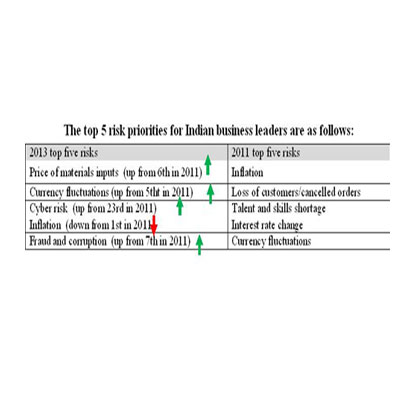
    Ipsos surveyed over 500 of the world’s most senior business leaders for the Risk Index, which shows that cyber risk has become a key concern among Indian businesses, soaring up the Index from the 23rd highest priority in 2011 to 3rd this year.

    The findings show that Indian businesses are taking cyber security more seriously than their Asia-Pac counterparts; prioritising cyber risk five places higher than the Asia-Pac average of eighth place.

    While prioritisation of cyber risk is high, business leaders feel less prepared to cope with the threat of an incident, rating cyber just 14th in terms of the risks they are most prepared to deal with.

    The increased awareness of cyber risk comes at a time when research has shown the average annualised cost of cyber breaches has sharply increased. For 56 benchmarked organisations the average cost was $ 8.9 million a year, up from $ 8.4 million in 2011, and ranging from $ 1.4 million to $ 46 million per year, per company.

    Lloyd’s head of Asia-Pacific Kent Chaplin said: “It’s encouraging to see Indian businesses increasingly leading the way when it comes to recognising the threat of cyber incidents. As recent high profile events have shown, cyber-breaches are only getting more sophisticated and it seems business leaders are beginning to acknowledge that.”

    “However, the risks faced by Indian businesses go far beyond cyber and leaders must ensure they are responding to the challenges they face today and evolving to meet the emerging risks of tomorrow. With the timetable for global economic recovery likely to be much longer than we hoped, effective risk management should be a priority for boards across the world,” added Chaplin.

  • Social Media is Important to Majority of Indians: Ipsos Study

    Social Media is Important to Majority of Indians: Ipsos Study

    MUMBAI: Majority (58 per cent) of Indians say social media is important to them; compared to 42 per cent globally, according to a new poll of online respondents conducted by Ipsos OTX – the global innovation center for Ipsos, the world’s third largest market and opinion research firm.


    “As Mahatma Gandhi rightly said – ‘action expresses priorities’, social media is well on its way to being a priority as majority of Indians who have access to the internet claim social media is important in their lives,” said Ipsos India head of marketing communication Biswarup Banerjee.


    “With proliferation of mobile internet in India, social media has become a part of everyone’s life, it influences people’s daily life and how they interact with each other. Social media has now become a mainstream way of communicating – for individuals as well as businesses,” added Banerjee.


    The big social media story is told in the demographics, especially age. Age appears to be the strongest demographic driver of placing importance on social media in India. Indeed, a big majority (62 per cent) of those under the age of 35 rate social media as important vs. 58 per cent for those aged 35-49 and 44 per cent for those aged 50-64. Women (64 per cent) seem more likely than men (54 per cent) to rate it highly.


    The countries with the highest proportions those indicating social media is important to them are from: Turkey (64 per cent), Brazil (63 per cent), Indonesia (62 per cent), China (61 per cent), Saudi Arabia (59 per cent), India (58 per cent), Mexico (54 per cent) and South Africa (52 per cent). This group of social media lovers is followed by Argentina (45 per cent), Russia (44 per cent), Spain (42 per cent), Poland (37 per cent), Hungary (36 per cent), Sweden (35 per cent), Germany (33 per cent), Great Britain (33 per cent) and the United States (32 per cent). The lower group includes: Australia (30 per cent), Italy (30 per cent), Belgium (29 per cent), Canada (28 per cent), South Korea (28 per cent), Japan (24 per cent) and France (17 per cent).


    Ipsos conducted this study among 18,002 people in 24 countries in the month of July.

  • Hansa Research, Ipsos sign MoU to jointly bid for IRS

    Hansa Research, Ipsos sign MoU to jointly bid for IRS

    MUMBAI: Hansa Research and Ipsos have entered into a Memorandum of Understanding (MoU) to jointly bid for the new Indian Readership Survey (IRS) contract that starts with IRS 2013.

    Hansa Research has been conducting the IRS since 2003. So far, Hansa has been doing it with Media research Users Council (MRUC).

    The Indian Readership Survey (IRS) has been owned and administered by Media Research Users’ Council (MRUC), an Industry body set up in 1994. Earlier in 2011, MRUC and ABC (Audit Bureau of Circulation) decided to merge their parallel readership studies by entering into an alliance to form the RSCI, which is now taking charge of administering the IRS.

    Hansa Research Group MD Ashok Das said, “We are happy and excited to work with Ipsos on this prestigious project, and hope to bring in a number of new ideas into the IRS.”

    This joint bid will combine Hansa’s experience of readership measurement in the Indian context with Ipsos’ global expertise of conducting readership surveys in 60 countries.

    Ipsos-India CEO Mick Gordon said, “We are delighted to be working with Hansa on this very exciting project and we hope we can persuade RSCI (Readership Studies Council of India) that our combination will be a very big plus for the industry. Ipsos measures readership in more than 60 countries around the world and has made a name for itself in introducing many innovations into this specialist area of market research – we were the first to use CAPI and DS-CAPI in readership measurement, for example. We believe we can add significant value to Hansa‘s proven expertise and experience on the ground in India.”

    Through the joint participation of these two entities, the two companies expect to make a very strong and forward looking pitch for the new IRS contract.

    The current sample size of the IRS is 262,000.

    Hansa Research is a global full service market research agency headquartered in India, conducting market research in 77 countries with offices in India and US. Over the last few years, Hansa has developed sound mechanisms to reduce fieldwork related issues that has been widely acclaimed by research users for its ability to minimise some long standing industry weaknesses.

    The Pulitzers are given out annually by Columbia University on the recommendation of a board of journalists and others. Each award carries a $10,000 prize except for the public service award, which is a gold medal.

    Matt Wuerker of Politico, Massoud Hossaini of Agence France-Presse, and Craig F. Walker of The Denver Post bagged the prize in Editorial Cartooning, Breaking News Photography and Feature Photography respectively.

  • Indians second most confident about their economy: Ipsos Global Study

    Indians second most confident about their economy: Ipsos Global Study

    MUMBAI: India‘s Economic Confidence grew by six points to 75 per cent in the month of October compared to the previous month, becoming the second most economically confident country, according to the global economic report released by Ipsos, the market research company.


    The report, titled ‘Ipsos Global @dvisory: The Economic Pulse of the World‘ is based on 18,682 recent interviews in 24 countries around the world; and examines citizens‘ assessment of the current state of their country‘s economy for a total global perspective.


    Ipsos in India MD Mick Gordon said, “The Indian economy has been well insulated from global economic conditions as it has been fueled by domestic consumption and the increased FDI into the country. Our economy has remained steady at a robust 8.1% and this positive consumer sentiment is seen reflected in our survey.”
     
    How are some of the other global economies performing?


    The global aggregate national assessment was dragged by Europe (-2 points to 24 per cent), which was 16 points lower than the next lowest region, North America (40 per cent). In fact, all the regions have reported declining national economic assessments – the Middle East and Africa (-2 to 60 per cent); Asia Pacific (-1 to 41 per cent); except Latin America (46 per cent) which experienced no change in October.


    Despite all the ups and downs, two countries gained significantly – India gained six points to reach 75 per cent; while South Africa gained five points to reach 39 per cent. So, if one looks at the pecking order: Global leader Saudi Arabia experienced a six-point drop to 83 per cent but continued to hold its pole position; India as mentioned earlier bagged the second spot at 75 per cent; Sweden lost five points and was third at 69 per cent; Canada was unchanged at 66 per cent; China too was unchanged at 65 per cent.


    The countries at the bottom of the heap were the same as last month with abysmally low consumer sentiments: Hungary lost two points and was at 2 per cent; Spain gained 2 points but was low at 5 per cent; Japan further lost two points and was 6 per cent; France lost 1-point and was at 6 per cent and Italy was unchanged at 8 per cent. Sadly, Europe continued to lag by Belgium dropping 6 points to 25 per cent; Great Britain (-6 to 11 per cent) experienced the greatest drop in this wave after Indonesia (-7 to 35 per cent).


    Future Outlook for Local Economy was reported unchanged at 24 per cent. The predictions of global citizens regarding whether their local economy would be “stronger”, “weaker” or “about the same” six months from now stagnated at 24 per cent, agreeing it would be stronger – unchanged since August 2011.
     
    Brazil‘s assessment levels on this measure made the world‘s recent zigzag look flat. Though it consistently stood at the top of 24 countries measured, Brazil (+9 to 74 per cent) has swung up and down throughout 2011: down 6 in March (67 per cent), up 5 in April (72 per cent), down 7 in June (64 per cent), up 7 in July (71 per cent), down 6 in September (65%), and was up 9 points in October (74 per cent).


    After Brazil, India (+2 to 56 per cent) emerged the strongest on this measure followed by Saudi Arabia (-4 to 53 per cent), Argentina (-2 to 50 per cent) and China (-5 to 39 per cent).


    France (unchanged at two per cent) remained at the bottom of the rating, followed closely by Hungary (-1 to five per cent), Great Britain (-2 to 8 per cent), and Belgium (unchanged at eight per cent).


    Brazil experienced the greatest rise (+9 to 74 per cent), followed by Spain (+8 to 23 per cent), Russia (+5 to 20 per cent) and Canada (+4 to 19 per cent).


    Turkey once again showed the greatest decline (-5 to 35 per cent) on this measure followed by China (-5 to 39 per cent) and a four-point decline in Poland (15%), Germany (12 per cent) and Saudi Arabia (53 per cent).

  • Ipsos completes acquisition of Synovate

    Ipsos completes acquisition of Synovate

    MUMBAI: Ipsos has successfully completed the
    acquisition of the Synovate business for an enterprise value of ?525 million.


    Following this transaction, Ipsos becomes the third largest global market research company.


    The acquisition was announced on 27 July 2011 and was conditional upon various approvals, which have been obtained since then: the transaction was approved by Aegis’ ordinary shareholders on 16 August 2011 and obtained the mandatory anti-trust clearances thereafter.
     
    The completion of the transaction occurs following the successful capital increase with preferential subscription rights of €200 million launched by Ipsos on 8 September to fund part of the acquisition price, and completed on 30 September.


    Ipsos co-president Didier Truchot said, “We are delighted to have completed the acquisition of Synovate which is transformational for our company. With Synovate, Ipsos strengthens its leadership position in its chosen areas of specialisation and enhances its intellectual and commercial offer to bring enriched and improved solutions to our clients.”

  • Ipsos to buy out Aegis’ Synovate for $860 mn

    Ipsos to buy out Aegis’ Synovate for $860 mn

    MUMBAI: Aegis Group plc has agreed to sell its market research business Synovate to French market research company, Ipsos S.A, for $860 million, opening the window for speculation of being gobbled up by a possible bidder.

    The deal will make fifth-ranked Ipsos the world‘s third-largest market research company by revenue, ahead of Germany‘s GfK SE. The top two positions are occupied by Nielsen Holdings and WPP‘s Kantar.

    Aegis Group plc CEO Jerry Buhlmann called the announcement of the proposed sale as the largest structural change in the history of Aegis Group plc.

    The selling of Synovate underlines Aegis group‘s intent to focus pre-dominantly on media buying through its Aegis Media business.

    Ipsos said that the acquisition is “transformational” for it and will provide a powerful platform to better serve clients through the combination of its experienced research experts, enhanced geographic footprint and delivery of a wider suite of research tools and products.

    The enterprise value of $860 million is subject to customary adjustments for the levels of cash, debt and working capital in Synovate at the date of completion of the sale.

    The deal excludes Aztec, the Group‘s scan data services business, which will remain part of Aegis and will now be used by Aegis Media.
     
    Aztec hasn‘t entered the Indian market as yet.

    According to Ipsos, the acquisition will be financed through a new debt financing of €250 million, a rights offering of approximately €200 million to Ipsos‘ shareholders and existing facilities and available cash.

    Aegis has said that the balance of the proceeds from the sale is intended to provide increased financial flexibility to invest in value-enhancing acquisitions by the company.

    The transaction is conditional upon the approval of the disposal by Aegis‘ ordinary shareholders, as required by the listing rules for a Class 1 transaction in the UK. Aegis‘ general meeting will be convened in the coming days and is expected to be held in mid-August 2011.

    A majority of votes cast must be in favour of the transaction and Aegis has received an irrevocable undertaking from Vincent Bolloré, Aegis‘ 26.5 per cent shareholder, to vote in favour.

    Ipsos entered the Indian market in 2007 through build-operate-transfer model with Indica Research and finally acquiring the company recently. Synovate entered India in 2003 with its full acquisition of Blackstone Market Facts.

    The newly formed entity will be competing with players such as Kantar, TNS and IMRB.

    In India, Synovate has nearly 300 full-time employees and 60-70 free-lancers, four full-service offices and 14 field offices.

    “For Aegis shareholders, the offer from Ipsos provides value and certainty and enables the Group to increase its focus on delivering communications services based on media, digital and content creation. Aegis Media‘s strategy is based on capturing organic growth from the rapidly changing media market”, Buhlmann added.

    Ipsos S.A. chairman and CEO Didier Truchot stated, “This deal will meet our goals to make Ipsos brand a worldwide brand, synonymous with excellence in each of its fields of specialisation and better able to attract and keep clients. I look forward to welcoming the Synovate team to Ipsos and together creating a leading player in market research, with the best talent in the industry.”