Tag: Ipsos India

  • Ipsos hires Rajashree Ivaturi as Ipsos Strategy3 partner

    Ipsos hires Rajashree Ivaturi as Ipsos Strategy3 partner

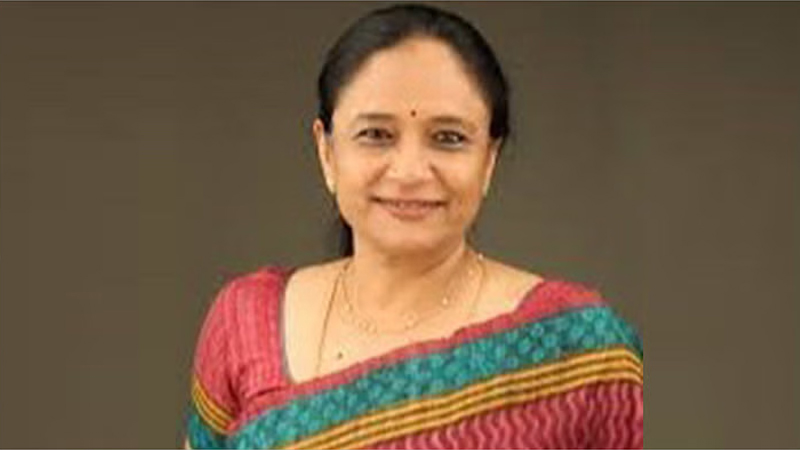
    Mumbai: Eyeing increased opportunities and demand for research-based consulting from clients, Ipsos, a global market research player, has roped in Rajashree Ivaturi, as partner, Ipsos Strategy3 in India. Ipsos Strategy3 is the management consulting arm of Ipsos.

    Ivaturi moves from Quess Corp and has previously worked for over two decades with feedback consulting. Her work experience has spanned research-based consulting at feedback consulting to scaling vocational training programs in social enterprise at Quess Corp.  She reports to Ipsos India CEO Amit Adarkar.

    “Being a leading custom market research company, Ipsos has provided strategic counsel and competent advisory services to our roster of clients via Ipsos Strategy3; and with the increasing demand in a highly growth-oriented market like India, we have expanded the team at the top level with the hiring of Rajashree Ivaturi, whose experience straddling private and government clients will be a great asset to Ipsos Strategy3. Her remit is to leverage opportunities with the government across different ministries, government bodies, trade associations, apart from handling a wide roster of clients across consumer-packaged goods, healthcare, automotive, education etc. We are seeing a lot of clients demanding research-based consulting and Ivaturi brings with her a lot of rich experience that will upscale our client delivery, even for uncharted sectors,” said Ipsos India CEO Amit Adarkar.

    She holds a PGDBM degree from IIPM and an AI ML Program for Leaders diploma from The University of Texas, Austin. And has been on the advisory of several not-for-profit organisations.

  • India remains optimistic in April 2024 amid global pessimism: Ipsos What Worries the World global monthly survey

    India remains optimistic in April 2024 amid global pessimism: Ipsos What Worries the World global monthly survey

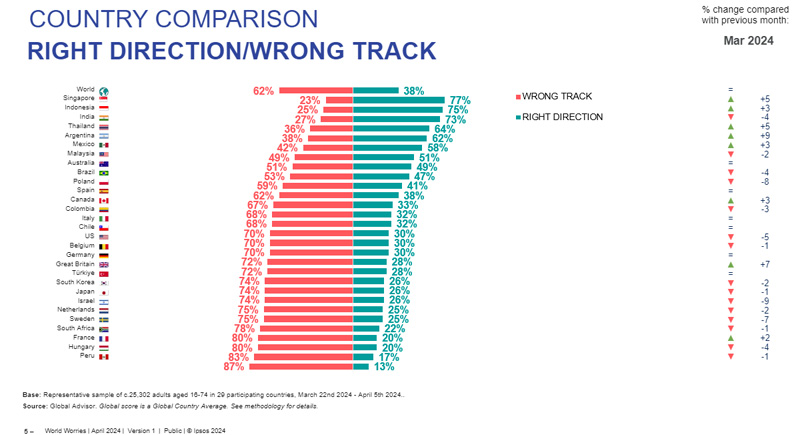
    Mumbai: About three in four urban Indians (73 per cent) believe India is moving in the right direction in April 2024. Though there has been a four per cent dip over the previous month. The good news is, India continues to rank among the top three most optimistic markets and largely driven by global south, with the markets in the pecking order including Singapore (77 per cent), Indonesia (75 per cent), India (73 per cent), Thailand (64 per cent) and Argentina (62 per cent). In sharp contrast, only 38 per cent of global citizens said their country is on right track, with the markets at the bottom of the heap led by Peru (13 per cent), Hungary (17 per cent), France (20 per cent) and South Africa (20 per cent).

    Ipsos India

    Ipsos’ What Worries the World survey tracks public opinion on the most important social and political issues across 29 countries, covering 25,302 adults, apart from the direction of travel, of how confident citizens are about their country and its future.

    What worries Indians?

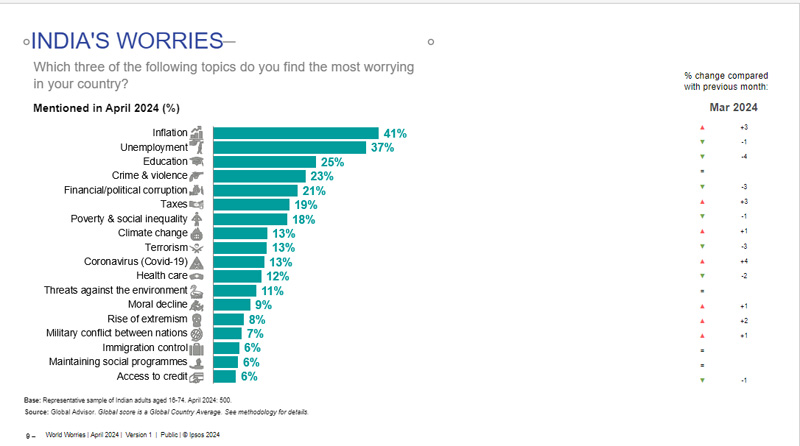
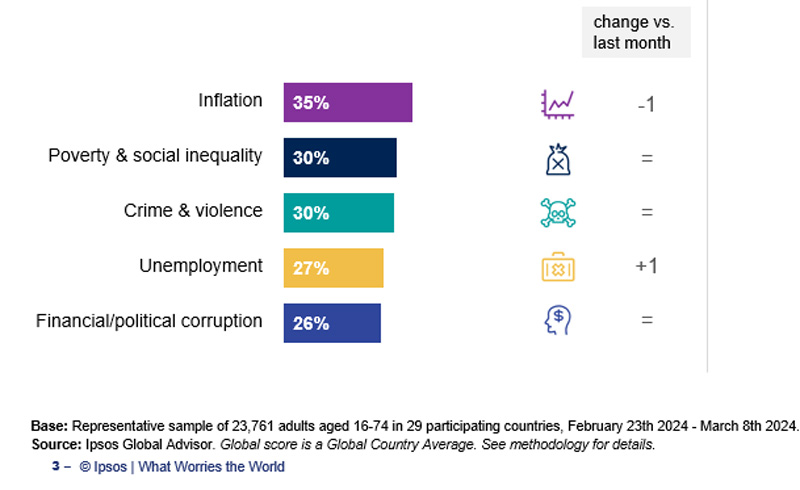
    The top issues worrying urban Indians included inflation (41 per cent), unemployment (37 per cent), education (25 per cent), crime and violence (23 per cent) and financial and political corruption (21 per cent). While most global citizens were worried about inflation (34 per cent), poverty and social inequality (30 per cent), crime and violence (30 per cent), unemployment (27 per cent) and financial and political corruption (26 per cent).

    Interestingly, 19 per cent urban Indians claimed to be worried about taxes.

    india-worries

    Elucidating on the findings of the Ipsos Global Advisor What Worries the World global monthly survey, Ipsos India CEO Amit Adarkar said, “There is stability in the country and the nation is being steered responsibly, by surmounting global and local challenges – whether showing resilience to global challenges arising out of war in Ukraine and Israel, or combating rising cost of living, fuel prices, law and order and corruption, government has taken concrete steps to address some of these issues. With the election season in India in April and May, there will be a status quo on decision making by the incumbent government to address some of the issues impacting the citizens. Though the issues notwithstanding, unlike high level of pessimism rampant across global markets and the frustration and angst seen, three fourths of Indians polled are positive about how we are doing as a country. Though redressal of these issues can further elevate the mood of the masses and improve the quality of living. Month on month, Ipsos captures this pertinent information about 29 markets (including India) from their citizens, which provides local governments views of citizens and their top concerns.”  

  • India maintains highest national index score despite April 2024 consumer sentiment drop: LSEG-Ipsos PCSI survey

    India maintains highest national index score despite April 2024 consumer sentiment drop: LSEG-Ipsos PCSI survey

    Mumbai: India continues to sit at the top of the consumer confidence index with the highest national index score of 67.0, despite a 5.0 percentage point drop in overall consumer sentiment index in April 2024, according to the LSEG Ipsos primary consumer sentiment index (PCSI).

    Among the 29 countries, India (67.0) and Indonesia (65.1) remain the only countries with a National Index score of 60 or higher.

    Ten other countries now show a National Index above the 50-point mark: Mexico (59.8), Thailand (57.6), the Netherlands (54.8), Singapore (54.6), Sweden (54.5), the U.S. (53.4), Brazil (53.3), Poland (50.3), Great Britain (50.2) and Australia (50.1).

    In contrast, just three countries show a National Index below the 40-point mark: South Korea (39.6), Türkiye (36.8), and Hungary (33.2).

    Each month, Ipsos tracks attitudes of consumers in 29 markets on the current and future state of their local economy, their personal financial situation, the employment climate, and their purchasing and investing confidence.

    Consumer sentiment lowers in April 2024 for India

    The overall or national index has experienced a drop of 5.0 percentage points in April 2024 for India. Further, consumer sentiment has fallen across the 4 sub indices (the PCSI is an aggregation of four weighted sub-Indices) – the PCSI Employment Confidence (“Jobs”) Sub- Index, is down  6.3 percentage points; the PCSI Current Personal Financial Conditions (“Current Conditions”) Sub-Index is down 6.6 percentage points; the PCSI Investment Climate (“Investment”) Sub-Index is down 6.5 percentage points; and the PCSI Economic Expectations (“Expectations”) Sub-Index has a minor drop of 1.5  percentage points.

    Summarizing on the findings of the survey, Ipsos India CEO Amit Adarkar said, “India continues to show the highest national index score of 67.0 percentage points despite the drop in consumer sentiment this month. There is  lowering of consumer sentiment overall and largely driven by lowering of sentiment for personal finances, investments, jobs and the economy. Consumers are experiencing financial crunch for not only day-to-day running of households but also for savings and investments. We see downgrading of confidence for jobs. End of the financial year for a lot of companies would mean freeze on hiring by India Inc. And it should pick up in May/ June. Further, around this time, the tax burden increases on personal incomes, tightening the tight rope for discretionary spends. Also, it is election time in India. For 2 months no course correction or sops are likely to be announced by the incumbent government.”  

    Sentiment is largely up throughout Europe. Sweden (+3.6 points), Great Britain (+3.1 points), France (2.8 points), and Spain (+2.5 points) all show significant gains this month. For Sweden, this month’s reading is the country’s highest in nearly two years.

    In contrast, sentiment is more mixed in other regions. In the Asia-Pacific region, consumer confidence is up in Thailand (+2.1 points), while India (-5.2 points) shows the largest decline of any country. In Latin America, Argentina (+3.7 points) shows the largest increase among all countries, while sentiment declined sharply in Brazil (-3.5 points).

    The Global Consumer Confidence Index is the average of all surveyed countries’ Overall or “National” indices. This month’s installment is based on a monthly survey of more than 21,000 adults under the age of 75 from 29 countries conducted on Ipsos’ Global Advisor online platform. This survey was fielded between 22 March and 4 April 2024.

  • Indians have a sense of onus on climate change but live in their own reality: Ipsos’ Earth Day survey

    Indians have a sense of onus on climate change but live in their own reality: Ipsos’ Earth Day survey

    Mumbai: Ipsos, one of the world’s leading market research companies, releases a 33-country study as part of Earth Day, looking at how attitudes to climate change are changing. Urban Indians believe govt (75 per cent), businesses (75 per cent), individuals (77 per cent) need to act now to mitigate the risk of climate change, at the same time two in three urban Indians (68 per cent) believe the negative impact of climate change is too far off to worry in the present. Further, 68 per cent urban Indians see no rationale in changing their own behaviour in tackling climate change believing it will make no difference.  

    Should developed countries be doing more?

    Two-thirds across 33 countries and 76 per cent Indians think countries like the US, GB, France, Canada and Germany should pay more to solve climate change. At the same time, France and Canada have seen an increase in people feeling they are being asked to sacrifice too much to fight climate change, with both countries now more likely to say this is the case than not.

    Attitudes to climate change and misconceptions

    People do want to help in limiting the effects of climate change. In all countries people are more likely to say if everyone made small changes in their everyday lives this could have a big impact, with at least 77 per cent in India endorsing this view. However, they lack the knowledge on how to do this. For instance, 66 per cent urban Indians believe it is the usage of products that deplete the ozone layer as the biggest contributing factor for climate change, while in actual rank the number one cause was industry, electricity and heat production; number was deforestation, agriculture and other land use changes; and number three was air pollution caused by cars, trucks, planes, trains and ships etc. Further, they overestimate the importance of recycling and underestimate the impact of acts like not having a car or going vegan.

    Incentives for personal action

    Urban Indians say the following would encourage them to take personal actions to fight climate change: Seeing the impact of climate driven weather events in other countries around the world (30 per cent), seeing the impact of climate driven weather events in my country (29 per cent), having easy access to information on the steps which I can take every day (28 per cent) and a financial incentive, or tax cut to allow me to make more environmentally friendly purchases of goods and services (27 per cent).

    Summarizing on the findings of the survey, Ipsos India CEO Amit Adarkar said, “On Earth Day, we are aware of the grim realities of climate change and how it is leading to sudden, unforeseen weather conditions and natural calamities in India. We need to build more awareness around the actions actually needed to offset the impact of climate change. Right now the immediate actions needed are not the ones on the radar of citizens. Indians also tend to underestimate the power of personal actions.”

    https://resources.ipsos.com/GM-GC-2024-04-22EarthDay_W.html

    The “33-country average” reflects the average result for all the countries and markets where the survey was conducted. It has not been adjusted to the population size of each country or market and is not intended to suggest a total result. All global numbers cited reflect this 33-country average.

  • Excitement high among cricket enthusiasts this IPL: Ipsos IndiaBus IPL survey

    Excitement high among cricket enthusiasts this IPL: Ipsos IndiaBus IPL survey

    Mumbai: With the Tata Indian Premier League (IPL) 2024 extravaganza off to a flying start from March 22nd 2024, an Ipsos IndiaBus pan India IPL Survey shows at least 1 in 2 urban Indians polled (53 per cent) claim to be following the sporting event. Men’s T-20 annual sporting event in its 17th year, has a run of about 60 days, making it a highly engaging event for cricket lovers.

    Interestingly, more males (67 per cent) claimed to be following the event vis-à-vis females (38 per cent). Though there was not much difference seen across age bands and their interest in the game – 18-30 years (56 per cent), 31-45 years (56 per cent) and 45+ (45 per cent) claimed to be following the IPL.

    Excitement with IPL

    The IPL has struck a chord with the cricket enthusiasts with 88 per cent of those polled (and following the IPL) claiming to be excited about the annual sporting event.

    The excitement was palpable across demographics to the same extent, though among a few cohorts it was a lot higher, particularly the south zone (96 per cent), north zone (93 per cent), metros (91 per cent), tier 2 (92 per cent), tier 3 (95 per cent), high education (92 per cent), self-employed (95 per cent) and 45+ age group (92 per cent).

    Commenting on the findings of the Ipsos IndiaBus IPL Survey, Ipsos India Group Service Line Leader Public Affairs, Corporate Reputation, CSR and ESG Parijat Chakraborty said, “Tata IPL 2024 is this big, 60 day annual big treat for cricket enthusiasts, which has a heady mix of great batting and bowling order – also captured under orange and purple caps – best of cricket, world class players unleashing their prowess under pressure and the short format of cricket, creating a high level of engagement and excitement around this annual fiesta. The stakes are high, and this is one recession proof brand. As the event picks up, those following the game are likely to increase.”    

     Where is the IPL being watched?

    Urban Indians who are extremely kicked about the sporting event claimed to be watching the IPL 2024 across different mediums of access – Television (75 per cent), online/ mobile (49 per cent), OTT platforms (20 per cent) and radio (4 per cent).  33 per cent).

    And if we explore deeper, while TV is the most popular medium for watching the game, more number of respondents from north zone (83 per cent), full time parents and homemakers (84 per cent), SEC B (80 per cent), SEC A (78 per cent), 45+ age group (86 per cent), metros (79 per cent), tier1 cities (79 per cent) said they are watching the game on TV.

    Further, those watching the game on their mobile devices, were largely the self-employed (68 per cent), employed – part time or full time (56 per cent), males (57 per cent), 31-45 years (54 per cent), 18–30-year-olds (51 per cent), high education (58 per cent), living in the metros (56 per cent), from south zone (56 per cent) and west zone (55 per cent).

    The game was being watched on OTT more by those belonging to SEC A (44 per cent), metros (34 per cent), high education (32 per cent) and self-employed (33 per cent).  

     And those catching the game on the radio were largely the self-employed (9 per cent), from tier 1 (9 per cent), west zone (8 per cent), SEC A (7 per cent) and women (7 per cent). Males were a miniscule 2 per cent.            

    The survey also explored the psyche of the IPL enthusiasts, to understand from them the motivations for liking the IPL so much. There is so much noise and chatter around this annual spectacle, which also packs in the best of breed and play in Cricket.

    Why is the IPL liked?

    Urban Indians claimed to be liking the IPL for a plethora of reasons – entertainment (64 per cent), T-20 format (47 per cent) and the team format – of world class players (37 per cent).

    Audiences most kicked about the entertainment aspect were the self employed (76 per cent), from east zone (74 per cent), south zone (72 per cent), SEC A (71 per cent), SEC B (64 per cent), men (64 per cent), women (62 per cent), aged 45+ (67 per cent), 18-30 years (64 per cent), 31-45 years (62 per cent) etc.

    T-20 format was most liked by respondents from SEC A (65 per cent), metros (75 per cent), high education (58 per cent), tier1 (52 per cent), tier2 (50 per cent), west zone (53 per cent) and north zone (50 per cent).  

    And those most enthused about the T20 team format were, SEC A (54 per cent), employed (47 per cent), men (40 per cent), high education (45 per cent), tier 1 (52 per cent), metros (42 per cent), tier 2 (41 per cent), east zone (53 per cent) and west zone (45 per cent).  

     “When the IPL made its debut 17 years ago, conceived by the Board of Control for Cricket in India (BCCI), it was a big draw and it continues to be one of the most anticipated annual sporting events. This year there are 10 teams and 74 matches. Also the matches are aired from evening to night, over 3 hours, making it conducive for cricket enthusiasts to watch the game without disruption. With great cricket, cricket legends, Bollywood, music, cheerleaders and toots, the whole experience is now being called Cricketainment. And the BCCI has set up 50 fan parks in different cities of India, to enhance the whole experience for audiences, bringing the game closer to the fans. Fan parks during the weekends have giant size screens, music, subsidized food for cricket fans to enjoy the IPL at another level,“ added Chakraborty.

    “The 10 teams of Delhi Capitals, Kolkata knight Riders, Lucknow Super Giants, Mumbai Indians, Rajasthan Royals, Chennai Super Kings, Gujarat Titans, Punjab Kings, Royal Challengers Bengaluru and Sunrise Hyderabad are playing 74 matches in 13 cities from March 22nd to May 26th, 2024, making it a visual treat for cricket crazy country like India. With defending champions Chennai Super Kings hosting the opening and closing ceremony, there is a keen interest among south zone fans for the game and across cities and cohorts. With free live streaming of the IPL on Star Sports (TV) and Jio Cinema (internet) it will be about excitement, entertainment and eyeballs, as the IPL keeps getting bigger,” stated Chakraborty.                    

    How is the IPL most watched?

    Urban Indians said they mostly watch the game with family (49 per cent), friends (22 per cent), alone (18 per cent) or with colleagues (9 per cent).

    The survey even drilled it down to the cohorts on how they were watching the IPL – those watching with family were largely full-time parents/ homemakers (75 per cent), women (73 per cent), 45+ age group (62 per cent), SEC A (55 per cent), SEC B (54 per cent), north zone (58 per cent), east zone (55 per cent), tier 1 (55 per cent) and metros (51 per cent).

    Those watching with friends were particularly males (29 per cent), SEC C (32 per cent), south zone (41 per cent), east zone (31 per cent), tier 3 (33 per cent), self-employed (32 per cent) etc.

    Those watching alone were males (23 per cent), aged 45+ (23 per cent), employed (24 per cent), tier 2 (26 per cent), north (21 per cent), south (20 per cent) etc.

    Those watching with colleagues, aged 18-30 years (13 per cent), students (14 per cent), tier 1 (17 per cent), west zone (15 per cent), north zone (12 per cent), et al.

    How we did it

    We ran the survey on Ipsos IndiaBus, our monthly pan India omnibus (which also runs multiple client surveys), using a structured questionnaire and is conducted by Ipsos India on diverse topics among 2200+ respondents from SEC A, B and C households, covering adults of both genders from all four zones in the country. The survey is conducted in metros, tier 1, tier 2 and tier 3 towns, providing a more robust and representative view of urban Indians. The respondents were polled face to face and online. We have city-level quota for each demographic segments that ensure the waves are identical and no additional sampling error. The data is weighted by demographics and city-class population to arrive at national average. 
  • India emerges most optimistic market in March 2024 across 29 markets polled: Ipsos Global Advisor What Worries the World

    India emerges most optimistic market in March 2024 across 29 markets polled: Ipsos Global Advisor What Worries the World

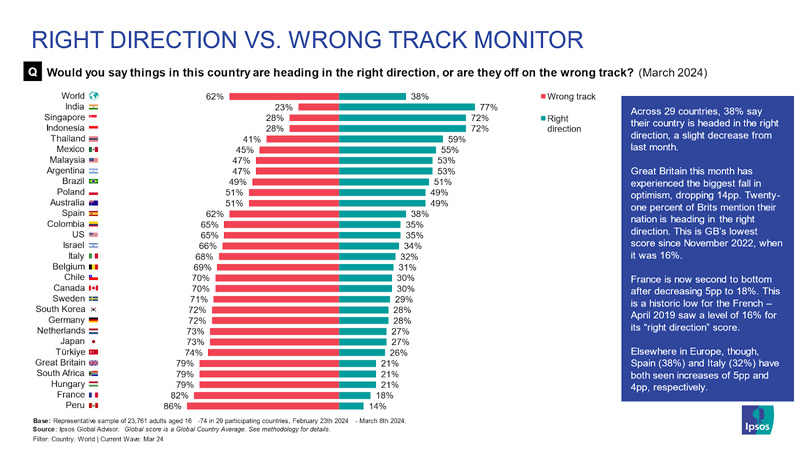
    Mumbai: India has emerged the most optimistic market in March 2024, across all the 29 markets covered in the survey with over three in four urban Indians polled (77 per cent) believing India is moving in the right direction, according to the Ipsos Global Advisor monthly survey that tracks public opinion on the most important social and political issues across 29 countries, alongside whether people think things in their country are heading in the right or wrong direction.

    The other top markets on optimism were Singapore (72 per cent) and Indonesia (72 per cent), tied at the 2nd spot, followed by Thailand (59 per cent) and Mexico (55 per cent). The markets at the bottom of the heap were Peru (14 per cent) and France (18 per cent) with lowest optimism levels about the future. Only 38 per cent global citizens were optimistic about the future.  

      Ipsos

    Worry levels diminish around key issues for Urban Indians in March 2024

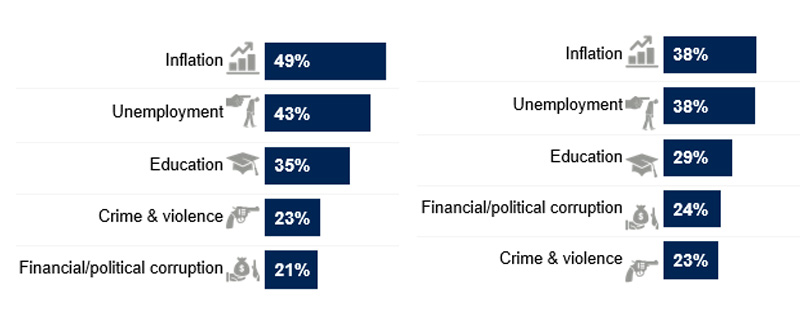
    Further, the survey reveals a significant drop in worry around the key issues of inflation (38 per cent) (minus 11 per cent), unemployment (38 per cent) (minus five per cent) and education (29 per cent) (minus six per cent) over the previous month. Though worry around financial/ political corruption (24 per cent) ( plus three per cent) has increased, but unchanged for crime and violence (23 per cent).  

    Inflation

    A graph of a graph with text Description automatically generated with medium confidenceA graph of a number of people Description automatically generated with medium confidence

    Global worries – Global citizens have got a slight reprieve in March 2024 around inflation.

    Global worries   Summarizing on the findings of the survey, Ipsos India CEO Amit Adarkar said, “India has bucked the global trend of pessimism and emerged the No.1 market in optimism across the 29 markets, where the Ipsos Advisor survey is held every month. If we look back, India has always been among the top markets in optimism, through months and years. India has not crumbled under global adversities and citizens have believed in the system, unlike many global markets that have been downbeat. What could have worked for India? Its resilience, its course correction in the face of severe hardships on citizens. Govt cut fuel prices by Rs. 2, in March, across India, which provided some relief around inflation and cost of living. Worry around unemployment has also reduced with the job market in the hiring mode in some sectors like retail, automotive, f&b, IT & technology etc. Worry around inflation and unemployment has seen a significant drop in March 2024 and likewise for education. With general elections coming up in mid-April, corruption charges are already flying thick and fast, which is a matter of concern. Also crime and violence are of deep concern to citizens.”


  • 72 per cent urban Indians happy in Circa 2023: Ipsos India happiness report

    72 per cent urban Indians happy in Circa 2023: Ipsos India happiness report

    Mumbai: 20 March marks the UN’s International Day of Happiness with the theme of 2024 being  “Reconnecting for Happiness: Building Resilient Communities.” It’s also the day when Ipsos, a global market research company releases its Ipsos India annual Happiness Report which deep dives into 12 months of a rigorous study to emerge with the true indicators of happiness for 2023.

    Overall, in Circa 2023, 72 per cent per cent Indians claimed to be happy. While the Indians are most happy with family (73 per cent), deeper analyses reveal that personal finance and health are the top influencers of our happiness.

    Ipsos experts ran a regression analysis on the 12 months of happiness data and the derived analysis provided a more nuanced view about what influences happiness and what contributes to happiness.  The analysis further revealed that health and personal finances were the biggest influencers to Happiness for Indians. Family, which we are most happy about, was placed third in the pecking order of the importance hierarchy – far lower in influence as compared to health and personal finances.

    The analysis also revealed, Indians have higher expectations on the financial front. So, while it was an important influencer, the current happiness score of personal finances was much lower, at 55 per cent.

    Interestingly, on the professional front, work and career was seen to play a more significant role in terms of how it affects their finances. The actual work and colleagues had lesser impact on overall happiness.

    “Indians are happy in their own ‘personal bubble’. Their attention is more inward-driven, rather than the external situation of the country and the world. The report captured variations across life stage, location and gender of the individual. For instance, for men, health and personal finances were equal influencers, while for women, health was clearly ahead as a driver to be happy. For those living in metros, health was a bigger influencer than for those in non-metros. An age-wise analysis also revealed the shift in what makes individuals happy – health overtakes finances for those older than 46 years, as compared to the younger generation (where both health and personal finances were equally important),” stated Ipsos India group service line leader, public affairs, corporate reputation, ESG & CSR Parijat Chakraborty.  

    The report, first of its kind in India, is based on the twelve-month data for 2023 from the Ipsos IndiaBus monthly Happiness Monitor. Ipsos IndiaBus is an urban India omnibus, fielded among 2200+ respondents per month from NCCS A, B, and C households, covering adult males/ females across all four zones in the country. The survey is conducted across 16 cities – a mix of metros, tier 1, tier 2, and tier 3 towns, providing a robust and representative view of urban Indians.

    Access full report here

  • 78 per cent urban Indians perceive India to be on right track: Ipsos Global Advisor What Worries the World

    78 per cent urban Indians perceive India to be on right track: Ipsos Global Advisor What Worries the World

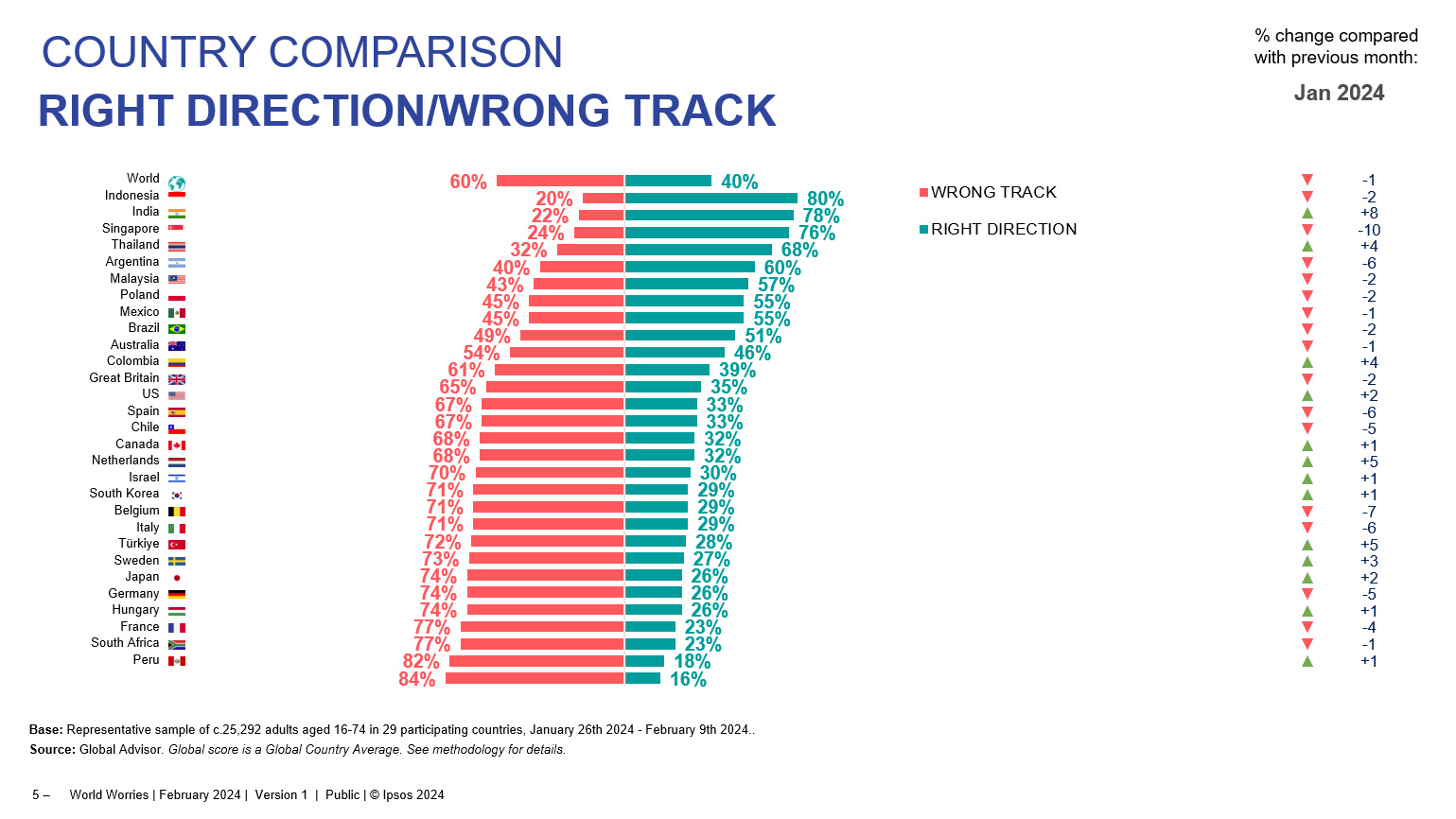
    Mumbai: The Feb 2024 wave of the Ipsos What Worries the World shows that at least 78 per cent of the urban Indians polled believe India is moving in the right direction. Interestingly, there was an eight per cent surge seen over Jan 2024. On the contrary, six in ten global citizens said their country is on wrong track.

    wrong-track

    Countries belonging to the global south were at the top of the heap. Signalling the new shift in growth and optimism. The markets being Indonesia (80 per cent), India (78 per cent), Singapore (76 per cent), Thailand (68 per cent), Argentina (60 per cent), Malaysia (57 per cent) etc. Countries most downbeat about the future and believing their country is on wrong track and at the bottom of the heap were – Peru (16 per cent), South Africa (18 per cent), France (23 per cent) and Hungary (23 per cent).

    What worries urban Indians and global citizens

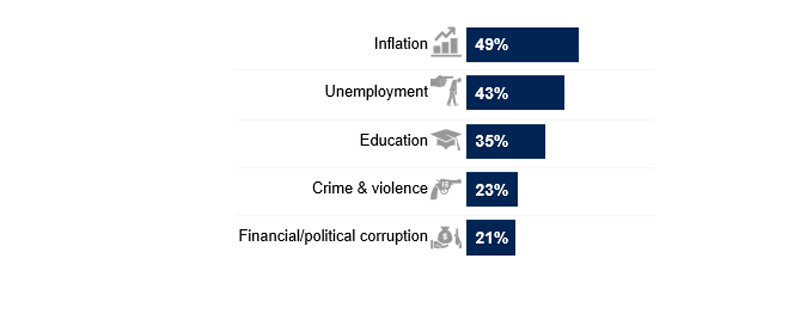
    Ipsos What Worries the World global survey also covers views on the top issues citizens believe their countries are facing. In Feb top issues enlisted by Indians included – Inflation (49 per cent), unemployment (43 per cent), education (35 per cent), crime and violence (23 per cent) and financial and political corruption (21 per cent). For global citizens their top worries included inflation (36 per cent), poverty and social inequality (30 per cent), crime and violence (30 per cent), unemployment (26 per cent) and financial and political corruption (62 per cent).

    Ipsos  

    “In Feb we witness more Indians being confident about the future and about how we are doing as a country. India has always been resilient during torrid times. Even with the 2 wars (Ukraine & Gaza) impacting global economies including India, increasing inflationary conditions and leading to massive job cuts. We have shown stability and consistency in growth. As a country we are defining our own set of priorities for trudging forward . A confident nation has a positive impact on its citizens. Indians worry about inflation, unemployment, education, crime and corruption the most. The survey highlights issues to flag it to the govt that some of these areas need attention. Though inflation continues to be the No.1 global worry as well,” stated Ipsos India CEO Amit Adarkar.

    “It’s a double whammy of issues Indians are dealing with – high cost of living and unemployment. And these issues continue to sit on the top, for 2 years in a row now. Global polycrisis has accentuated it for India as we live in an interconnected world and no country is insulated from it,” added Adarkar.

  • India shifts to a new socio-economic classification system ISEC, women education is one of the key definers of social capital

    India shifts to a new socio-economic classification system ISEC, women education is one of the key definers of social capital

    Mumbai: India’s sole and autonomous market research industry body, Market Research Society of India (MRSI) announces the adoption and implementation of its latest Socio-economic Classification System, ‘ISEC’. The current Socio-economic Classification (SEC) being followed in India is based on ownership of consumer durables and vehicles. The growth in GDP and income, penetration of consumer durables, and ownership of vehicles has witnessed a significant increase, leading to the current socio-economic classification becoming less discriminatory and more volatile. The need to redefine the key variables led to the formation of a more stable, and more robust construct, ‘ISEC.’ Among the various industry stakeholders on track to adopt ISEC are The Indian Society of Advertisers (ISA), research users of various organisations such as ITC, Hindustan Unilever Limited, Marico, Dabur India, etc., research agencies including Kantar, IPSOS, as well as key media agencies.

    On rolling out the new socio-economic classification system, Market Research Society of India director general Mitali Chowhan said, “Socio-economic classification is the base of any targeted consumer understanding. At MRSI we recognise the need for an evolved SEC structure and ISEC is a system that is highly relevant. ISEC was developed by the industry, for the industry and unlike any previous classification system, it considers women’s education as a key definer of social capital, an attribute that is highly pertinent in current day. As an industry body, we are deeply invested in our stakeholders and the launch of ISEC is in line with our commitment to help our industry grow and evolve.”

    Socio-economic classification enables brands and agencies to understand their target audience’s behaviour and profiles and set price points. Updates to the current socio-economic classification is critical given the changing landscape of Indian households. ISEC addresses this with classification using household education and occupation profiles.

    In line with the roll-out of ISEC, MRSI organized a panel discussion that reaffirmed the importance of an evolved Socio-economic classification system to target consumers. Reinforcing ⁠their thoughts were senior industry leaders Amit Adarkar, CEO of IPSOS India, ⁠Jasmine Sachdeva, Managing Partner of Wavemaker India, ⁠Muralidhar Salvateeswaran, Chief Operations Office, Insights APAC at Kantar, ⁠Rajiv Dubey, Head of Media at Dabur India, ⁠Vivek Malhotra, Group CMO of India Today Group and Vinay Virwani, Head – Consumer Insights at Dabur India. The panel that was moderated by MRSI’s General Secretary, Shuvadip Banerjee, Chief Digital Marketing Officer of ITC Ltd. discussed the increased need for a deeper understanding of consumer behaviour, media targeting, and challenges the industry is faced with given the existing NCCS construct.

    Stressing on the need for a robust SEC system, IPSOS India CEO Amit Adarkar said, “Socio-economic classifications are the starting point of any planning or decision-making, impacting almost all industries. Following a SEC system that is relevant, evolved and representative is hence critical. NCCS was introduced at the time when digitisation was gaining momentum and women representation in household decisions was marginal. Our country has evolved greatly since then and it is essential that we follow a SEC that is equally evolved.”

    Concurring with Adarkar, Worldpanel Division managing director South Asia K Ramakrisnan Kantar said, “The challenges that companies are faced with these days are innumerable with the current SEC system adding to these challenges in terms of targeting and understanding behaviours. ISEC is a robust system that works well in both urban and rural India. It has more distinctiveness, a better distribution and it gives us the confidence that its structure will benefit brands and their decisions.”

    Unlike NCCS that only factored the education of the chief earner and the presence of certain consumer durable items in the household, MRSI’s ISEC takes on a more advanced approach by including the occupation of chief earner, education of highest educated male adult as well as education of highest educated female adult. Created by a team of seasoned experts and professionals from across the research and insights industry using National Council of Applied Economic Research (NCAER), the Worldpanel division, Kantar, Indian Readership Survey (IRS), and referencing data from VTION,  ICUBETM, among others.

    Speaking on the new SEC, Sunil Kataria, chief executive Officer – Raymond Lifestyle – India & International, and chairman of The Indian Society of Advertisers said, “The development and progress of our economy is at a rapid pace. At such a pace it is even more important for us as advertisers and spenders to understand our consumers and their behaviour. ISEC is representative, relevant and robust. It gives us a holistic view of our audience segment and how they are equipped to make decisions. We welcome this new socio-economic classification and will continue to work with MRSI to further strengthen this system as and when required.”

    ISEC makes way for improved distribution and sharper and refined targeting. It is considerably more stable than NCCS, hence omitting the need for frequent updates.  ISEC’s discriminating quality is visible with each of the class/tier behaving differently, thus being more relevant as the economy develops with improvements in standards of living, increased asset ownership, infrastructure development and government interventions. Moreover, social capital in India can be defined by the education of the female and this parameter helped improve ‘discrimination’.

    Speaking on the implementation, IPG Mediabrands India CEO Shashi Sinha, further added, “A better and deeper understanding of consumer cohorts is always appreciated. It equips brands the opportunity to identify and target consumers in a sharper manner and opens up avenues for sharper communications. ISEC is highly discriminatory which is also crucial in current times. The implementation was long due and we are certain that this will help the industry considerably going forward.”

    “Following a socio-economic classification system that is representative of the population ensures that the industry is marching forward with efficiency. It ensures that the money spent is being spent correctly and more effectively. ISEC gives us that confidence and we are certain that this is a step forward in the direction of economic growth and development.” added India Today group CMO Vivek Malhotra.

    Representative of India’s social-economic strata, ISEC works equally well for urban and rural, is straightforward and quick and is not intrusive to administer.  A classification system spanning 1 to 12 tiers, ISEC is an open-source system and is available for all industry stakeholders

    SEC systems are used by all research companies, advertisers, and measurement bodies to target households. 

  • Ipsos India busts popular myths about Gen Z & Gen X

    Ipsos India busts popular myths about Gen Z & Gen X

    Mumbai: Ipsos India showcased new thinking on Generations busting myths about Generation Z and Gen X, providing a true understanding of the two key cohorts, exhorting marketers to fine tune their targeting with precise messaging. The views were shared at the Ipsos After Hours, client event.  

    Generation Z, those born between 1997 to 2012 and Generation X (born between 1965 to 1980) have been the fastest growing cohorts. Ipsos highlighted some of the misconceptions around these two groups of dynamic people.

    Ipsos India group service line leader, UU and Synthesio Ashwini Sirsikar said, “We all know that India is a young country, with 65% of its population belonging to Gen Z or Y. What may be news to some of us is that it is actually Gen X which is the faster growing population for India. While much is written, spoken and known about Gen Z, there is very little which is known about Gen X. However, what is common to both segments is the abundance of myths which exist around each of these segments. Our attempt is to bust some of these myths and leave some food for thought for marketers.”

    Generation Z

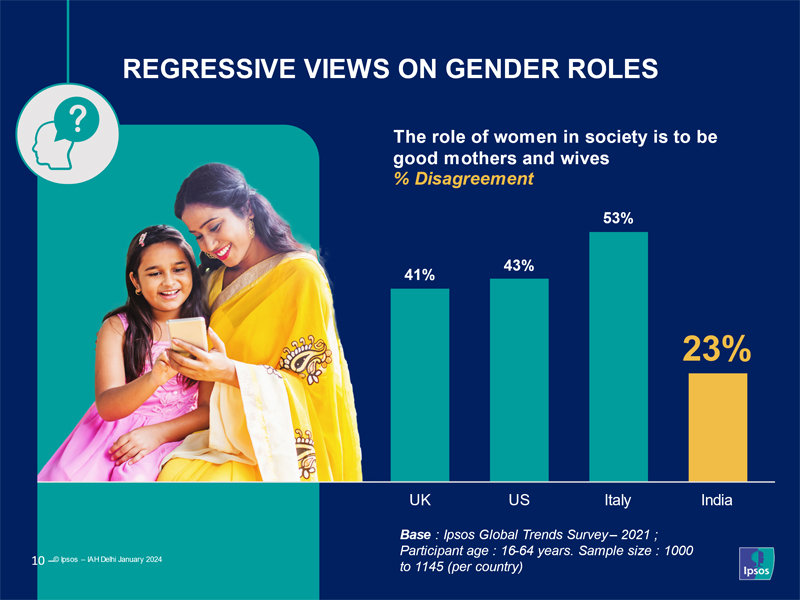
    Myth one – We all tend to have this stereotypical Gen Z image shaped by the popular media and our own exposure to various western influences. But the reality is different as shown by the data on this slide – the difference between Gen Z in India as compared to other countries.

    IPSOS

    Generation Z has regressive views on gender roles.

    Myth two – One would expect Gen Z as a cohort to be a happy bunch and someone who would lead a very carefree life where they are able to navigate the complexities of life very easily.

    In reality, Gen Z was seen to be largely bored, lonely and frustrated. And constantly under stress.

    Myth – GenZ often seen as digital natives are not just social butterflies in the virtual world but also adept at forming meaningful connections in the physical world.

    Not only were they bored and lonely, but they were also finding it more difficult to make friends after the pandemic. They are comfortable interacting with people online but that itself could be a stressor for them – as it becomes difficult for them to form true human and personal connect in the non-online world.​

    ​They find the thought of talking to strangers difficult and struggle to open conversations.

    Myth: Gen Z is self absorbed, entitled and privileged.

    Interestingly, what we saw was a heightened sense of awareness about financial responsibilities – they did not feel as secure financially (some of them would have just started working) and worry the most about being a financial burden on the family.  ​

    ​To combat this, they were seen to often start to earn early and supplement their income through side jobs.

    Gen Z was seen to be different from how it is perceived in money matters.

    Generation X

    Myth 1: Gen X is often caught between the responsibilities of caring for parents and raising their own families coupled with the pressures of maintaining their careers, mental and physical wellbeing.

    Contrary to the popular notion, Gen X-ers actually felt way better physically and mentally when compared to Gen Z.

    Myth 2: Significant global events, economic fluctuation have resulted in Gen X being pessimistic

    We know that the Gen X has seen considerable financial fluctuation as well as big global events that have impacted their lives – which leads us to think that they are a naturally pessimistic generation.

    However, they are feeling a lot more optimistic about life in general – more well prepared, excited and optimistic and less lonely, bored and frustrated.

    Myth 3: Generation X with multiple financial responsibilities find themselves cash strapped and need to dip into savings.  

    We already know that as a Generation, they have a huge spending power. ​

    ​Despite this, it was interesting to note both Gen X and Gen Z feel similarly when it came to buying things they need. However, Gen X-ers also try to keep their life simple as far as possessions are concerned. They in fact believe in leading a simple life.

    While Gen Xers believe in simple living, it does not translate to frugal. They are in fact enthusiastic about making purchases across a very wide range of categories.

    These categories span a broad range – these not just include the obvious ones like grocery, financial services, health care etc. but also others like fashion, home décor, consumer durables, personal care, automobiles etc.

    Myth 4: Generation X often considered financially pragmatic, is known for saving for very specific goals.  

    Interestingly, Gen X was seen to be self-sufficient when it comes to money. They have a savings mindset but were not saving for anything in particular.

    Popular culture Vs reality. Does Gen X’s portrayal match up?

    Portrayal of Gen X in popular culture to see if this representation matched the reality or just carried forward the existing stereotypes showed, Gen X was a forgotten generation or a sandwiched generation. Every generation had its stereotype — millennials were seen to be whiny, Gen Z weird, and boomers were seen to be selfish. Gen X’s nobody remembered them.​

    41 per cent of them felt that their generation is not at all well-represented in the advertisements today.

    Look at some salient TV commercials – Most categories focus on either the youth or the boomers, youth – because everyone runs after them, boomers – as everyone listens when granny speaks. ​

    What was clearly evident that there were very few meaningful portrayals of Gen X or any meaningful relationships shown between Gen X and Gen Z.

    Even when Gen X were represented in ads, the depiction was stereotypical and it was in categories like health, insurance etc. – portrayed as the ignorant, tech unsavvy folks, just as provider who need to be educated either by their smarter kids or an expert.​

    Also shown as being at logger heads with Gen Z – having extreme and traditional views. And the portrayal of one generation teaching the other.

    Gen Xers also felt very under-represented in specific categories like fashion, beauty, durables, automobiles etc. – and unfortunately, these were the very categories that they were looking forward to buying in the very near future.

    A few brave attempts made to unstereotype this generation – but not enough.

    ​There was some glimmer of hope seen when it came to OTT – Many Gen X centric shows with lead actors in their  50s of late, have been coming through. Playing their age, breaking the stereotypes.

    Need for more authentic representation of both generations to avoid alienation.

    What will it take to engage them meaningfully and tap into their buying power?

    At what age do we cap survey participation?

    “The narrative of Generation X is marked by satisfaction, wealth accumulation, and unfortunately, disregard. This rapidly growing, affluent generation is often overlooked, both in terms of dedicated research and representation in studies and targeted marketing – a situation that requires introspection and change,” stated Ipsos India executive director and country service line leader, Synthesio Maitreyi Mangrati.

    While there are many misperceptions and differences between these two generations, one thing on which their views converge is the impact of climate change on the planet and the need to take necessary action.