Tag: Ipsos India

  • Consumer sentiment surges in October amid festival cheer: LSEG-Ipsos PCSI India

    Consumer sentiment surges in October amid festival cheer: LSEG-Ipsos PCSI India

    Mumbai: Consumer sentiment of urban Indians has displayed a major resurgence of +4.3 percentage points in October amid festival cheer and above normal monsoons, according to the monthly LSEG-Ipsos Primary Consumer Sentiment Index (PCSI) India report. Last month consumer sentiment had shown a minor uptick of of +0.4 percentage points and prior to that in August was down -2.9 percentage points.

    The LSEG-Ipsos PCSI maps consumer sentiment on four sub indices and interestingly, all four have shown improvement – the PCSI current personal financial conditions sub index (current conditions) is up +7.7 percentage points; the PCSI economic expectations (“expectations”) sub-index is up +3.3 percentage points; the PCSI investment climate (“investment”) sub-index is up +7.1 percentage points and sentiment for the PCSI employment confidence (“jobs”) sub-index, has seen a minor surge of +0.3 percentage points

    Ipsos India CEO Amit Adarkar said, “Consumer sentiment has phenomenally improved for personal finances – for day-to-day household expenditure – and investments – making it conducive for customers to save and invest in big ticket purchases, in the festival season, particularly, when marketers are doling out promotional schemes and easy financing. Confidence around the economy is seeing a major rebound, riding on good monsoons and boosted by growth in infrastructure and domestic consumption. Even the IMF has pegged the economic growth of India at 7% for 2024. Confidence around jobs was up but somewhat sluggish as hiring is slow with companies focusing on closing a robust H2, after a tough H1, due to the elections, heat wave, heavy rains and its collateral impact. Automotive sector grew by a miniscule 0.5 per cent April to September. The festival season has seen a major upturn in consumption bringing much cheer to marketers.”

    Overall Consumer Confidence

    Consumer sentiment in 29 countries

    Among the 29 countries, India (66.3) now holds the highest National Index score. India and Indonesia (62.1) are the only countries with a National Index score of 60 or higher.

    Ten other countries now show a National Index above the 50-point mark: Singapore (58.3), Malaysia (58.2), Thailand (56.8), the U.S. (55.6), Sweden (55.4), Mexico (53.8), Brazil (53.4), the Netherlands (52.1), South Africa (51.4), and Great Britain (50.7).

    Consumer sentiment in 29 countries

    In contrast, just three countries show a National Index below the 40-point mark: Japan (39.3), Hungary (35.3), and Türkiye (33.0).

    Compared to 12 months ago, just three countries show a significant drop in consumer sentiment. In contrast, thirteen countries show a significant increase from October 2023, most of all in Malaysia (+12.1).

  • IBS 2024: The Power of data, is it enough?

    IBS 2024: The Power of data, is it enough?

    Mumbai: The panel at IBS 2024 engaged in a thought-provoking dialogue on the evolving role of data in advertising, specifically questioning whether the sheer volume of data available today is sufficient for driving effective Return on Investment (RoI) in marketing campaigns. It also assessed if over-reliance on data and programmatic approaches might be overshadowing the need for value-driven strategies and calculated risks.

    The session was chaired by Ipsos India, senior client director, Ananya Roy Mathur followed by panelists: Blue Star India head – Digital Initiatives, Abhishek Kumar, dentsu India senior vice president – Product & Technology, Abhinay Bhasin, NitiAayog chief mentor Kushal Sanghvi and Quora head of marketing, APAC and EMEA, Neha Chimbulkar.

    Ananya asked Kushal on some of the most significant initiatives undertaken by the government years ago to which he says was the introduction of a single identity system, exemplified by the Aadhaar card. “With approximately 943 million Aadhaar cards issued, it serves as a unique identity for citizens, offering a comprehensive dataset that surpasses what any company, including Google or Facebook, possesses regarding consumer behavior. Today, almost everything is linked to this identity.”

    He also delved on initiatives like UPI (Unified Payments Interface), which have revolutionized transactions by providing a seamless payment platform. “Just a decade ago, it would have been unimaginable to have such a unified channel. Today, numerous platforms like Paytm and PhonePe enable marketers to effectively engage with audiences. The government’s approach emphasizes using data to create a holistic environment, rather than merely monetizing it.”

    Abhinay highlighted the behavior of the audiences and how it is evolving over the years. “Discovering audiences today involves understanding how behavior is evolving and integrating those insights into marketing strategies. Keeping a pulse on these changes is crucial for developing effective creative. The abundance of data we now have—processed at an unprecedented scale—provides invaluable signals from various sources, such as video viewership and behavioral patterns on platforms like Facebook and Google. This wealth of information shapes our understanding of consumers, directly informing the creative process and ensuring we reach the right addressable audiences effectively,” says Abhinay.

    Neha lastly gave insight more on to the analytical tools available. “The key lies in combining strategy with the available analytical tools. Once you clearly define your objectives, it becomes easier to identify the relevant metrics and data points necessary for achieving those goals. Despite the vast amount of data at our disposal, if we don’t focus on selling products or services that truly matter to us, we risk deflection and losing sight of ROI. In today’s marketing landscape, being ROI-driven is essential,” concludes Neha. 

  • Consumer sentiment shows recovery and improves with a minor uptick: LSEG-Ipsos PCSI September 2024

    Consumer sentiment shows recovery and improves with a minor uptick: LSEG-Ipsos PCSI September 2024

    Mumbai: Consumer sentiment among urban Indians has improved and has shown recovery in September 2024 with a minor uptick of plus 0.4 percentage points. Further, the consumer sentiment is up for jobs, economy, investments and personal finances, according to the September wave of the LSEG-Ipsos primary consumer sentiment index (PCSI) India report.

    The LSEG-Ipsos PCSI maps consumer sentiment on four sub-indices and the sentiment for the PCSI employment  onfidence (“Jobs”) sub-index, has seen an uptick of plus 1.1 percentage points, the PCSI  urrent personal financial conditions sub index (current conditions) is up plus 0.3 percentage points; the PCSI investment climate (“Investment”) sub-index is up plus 0.1 percentage points; and the PCSI Economic Expectations (“expectations”) sub-index is up plus 0.5 percentage points.

    Also, India has ranked second on national index score across 29 markets.

    Ipsos India CEO Amit Adarkar has high hopes on H2, after a tough H1: “Consumer sentiment has shown recovery after being downbeat last month. Apart from the overall upswing in consumer confidence this month, the sentiment has shown recovery for daily household spends, savings, economic growth and jobs. H1 saw major cutback by companies due to tough macro conditions and the global economic slowdown, global inflationary conditions and job cuts. With a good monsoon this year and the festival season reaching its pinnacle with navratri, dhanteras and diwali coming up, consumer sentiment should see a major boost next month. Sentiment around jobs improved last month, and this month too consumers are bullish about the job market and hiring. India is also recovering from the havoc unleashed by extreme weather conditions, in terms of flooding and landslides through July and August.”

    Consumer sentiment in 29 countries

    Among the 29 countries, Singapore (62.5) now holds the highest national index score. Singapore, along with India (62.0) and Indonesia (61.5) are the only countries with a national index score of 60 or higher.

    Eleven other countries now show a National Index above the 50-point mark: the Netherlands (57.4), Mexico (55.9), the U.S. (55.0), Great Britain (54.1), Sweden (54.0), Germany (53.7), Thailand (52.1), Brazil (51.3), Malaysia (51.2), South Africa (50.5), and Australia (50.2).

    In contrast, just four countries show a National Index below the 40-point mark: South Korea (39.7), Japan (39.4), Hungary (36.4), and Türkiye (30.8).

    “Notably, India has stayed among the top three markets with high national index score and stayed resilient despite several global crises popping up one after the other. Being a growth oriented emerging market and its economy resting greatly on domestic consumption, we have been able to offset the extreme impact. Though global economic slowdown has further weakened the rupee against the dollar,” stated Adarkar.

  • Consumer sentiment up for jobs: LSEG-Ipsos PCSI August 2024

    Consumer sentiment up for jobs: LSEG-Ipsos PCSI August 2024

    Mumbai: The August 2024 wave of the LSEG-Ipsos primary consumer sentiment index shows confidence around jobs has improved and India was placed second in the pecking order on the national index score across the 29 markets covered in the survey.

    However, overall the sentiment was seen to be down -2.9 per cent points.  

    The LSEG-Ipsos PCSI maps consumer sentiment on four sub-indices and sentiment around the PCSI employment confidence (‘Jobs’) sub-index, has seen an uptick of +0.9 per cent points, the PCSI current personal financial conditions sub index (current conditions) was down -6.5 per cent points; the PCSI investment climate (‘Investment’) sub-index has lowered -6.5 perc ent points; and the PCSI economic expectations (‘Expectations’) sub-Index was down 2.0 per cent points.

    Ipsos India CEO Amit Adarkar elucidating on the findings said: “The sentiment around jobs has improved with some sectors hiring in H2 and also with the government announcing new initiatives for job creation in the budget. Some consumers are feeling the pinch of high cost of living in terms of strain on personal finances for day-to-day running of households and lack of disposable incomes for savings and buying of big ticket items and discretionary spends. The sentiment is also down around the economy. Global factors continue to bog down our economy also with the rupee weakening against the dollar at Rs. 84/$, with the wars in Ukraine and Gaza continuing.”

    Consumer sentiment in 29 countries

    Among the 29 countries, India has now moved to the 2nd spot, preceded by Indonesia (63.6) which now holds the highest national index score. Indonesia and India (61.6) are the only countries with a national index score of 60 or higher.

    Eleven other countries now show a national index above the 50-point mark: Sweden (57.3), the Netherlands (55.6), the U.S. (55.3), Malaysia (54.2), Great Britain (53.8), Brazil (53.1), Singapore (52.5), Mexico (52.0), Spain (50.2), Canada (50.1) and South Africa (50.1).
    In contrast, just three countries show a National Index below the 40-point mark: Japan (38.0), Hungary (36.8), and Türkiye (36.4).

    “India continues to be one of the most resilient markets despite all the global turbulence and tough macro conditions. We have good monsoons and that should bring down food inflation,” added Adarkar.

  • Polarised views among Indians on Paris Olympic Games 2024: Ipsos Global Attitudes

    Polarised views among Indians on Paris Olympic Games 2024: Ipsos Global Attitudes

    Mumbai: The Ipsos Global Advisor Survey in 33 countries on the Paris Olympic Games 2024, displays polarised views among Indians for those interested (53 per cent) in watching the games versus those uninterested in watching the game (47 per cent). Though the interest in the Paris games was significantly high among most Asian countries, particularly in China (86 per cent), Thailand (77 per cent), Indonesia (75 per cent) and Philippines (71 per cent).

    The global sporting event is being held from 26 July to 11 August 2024.

    Favourite games

    Among all games, global citizens (28 per cent) and urban Indians (28 per cent) are most interested in watching football/ soccer. Other games Indians have evinced interest in, included, badminton (18 per cent), volleyball (14 per cent), tennis (14 per cent), cycling (13 per cent), boxing (11 per cent), basketball (11 per cent), among others. While global citizens were keen to watch athletics (26 per cent), gymnastics (24 per cent), aquatics (18 per cent), volleyball (17 per cent) etc. A whole array of sporting events causing frenzy among sports enthusiasts.

    Elucidating on the findings of the survey, Ipsos India CEO Amit Adarkar said, “While the Olympic Games in Paris is a global sporting event, India has not bagged many medals in the past, just a trickle, except in the Tokyo 2020 Olympics which was held 3 years ago in 2021 (one year delay due to Covid19),  when India bagged seven medals – one gold, two silver and four bronze medals – the highest ever medal tally. The stickiness is not as profound as it is for cricket. But the good news is that India is sending a large contingent of 171 athletes to Paris, with 72 athletes making their Olympics debut and there is a huge hope around them to potentially get a haul of medallions.”        

    Positive sentiment for the global sporting event, all pervasive

    Interestingly, Indians were seen to have a positive sentiment for the Olympics rating it high across a bunch of parameters: for instance, three in four Indians (75 per cent), held the view that the Paris Olympics is a good opportunity for the world to come together; 76 per cent Indians said the Olympics will bring the country together; 75 per cent Indians said seeing their Olympics team made them proud of their country; though 75 per cent urban Indians also felt that there was too much display of nationalism during the Olympics; 76 per cent Indians were of the view that govt funding should support our athletes are the Olympics; further there was a strong support among Indians for global events like the Olympics to be held  despite the climate impact of travel and construction, with 76 per cent Indians endorsing this view. 74 per cent Indians also believed that Paris Olympics should go ahead regardless of the world’s economy and conflicts, for example wars in Ukraine and the Middle East; and 76 per cent of the urban Indians polled build a strong case for Olympics, believing Olympics inspire tomorrow’s generation to participate in sports.  

    “The global sporting event of Olympics unifies the world, reaffirming the spirit of nationalism, especially just watching one’s contingent gives goose bumps. And let’s not forget, one gets to watch the best of breed players vying for the much-coveted medals. Now that we are closer to the event, with the event kicking off this week, more number of sports enthusiasts are likely to watch the event, with all the amplified hype built up at the local level,” added Adarkar.

    Check out the entire survey here
     

  • Bigger expectation from govt in creating jobs and boosting economy: Ipsos global advisor attitudes

    Bigger expectation from govt in creating jobs and boosting economy: Ipsos global advisor attitudes

    Mumbai: The Ipsos global survey titled, attitudes to crime & law enforcement shows, urban Indians want govt to prioritise creating jobs and boosting the economy (49 per cent) over stopping or reducing crime (32 per cent) and protecting local citizens’ health and environment (27 per cent).  

    Global citizens too had similar views of expecting their govt to focus on creating jobs and boosting the economy (50 per cent), over stopping or reducing crime (24 per cent) and protecting local citizens’ health and environment (27 per cent). Though in case of Chile (59 per cent) and Peru (55 per cent) more number of citizens expected their govt to prioritise stopping and reducing crime over everything else. Singapore (80 per cent) and Indonesia (77 per cent) had a vast majority of citizens exhorting their govt to prioritize creating jobs and boosting the economy over stopping and reducing crime or protecting citizens’ health or environment.

    Further, the survey captured the perceptions of citizens on crime.

    Views were divided on the state of crime and violence in the neighbourhood in the past 12 months: For urban Indians, 26 per cent said crime had increased, 37 per cent said it was the same, while 19 per cent said it had reduced. Chile (63 per cent) and Peru (62 per cent) had highest number of citizens claiming crime and violence had seen an uptick.  

    Citizens were asked to provide their views on a host of law and order issues around their neighbourhood in the past 12 months and across the list of crimes, that were seen to fester and the Indian citizens who replied in the affirmative for issues were –  vandalism (26 per cent) (though India was placed lowest on this issue across all 31 markets); illicit drug consumption (28 per cent); burglaries (35 per cent); drug trafficking (27 per cent); violence against adult women (25 per cent); violence against adult men (26 per cent); gangs (25 per cent); violence against children and adolescents (27 per cent); and prostitution/ people prostituting themselves (23 per cent).

    “For a market like India with large inequalities and the glaring divide between the haves and have nots, it is inevitable that crime is a harsh reality one lives with; and it takes more than a robust law and order system, vigilance and crackdown by the law enforcers. Onus also rests with the citizens in terms of being aware and cautious of potential dangers. Interestingly, jobs and the economy is taking precedence for citizens over law and orderin their expectation from the government,” stated Ipsos India CEO Amit Adarkar.

    Confidence in law enforcement

    A good law enforcement ecosystem is reassuring to citizens providing them both physical and mental peace. We assessed citizens on how confident they felt about law enforcement in their neighbourhood capturing views on different aspects. And interestingly more number of citizens were happy with the services rendered by law enforcers, in fairness, capability and effectiveness. For instance, 76 per cent Indian citizens said the law enforcers like the police in their neighbourhood was providing the same level of respect to all citizens; 76 per cent Indians were satisfied with the capability of the law enforcers in finding and arresting the correct criminal after a crime; 77 per cent citizens were satisfied with the ability of the law enforcers in stopping violent crimes from happening (India topped the global list on this attribute and the ability of our law enforcers);  and 77 per cent citizens were satisfied with law enforcers’ ability of stopping non-violent crimes like burglaries, thefts from happening.

    “Among citizens, there is fear of breaking the law and its implications. Likewise, the police, lawyers are respected by those on the right side of the law but dreaded by those who flout law. They are embodied with power to prosecute, jail and fine the offenders. That itself is highly reassuring for citizens and a deterrent,” added Adarkar.  

    The survey delved deeper to unravel the primary causes of crime and corruption. And the causes that came to light were alarming, at the same time addressable. Citizens felt the causes for crime and corruption were multitude, like, poverty and unemployment (50 per cent), drug and alcohol abuse (38 per cent), lack of education (34 per cent), corrupt political environment (31 per cent), ineffective law enforcement (20 per cent) and breakdown of traditional values (20 per cent).

    “These factors are responsible for high crime rates; so apart from lifting the poor from their misery, the other factors cited that are fueling crime and corruption in our society should be addressed like unemployment, drug and alcohol abuse, breakdown of traditional values,” stated Adarkar.    

    The survey also captured views on what is right and whether breaking the law under some circumstances was acceptable.

    At least six in ten urban Indians (60 per cent) held the view that citizens should always obey the law even when it interfered with their interest; 40 per cent on the contrary held the view that sometimes one must ignore the law to do the right thing.  

    These are the findings of a 31-country Ipsos global advisor survey titled Attitudes on Crime and law enforcement survey that tracks how people around the world see crime playing out in their communities, what they want governments to do, and how much trust they have in law enforcement, among other trends etc.

  • 77 per cent citizens report high happiness levels in June 2024: Ipsos IndiaBus Happiness Monitor

    77 per cent citizens report high happiness levels in June 2024: Ipsos IndiaBus Happiness Monitor

    Mumbai: How happy were Indians in June 2024? More happy or less? Interestingly, overall happiness levels have stayed constant and high in June wave at 77 per cent, like the previous month.

    June wave shows that the cities and cohorts most happy were tier1 (88 per cent), east zone(85 per cent), north zone (84 per cent) and west zone (83 per cent) citizens; full time parents and homemakers (83 per cent), 45 plus age group (81 per cent), low education citizens (80 per cent), females (79 per cent), SEC A (78 per cent), SEC C (78 per cent), SEC B (77 per cent), males (76 per cent), employed – part time/ full time (78 per cent), tier 2 (76 per cent), 18-30 years (77 per cent) and 31-45 years (76 per cent), high education (74 per cent) among others.

    Citizens dwelling in non-metros were happier (80 per cent) vis-à-vis those residing in the metros (71 per cent).

    South zone residents continued to be the least happy, at 56 per cent. Do they feel excluded?

    These are the findings of the Ipsos IndiaBus Happiness Survey, that is the monthly barometer of happiness of urban Indians.

    Commenting on the findings of the survey, group service line leader, public affairs, corporate reputation, ESG and CSR Parijat Chakraborty said, “Largely, majority of Indians are happy, across cities, cohorts and age groups. For a growing, emerging market like India, it is understandable as people are happy and filled with hope and aspirations and are driven. Monsoons in several parts of the country could have worked as a mood elevator, amplifying happiness; more so after a hot and prolonged summer season. And non metros are seeing a lot of improvement in infrastrucure, with a manageable cost of living, making it conducive for the citizens to lead a comfortable life and be joyful.”

    “Full time parents/ homemakers seem the happiest across all cohorts – spending time with children as they have their holidays and family, socializing/ outings and binge watching OTT at home, could be other reasons for their elevated happiness levels,” added Chakraborty.

    Further, the survey showed, that in the June wave, urban Indians were the happiest about family (77 per cent) (minus two per cent), health (72 per cent) (minus two per cent), friends’ circle (70 per cent) (minus two per cent), economic conditions (66 per cent) (plus two per cent), colleagues/ business associates (68 per cent) (plus two per cent), employment/ work (65 per cent) (=), neighbours (65 per cent) (plus one), situation of the country (62 per cent) (minus one per cent), situation of the world 58 per cent (=).

    “Happiness is not just a fleeting feeling. Different aspects of our daily life have a bearing on happiness and it manifests in our relationships, wellbeing, social network, work and other key areas,” said Chakraborty.
     

  • Consumer sentiment dips in June, yet India holds onto highest national index score: LSEG-Ipsos PCSI June 2024

    Consumer sentiment dips in June, yet India holds onto highest national index score: LSEG-Ipsos PCSI June 2024

    Mumbai: Consumer sentiment has weakened and dipped -2.6 percentage points in June 2024, though notably India continues to lead with the highest national index score across all 29 markets polled, according to the LSEG-Ipsos primary consumer sentiment index (PCSI) June 2024 wave.

    The LSEG-Ipsos survey also maps consumer sentiment across four sub-indices and all of them have seen a drop this month: the PCSI employment confidence (“Jobs”) sub- index, is down -4.6 percentage points; the PCSI current personal financial conditions (“Current Conditions”) sub-index is down -0.7 percentage points; the PCSI investment climate (“Investment”) sub-index too is down -0.6 percentage points; and the PCSI Economic expectations (“Expectations”) sub-index is down -6.4 percentage points.

    Elaborating on the findings of the survey, Ipsos India CEO Amit Adarkar said, “Confidence around personal and household expenses is still stable and same goes for investments in savings and big-ticket purchases. It is the confidence around the economy and jobs that has seen a significant drop. Some of the impact is due to macro conditions, with the global economic slowdown and job cuts and further, with the new government in the saddle and the union budget yet to be announced, the overall approach is cautionary and tardy. It has also been a hot summer with the farm sector impacted due to drought in some. Monsoons could bring back some cheer and a growth-oriented budget announcement in July 2024.”

    “Even The Reserve Bank of India (RBI) warned mid June that the exceptionally hot summer and low reservoir levels could stress the summer crops of vegetables and fruits, potentially disrupting efforts to control inflation. And while overall inflation has eased, food prices remain volatile and elevated, complicating the inflation battle,” added Adarkar.

    How global markets stack up

    The global consumer confidence index is the average of all surveyed countries’ overall or “National” indices. This month’s installment is based on a monthly survey of more than 21,000 adults under the age of 75 from 29 countries conducted on Ipsos’ Global Advisor online platform. This survey was fielded between 24 May and 7 June 2024.

    Consumer sentiment in 29 countries

    Among the 29 countries, India (65.2) continues to hold the highest national index score. India and Indonesia (63.2) are the only countries with a national index score of 60 or higher.

    Ten other countries now show a National Index above the 50-point mark: Singapore (58.1), Mexico (57.2), the Netherlands (55.2), Thailand (55.2), Sweden (54.7), Great Britain (53.9), the U.S. (53.8), Malaysia (52.9), Brazil (52.3), and Australia (50.5).

    In contrast, just five countries show a National Index below the 40-point mark: South Korea (39.5), Japan (37.7), Hungary (37.0), Peru (36.7), and Türkiye (29.1).

  • PM Modi gets 70 per cent approval rating despite slight dip in May 2024: Ipsos IndiaBus PM’s Approval Rating

    PM Modi gets 70 per cent approval rating despite slight dip in May 2024: Ipsos IndiaBus PM’s Approval Rating

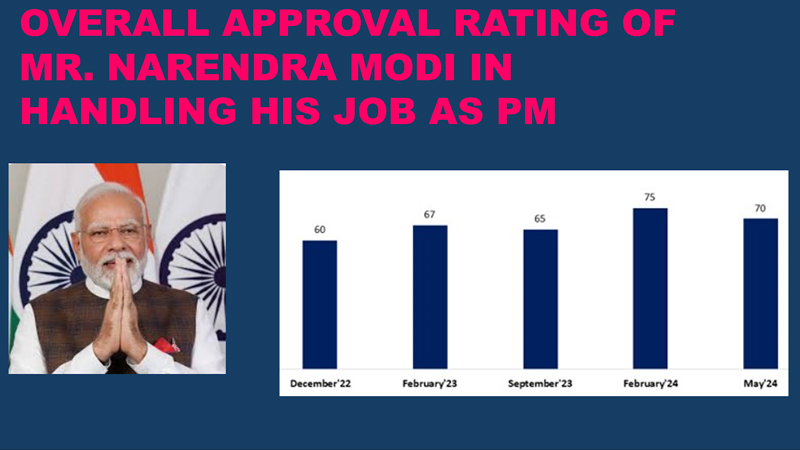
    Mumbai: Narendra Modi has been voted back to power in the general elections as the PM of the country and on 9 June 2024, took oath as the PM of the country. Interestingly, Modi being high on the popularity sweepstakes is ratified by the Ipsos Approval Rating of the PM, carried out in May 2024, where he scored 70 per cent for his performance as the PM of the country. Though there has been a five  per cent dip over the last round of the Ipsos survey conducted in February 2024, yet, majority of citizens polled believe Modi is doing a good job as the PM, as opposed to the naysayers, who were far and few.    

    Interestingly, Modi’s approval rating was seen to be high across different cohorts and cities: Citizens of north zone (86 per cent), tier1 (85 per cent) and east zone (83 per cent) gave Modi a distinction in performance as PM. He was further rated high on performance by full time parents/ homemakers (79 per cent), tier3 cities (76 per cent), 45-plus age group (75 per cent), west zone (75 per cent), low education citizens (73 per cent), females (72 per cent), 18-30-year-olds (71 per cent), SEC B (71 per cent), employed part time/ full time (71 per cent), SEC A (69 per cent), SEC C (69 per cent), males (68 per cent), 31-45 years (66 per cent), high education (65 per cent), students/ pupils (62 per cent) and tier2 (60 per cent).

    His approval rating was relatively lower for metros (53 per cent), self employed (43 per cent) and south zone (31 per cent). 52 per cent disapproved in south zone.

    Performance of Modi government on key issues

    What were the hits and misses of the Modi government? The survey also gauged the performance of the government on some of the key portfolios. Education system, sanitation and cleanliness and healthcare emerged the top performance areas. Pollution and environment, poverty, inflation and corruption were the middle of the road performance areas. While unemployment was rated lowest in performance.

    Areas

    Performance April ‘24

    Performance May ‘24

    1

    Education System

    76 per cent

    2

    Sanitation & Cleanliness

    67 per cent

    3

    Healthcare System

    64 per cent

    4

    Pollution and Environment

    56 per cent

    5

    Poverty

    45 per cent

    6

    Inflation

    44 per cent

    7

    Unemployment

    43 per cent

    8

    Corruption

    42 per cent

    Ipsos India group service line leader, public affairs, corporate reputation, ESG & CSR, Parijat Chakraborty said, “PM Modi has been elected for the third term as the PM of the country and that gets validated in our approval rating for the PM carried out in May 2024, which gives him a high rating of 70 per cent on his performance. Though there has been a five  per cent dip from last round, Modi continues to be popular among the masses as their leader to steer the country The poll lauds his work particularly in the areas of education, sanitation and cleanliness and healthcare. In some areas the views were polarized on his performance. Particularly, for pollution, poverty, inflation, corruption and unemployment.”  

    Methodology:

    Ipsos IndiaBus is a monthly pan India omnibus (which also runs multiple client surveys), that uses a structured questionnaire and is conducted by Ipsos India on diverse topics among 2200+ respondents from SEC A, B and C households, covering adults of both genders from all four zones in the country. The survey is conducted in metros, tier 1, tier 2 and tier 3 towns, providing a more robust and representative view of urban Indians. The respondents were polled face to face and online. We have city-level quota for each demographic segments that ensure the waves are identical and no additional sampling error. The data is weighted by demographics and city-class population to arrive at national average.

  • Consumer sentiment up in May 2024: LSEG-Ipsos primary consumer sentiment index

    Consumer sentiment up in May 2024: LSEG-Ipsos primary consumer sentiment index

    Mumbai: The LSEG-Ipsos primary consumer sentiment index (PCSI) for India in May 2024 shows improvement in the overall sentiment, with the upside of +0.8 per cent points. Also, the survey shows that India continues to hold onto the highest national index score (67.8 per cent points) across all the 29 countries covered in the monthly survey.

    Consumer sentiment is measured across four sub-indices and the sentiment showed a mix bag of performance in May 2024 – the PCSI employment confidence (“Jobs”) sub-index, was seen to move up 1.9 per cent points; the PCSI current personal financial conditions (“Current Conditions”) sub-index however was down 0.6 per cent points; the PCSI investment climate (“Investment”) sub-index too was down 0.1 per cent points; and the PCSI economic expectations (“Expectations”) sub-index was up 1.7 per cent points.

    “India is the most buoyant market across all markets covered in the survey with a National Index score of 67.8 per cent points and we also see an upturn in consumer sentiment in May which augurs well for growth and attracting more FDI – as we see the sentiment for the economy and jobs is seeing a major boost. The Indian economy and been showing a lot of resilience and is largely defined by domestic consumption and though it has been on the radar of global companies for pumping in most investments, as India is a highly growth oriented market. Though with the General Elections in India some of the decisions maybe delayed, like in the case of Tesla, Elon Musk recently postponed his visit to India to the time once the Lok Sabha elections are done and dusted. Also with the new financial kicking in, hiring is back on grid and the job market is looking up. Though the sentiment around personal finances and for investments and savings continues to be somewhat depressed, which could impact consumption around discretionary spends and put a strain on daily spends of households,” said Ipsos India CEO Amit Adarkar.

    How does India stack up across 29 countries?

    Among the 29 countries, India (67.8) continues to hold the highest National Index score. India, Indonesia (63.2), and Mexico (61.0) are the only countries with a National Index score of 60 or higher.

    Nine other countries now show a national index above the 50-point mark: Singapore (58.0), Thailand (55.8), the U.S. (54.3), Sweden (54.1), Great Britain (52.8), the Netherlands (51.9), Brazil (51.7), Poland (50.3), and Australia (50.3).

    In contrast, just four countries show a National Index below the 40-point mark: South Korea (39.7), Chile (39.6), Japan (37.9), and Türkiye (33.8).

    Compared to 12 months ago, seven countries show a significant drop in consumer sentiment. Twelve countries show significant increases, most of all in Argentina (+11.0), Poland (+9.4), and India (+9.1).