Tag: IPL

  • Vodafone’s new campaign aims to target IPL fan frenzy

    Vodafone’s new campaign aims to target IPL fan frenzy

    MUMBAI: As the anticipation for the next season of IPL builds up, Vodafone has put together an engaging campaign, ‘Speed Is Good,’ which aims to throw light on the benefits of faster data transfer and how it touches its consumers’ lives.


    The campaign is made up of short memorable stories where Vodafone customers use their fast 3G network to bring a smile on someone’s face, which is being portrayed by its recent commercials ‘Farewell’ and ‘Haircut’. Not only that, Vodafone will kick-off a series of on-ground campaigns during the matches, as well as online events for the same. 


    “We will amplify the concept of ‘Speed is Good’ through several on-ground and digital promotions like Vodafone Speed Quiz where winners will be gratified via the Vodafone SuperFan and Vodafone Fan Army,” said Vodafone India senior vice president –brand communications and insights Ronita Mitra.


    Vodafone ‘Speed Quiz’ will leverage the cricket fever and the winner with the fastest correct answer will be hailed as the Vodafone Super Fan, who will be in for a ‘money-can’t buy’ experience on the field.


    The remaining 20 winners will join the Vodafone Fan Army respectively. In addition, there will be Vodafone Speed Zones to host interactive activities around the core concept of ‘Speed’ to engage in-stadia crowd. 

  • GroupM ESP lists top 10 trends for IPL season 8

    GroupM ESP lists top 10 trends for IPL season 8

    MUMBAI: Move over Cricket World Cup, welcome Indian Premier League (IPL) Season 8! 


    With the home grown league becoming a global reputable property, GroupM ESP (Entertainment & Sports Partnerships), has predicted top trends in 2015.  


    Commenting on the trends for this season, Group M ESP national director Vinit Karnik said that the sports entity has come a long way in how it addresses sponsorship sales and convergence of technology. “From selling tickets to selling an experience, IPL has come a long way. This further extends from the execution of sponsorships across major platforms — all the way to the idea/solution generation phase during the sales process,” he added.


    Karnik also stated that in 2015 teams will continue investing in the in-stadia experience content delivery. With feeds available through internet, Sony’s regional channels, mobile applications etc the content is truly taking the center stage. “It makes sense because if fans aren’t in the stadium consuming content, they’re consuming it somewhere else — work/ home/ in a cafe… wherever,” he informs.


    According to him there will be an amalgamation of technology integration and enhancement throughout the sport. The proliferation of video and statistical information backed by increased social exchange will define the popularity of teams.


    Uniquely positioned at the intersection of media and marketing, GroupM ESP has made the following predictions: 


    1) Smart talent acquisition by franchises increasing competitiveness with teams evenly matched.


    2) Enhanced broadcast production quality with regional language feeds from the broadcaster MSM.


    3) Fan Park idea will heighten interest and involvement in smaller cities and towns.


    4) Digital platforms to create sustained and deep engagement with real time analytics.


    5) Surround content to drive social conversations via social media platforms.


    6) Technology to enhance spectator interactions and engagement inside stadium.


    7) Realistic sponsorship pricing strategies resulting in repeat purchases and a stable sponsor ecosystem.


    8) Apparel as an emerging and popular sponsor category among franchises.


    9) Sponsor’s increased dependence on crowd sourcing to create excitement around their brands .


    10)  E-commerce brands will dominate ad spends on broadcast platform.


    “In all aspects, IPL offers a consumer delight by integrating newest technologies and enhanced fan experience while building affinity with future generations of fans who have moved from passive viewers to engaged amplifiers. We also see a lot of new generation brands jump onto the IPL bandwagon, making it a high spend high visibility and now high engagement business,” concluded Karnik.

  • Dish TV comes on board as official partner for Kolkata Knight Riders

    Dish TV comes on board as official partner for Kolkata Knight Riders

    MUMBAI: Gearing up for the Indian Premier League (IPL), direct to home (DTH) operator Dish TV India has extended its association with Kolkata Knight Riders as an official partner for the fourth time. This year’s tournament will start on 8 April 2015. As part of the association, the logo of Dish TV will be prominently featured on the non lead arm of the jersey of KKR players.

    DishTV COO Salil Kapoor said, “Through this association, we would like to pull entertainment a notch higher for all cricket fans. We look forward to the tournament and hope that Kolkata Knight Riders emerges as a champion in this season of IPL as well.”


    Continuing its relationship with Shah Rukh Khan Dish TV expects its association with the KKR co-owner to bring good luck to the team. Through this partnership, there will also be an engagement of player with consumers and trade partners.  Furthermore, this season Dish TV will be reaching out to the consumers through the digital space through interesting contests and engagement opportunities on KKR’s Facebook and Twitter pages.


    KKR CEO Venky Mysore stated, “With the fine performance of Team KKR over the last four years, which includes IPL championships in 2012 and  2014, we have been able to generate a lot of interesting content for our fans and supporters. This is where the partnership with Dish TV is a perfect fit. Integration of exclusive KKR content through the extensive reach of Dish TV will give people an inside peak into what makes Team KKR work! “

  • Royal Challengers Bangalore ropes in Tata Motors as principal sponsor in IPL

    Royal Challengers Bangalore ropes in Tata Motors as principal sponsor in IPL

    MUMBAI: Indian automobile company Tata Motors’ Tata Bolt has hopped on board as the principal sponsor of Royal Challengers Bangalore (RCB) in the Indian Premier League’s (IPL) eighth season, which starts from 8 April 2015

    Tata Bolt will occupy the leading arm position on RCB’s playing jersey. This association will extend the brand’s existing relationship, which was established during IPL 2014.


    Tata Motors and RCB will shortly launch campaigns to promote this association and roll-out joint initiatives across mediums to engage their customers and RCB fans across India.


    Tata Motors president passenger vehicles Mayank Pareek said“We are delighted to extend our partnership with Royal Challengers Bangalore this season. RCB has established itself as a strong contender and the Bolt, our latest offering, is a stylish sporty premium hatchback. Through this association, Tata Motors Passenger Vehicles Division and RCB have brought their stars together to offer a unique platform with an objective of engaging with customers and the youth of today around one of the biggest and passionate cricket tournaments, the IPL. We wish the team all the luck this season and look forward to engaging with our audience through one of the most popular sport in India.”


    RCB VP commercial operations Russell Adams said, “Royal Challengers Bangalore is delighted to extend the partnership with a globally recognised brand like Tata Motors going into the eighth season of Indian Premier League. Tata Motors is respected as a world leader in technology and innovation. This is a marriage of two very prestigious and popular brands with similar attributes. Tata Bolt will be occupying the leading arm on the RCB playing jersey for IPL8 and IPL9. We look forward to this partnership and hope it grows from strength to strength.”


    Bolt will be used to transport team personnel and it will also have significant brand exposure at RCB’s home ground, the Chinnaswamy Stadium, along with in-stadium promotional rights. There are several on-ground activities planned for Bolt customers.


  • BCCI to launch workshop for match officials before IPL

    BCCI to launch workshop for match officials before IPL

    MUMBAI: Twenty six match officials, which includes umpires and referees, will participate in a two-day workshop organised by the BCCI in preparation of the upcoming Pepsi Indian Premier League (IPL) season. 


    The Umpires and Match Officials Workshop will be conducted by Simon Taufel, a former member of the ICC Elite Umpire Panel, five-time winner of the ICC Umpire of the Year Award, and presently the ICC umpire performance and training manager. 


    The workshop, now in its third year, is an ongoing initiative as part of the BCCI Match Officials development programme. 


    With 60 matches scheduled, the Pepsi IPL will provide an opportunity for top Indian match officials and this workshop will prepare them for the eighth editing of the IPL.


    The Pepsi IPL 2015 season will see 26 match officials, 13 Indian umpires and four match referees, who will be officiating throughout the tournament.


    A wide range of topics, which involve the match officials in the conduct of the game will be covered during the workshop, from clothing regulations, to on-field player behavior and the overall playing conditions.


    Taufel will travel with the Match Officials team during the initial part of the tournament to the various venues. 


    The workshop will be held at the Cricket Centre Mumbai on 4 and 5 April, 2015.


  • MSM launches new pay channel in Sony Kix

    MSM launches new pay channel in Sony Kix

    MUMBAI: Multi Screen Media (MSM) has launched another sports channel called Sony Kix to complement its existing channel – Sony Six.


    Kix will be available on all the major cable and DTH platforms with a pricing of Rs 45 and Rs 18.90 in analog and digital respectively. 


    The channel will be headed by Sony Six business head Prasana Krishnan. Speaking to Indiantelevision.com, he says, “With the number of sports we have in our catalogue, a new sports channel launch was just a matter of time. Recently we saw a number of FIFA matches taking place simultaneously and we were handicapped since we could not air all of them. Moreover, we also at times had to place important matches on our GECs and that creates a lot of confusion for consumers. As the name suggests, Kix will mainly focus on football and fight sports but whenever needed it will complement Six with other sports too.”


    Speaking about his vision for the channel, Sony CEO NP Singh says, “Sports has always been a core focus for us right from our early days. Our entertainment and movie channels such as SET, Max and Pix have also, over the years, broadcast some of the landmark sports events both in India and internationally. While the resounding success of Six in less than three years was a deciding factor to launch Kix, there was also this need to cater to the clear demand seen in the market for largely, alternative sports programming. Kix promises to be a great addition to our mix of channels and will go on to complement Six in more ways than one with exciting and iconic properties such as Pepsi IPL, UFC and NFL among many others.”


    The channel will be launched during MSM’s flagship asset Indian Premier League (IPL), which is set to kick off on 8 April, 2015. Kix will carry Tamil and Telegu feeds apart from English. The channel’s major geographic target will be South India for the time being.


    “When one campaign is already on, there is no point setting up another and hence we will not launch a promotional campaign for Kix till the IPL is over. Post IPL, we might give an aggressive push but for the time being, it’s a new sports channel from Sony and will be airing IPL in three different languages. The channel will be launched in standard definition and in near future there may be another HD feed too,” Krishnan informs.


    According to Krishnan, multilingual feed is emerging as a recent trend and every big event has been following the trend. “We started it with FIFA and Sony Aath airing the Bengali feed and now no big event is complete without the multilingual feed. In the future too, we will innovate and invade into new territory,” he adds.


    In his two year stint at Sony, Krishnan has helped expand Sony Six’s portfolio and acquired new assets of international importance. Kix will be the newest channel under his tutelage. “I am happy and satisfied. It has been very significant two years and we managed to grow bigger and bigger. Being a two years old sports channel, what we are doing and have done is commendable. The end goal is to make Sony the one ultimate destination of sports broadcasting for both viewers and advertisers. We have partnered and discovered new leagues like Champions Tennis League and World Kabaddi League and in future also we will evaluate and explore something new, which will be long term entertainment for viewers,” he concludes.

  • IPL is the largest reached sports event in 2014: FICCI KPMG Report

    IPL is the largest reached sports event in 2014: FICCI KPMG Report

    The global sports industry is estimated be worth of $600 – $700 billion. Revenue generated from the industry is estimated at $80 billion globally and is growing at Compound Annual Growth Rate (CAGR) of 6.5 per cent over 2009 to 2014, which includes revenues from media rights, sponsorships and ticketing.

    The market for advertising in sports in India was estimated at Rs 41 billion in 2013 growing at a CAGR of 14 per cent from Rs 21 billion in 2008. It consists of on ground advertising, team sponsorship, athlete sponsorship and media ad spends on sports. Licensing and merchandising contribute Rs 2 billion to the industry in India. Gate revenues make up another revenue stream but its contribution to the sports market in India is relatively low compared to media ad spends and sponsorship.

    Sporting events have been popular throughout history, and have gained greater viewership with bigger stadiums and TV broadcasting of domestic and global events. Annual sports viewership in India reached 276 million in 2014. But the sports genre accounts for only 2.4 per cent of total TV viewership and 4.3 per cent of AdEx (Advertisement Expenditure) revenue in the Indian TV industry, much smaller than the general entertainment genre.

    The median age in India is around 27 years and around 64 per cent of the population is expected to be in the working age group by 2020. This provides a large and growing target segment for sports in India. Moreover, an increase in percentage of middle class and rich households (households with annual income greater than Rs 2,00,000) from 6.1 per cent in 2001-02 to 14.5 per cent in 2009 -10 has increased the number of people with an appetite for sports consumption. The middle class alone is expected to increase to 41 per cent of the population by 2025. There has also been an increase in the average share of educational and recreational activities in the annual household consumption and it is estimated to increase from five per cent in 2005 to nine per cent by 2025.

    A good start to non cricket sports is one interesting to look at the growth of sports other than cricket in India. Many sports have grown well over the last half decade. A survey on the popularity of sports in the Indian online community reports that while 85 per cent of respondents followed cricket in some manner, an estimated 44 per cent followed tennis, 41 per cent followed football (soccer) and 32 per cent followed badminton. With economic development, sports viewership in a country usually moves from single sport to multi sport. Africa and the Indian subcontinent have been traditionally dominated by football and cricket respectively. However, with greater economic development, India is seeing a growth in other sports as well. 

    League formats have helped in increasing popularity of sports Globally

    The leagues system has served as an important way for companies to enter the sports sector. A sports league creates several opportunities for private companies in domains such as league management, franchisee, broadcasting and sports videos production houses, advertising, sports infrastructure such as multipurpose venues, player management, licensing and merchandising. One of India’s most successful leagues in terms of viewership and revenues has been the Indian Premier League (IPL), which is based on the English Premier League (EPL) format. The league was launched in 2008 by the Board of Control for Cricket in India (BCCI) with eight city franchisees. Though it is still small in comparison to some of the biggest leagues of the world, it has been able to achieve success in a short span of time, which other mature leagues could not manage to do. The evolution of IPL as a brand is an example of successful product innovation, which effectively combined entertainment and sports. The Twenty20 (T20) format of IPL has made the sport more popular and convenient to watch for cricket enthusiasts. The success of the IPL, which is estimated to have had a viewership of 191 million people and ad revenue of Rs 8 billion in 2014 has led to the creation of several other league-format sporting events, such as the Indian Badminton League, Hockey India League and the recently launched Pro-Kabaddi League. The inaugural season of football’s Indian Super League has been fairly successful as well. Cumulative reach of Pro Kabaddi League was 435 million compared to 560 million for IPL in 2014. Football’s Indian Super League was close with 410 million cumulative reach. The new domestic sports leagues however require significant management efforts over a period of time to get established and be successful. 

    Viewership refers to sum of weekly GVTs, which is a factor of number of viewers and frequency.

    IPL leads the cumulative reach chart amongst sporting events held in 2014
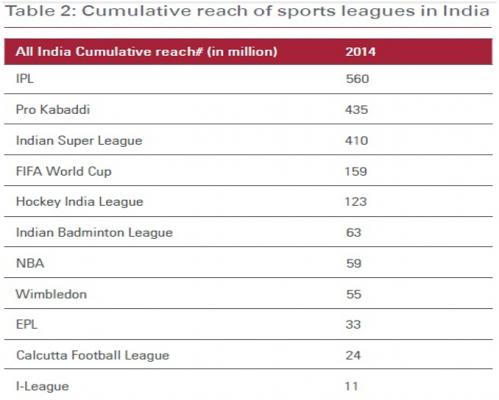
    Cumulative reach refers to the number of individuals within the target group who viewed the tournament over a certain period of time, including duplication.

    Ecosystem to support sports development in India

    However, in order to sustain the growth in sports and sports-related businesses, a flexible regulatory and policy framework that is able to realise synergies between various segments of sports needs to be developed. This in turn requires the sports ecosystem and its stakeholders to be recognised under the purview of a dedicated industry of sports which can provide impetus to an organised and professional business environment for sports in India.

    Sports Broadcasting in India

    There has been a surge in the number of sporting events broadcast in the past few years. These events include tournaments and leagues played at state, national and international levels. Several international tournaments and leagues played at the regional or global level are now telecast in India bringing in a larger and much diverse audience. Males form around 60 to 65 per cent of viewers and are expected to continue to be the main target segment. However, the number of female viewers has been increasing. About 57 per cent of the viewership of ISL and 53 per cent of the viewership of Pro – Kabaddi League was made up of women and children. Broadcasters are supplementing the sports with other entertaining and informative pieces to make the program more inclusive.

    Getting to the right content mix

    With the rise in number of sporting events, sports channels are covering several sporting events in their annual calendar. It consists of a mix of marquee events from domestic and international leagues, major tournaments along with minor domestic leagues and tournaments.

    Star Sports has revamped itself with uniformly branded eight channels to showcase a variety of domestic and international sports both cricket and non – cricket and in English as well as Hindi. While international cricket matches featuring India will make up 65 per cent of Star Sports 1, Ranji matches, university and women’s cricket and international cricket matches not featuring India will form 50 to 60 per cent of content on Star Sports 2. This will enable Star to nearly double its cricket content, which is the major revenue driver for sports channels in India. Star Sports 4 will feature other sports, which include international football (soccer), European soccer leagues, badminton, tennis and Formula-1 racing.

    The new Indian leagues, which include hockey, badminton and soccer, will be telecast on Star Sports 1 to 3 to reach a larger audience. Such a strategy enables Star Sports to increase its cricket content as well as broadcast non – cricket sports, which are seeing increasing traction. There is also an increasing trend towards multi-sports channels, as the viewership of different sports are increasing and sports channels are vying for TV rights across sports. Star has seen a shift from having a cricket specific channel in its cluster to multi-sports channels. It enables Star to broadcast both international and domestic cricket content simultaneously as well as gives it flexibility to show different sports across different channels. This can be attributed to the large investments made by Star to purchase rights for domestic and international cricket, football, tennis, badminton etc.

    On the other hand, Neo has rebranded its cricket specific Neo Cricket to Neo Prime on account of reduced live cricket properties and surge in volume of several sports.

    Ten however, has sports specific channels with Ten Cricket for cricket, Ten Action for football and Ten Golf for Golf broadcasting. Availability of sufficient single sport media rights and a definite viewership base for that particular sport drives the presence of sports specific channels. This helps advertisers to target a specific audience, for example luxury products have tied up with Ten Golf. Although, digitization and lower costs of distribution make single – sport channels more viable than before, it can take some time to evolve in India and reach the popularity of golf and tennis channels in some developed countries.

    Regional language boost to broadcasting

    Another strategy to target a specific audience is the language of telecast. Hindi and other regional languages increase the audience reach for sports as English has a limited audience. Star Sports 3 replicates Star Sports 1 in Hindi. In 2014, it telecast the domestic football league – Indian Super League in five languages. Its regional TV channels were used to telecast the league in Bengali, Kannada and Malayalam apart from English and Hindi broadcasts. During FIFA World Cup 2014, Bengal accounted for half the country’s viewership mainly because of regional language feed by Multi Screen Media (MSM) on its Bengali general entertainment and film channel Sony Aath. Hindi broadcast of the Pro Kabaddi League on Star Gold also helped take the cumulative reach to 435 million for the event. Other than using regional sister channels for feed in local languages, sports channels may spin off separate regional language sports channels if the demand picks up.

    Revenue and Profitability model

    Sports industry is still an ad driven revenue model. Media spends on sports, most of which is on TV, increased from Rs 11.5 billion to Rs 22.5 billion over 2008 to 2013 at a CAGR of 14 per cent. In mature markets, subscription is the main revenue driver for sports channels, contributing nearly 60 to 90 per cent of the revenues. However in India, advertisements still account for nearly 60 per cent of the revenues of sports channels, mainly driven by cricket, which is the largest revenue spinner and accounts for nearly 80 to 85 per cent of the total television sports media revenue. Non-cricket sports provide live sports content around the year, which gives advertisers a regular touch-point to their target segments. Revenues from advertisements in any year vary depending on the tournaments and series held during the year. Cricket mostly forms the peaks whereas the troughs are being evened out with non–cricket sports and non-live cricket content. In 2011, ad spends on TV for cricket was estimated to have crossed Rs 20 billion. In 2015, ad spends from the ICC World Cup and IPL 8 alone are expected to be around Rs 22 – 25 billion. Ad revenues for non-cricket sports are only a small fraction of cricket revenues. In 2013, ad revenues from Indian Badminton League and Hockey India League were Rs 0.9 billion and Rs 0.7 billion respectively.
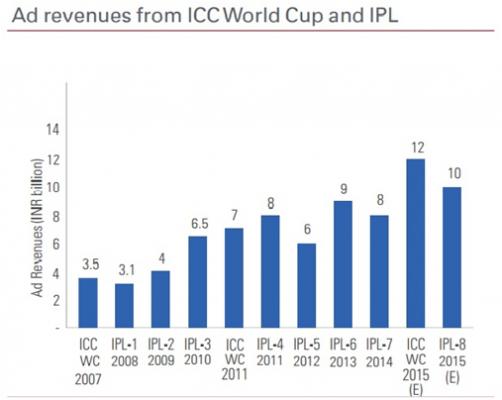
    Key challenges facing the spurt of non-cricket leagues in India includes:

    • Poor investor confidence

    For instance the Indian Badminton League (IBL) suffered a loss of Rs 25 crore in the opening season in 2013 owing to investors pulling out casting doubt on the return of IBL with its second season. However, despite no play in 2014, the IBL is set to return in 2015.

    • Lack of industry status

    Provision of industry status could lead to an organized sports industry leading to higher available capital, newer sports businesses, additional revenue streams for stakeholders making leagues commercially viable ventures.

    • Lack of a culture for sports

    Sporting leagues in India are designed to last just a couple months every year. However, many major sporting league seasons in the world last for longer durations every year. Sporting leagues need to become year round (or at least three – four months a year) ventures. Apart from the benefit of a longer engagement with viewers (allowing the building of a larger fan base and culture for the game), this also touts the idea of sport becoming a year round profession furthering the advent of sports businesses.

    Revenue model in leagues

    Major sources of revenue for any league come from media rights, sponsorships and revenue from franchisees. Share of franchisee consideration in IPL has increased from 30 per cent in 2010 -11 to 37 per cent in 2012- 13 with a corresponding decrease in the revenues from sponsorship rights. Income from media rights and other sources have nearly the same share in 2012-13 as in 2010- 11.

    Major Sources of revenue for a League Franchisee

    Major sources of revenue for any league franchisee are share of the central revenues, local revenue and performance revenue.

    • Share of central revenue

    This includes a percentage of the revenue to the league from media rights and central sponsors like Pepsi in the IPL. In India, media rights are a major revenue sources both for the league and the franchisees. Channels are expected to further increase the subscription revenue for sports channels.

    • Local revenue

    Local revenue for a franchise entails revenue from match day ticket sales (gate revenue) and commercial revenue that includes funds from franchise sponsors, merchandise sales and revenue generated from membership with the franchise club if any. However, revenue from franchise sponsors makes for a majority of the commercial revenue. Sports merchandise sales is a fast growing segment with Rs 2 billion in retail sales in 2013. Moreover, contribution of gate revenue to overall revenue of franchises is low due to inexpensive ticket pricing, especially in non-cricket leagues. This is in contrast to leagues abroad where gate revenues are a significant contributor to a franchisee’s revenue.

    How can leagues be further popularised/ monetized?

    Some of the critical success factors of a league in India are identified below:

    • Players

    Involvement of top players of the world creates interest in the viewers and increases the quality of the game. The IPL is a successful example of the same. On the other hand, I-League is struggling to attract top players resulting in poor viewership.

    • Marketing

    An effective marketing campaign is another critical factor in making the league popular. Again, the involvement of various celebrities as brand ambassadors or owners in the IPL contributed to generating larger viewer interest in the league. In fact, the marriage of the Indian entertainment industry and cricket has aided in making IPL a commercial success.

    • Governance framework

     It is seen that leagues, which are run with the support of the approved federation have been able to sustain. The ICL failed due to lack of support from BCCI and World Series Hockey (WSH) is facing similar troubles due to non-recognition of the founding federation as the official national sports federation of hockey itself.

    • Stadium Infrastructure

    Quality of stadium infrastructure improves the viewing experience, hence increases the level of interest in the sport. It is important to create supporting infrastructure like restaurants, bars, fast-food chains, merchandise, stores, books and music stores, etc. to develop stadiums into popular entertainment spots for the family. Hike in ticket prices subsequent to rise in viewership, organizing multiple sporting events and entertainment shows wherever possible can help monetise stadium infrastructure.

    • Fan base

    An effective strategy to increase a franchisee fan base is engagement of respective franchises with local community. This helps generate greater TV viewership, increase attendance of matches and sale of merchandise. Performance of national team or players at international level increases the interest in the game, hence the league.

    League timing

    The tournament should be held at a time when there is no clash with international tournaments that could divert a significant section of the viewers, many players are available and weather is suitable for holding matches. The length of games and timing of matches (conducive for family viewing) are also important factors to consider, both having further helped significant viewership of the IPL. Other factors may include spectator friendly broadcasting such as better viewing angles and broadcasting in Hindi and English.


  • Sony Aath to broadcast Pepsi IPL 2015 in Bengali

    Sony Aath to broadcast Pepsi IPL 2015 in Bengali

    MUMBAI: After tasting success with airing FIFA World Cup 2014 in Bengali, Multi Screen Media’s (MSM) Bengali entertainment channel Sony Aath will offer Bengali language feed for the upcoming Indian Premier League (IPL).


    This will be the first ever broadcast of the Pepsi IPL on the channel and will also be the first such exercise by MSM to launch a Bengali feed of the tournament. Sony Aath will cover the opening ceremony and all 60 matches of the eight edition of Pepsi IPL.


    MSM senior vice president Tushar Shah, who also manages the operations of Sony Aath, said, “With an aim to provide the most premium content to our viewers in West Bengal, we are back yet again to enthrall them by offering a whole new experience of consuming the largest cricketing extravaganza in their favourite language. We believe this initiative will not only help further expand the popularity of the nation’s most beloved cricketing tournament but also augment a larger fan base for the channel.”


    MSM CEO N P Singh added, “West Bengal has always been one of the key markets for Pepsi IPL. We believe that by offering the world’s largest cricketing spectacle in one of the most popular and widely spoken languages in the country will help enthrall the viewers. It will create a holistic viewing experience unlike anything else seen before on the channel. Given the tournament’s aggressive growth and ability to connect with millions on a national scale, this year we are positioning the event as ‘India Ka Tyohaar,’ which establishes the event as an annual sporting and entertainment festival.”


    As a prelude to the event the channel will run the ‘India Ka Tyohaar’ marketing campaign till the tournament kick-starts on 8 April 2015.


    The tournament will feature a total of 60 matches, including the live telecast of the opening ceremony on 7 April, the home and away matches between the franchises, the qualifying playoffs and the finals. The knockout stage will be from 19 – 22 May and conclude with the final match on 24 May, 2015.

  • Research imperative to exploit big sports leagues

    Research imperative to exploit big sports leagues

    MUMBAI: The year 2014 witnessed the emergence of sports as it rekindled the nation’s hope and sports channels played a huge role in creating buzz in the arena of sports.


    The successful league models in Kabaddi, Cricket, Hockey, Football, Badminton and Tennis paved the way to create viable career options for young Indians. However, the key to success remains in monetization and return of investment for stakeholders and the sustainability of their business models.


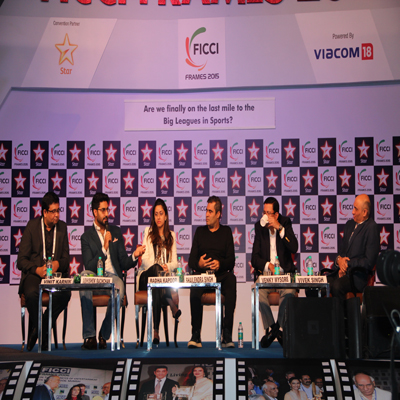
    In a session of FICCI Frames moderated by Group M national director sports and entertainment Vinit Karnik, which had Percept joint MD Shailendra Singh, DOIT media founder Radha Kapoor, KKR CEO Venky Mysore and various sports franchise owner Abhishek Bachchan, panelists spoke on the issues relating to a national policy on sports.


    Infrastructure status to build stadiums and facilities, challenges before rights holders to monetise sports content, franchisees business models and a national curriculum on sports were some of the topics that were touched upon.


    The panel spoke aggressively against federation becoming a regulatory body and intruding into business strategies of a privately owned entity. Speaking on the same Singh said, “The growth is determined by demand and supply, you can make money of something you go for it. India has a large youth population desperately waiting for an opportunity to make a career out of sports but what’s stopping them is poor infrastructure and that is where Narendra Modi is going wrong. The federations are unwanted obstacles headed by corrupts. They make things difficult and people walk off from doing a business. I organised a similar tournament like IPL in 1999 but Dalmiya called it Masala and asked me to stop it immediately. Today BCCI cherishes the IPL.”


    While Venky Mysore, who closely works with the BCCI being the CEO of Kolkata Knight Riders (KKR), emphasised on the commercial sector saying, “While it’s easier to work with the BCCI considering the fact that one has to deal with less number of people compared to the sports ministry, their intrusion in the business and strategic affairs of the franchisee is a bit irrational. KKR has made money out of IPL and we are a debt free franchisee – a fact that I am proud of. For any brand to work in India you need fans and the ratings show that KKR matches always bag the pole position. So every new sport has room but it should not be rushed as the loss is immense.”


    While non-cricketing sports are also emerging in the major sporting league category, making money out of them is difficult for broadcasters, addressing the issue Bachchan said, “When Charu came to me with the Pro Kabaddi concept, I was shocked. But after seeing the ground reality my perception changed. There are more than 1500 Kabaddi clubs in Mumbai desperately looking for an opportunity and a platform to showcase their talent and Star and Pro Kabbadi League opened it up for them. The Indian Super League (ISL) is another example of broadcasters and corporates coming together to put up an exquisite event. Due to the ISL deal that ensures ground level improvement of the sport, more kids are getting the infrastructure they deserve, which will show its relevance 10 years down the line.”


    DOIT Media founder served for more women participation and declared new platforms for women in India. “We are launching a new kabaddi league dedicated to women, which will ensure their participation and it’s just the beginning. Every sport in future may have a female version too because the talent exists but gets rusted due to lack of use.”


    Every major sport now has two leagues but all of them are not profitable for the broadcaster. Kabbaddi changed rules to rope in more revenue generating opportunities and the federation supported it, cricket also did the same with innovations like strategic time out. While it is very important not to lose the authenticity of the sport, generating revenue is a big necessity in order to ensure longitivity.     

  • “Smart monetization can generate good revenue from badminton”: Prasana Krishnan

    “Smart monetization can generate good revenue from badminton”: Prasana Krishnan

    MUMBAI: Continuing the process of building a strong portfolio, Multi Screen Media’s (MSM) sports and entertainment channel Sony Six has acquired the rights of yet another event of international magnitude – the Yonex Sunrise Badminton Open.


    The second super series of 2015, the Indian open is one of the flagship badminton tournaments with a prize money of $250,000. Renowned shuttlers will fight their way in Siri Fort Sports Complex, New Delhi to win the title.


    India’s contingent is led by top seed and World number 2 Saina Nehwal. It is for the first time in the last four years that a non Chinese woman player sits in the pole position before the start of the tournament. The other X-factor in the tournament is Olympic Gold medalist and five time World Champion Chinese superstar Lin Dan, who will fight hard against Danish top seed Jan O Jorgensen and India’s second seed Kidambi Srikanth to win the tournament and earn a Rio Olympic berth.


    The tournament has potential of upsets and high expectations as both Srikanth and Jorgensen defeated Dan in the recent past. Moreover, World Champion Carolina Marin may face Saina Nehwal if both eves manage to qualify for the final. Such uncertainties are the main reason for Sony Six’s decision to showcase the tournament.


    Sony Six business head Prasana Krishnan says, “We’ve been having this tournament since a good time and the main reason behind it is the fact that it is played in India. Whenever a sport is played in India, the fan connect is more and a badminton tournament involving Saina Nehwal, Lin Dan and others is certainly a big thing.”


    Unlike cricket, badminton has a very limited space to fit in an advertisement during the course of the game. The fastest racquet sport of the world sees a mere one minute gap after 11 points when the players change court and hence making money from the sport is immensely difficult for the broadcasters.


    “It depends on how you manage. While it’s true that badminton does not have equal room for monetisation as cricket but we also have to understand that the acquisition value is also comparatively low and hence if you smartly manage and monetize, you can generate good revenue from badminton and other non cricket sports too,” Krishnan opines.


    Speaking on advertisers’ reaction to the tournament, Krishnan asserts, “We have got a good response so far. Our associate and co-presenting sponsors have been locked and we have sold out our inventory.”


    Total Lubricants has been roped in as co-presenter whereas Yonex Sunrise is the associate sponsor on-air.


    The acquisition is backed by marketing initiatives to generate awareness. “We have put ads on various channels of our network in order to back the asset and I am happy with the progress so far,” he adds.


    Multi-lingual feed in sports is fast becoming a trend. Not long back the Syed Modi Badminton tournament was aired in both Hindi and English on Sony Six and Pal respectively. However, Krishnan said that there are no such plans for the 2015 Indian Open. “With Syed Modi we tried something, which we may execute again in the near future but Sony Pal will not be involved this time and the Indian Open super series will only be aired in Sony Six and we will stick to the world feed.”


    IPL is knocking at the door and once the million dollar league starts, there are high possibilities of other sport properties of Sony Six getting suppressed by the glitz and glamour of IPL. When queried about the same, Krishnan says, “Yes there will be a lot of changes in the scheduling as the entire prime time is devoted to the IPL but that necessarily does not mean that other properties will get suppressed. We will use IPL, which is the biggest platform for promotion in India, to promote our established assets like Fight Sports, NBA and others. IPL actually benefits getting more viewers and complements the other sports that we have.”


    2014 was a good year for Sony Six as it touched new heights in terms of garnering viewership. The year started with India playing New Zealand followed by IPL and the FIFA World Cup. Continuing the growth process, Sony Six started 2015 by hosting the Australian Open Grand Slam, which was followed by the Africa Cup of Nation football. “We are trying to grow bigger and whenever there is an opportunity to acquire broadcasting rights of an event of international importance, we will aggressively go for it,” Krishnan informs.


    Badminton is the largest played racquet sport in the world and India is emerging as a strong contender in international events. However, the sports’ brand value was always under question. Commenting on the same, GroupM national director – entertainment, sports & live events Vinit Karnik says, “Badminton is a very popular sport in India. It is the only sport that is equally played by men and women. Having said that, the sport doesn’t deliver compelling ratings for advertisers to leverage its popularity. Popularity is restricted to follow the top three players, watching top three marquee matches only. Ratings only improve when Saina Nehwal plays her semis and finals. This needs to change for advertisers to look at badminton as a lucrative platform to promote their brands. Badminton as a sport needs aggressive marketing and more Indian players need to perform and win international marquee tournaments.”


    Adding to that, Maxus ESP client leader Jigar Rambhia asserts, “Unfortunately badminton is not an advertiser friendly sport and therefore it fails to attract sponsors. Also, there aren’t many opportunities to advertise with very few breaks for advertising. However, of late, there have been some opportunities like branding on the net, court and perimeter boards etc. This might be able to get some sponsors, which in turn can bring in revenue to broadcasters. Since there aren’t many opportunities to advertisers during telecast, brands don’t look at badminton as a promotion platform. Though this might change, as Saina Nehwal is likely to be World No. 1 if she reaches the finals of the Indian Open. In case that happens, advertisers will definitely start looking at the sport more seriously.”


    It remains to be seen if the Indian contingent in the super series successfully manages to overcome obstacles and win the prestigious title. The entire badminton fraternity will closely observe Nehwal as the World Number 1 spot is up for grabs. The crowd at Siri Fort will be biggest boost for Nehwal, even as Marin tries every possible option to block her progress.