Tag: IPL

  • Star India to introduce VR for IPL 2018

    Star India to introduce VR for IPL 2018

    NEW DELHI: With Star India, you can always expect the unexpected or something high-octane. In line with this philosophy, the broadcaster, along with its over-the-top (OTT) service Hotstar, is exploring the use of virtual reality, or VR, to heighten viewer experience during the 2018 season of the Indian Premier League (IPL).

    Speaking at a session themed ‘10 Media Transformations for 2018 & Beyond’ at the CII Big Picture Summit 2017 here yesterday, Hotstar’s consumer and revenue head Prabh Singh gave a sneak peek into the innovations being planned around the IPL, which included the VR experience for viewers.

    “Yes,” Singh said when asked by session moderator and NDTV consulting editor Vikram Chandra whether he had heard correctly that Star/Hotstar was mulling introducing VR headsets for viewers in IPL matches in 2018.

    Apart from VR, Singh divulged that Hotstar had been experimenting with other innovations such as score overlays to give additional benefits to subscribers watching cricket matches on the streaming service so they could not only watch the video but also enjoy extra information to add to the overall viewing experience.

    On the sidelines of the event, when asked by Indiantelevision.com how the VR experiment would play out, Singh mysteriously said: “wait and watch”. Pressed further on the issue whether VR headsets would be given to random spectators in stadiums or select subscribers of Hotstar, he added that the logistics were still being worked out, which included a possible tie-up with a VR (headset) company, too.

    Will the VR experience be extended to all the IPL matches? Singh refused to comment on the question.

    Star India, earlier in the year, had won the five-year global broadcast and digital rights to the IPL for $ 2.55 billion, a sum that has been described as from being `staggering’ to `over-priced’ to simply OTT.

    In September, when asked how the company planned to monetise the IPL, Star India chairman and CEO Uday Shankar (now elevated as head of 21st Century Fox Asia) in an interview to Indiantelevision.com had said: “All I know is that IPL is a very powerful tournament and cricket runs really deep in everybody’s bones in this country. To be successful, you just need to work on intensifying and heightening the experience of cricket further.”

    ALSO READ:   

    http://www.indiantelevision.com/television/tv-channels/sports/star-bids-highest-for-ipl-media-rights-and-is-the-winner-170904

    http://www.indiantelevision.com/television/tv-channels/gecs/stars-uday-shankar-on-distribution-challenges-ipl-fta-vs-pay-tv-innovations-make-in-india-content-and-much-more-170919

    http://www.indiantelevision.com/specials/event-coverage/asia-tv-forum/17-to-be-year-of-survival-for-vr-market-161209

    http://www.indiantelevision.com/specials/event-coverage/vidnet/republic-to-debut-vr-content-from-august-for-viewers-170714

  • Comment: Does Star stand to gain or lose by sharing IPL with DD?

    Comment: Does Star stand to gain or lose by sharing IPL with DD?

    MUMBAI: On a balmy September afternoon, while some reps from bidding companies blew smoke in the air (and the tensions, too, probably) at a five-star hotel in South Mumbai’s Colaba, some senior executives of Star India were lounging in a room in the same hotel-not as anxious as some of the smokers outside, a person familiar with the settings chirped. Soon, the Indian cricket board, BCCI, announced that Star had won the broadcast rights to the money-spinning IPl cricket tournament for five years for Rs 16,3475 million (Rs 16347.5 crore) or approximately $ 2.55 billion.  

    Cut to a fortnight or so earlier to New Delhi where the August summer was refusing to relent and the temperature fluctuated in a room in Supreme Court where the learned judges observed that India’s pubcaster Prasar Bharati cannot freely re-transmit TV signals of sports or cricketing events to other distribution platforms where the rights were held by a private broadcaster or a TV channel and was being shared with Doordarshan under a legislation of the country.

    In both the cases cited above the common factor was Star India (a subsidiary of Rupert Murdoch-controlled News Corp/21st Century Fox), probably the biggest broadcasting company in India in terms of revenues.

    Champagne should have been popped on both the occasions. Probably it was, but privately. And, the public reactions were cautious. Even in his interview to indiantelevision.com mid-September, Star India chairman and CEO Uday Shankar was cautiously optimistic about IPL win and India’s regulations relating to the media sector.

    Almost 70 days after winning the IPL rights — somewhere in between hectic consultations would have happened between Star India top leadership and company’s promoters — reports surfaced in media that Star India probably would have to share the IPL telecasts with pubcaster DD that will air the cricket matches on its terrestrial network and FTA DTH platform, DD FreeDish.

    What’s the gist of these reports in the media? IPL cricket matches would be telecast live on Star Sports channels and also a DD channel that would be available terrestrially and on DD FreeDish. This would be made possible — as and when the government formally issues a directive as both the law  and information & broadcasting ministries were being consulted — under a regulation called the Sports Broadcasting Signals (Mandatory Sharing with Prasar Bharati) Act, 2007. Some tweaks would have to be made and IPL categorized as a tournament of national importance at par with other sporting events like Olympics, Commonwealth Games and Wimbledon for the sharing to be mandated.

    Indiantelevision.com must admit, though, till the time of writing this piece everything’s in the realm of conjectures and possibilities. While Star and BCCI did not comment on emails on the issue sent to them by us, even the government sources quoted in the media as having articulated on the possible development were unnamed.

    It makes one thing clear: that nothing is clear as of now or set in stone. It’s also possible that as a trade-off for the Supreme Court directive barring  free re-transmission of shared TV signals of sporting events where rights were held by a private broadcaster, Star India could be mulling sharing IPL matches with DD — and also part of the advertising revenue.

    According to Financial Express newspaper, which quoted industry estimates, Sony Pictures Networks India (SPN), the official broadcaster (till 2017) of the T20 tournament since its inception, had crossed the Rs. 1,300 crore (Rs. 13,000 million)-mark in terms of ad revenue. The newspaper also stated that IPL’s season 10 garnered 1.25 billion impressions as per BARC data, gaining 24 per cent more viewership (compared to last year) on Sony channels.

    Writing a guest column in indiantelevision.com after Star won the IPL bid in September, senior business journalist and author of two books on IPL, Alam Srinivas, observed: “In 2009, when the IPL rights were renegotiated, Sony agreed to pay Rs 82,000 million for a nine-year period or Rs 9,111 million a year. At a simple inflation rate of 10 per cent, the figure will escalate to Rs 17,311 million over nine seasons. At a compounded rate of 10 per cent, the figure will be Rs 21,483 million. Star agreed to pay Rs 32,695 million per year, or a sizeable over 50 per cent higher than the 10 per cent compounded figure. This indicates that the IPL’s valuation has shot up, or at least the stakeholders think so.”

    Given this scenario, the following questions arise:

    Question No. 1: Is IPL that crucial (versus Test cricket, for example) to be designated as a sports of national importance to be shared with the pubcaster?

    Question No. 2: If that’s made possible, how will the technicalities of different TV feeds play out?

    Question No. 3: Will Star gain or lose financially having dished out $ 2.5 billion for a five -year rights?

    Question 4: Will sharing of the IPl matches with DD impede or affect Star’s usual high-octane marketing campaigns aimed at monetization of high-value events and will it set a precedent?

    The answers are not easy to frame as possible explanations are not forthcoming in the absence of any formal and official confirmations or denials.

    If we have to answer Q. 1, then prima facie, the answer would be ‘no’. IPL is a domestic cricket tournament having played out for 10 years with DD showing (officially) minimum interest. That IPL’s popularity has increased shouldn’t be reason for it to be shared with pubcaster, especially when the pubcaster has mostly shied away from airing Test cricket, which is a five-day affair over seven hours daily, and even when India featured in such matches.

    But then in an age of social media, when many games are played on the basis of perceptions, giving a huge swathe of Indian population easy and practically free access to IPL matches on DD could also mean scoring points with a big voting bank. After all, TV services or even entertainment are not categorized under essential services (like some utility services) that need not be subsidized by the government or access made free. Still in India, politics and sports have had a history of an intricate and, at times, incestuous interplay.

    Question 2 and 4 are easier to attempt. Simply because if Q1 and Q3 are sorted out — amicably — then these issues don’t matter much. TV feeds have been shared with DD and AIR by private broadcasters in the past on few occasions. What would be important is that DD adheres to the Supreme Court verdict and ensures that its free signals are not illegally carried by any unauthorized distribution platform(s) in the case of IPL matches.

     This brings us to Q.3 on which hinges Star’s fortunes despite being mandated by a regulation that can smack of strong-arm tactics by the government.

    However, it has to be admitted, again, that DD’s reach is tantalizing — at least theoretically. The FreeDish FTA DTH platform has an estimated 22 million subscribers, mostly in non-urban areas, while DD channels on the terrestrial network supposedly cover over 80 per cent of the approximate 1.26 billion Indian population.

    Given these numbers — clamour amongst private TV channels to be on the FTA DTH platform could be an indication — sharing of IPL matches with the pubcaster may not be such a big loss for Star.

    In an imagined world, Star could agree to share the IPl matches, forced under a regulation, but insist that it would retain the rights for marketing and ad sales of the matches  shown on DD channel too, sharing 25 per cent of the ad revenue— again as per stated law.

    This move could help Star not only increase the reach of IPL matches by at least 25 per cent, but also do some imaginative and aggressive ad sales with sponsors on digital and linear TV spaces. A marketing guru did admit in private that most FMCGs and big global spenders are now more looking at non-urban markets, which DD’s platform guarantees.

    In conclusion, we might say there are too many straws in the wind presently. A word of caution: this can set a precedent that may not always be healthy for the rightful rights owners. But then, as the boss, the government is always right, as the folklore goes.

    ALSO READ:  

    Guest Column: Star India’s IPL deal raises three crucial questions

    Star bids highest for BCCI’s IPL media & digital rights and is the winner

    IPL has come to the rightful home of cricket in India: Star’s Uday Shankar

    Star’s Uday Shankar on distribution challenges, IPL, FTA vs. pay TV, innovations, Made in India content…and much more

    With IPL rights, Uday Shankar gambles audaciously, must plan pragmatically


  • MIB mulls IPL telecast on Doordarshan

    MIB mulls IPL telecast on Doordarshan

    MUMBAI: The Ministry of Information and Broadcasting may bring the Indian Premier League under the ambit of events of national importance. Therefore, Star India’s coveted cricket property may be telecast simultaneously on public broadcaster Doordarshan.

    According to reports, the ministry is working on a proposal make live matches available on Doordarshan and has asked the sports ministry to look into the matter.

    Currently, the Commonwealth Games, Asian Games, the Olympics, and select cricket, hockey, football, and tennis events fall under the ambit of events of national importance.

  • WWE live telecast catapults Sony to the top after 10 weeks

    WWE live telecast catapults Sony to the top after 10 weeks

    MUMBAI: It has been a 10-week-long wait for Sony Pictures Network (SPN) India to make it to the top of the ratings chart. Broadcast Audience Research Council (BARC) ratings show that the live telecast of WWE Raw and Smackdown on Sony Ten 1 managed to clinch it for SPN.

    In week 46, Sony Ten 1 netted 97932 Impressions (000s) sum as compared with 89102 Impressions (000s) sum the week before. The most popular programme WWE Raw garnered 1873 Impressions (000s) sum for the channel.

    Star India and IMG Reliance-owned Indian Super League season 4 struggled to grab eyeballs for the opening ceremony held on 17 November 2017. The opening ceremony garnered 1055 Impressions (000s) sum on Star Sports 1 Hindi.

    Star India, thanks to domestic leagues, ICC events and the BCCI rights, stayed on top for several weeks because of back-to-back sporting events such as the ICC Champions Trophy 2017, ICC Women’s WC 2017, Pro Kabbadi League season 4 and the India vs New Zealand series. The third T20 match between India and New Zealand, earlier this month, was the top programme, garnering 16975 Impressions (000s) sum in BARC All India data week 45.

    The last time SPN sports cluster took the top spot was in week 35 with 166753 Impressions (000s) sum at the time of third ODI match between India and Sri Lanka.

    The tenth season of the T20 cricket tournament Indian Premier League (IPL) got the nation hooked with 1.25 billion impressions for the 59 matches played between 5 April and 21 May 2017 on Sony sports cluster, a 22.5 per cent jump compared to ninth season.

    Let’s see how long Sony can manage to retain its peak position in BARC ratings of the sports genre. Despite the disappointment of the opening ceremony, the ISL may still work wonders for Star India.

  • Star’s Uday Shankar on distribution challenges, IPL, FTA vs. pay TV, innovations, Made in India content…and much more

    Star’s Uday Shankar on distribution challenges, IPL, FTA vs. pay TV, innovations, Made in India content…and much more

    From the thirty seventh floor room, consisting of a table for the occupant to stand and work, some thought-provoking books and a huge TV screen, apart from other knick-knacks, the city life and environs below look scenic. Rather, most of the surrounding sea-facing skyscrapers in between the  green patches of land that could be seen below belie the image that it’s India. Until a Mumbai local train passes by, giving away the address of  Urmi Estate (which houses Star India’s Hq) , it could have been located anywhere in Hong Kong or Singapore for that matter.

    But in sharp contrast to the tranquil view of Mumbai from behind big glass windows of the thirty seventh floor, in most of the other 14 floors occupied by Star India in a tony building in South Mumbai’s Lower Parel business area, there is a sense of urgency — and excitement. And, why not? After all one of the biggest media companies in India — some say it’s the largest in terms of revenues — has many things on the plates of every employee, including the top honchos residing in the top floor. Bagging the global media rights for the  much-coveted IPL  is just one of the many issues engaging Star India’s employees. Though, in all fairness, it won’t be wrong to state that IPL probably could be one of the most important issues presently. Simply because, as the dust settles on the euphoria of this massive win , the difficult task of planning for returns on  the investment of $ 2.55 billion starts now.

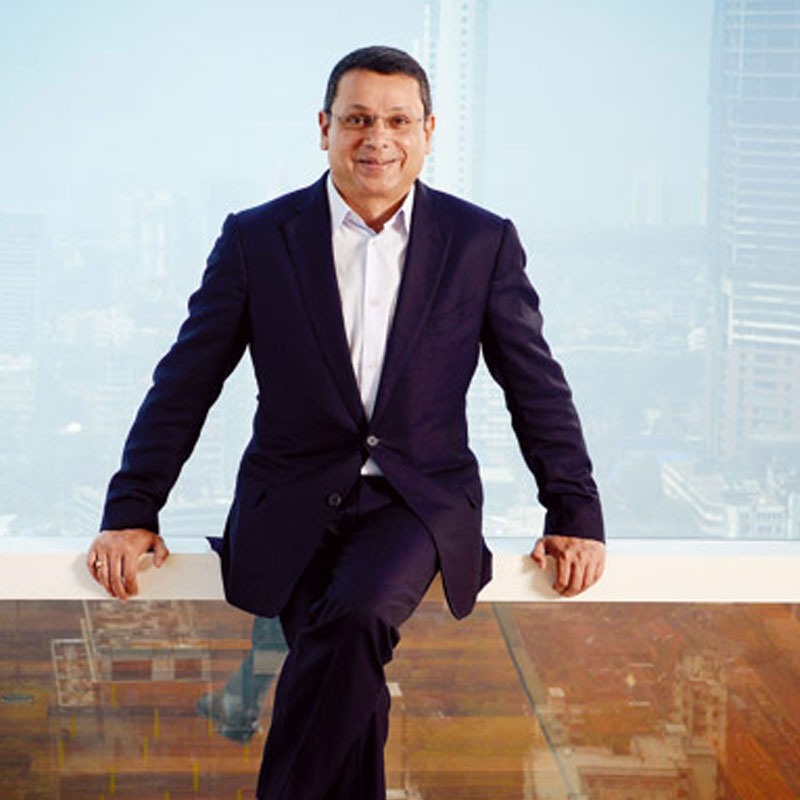
    Ushered into the room with a view, its occupant and Star India chairman and CEO Uday Shankar shakes my hand warmly, exuding the same camaraderie that he did almost three decades back when we used to meet as journalist colleagues sometimes in the New Delhi house of one of his early mentors, Siddharth Ray (India’s first general manager  for Star TV  – yes, in the 90s it carried that name officially). Over tea (for him) and strong Espresso coffee for Indiantelevision.com’s consulting editor Anjan Mitra, a wide range of media matters were debated for about 90 minutes. Edited excerpts from a free-wheeling interview follow. Read on:

    How do you view the Indian broadcast and entertainment industry as of today?

    There are two or three things that I feel very strongly about. From a consumer point of view it’s a great time for them because large volumes and range of domestic and global content is being made available to them at increasingly competitive prices. But when it comes to the industry itself, it’s a bit of a mixed bag. Though the industry has grown dramatically in terms of the number of players in the last several years, the business case of the industry looks under pressure. When I say business case, I don’t mean just the profit model, which is under pressure for a large segment, but the sustainability itself for the whole industry. 

    I think, the IPL bidding is a very interesting case in point and an indicator of things to happen in future in the media sector.  This is probably the only place and example where for a major content right, the contenders included two very strong media companies (Star and Sony Pictures Networks India), two big telecom companies (Airtel and Reliance Jio) and a couple of global digital/technology companies (including Facebook). And, they all valued the property almost equally as important and almost in the same ballpark.

    So, media is no longer the sole domain of traditional media companies. We have heard this being said for some time now, but it played out for the first time in broad day light here. What is more significant is that such competitive bidding for content has not happened in the UK or the US, which are considered mature and big media markets with good broadband infrastructure, but in a country where the digital distribution of content is of very recent vintage.

    I think in some way we set ourselves up for such high inflation by creating Hotstar, which led everybody to realize that there is a value in that kind of a business model. So, for the industry this is time to wake up and take note.

    Third, while parts of the media and entertainment businesses have leaped forward as has the consumer, the distribution and the regulatory models remain locked up in legacy issues and that’s creating a bit of a mismatch. That’s a challenge that we need to solve together as an industry.

    What are the problems besetting video content distribution in India?

    There are various aspects. If you are talking about it in the digital domain, I think with the launch of Reliance Jio there has been a huge disruption. But access to data still remains limited and expensive. The broadband infrastructure has improved in the last 12 months or so, but is still nowhere where it should be. The number of smart phones has grown dramatically in India, but is still a small percentage of the total mobile penetration.

    On the TV side, the industry has done a great job on many fronts. Still, we have to realize that we are competing with global companies with great resources and scale, and the benchmarks too are global. Whether it is story telling or quality of production or marketing or brand strategy, benchmarks are global. So, we the content industry need to step up our game.

    The competition for Star will not be only from similarly placed media companies in India but will come from technology and other global companies; from the likes of Amazon, Alibaba, Google and Facebook. Are we ready for that as an industry? Individual companies may be ready for such competition, but I am not sure if we are ready as the content industry.

    Part of the problem is because the monetization models haven’t evolved much. We still have regulatory issues, which are challenges, though I don’t want to go into too many details on that aspect.

    Still, the entire TV distribution industry, according to me, has done an amazing job of creating 180+ million connected homes. Now that segment has to make sure each one of those homes is going up the value chain rather than trying to offer them discounts, etc. The stakeholders are competing only on the price front. If you are competing only on the price point, then you are compromising on the consumer experience and soon the consumer will start questioning whether it is worth having a cheap service, minus the experience. So, there is this whole challenge of getting the consumer up the value chain.

    Where do you see Star India placed in the scenario that you have painted where both challenges and the opportunities abound?

    There are things that an individual or a company can do with its own enterprise. Then there are things that all of us can do as an industry. I believe that if the whole industry is not progressing, individual companies can only progress so much. In that context, at Star India, we have done a good job and I am satisfied. Can we do more? Of course we can always do better. But we have managed to create a fairly deep and diverse entertainment platform on television and have leadership in a large number of entertainment markets.

    To give you an example of the enterprise we have shown, take sports for instance. Five years ago we got into sports (management and broadcasting) and have created, perhaps, some of the most exciting franchises anywhere in the world. We have not limited ourselves to the sport that guarantees success (cricket), but have gone and experimented too. We have put our faith behind new initiatives in sports whether they are kabaddi or badminton or hockey or football. Our mission is to try turning India from a one-sport nation to a multi-sport one, while maintaining the pre-eminence of cricket. Some progress in that direction has been made and it’s satisfying.

    Can Star make it a mission to get India the Olympic gold considering its continued investments in sports?

    Star is a media and entertainment company and I would not want to have the arrogance to say we can make India win an Olympic gold medal. All I can say is that we’d be happy to partner with any agency or initiative that is designed to get India closer to the Olympic gold(s). Our job is to make sure that we showcase sports’ growth and breakout stories. I think we have done that job very well. I would like to believe that with Star Sports we are able to showcase the new (sporting) heroes far more prominently today than what we could have done few years back. If national team members of various sports, who were relatively unknown, now are recognized by ordinary citizens, I think we have done our job — in fact we are doing just that.

    That being said, I would like to add that private investment in sports ought to be welcome as it is this investment that helps sporting organizations plough funds into infrastructure, training and facilities, which in turn contribute to sporting success.

    What are the changes on the content distribution front that you have seen and what are the continuing challenges for the industry, considering Star has had limited exposure to the distribution business?

    If you look at how much we have moved in the last 10 years, it’s an impressive story.  The problem is that the process of digitization, which started essentially with DTH, and then picked up steam in 2011-2012 hasn’t delivered the full value.

    Digitization still remains an unfinished agenda though it was meant to have been over quite some time back. It was supposed to have meant that people had access to better content at competitive prices and for good content to get easier distribution avenues. That hasn’t happened. The idea of digitization was also to allow content creators like us to offer integrated services to the consumers. That too hasn’t happened and the story has really not moved. Broadband access may have improved dramatically, but the participation of cable and DTH sector in that is miniscule.

    public://Uday Image--1_1.JPGDigitisation still remains an unfinished agenda. People should have access to better content at competitive prices, and for good content to get easier distribution avenues

    To put it bluntly, a bunch of people, who have got used to the idea of benefitting from an economy of shortages or scarcity, continue to create scarcities or continue to create conditions of scarcities (of content) and benefit. Fundamentally, it hurts the society and the industry. That is the disappointing side of the distribution business.

    Star could have continued contributing by remaining a stakeholder in the distribution business. Comment.

    While we were a minority shareholder (in Hathway) our ability to influence the business was limited. That is why we decided to get out because we were not shaping the (distribution or the company) agenda. We do have a minority investment in Tata Sky, but, again, our ability to set the agenda of that company is limited.

    Will Star review its distribution business exit or its paring down, now that the government has liberalized investment norms for the DTH and cable sectors?

    Government has allowed (increased FDI in DTH and cable companies) only at a headline level. The problem is that we were restricted even before the FDI investment limits went to 100 per cent. I think the Prime Minister has eased the investment norms facilitating more FDI in this sector, but we are hampered by other regulations. Cross media restrictions, which in any case is a discriminatory piece of regulation, has only blocked a company like Star from investing in the distribution sector more aggressively. This restriction is applicable only to DTH/HITS ventures but not to cable or IPTV, which in itself appears to be an arbitrary measure. And, we don’t want to skirt around regulations to create business entities to be in a business. We don’t want to invest and create a value when our say in a company remains locked. In that sense, our ability to invest more in Tata Sky is still restricted.

    Is the business model in India changing for content aggregators and owners like Star? Has it now boiled down to free-to-air (FTA) vs. pay TV?

    I am glad you asked this question. It is amazing how in this country we indulge in polarized arguments where none needs to exist.  Where does the question on pay TV versus FTA arise? Why should it exist at all? In most other countries, there is a place for FTA and pay TV businesses. The problem starts arising when they start competing with each other and that does not need to happen. In this country, a major part of the broadcasting business that developed in the last 20 years was primarily done by pay TV broadcasters. As access to FTA broadcasting, which is mostly terrestrial, was not open to private broadcasters it remained in the hands of the public broadcaster. Until Doordarshan FreeDish came along.

    Now technology has opened up an opportunity creating a space for FTA and pay TV broadcasting.  I personally believe that the two should and could co-exist in this country — pay TV for those who want to pay and have access to a much diverse and richer range of content and FTA platform for those who don’t want to pay as much for all of it but still want to get some basic content.

    Does it happen vice versa too when pay TV content or channel is brought onto a free platform just to botch up the competitor’s business plans?

    I think that should not happen. My public position has been that we should not take pay TV content onto a free platform (like DD FreeDish) because it not only undermines a pay TV consumer, but also a pay TV platform. In my opinion that is a wrong strategy. I personally started a dialogue between platforms and broadcasters to stop such a practice but it has not been too fruitful. We launched Star Bharat on the FreeDish platform, but it has fresh content.

    Q: Will Star Bharat continue to remain a pay channel also as per media reports?

    Don’t trust everything that you read in the media. However, there is nothing that prohibits a channel being available on DD FreeDish and on pay TV platforms. A whole bunch of channels in the past have done this; almost the entire language news category is on pay TV and FreeDish platforms at the same time. A whole bunch of entertainment channels too have followed that practice. So, what you hear about Star Bharat is simply mischievous.

    Q: Please clarify whether for Star Bharat a consumer will have to pay if available on DTH or cable platforms?

    Yes, a consumer of a DTH service or a cable platform will continue to pay for Star Bharat just as he did for Life OK for the time being. We sought permission from the government saying the channel will be rebranded as Star Bharat and would be offered on DD FreeDish as well. So, the pricing issue remains where it is.  Some people have chosen to find a problem with Star Bharat, while being totally comfortable with their own friendly channels. We are the only ones to have fresh original content for a channel on FreeDish like Star Bharat. Quality of production is high on Star Bharat as we are spending the same amount of money per hour or per half hour that we would have spent on Star Plus, which is a premium channel.

    Q: James Murdoch said in an investor call that Star India is on course for $ 500 million EBIDTA for year 2018 and that cricket bids would have to be disciplined. Do you agree?

    (Smiles) If my bosses have said that we are on course, then I would have to follow the directions. However, those statements were made in a responsible manner as we do have a plan and are working towards the goal. If the Indian economy remains on course, we are on course for all that.

    As far as disciplined bids (for cricket rights) are concerned, of course it was a disciplined bid for IPL. Everybody has seen how close it was where the margin of victory was just three per cent. So, what more can I say in defense? Six years ago when we signed up for BCCI rights (media rights to Indian cricket), we paid Rs. 430 million (per match). At that time critics said Star had probably paid too much. It turns out now that we didn’t and that worked out really well for us. Today that (figure) has become the new normal. Now people are saying we are paying too much for IPL (US $ 2.55 billion for a five-year global media rights) only because 10 years ago it went at a much lower price. But then ten years ago the world was different, India was different and IPL was an untested product.

    Q: Would you agree with Indiantelevision.com’s analysis that Star actually got a good bargain for the $ 2.55 billion it bid for IPL rights?

    I don’t understand why people are so excited about it. Hardly ever a sports media rights been awarded at such a close margin. Why are people asking ‘why has Star paid so much’? Clearly there were a whole bunch of people who were willing to pay and it was evident in the bidding numbers.

    public://Uday Image--2_2.JPGEach media company has its strengths. I respect Zee enormously

    As an aside, my personal view is that BCCI (Indian cricket board) lost a lot of value because of the duration of the contract. If it had been for 10 years, the value would have gone up dramatically. And, I am not just saying so because of the length (of the contract). Had it been for a longer period, per year value too would have increased tremendously —shorter the period, lesser is the flexibility. 

    Q: What are your plans to monetize the IPL property?

    These are still early days, so you have to give us time to think through our strategies, which will unfold in due course. But I certainly won’t share with the media what I am trying to do.

    Whether we have bid high or not will be judged by the fans of cricket. All I know is that IPL’s a very powerful tournament and cricket runs really deep in everybody’s bones in this country. To be successful, you just need to work on intensifying and heightening the experience of cricket further.

    I believe that power of sports is such that you don’t need to give it steroids. You just need to be true to the spirit of the game and make sure that the experience for the fans is evolving continuously.  That is where our strength comes in and I would like to believe that as Star is the company that successfully created a few sports franchises that didn’t exist in the public domain earlier. We should be able to do that with IPL too. With cricket it’s not a one shot affair, it’s a process where you need to continuously evolve and we will work on that.

    Q: Will you continue to work on Pro Kabaddi League too and bring it up to the IPL level?

    We have brought PKL already in the limelight. But to be honest, though PKL still has some distance to travel to reach the levels of IPL, its growth has been phenomenal. When we were looking for franchisees for the inaugural edition, it took Anand Mahindra’s personal charm to get people in. This time round, when we added four new teams, there was a problem of plenty — a large number of top corporate houses and individuals were extremely keen to get associated with PKL. So, clearly people believe in what we are trying to do. Look at the Indian Super League (soccer) story, which is in partnership with Reliance Industries. Except a few loyal pockets in the country, football nowhere figured in the country’s psyche or much in public debates. However, we have managed to turn the passion for football into a serious commitment for fans all over the country.

    Q) Is that why you are picking up another indigenous game kho-kho to try its rediscovery?

    Are we? We haven’t taken a decision on that sport yet. 

    Q) Which media company is the closest competitor of Star whom you respect?

    Each media company has its strengths. I respect Zee enormously.  I think it is very strong on discipline and doesn’t get distracted by what others are doing. It works hard to execute a plan it has. Similarly, other companies have their own strengths.

    This is a business where competition is very dynamic and the power lies in the hands of the consumer. One half hour gone wrong can swing things away from you. As we have such a diverse portfolio, it is not about one competitor. Even if we are the leaders in one segment, in some other part of the business we are facing heat. But the entire business, hopefully, will not face heat from any one competitor.

    Q: So Star is in a dominant position.

    I don’t like the `dominant’ word. Especially because I feel this whole idea of dominance in a business — especially a media business — is a spurious claim. Either it comes from a complete lack of understanding of the business or it’s a mischievous allegation. Simply because there is no one product called Star India. For viewers and advertisers, it is a combination of multiple TV channels and each of those channels consist of large number of shows. You may have a show at 8 pm that is chart-busting and then at 8.30 pm you may have a show that nobody is watching, which usually is the case. A show that was doing really well three months ago can go into a total free fall if one artist is not there or there’s twist in the story-line.

    Take sports, for example, again. You go and get rights of a property for a number of years and after that it goes to the public when anybody else can also bid for the rights and participate. On the digital front, the competition is even crazier. So this argument of anybody building dominance, not only Star, is totally mischievous and spurious.

    Q: Let us rephrase the question. Isn’t it a great feeling to continue being a leader?

    In some parts of the business, we continue to stay ahead and that’s because we work harder. We spend more money on our content and are less focused on profits. We reinvest (in the business) more than probably anybody else in this sector in the country. Media and critics have written for the last five years or so that Star was not making profits in sports after investing heavily in sports content and now people are saying otherwise. We have now started investing in Hotstar, a digital platform. I think the one big difference between us and everybody else, and which gives us leadership and a little more of steadiness, is that we are always trying out new things.

    We have tried to explore new horizons and boundaries. Not all such initiatives have been successful, though. I would like to believe that we have pushed the creative envelope in a responsible way far more than what has been done in the past. Are we trying to future-proof ourselves, as you ask? I wish it could have been possible. But, yes, we are investing in the future.

    Q: Critics and some industry players feel that Star India has become so big that it can challenge the sector regulator too. Comment.

    First, we have not taken on any regulator. We have had some fundamental and limited issues, which became sharper in the new tariff order (of TRAI, the broadcast regulator). Our understanding of the TRAI Act says that the regulator has jurisdiction over distribution/transmission of content, but not the content itself, which in our case can be determined only under the ambit of the copyright law of the country. The law of the land gives every aggrieved person the freedom to go to a court for adjudication. And, that’s what we have done. There is nothing like challenging the jurisdiction of the TRAI.

    Q: Is the India market over regulated compared to some other markets in Asia or the west?

    I would not make such a blanket statement. There are parts of the market that are over regulated and there are parts which are not. All I would like to humbly submit is that there are some parts in the existing regulations — especially those dealing in relationships between distributors and content owners — that are debatable. If the proposed regulations were to come into effect today as they are, any new entrant to the Indian broadcast industry would find it a difficult and expensive proposition.

    Q: What more would you like the government and regulator to do to be a bigger facilitator of doing business apart from what they have already done?

    We don’t have to create a shoe to fit every foot as there are different feet sizes. Similarly, there are different needs for different set of people in terms of content. However, let me make it clear that I am not making a case for smut because Star doesn’t do sleazy content.

    TV is a family medium and we should be mindful of that; Star certainly is. There may be families where kids also watch television along with elders, but there are homes where there are no kids. Hence, the need (for content) of the latter family might be different and mature. So, content creators should be allowed to factor in all such diversities and create a spectrum of content rather than just uniform content in a one shoe-fits- all model. TV is an instrument of change and also a huge driver of employment and wealth creation.

    While agreeing there are areas where some restrictions are needed, I would say policy-makers should allow the whole eco-system to come together and be more flexible. Take, for example, the number of people who are dependent, formally or informally, on the TV industry as a category. That number would be around five million if the whole value chain is taken into consideration. I feel the number can increase manifold.

    Q: How do you see the Hotstar growth story now that it has been launched in the US and Canada?

    I find that space very exciting. It’s a market with an affluent South Asian diaspora with huge appetite for Indian content whether sports or drama or movies. They pay high subscription money presently to watch Indian content on American platforms as the structure for getting access to South Asian content is complicated and expensive. We think with Hotstar we can make a difference by offering people living abroad high quality content and world class experience at prices far more competitive than what they are paying now.

    Q: Does Star have a time frame, say 12 months, to rollout Hotstar worldwide?

    I don’t have a hard and fast deadline. For me it is more important to first build a business, stabilize it and then scale it up. We are not playing a valuation or a stock market game. I would like to build things on a solid foundation. So, to answer your question, I think it is clearly not going to happen in one year’s time.

    Q: How closely is IPL’s monetization linked with Hotstar?

    We have got the global rights for IPL and we will explore internally what trade-offs we can do. We would have to examine whether we can get better business value by offering it (IPL) ourselves or we should license it to other companies. The financial case will influence those decisions.

    Q: Is Star still in the lookout for properties to acquire to fill gaps?

    We are not a big M&A company. In my 10 years at Star India, we have acquired MAA TV and before that Asianet (both companies located in South India).  In this company, my bosses, my colleagues and I like to build things ourselves as that way we can shape the business the way we want to. Such initiatives are also more sustainable and self-sufficient and, remember, we have an exceptionally high quality plan execution team.

    However, I would admit there are always gaps, but you need not fill all of them. Also, there are not many quality assets available in the media space presently.

    Q: What about the regional space? No opportunities there?

    There would always be opportunities, but I don’t think we are considering any (M&A) in the regional language side in the foreseeable future and going deeper in the regional markets. We already have much on the plate.

    Q: Would Star like to review an earlier decision and return to news business in India?

    There is no plan to get back into the (television) news business. Moreover, with my limited understanding, news on television globally faces challenges these days as second on second updates are available on one’s hand-held devices. So, what new proposition can one create for people to come back night after night, 365 days on television, to spend some time watching you? Those who had created a brand on news television and are carrying on can continue to benefit from a legacy habit. But creating new news brands on television is lot more difficult today than in the past. People also have access to news on digital platforms as there is so much news available in one form or the other, including professionally produced and user generated. So, at the moment there are no plans to revisit our decision to exit news business in India.

    Q: Hotstar seems to have a special affinity for Republic TV and is it filling Star’s news need?

    (Smiles) In the same way Hotstar offers Sky News, Republic too is offered to consumers. If others are interested, we will give them a platform too. Don’t read too much into the agreement with Republic TV; it’s a simple distribution arrangement.

    Q: Would you agree that because of the audience ratings game, entertainment is becoming news and news is becoming entertainment in India?

    I would, rather, not get into that argument at all. However, since you have asked, I don’t think TRP(s) is a bad word. In the business that we are in, which is called mass media, if you take out the mass there is no business left. If it is mass media, measurement of the masses comes from ratings. The question is: what all would you do to get ratings? The answer lies in each individual and each company’s value systems. At Star, we have decided that we would do certain things and we would never do certain other things to get ratings. Some other people have defined that differently.

    Q: You have said in the past media and entertainment industry is not throwing up young talents because of inadequate human resources R&D. Do you still believe so and what has Star done to counter the inadequacy?

    The industry was not geared for creating so much of output as it is today between films and TV. Look at these small shops that have mushroomed all over.  We have been unable to expand the pipeline of training creative talent whether it is at the MCRC or the FTII, for example. In the meantime, requirement has grown manifold.

    I, generally, believe that our ability to compete with companies that are modern, resourceful and global will depend on the (human) resources and talent we create in the country. In a country where formal institutions are not geared to identify and shape new talent, the industry has to do it. I have been an advocate of that for a long time. Though we need to do this collectively as an industry, a beginning has been made by Star. We have created a big academy where we have got a respected name from Hollywood to be based in India to teach.

    Q: What are your thoughts on Made in India content for the world market?

    We are doing some things on that front by creating products that we can take outside India. We have succeeded in that endeavour with few Hindi films like `Neerja’ and ‘Dhoni’.  Hopefully, we will be able to open up that market more. At some stage, hopefully, some of the sports leagues that we have created, especially kabaddi, will be of interest to people outside India.

    public://60371509.jpg

    Technology has created space for FTA and pay TV. The two could co-exist — pay TV for those who want diverse and richer content, FTA for those who want basic content

    However, I don’t see Indian drama in its current form travelling outside India for a long time. Such shows are culturally too specific and too rooted in our family culture. Moreover, our business model is different that works the best when we offer large number of episodes. When you do that, given the monetization model, limited revenue comes from the investments made in a show with huge number of episodes. Until a totally distribution driven business model for premium content comes along, I think Indian entertainment content would not be competing in the global market.

    Q: What’s your perception on linear TV continuing as a medium in India?

    In this country TV will continue for a long time. I am not one of those who believe that linear TV would disappear in five years time and people would go completely digital. First, in a country where the family values are still strong, TV continues to act as glue for the family to get together. I don’t think, and hope, it would change very soon. Second, TV’s biggest comparative advantage comes from it being very affordable. Despite prices of broadband having dropped, if you take into account the cost of data and content, a digital platform is still way more expensive than TV. For anything between Rs 150-Rs 400, people can get more content than they can ever watch on TV.

    Then there is a long tail of households that is still waiting to get into the television world. The question is: can we create innovative price models for different user groups so it’s a win-win for the creative people and the business too? 

    It is also a mistake to think that television is only competing with television. No. TV also competes with digital platforms and people only have finite time to spend watching shows. Again, are we innovating enough? I think we are not innovating enough for TV to be at the cutting edge of competition with digital.

    Q: In terms of management of Star’s Indian operations some structural changes happened two years ago. Are some more in the offing?

    We created a new structure, as you have said, where we pushed decision making further down. I think Star India is, probably, the most decentralized media company in this country. We have different CEOs for sports, entertainment, digital and South Indian markets, and a head for international business. Not only it is fairly deep, but also diverse and aimed towards creating more entrepreneurship.

    Q: Having begun your career as a print media journalist, you have gone on to head Star India, an entertainment company. What would be the achievements over the last 10 years for the company, people and you?

    We have created a healthy and robust company with a bench of high quality talents across all segments of our business. Not only at Star we have encouraged innovation and entrepreneurship, but have created serious consensus on a whole bunch of issues in the industry ranging from content creation to brands. Personally, I take a lot of satisfaction in driving initiatives like self-regulation in content, etc. Above all, it is a matter of huge satisfaction that we have taken initiatives that have gone beyond the remit of a traditional media company like Star — like create and build sports leagues.

    I keep talking about it (various sports leagues) only because it’s only a matter of time before other companies will also get into it and then the transformation would really impact the country. I would like to see the same transformation in India that has been seen in places like parts of Latin America, Africa and Europe where the power of sports has acted as a social glue to create opportunities for people who would otherwise be totally on the margins of society. Being able to be part of such a transformation has been hugely motivating for me all these years.

    Q: Where do you see yourself five years from now?

    I am typically the kind of person who doesn’t forget his background and my base has been in news where I was extremely focused on tonight’s headlines as tomorrow is another day. So, I am very focused on clarity for today without worrying about tomorrow. I believe that one thing leads to another. Honestly, I have never planned my life, but it has been a great ride till now.

    ALSO READ:

    Major restructuring in Star India; Uday Shankar, chairman & CEO, Sanjay Gupta, MD

    Comment: With IPL rights Uday Shankar gambles audaciously, must plan pragmatically

    TRAI can only regulate transmission, not broadcast material: Star tells Mds HC

    Jawahar Goel raises alarm of emerging Star cricket monopoly (updated)

    Life OK rebranded as Star Bharat may start from 15 Aug
  • Lachlan Murdoch opens up about Fox & Star TV’s billion-dollar EBITDA target

    Lachlan Murdoch opens up about Fox & Star TV’s billion-dollar EBITDA target

    MUMBAI: The billion-dollar EBITDA target for Star India is not just talk. 21st Century Fox executive chairman Lachlan Murdoch stated this firmly at the Goldman Sachs  Communacopia 2017 conference mid-last week.

    Labeling the billion-dollar target as Fox’s second highest priority at present, while speaking with Goldman Sachs analyst Drew Borst, Murdoch further waxed eloquent calling Star TV the group’s “greatest growth asset.”

    “We are on track to hit the billion-dollar EBITDA mark by 2020, which we have flagged for a few years  now,” he said, explaining that Star’s successful  IPL bid of $2.55 billion would not have happened if there was any doubt.

    “We strongly believe in…and we would have not bid for it at that price without being absolutely confident that we can hit out 2020 target. There are a lot of assumptions within that in terms of how we will monetise the IPL and also the growth that we have already seen in the Indian advertising market,”  he emphasised.

    The acquisition of the 61 per cent of satellite TV powerhouse Sky in the UK for $15 billion has been accorded the highest priority status for the group, Lachlan  revealed at the investor confab.

    He highlighted that the group believes the transaction is on course to get completed by mid-2018. That’s taking into consideration Britain’s culture and media secretary Karen Bradley’s decision to refer the acquisition to the Competition & Markets Authority (CMA) on both, plurality and broadcast standards.

    “We are disappointed that it has taken us six months to come to this point of view to refer to the CMA,” he said. “Especially as the regulator Ofcom has agreed that we can get through on the plurality arguments with certain concessions that we have made. Also there’s no grounds…and the secretary in her own words said that the Ofcom, her regulator, was unequivocal in saying there were no grounds on broadcast standards. Having said that, as we are likely to be referred, we would like to be referred as early as possible.”

    In fact, almost as if taking heed of what Lachlan was saying Bradley did refer the Sky bid to the competition watchdog – a process that is likely to take 24 weeks – just as the week was coming to a close. The Murdochs have said that they will work closely with the CMA  to expedite its go-ahead.

    Lachlan further stated that Fox will continue its focus on its five core television brands – National Geographic, FX, Fox Sports, Fox News and Star television in Asia. “Our entire content and  distribution strategy is built around these brands , strengthening them and the shows that are associated with them in a way to make consumers engage deeply with them across multiple platforms,” he explained.

    The older of Rupert Murdoch’s two sons was categorical in stating that the industry is being forced to go directly to the consumer.  “I don’t think  there will be any major media company on this planet which will not go direct to the consumer with a product launched in the short to medium term. ”

    He, however, cautioned that care should be taken to not damage the current profitable ecosystem in the process of building a direct connect with viewers. Hence, the group has been investing hundreds of million of dollars into its core  five  brands in content and programming.

    “Every one of them is on every new digital multichannel video programming distribution (MVPD) platform that exists out there,” he said. “We have to have must-watch-entertainment and sports associated with valuable brands,” he added.

    He stated that, even in the US, the industry is only at the very beginning of the over-the-top (OTT) distribution to the world.

    “The models that are evolving…there would not be a single successful model,” he elaborated. “Our channels are fully distributed over the entire cable and satellite TV universe. We have our own authenticated apps where we put our brands in our own ecosystem on an app  – which Comcast and AT&T Direct TV customers can get. Then, you have the new DMVPD and SVoD services. Plus, you have a direct to consumer for a bouquet of channels. There will be tremendous competition amongst all these, which is good for the consumer, and he will win out. All you have to do is produce great content, and you will do well out of it.”

    Murdoch clarified that Fox’s fundamental belief is that the consumer should be able to access its shows anywhere and everywhere; that exclusive content deals are something it rarely signs, if at all.

    “We believe that the exclusivity of content to a platform is detrimental to the consumer experience as well as to the content-owner.  We have been moving over to a model that is non-exclusive,” said Lachlan. “I would like to have our content on as many platforms as possible. We have noticed that in every single case of digital MVPDs we have earned in multiples of what we earn per subscription in the traditional distribution world. Also, the DMVPD allows us to significantly upsell our advertising because of the consumption data we get.”

    He added that Fox varies its model depending on the market. “In some markets there are low broadband speeds, so we take the route that suits that market and we are happy that we have several models in different markets.”

    ALSO READ :

    Sky buy: Fox disappointed at US secy’s statement, hopes for closure by 30 June

    Demon contributes to lower ad revenue at  21st Century Fox

    21st Century Fox outlook on Star bullish despite $30 million demonetisation hit

    21st Century Fox says it expects Sky buy to be completed by June 2018


  • Star Bharat debut ratings and reach impressive

    Star Bharat debut ratings and reach impressive

    MUMBAI: Well, Star India seems to be on a roll these days. No sooner had the euphoria dimmed after it outwitted others with a masterstroke $ 2.56 billion global bid for India’s premier cricket league IPL, it’s now time to savour the success of  rebranded-cum-rechristened channel Star Bharat, which is rubbing shoulders with category leaders in terms of ratings and reach — and that too within a short period.

    On 28 August 2017, Life OK was revamped with a new name, logo, tag line and, of course, a lineup of fresh original shows. It debuted on free-to-air DTH platform DD FreeDish with its parent having successfully bid for a place after coughing up a shade over Rs. 160 million. That Star Bharat continues to be available on other cable and DTH platforms could be another masterstroke.

    Now sample the data collated by audience measurement organization BARC India. In week 36, Star Bharat took the second position in the GEC category garnering 669588 (000s) Impressions and 378234 (000s) Impressions, respectively, in the urban+rural and rural markets. The two-week old channel’s reach too had gone up by 15 per cent from week 35-36, while the ratings or impressions grew by 29 per cent.

    In contrast, in week 34 of BARC India, Life OK (the earlier avatar of Star Bharat) was placed at 10th spot in the urban+rural market with 328571 (000s) Impressions, while  in the urban market it did slightly better at sixth position with 213162 (000s) Impressions.

    Cometh week 35 of BARC India. After an overhaul in name and programming, Star Bharat in its first week of operation climbed to the fifth spot in urban+rural market with 519743 (000s) Impressions. It also made an entry in the rural market at the fourth spot with 278785 (000s) Impressions and in urban market occupied the sixth position with 240958 (000s) Impressions.

    An independent observer of the TV industry, having seen many a channel strategy gone awry, admitted that Star’s planning and research regarding distribution and programming does seem to be working. Primarily the FTA platform approach, though audience data provided to indiantelevison.com regarding Star Bharat doesn’t specify whether the viewership and reach is coming from DD FreeDish or elsewhere.

    TG: HSM, 2+
    Top 10 Channels pre re-branding and post:

    public://barc_3.jpg
    Top 10 Hindi GECs in week 36:

    public://barc1_3.jpg

    Here the equation becomes interesting. According to information collated by Indiantelevision.com, a 10-second ad rate for Star Bharat is presently estimated at around Rs 10,000, whereas Life OK commanded a higher price in the range of Rs 30,000-40000/10 seconds.According to the BARC India data, the four-week average for Life Ok (Week 31-34) was 345621 (‘000s) Impressions.However, the average for weeks 35-36 shows a growth of 72 per cent in the viewership of Star Bharat with figures of 594666 (‘000s) Impressions.

    “The (sponsorship) rates will pick up once the ratings come. At present, it is just two weeks data. If there is stability in the ratings over the future weeks, there is a possibility that Star Bharat may increase its ad rates. Right now the marketing buzz and hype is pushing the channel, but after a few weeks it will not only stop, but may even out too,” a senior media planner told Indiantelevision.com, adding that the channel, as also the advertising world, will have to wait for at least “four to six weeks” to fairly evaluate the viewership data.
    Old shows  such as ‘May I come in Madam’, `Sher-E-Punjab Ranjeet Singh’, ‘Ghulam’ and `Chandrakanta’ have been taken off the air by the channel management of Life OK/Star Bharat, though crime series ‘Savdhaan India’ continues on Star Bharat. The channel in its new avatar has unveiled a content line up that is aimed at living up to the brand’s philosophy of ‘Bhula ke darr, kuch alag kar’ (forget the fear of the unknown and do something different).

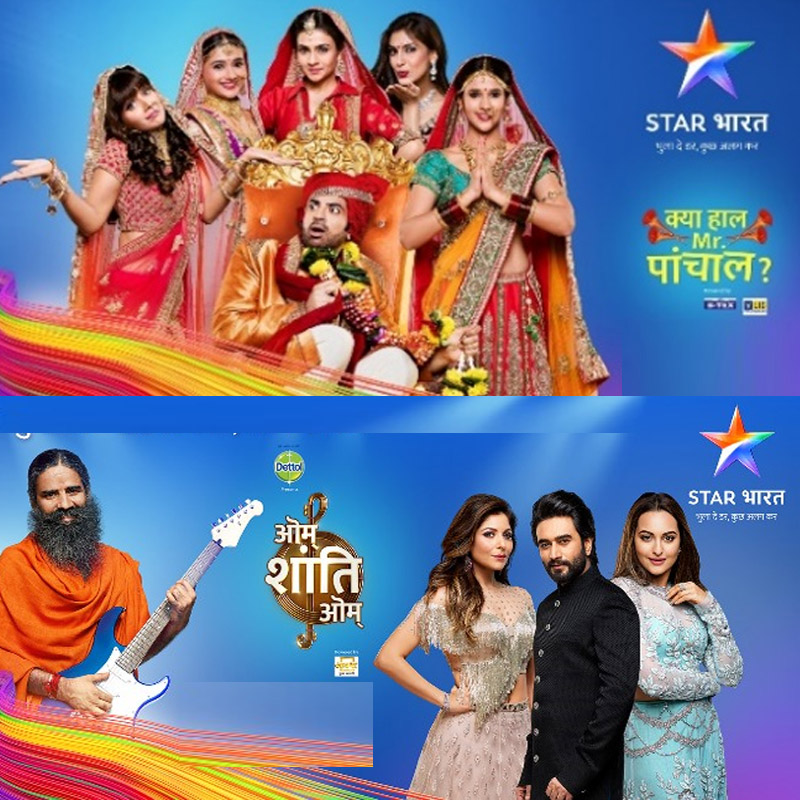
    So, Star Bharat now flaunts shows like `Om Shanti Om’, `Kya Haal Mr. Panchaal’, `Nimki Muhkiya’, `Saam Daam Dand Bhed’ and `Ayushman Bhav’.

    Reach ‘000s for week 35 and 36

    public://barc2_3.jpg

    Star has three other channels on the DD FreeDish platform including Star Utsav, Star Utsav Movies and Star Sports First. The last one, which debuted earlier this year, again is a new FTA offering of sorts that has been riding the kabaddi league wave.Indiantelevision.com tried to reach out to Star India for its comments, but could not elicit a response till the time of writing this report. However, if we get some comments on Star Bharat from the channel owner, it’d be updated.

    The big question is: will this rebranding and repositioning strategy work for Star Bharat? To use a cliché, only time will tell… oops, sorry, BARC India will tell.

    ALSO READ :

    Life OK rebranded as Star Bharat may start from 15 Aug
    Star Bharat to be available on DD FreeDish as b’caster’s fourth FTA offering

    TDSAT ‘no’ to stay Star Bharat launch, DPO payments subject to adjudication

  • Day after IPL euphoria, Sony launches FIFA U-17’s co-created song as countdown begins

    Day after IPL euphoria, Sony launches FIFA U-17’s co-created song as countdown begins

    MUMBAI: It could not have been timed better. In the backdrop of Star winning the IPL media rights, SPN, the official broadcaster of the FIFA U-17 World Cup 2017, has launched the official song — Kar Ke Dikhla De Goal.

    Sony Pictures and FIFA U-17 Local Organising Committee (LOC) have launched the song, marking the 30 day countdown to the tournament.

    With exactly a month to go for the tournament, the Local Organising Committee (LOC) and Sony Pictures Networks India (SPN) formally launched Kar Ke Dikhla De Goal, the Official Song of the FIFA U-17 World Cup India 2017.

    Written by lyricist Amitabh Bhattacharya and composed by Pritam, the song features a host of well-known music artistes that include Sunidhi Chauhan, Neeti Mohan, Babul Supriyo, Shaan, Papon, Mika along with a rap performance by actor Abhishek Bachchan.

    The composition showcases the vibrancy and uniqueness of India while resonating with a global audience simultaneously. The music video for the song celebrates diversity, showcases how the nation is waiting in anticipation for FIFA U-17 World Cup India 2017, and features stars like Bhaichung Bhutia, Ngangom Bala Devi, Shaan, Papon and the legend Sachin Tendulkar amongst others.

    The music video of the song will be broadcast on SPN’s on-air and digital platforms across genres.

    Sony Pictures Networks India president – distribution and sports business Rajesh Kaul said: “We are ecstatic to be the first broadcasters in history to collaborate with FIFA to co-create an Official Song for a FIFA tournament. From the very beginning of this association, we have worked closely with the Local Organising Committee/FIFA to ensure that FIFA U-17 World Cup India 2017 is a monumental success. Our efforts include the creation of the Official Song, an inspirational composition that will boost the nation’s spirit of sportsmanship.”

    AIFF president and LOC chairman Praful Patel said: “We are doing everything in our capacity to make this the biggest sporting event in India and I am sure the Official Song will help increase and broaden the appeal of the first ever FIFA tournament in India.”

    Minister of state for heavy industries and public enterprises and LOC vice-chairman Babul Supriyo said: “Football is synonymous with euphoria and we shall add on to that virtue with a euphoric Official Song beautifully created by the super hit duo of Pritam and Amitabh Bhattacharya. I can safely say that we’ll have everyone dancing to its tune and cheering the first ever football World Cup in our country with renewed vigour”.

    The FIFA U-17 World Cup, the first FIFA tournament to be held in India, will be played across six venues in October 2017. The tournament will begin on 6 October with the final scheduled to take place on 28 October at the iconic Salt Lake Stadium, Kolkata. Sony Pictures Networks India (SPN), the official broadcasters of the tournament, will telecast it live and exclusively on their sports channels and live stream it on their digital platform, SonyLiv.

  • IPL has come to the rightful home of cricket in India: Star’s Uday Shankar

    IPL has come to the rightful home of cricket in India: Star’s Uday Shankar

    NEW DELHI: Star India chairman and CEO Uday Shankar today said that the winning bid figure for IPL media rights of approximately $ 2.55 billion (Rs. 163475 million) was the “right” amount for a property as exciting as the Indian Premier League and justified the acquisition by asserting the competitiveness in bidding in various categories proved it.

    “We are delighted to bring IPL to the rightful home of cricket in India and elsewhere,” Shankar said at a post-bid press conference in Mumbai, adding that the eco-system of IPL and sports broadcasting has changed over the last 10 years, which reflected in the figures bid by players anxious to corner a slice of the cricket pie.

    “We believe that the IPL is a powerful property and lots of value can be created in the digital (world) and on TV for fans,” Shankar said explaining why Star bid both, for the digital and TV rights of the premier cricket property that was with Sony for the last 10 years.

    Shankar drove home the point that, as Star had a strong presence in TV and was also the owner of a robust digital platform (Hotstar), it made sense for the company to get complete rights of IPL. 

    However, Shankar made no bones of the fact that the company would have to think hard on the strategies to monetise the IPL as pay TV revenues were “highly regulated” in India, courtesy sector regulator TRAI’s new proposed tariff regime.

    For the record, Star India had challenged the tariff regime proposed by the TRAI in Madras High Court and a final directive form the court is still pending.

    Pointing out that Star would “continue to work within the law” in an effort to get better return on investment, especially now that it has invested heavily in IPL too, Shankar jocularly added, “We’d have to figure out something or we have a problem.”

    Shankar was also of the opinion that the Indian consumer had surprised critics and skeptics alike by taking to digital quite well. “As a country, we were told India was not broadband-ready (but) in less than two years India has emerged as one of the exciting markets (for digital players),” he said, adding that a better broadband infrastructure and cheaper data prices would further boost the market for online video consumption in India.

    The Indian cricket board, owners of the IPL brand and property, however, skirted questions on Star’s impending monopoly over the broadcast business now that it has also acquired the rights for IPL. Dish TV had written to BCCI and the government warning that if Star won the IPL rights too, it would be in a monopolistic situation to dictate terms to distributors of TV content as Star already had rights of most major cricket properties around the world.

    Meanwhile, the man credited with conceiving IPL, Lalit Kumar Modi, now living in exile in the UK, tweeted, “So, Star Sports wins the global rights for IPL. I would’ve hoped for a larger figure. Deserved greater value after 10 years of success.” 

    Also Read:

    IPL chief Shukla recuses from ‘live-streaming’ media rights auction

    Jawahar Goel raises alarm of emerging Star cricket monopoly (updated)

    IPL tendering process to commence 17 July; bidding to be fierce

  • Star bids highest for BCCI’s IPL media & digital rights and is the winner

    Star bids highest for BCCI’s IPL media & digital rights and is the winner

    MUMBAI: Star India has been investing heavily in Indian sport. And that investment – and promise to invest more – got the vote of confidence from the Board of Control for Cricket in India (BCCI) when its  offer of Rs 16,3475 million or Rs 16347.5 crore or approximately $ 2.55 billion proved high enough for it to snare the five year global consolidated (telecast & digital) rights for the most lucrative and prized cricket league in the world – the Indian Premier League (IPL). 

    Star India’s offer was about Rs 5000 million more than the consolidated highest individual bid total which stood at Rs 15,8195.1 million.  The bidding rules had made it clear that the global rights  (Rs 16,347.50 crore) bid would get precedence over the individual bids if the latters’ sum total (Rs 15,8195.1 million) was lower than the former.  For viewers, what this means is that they will be watching IPL action on Star India’s sports channel bouquet and VOD platform Hotstar for the next five seasons of the IPL (2018 to 2022).

    Though 24 companies picked up the offer documents, only 14 turned up for the bidding process early this morning, from which BAM Tech was disqualified. Those who took part included:  beIN, Star India., Followon Interactive Media, Sony Pictures Networks (SPN) , Times Internet, Supersport International, Reliance Jio, Gulf DTH, Econet Media, Facebook, DAZN / Perform Group, Yupp TV, Airtel and BAM Tech.

    Star India and SPN India were the only two bidders for the Indian subcontinent TV rights and the latter’s  bid  of Rs 11,0500 million was much higher than Star India’s Rs 6,1969. million.  Facebook India was the highest bidder for digital Indian subcontinent rights with its offer of Rs 3,9000 million. It beat back telcos Jio, which bid Rs 3,0757.2 million, and  Airtel’s offer of Rs 3,2800 million, and even Star India that had bid Rs 1,4430 million. The Rest of World A (Austrailia, New Zealand & rest of world) telecast rights saw a bid of Rs 700.1 million by Followon emerging as the highest offer, ahead of Times Internet Ltd’s  (TIL’s) Rs 533 million and Star at 178.8 million. 

    The beIN bid of Rs 3900 million for the Rest of World B (Middle East) rights  was much higher than OSN’s Rs 2112.5 million, YuppTV’s Rs 1001. million and Star India’s Rs 650 million.

    Supersport came out tops on the Rest of World C (South Africa) rights with its bid  of Rs 1202.5 million as against Econet’s Rs 845 million and Star India’s Rs 617.5 million. The Rest of the World D (UK) rights  had only one bidder: Star India with its offer of Rs 487.5 million, the only territory for which it emerged as the highest  individual bidder.

    The Perform group led the race for the Rest of the World E (US) rights by bidding Rs 2405million leaving YuppTV (Rs 2346.5 million), TIL (Rs 1852.5 million) and Star India (Rs 491.6 million) far behind.  The consolidated figure for the highest bids for each individual right thus worked out Rs 15,8195.1 million.

    Almost all the cricket ecosystem players were cock-a-hoop with delight about the successful global bid placed by Star India.

    Said BCCI acting president CK Khanna in a press release:  “We are happy to announce Star India as our new global media and digital partner. We thank all the bidders that participated in the process. We have ensured that transparency of the highest form was maintained throughout the process. I would like to thank cricketers and franchises for making the league one of the eminent sporting leagues in the world. I would also like to thank all the fans for showing their continuous support for the VIVO IPL for the last 10 years.”  

    Added BCCI acting secretary Amitabh Choudhary:  “We welcome Star India on board as our broadcast and digital partner. Cricket as a sport has evolved over the years, and today’s bids were a reiteration of VIVO IPL’s growing global popularity.”

    Star India chairman & CEO Uday Shankar too expressed his excitement about his company’s successful bid. Said he:  “We are honoured to be selected as IPL’s global media rights partner and we thank BCCI for conducting such a transparent process. The VIVO Indian Premier League is undoubtedly one of the most exciting sporting leagues in the world and this acquisition of media rights reaffirms our commitment to serve cricket fans and make cricket even bigger than it is. We are delighted that in Star, IPL has found its natural home. We look forward to bringing this exciting format to our audiences across the world in a quality that all our viewers are accustomed to both on television as well as on digital on Hotstar.”

    Shankar further added, “At Star India, we believe that Indian sports have barely scratched the surface of its potential. Both the viewership of sports and more importantly participation in sports is something that we would like to grow substantially over the next few years. The acquisition of these rights is symbolic of our commitment to not just cricket but to the growth of a wider sports culture in the country.” Not to let go of a chance like this, Shankar also added that Star would have to come up with solid business proposal to monetise the IPL property over a period of five years as pay TV revenues — read tariffs — were highly regulated in India.

    BCCI CEO Rahul Johri expressed:  “We are grateful to the Supreme Court, the Committee of Administrators and the office bearers of BCCI. We are also thankful to Deloitte and our legal partners Cyril Amarchand Mangaldas for their support in carrying out a fair and transparent bidding process efficiently. We would like to welcome Star India on board as our IPL global media and digital partner.  We believe this is a global benchmark and all the stakeholders of IPL will significantly benefit from this association with Star India.”

    Sportingly, SPNI congratulated and wished Star India all the best in its endeavor to shape the  IPL over the next five  years.  Said the previous rights holder in a press note:  “SPNI  has nurtured the IPL since its inception and within a span of 10 years established it as one of the most popular sporting properties in the world. We would like to thank all those who supported us in curating the lineage and legacy of IPL.  At the same time, we take this opportunity of wishing STAR India the best as they shape IPL over the next five years. With our recent acquisition of the Ten Sports network, the sports network of SPNI holds the broadcast rights to five cricket boards, guaranteeing that our channels will continue to offer a strong mix of programming for cricket fans.”

    Also Read:


    IPL tender submission & result date rescheduled

    IPL chief Shukla recuses from ‘live-streaming’ media rights auction