Tag: IPL

  • For creative agencies, Vivo IPL is India’s SuperBowl

    For creative agencies, Vivo IPL is India’s SuperBowl

    MUMBAI: For 11 years now, the Vivo Indian Premier League (IPL) has entertained the country as no other sporting event has. Not just the cricketers on the pitch but brands, marketers and advertisers have gradually upped their game to keep viewers engaged during the sporting extravaganza.

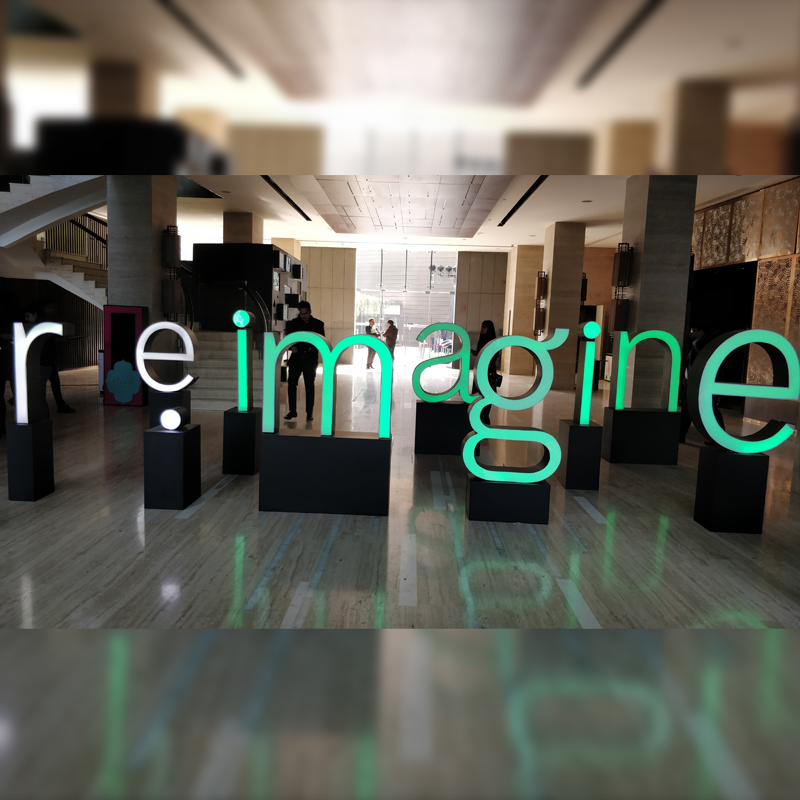
    In a bid to bring the advertising culture to the forefront of Indian sports broadcasting, Star India built a platform called the Re.Imagine Awards to recognise and encourage the creativity and innovation in the use of integrated media in advertising campaigns aired during Vivo IPL on Star Sports and its OTT platform Hotstar.

    This initiative by Star gets all the marketers, media and creative agencies to join hands, thereby pushing all stakeholders to innovate the advertising experience.

    First year of Re.Imagine Awards was a major success, with all the big brands and agencies participating. Over 300 campaigns by 120 brands vied for the awards. Brand Factory, Amazon, Dr.FIXIT, Sprite, Peter England, Swiggy, Tata Sky, Vivo and Fevikwik were some of the brands that jostled against one another to bag top honours.

    Brands have long recognised the power and popularity of cricket in India. However, with the video proliferation and regional language market expansion, more avenues seem to have opened up for the marketers to position their products.

    “The Re-imagine awards are quite unique. The fact that it focuses on one event (Vivo IPL) and the work generated and aired in it makes it interesting. Especially since the event by itself is both a massive opportunity for brands and equally a challenge of sorts to stand out in the storm of brands advertising in it. The shorter format further pushes the challenge bit. Another special feature of Re-imagine is the judging criteria of both creativity and integration," Lowe Lintas CCO Sagar Kapoor said.

    In 2018, winners of Re.imagine awards were Fevikwik for Khushiyon ke chand pal and Swiggy for No order too small. After its campaign during Vivo IPL matches, Swiggy’s ad recall increased by 62 per cent. The food delivery app saw 25 per cent growth in orders across India and 42 per cent spike in Google searches. The campaign also helped in uplifting the perception of the product proposition of fast delivery by 18 per cent.

    Swiggy ran a series of integrated campaigns throughout Vivo IPL season such as Match Day Mania, various TVCs and in-game innovation. Vivo IPL-themed advertisements explored relatable scenarios that have made Swiggy a household name today.

    “Many brands plan exclusive and relevant campaigns for IPL/cricket. This year too we will see the same. However given the reach of IPL as a platform, regular advertising works as well,” said Havas Media group CEO – India and South East Asia Anita Nayyar.

    "IPL with its undisputed reach and combination of cricket and entertainment is a zero risk property for brands. There have been many a brand launches using this platform over the years and brands earmark specific budgets for the event,” she added.

    Ogilvy, Madison, IPG, GroupM, DDB Mudra, Lowe Lintas, and Havas Media among others were some of the high-profile creative agencies that were a part of the Re.imagine awards last year.

    The 11th season of the cash-rich league enjoyed humungous reach both on TV and OTT platform of Star India.

    Building on the success of Vivo IPL 2018, the host broadcaster seems to be carving open more avenues for brands and marketers to collaborate for the latest edition.

    For instance, Star is putting together custom integrations and ad-tech solutions for television and digital respectively. This initiative of the broadcaster has been devised keeping in mind start-up companies that intend to use cricket as their preferred choice of vehicle for maximum impact.

    The American SuperBowl continues to remain one of the most awaited sporting leagues around the world from an advertising perspective. Agencies and brands create customised ads for the SuperBowl, spending millions of dollars on their campaigns to conjure up an iconic moment of marketing.

    In a conversation with Indiantelevision.com last year, Star Sports CEO Gautam Thakar had said, “In the US, as you know SuperBowl has been on for a long time and this has built-up. It is like high points of the year and there is a lot of social viewing and from the advertising perspective, people actually take pride in what they have created and are very expensive. Some of the ads only air at the time of SuperBowl and they spend millions of dollars doing that, but it breaks through the clutter and gets them virality.”

    Kapoor and Nayyar believe that Vivo IPL is the SuperBowl of India.

    “Besides being a big property, IPL is great for its very content. People do not watch IPL for ads but they will definitely watch our ads more because of the IPL. So it remains one of the most exciting platforms to land our brand messages,” Kapoor added.

    Thakar had pointed out that broadcasters can play a limited role but ultimately marketing professionals need to drive the agenda of matching the Vivo IPL advertising to the SuperBowl standard.

     “We had Re-imagine awards for IPL, it was the first time we were doing it but the idea behind that was to spur the marketing community to think of the IPL in a different way and create advertising for the IPL. We will do the awards every year now to showcase what is the best advertising. In our own little way we are trying to enable it but ultimately the marketers need to embrace it,” he added.

    As the 2019 Vivo IPL season inching closer by the day, Star India has announced the latest edition of the Re.imagine awards. The competition is bound to heat up as gurus and creative geniuses aim to deliver for cutting-edge, ground-breaking and pioneering campaigns. The audience can look forward to some unique and interesting campaigns this year as well in addition to the high-octane action on the field.
  • Viacom18 continues period drama experimentation with ‘Jhansi ki Rani’

    Viacom18 continues period drama experimentation with ‘Jhansi ki Rani’

    MUMBAI: Viacom18 is not one to stay down after one fall. Recently, the network released a periodical historical drama Dastaan-E-Mohobbat on Colors but when it failed to grab eyeballs, it has swiftly decided to replace it with another in the same genre – Jhansi Ki Rani produced by Contiloe Pictures.

    Viacom18 Hindi mass entertainment and kids TV network head Nina Elavia Jaipuria said, “The show Dastaan-E-Mohobbat didn’t click very well. Since we are in the business of entertainment, there comes a time when viewers embrace us and sometimes they don’t. Therefore, we learnt from our past and moved on to new things because entertainment is all about finding the right viewers and finding the right content for them. So, unfortunately, it didn’t do really well for us and it’s off-air right now.”

    The new tariff regime was also likely to impact broadcasters. Jaipuria said that it puts the control of choice squarely in the hands of the viewer. She added that the second benefit of this regime is that it brings in the much-needed transparency into the system, with under-reporting promising to become a thing of the past. “As business becomes more streamlined and transparent, I feel the process of content creation, curation and distribution will significantly improve. Interestingly, the future for the broadcasters will now undergo a subtle yet tectonic shift – from networks bundling and pushing channels to consumers, it will become consumers pulling in channels that they want to watch. This, I believe, in the mid-long term will lead to content quality dialling up even further,” she added.

    Most broadcasters bundled their long-tail channels with their best ones to increase uptake. While it is likely that these channels will suffer, Jaipuria doesn’t think so. According to her, niche channels will not be affected. “While Nick is number one and Sonic is not, that doesn’t mean Sonic can’t make it. Sonic has Shiva. Kids who love Shiva will anyway watch it. I think it is not about the platform but it is about the loyalty and the shows you have today.”

    Meanwhile, two big national events are coming up – IPL and Elections, which may hamper viewership of Hindi GECs. Jaipuria said, “What happens in any country when there is large mass viewership, there is one television household and the viewership time gets divided. But like I told you that the power of content is so much that there is no viewer who is going to stay without television for 2 months and without their characters. It’s the eleventh IPL and Hindi GECs have always done well. It is not that people stop watching GECs. So to my mind, there will be a little division of time and little more time given to different genres of channels. But people will not stop watching their favourite shows and characters.” She is confident that Viacom18 has a very strong line up and there’s no reason that it will be losing viewership on the channels.

  • Ad volume for cricket up by 16% in last 2 years

    Ad volume for cricket up by 16% in last 2 years

    MUMBAI: Sports viewership has undergone a transformation, with the burgeoning interest in sports other than cricket. While the gentleman’s game still commands most eyeballs (69 per cent), other sports contributed around 31 per cent of the overall viewership in 2017. Of this, Star India’s Pro Kabaddi League (PKL) scooped up approximately 50 per cent of the viewership.

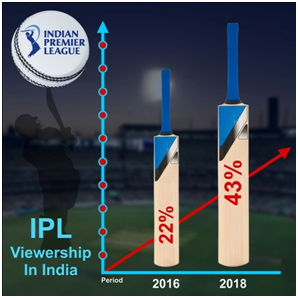
    However, a decade since its initial fervour, the Indian Premier League (IPL) still continues to enjoy a huge share of overall sports viewership in India. While the 2016 edition contributed 22 per cent of total sports viewership, that figure almost doubled to 43 per cent in 2018. 


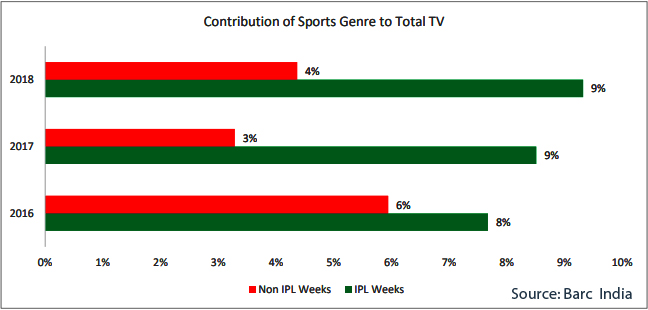
    Share of sports viewership jumped 2 per cent points in 2016 when IPL was on, and that scale up has only risen further over the years. It is also to be noted that in 2016 and 2017, the popular tournament was broadcast on Sony Max while from 2018 onwards it is being shown on Star India which expanded its reach into several regional languages too.


    IPL 2018 generated almost equal viewership for English as well as regional language (i.e., other than Hindi). This opportunity will not be missed by brands looking to target emerging markets as well as those focusing on local markets. Broadcast in more regional languages will further aid this process.


    AdEx on the rise

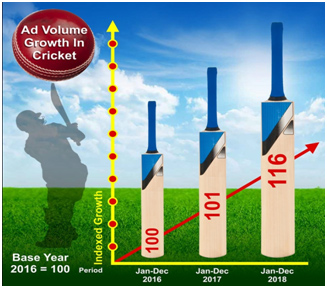
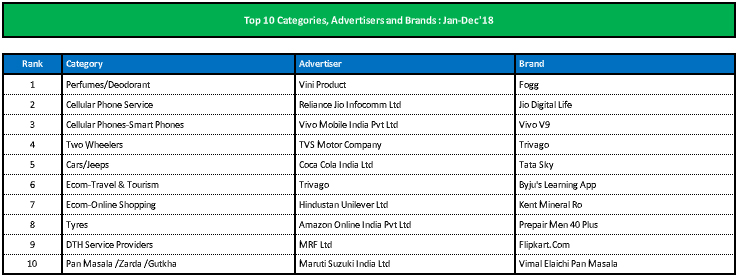
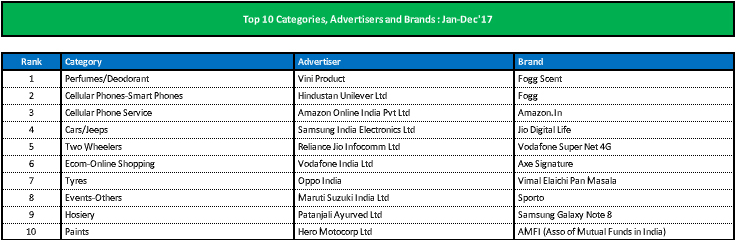
    The ad volume growth registered in cricket genre was highest in 2018, as compared to 2016, with 16 per cent. The top 10 list consists of seven advertisers that have remained common for the last three years for the cricket genre according to AdEx India, a division of TAM Media Research. 


    Top three categories (Perfumes/deodorant, cellular phones-smart phones and cellular services) dominated the list of top 10 categories across last three years in cricket genre.


    Every element of the digital ecosystem has become smarter – the consumers, the technology, and the platform itself. With IPL just a couple of months away, experts say that the there's going to be a rise of 15 per cent in India's AdEx and 2019 is going to see exponential growth in advertisement spends. 


    In the long run, the overall TV advertisement spends are expected to grow on the back of sustained viewership from both urban and rural audiences as well as continued returns from the large investments that have been made by broadcasters in cricketing properties. However, with rising levels of content consumption on OTT platforms, advertisers could look to shift some of their marketing spends to digital platforms.

    The use of sports in corporate and brand development in India continues to grow steadily. Sports sponsorship is driven by technological support throughout the system, increasing availability and consumption of sports online, growing options in sports events (beyond cricket) and use of social media to spread awareness and excitement about events.

    On the strategy of brands with the IPL and general election set to clash, White Rivers Media co-founder and CEO Shrenik Gandhi said, “The game entirely depends on communication. For a person like me, who likes both cricket and politics, where and when I see an ad is essential. There will be a dissonance if I get to see an advertisement related to cricket when I am consuming election content. For example, there might be a day when the captain hits a century and the election results are going to be announced, during these times, a judgement call needs to be taken, and the other one should stay low. The key is to advertise the right thing at the right time.”

    Technology and content innovation

    Innovation is the key to driving engagement on social media and using technology can help achieve scale. International Cricket Council (ICC), for instance, enabled fans to collect virtual trump cards on Twitter using the hashtag #WorldT20Heroes. Through the use of technology and back-end algorithms to power automated responses at scale, these virtual cards achieved massive reach with over half a million tweets.

    Star Sports’ epic “Mauka Mauka” campaign was extended on digital during the 2015 Cricket World Cup with custom emoticons from the Mauka Man (“Maukaticons”). Digital is a medium that smoothly allows you to innovate, and the best brands are constantly experimenting to create magic.

    This is a great time for legacy companies with no or minimal branding to re-introduce their brand and to advertise for brand recall amongst audiences.

    “To be very honest, any amount of spending on the same is not equal to splurging. Newly funded start-ups, companies that have introduced path-breaking ideas and have brought about a revolution in the ecosystem, may introduce themselves for the first time and make the most of this opportunity,” Gandhi added.

    The hold of perfumes/deodorant, cellular phones-smart phones and cellular phones service as the top three consistently advertised categories on TV during cricket indicates that, for marketers, this sport remains a platform to engage with young, affluent audiences.
     

  • Star India awaits cricket bonanza in 2019 after solid sports growth in 2018

    Star India awaits cricket bonanza in 2019 after solid sports growth in 2018

    MUMBAI: Uday Shankar, who was recently promoted to president of The Walt Disney Company Asia Pacific and chairman of Star and Disney India after the Fox-Disney units combined, has disrupted the Indian sports broadcasting business in the last couple of years. From scooping the media rights of the cash-rich Indian Premier League (IPL) to bolstering his sports networks’ regional offerings with the launch of Telugu and Kannada language, Shankar has thrown caution to the wind on more than one occasion in his bid to change the rules of the high-stakes game. Shankar’s grand vision and appetite for big bets has now placed Star India in a rather enviable position with a stranglehold over cricket properties this World Cup year.

    Tightened grip on Indian cricket

    Star wasted no time in setting the tone for the year as it appointed Gautam Thakar as the new Star Sports CEO on 15 January 2018. Thakar was roped in to fill up the void left by the exit of Nitin Kukreja, Shankar’s blue-eyed boy, who left the organisation in March 2017.

    The broadcaster tried to alter the IPL timings (8 pm game to 7 pm and the 4 pm match to 5.30 pm), a controversial development which was confirmed to Indiantelevision.com by then IPL chairman Rajeev Shukla. Despite the IPL governing council on board with the idea, opposition from team owners stalled Star’s plans.

    In February, Star won the rights for IPL’s audio-visual production as well as the BCCI domestic circuit for 2018-19, further tightening its grip on Indian cricket.

    In April, Star kept its foot on the pedal as it retained the BCCI rights, conducted via an e-auction for the first time, until 2023 for mind-boggling Rs 6,138.1 crore. Star came out on top after a fierce bidding war, which lasted three days, against Sony Pictures Network India (SPNI).

    The broadcaster paid Rs 60.1 crore per match for the 2018-23 home rights across five years which, a 50 per cent increase from the Rs 40.1 crore it shelled out for the 2012-18 cycle with a bid of Rs 3,851 crore for 96 matches.

    Kicked off IPL with a bang

    Star couldn’t have asked for a better start to its IPL reign, firing on all cylinders. The IPL final, aired live on 17 channels across eight different languages, powered the network’s growth by 34 per cent with 52.9 million average impressions. The title decider was produced with 11 live feeds across the TV network and Hotstar.

    Super streamer Hotstar, then led by Ajit Mohan, hit a world record for concurrent online viewing with 10.7 million viewers for the final. The final witnessed a sudden hike from eight million to 9.1 million and then to 9.7 million before hitting the 10.7 million mark.

    The television viewership for the tournament was 1.4 billion impressions with a growth of 15 per cent. With a total of six regional languages contributed to 22 per cent of the overall viewership.

    According to industry sources, the network clocked close to Rs 2000 crore in advertising revenue for the first season.

    For the first time, IPL was also aired on public broadcaster Doordarshan. According to the agreement, Doordarshan could telecast a select number of matches with a 60-minute delay along with some highlights.

    Another potential Star-Prasar Bharti face-off

    It wasn’t all smooth sailing for the broadcaster. In October, MIB proposed to amend the Sports Act 2007, which will provide ‘sports events of national importance’ on Prasar Bharati-owned, free-to-air Doordarshan Network an extended reach via private direct to home and cable TV Networks.

    The MIB has now proposed to amend the act to make such events available on DD through all mediums of distribution. This may result in preference changes of the consumer and would not subscribe to costly private sports network channels. This will also give the distribution platforms an opportunity to negotiate harder with the sports broadcasters.

    The move to amend the Sports Act 2007 has been necessitated due to a Supreme Court verdict which held that the public broadcaster Doordarshan cannot air events of national importance on private distribution platforms.

    In the same month, MIB issued a notice for receiving feedback/comments from general public/stakeholders on the draft bill, 2018. In a recent update, the ministry has extended the deadline to give feedback on the draft sports broadcasting signals (Mandatory sharing with Prasar Bharti) (Amendment) Bill 2018 till 15 January 2019. The earlier deadline was 31 December 2018.

    A move of this nature could adversely impact the revenues of sports broadcasters, particularly Star given its big bets on Indian cricket.

    Bolstered regional play

    Star India launched three channels in 2018, in line with its commitment of fostering a multi-sports culture in the country. Star Sports 3, a multi-lingual channel, was launched on 15 September and the first big event to air on it was Indian Super League (ISL) Season 5 in Hindi.

    Star Sports launched its third regional channel Star Sports 1 Telugu after Star Sports 1 Hindi and Star Sports 1 Tamil. The channel went on-air on 7 December.

    The broadcaster added a fourth regional channel, Star Sports 1 Kannada, on 29 December. Star India’s attempt at securing an exclusive sports channel for its Kannada viewers didn’t see the light of day for the 11th season of IPL. Regulatory hurdles made the broadcaster switch the Kannada feed to Suvarna Plus.

    According to FICCI- Re-imagining India’s M&E sector 2018, the sale of broadcasting and media rights is the biggest source of revenue for most sports organisations, and can account for 55 per cent to 70 per cent of total revenues. The global sports media rights is expected to breach the US$50 billion barrier in 2019 and could reach US$54.3 billion by 2021.

    2019 cricket bonanza

    2019 is loaded with marquee cricket events with Star India owning rights to most of them. The summer has four key series or tournaments – New Zealand versus India, India versus Australia followed by the 2019 IPL and the all-important ICC World Cup 2019. Barring two series, Star is bound to be the home for Indian cricket lovers this year. That’s not all. The broadcaster intends to further dominate the regional language market play with the launch of three additional sports channels in Bengali, Marathi and Malayalam. 

  • Brands with most integrated marketing plans to win as cricket season heats up

    Brands with most integrated marketing plans to win as cricket season heats up

    MUMBAI: Franchises, brands, broadcaster and most importantly the fans were left delighted on Tuesday as news trickled in that the Indian Premier League 2019 will be played entirely in India. The Board of Control for Cricket in India (BCCI) also announced that the 12th edition of the cash-rich league will commence from 23 March 2019.

    This is the first time since the inception of the IPL that all its matches will be played in India during a general election year. In a sense, this is a testament to the humongous popularity of the cash-rich league. It must be noted that the entire 2009 edition was moved to South Africa, while in 2014, some matches were played in the UAE.

    Season 11 of the IPL was a runaway success on every front. Broadcaster Star India leveraged 17 of its channels, including Star Plus and Star Gold, to make the finals a smash hit. It was aired in eight languages including Hindi, English, Tamil, Telugu, Bengali, Kannada, Marathi and Malayalam.

    Last year, the IPL was broadcast in six different languages – Hindi, English, Tamil, Telugu, Kannada, and Bengali. While Star was unable to get full-fledged Telugu, Kannada and Bengali channels up and running at that time, it ensured that viewers from these regions didn’t miss out on the experience. It aired the matches on Suvarna Plus (Kannada), Maa Movies (Telugu) and Jalsha Movies (Bengali).

    The thrilling final powered the network’s growth by 34 per cent with 52.9 million average impressions. The final between Chennai Super Kings and SunRisers Hyderabad was produced with 11 live feeds across the TV network and Hotstar.

    Brands have long recognised the power and popularity of cricket in India.  However, with video proliferation and regional language market expansion, more avenues seem to have opened up for the marketers to position their products.

    With India kicking off the year with a historic 2-1 Test series win against Australia, 2019 could be the year the nation is hooked on to cricket like never before.

    PwC India partner- media, entertainment and sports Raman Kalra says, “India is always a cricket hungry nation and will always continue to be cricket loving nation. A lot of diversified brands will be seen participating. The important thing is how they weave this story into a much more deeply integrated marketing plan. It is not just about running one campaign or two campaigns, can they really integrate the storyline throughout the ATL and BTL and do something beyond what is being done.”

    Barring series (ongoing Australia versus India and West Indies versus India in the month of July and August) Star is bound to be the home of cricket for India’s cricket-loving public.

    The broadcaster’s offering in 2019 commences with New Zealand versus India series followed by Australia’s visit to India, followed by the IPL and the all-important 50-over ICC Cricket World Cup among others.

    Sports advertising expenditure is largely driven by cricket with other sports contributing a minor share. According to India Sports Sponsorship report 2018 by ESP properties and SportzPower, media spending in sports as a whole grew 15.8 per cent from Rs 3511 crore ($ 516 million) to Rs 4065 crore ($ 616 million), driven even more strongly in 2017 by Television On Air, which grew an incredible 42.7 per cent from Rs 2376 crore ($ 348 million) to Rs 3379 crore ($ 512 million). The other reason for sports adex increase is the annual increase in ad rates, especially on IPL.

    “The crux would be which brand has the most integrated marketing plan and go beyond the TV, digital campaign to engage with the audience and convert them into fans,” Kalra adds.

    The marquee cricket season is also an opportunity for new brands to tap into a wider audience and amplify their reach and communication.

    Some of new brands that associated with the IPL last season were AMFI, Asian Paints, Berger Paints, Blue Star, Ceat Tyres, Crompton, Dollar, Ford, Haier, Luminous, Pidilite, Sleep Well, Vanessa, Vimal Pan Masala and Voltas joined the existing ones like Vivo, Colgate, Amul, Dream11, Elcia, Kent, Parle Agro, Polycab to name a few.

    When it comes to the big ICC events, the likes of Oppo, Nissan, MRF Tyres, Emirates, Uber, Bira, Dream11, and Royal Stag do not miss a chance to grab the audiences’ attention.

    Some industry experts believe that advertisers could be looking at an option that includes featuring both during the IPL and the World Cup as part of a combo deal.

  • Zee strengthens early primetime with ‘Rajaa Betaa’

    Zee strengthens early primetime with ‘Rajaa Betaa’

    MUMBAI: After launching four new shows last year in the primetime slot, Zee is adding another feather to its cap by launching yet another show named Rajaa Betaa in the early primetime. It will premiere on 15 January, Monday to Saturday at 6.30 pm and is produced by Sobo films.

    Zee TV business head Aparna Bhosle said, “Zee was pretty set in its prime time and the next strategy that we wanted to tackle was to strengthen our pre-prime slots." Therefore, Raabta, Guddan and Man Mohini were launched last year.

    She added further that a good show is time agnostic. A good show will attract viewers even at the last hours of 4pm.

    As far as content strategy is concerned during big events like IPL and the country's main election, "Zee actually grew in IPL last year. When your content offering is strong, viewership invariably follows," she said.

    The recent TRAI tariff order will have given a jolt to broadcasters where they are likely to lose chunks of viewers. But Zee is unfazed. Zee's strong primetime viewership, says Bhosle, is testimony to its good content that people will demand for.

    However, she expects significant changes in viewing patterns to take place. According to her, people consume at max 130 channels when surfing. So, some channels may not make it to a viewer's list.

    Zee, on the other hand, seems ready to tackle challenges head on.

  • Good news for Star as IPL 2019 to be played entirely in India

    Good news for Star as IPL 2019 to be played entirely in India

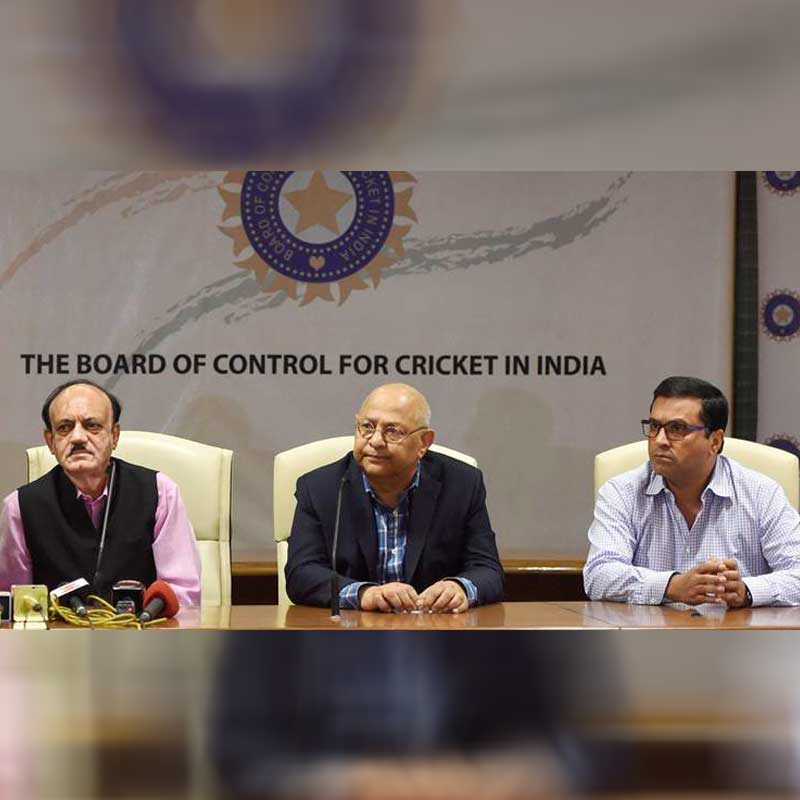
    MUMBAI: The 12th edition of the Indian Premier League (IPL) will be held in India, the Board of Control for Cricket in India (BCCI) announced, allaying fears of franchises, brands, fans and most importantly the broadcaster Star India. The cash-rich league will kick off from 23 March 2019 said the Indian board after the Supreme Court-appointed Committee of Administrators (CoA) met on Tuesday to discuss the tournament’s venues and window.

    "Based on the preliminary discussions with the appropriate central and state agencies/authorities, it was decided that the 12th edition of the world's most popular and competitive T20 tournament will be scheduled to be played in India," a statement issued by the BCCI read.

    The CoA will have detailed discussion with all the stakeholders before releasing the IPL 2019 schedule.

    "It is proposed that the IPL 2019 will commence on 23 March 2019. The detailed schedule will be finalised in consultation with the appropriate authorities," it added.

    The BCCI’s announcement put an end to months of speculation about IPL’s venue given the possibility of it clashing with the 2019 Lok Sabha elections, the dates of which are yet to be communicated by the Election Commission.

    “Franchises, sponsors and broadcast rights holders, and more importantly the fans, will be delighted,” tweeted veteran sports commentator Harsh Bhogle after the development.

    The last time the IPL was held in March was way back in 2010. Since then, the league has always commenced in the first half of April and ended in May.

    Spatial Access CEO Vineet Sodhani said, “The elections give better reach to brands than cricket at a far lesser cost. It may be a good alternative or some kind of blend that brands can do with little bit of elections and little of cricket.”

    The dates have been changed due to the ODI World Cup in England from May 30. According to the new BCCI constitution, it is mandatory to have a 15-day gap between the end of the IPL and India's international engagements.

    The IPL has hosted outside India twice due to general elections. The entire 2009 edition was moved to South Africa, while in 2014, some matches were played in the UAE.

  • IPL auctions set to kick off 2019 cricket bonanza for brands, marketers

    IPL auctions set to kick off 2019 cricket bonanza for brands, marketers

    MUMBAI: Indian fans are in for a rollercoaster ride in 2019 thanks to an action-packed cricket calendar. Virat Kohli’s men have major challenges – tough and exciting in equal measure – lined up right through the year. The Indian side is set to play 12 Tests, 22 ODIs, 17 T20Is and the all-important World Cup in June. That’s in addition to the two-month-long cricket party – the Indian Premier League (IPL).

    The mouth-watering prospect of the star-studded Indian cricket team taking on some of the most formidable cricketing nations offers an exciting proposition for fans, marketers, and brands. From a broadcast perspective, it obviously is a golden opportunity for ensuring maximum viewership and revenue. While Indian broadcasters are now investing in emerging sports along with a growing interest from audiences, nothing captures the hearts and minds of India’s public like a hotly contested cricket match.

    Dentsu Aegis Network South Asia chairman and CEO Ashish Bhasin says cricket always commands premium price purely because of the consistency of viewership that it ensures.

    “I think cricket is always a good opportunity for brands particularly those who want to reach a wide range of audience because it is one of those properties that reaches to each and every corner of the country and has got the universal appeal. If you look at the last few years, cricket hasn’t let any advertisers down because the interest has only gone on increasing. So I do think it’s a good opportunity and every opportunity comes at a price. Advertisers pay for eyeballs and cricket gets you consistent eyeballs. So it will always command a good price,” he feels.

    According to the 2018 KPMG media and entertainment report, television is expected to grow at a CAGR of 12.6 per cent owing to growing TV penetration, strong advertising demand on the back of domestic consumption and major events (two cricket world cups and a general elections on the next five years) supported by better distribution realisations due to operationalisation of TV digitisation.

    Season 11 of the IPL saw a spike of 15 per cent in viewership from 1.2 billion impressions in 2017 to 1.4 billion impressions in 2018. On the other hand, Star India’s OTT platform Hotstar hit a world record for concurrent online viewing with 10.7 million viewers for the final. The 2015 ICC World Cup garnered 635 million viewers till the India versus Australia semi-final. A total of 309 million Indians (TAM Panel CS4+ extrapolated to the universe using a standard conversion factor) tuned in to watch India’s semi-final clash against the Aussies on their television sets.

    Syska Group marketing head Amit Sethiya is looking forward to all the opportunities the upcoming year is likely to throw up to his brand.

    “Definitely there are a lot of opportunities that are going to come because of a whole range of experiences in 2019. But I think the main concern is that advertisers and brands need to check what kind of integration they are going ahead with. Three things that we are fundamentally repeating that it’s Bollywood, politics and cricket and these things still stand true,” he adds.

    Sports advertising expenditure is largely driven by cricket with other sports contributing a minor share. According to India Sports Sponsorship report 2018 by ESP properties and SportzPower, media spending in sports as a whole grew 15.8 per cent from Rs 3511 crore ($ 516 million) to Rs 4065 crore ($ 616 million), driven even more strongly in 2017 by Television On Air, which grew an incredible 42.7 per cent from Rs 2376 crore ($ 348 million) to Rs 3379 crore ($ 512 million). The other reason for sports adex increase is the annual increase in ad rates, especially on IPL.

    Broadcasters have started investing heavily in regional feeds, the likes of which were witnessed in the last IPL season. Star India leveraged 17 of its channels, including Star Plus and Star Gold to make the finals a runaway success. It was aired in eight languages including Hindi, English, Tamil, Telugu, Bengali, Kannada, Marathi and Malayalam.

    At the time, Star India aired all the regional feeds apart from Hindi and Tamil on GEC and movies channels, but in the recent past, it has launched a new channel for Telugu feed called Star Sports 1 Telugu. The network is also ready to launch its fourth regional channel on 30 December for the Kannada audience named Star Sports 1 Kannada.

    Fashion brand fbb’s marketing head Prachi Mohapatra said that cricket now reaches more demographic segments than before and therein lies its true power.

    “Our association with IPL has been positive from a view of fbb’s brand visibility and subsequent in-store traction. We were confident about the partnership and believed in the strength of the association. Cricket stays a superior property and now has a wider consumption that cuts across demographic segments than what it had earlier. Hence, association with the same will remain high on the agenda for many participating brands,” she adds.

    The ad expenditure on IPL increased from Rs 228 crore in 2008 to Rs 1204 crore in 2017. Sports advertising across all media accounted for Rs 4065 crore, 6.6 per cent of the total ad spends in the country. While the bulk of this advertising is on cricket though, other sports like kabaddi, football and badminton are now gaining traction from both the viewers and advertising.

    Eros Digital COO Ali Hussein highlights how his platform’s partnership with Kohli’s IPL franchise helped him drive their subscriber numbers.

    “It has been an interesting collaboration with Royal Challengers Bangalore as it was an industry first. No other OTT player in India has sponsored an IPL team. This association helped us reach a larger audience for Eros Now and we were able to leverage great synergies with content that we created for the platform and value that we were able to drive to our subscribers via match tickets and exclusive merchandise,” he said.

    While cricket has been the country’s most loved sport for a while, the explosion of the IPL has added another dimension to the sport. Apart from helping the Board of Control for Cricket in India (BCCI) to further propagate the game, the cash-rich league has aided brands in unlocking new markets and tapping more consumers.

    “Consumer-focussed brands are always seeking for various mediums & opportunities to reach out to their target audience. Given the kind of viewership these cricketing events enjoy in India, they would always serve as potential platforms for partnerships. Cricket and Bollywood are the two most followed headlines in the country and hence provide for a great association for a brand like Eros Now,” Hussein adds.

    Earlier this in January, IPL teams spent a mind-boggling Rs 431.7 crore in a two-day auction in Bengaluru, with pacer Jaydev Unadkat bagging a Rs 11.5 crore contract to earn the top Indian grosser’s tag.  The salary cap of Rs. 80 crore then was 33 per cent higher than the Rs 60 crore available in the 2014 auctions.

    Franchises have witnessed a windfall due to the renegotiated broadcast rights (won by Star India for Rs 3270 crore per year, four times higher than what Sony Pictures Network India paid per year during from 2008 to 2017) and title sponsorship rights (acquired by Vivo for Rs 440 crore per year).

    Indian cricket has set global benchmarks in the past couple of years, with the IPL rights being awarded for a record Rs 16347 crore to Star India for the period 2018 to 2022 and Oppo snapping up the Indian cricket team’s sponsorship rights for Rs 1079 crore till 2022.

    As the IPL money-spinner returns for its 12th edition, the auction on 18 December is where all the action commences before the players battle it out on the field.

    While 1003 players had initially registered but the final auction list is out with a total pool of 346 cricketers set to undergo the hammer in Jaipur. In a sense, the IPL auction is likely to end 2018 with a big and set the agenda for a thrilling season of cricket in 2019.

  • Disney hoicks Uday Shankar to top job at Fox-Disney combined unit for APAC

    Disney hoicks Uday Shankar to top job at Fox-Disney combined unit for APAC

    MUMBAI – As part of the integration planning for the pending acquisition of Twenty-First Century Fox, Inc. (“21st Century Fox”-NASDAQ: FOXA, FOX), the Direct-to-Consumer & International (DTCI) segment of The Walt Disney Company (NYSE: DIS) today announced plans for the strategic alignment of its consolidated international business units under three key leaders.

    “The planned restructuring of our business units outside of the U.S. will result in a stronger, more agile organization, one that is better able to pivot and capitalize on the many opportunities present in today’s fast-changing and increasingly complex global marketplace,” said Kevin Mayer, Chairman of The Walt Disney Company’s Direct-to-Consumer & International segment. “Once the acquisition is complete, all three regions will be led by exceptional, highly experienced executives who will combine the 'best of the best' talent from both organizations. This new structure and the outstanding leadership team we’ve put in place are clear demonstrations of our strong commitment to integrating operations and thoughtfully executing our strategic priorities around the globe.”

    The structure will allow for more efficient management of the Company’s portfolio of assets and the optimization of resources applied in support of the Company’s strategic priorities.  DTCI’s international operating structure and executive management, effective upon the completion of the acquisition, will include three distinct regions:

    ·  EMEA– Rebecca Campbell, who currently serves as President, The Walt Disney Company EMEA, will maintain oversight of this region and adds oversight of Russia and the Commonwealth of Independent States (CIS)

    ·  Latin America – Diego Lerner, who currently serves as President, The Walt Disney Company Latin America, will maintain oversight of this region

    ·  Asia Pacific – Uday Shankar, who currently serves as President, 21st Century Fox, Asia, and Chairman and CEO of Star India, will become Chairman, Star and Disney India, and President, The Walt Disney Company Asia Pacific

    Additionally, Janice Marinelli will serve as President, Global Content Sales and Distribution.  Responsible for DTCI’s integrated global content sales organization, she will lead and have oversight of the Company’s programming sales efforts for its combined portfolio of content, as well as the distribution of branded direct-to-consumer apps and services to broadcasters, digital services and other third-party distributors around the world.

    Ms. Campbell, Mr. Lerner, Ms. Marinelli and Mr. Shankar will report to Mr. Mayer.

    Joining the EMEA leadership team, reporting to Ms. Campbell, are:

    ·       Jan Koeppen, currently President of Fox Networks Group Europe and Africa, who will serve as President, Television and Direct to Consumer, The Walt Disney Company EMEA

    ·       Marina Jigalova-Ozkan, who will continue in her current role as DTCI’s Managing Director, Russia and CIS for The Walt Disney Company CIS LLC

    Joining the Latin America leadership team, reporting to Mr. Lerner, is:

    ·       Carlos Martinez, President, Fox Networks Group, Latin America, who will serve as Executive Vice President and General Manager, Media Networks, North and Brazil, The Walt Disney Company Latin America

    Reporting to Mr. Shankar as part of the Asia Pacific leadership team will be the following current DTCI executives:

    ·       Luke Kang, Executive Vice President and Managing Director, Greater China, Japan and Korea

    ·       Kylie Watson-Wheeler, Managing Director, Australia and New Zealand

    ·       Chafic Najia, Senior Vice President and Managing Director, Middle East

    In the coming weeks, DTCI plans to announce additional executives joining the three regional leadership teams as well as the global sales organization.

    Additionally, the following DTCI business leaders will all continue in their previously announced roles, reporting to Mr. Mayer:

    ·       Rita Ferro, President, Disney Advertising Sales

    ·       Aaron LaBerge, Chief Technology Officer

    ·       Michael Paull, President, Disney Streaming Services

    ·       Ricky Strauss, President, Content & Marketing, Disney+

    The current leaders of DTCI’s shared services areas, listed below, will continue in their roles:

    ·       Linda Bagley, Deputy General Counsel

    ·       Karen Hobson, Senior Vice President, Communications

    ·       Jim Lygopoulos, Senior Vice President, Human Resources

    ·       Justin Warbrooke, Chief Financial Officer

    Disney’s acquisition of 21st Century Fox has received formal approval from shareholders of both companies, and Disney and 21st Century Fox have entered into a consent decree with the U.S. Department of Justice that allows the acquisition to proceed, while requiring the sale of the Fox Sports Regional Networks. The transaction is subject to various international regulatory clearances, a number of which have been obtained, while others remain pending.

  • Star India’s PKL draws higher sponsorship revenues in season 6

    Star India’s PKL draws higher sponsorship revenues in season 6

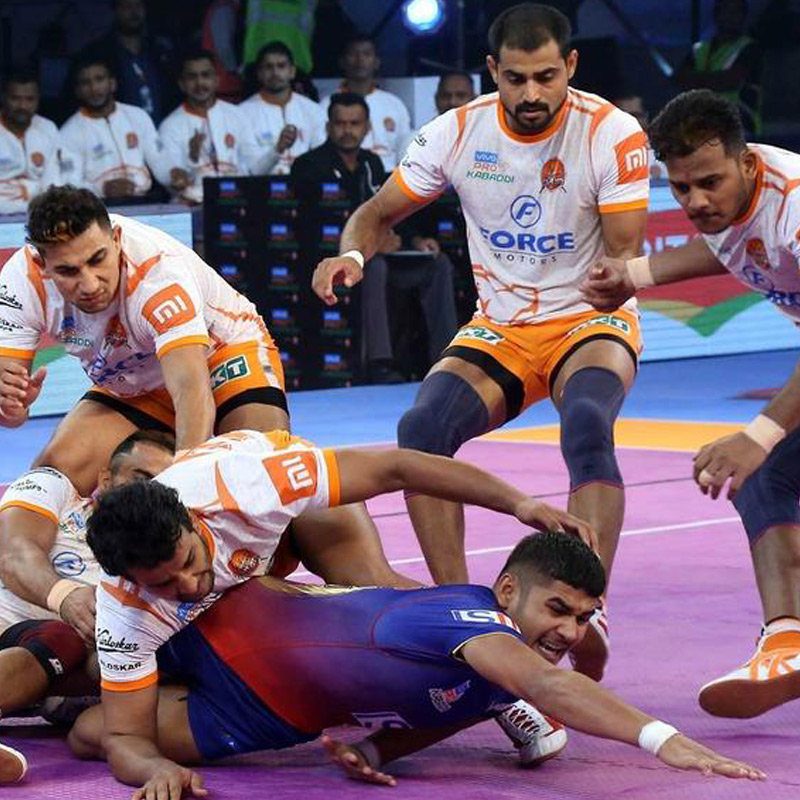
    MUMBAI: The Pro Kabaddi League (PKL) auctions saw six players command over a crore, offering further proof of the property’s rising popularity in terms of viewership and advertising interest.

    If we look at the viewership, the live telecast of PKL season 5 garnered 1.6 billion impressions with a target audience of 2+ which was broadcast on eight channels. Rural contributed to 75 per cent of the overall viewership and the remaining was contributed by urban audience.

    UMumba CEO Supratik Sen said, “Performance does matter. In season 1 to 3, brands were really excited to speak to us, in season 4 and 5, we did not perform well. We have got our sponsors and we are happy with the way the league is functioning. The overall sponsorship including jersey, on-ground and title has increased because we have changed the team and the range is Rs 4-4.5 crore right now. The team has a list of good sponsors like Indigo paints, Syska, MI, Aisen (new electronic brand) and Wintogeno. The team is in talks with two more brands and are planning to have a total of 8-9 sponsors.”

    According to an industry source, the sponsorship for the best team would be in the range of Rs 1.5-3 crore, which can only be fetched by 2 or 3 teams. Star India is pegged to earn around Rs 150 crore from the ad revenue and sponsorship this season, the source adds.

    Bengaluru Bulls CEO Uday Sinh Wala said, “As the festive season is approaching, we have lots of activations for the fans. We are still in talks with 2 more brands and hopefully we will get our title sponsor. The range this time has increased to Rs 1.5 to 3.5 crore.” The team has only one brand – MI – on board so far.

    “Things do change in the first 2-5 matches as the people want to look at how the team is performing. This time our tickets will be priced very low and will be in the range of Rs 300-500 which was previously in the range of Rs 800-1000,” Sen added.

    Tamil Thalaivas has brands like Orbit, Valvoline, Moship, Tractor emulsion, BKT, Radiomirchi 98.3 and Paytm. Brands that connect, get the whole of Tamil Nadu to activate.

    Tamil Thalaivas CEO Viren Dsilva said, “With the brands we have till now, we see the potential in terms of connect with the audience. There are brands who are looking to exploit it beyond the simple television exposure. I think the brands plan to earmark as part of their yearly calendar and we as a club are extending the calendar in terms of activities we do year round."

    Another industry expert said, “It’s been better than ISL so far. The sponsorships depend on market to market. Teams like Patna Pirates and Tamil Thalaivas have been the most successful in terms of sponsorship. Patna Pirates is in the list as it has performed very well in the previous seasons.”

    The latest season of PKL features 12 teams participating in close to 140 matches that are spread over 13 weeks. In May, Chinese handset maker Vivo signed a five-year deal with PKL as its title sponsor.

    Gujarat Fortunegaints CEO Sanjay Adesara said, “The brands' response this time has been better than the previous seasons. We have sold all our spots and we have brands like MI, Adani, Fogg, Fru2go, Jade Blue, Ranjit Rockey and Odayo. Brands connected with us from the start because they get more mileage as the league starts. We have seen an overall growth of 20-25 per cent as compared to last season.”

    It seems like brands resist putting money beforehand and instead prefer to wait to grab a good deal.