Tag: internet

  • Tewari believes internet represents the largest ungoverned space on earth

    Tewari believes internet represents the largest ungoverned space on earth

    NEW DELHI: While border control, visa regulations and immigration formalities were the ground realities in connecting the global youth, it is undeniable that the march of technology, through the use of the internet, has enabled them to become a part of the global conversation, Information and Broadcasting Minister Manish Tewari said today.


    Speaking at the Plenary Session of Youth Prasar Bharati Divas, Tewari said that internet represented the largest ungoverned space on earth and every two days more data is produced than since the dawn of civilisation to the year 2000. This technology has given rise to a virtual civilization that allows young people who have the desire and passion to connect with others with similar aspirations around the world.

    He said during his overseas travel in recent months, he has discovered that the younger generation has a common aspiration: to make a life for themselves and make the world a better place to live in. In this context, Tewari suggested that PBD should evolve a non-formal connect in an unstructured manner to allow the youth across the world to connect with one another seamlessly.

    The session provided insights into India’s fast emergence as a youthful and exuberant nation where approximately 50 per cent of the working population falls in the age group of 18- 35 years.


    There has been some reverse migration in which a number of experienced and educated NRIs are now returning home to use their knowledge to build an inclusive and economically sound future for the country.


    This has led to the creation of a unique synergy wherein young Indians worldwide are now set to shape the future of the Indian growth story. This synergy is expected to be directed by the core principle of inclusive prosperity and driven by innovation and technology.

  • Comedy Central reaches two million fans on Facebook

    Comedy Central reaches two million fans on Facebook

    MUMBAI: It has been two years since Comedy Central launched in India. The channel dedicated to comedy has surely made its inroads into its audience’s heart. The proof is the two million fans on Facebook in just two years.


    In a time wherein social media platforms make or break a brand’s market presence, Comedy Central has used them effectively to engage audiences and maintain a presence in their lives even when the television is off. 

    Growth chart of Comedy Central India Facebook page

    Commenting on the achievement, Viacom18 sr VP and head English entertainment Ferzad Palia said, “Our Facebook page is the epicentre of all our social activity online. We are delighted to reach this milestone especially considering we went from one to two million in a matter of only eight months!  This is symbolic of our fans loyalty. We will continue to strive to provide the best of comedy entertainment both on & off air”


    One of the engagements that had outstanding results was Suits Season 2 FB App: Are You a Real Suitor? The objective was to capitalise on the show’s wide appeal and provide a refresher to audiences before the second season. Over 10,000 participants signed up to test their “Suits Quotient” giving the page 60,000 page views and 40,160 unique views. Social media conversations around the show increased by 200 per cent generating over 200,000 impressions and the show hashtag #SuitsS2onCC trended in India.

    “A big thank you to all our fans for helping us reach this mark. It truly feels wonderful to see this FB page reach this milestone. This only goes to prove their loyalty. CC India re-affirms the endeavour to provide its fans with cult entertainment,” added Viacom18 digital media VP and business head Rajneel Kumar.


    Comedy Central India since its inception prides itself of having the right mix for the diverse audience it caters to. The channel’s reach has grown five times in the past one year. Smaller cities have shown a steady growth in contribution while the channel maintains number one position in the metros.

  • US-based FCC seeks to open up FDI norms for broadcasting

    US-based FCC seeks to open up FDI norms for broadcasting

    MUMBAI: Are the winds of change blowing in probably what is the most hypercompetitive and protected media market in the world after China? It looks likely that they are.


    The US Federal Communications Commission announced over the weekend that it is considering relaxing foreign investment norms in broadcast TV and radio stations in the US. Current norms restrict foreign holdings in companies holding broadcast licences at 25 per cent.


    The FCC is scheduled to have an open discussion on this when it meets on 14 November under Acting Chairwoman Mignon Clyburn. Clayburn says once its proposal is approved, the FCC will take decisions on proposals on a case by case basis. An official statement quoted her saying: “I circulated a declaratory ruling that clears the way for increased access to capital and potential new investors for the broadcast sector. Approval of this item will clarify the Commission’s intention to review, on a case-by-case basis, proposed transactions that would exceed the 25 per cent benchmark that restricts foreign ownership in companies holding broadcast licenses.”


    FCC Commissioner Ajit Pai added while speaking to a wire service that there is a great disparity in the fact that foreign companies can indirectly invest more than 25 per cent in wireless telecom, internet, cable TV ventures while draconian restrictions continue to hamper the flow of capital in the US broadcast sector which is going through turbulent times.


    The proposal has been welcomed by many in the broadcast sector including the National Association of Broadcasters and The Minority Media and Telecommunications Council (MMTC), which has in the past stated that the rules framed in 1912 need to be changed.


    In a statement, MMTC explained its advocacy for the measure: “MMTC, along with over 50 national civil rights, intergovernmental, entrepreneur, and professional groups, has petitioned the Commission to amend the rules for eight years. The organisations have cited the lack of domestic investment in diverse radio stations and the relief foreign investment capital would provide to American broadcasters, especially minority entrepreneurs. The move would also facilitate American broadcasters’ reciprocal entry into diverse overseas markets hungry for African-American, Hispanic-American, and Asian-American music and culture.”


    It may be recalled that News Corp boss Rupert Murdoch had to become an American citizen and give up his Australian citizenship in September 1985 in order to buy a network of independent television stations. He went to buy 50 per cent of 20th Century Fox Film Corp. (21st Century Fox) and had plans to purchase Metromedia, the nation’s largest group of independent television stations, including KTTV in Los Angeles.


    The change in thinking brings to mind the fact that TRAI has been recommending a freeing up of foreign investment norms in cable TV, television – news and current affairs channel (in the uplinking guidelines may be increased from 26 per cent to 49 per cent through the FIPB route), radio (the FDI limits may be enhanced from 26 per cent to 49 per cent through FIPB route for the FM radio sector), DTH, and putting it on par with telecom. Hopefully, there will finally be some movement in that direction.


    We don’t know if Indian firms are smelling opportunity, but it well could be. Zee TV already owns a wellness TV service in the US under the brand of Veria and several other Indian broadcasters have launched versions of their Indian channels and delivered them to south Asian diaspora via satellite in the US. Sure, it will provide India’s going-global media firms a chance to put in investments and acquire broadcasting firms – even though they may be local TV stations – in the US. Yes, it will take big money, but for the risk takers the rewards will be big too when they work out.

  • ICANN & CDAC to establish Center of Excellence to thwart cyber attacks

    ICANN & CDAC to establish Center of Excellence to thwart cyber attacks

    NEW DELHI: Coordination plans for the creation of a Center of Excellence in Domain Name System Security in India are to be put together by the Internet Corporation for Assigned Names and Numbers (ICANN) in partnership with the Center for Development of Advanced Computing (CDAC).


    The Center of Excellence is expected to work alongside ICANN security staff to design research projects intended to solve critical Domain Name System (DNS) security issues, such as thwarting cyber attacks. The center is also envisioned to be home to a state-of-the-art research laboratory to evaluate and test security solutions.


    In the presence of Communications and Information Technology Minister Kapil Sibal, ICANN president and CEO Fadi Chehadé and CDAC DG Dr. Rajat Moona today signed a letter of intent regarding the building of the center during a signing ceremony at the ‘Internet, Mobile & Digital Economy Conference’ (IMDEC) organised by FICCI in association with the Ministry. The theme of the conference was ‘Internet to Equinet: Empowering A Billion Online’.


    Sibal said India is fully committed to freedom of expression to work towards creating equality of opportunity, and there is a need to create systems for encouraging free flow of information, moving away from the traditional idea that knowledge is a personal asset.


    He said that the way forward is to take the consensual approach where all the stakeholders including the government will have an equal say while deciding the institutional framework. Creating an inter-governmental group is not a solution because governments will have their differences. Besides, the industry forms the crux of cyber space and without them feasible policy cannot be conceived.


    Sibal said the spread of internet and technology is creating awareness among people; they now know of the public services that are available to them, and this was leading to the development of a transparent society.


    Speaking about the relevance of the centre, Chehadé, said, “This center will play a central role in ensuring the security and stability of the Domain Name System. The Internet has become one of the world’s most valued resources and it is deserves nothing less than full global cooperation and collaboration in developing concrete solutions to combat threats to the DNS.”


    Nehchal Sandhu, Deputy National Security Advisor to the Government, said equal, unrestricted, affordable and sustainable access to ICT are needed to give equal opportunity to the people of India. Equal opportunity means democratic, transparent, collaborative and participatory way of knowledge sharing.


    M F Farooqui, Secretary in the Department of Telecommunications, said internet and telephony are interconnected and people at the bottom of the pyramid can be empowered by granting them access to these tools. The National Optical Fibre Network tends to provide connectivity to 600 million people by 2020, which would open new choices for people.


    J Satyanarayana, Secretary, Department of Electronics & IT, Ministry of Communications & IT, Government of India, said, “We are always in doubt when accessing the internet whether whatever is being shared is visible to someone else far off. We need to dispel this fear, which is associated to the internet.”


    He said, “Last week, the Union Cabinet approved the National Policy on Universal Electronic Accessibility that recognizes the need to eliminate discrimination on the basis of disabilities as well as to facilitate equal access to electronics and Information and Communication Technologies (ICTs). It is a step towards shifting emphasis from internet to equinet.” He added that the policy will facilitate equal and unhindered access to electronics and ICT products and services by differently-abled persons (both physically and mentally challenged) and to facilitate local language support.

  • India among partly-free countries as far as Freedom on the Net goes

    India among partly-free countries as far as Freedom on the Net goes

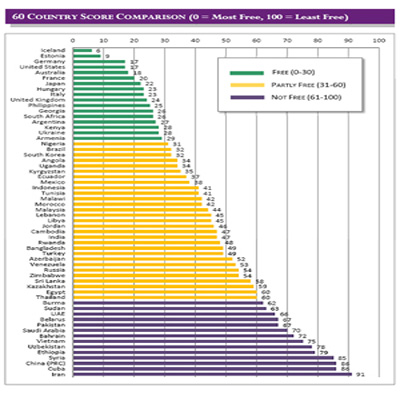
    NEW DELHI: India is 35th among sixty countries in the Freedom on the Net 2013 report.


    The annual report is carried out by Freedom House, an independent watchdog organization, and measures the level of internet and digital media freedom in 60 countries.


    In the new report, each country received a numerical score from 0 (the most free) to 100 (the least free), which serves as the basis for internet freedom status.


    India with 47 points is 18th in the list of the countries listed as partly free (31 to 60 points). There are seventeen countries in the most internet-free countries (0 to 30 points), 29 in the partly free countries, and fourteen in the ‘not free’ list (61 to 100 points).


    Iceland with six points tops the list of the free countries with the United States at the fourth place with 17 and the United Kingdom with 24 points, while Iran (91 points) is at the bottom with China (86 points) at the third place from the bottom of the countries which are not free of control. Pakistan has 67 points and is the fifth among the not-free countries.

  • The Indian Media Business gets a new edition

    The Indian Media Business gets a new edition

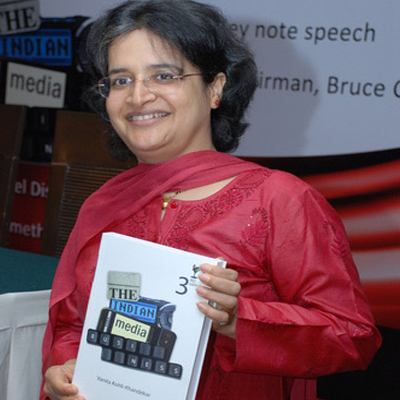
    MUMBAI: Her tome has become a reference book for students of Indian media courses. Media watcher Vanita Kohli-Khandekar released the fourth edition to her book on the Indian media business earlier this month. It has been titled matter of factly The Indian Media Business (TIMB) like in the past.

    She, however, reveals that things are different this time around in the book. Says she: “This edition has three major changes. One, there is a completely new chapter on digital media and I have dropped the chapters on telecom and internet. Two, I have focused a lot on regulation since it is very critical at this stage of the industry’s growth. And three, I have tackled a whole lot of the textural issues whether it is falling standards in news or the rising quality of Indian cinema in more detail.”

    TIMB gives a perspective and information to readers on eight segments: print, TV, film, radio, music, digital, outdoor, and events. It presents business history, current dynamics, regulation, economics, technology, valuations, case studies, trends (Indian and global) and a clear sense of how the business operates.

    The outstanding feature of the fourth edition is the chapter on digital media – arguably, the first ever serious and in-depth look at digital media from a comprehensive business perspective.  
    “This is the first time that anyone has focused on the progress of digital media in such detail, as there is no conceptual framework for the same. This chapter took a lot of effort and research,” adds Vanita.

    TIMB’s fourth edition tackles regulation in more detail than any of the previous ones. There is one large case study on the quality of regulation in India and several case-lets such as the ones on copyright law, defamation law and how it works for social media. Additionally, there are case-lets on the changes in readership methodology, on the trouble with news broadcasting and on the rising power of Hindi newspapers and the impact of digital on both print and TV among others.

    “At this stage of the growth in the industry the focus on good regulation is critical, and that can be seen in television where digitisation has finally been mandated and will have a huge impact on the top-line of the industry. So this time, this edition has a lot of focus on regulation as against earlier editions,” Vanita expounds.

    Sage Publications has been publishing TIMB for the past 11 years now. The book is also available on Flipkart.com, Amazon.com and Infibeam.com at a tab of Rs 650.   “I believe that this book will do better online as it is not in the realm of fiction. It is non-fiction and for a very specific audience,” says Vanita.

    In all 10,000 copies of the previous three editions have been sold thus far.

    Journalist, columnist and writer for Business Standard and Mid-Day, Vanita has been tracking the Indian media and entertainment business for over a decade now. Her earlier stints include one at Businessworld and Ernst & Young. A Cambridge University fellow (2000), Vanita teaches at some of the top communication schools in India as well.

    “For me professionally, it brings a lot of rigor to my work. Since I do the book every two years it forces me to sit back and read a lot of material which I would not have been able to read on the job, and this enables me to build phenomenal perspective. I ended up getting many story and column ideas while doing the research and analysis so it feels good,” Vanita exults.

    Vanita highlights that writing the book disciplines her as far as research and analysis go, and for her the whole idea of the book was that it helps those in the periphery of the media world – whether foreigner or student – get an understanding of it. A noble intent, and which many would agree has helped this generation of media professionals.

  • Verizon Terremark cloud gives Panviva a push in service-delivery time

    MUMBAI: Panviva has chosen Verizon Terremark’s private cloud to transition its flagship enterprise solution, Support Point. The decision has helped facilitate an important strategic direction for the company’s chief information officer – transforming Support Point into a SaaS-ready solution that easily scales to Panviva’s growing global customer base.


    As a result, Panviva will now deliver Support Point to customers 90 per cent faster than before, enabling the company to offer its services at a more competitive price point and also frees up employees to focus on the customer experience, rather than the delivery process. 


    Support Point offers real-time guided navigation to improve efficiency and accuracy in modern contact center and customer service environments, as well as highly regulated or complex work environments. Support Point guides leading organisations through complex policies and systems, and helps them to outperform their competitors and reduce operating costs, while maximising the end-customer experience. 


    “We have over 200,000 users in 37 countries who count on us to deliver a product that adds genuine value to their service levels and operations,” said Panviva’s chief information officer Ben Cordeiro. “This requires us to be relentless in seeking out new technologies and innovations that will become that next differentiator, the thing that carves out another 10 per cent from end-customer wait times or adds another way to simplify compliance for end users. Most importantly however, all this needs to happen seamlessly. “In Verizon, we have found a partner that is not only helping us make a measurable difference to our service delivery, but has also provided us with a secure and globally scalable platform that is coupled with the transformation of our product and international expansion of our business,” said Cordeiro.

  • MTV tells youth to play safe on the net

    MTV tells youth to play safe on the net

    MUMBAI: Six years ago, the sensational case of a sixteen-year-old who ended up being murdered by two teenagers he had befriended on the then popular website Orkut sent shock waves through the country.

    Today, instances of cyber crime have grown multi-fold, permeating our everyday lives; be it something as serious as child pornography or abuse or just someone having been taken for a ride on the internet.

    In a world where danger may be lurking just a click away, MTV, through its pro-social platform, MTV Act, has taken upon itself the task of teaching the youth how to protect themselves from being victims of cyber crime.

    MTV Act will be starting a new series called MTV Webbed, which attempts to explain how every Like, Share, Comment or Tweet can have a Domino effect. With fictional representations of real-life incidents that youngsters have encountered on the Web, the ten-part series, airing on Saturday, 14 September at 7:00 pm, targets the age group between 15 and 24 years.

    To be able to stay as true to what is happening online, MTV has associated with the NGO – Cyber Crime Awareness Society (CCAS), apart from some intensive research on the subject.

    Dos and donts while surfing

    * Don’t share your pictures and other personal details on social networking websites.
    * Don’t add strangers on social networking sites, and other android applications.
    * Use https only when you are net banking websites.
    * Don’t use pirated software and operating systems.
    * Use genuine anti-virus and operating systems.
    * Keep your anti-virus and windows updated.
    * Don’t give your laptops, mobiles phones, credit/debit cards to your friends.
    * Use WPA/PSK or higher encryptions for your WI-FI connections.
    * Don’t sign in into your net banking accounts while using public internet
    * Don’t give your credit card number(s) & CVV online unless the site is secured and reputable.
    * Don’t leave your credit card around that tempts children to use it.
    * Be careful while downloading any free software or screensaver etc.
    * Don’t reveal if you’re going out of town or details of your location
    * Choose strong passwords for your accounts to keep them safe. (Use special characters, etc)
    * Always type the website address yourself in the browser rather than clicking on a link provided in an email or   in a chat by your friend.
    * Keep a questioning attitude, if you receive any big amount of lottery through the internet even without   participating in it.
    * Use a variety of passwords, not the same for all of your accounts.
    * Disconnect from the internet when not in use, while using computers or mobiles.
    * Check your online account frequently and make sure all listed transactions are valid.
    * Always delete spam emails immediately and empty the trash box to prevent accidentally clicking on the same link.

    MTV Webbed will be hosted by celebrities such as Jay Bhanushali, Siddharth Shukla, Karan Vir Bohra, Ritwick Dhanjani, choreographer Salman Khan, Pratyusha Banerjee, Sana Syed, Priya Wal and singer Chang. The emphasis will be on how more often than not, youngsters let curiosity and natural instincts take precedence while surfing the net, only to regret their actions later.

    Says MTV India EVP and business head Aditya Swamy: “We have realised that today, the youth is online and they don’t realise that though internet has its advantages, every advantage comes with associated risks. So, we want to tell people how they can protect themselves from being victims.”

    What about the umpteen reality shows that already cater to this subject? “Cyber crime has become so prevalent today that it needs that much more of coverage and awareness to be created. Since we have a good digital presence and we want our TG to be there, it is also our responsibility to make sure they are safe,” replies Swamy.
    The promos, created by an in-house team with the tagline ‘Think before you click’, are already on air.

    There was also a debate on the topic on CNN IBN with Sagarika Ghose on 12 September.

    Also, MTV has tied-up with various colleges to create help lines that one can contact in times of distress.
    While MTV is gung-ho about the new series, media analysts too feel it might do well, what with parents watching it as well just to increase their awareness about what happens online.
     

  • India to have highest IP traffic growth in four years

    India to have highest IP traffic growth in four years

    NEW DELHI: India is set to have the highest Internet Protocol (IP) traffic growth rate with a 44 per cent compound annual growth rate from 2012-2017 followed by Indonesia (42 per cent CAGR) and South Africa (31 per cent CAGR) over the forecast period, a new study has revealed.

    The Cisco Visual Networking Index (VNI) Forecast (2012-2017) projects that global IP traffic will grow three-fold between 2012 and 2017.

    By 2017, the highest traffic-generating countries will be the United States (37 exabytes per month) and China (18 exabytes per month), says the report.

    At the regional level, the Middle East and Africa (MEA) will continue to be the fastest growing IP traffic region from 2012-2017 (five-fold growth, 38 per cent compound annual growth rate over the forecast period); MEA was the fastest growing region last year as well (10-fold growth, 57 per cent compound annual growth rate for 2011- 2016 forecast period) in this category, the report said.

    Asia-Pacific (APAC) will generate the most IP traffic by 2017 (43.4 exabytes/month), maintaining its leadership from last year.

    According to the report, by 2017, there will be about 3.6 billion Internet users – more than 48 per cent of the world‘s projected population (7.6 billion). In 2012, there were 2.3 billion Internet users – about 32 per cent of the world‘s population (7.2 billion).

    By 2017, there will be more than 19 billion global network connections (fixed/mobile personal devices, M2M connections), up from about 12 billion connections in 2012.

    Global network users will generate 3 trillion internet video minutes per month, that is six million years of video per month, or 1.2 million video minutes every second or more than two years worth of video every second.

  • Viacom18 & Tata Comm go cloud surfing

    Viacom18 & Tata Comm go cloud surfing

    MUMBAI: In the earlier days when telephones, internet and aeroplanes did not exist, messages were sent manually across countries through messengers. Today we watch the telecast of live matches at the same time globally. But somehow, broadcasters were caught in a time warp when it came to delivering the content syndicated to TV or VOD or online clients worldwide. The norm was to either send a tape to the broadcast customer whichever part of the world it was located or send out the show‘s episodes on a hard disk or via web-based ftp transfers online.

    No more. Telco services provider Tata Communications in partnership with Harmonics has developed what is being claimed as the world’s first cloud based broadcast quality video transcoding and delivery network. Viewers now have the choice to watch their favourite programs from other countries at the same time or a few minutes after the original playback without having to resort to piracy. What gets better for them is that they get broadcast quality videos, close enough to HD (high definition) quality rather than low resolution ones across a variety of platforms. This service is not restricted to just broadcasters but also production houses.

    How does it happen?

    Customers can upload their content to Tata Comm‘s portal while mentioning the device (iphones, tablets etc) for which they want it to be transcoded. The service picks it up and takes it to the cloud where the transcoding takes place after which it is either pushed back to the client or to wherever it has been asked to be sent to. A secure file acceleration method ensures safe delivery over the internet, says Tata Communications.

    Where huge amounts of data have to be archived, Tata Communications, is open to doing the job for clients after receiving a detailed document, along with the hard disk containing the data. A client may only be able to do one transcode at a time but Tata Communications can have multiple transcoding devices for speedy delivery with its 1gbps port.

    Tata Communications business
    head Sameer Kanse 
    says that the transcoded video
    is comparable to near HD quality

    Tata Communications says its cloud service helps reduce piracy. Viewers resort to piracy as the content is not available at the time they want to consume it legally and because the content is transported manually.

    With the Tata Communications service, shows can be simulcast or near simulcast because of quick delivery via the cloud and in the process this tends to reduce piracy, says Tata Communications business head Sameer Kanse. In this way the brand is protected, the copy is of good quality and the owners can get advertising as well as increased revenue.

    “They (clients) can either spend a lot of time protecting their content. Or they can actually make their content available before the pirates,” adds Kanse.

    On whether the system can be hacked , he says that it is much more difficult to pry open a secure network than steal a hard disk.

    He maintains that the transcoded video needn‘t be of the exact same quality as it was shot but it is comparable to near HD quality. “The service can effectively convert from any video format to any other video format – including between all common SD (standard definition) and HD formats, although its unique strength lies in its ability to handle professional grade broadcast video standards,” he says.

    What about time?

    By opting for this service broadcasters don’t have to undergo the Herculean task of setting up the hardware, maintaining and upgrading it as well as appoint people to handle it. This can be outsourced thus reducing time losses.

    IndiaCast, a joint venture between Viacom 18 and TV18 for distribution of its channels and content, has already started using the service for simulcast of its shows such as Bani, Sasural Simar ka and Na Bole Tum from Colors in Pakistan. IndiaCast COO Gaurav Gandhi says that this has cut down the time needed for this from three hours to an hour apart from that needed for file conversion to the requisite format, thanks to Tata Communications.

    With the rapid evolution of the internet it has become necessary to make content ready in multiple formats in a quick span of time. This service will take off a big burden from broadcasters‘ shoulders. “We are saying you (broadcasters) focus on creativity and we will focus on our work,” reiterates Kanse.

    IndiaCast COO Gaurav Gandhi is
    looking at using cloud based services 
    for simultaneous broadcast in other
    markets as well

    Tata Communications also provides a ‘live’ service to its customers, if asked for, which would allow seamless transmission of live content across different countries and operators. Without naming the broadcaster Kanse says that one of the ‘key’ broadcasters that recently launched on its own is taking its live service from them.

    Customers opting for the service normally ‘pay as they go’ wherein a higher commitment is priced higher and vice versa. Another aspect of pricing is the format of content in which it is received. Cost for converting tapes is higher than hard disks.

    Curbing Piracy

    Piracy of Colors by cable operators in other territories was one of the main reasons why Viacom18 chose to use this cloud based service. “We are looking to use the cloud based service actively for certain kind of programming of ours that has appeal/demand for simultaneous broadcast in other markets as well,” points out Gaurav Gandhi.

    The transcoding is currently taking place in Tata Communications Mumbai and London centres and can be sent across the globe. As far as numbers are concerned, Kanse says that he couldn’t share numbers but the increase in revenue would be ‘significant’ as there isn’t any other company providing similar services which is the need of the hour.

    Kanse was wary of revealing any client names apart from Viacom18, but apparently quite a few producers and broadcasters have taken a shine to the Tata Communications cloud based service.

    Clearly, that should put him up in the clouds.