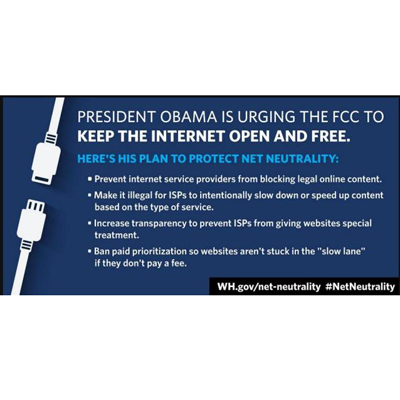
NEW DELHI: President Barack Obama has urged the American telecom regulator Federal Communications Commission (FCC) to keep the internet open and free.
But this plea will give a blow to top US wireless carriers who are looking to control price and quality of internet services.
The FCC is already in the process of considering new rules for how to safeguard competition and user choice. “Ensuring a free and open internet is the only way we can preserve the internet’s power to connect our world,” Obama said.
“We cannot allow internet service providers (ISPs) to restrict the best access or to pick winners and losers in the online marketplace for services and ideas. I am asking the FCC to answer the call of 4 million public comments, and implement the strongest possible rules to protect net neutrality,” said Obama.
However, the Telecommunications Industry Association (TIA), an association representing the manufacturers and suppliers of high-tech communications networks, said: “We are concerned over President Obama’s endorsement of reclassifying the internet as a Title II utility-like telecom service. Such a move would set the industry back decades, and threaten the private sector investment that is critically needed to ensure that the network can meet surging demand.”
“We saw a significant negative impact on investment the last time restrictive Title II regulation was in place, and no one will benefit from returning to that failed policy. As manufacturers and suppliers who build the internet backbone and supply the devices and services that ride over it, our companies strongly urge regulators to refrain from reclassification that will guarantee harm to consumers, the economy, and the very technologies we’re trying to protect,” said TIA CEO Scott Belcher.
Four years ago, the FCC tried to implement rules that would protect net neutrality with little to no impact on the telecommunications companies that make important investments in the economy.
Earlier, the court reviewing the rules agreed with the FCC that net neutrality was essential for preserving an environment that encourages new investment in the network. The court ultimately struck down the rules because it believed the FCC had taken the wrong legal approach.
Obama said there should be no blocking and throttling by ISPs. There should be more increased transparency. Some sites should not get more treatment.
Some companies should not enjoy paid prioritisation. Wireless carriers should not keep some services in “slow lane” because it does not pay a fee. “That kind of gatekeeping would undermine the level playing field essential to the internet’s growth. I am asking for an explicit ban on paid prioritisation and any other restriction that has a similar effect,” Obama said. FCC should reclassify consumer broadband service under Title II of the Telecommunications Act — while at the same time forbearing from rate regulation and other provisions less relevant to broadband services.
Referring to the White House proposal, AT&T senior executive VP, external & legislative affairs Jim Cicconi said, “If the FCC puts such rules in place, we would expect to participate in a legal challenge to such action.”
Time Warner Cable, a top cable company, remains committed to an open internet, but disagrees with President Obama’s statement that an open internet can only be achieved by reclassifying broadband as a public utility.
“Regulating broadband service under Title II, as the President proposes, will create uncertainty, lead to years of litigation and threaten the continued growth and development of the internet. The FCC has sufficient tools without reclassifying broadband to protect the openness of the internet, while at the same time encouraging continued investment and innovation in the internet ecosystem,” said Time Warner Cable chairman and CEO Rob Marcus.