Tag: Intellectual Property

  • Kaushik Moitra elevated to partner & practice lead for regulatory, IP &TMT at Bharucha & Partners

    Kaushik Moitra elevated to partner & practice lead for regulatory, IP &TMT at Bharucha & Partners

    MUMBAI: Kaushik Moitra, a seasoned legal practitioner with over 15 years in the technology, media and telecommunications sphere, has been promoted to partner and practice lead for regulatory, intellectual property and TMT at Bharucha & Partners.

    The Delhi-based lawyer, who cut his teeth at Bennett, Coleman & Co. Ltd before sharpening his legal claws at B.A.G Films & Media, has been with Bharucha since the firm’s 2017 merger with Arthe Law—itself a fresh-faced amalgamation at the time.

    Moitra’s ascension up the legal ladder comes as no surprise to industry watchers. Having spent nearly eight years at the firm, his expertise spans beyond mere regulatory matters to include private equity, mergers and acquisitions, and the ever-burgeoning start-up landscape.

    Before joining Bharucha, Moitra helped establish TMT Law Practice, India’s first boutique firm focused exclusively on technology, media and telecommunications—a legal niche that has since become a necessity in the digital age.

    The appointment reflects Bharucha’s continued commitment to strengthening its regulatory and technology practices as Indian businesses navigate increasingly complex digital waters. For Moitra, it’s simply another feather in an already well-decorated cap.

  • Mothercare and Reliance Brands form joint venture to expand in South Asia

    Mothercare and Reliance Brands form joint venture to expand in South Asia

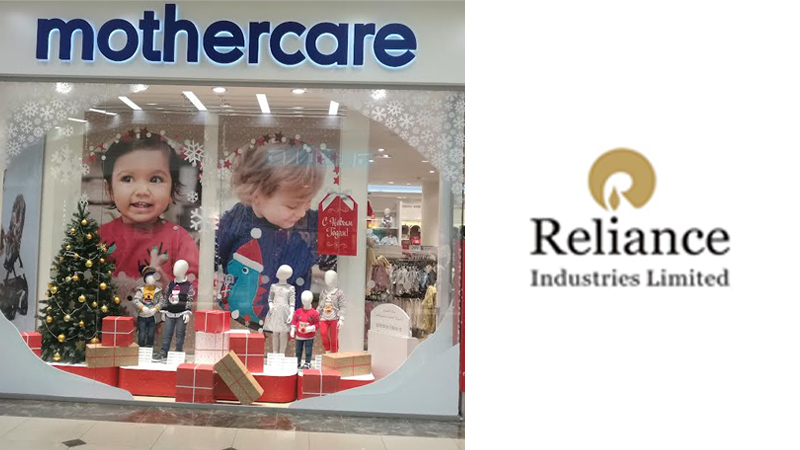
    Mumbai: Mothercare plc, a global leader in parenting and young children’s products, partners with Reliance Brands Holding UK Ltd to form a new joint venture, JVCO 2024 Ltd, aimed at strengthening the brand’s presence across South Asia. The joint venture will manage the mothercare brand and all related intellectual property (IP) assets for India, Nepal, Sri Lanka, Bhutan, and Bangladesh, creating new opportunities for growth in the region.  

    Under the agreement, Reliance Brands Holding UK (RBL UK) will acquire a 51 per cent stake in the joint venture for a cash consideration of £16 million, while Mothercare Global Brand Limited will retain a 49 per cent stake. This strategic move further solidifies the long-standing partnership between the companies, with RBL UK set to take on franchising responsibilities to ensure brand consistency and deepen customer engagement.  

    Reliance Brands Ltd, managing director, Darshan Mehta shared his excitement about the deal: “Mothercare has been a trusted name for parents in India for years, and this joint venture marks an exciting new chapter in our partnership. It’s been incredibly rewarding to work alongside the talented Mothercare team, and this deeper collaboration reflects the strong relationship we’ve built over time. I’m excited about the opportunities this new era brings as we continue to expand the brand’s presence across South Asia.”  

    Reliance Brands first brought Mothercare to India in 2018, and currently operates 87 stores across 25 cities, as well as having a strong e-commerce presence. The joint venture aims to expand its footprint in the region while retaining the quality and heritage associated with the Mothercare name.  

    Mothercare chairman, Clive Whiley commented on the significance of the agreement: “Today’s agreement strengthens our operations in South Asia through an even closer working relationship with Reliance, our existing valued franchise partner, and underlines the intrinsic value of the Mothercare brand strength. We have renewed confidence in the opportunity that this reinvigorated joint venture now presents. We look forward to working even more closely with Reliance Brands as our joint venture partner and not just as a franchisee in the region, moving forward together.”  

    Key highlights of the joint venture:  

    – Ownership and Management of IP Assets:JVCO 2024 Ltd will hold all rights to the Mothercare brand and related IP for the specified regions.  

    – Franchise Operations: The joint venture will oversee franchising and brand management across South Asia, ensuring a consistent customer experience.  

    – Strategic Investment: RBL UK’s 51 per cent stake acquisition underscores the partnership’s strength and Reliance’s commitment to growing Mothercare’s reach.  

    This collaboration is set to bring fresh momentum to the Mothercare brand in South Asia, blending Reliance’s market expertise with Mothercare’s global reputation to offer quality products to parents across the region.  

  • IPRS kicks off ‘IPRS for Fair Music’ campaign

    IPRS kicks off ‘IPRS for Fair Music’ campaign

    New Delhi: The Indian Performing Right Society (IPRS), representing nearly 6,500 authors, composers, and publishers from all over India, has launched the ‘IPRS for Fair Music’ campaign to strengthen the music ecosystem in the country.

    The week-long campaign that began on 26 April will witness a slew of activities including panel discussion, virtual knowledge sessions, felicitation of fair music partners to create awareness about the need to safeguard the creators’ right to fair compensation.

    “At IPRS, we strongly advocate why fair trade of music is critical and how it will help the original creators. Digitisation and other technological advancements have empowered creators and taken the music far and near. But at the same time, the creator stands a higher risk of his/her creative ideas getting copied. So, there is a need to protect the rights of the music right holders,” said IPRS CEO Rakesh Nigam. “We are pleased to launch this campaign to spread this message across platforms. Fairtrade music is a practice that needs to be accepted and followed in India.”

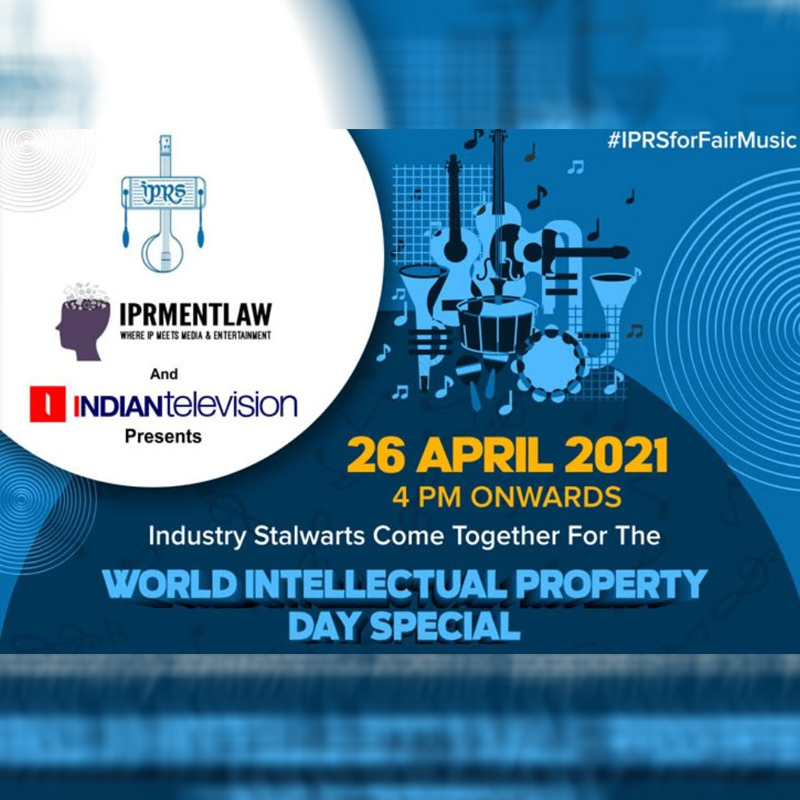
    On Monday, IPRS organised a virtual panel discussion in partnership with Indiantelevision.com and Iprmentlaw, which focused on the challenges and opportunities and the need to build a healthy ecosystem for music in India.

    It will also organise ‘Know Your Rights’ – a virtual knowledge session with eminent lawyer Ameet Datta. There will also be a session on music licensing and fair pay for music to address the frequently asked questions about different licensing options based on usage and platform. IPRS will also felicitate its fair music partners, for endorsing fair trade music.

    “The exploitation of any creative work is entitled to be duly credited and remunerated. We need to build more awareness about fair pay and fair play of music,” said noted lyricist, poet and screenwriter Manoj Muntashir.

  • Intellectual Property Rights is the oxygen for creators, say industry experts

    Intellectual Property Rights is the oxygen for creators, say industry experts

    MUMBAI: As we move towards a content-based economy, the question of ownership has taken centre-stage. With a wide gamut of content being produced and consumed, establishing and protecting Intellectual Property (IP) rights is essential for content creators and the businesses that host/promote it.

    To drive forward the conversation around licensing and paid consumption of music in India, The Indian Performing Right Society Ltd. (IPRS) in association with Indiantelevision.com and Iprmentlaw organised a panel discussion hosting eminent members of the Indian music industry. The panel discussion was moderated by Indiantelevision.com founder, CEO & editor-in-chief Anil Wanvari and Iprment Law founder Anushree Rauta. 

    The panelists unanimously suggested that the royalty and copyright act in India needs serious revision. Industry experts who took part in the discussion claimed that proper implementation of the copyright act in India could benefit music creators financially, as most of their scores are being aired on television channels, OTT, radio, and on other programs without royalty. 

    Intellectual Property rights: The oxygen for music creators

    During the panel discussion, Wanvari described Intellectual Property rights (IPR) as the oxygen for music content creators. Panel members seemed to agree with Wanvari’s view, and asserted that IPR is very much necessary to ensure the stability of the music industry. 

    “Intellectual Property forms the base for the industry. The originator should always be awarded and acknowledged for it. It is very vital,” said Tunecore India head Heena Kriplani. 

    Music director Raju Singh deemed IPR as the shield of protection music creators have. In fact, IPR is the ”core existence of what we create”, he added.

    Turnkey Music and Publishing MD Atul Churamani said, “The backbone of the entertainment business is IP. Whatever we are creating, is protected by Intellectual Property rights.” 

    The royalty dilemma and copyright issues

    Issues related to royalty and copyrights are one of the most common challenges faced by composers in the country. Supreme Court advocate Harsh Kaushik revealed that the royalty business in India is confusing. 

    “The ongoing debate is if the song recording is being exploited, whether the underlying works need to be compensated separately or not,” said Kaushik. 

    IPRS CEO Rakesh Nigam said that copyright-related laws in India should be made in such a way that they should help the business. 

    “Digital royalties have sprung up during the pandemic, but TV royalties went down. In 2021, we distributed Rs 185 crore royalties,” he added remarked. 

    Panelists who attended the event concurred that royalty and copyright acts in India need serious amendments. IPRS which has currently 5,000 members including T-series, Sony Music, Saregama, Universal Music Publishing, Times Music, and Aditya Music collects royalties on behalf of them each time their music is played, be it over the radio, live concerts, or music OTTs. 

    Even though IPRS is continuing its efforts to ensure royalty amount for music creators, the copyright act which may be still in its nascent stage negatively impacts these efforts. Citing the example of royalty collection in foreign countries, Nigam added that the arrival of more royalties could elevate royalty collections to new heights, and may grow up to Rs 700-800 crore from the lowly Rs 180 odd crore now. 

    The revelation from Nigam comes at a time when several radio stations in the country have engaged in legal battles with content creators over the royalty row. 

    Churamani, during the panel discussion, suggested that separate tribunals should be set up to handle cases related to copyright issues. 

    The rising popularity of regional music

    Aditya Music director Aditya Gupta, whose firm holds the music rights of movies like Ala Ala Vaikunthapurramuloo, Uppena, and Vakeel Saab, revealed that digitalisation has helped his company to stay afloat even during Covid times. He also added that the Indian music industry is witnessing the growing popularity of regional music. Gupta revealed that his company had the. 

    “Luckily for us, last year went well because of new digital platforms. The consumption increased on digital. There were a good number of releases in the regional market. Regional music is growing well in India. Earlier, their distribution was the biggest hurdle, but deep penetration of the internet, smartphones have removed that obstacle. The consumption is growing,” added Gupta. 

    On the other hand, TM Talent Management founder Tarsame Mittal said that the pandemic has hit their business very badly. 

    “Majority of our business comes from live events. It became Zero suddenly when the pandemic struck. So we tried and looked for alternatives, and we survived somehow,” he shared. 

    Indians should pay for music

    During the panel discussion, Rakesh Nigam and Tarsame Mittal unanimously suggested that Indians should change the way in which they consume music. The duo claimed that we have the affinity to enjoy whatever is available for free, and added that this trend needs to go to ensure the stability of the industry. 

    “In India, most of the music platforms provide free music, be it Spotify, Wynk or Gaana, unlike other countries where these are paid services. We need to create a culture, where people start to pay for the music they listen to. There has to be a cost attached to it,” suggested Nigam. 

  • Law college apologises for Suits vs Jolly LLB 2 ad

    Law college apologises for Suits vs Jolly LLB 2 ad

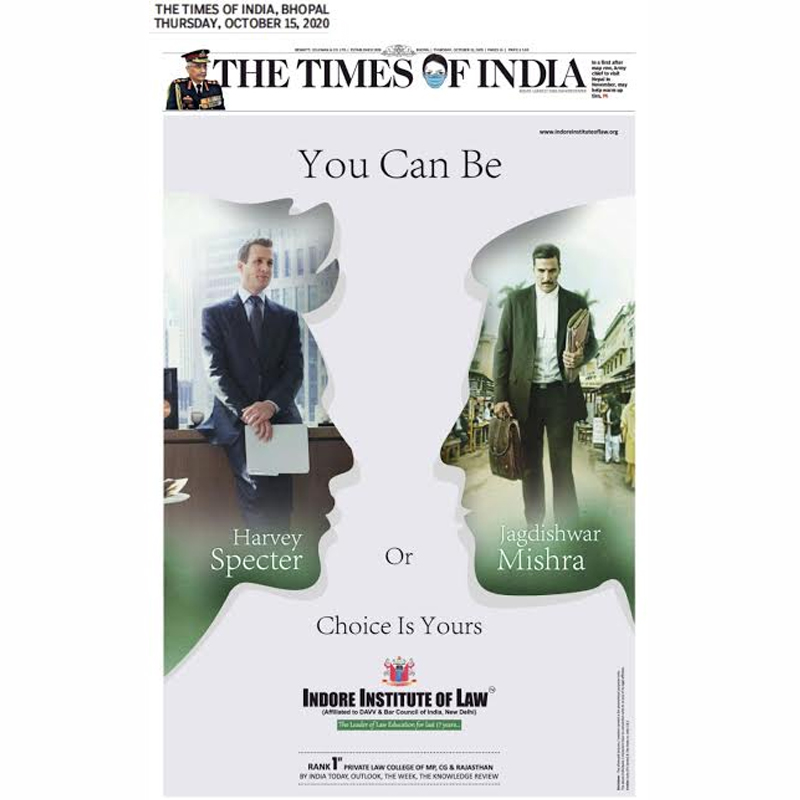
    NEW DELHI: Last week, readers came across a curious ad on the front page of The Times of India’s Bhopal edition. The print advert by Indore Institute of Law drew a comparison between two fictional characters Harvey Specter from American TV series Suits and Akshay Kumar from Jolly LLB. It bore the caption that an aspiring lawyer could be either – “Choice is yours.”

    The picture started doing the rounds on social media platforms and netizens were quick to slam the college’s perceived elitist stance behind the ad. Others accused the institute of denigrating the “dignity of Indian lawyers.” Social media pundits also questioned whether the college had obtained permission from the original creators before running the campaign. A fair few wondered why the institute chose fictional characters instead of its own alumni or famous practitioners of law in the real world.

    The overall impression in certain sections of social media was that the ad was in poor taste and problematic; and not the inspired idea that the advertisers imagined it to be.

    Facing flak, the law college later issued an apology saying, “We assure everyone that it was absolutely not our intention to offend anyone or defame any section of the legal profession.”

    But the damage was already done and the ad-makers were brutally trolled for their creative sense.

    Please find our clarification regarding our advertisement published on 15/10/2020. We would like to make clear the…

    Posted by Indore Institute of Law on Thursday, 15 October 2020

    Being a Law Institute, the college should have known better than to draw such a superfluous comparison, besides flagrantly violating the Intellectual Property and Trademark code on top of that. As per rules, no agency or brand can use any celebrity or work of any other firm without their approval, and if it has done so then the company has to pay the penalty under the Copyright Act. However, if the ad is published on social media, not many will raise the question of ethics.

    Using others’ IP in an advertisement is not uncommon, but this case has come into the limelight because the brand chose the ATL medium. Had the flyer had been limited to social media, it probably wouldn't have caused such a ruckus.

    ASCI secretary-general Manisha Kapoor shared that the council has not received any complaint in this regard as of now.

    Explaining the due process of dealing with violations, Kapoor said: “The advertiser will be asked to furnish the required permissions and an independent consumer complaints council will duly examine the objections and the advertiser’s response, and ascertain if the ASCI code has been violated. The advertiser will be asked to modify or withdraw the advertisement in question if it is found violating the ASCI code.”

    ASCI seeks to ensure that advertisements conform to its code for self-regulation, which requires advertisements to be legal, decent, honest, and truthful and not hazardous or harmful while observing fairness in competition. The code also describes that the ad should not be derogatory to competition without any plagiarism. It should not use indiscriminately for the promotion of products, hazardous or harmful to society or to individuals.

  • “Time to discuss IP ownership”: Contiloe Pictures’ Abhimanyu Singh

    “Time to discuss IP ownership”: Contiloe Pictures’ Abhimanyu Singh

    MUMBAI: Television producers, after a long hiatus, have started shooting with limited cast and crew members. However, taking care of the team and the implementation of other SOP measures has escalated production cost.

    Contiloe Pictures founder and CEO Abhimanyu Singh says that most companies are at a vulnerable stage. Production has come to a standstill where revenue is zero with underlying assets to depend on.

    Singh believes that the IP-based system needs to start so that creators can benefit from reusing, reworking and reutilising their assets. He adds that the entire ecosystem needs to prepare itself to be able to create world-class content.

    He further explains that apart from owning studios, having a stronger production fraternity is good for the creation environment. “Smaller units will always have a problem and the system will remain fractured in the way it functions. If you have a strong infrastructure and strong production companies it will be always helpful to fight any natural disaster.”
     
    Singh is currently shooting with his team in Amgaon and Naigaon where he has arranged a living accommodation for his cast and crew members. The entire arrangement was done within 20 days since the lockdown was imposed. The team at Contiloe Pictures worked overtime to make this transition happen. Nearly 75 people are staying within the studio in Amgaon. Everything from their living cost to food is taken care of by the studio. In the same manner, close to 30 people are staying at the other set in Naigaon.

    Contiloe Pictures has hired an external agency called Momentum India that looks after all the sanitisation, fumigation and other safety measures.

    Singh highlights that shooting is running smoothly with not limited challenges. He shares, “We had over 100 animation people and VFX supervisors because most of our shows require visual effects. Now there are fewer people in one slot. We have two floors where people were working in different shifts which have reduced now. Most of the post-production work is happening remotely.”

    The studio has introduced Adaptra lines, where data transfer happens at a higher speed. He also highlights that even if the cost goes up it is safe for the environment as people are working from home. This will help to stop the mitigation of viruses on the set. Singh says that these added costs will have to be taken for the time being since there isn’t any other option. 

    Singh has introduced very limited changes in the scripts. Storytelling has changed to a certain extent, but the plotline remains the same. A lot of crowd scenes, darbaar sequences are done through CGI (Computer-generated imagery).

    Singh credits the entire industry for coming together in this time of crisis.  He shares, “Most of the industry is shooting for over 40 days now and people are being responsible for their working environment and their units.”

    Contiloe's currently running shows on television include Tenali Rama and Vighnaharta Ganesh. It has also previously created shows like Veer Shivaji, Jhansi ki Rani, Mahabali Hanuman, Chakravartin Ashoka Samrat, Maharana Pratap, Ssshhhh…Koi Hai amongst others.

  • Will TV producers look at IP ownership in the post-Covid2019 world?

    Will TV producers look at IP ownership in the post-Covid2019 world?

    MUMBAI: When a nationwide lockdown was imposed to stem the tide of Covid2019, all film and TV shoots were suspended. Finally, the Maharashtra government gave a green signal for the resumption of film and television shootings in non-containment zones.

    As things are slowly getting back to normalcy it has become important for every production house to hold its intellectual property.

    This was the unanimous view of a virtual round table conference organised by Indiantelevision.com to discuss the challenges faced by TV producers. 

    The panel, moderated by indiantelevision.com founder, CEO and editor-in-chief Anil Wanvari, had Swastik Productions & One Life Studios producer & managing director Rahul Kumar Tewary, SOL Productions founder and managing director Fazila Allana, Contiloe Pictures founder and CEO Abhimanyu Singh, Endemol Shine India CEO Abhishek Rege, Fremantle India Television Productions managing director Aradhana Bhola, Taarak Mehta Ka Ooltah Chashmah producer and Neela Films owner Asit Kumarr Modi, and ANM Global managing partner Nidhish Mehrotra.

    With the whole pandemic situation, some television producers also have the fear of being kicked out of shows. This scenario has put a big question mark on broadcasters who own the intellectual property rights for most TV shows.

    Swastik Productions & One Life Studios producer & managing director Rahul Kumar Tewary says, “Currently broadcasters have been very supportive, but mostly it is discussion rather than action that has happened from broadcasters’ end. However, I am very hopeful that they will come forward and help. Ultimately, they are the owners of the IP.”

    He adds that this lockdown will create opportunities for producers who have trust in their content and IP. This situation will give producers some time to create different business models and IPs. Apart from this, there will be huge financial calculations also.

    Adding to Tewary’s point, Contiloe Pictures founder-CEO Abhimanyu Singh said, “It has been a long discussion among all producers. This is a time where the production community can work along with broadcasters with some co-investment in place to create IPs.”

    Taarak Mehta Ka Ooltah Chashmah producer and Neela Films owner Asit Kumarr Modi thinks it is very important for all producers to own their IPs. With the help of IPs producers can also sustain their business and become a long-time player.

    He adds, “If I don’t own an intellectual property then I am merely a production coordinator and not a producer. Post Covid2019 it will be interesting to see who owns IP. Repeat telecasts are seeing a huge consumption on digital media. IP has its own value, who will own what percentage that producers and broadcasters will have to mutually decide.”

    SOL Productions founder-MD Fazila Allana said: “Despite having our own IP there are certain formats which are created indigenously for the movie market which is not owned by them.”

    She adds that it is a continued struggle. It is more than ever now that the platforms and the channels do not want to give up IPs. Because even they have realised that in this situation, they need a bank to play and they don’t want to pay for it again.

    “The struggle is going to be tougher as everybody is now realising that there is a huge financial problem, so they are alright with producers sharing the cost and therefore own half IP. So, co-investing and co-owning could be a solution for this mid path. I don’t think the broadcasters or OTT players will give 100 per cent IP,” she further explains.

    Adding to what Fazilla Allana said, Fremantle India Television Productions MD Aradhana Bhola believes that OTT players have now realised that there is no boundary to create content. They can do dubbing and subtitling; and consumers are willing to see those contents.

    As we all know that a large part of Indian television comprises reality TV shows like Indian Idol, Bigg Boss, Dance Plus, etc.   While some producers are of the opinion that owning IP will incur them huge costs and financial burden, others think that it could be the way going forward.
     

  • India gets its own IPR mascot ‘IP Nani’

    India gets its own IPR mascot ‘IP Nani’

    MUMBAI: India’s intellectual property (IP) mascot – IP Nani – was launched by Commerce and Industry minister Suresh Prabhu over the weekend.

    Speaking on the occasion, Prabhu said that the protection of IP rights (IPR) is critical for building a knowledge-based society adding that mere legal provisions are not sufficient for its protection but their strict implementation is equally required. He underlined that piracy is a serious crime which should not go unpunished. He even called for creating awareness against stealing IPR and stressed on the need for participation of society in the effort.

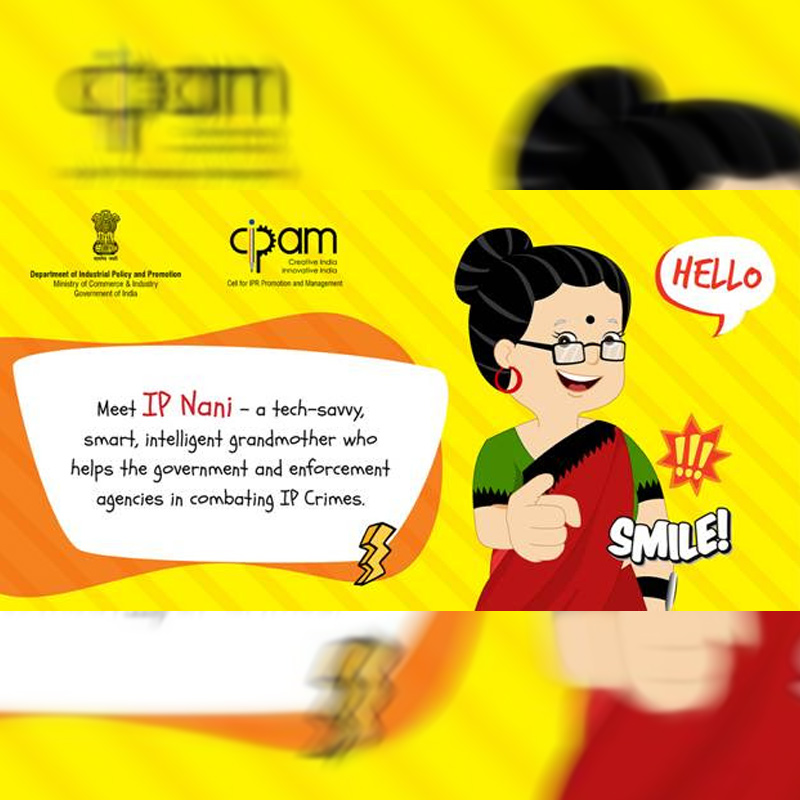
    Mascot IP Nani is a tech-savvy grandmother who helps the government and enforcement agencies in combating IP crimes with the help of her grandson ‘chhotu’ aka Aditya. The IP mascot will spread awareness about the importance of IPRs among people, especially children, in an interesting manner.

    This character is also in line with the World Intellectual Property Organisation’s campaign for the World IP Day which celebrates the brilliance, ingenuity, curiosity and courage of the women who are driving change in our world and shaping our common future. It also highlighted that how a strong IP system can support innovative and creative women.

    The Cell for IPR Promotion and Management (CIPAM), a professional body under the Department of Industrial Policy and Promotion collaborated with the European Union Intellectual Property Office to produce a series of animated videos on IPRs for children with IP Nani as the central character.

    CIPAM has been conducting IPR awareness workshops for school students since April 2017. For the first time ever IPRs have been exclusively included in the NCERT textbook for class 12 school syllabus. These efforts are aimed at inspiring the next generation of creators and innovators to become proud IP owners.

    Also Read :

    World IP Day celebration in Delhi and Mumbai

    Owning IP not priority for Big Synergy

  • ‘Motu Patlu- King of Kings’ is Viacom18’s calculated risk

    ‘Motu Patlu- King of Kings’ is Viacom18’s calculated risk

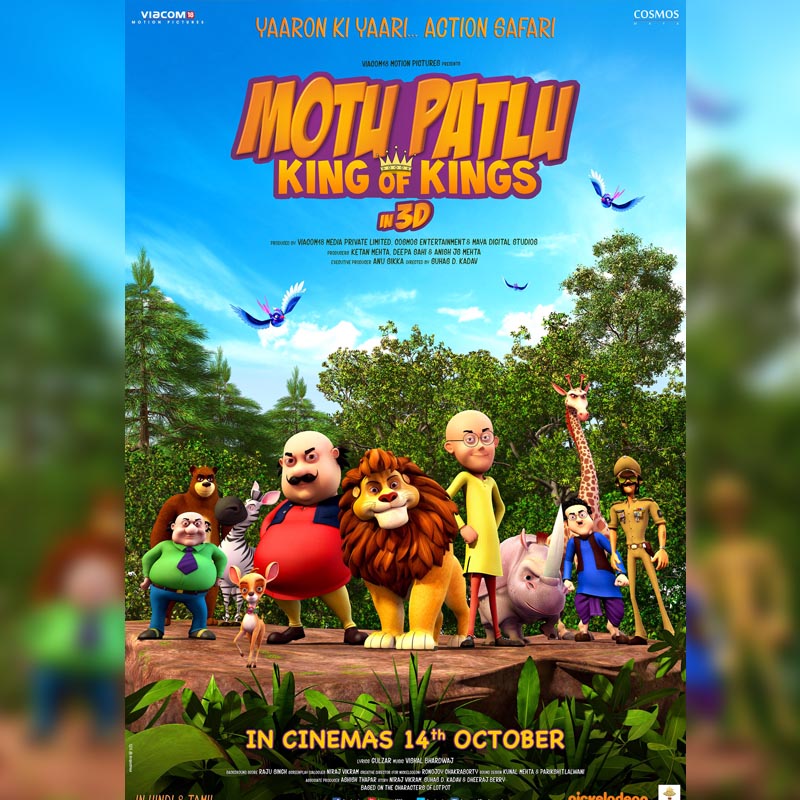
    MUMBAI: At a time when major studios are either washing their hands off the Hindi film market or threatening to do so, jilted by the low box-office collections, Viacom18 has announced its maiden animation theatrical, ‘Motu Patlu King of Kings’.

    Produced by the popular studio Maya, the film is slated to release on 14 October 2016, in Hindi and Tamil. This isn’t the first movie that highly rated toon characters Motu and Patlu have to their name. Nickelodeon had aired 10 ‘made for TV’ films, which did extremely well in television viewership.

    Not belittling the craze the young ones in India have for the toons, the obvious question still stands ‘Why would Viacom18 bet so high on the already struggling animation feature film market in India?’ Not if the core objective isn’t about gain or loss at the box office but to augmenting an already popular franchise to become a premium brand for the network.

    “Motu Patlu is already a very successful Intellectual Property (IP). Media business is fundamentally about widening the base of existing IPs. Cult franchises have been built on this principle across the globe. When you have characters like Motu and Patlu under your own home network, it is only right to invest in them by treating them to a film screen. Even if the film fails, we would have had marketed these characters well and grown brand Motu Patlu. Therefore, even on a bad day when collections aren’t that great, this film is still a good business decision,” Viacom18 Motion Pictures COO Ajit Andhare shed some light on the strategy.

    Referring to the studios shutting down, he frankly stated, “I think when you bank on a film too much, you run the risk of ending up that way. The key approach is to have a diversified portfolio. One film might not work but it is unlikely that a well-thought-of portfolio will crash.”

    “Your chances of succeeding as an aggregate are far greater due to diversification,” he said.

    Viacom18 isn’t completely giving up on the theatre footfalls. From releasing the movie to leveraging its strength to market it, the media behemoth isn’t leaving any stone unturned.

    “We are releasing the film in a calibrated fashion: The film’s launch date has been carefully decided upon so that it won’t be completely walked over by the Rs 100-crore magnum opuses. We locked in a holiday period that roots out potential competition”.

    Viacom 18 group CEO Sudhanshu Vats further laid down the marketing plans for the run-up to the release in the next six weeks.

    “We will strongly use the combined strength of our network to reach far and wide for the promotion of the film. Besides, we plan to use all the right media vehicles that fits our objective of reaching the right audience. Cross network promotion on relevant channels like movie and entertainment will also be part of the marketing initiatives. We will be heavily present on print and out-of-home spaces,” he said. The network also plans to use its FTA channels to spread the word in the tier II and tier II markets.

    “We will add engaging brand alliances as part of the marketing mix with experiential being a key focus to popularise the characters,” he shared. The pre-festive season ties up with Nickelodeon’s already planned out marketing blitz for the year.

    From a distribution standpoint, the film will be released in approximately 700 screens across the country. While it is significant number in the animated feature film category, to put some context, Disney’s The Jungle Book was released in India in around 1,640 screens.

    Explaining why a smaller screen strength won’t deter the movie’s overall visibility, Andhare added, “Screen numbers don’t necessarily make a film big or small. Unlike a ‘star geared’ film, when it comes to a movie like this, what counts more is the show time. What will be a convenient time for the kids to go and watch, will the parents be able to accompany them? — become the deciding questions. So when we say 700 screens, we mean a wide release with proper show timings that can tackle such a specific audience.”

    Given the track history of home-grown animated feature films on the Indian box office, Andhare was quizzed how he plans to recover the cost of production, when animated films are expensive to produce.

    “I wouldn’t have agreed to do this film if I weren’t confident that we will be profitable. But, the onus is not just on theatre footfalls. It will be through a combination of all the monetization avenues available to us, whether it’s selling satellite rights, digital rights, or merchandising and brand integration deals.” Also, animated content has longer shelf life and are a lucrative property for syndication to other markets as well.

    Speaking of brand integration, Viacom18 kids entertainment, business head Nine Elavia Jaipuria assured that the network is in talks with several brands to partner for the film’s promotion. Marketing alliances with more than 20 brands across categories such as Confectionery, Toys, FMCG, Milk supplement products, et al, are being tapped.

    “The movie is unadulterated, meaning, there is no in-movie tie-up with a brand,” she said.

    Adding her insight on how this film adds value to brand Motu Patlu, Jaipuria said, “From Tv-dom to stardom would draw us a premium on the IP”.

    Jaipura also stressed on the ancillary revenue that the IP generates from the various merchandising deals it lends itself to, be it apparels, toys, stationery, back-to-school products, etc, which is further strengthened by its presence on various e-commerce platforms.

    From the content standpoint, Motu Patlu King of Kings is a story about a runaway circus lion, a king trying to protect his kingdom, a greedy poacher and Motu Patlu caught up in the final battle to save the life of the jungle. Motu Patlu King of Kings, releasing on October 14, is sure to capture the imagination of the children and adults.

    Maya Digital Studios chairman Ketan Mehta said, “This is a film that will be driven by children, but one that will be equally enjoyed by adults.”

    Some of the leading names were roped in for the movie. The film is directed by Suhas Kadav and the celebrated poet Gulzar has penned the lyrics of the title track.

  • ‘Motu Patlu- King of Kings’ is Viacom18’s calculated risk

    ‘Motu Patlu- King of Kings’ is Viacom18’s calculated risk

    MUMBAI: At a time when major studios are either washing their hands off the Hindi film market or threatening to do so, jilted by the low box-office collections, Viacom18 has announced its maiden animation theatrical, ‘Motu Patlu King of Kings’.

    Produced by the popular studio Maya, the film is slated to release on 14 October 2016, in Hindi and Tamil. This isn’t the first movie that highly rated toon characters Motu and Patlu have to their name. Nickelodeon had aired 10 ‘made for TV’ films, which did extremely well in television viewership.

    Not belittling the craze the young ones in India have for the toons, the obvious question still stands ‘Why would Viacom18 bet so high on the already struggling animation feature film market in India?’ Not if the core objective isn’t about gain or loss at the box office but to augmenting an already popular franchise to become a premium brand for the network.

    “Motu Patlu is already a very successful Intellectual Property (IP). Media business is fundamentally about widening the base of existing IPs. Cult franchises have been built on this principle across the globe. When you have characters like Motu and Patlu under your own home network, it is only right to invest in them by treating them to a film screen. Even if the film fails, we would have had marketed these characters well and grown brand Motu Patlu. Therefore, even on a bad day when collections aren’t that great, this film is still a good business decision,” Viacom18 Motion Pictures COO Ajit Andhare shed some light on the strategy.

    Referring to the studios shutting down, he frankly stated, “I think when you bank on a film too much, you run the risk of ending up that way. The key approach is to have a diversified portfolio. One film might not work but it is unlikely that a well-thought-of portfolio will crash.”

    “Your chances of succeeding as an aggregate are far greater due to diversification,” he said.

    Viacom18 isn’t completely giving up on the theatre footfalls. From releasing the movie to leveraging its strength to market it, the media behemoth isn’t leaving any stone unturned.

    “We are releasing the film in a calibrated fashion: The film’s launch date has been carefully decided upon so that it won’t be completely walked over by the Rs 100-crore magnum opuses. We locked in a holiday period that roots out potential competition”.

    Viacom 18 group CEO Sudhanshu Vats further laid down the marketing plans for the run-up to the release in the next six weeks.

    “We will strongly use the combined strength of our network to reach far and wide for the promotion of the film. Besides, we plan to use all the right media vehicles that fits our objective of reaching the right audience. Cross network promotion on relevant channels like movie and entertainment will also be part of the marketing initiatives. We will be heavily present on print and out-of-home spaces,” he said. The network also plans to use its FTA channels to spread the word in the tier II and tier II markets.

    “We will add engaging brand alliances as part of the marketing mix with experiential being a key focus to popularise the characters,” he shared. The pre-festive season ties up with Nickelodeon’s already planned out marketing blitz for the year.

    From a distribution standpoint, the film will be released in approximately 700 screens across the country. While it is significant number in the animated feature film category, to put some context, Disney’s The Jungle Book was released in India in around 1,640 screens.

    Explaining why a smaller screen strength won’t deter the movie’s overall visibility, Andhare added, “Screen numbers don’t necessarily make a film big or small. Unlike a ‘star geared’ film, when it comes to a movie like this, what counts more is the show time. What will be a convenient time for the kids to go and watch, will the parents be able to accompany them? — become the deciding questions. So when we say 700 screens, we mean a wide release with proper show timings that can tackle such a specific audience.”

    Given the track history of home-grown animated feature films on the Indian box office, Andhare was quizzed how he plans to recover the cost of production, when animated films are expensive to produce.

    “I wouldn’t have agreed to do this film if I weren’t confident that we will be profitable. But, the onus is not just on theatre footfalls. It will be through a combination of all the monetization avenues available to us, whether it’s selling satellite rights, digital rights, or merchandising and brand integration deals.” Also, animated content has longer shelf life and are a lucrative property for syndication to other markets as well.

    Speaking of brand integration, Viacom18 kids entertainment, business head Nine Elavia Jaipuria assured that the network is in talks with several brands to partner for the film’s promotion. Marketing alliances with more than 20 brands across categories such as Confectionery, Toys, FMCG, Milk supplement products, et al, are being tapped.

    “The movie is unadulterated, meaning, there is no in-movie tie-up with a brand,” she said.

    Adding her insight on how this film adds value to brand Motu Patlu, Jaipuria said, “From Tv-dom to stardom would draw us a premium on the IP”.

    Jaipura also stressed on the ancillary revenue that the IP generates from the various merchandising deals it lends itself to, be it apparels, toys, stationery, back-to-school products, etc, which is further strengthened by its presence on various e-commerce platforms.

    From the content standpoint, Motu Patlu King of Kings is a story about a runaway circus lion, a king trying to protect his kingdom, a greedy poacher and Motu Patlu caught up in the final battle to save the life of the jungle. Motu Patlu King of Kings, releasing on October 14, is sure to capture the imagination of the children and adults.

    Maya Digital Studios chairman Ketan Mehta said, “This is a film that will be driven by children, but one that will be equally enjoyed by adults.”

    Some of the leading names were roped in for the movie. The film is directed by Suhas Kadav and the celebrated poet Gulzar has penned the lyrics of the title track.