Tag: Instagram

  • TikTok ban to see influencer spillover onto YouTube & social spaces

    TikTok ban to see influencer spillover onto YouTube & social spaces

    KOLKATA: The recent ban on Chinese social media platform TikTok in India sent shockwaves across the country's TikTok community. The platform, which leverages viral, user-generated content, has more than 120 million users as recorded in June 2020.

    TikTok has emerged as a viral phenomenon in India, providing the power of digital content creation and virtual stardom to many in India. The country is also the largest market for the app outside China. Currently, TikTok influencers command a sizeable following, benefitting from lip dub, stunts and quickie content on the short video format platform.

    "The TikTok ban will lead to a boom in influencers and viewers onto other video-based platforms and homegrown competitors. We at Bisbo India, expect a surge in influencers and viewers to hit YouTube, Instagram and Sharechat," explained Bisbo India founder and creator Shakir Ebrahim.

    "TikTok works because of its short content length. Recently, TikTok users had begun working with informative and educative content (including explainers). I look forward to how they'd synergise their short video sensibilities to YouTube," he added.

    Ebrahim also talked about how the ban on TikTok would fuel similar, homegrown startups. "TikTok had hooked its specific junta. Platforms like Mitron, Chingari or Roposo would be an easier adjustment for them."

    This is not the first time the app has faced public ire and legislative action. India had banned the platform in April 2019, when an Indian court ruled that the app could expose children to sexual predators, pornography and inappropriate content. TikTok had successfully appealed against the move, convincing the court it had taken steps to safeguard against such dangers. However, recently it has clarified that it is not going to take any legal route.

  • SonyLIV 2.0 seeks to refresh through new-age, youthful vibe

    SonyLIV 2.0 seeks to refresh through new-age, youthful vibe

    KOLKATA: While the lockdown demotivated many, it did not stop OTT platform SonyLIV from taking a bold stop. With new content in-store, SonyLIV is reviving itself as SonyLIV 2.0. A new team which took up the role to lead the platform last year has reimagined the transformation. As the streaming war in India continues with Amazon Prime Video, Netflix, Disney+ Hotstar, ZEE5 and MX Player being leading names, the rebranding is likely to give leverage.

    “We wanted to become more new-age, youthful, user-friendly. That was one thing which we wanted to say through the new logo design. Secondly, the V of LIV also resembles the tick mark. So, the entire design came from the fact that this is the right choice of entertainment,” said SPN digital business marketing head Aman Srivastava. The new logo emphasises the ‘liv’ part in a bright yellow colour in contrast to a colourful background with streaks of purple, blue and orange.

    Srivastava said they are informing existing customers about new content through notifications and emailers. Moreover, there is a way to interact with these consumers on the app itself. Apart from that, he adds that SonyLIV has been present on all digital and audiovisual platforms which provides it with the right kind of target audience including its network channels, major platforms like Facebook, Twitter, Instagram, etc. He added that SonyLIV was always well-played from a distribution point of view as its available across devices, platforms and telecom players. 

    He is also confident about customer retention even after the lockdown easing as it will have new content every week. Moreover, he added that live sports has also started and the sports fans are coming in and there might even be some more new sports content. As television shootings have resumed, catch-up content will also come back. Together, original, live sports, catch-up content will keep subscribers engaged. 

    Just after the launch, SPN digital business and SET content head Ashish Golwalkar said that it would start the journey with Hindi and English content. Although the English library has always been heavy of the streaming platform, it has now collaborated with the best creative minds of the country for good local content. 

    “Currently, we are starting with Hindi and English content. In English content, we have content from Sony Pictures Television, our own studio. We have acquired some content from ITV and NBC. We have an existing Lionsgate library. We have a rich rapporteur of English content. Now, we are launching with Your Honour. We will launch five shows in the next two months.  We have content planned for Hindi, Marathi and English. We have very enriching content from TVF as well,” he said.

    Golwalkar admitted that the space is highly competitive but even then he feels there is a lot of space for content in certain genres like comedy or content that is Indian in approach. According to him, there is not much content in the genre. The online content that is coming from India is revolving around crime, thriller and dark subjects. There are a lot of other stories that can be told and that will allow SonyLIV to create a niche for itself. He added that they would be launching around 15-20 originals in the next 12 months. Some of the content can be dubbed in major regional languages in the coming days.

    The first original with which the rebranded platform started the journey was Your Honor, Created by Applause Entertainment. Deepak Segal, the content head of Applause Entertainment said that it is one of format among six which were acquired from Israel. The show was first adapted and produced by it and then SonyLIV was approached. It has three shows coming up on SonyLIV.

  • TikTok ban forces influencers to shift to homegrown short-form video apps

    TikTok ban forces influencers to shift to homegrown short-form video apps

    New Delhi: On Monday, thousands had a career in making videos and overnight they are jobless, adding to the existing recession in the country. TikTok was not just a source of entertainment for many but also a way to earn their daily bread and butter. Right after the ban, the app became unavailable for download on Apple’s App Store and Google Play Store in India. 

    TikTok, which has amassed more than 200 million users in India, identifies Asia’s third-largest economy as its biggest overseas market. Over the years, the platform has become a favourite amongst brands for influencer marketing. 

    Mirum India director of business development- Srikant Subramanian said that the budgets on influencer marketing will continue to remain. The marketers realise that influencers are the ones who are creating meaningful relationships for their brands with consumers and using those influencers would be key for their endeavours.

    “The next few months will be critical from an analytics POV. We will start to see the movement of audiences and behaviour of content consumption on existing large channels. Basis that, the brands will need to change strategies when that happens. In the short term, depending on the channel, brands will continue to do what they are doing now,” Subramanian adds.

    Zirca Digital Solutions CEO and director Neena Dasgupta is of the opinion that the platform’s rise has been phenomenal and what is interesting is that not only did people adapt to its format rather quickly but people stuck to the platform. 

    “In its absence, this huge number of users will migrate to other platforms and everything from digital marketing budgets to consumer engagement strategies will need to be rejigged. The marketing spends – particularly on influencers – were on the rise and the ban will lead to the reallocation of these budgets. So, the influencer marketing system is in for a change. For new platforms similar to TikTok it is going to be an opportunity to acquire and for existing platforms, it could be an opportunity to adapt as well as acquire."

    TikTok, which was blocked in India for a week last year but was accessible to users who had already installed the app on their smartphones, said last year in a court filing that it was losing more than $500,000 a day. According to reports, ByteDance had planned to invest $1 billion in India to expand the reach of TikTok, a plan that now appears to have been derailed.

    As per the Indian government’s statements, the ban of TikTok and 58 other Chinese apps is in response to the alleged possibility of data theft and security breach of Indian nationals, due to the ongoing geopolitical Indo-China tension.

    According to Dasgupta, Data security has been a long-pending agenda for the government. “I would not be surprised if this is accompanied by further bans irrespective of the source of the apps. The need of the hour are policies that can safeguard internet users and their privacy and we are yet to see these policies and how they are implemented.”

    Marcom Avenue director Divanshi Gupta says that India is working on undertaking various campaigns and projects that will make the country self-reliant regarding Chinese companies in power and mobile technology. “The country is home to multiple brands working on a three-pronged strategy (restart, restore and resurgence) to boost in-house technology and innovation while uplifting manufacturing in the national state,” she says.

    However, Gupta says that the decision to ban Chinese apps may not be directly classified as an "economic sanction" as China is a massive investor in the Indian business diaspora. It is more because of the national security threat and data theft.

    Content creator Ankush Bahuguna, who makes several videos on social media platforms including TikTok, says that due to the ban on the app, he will have one less platform to expand his universe and to engage with the audience. 

    "I think it is going to have a huge impact on creators who were making content exclusively on TikTok. The shift to a new platform means starting from scratch and I can't imagine how difficult it must be for so many people. I think it will be nice if other content creators could step in and help out TikTokers build themselves back on other platforms because I've seen a lot of TikTokers create very entertaining content and they deserve to stay relevant regardless of what happens to one app," he says. 

    RJ Sukriti Chaturvedi, popular content creator on Tiktok, Instagram, Facebook and Youtube who is known for her quirky and funny videos on social media platform says that if a breach of privacy has been conducted on the app, then it’s best that users shift to some other platform which ensures security. “It’s a piece of sad news for content creators who rose to fame through TikTok but there are other platforms too like Instagram or Youtube which can also add value for content creators.”

    The short-form video app also became advertisers’ new darling, mainly due to the access it gives to advertisers to creators and consumers. 

    “TikTok will suffer but Bytedance is a trooper,” Subramanian mentions. “They will find a way to make revenue. A lot depends on the regulation bit. Overall advertisers will be fine, they will split the audience and hence mostly split the revenue in the long term. It all depends on how long the void remains. I suspect many new apps will launch, and some existing ones like Hike could take advantage and then add some new features – especially since the markets are the same.”

    TikTok ban in India has already forced its users to look for alternatives. TikTok creators are requesting their fans to follow them on other social media platforms including Instagram and YouTube. Many influencers are also welcoming the latest move by the government. Whether it is Mitron, Chingari or Bolo Indya, the Indian rivals of the Chinese video-sharing app are hoping to grow their presence in the country and expand their user base by attracting several TikTokers to their platforms.

    “This would help Indian UGC platforms to garner content creators at a much higher pace and organically. Cost of creator acquisition will tend to reduce drastically due to this. This shall also enable a lower cost of consumer acquisition as many creators would be bringing in their follower base (to some extent) on to the Indian UGCs which they finally opt for creating videos going forward. For example, we have seen over one lakh new content creators join Bolo indya in last 24 hours at zero cost, and more than five lakh videos being created by them in last 24 hours, enabling them to go viral on Bolo Indya in least possible team, much quicker than other Indian UGCs,” shares Bolo Indya founder Varun Saxena.

    Saxena adds that since Monday, the platform has witnessed 10x surge in traction. “However, this has increased to 30x and we have hardly seen any downtime (apart from little speed issues for a few minutes) as compared to some of the other Indian UGCs which went down for hours today. We have taken requisite measures both on application server and database server sides and we are now ready to handle 80x surge in traffic from here.”

  • Harley-Davidson India introduces India’s first-ever virtual H.O.G. Rally

    Harley-Davidson India introduces India’s first-ever virtual H.O.G. Rally

    National: Continuing the streak of offering the most experiential and innovative events to its riders, Harley-Davidson India recently hosted India’s first-ever live virtual Eastern H.O.G. ® Rally (EHR) over Facebook, Instagram, Twitter and YouTube. The EHR is one of Harley-Davidson’s zonal rallies which was originally planned for March 2020, however, had to be postponed on account of the lockdown. In a 60-minute live streaming show, Harley-Davidson India found yet another way to celebrate the love for motorcycling by engaging over 5.7 Lakh organic viewers across H-D’s social media platforms & partner platforms. In a first-of-its-kind initiative, Harley-Davidson India, through this virtual rally celebrated the shared passion for freedom, self-expression and epic adventure, attended live by thousands of H.O.G. community members. It also reached out to brand lovers outside the H.O.G. community giving them an opportunity to experience the Harley-Davidson lifestyle.

    Earlier in the year, the 8th India H.O.G. Rally was conducted in Goa in February ’20 that witnessed around 2500 riders joining the annual celebration in person.

    The Rally was kick-started by Mr. Sajeev Rajasekharan with a beauteous welcome message for the H.O.G. community, followed by a quick view on the post-lockdown phase by Regional Directors and the host dealer Bengal Harley-Davidson. The Rally offered exciting performances by leading artists such as Ash Chandler, The Unplugged Project, Rahul Ram from Indian Ocean and Debanjali Lily.

    Speaking on this first of its kind initiative, Sajeev Rajasekharan, Managing Director, – Asia Emerging Markets and India, Harley-Davidson said, “Harley-Davidson has always thrived upon sharing experiential events with their riders. With these changing times, Harley-Davidson India is adapting to new ways to provide experiences to its riders and deliver upon the promise of a Harley lifestyle.  This virtual rally is a testament of our commitment towards celebrating the H.O.G. community and keeping our riders at the forefront of everything we do.”

    The Virtual H.O.G. Rally also witnessed the first virtual launch of Harley Davidson’s new Low Rider® S model, a cruiser that takes a performance-first approach to customizing. This new model is powered by 1,868 CC Milwaukee-Eight 114 engine that puts out good 92 bhp at 5,020 rpm and 155 Nm and is paired with a six-speed transmission. The Low Rider S differentiates itself from the standard version with its all-black theme, it gets its styling inspiration from the West Coast custom design philosophy.  The new Low Rider S is the latest addition to the Softail family and is now available at most of the dealerships for a test ride. The model is priced at INR 14.69 lacs and was earlier introduced to market with a press announcement during the lockdown phase. 

  • Wake-up call for social media platforms as brands boycott in droves

    Wake-up call for social media platforms as brands boycott in droves

    NEW DELHI: Social media platforms, which were a boon for brands, seem to have turned into a bane now. After consumer product giant Unilever announced that it will halt advertising on social media platforms such as Facebook, Instagram and Twitter in the US for the rest of the year, due to the rising hate speech and upcoming election period, Coca-Cola, which advertises heavily on digital media, has also suspended advertising on social media for at least 30 days.

    "There is no place for racism in the world and there is no place for racism on social media," said The Coca-Cola Company chairman and CEO James Quincey.

    Should social media companies worry about the rising boycott? TRA founder and CEO N Chandramouli believes that the #BlackLivesMatter protests compelled brands to take a closer look at things they often considered “normal.”

    “Coca-Cola and Unilever are leaders not only in terms of the advertising spends but also thought-leaders such that other brands will see and follow. Social media has always been a little free of scrutiny with the indiscriminate show of ads with irrelevant content and also with content that the brand may not want to associate with. Social media has to turn its technology to deliver ads more contextually, with the advertiser deciding what type of content they do not want to be seen with," he says.

    The boycott has had a ripple effect with other brands coming on board to boycott including Diageo, Lululemon, Starbucks, Verizon. Levi's and Dockers have also restricted themselves from advertising on Facebook and Instagram till July. Hershey’s has also decided to join hands with #stophateforprofit; the brand will slash its advertising budget on Facebook. American Honda has also decided to withhold its advertising on Facebook and Instagram for Honda and Acura, to stand with people against hate and racism.

    Even P&G chief brand officer Marc Pritchard said that the company would be conducting a comprehensive review of where it was advertising.

    Tidal7 co-founder and chief creative officer KS Chakravarthy explains, “This is no longer about a few brands or a few hundred million in revenues. It is a wakeup call for all media and particularly for those depending on an online audience. Crossing the line can spark off a whole series of adverse reactions that can very quickly feed off one another to escalate into a universal movement. And it is this symbiotic growth of outrage that Facebook should be seriously worried about.”

    Unilever has more than two dozen brands in its kitty including popular ones like Dove, Lipton and Breyers. According to marketing analytics firm Pathmatics, Unilever spent more than $11.8 million in the US this year on Facebook. While it quit social media, the consumer giant will maintain its planned media investment by shifting to other media.

    Consults Inc founder Harish Bijoor shares, “Brands are getting sensitive in these sensitive times as to where they advertise. Coca-Cola and Unilever's action is part of this sentiment translating into action. Hate speech in the time of social angst is something responsible brands want to avoid. Social media will need to realign its content policy if it wants sponsors to stay with it in terms of advertising.” 

    Following the resentment, Facebook CEO Mark Zuckerberg, on Friday, said that the company would implement new policies to connect people with authoritative information about voting and fight hate speech. However, he did not directly address the advertisers boycott.

    As per media reports, Facebook brought in $69.7 billion in ad revenue globally through its millions of advertisers last year. The company said earlier this year it has more than eight million advertisers.

    Brand-nomics MD Viren Razdan says, “For Facebook, it’s really a time to put their transparency out to test, it’s important for them to clarify that their self-created code of conduct does not lean towards any business goals.”

    Chakravarthy says, “Social media does have a real responsibility and unfortunately, they are not stepping up, at least not enough, in many people's opinion, including their own employees.”

    The list of brands boycotting social media platforms, especially Facebook, is likely to increase and unless they take the issue seriously, may incur severe losses.

    (With inputs from Mansi Sharma)

  • TV actors expand footprint via digital platforms

    TV actors expand footprint via digital platforms

    MUMBAI: Even before the lockdown, Bollywood actors had started to make themselves prominent on social media.

    During this pandemic, Instagram, YouTube and TikTok gave TV stars ample opportunity to connect with fans in a relatively safe environment. While production was halted, actors leveraged digital mediums to expand their footprints as well as their earning potential. They are able to provide companies, advertisers and sponsors, a solid set of analytics and data attached to a specific audience. 

    Television actors Vatsal Sheth and Ishita Dutta have been posting fun videos on TikTok recently. Dutta says that technology has felicitated work from home format to a certain extent. Says she: “We have made a music video and a short film at home. Thanks to technology we could still work from home. Because of social media platforms specially Instagram and TikTok, our fans can connect to us directly. During this lockdown, I utilised my time to create content.”

    Initially the couple started creating short films for their own platform. But slowly their content gained traction after which Times Music approached them to make a music video. This lockdown period is also giving different revenue options for the couple. When actors are unable to shoot, social media helps in terms of networking and brand endorsements.

    While Dutta is busy creating content for Instagram and TikTok, she is not planning to make videos for YouTube anytime soon. According to her, Instagram is very convenient for people who are not tech-savvy or who are interested in creating short-form content. Most importantly, technology has set artists free.

    She further adds, “Digital medium is here to stay. All the leading TV channels have their own apps now. People are preferring OTT platforms and social media platforms to watch content.”

    They are planning to continue making content even after shooting resumes. As a result, the couple has already invested in tripods, lights and other necessary equipment.

    TV actor Niti Taylor is busy creating content for her recently-started YouTube channel. It mainly features home remedies and easy home exercise. She thinks that on YouTube collaborations and cross promotion helps to garner more audiences.

    The actor believes that digital would be the most preferred medium now because even after the lockdown is lifted, things would be stricter in terms of crowd gathering.

    She adds that technology has made her life much more easier and hassle free. However, technology has its own pros and cons. For a beginner who is just setting up, it could be really frustrating at times to understand things. Taylor also thinks that at times, technology makes a person more dependent.

    According to Taylor, a digital medium acts as a platform to address important issues. But, actors, at times, pay the price for being vocal; they are constantly under the radar. She adds, “Sometimes I feel social media is overrated, we are being judged for whatever we say.”

    Kasautii Zindagii Kay actor Erica Fernandes thinks technology has facilitated work from home option. It has become easier to upload content by sitting in the comfort of your home. Fernandes, who has 1.26 million subscribers on her YouTube channel, feels that today everybody has all the devices and equipment ready to create content. One does not need a proper setup to begin a channel, content can be created just by using a mobile phone.

    For Fernandes, YouTube is the most favourite platform and she is not planning to expand to other platforms like Instagram or TikTok. According to her, YouTube has a huge audience base and consumption rate is also high. It is highly profitable in terms of revenue. She adds that YouTube has more reach as compared to Instagram’s IGTV feature.

    She notes, “YouTube is a knowledge-based platform. If someone wants to know about a particular topic they will go to YouTube and not Instagram.” Investors will be more interested in digital entities now as the sector is booming. Unlike television, digital platforms don’t have a set deadline to meet.

    Fernandes concludes the conversation by highlighting that digital will remain the most preferred medium because it is easily accessible and convenient. Actors who are not able to explore their creativity on television, can express themselves through digital mediums. It also helps in generating revenue, getting brand deals and advertisement.

  • Impact of Covid2019 on global ad spends on Indian ad industry

    Impact of Covid2019 on global ad spends on Indian ad industry

    The Covid2019 pandemic has presented serious challenges when it comes to stabilising the overall economy amidst lockdown, one of which is changing industry dynamics. Covid2019 has impacted the way brands, agencies and various other businesses work which disrupted the ever-evolving advertising and marketing industry. The world’s leading economies have witnessed a downfall in the revenue as the businesses are shut. While there is no handbook that one can follow in such crisis, it is essential for advertisers to re-calibrate their entire approach and connect with the right target audience.

    Since people spend maximum time staying at home during the quarantine, connecting with them through digital media is convenient. In such cases, advertiser’s needs to know the tactic of how to keep their audiences engaged through right media platforms and how to make the brands invest through them.

    Are brands taking a responsible route? Shifts that were witnessed

    Restrictions on travel due to lockdown have posed to be a threat for Out-of-home (OOH) advertising and seems to be a medium that has no realistic lockdown replacement as it has majorly been impacting revenues. But what has actively taken over the current scenario during these tough times and has saved brands from sinking is the way online advertising is responding to it. Brands have started focusing on alternative ways of boosting their businesses online by taking a different approach towards dealing with the current scenario.

    Is global ad spends sinking?

    Spending has now made a shift from the traditional means of advertising from newspaper ads, hoardings, printed pamphlets etc., to digitally active platforms. These include social media like Youtube, Instagram, Facebook, Snapchat and also digital OTT Platforms like Netflix, Amazon Prime, Spotify, Voot etc. 

    Global ads are expected to sink this year as the pandemic has led to dip in travel and tourism and entertainment industry among others, all of which has impacted demand. This change in the global ad spending is what is been highlighted in the way brands have chosen to spend particularly on platforms as a means to increase their sales during and post lockdown. One of the major reasons why ad spends are sinking is because of the attitudinal shift in consumer behaviour. Most advertising companies will experience negative impacts on their business as ad revenues are dropping at a faster pace.  

    Even when sales are at halt because of the pandemic, what was to be noticed is the way how brands did not stop advertising. They continued to create awareness through digital platforms by posting TVCs and coming up with creative ways on Instagram pages which strongly depicted how brands are posing to be with their audience even during these tough times. 

    Creatives from various brands like Metro, Mochi, Burger King, Swiggy, Zomato, Audi etc., have found different ways and means to stay connected with their audiences on typical topics like lockdown, quarantine, isolated, pandemic while playing around strategically with these terms. Changing their logos to promote social distancing, etc brands like Dominos, Swiggy, Big Basket have even started safely delivering groceries by following WHO's guidelines at your door steps to hold credibility in the eyes of its consumers.

    Impact on Indian advertising industry

    While industry is actively dealing with the challenges of OOH during these challenging times, advertisers have now realised that digital progression is the only savior. Digital is the best medium for advertisers to reach their end users. We can already see a shift in Flipkart’s Big Billion Day sale, Myntra’s end of reason sale, etc has always happened in a particular way, but have a possibility of changing due to the crises.

    (The author is co-founder and managing director, Makani Creatives. The views expressed are his own and Indiantelevision.com may not subscribe to them.)

  • Are brands ready to make the most of Twitter fleets?

    Are brands ready to make the most of Twitter fleets?

    MUMBAI: Recently, micro-blogging site Twitter joined the likes of Instagram, Snapchat and Facebook by launching fleets, stories which will disappear in 24 hours. The purpose is to encourage timid Twitter users to post their drafted thoughts without the social pressure of public likes and replies.

    The stories function is a popular feature on other platforms, especially Instagram, where brands and users have used it to craft different interactions than just a picture one can like. On the arrival of fleets in India, many social media users took at dig at Twitter for recycling features but experts are of the opinion that fleet is here to stay and it opens a new door for content creators and brands to engage with their audiences.

    AdLift co-founder and CEO Prashant Puri says, “Just like Instagram stories have been usefully leveraged by brands and influencers (over 500 million Instagram accounts use stories) – we see that fleets would also be leveraged by both brands and content creators. Short video (three to six seconds), text content, offers and sales (by brands), breaking news by content creators are some of the content that will be shared.”

    According to GenY Medium VP strategy Niki Singh, fleets look like a great opportunity to share more authentic, real and behind the scenes content with the audience hence, making the brand more relatable. It gives the brand a more human touch, thus making the viewer feel ‘this brand is for me.’ Disappearing story format is a great way to build urgency for time-bound offers. Think coupons, flash sales, giveaways, announcements or information that is relevant only for that day, Singh states.

    BC Web Wise creative director Yorick Pinto believes that the disappearing stories format is here to stay. However, he says that it’s too early for brands to use this opportunity as they are still getting used to Instagram stories even as Facebook stories hasn’t been leveraged much. Some of the names that come to his mind are magazines and other content portals that can make use of fleets.

    He adds that fleets will be another way for Twitterati to express themselves, especially if it’s a more fleeting story like a picture of them enjoying a coffee during the rains. This is to be noted since Twitter has been viewed as a more serious platform compared to its peers.

    “I can expect to see a lot of fleets on monsoons, memes, gifs, etc., anything that’s in the fun space and is topical, as opposed to tweets that would remain on their timeline. I’m also guessing that there could be a behavioural change in the way Twitterati use the platform,” he says.

    Adding to this, Pulpkey founder Amit Mondal says that influencers, who predominantly have their primary channel on other social networks, now have a way to be more active on Twitter. A fashion influencer can share his or her visual lookbook, a food influencer can share recorded recipes, etc. It opens a new door for Twitter to onboard newer influencers. Influencers always had a mindset that Twitter was serious copywriting, breaking news-heavy, so getting a casual feature like fleets will make them share their daily life updates, behind the scene etc more comfortably.

    So, will fleets surpass Instagram or Snapchat in terms of popularity? “Each platform has its own unique features and influencers. So, I might follow a journalist or a business leader on Twitter, whereas I’m more likely to follow a musician or a sportsperson on Instagram, and the ones I follow on TikTok would be a completely different set. So, comparing fleets to stories on the platforms is not an apple to apple comparison. Only time will tell as to how popular will fleets become,” Pinto responds.

    While perishable content has proven to work well for all major social platforms including Snapchat, Facebook, Instagram and LinkedIn, Twitter is a fairly busy platform.

    According to growth marketer Rohan Chaubey, the lifespan of a tweet is between 15 to 20 minutes, so Twitter’s fleet gives content creators and brands an opportunity to enjoy extended lifespan and visibility for their content.

    “Fleets will help brands and creators have more direct and personal conversations as their fans and followers will be able to reply or react to the fleets. Creators can share more personal thoughts and brands can leverage perishable content by sharing glimpses from behind-the-scenes. Fleets will be suitable for live reporting on any news or events. They can post a series of fleets sharing live updates,” he says.

    Since its launch two days ago, celebrities and brands alike have made a smashing debut on fleets. The announcement received a resounding response and instantly piqued the curiosity of Twitter enthusiasts, including Amitabh Bachchan, who expressed his desire to learn more about fleets in a good old tweet.

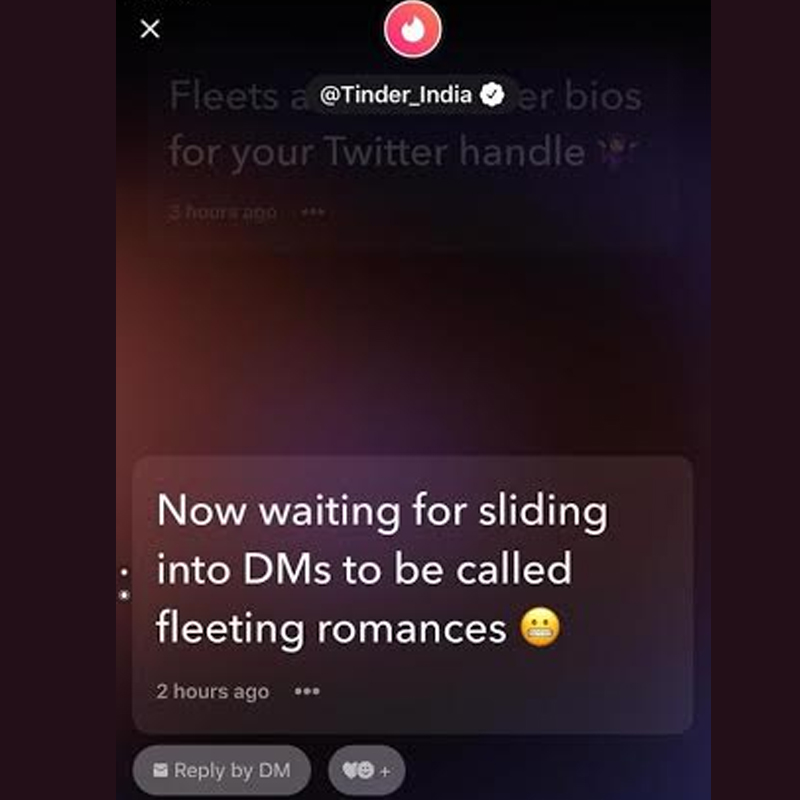
    Brands like Netflix, Zomato, Amazon Prime Video and Tinder made the most of fleets too.

  • Instagram to launch IGTV ads, share 55% revenue with creators

    Instagram to launch IGTV ads, share 55% revenue with creators

    MUMBAI: Instagram will soon start sharing revenue with creators through ads in its long-video format section, and by letting the viewers purchase badges on Instagram Live. Fifty-five per cent share of the revenues thus generated will be shared with the creators. The social media giant, a part of Facebook, had been hinting at introducing ads on the IGTV section for more than a year. 

    The Verge reported the ads will begin showing up on IGTV next week, for only around 200 approved, English-speaking creator partners, including Adam Waheed and Lele Pons, from a handful of major advertiser partners like Ikea, Puma, and Sephora.  

    “To begin, the ads will only appear when people click to watch IGTV videos from previews in their feed, and the initial round of ads will be vertical videos up to 15 seconds long. The team will also test various experiences within IGTV ads throughout the year, like being able to skip ads,” The Verge elaborated in its report. 

    To ensure that ads are shown with only brand-friendly content, the creators will be required to adhere to a stringent Instagram Monetization Policy, which includes rules like the content must comply with Instagram community guidelines, and share accurate information only. 

    Current elected and appointed government officials, who are subject to applicable government ethics, will not be eligible for monetization features. 

  • Facebook’s Asia-Pacific numbers lesser impacted than other regions in pandemic quarter

    Facebook’s Asia-Pacific numbers lesser impacted than other regions in pandemic quarter

    BENGALURU: As people across most of the globe retreated indoors under the lockdown announced by most of the countries to reduce the growth rate of Covid2019, world economies were badly hit. Officegoers had no other option but to use media to keep themselves occupied as the amount of work-to-do shrank. With the closure of education institutions, theaters and malls and hotels, etc., misplaced suspicion about the safety of newsprint, no new television/film content being produced, news and movies on television, OTT, internet, social media, became the new tools for entertainment and information, for networking and socialising distantly, education, occupying minds, etc.  

    Social media networking major Facebook or FB reported its numbers for the first quarter ended 31 March 2020 (Q1 2020, quarter or period under review). Facebook reported 15.87 per cent lower Q-o-Q numbers for the quarter under review as compared to the previous quarter (quarter ended 31 December 2019, Q4 2019), but 17.64 per cent higher Y-o-Y than the year ago quarter Q1 2019. FB has witnessed Q-o-Q revenue declines in the first quarter earlier – in Q1 2018, revenue declined 7.76 per cent as compared to Q4 2018 and in Q1 2019 it declined 10.86 per cent as compared to Q4 2018. Overall, Facebook numbers have shown an increasing trend, the Covid2019 quarter is just a slightly bigger than the normal bump in its path to growth.

    FB reports revenues from four major geographical regions in the world – the largest in terms of revenue being the US-Canada region, followed by Europe, Asia-Pacific (A-Pac) and the Rest of the World or RoW. The US-Canada region contributes about 48 per cent, the Europe region about 24 per cent, APAC region about 18 per cent and RoW about 10 per cent to FB’s revenues. Please refer to the figure below for FB revenue breakup.

    Advertisement is the major revenue stream for FB that contributes to more than 98 per cent to its overall revenues. The figure below shows contribution in terms of percentage of ad revenue to total ad revenue from these geographical regions. As is obvious, the APAC region is the only one that has shown growth in contribution to FB’s ad revenues during Q1 2020 – It contributed 17.56 per cent to FB’s ad revenues in the previous quarter and its contribution to ad revenue increased to 18.56 per cent  in Q1 2020. As a matter of fact, the APAC region has shown only two downward blips in its contribution to ad revenue during 9 quarters (the quarter under review and its preceding 8 quarters). These two blips happened in Q1 2020 and Q4 2018.

    Growth in contribution to revenue from the APAC region has generally been steadier than the other regions. When FB’s revenues have declined Q-o-Q, the decline in revenues from the APACregion has been lower than the other regions during these nine quarters. The APACregion’s total revenue declined 11.13 per cent Q-o-Q in Q1 2020 as compared to declines of 16.45 percent, 17.54 per cent and 17.21 per cent from US-Canada, Europe and RoW regions respectively. Y-o-Y, revenues grew 17.16 percent, 16.55 percent, 21.44 per cent and 15.80 per cent in Q1 2020 from FB’s US-Canada, Europe, APAC and RoW regions, respectively.

    Facebook’s Daily Active Users or DAU grew 4.65 per cent in Q1 2020 to 1.734 billion as compared to 1.657 billion in Q4 2019. The APAC region has a major chunk of humanity, consequently, the company’s largest DAU are from the APACregion, and the number of these APACusers in Q1 2020 has grown 5.77 per cent Q-o-Q. Comparatively, the US-Canada, Europe and RoW regions have seen DAU growth in the quarter under review versus the immediate trailing quarter of 2.63 percent, 3.74 per cent and 4.51 per cent respectively. Please refer to the figure below:

    The US-Canada region has the least DAU  among the four FB regions, however, this region has FB’s highest ARPU or average revenue per person, as well as the highest Family Average Revenue Per Peson or ARPP. Facebook defines a monthly active person (MAP) as a registered and logged-in user of Facebook, Instagram, Messenger, and/or WhatsApp (collectively, FB’s "Family" of products) who visited at least one of
    these Family products through a mobile device application or using a web or mobile browser in the last 30 days as of the date of measurement. 

    With drop in revenue, Facebook’s ARPU in Q1 2020 dropped 12.89 per cent Q-o-Q world wide. Q-o-Q FB’s APAC region ARPU declined 6.08 percent. ARPU drops of 13.6 per cent by US-Canada, 13.02 per cent by Europe and 10.43 per cent by RoW also happened in the quarter under review. Please refer to the figure below:

    Excerpts on what the company has to say

    "Our work has always been about helping you stay connected with the people you care about," said FB founder and CEO Mark Zuckerberg, "With people relying on our services more than ever, we're focused on keeping people safe, informed and connected."

    Impact of Covid2019 on Outlook

    On Revenue: Our business has been impacted by the Covid2019 pandemic and, like all companies, we are facing a period of unprecedented uncertainty in our business outlook. We expect our business performance will be impacted by issues beyond our control, including the duration and efficacy of shelter-in-place orders, the effectiveness of economic stimuli around the world, and the fluctuations of currencies relative to the U.S. dollar.

    After the initial steep decrease in advertising revenue in March, we have seen signs of stability reflected in the first three weeks of April, where advertising revenue has been approximately flat compared to the same period a year ago, down from the 17 per cent year-over-year growth in the first quarter of 2020. The April trends reflect weakness across all of our user geographies as most of our major countries have had some sort of shelter-in-place guidelines in effect.

    On Expenses:We expect to realize operational expense savings in certain areas such as travel, events, and marketing as well as from slower headcount growth in our business functions. However, we plan to continue to invest in product development and to recruit technical talent. In addition, we have committed over $300 million to date in investments to help our broader community during the crisis, which will have an impact on our financial performance this year. As a result, we expect total expenses in 2020 to be between $52-56 billion, down from the prior range of $54-59 billion. While this reflects a moderate reduction in the planned growth rate of total expenses, our overall expense growth in the face of expected revenue weakness will have a negative impact on 2020 operating margins.

    On Capex: Our significant investments in infrastructure over the past four years have served us well during this period of high user engagement. We plan to continue to grow our capex investments to enhance and expand our global infrastructure footprint over the long term. In 2020, we expect capital expenditures to be approximately $14-16 billion, down from the prior range of $17-19 billion. This reduction reflects a significant decrease in our construction efforts globally related to shelter-in-place orders. Given the strong engagement growth and related demands on our infrastructure, this year's capex reduction should be viewed as a deferral into 2021 rather than savings.