Tag: INS

  • Sanmarg CMD Vivek Gupta assumes INS presidency for 2025–26

    Sanmarg CMD Vivek Gupta assumes INS presidency for 2025–26

    MUMBAI: Vivek Gupta has turned the page, and this time, it’s for the entire Indian newspaper industry. The managing director and chief group editor of Kolkata-based Hindi daily Sanmarg has been elected president of the Indian Newspaper Society (INS) for 2025–26, taking over from MV Shreyams Kumar of Mathrubhumi.

    The 86th annual general meeting, held on 25 September via video conferencing, also saw Karan Rajendra Darda of Lokmat elected deputy president, Tanmay Maheshwari of Amar Ujala as vice president, and Anant Nath of Grihshobhika as honorary treasurer. Mary Paul continues as the society’s secretary-general.

    INS, the apex body for newspaper, magazine, and periodical publishers in India, has been a barometer of the industry’s pulse for decades. Shreyams Kumar, in his presidential address, praised the resilience of India’s newspaper ecosystem, particularly in a rapidly digitalising world.

    Gupta, a former Rajya Sabha MP and current MLA from Jorasanko, expressed his humility and pride. “It is an honour to be among the few from Bengal in INS’s 86-year history to hold this prestigious position. This recognition belongs to the entire Sanmarg family, my colleagues, and well-wishers. I look forward to strengthening the newspaper industry, fostering innovation, and upholding credible journalism,” he said.

    The INS executive committee for 2025–26 reads like a who’s who of Indian publishing, including industry stalwarts like S Balasubramanian Adityan (Daily Thanthi), Vijay Kumar Chopra (Punjab Kesari), Viveck Goenka (The Indian Express), Mahendra Mohan Gupta (Dainik Jagran), and Mohit Jain (Economic Times).

    With India’s print industry still brimming with potential, Gupta’s leadership comes at a crucial time to balance tradition with modernity. As the sector navigates the hybrid world of print, digital, video, and social media, industry voices like INS will be pivotal in charting the future.


  • BE Viacom18 gets John Abraham to promote Arunachal tourism

    BE Viacom18 gets John Abraham to promote Arunachal tourism

    MUMBAI: Viacom18 CEO Sudhanshu Vats knows a good business opportunity when he sees one. From films, televisions, merchandising, events, start-ups to brand building, Viacom18 has expanded itself to several businesses.

    Armed with these many touch-point media and brand solutions arms that Viacom18 boasts of, Vats now plans to fill a demand-supply gap in the country’s public sector when it comes to media management.

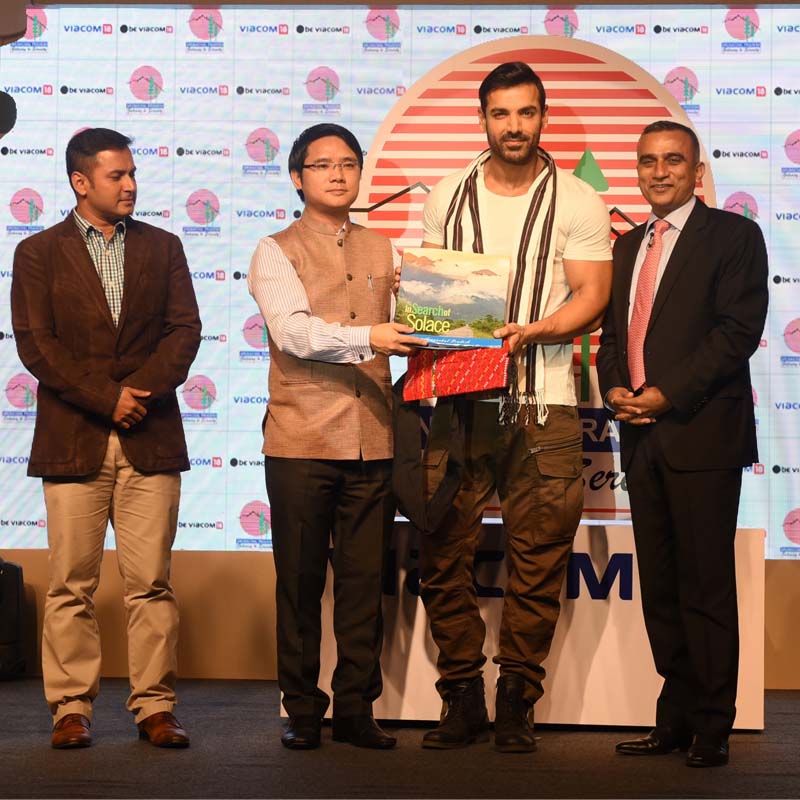
    First step to this goal is BE Viacom18 becoming the media partner for Arunachal Pradesh’s Department of Tourism through its first PPP (public-private partnership) model. And, what’s more, popular Hindi film star John Abraham has been roped in to be the brand ambassador for the project.

    BE Viacom is the brand solutions subsidiary of INS, which already takes credit for introducing Chinese technology brand Vivo into the Indian market.

    public://John Abraham performing at the press conference_0.jpg

    “Arunachal Pradesh is a traveller’s paradise and a land of untold tales. In John we have a celebrity who shares our enthusiasm of weaving the stories of the mystical land into a single narrative of ‘Must See, Must Experience’ Arunachal Pradesh tourism. After all, a journey is best when it is entertaining,” Vats said at a press conference here on Tuesday.

    Excited about representing Arunachal Pradesh tourism, Abraham said, “I am honored to have been chosen to promote the tourism of Arunachal Pradesh. I have always been fascinated with North East India: each state has its unique beauty, history and culture. It’s a state rich with culture, mysticism, great people and stunning views. When I’m there, all I need is some music, my boots to walk around and a mind free from all worries to be able to embrace the mesmerizing beauty of Arunachal Pradesh.”

    According to Arunachal Pradesh  Tourism Secretary Joram Beds, since the focus this year was boosting tourism sector, they needed like-minded partners.

    public://John-Abraham-at-the-press-conference_0.jpg

    “We found such a partner in Viacom18 who have helped us get John Abraham, a superstar, an adventurer and a great human being on board. John has played a pivotal role in promoting North East India, primarily by putting NEUFC (Indian football league where Abraham owns the football team comprising players from N-E) on the map of sports. We believe our association with him will strengthen our purpose of putting out our state as a prominent tourist destination,” the government official added.

    One of the unexplored lands of the country, Arunachal Pradesh can be best described as India’s mystical land. The largest state of the North-East region, or Seven Sisters as the states are known as, Arunachal with the least population density claims to be the perfect detox from a bustling city life.


  • BE Viacom18 gets John Abraham to promote Arunachal tourism

    BE Viacom18 gets John Abraham to promote Arunachal tourism

    MUMBAI: Viacom18 CEO Sudhanshu Vats knows a good business opportunity when he sees one. From films, televisions, merchandising, events, start-ups to brand building, Viacom18 has expanded itself to several businesses.

    Armed with these many touch-point media and brand solutions arms that Viacom18 boasts of, Vats now plans to fill a demand-supply gap in the country’s public sector when it comes to media management.

    First step to this goal is BE Viacom18 becoming the media partner for Arunachal Pradesh’s Department of Tourism through its first PPP (public-private partnership) model. And, what’s more, popular Hindi film star John Abraham has been roped in to be the brand ambassador for the project.

    BE Viacom is the brand solutions subsidiary of INS, which already takes credit for introducing Chinese technology brand Vivo into the Indian market.

    public://John Abraham performing at the press conference_0.jpg

    “Arunachal Pradesh is a traveller’s paradise and a land of untold tales. In John we have a celebrity who shares our enthusiasm of weaving the stories of the mystical land into a single narrative of ‘Must See, Must Experience’ Arunachal Pradesh tourism. After all, a journey is best when it is entertaining,” Vats said at a press conference here on Tuesday.

    Excited about representing Arunachal Pradesh tourism, Abraham said, “I am honored to have been chosen to promote the tourism of Arunachal Pradesh. I have always been fascinated with North East India: each state has its unique beauty, history and culture. It’s a state rich with culture, mysticism, great people and stunning views. When I’m there, all I need is some music, my boots to walk around and a mind free from all worries to be able to embrace the mesmerizing beauty of Arunachal Pradesh.”

    According to Arunachal Pradesh  Tourism Secretary Joram Beds, since the focus this year was boosting tourism sector, they needed like-minded partners.

    public://John-Abraham-at-the-press-conference_0.jpg

    “We found such a partner in Viacom18 who have helped us get John Abraham, a superstar, an adventurer and a great human being on board. John has played a pivotal role in promoting North East India, primarily by putting NEUFC (Indian football league where Abraham owns the football team comprising players from N-E) on the map of sports. We believe our association with him will strengthen our purpose of putting out our state as a prominent tourist destination,” the government official added.

    One of the unexplored lands of the country, Arunachal Pradesh can be best described as India’s mystical land. The largest state of the North-East region, or Seven Sisters as the states are known as, Arunachal with the least population density claims to be the perfect detox from a bustling city life.


  • I am looking at large strategic partnerships, says Jaideep Singh

    I am looking at large strategic partnerships, says Jaideep Singh

    MUMBAI: A new mobile handset brand, Vivo, is set to enter the Indian market. And helping it have a presence in the already cluttered mobile market space in the country is the two year old Viacom18 Integrated Network Solutions (INS).


    Both Vivo and INS have forged a strategic marketing and communications partnership. “Through this partnership we are giving them all the services required to launch their brand in India. This includes advising them in the first phase about the youth insight, the media market of the country and the overall brand space,” informs Viacom18 Media INS senior vice president Jaideep Singh.


    Since the audience the handset is catering to is the same as that of Viacom18, INS will also select the right broadcasts and the right digital social media platform which Vivo can choose from the Viacom18 portfolio. “We have some of the best brands and properties to target them,” adds Singh.


    So how did INS bag the partnership? Answers Singh, “Well, in a phased manner, we did an exercise with Vivo, which involved making them understand the insights about youth, then profiling all the assets we have, from broadcast to live to digital and social media and then creating a package for them, telling what it will take to launch a brand in India.”


    As for the marketing strategy of the new brand, INS has created a package, which is a mix of broadcast, live, digital, social media, PR communication, media planning services and a big brand launch event.


    This apart, all the creative ideas to be used and executed through the launch is what INS is working on. Singh informs that the deal with Vivo is a long term one and this is just the first phase. “The first phase is till June-July and we are working on it. The discussion of the phase post July is ongoing and we will come up with a plan for that,” he says.


    As part of the first phase, INS will be promoting the brand through properties like ‘Roadies’, ‘Comedy Nights With Kapil’, ‘MTV Bollyland’ etc. It is also exploring other fun ideas on the digital front. “We will also be creating the TVC for the brand,” informs Singh adding that currently it will use the global TVC of Vivo, since there is not too much time before the big launch. “But as we move forward, the TVC will also be created by Viacom18,” he says.  


    INS has got a dedicated team to service Vivo. This comprises digital experts, marketing experts, creative experts and operations experts for ground activations. “It is a sizable team, which has been taken both internally as well as externally from the partners we work with,” he adds.


    According to Singh, the deal with Vivo helps the company leverage its consultancy services and in-house strong marketing capabilities for launching a brand in India. “A deal like this also opens up a new avenue for us in terms of having long term strategic partner, rather than trying to find many small partners on regular basis,” he says.  


    “I am looking at large strategic partnerships which will be of sizable ticket size and covers the sizable assets we have on the network and create more assets,” Singh further adds.


    So what’s the marketing budget for the handset? Says Singh, “Vivo is a major brand in China with 8 per cent market share. Presently the size of the marketing activities is substantial, but as we go in the second phase, it will be equal to the scale of any major handset in the country.”  


    Singh also informs that while as a digital strategy for Viacom18’s large content library, it will be looking at being present on multiple handsets, but currently there is no such arrangement on exclusive content sharing with Vivo. “They could have access to content on the properties they are partnering with us. The content partnership can happen in the later stage. It is the core to our heart and can be explored,” he further adds.  


    Talking about the integrations, Singh says that as part of the soft play, while integration with ‘Roadies’ has already started, the TVC will break in end of December and ‘Comedy Nights With Kapil’ will begin  from January.


    INS is positive about the feedback the new entrant will get from the consumers in India. “The brand film is looking good and so is the product. From the Chinese market perspective it would be the best product to enter the market. Once the film comes out and the product is integrated and the features are shown, the brand will have an appeal,” he opines.

  • MRUC finds IRS 2013 data valid, lifts abeyance

    MRUC finds IRS 2013 data valid, lifts abeyance

    MUMBAI: Finally, taking the decision on the latest Indian Readership Survey (IRS) data, the Media Research Users Council (MRUC) said the voluntary abeyance placed on the IRS 2013 has been lifted with effect from 20 August 2014.


    The IRS 2013 data published on 28 January 2014, evoked several questions from the about the validity of the results. Therefore the Readership Studies Council of India (RSCI) requested subscribers to hold the study in abeyance while it took a revalidation exercise.


    A committee was then formed with two co-chairmen, one from the publishing industry and one from the advertising agency industry. They decided that the methodology was in order and a process audit needs to be done which was awarded to Praveen Tripathi (Magic 9 Media).


    The findings of this report were discussed by heads of four industry bodies- MRUC chairman, RSCI chairman, Indian Newspaper Society president and ABC chairman and a decision was to be taken. The heads also discussed it with the RSCI technical committee chairman and the two co-chairmen of the revalidating committee.


    The audit took place in two stages. The first stage involved direct back checking of respondent homes post which a broad and deep forensic statistical analysis exercise was carried out to identify and isolate both fieldwork compliance deficiencies and incidences of the occurrence of unusual publication incidence in respondent interview records. By sieving the aggregate data set for these issues, the audit was able able to judge unequivocally whether the statistical deviations systematically changed any of the crucial readership outputs. The outcome was conclusive and unequivocal that the study results had not been impacted.

  • Integrated Network Solutions appoints Shamik Talukder

    Integrated Network Solutions appoints Shamik Talukder

    MUMBAI: Integrated Network Solutions (INS), a wholly owned subsidiary of Viacom18 Media has announced the appointment of Shamik Talukder as its vice president and head of revenue management and business development.


    With over 16 years of experience in revenue assurance, brand development and marketing in the Media & Entertainment industry, Talukder’s new role will include business development and revenue management of Live Viacom18 (large format Live event Impact properties), Be Viacom18 (On ground activations in film advertising and promotions) and Spotlight (creation, management and operation of digital media interfaces for individual celebrities across genres).


    Viacom18 INS senior vice president & business head Jaideep Singh said, “Our debut year has been a successful journey where we created multiple IPs. As we consolidate our offerings and build capacity across network we are happy to announce Shamik entry into the Viacom 18 family. Shamik’s keen understanding of the business and his contribution to the division will be vital to our growth story as we move into the next phase.”


    Talukder said, “INS has done some great work in the past year, and I am eager to be a part of it. With my new role at INS, I look forward to leveraging the popularity and strength of the existing IPs, creating engaging solutions for brands on the digital platform through Spotlight, build customized solutions for brands in the film advertising and promotion space. It is an exciting space to be in and combining the properties to create new business opportunities will be my focus.”

  • Some newspaper groups content with IRS 2013 findings

    Some newspaper groups content with IRS 2013 findings

    NEW DELHI/MUMBAI: The findings of the Indian Readership Survey 2013 may ultimately not be rejected outright. A substantial number of publishers of newspapers and magazines may not have found the readership findings worth rubbishing.


    A group of 18 publication groups including The Times of India and The Hindu are very vocal in their complete rejection of IRS 2013 findings and have got to the extent of withdrawing from the IRS.


    But the group’s attempts at having the IRS 2013 annulled could face resistance.


    According to industry sources publication groups like The Hindustan Times, Rajasthan Patrika, Haribhoomi and Daily Thanthi have expressed satisfaction at the results of IRS 2013 and have accepted them.


    These publication groups may decide not to follow an advisory issued by the Indian Newspaper Society on Tuesday for boycott of the IRS 2013 findings or not to use them for advertising sales.


    The advisory was issued after the Media Research Users Council on Tuesday said it cannot decide on the ultimatum given by the INS for withdrawal of the IRS 2013 findings.


    The advisory by INS suggested its members convey in writing to MRUC that they are withdrawing from any association with the IRS and urge MRUC, Readership Survey Council of India and Nielsen India, the conductors of the readership survey, to immediately cease and desist from using for the purpose of the survey the mastheads of their publications.


    MRUC has said a meeting would be held with RSCI on 19 February to take a final view on INS demand.


    MRUC has said all aspects of the study will be placed before the RSCI for helping the broader community of stakeholders convince themselves about the robustness and integrity of the IRS 2013 findings.


    Meanwhile, INS expressed hope that the advisory issued by it would be acceptable to all its member publishers.


    A senior INS office-bearer, who did not want to be named, denied that the INS advisory had been issued at the behest of the Times of India Group or was being followed only by that group.


    INS sources told indiantelevision.com that the issue of whether the newspaper body or individual newspapers will take legal recourse against MRUC over the IRS 2013 findings was still not decided.


    Responding to the INS advisory and notices in newspapers belonging to the group of 18 publishers, IRS Technical Committee chairman Paritosh Joshi said MRUC has already asked individual publishers to send in their complaints to MRUC directly and the council will individually respond to each of them. “So far, we have sent out six explanations and clarifications to the complaints sent to us by publishers individually. And will continue to welcome more (queries).”


    The 18 publishing groups, in a joint statement, said, “The survey is riddled with shocking anomalies, which defy logic and commonsense. They also grossly contradict audited circulation figures (ABC) of longstanding.”


    The 18 publishers are Jagran, Bhaskar, India Today, Ananda Bazar Patrika, Lokmat, Outlook, Daily News and Analysis (DNA), Sakshi, The Hindu, The Times of India, Amar Ujala, The Tribune, Bartaman Patrika, Aaj Samaj, The Statesman, Mid Day, Nai Duniya and Dinakaran.

  • MRUC puts the ball in RSCI court; INS sticks to its 24-hour ultimatum

    MRUC puts the ball in RSCI court; INS sticks to its 24-hour ultimatum

    MUMBAI/NEW DELHI: The last couple of days have been a nail-biting one for everyone having an interest in the Indian Readership Survey. From the time the IRS 2013 was made public, publishers of newspapers and magazines have gone through a lot of turmoil because of the data provided.


    As claimed by many, IRS 2013 has a lot of anomalies and hence, after a meeting on Monday, the Indian Newspaper Society (INS) gave an ultimatum to Media Research Users Council (MRUC) to withdraw IRS 2013 within 24 hours or else face its rejection by publishers.


    MRUC today held an emergency meeting to decide on how to respond to the ultimatum by INS. After the meeting, MRUC issued a statement saying it cannot unilaterally decide on the withdrawal the latest readership survey.


    The Readership Studies Council of India (RSCI), a joint body of MRUC and the Audit Bureau of Circulation (ABC), has called for a meeting on 19 February before any further decision is taken.


    “Unlike three years ago, MRUC no longer can take a decision on its own. RSCI will take a final call now,” says IRS Technical Committee Chairman Paritosh Joshi.


    The members of MRUC unanimously voiced their opinion on the findings. They said decided aspects of the study will be placed before the RSCI to help the broader community of stakeholders convince themselves about the study’s robustness and integrity. The IRS 2013 was contracted to Nielsen.


    Joshi feels that a new methodology was used for IRS 2013, which could have caused some confusion amongst the stakeholders and that they will need time to understand not only the findings but also the methodology which has gone into it.


    The MRUC statement said IRS 2013 cannot be compared with past readership surveys and that the findings are based on the latest census data. It also goes on to say that the study design includes a margin of error.


    INS continues to stick to its 24-hour ultimatum given on Monday, 3 January, according to INS newsprint committee chairman Mohit Jain.


    Jain told indiantelevision.com, “The report submitted by MRUC (today) has been considered in-depth and the members (of INS) have taken a decision to collectively to reject it.”


    INS members were still in a meeting on the issue at the time of filing the story.


    Click here to read MRUC’s statement

  • TRAI recommendations on accreditation of rating agencies accepted: Tewari

    TRAI recommendations on accreditation of rating agencies accepted: Tewari

    NEW DELHI: Even as the industry body Broadcast Audience Research Council (BARC) is struggling with its teething problems, the Information and Broadcasting Ministry (I &B) has accepted view of the Telecom Regulatory of India (TRAI) that the minimum number of homes that a rating agency should measure should be 20,000 within six months of the guidelines coming into force, after which the number should be increased by 10,000 every year to reach 50,000.


    Minister Manish Tewari has said that his Ministry would place these guidelines before the union cabinet, a note for which has already been circulated. The Ministry had earlier asked the regulator to provide its guidelines on the issue, after which TRAI had in September released its recommendations including a condition that they be notified within two months.


    He said most recommendations had been “more or less accepted.” “Once we have the cabinet approval, we will notify the guidelines,” he added. Interestingly, Tewari, during his speech, also touched upon the dispute on whether the foreign direct investment should be raised for the print media.  While the Press Council of India (PCI) had submitted its recommendations that the current levels of FDI in print media should be maintained, the Indian Newspaper Society (INS) had favoured raising the limit to 49 per cent. “We are trying to build a political consensus after all media is a sensitive area,” Tewari said.


    The TV audience measurement mechanism has been a subject of controversy in the past with many channels expressing dissatisfaction with TAM ratings.


    Tewari said the amendments to the Press and Registration Books Act were already on the Ministry website and stakeholders’ had sought fresh consultations on issues including ‘paid news’, which had been slated for Tuesday.


    Replying to a question related to setting up of a National Gaming and Animation Centre in Mohali in Punjab, Tewari said there was a problem as it was intended to be a Public-Private Partnership (PPP) but the private sector had not responded.


    He said government was considering a plan to set up the institute with Japanese assistance. Tewari said bills to give special status to Film and Television Institute of India (FTII) and Satyajit Ray Film and TV Institute had been sent to the Law Ministry. He said another proposal to give the status of ‘institute of national importance’ to the Indian Institute of Mass Communication was by and large ready.

  • ‘Ad pie shifting towards Indian language newspapers’ : Dainik Jagran Shailesh Gupta

    ‘Ad pie shifting towards Indian language newspapers’ : Dainik Jagran Shailesh Gupta

    Shailesh Gupta, director of Dainik Jagran, has been in the print media industry for more than 18 years. He was recently elected chairman of the Audit Bureau of Circulations (ABC), which provides audited newspaper sales figures every six months, replacing Madison World CEO Sam Balsara. Gupta is also a member of The Indian Newspaper Society (INS).


    Gupta has been a director at Jagran since 1994 driving the newspaper group‘s advertisement and marketing functions.


    In conversation with Indiantelevision.com, Gupta says Tier 2 and 3 towns are now the new volume drivers for newspapers and we now see the advertising pie shift in proportionate terms in favour of Indian language newspapers.

    Excerpts:


    As there is a shift from newspapers to online, the reading habits are changing. What does this mean for the newspapers?
    As a group, we already have a presence in Mumbai with MidDay, MidDay Gujarati,Inquilab and City Plus. There‘s a sizeable presence that we have in the city, and all these brands are growing and doing well. The decision on Dainik Jagran entering Mumbai in the future would depend upon the market forces and many other considerations.


    Any plan of expanding in southern market through an acquisition?
    We currently have a presence in South through City Plus in Bangalore and Hyderabad. Once again the question of acquisition would depend upon the opportunity in question and the prevalent market environment. It would not be fair to conjecture on that as of now.


    The difficult economic conditions have continued in 2012-2013. How do you see the next six months?
    Yes, it‘s been a difficult year in terms of advertising revenue growth. The market sentiment is muted, but there is growth. With the policy level changes taking place, and the festive season coming up, the outlook is more positive for the rest of the year.


    Last year competition drove cover prices down. Do you see the pressure continuing?
    In our markets, we‘ve steadied and increased cover prices instead of reducing. Circulation growth too has happened.


    ‘Our digital portfolio consists of over 12 sites across genres and with over 8.5 million unique visitors, it‘s one of the leaders in the space. And this is just the beginning‘


    The advertisers in Hindi and other Indian language newspapers have still not fully recognised the improved demography of their readership and are not prepared to give advertisement rates that English newspapers command. Why?
    The fact that the market is rapidly shifting to the Tier 2 and Tier 3 towns is a reality. Marketers have increasingly started looking at these markets very seriously for both volumes and growth. From a marketer‘s point of view, it‘s a market that‘s most important, and if the market is sizeable enough, investment flow is commensurate. Historically, the metros provided small geographies with a high concentration of target audiences and the resultant sales volumes. English dailies dominated these metro geographies and at times earned a premium versus the other languages. However, with Tier 2 and 3 towns now being the new volume drivers, the situation has changed completely and we now see the advertising pie shift in proportionate terms.
     

    Is it possible that Hindi language newspaper publishers will agree not to lower their cover price till ad rates are on par with English newspapers?
    The business environment for English in metros and Hindi papers differ significantly as far as the cost structures are concerned. An English paper sells for example at a price of Rs 4 in the metro markets with an average pagination of 40 pages, and the cost structures of the metro notwithstanding. Contrast that with a Hindi newspaper, with an average pagination of 22-24 pages and priced at Rs 3, with a very different cost structure. The differences are all too apparent. The factors behind cover price determination are very different from the factors behind ad rate pricing. Having said that, the model of the Indian newspaper industry is based fundamentally on lower cover prices, high circulation and a higher dependence on ad revenues – and this is true across the board for all languages including English. At the same time, Indian language newspapers have a sizeable part of the revenue coming in from the local markets, which normally are not greatly impacted by macro-economic changes – either positive or negative. Ad rates are a function of position in the market, importance of the market, the prevailing competitive environment and the individual cost structures apart from a lot of other factors.


    What helped Jagran to beat the industry trend and grow at a faster pace?
    We‘ve always believed in realistic planning and extremely focused implementation – these probably are the two central pillars of our work ethic which have yielded results. Other key factors are quick response times, empowered teams, the ability to provide customised solutions, and above all transparency in our working. Innovation is another key driving factor. We study ongoing trends in the market, anticipate a scenario and are able to innovate accordingly.


    What are the plans for Dainik Jagran‘s digital platform? What kind of investments are you planning to make in the digital space?
    We‘ve been very serious about our digital delivery platforms and had taken a lead in investing in this platform as early as year 2000. We have a dedicated digital team that‘s working to distribute the Jagran content across multiple digital platforms and devices. Our digital portfolio consists of over 12 sites across genres and with over 8.5 million unique visitors, it‘s one of the leaders in the space. And this is just the beginning.


    Last year Mid Day and Mid Day Gujarati did well. What is the trend in the current year?
    MidDay is on a growth path – both on the circulation and readership level as well as at the product level. Over the last 3 years, MidDay has seen a good growth – this has come on the back of an improved product. Same goes for MidDay Gujarati – it‘s now the No.2 Gujarati paper in Mumbai and has grown on all counts.


    Last year you were not able to meet the ad revenue target, how do you see things this year?
    We‘ve been realistic with our planning and our expectations. We have a plan for the ongoing year, and we‘re progressing as per the plan.


    Which medium are you banking upon to promote Jagran?
    The biggest platform that we use to promote Jagran is our own existing platform – there‘s no bigger platform that reaches out to almost 70 mn readers and an 8.5mn+ unique digital audience. Add to this our OOH reach pan India. Additionally, we use Radio, TV and some targeted trade and business mediums.


    What is your agenda as the head of Audit Bureau of Circulation?
    The priority at ABC is to bring about a more transparent system, evolve the ABC as a currency and make it a powerful decision making tool for the industry.


    What are the drawbacks that ABC faces?
    There are no drawbacks as such. But clearly we will need to march ahead, look at the changes in the environment, and be able to evolve the currency to reflect the changes. For this, we will need to have all publishers on the same page. It will be important to consider suggestions and opinions of all stakeholders to create a robust and transparent currency – one that truly reflects what‘s happening in the marketplace.


    Will you increase the frequency of audit of circulation figures from six months to quarterly?
    This again is a decision that needs to be taken by the body in consensus with all the stakeholders. As I said, the first priority above all else is to evolve the ABC as a currency and make it a powerful decision making tool for the industry.