Tag: InfoSys

  • 76% of Global Retail Banks Becoming More Innovative Finds New Study by Infosys & Efma

    76% of Global Retail Banks Becoming More Innovative Finds New Study by Infosys & Efma

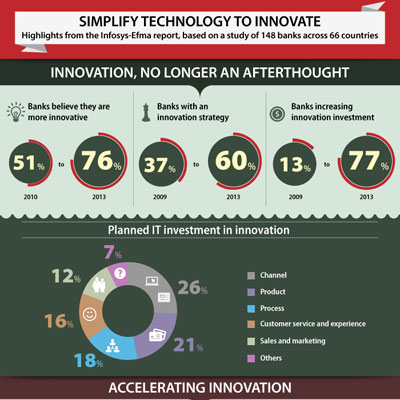
    BAMGLORE:  Infosys, a global leader in consulting, technology and outsourcing, today announced the launch of its Innovation in Retail Banking 2013 report. The fifth annual study, commissioned by Infosys and conducted by Efma, investigates how banks can overcome barriers to innovation and improve their innovation capabilities. This year’s study, which surveyed 148 banks in 66 countries, revealed that as the global economy recovers, retail banks across the world are increasingly investing in innovation as a means of generating revenue and controlling costs. In fact, 60% of banks surveyed have an innovation strategy compared to just 37% five years ago, when the report was first issued.

    The study also found that to overcome the main barriers to innovation – legacy systems and organizational siloes – banks are looking towards technologies that can simplify their operations and deliver a richer customer experience. In particular, mobile innovation is beginning to gather pace, with 77% of banks deploying or planning to deploy a mobile wallet solution.

    Key findings of the study include:

    76% of banks believe they are becoming more innovative, with the biggest increase being seen in customer channels

    7% of banks surveyed are increasing investment in innovation. This is an encouraging trend as the 2009 study revealed only 13% of banks had increased investment

    More than half (58%) of banks surveyed believe the ability to deploy new systems in components would have a positive impact on their ability to innovate.
    Mobile location-based offerings were cited as another area of innovation for banks, with 69% deploying or planning on making deployments

    · To enhance their product and service offerings, 45% of banks are already using or planning to invest in gamification, and 61% of banks currently allow or plan to allow customers to do some form of product personalization

    · Large and medium sized banks rated the top three barriers to innovation as legacy IT systems, culture and organizational siloes

    Quotes:

    Haragopal M, Global Head of Finacle at Infosys: “It is good to see innovation agenda taking the center stage at banks, with many focusing on increasing business process speed, agility and efficiency. The report also reiterates that retail banks across the world have recognized that simplification and innovation can go hand-in-hand to help grow business and deliver excellent customer service.”

    Patrick Desmares, Secretary General at Efma: “This year’s study indicates a global convergence of innovation practices around overcoming the barriers presented by legacy technology and ensuring that customer experience channels are optimized. Many retail banks are now creating innovation strategies and underpinning them with investment which tells us that global economies are beginning to recover. As banks once again target growth process, channel and operational innovation, this will only increase in importance.”

    Additional Resources

    o The full Innovation in Retail Banking 2013 report can be downloaded from the Infosys website or slideshare

    o Infosys Finacle and Efma will present the key findings of the study —‘at a webinar at 11.00 CET (10.00 BST) on 22 October. More details click here

    o Let’s Simplify Banking white paper click here

    o Last year’s report: Innovation in Retail Banking 2012

  • Infosys Named a Leader in Gartners Magic Quadrant for SAP Application Management Services

    Infosys Named a Leader in Gartners Magic Quadrant for SAP Application Management Services

    Infosys, a global leader in consulting and technology, today announced that it was positioned as a ‘Leader’ in Gartner’s Magic Quadrant for SAP Application Management Services, Worldwide, 2013. Authored by Gilbert van der Heiden, Frances Karamouzis, Ruby Jivan and Ian Marriott, the Magic Quadrant compares and evaluates vendor capabilities for providing multi-year SAP Application Management services among 18 providers across a broad range of SAP Application Management services and across multiple SAP solutions.

    According to Gartner, ‘Leaders’ are performing well today, gaining traction and mind share in the market; they have a clear vision of market direction, are helping clients beyond product road maps, and are actively building competencies to sustain their leadership position in the market.”

    Highlights

    This positioning recognizes Infosys for its ability to execute and completeness of vision. Evaluation criteria for this Magic Quadrant:

    · Ability to Execute: IT Services providers are evaluated on the quality and efficacy of their processes, systems, methods or procedures that enable IT performance to be competitive, efficient and effective, and to positively impact revenue, retention and reputation.

    · Completeness of Vision: IT services providers are evaluated on their ability to convincingly articulate logical statements about current and future market direction, innovation, customer needs, and competitive forces.

  • Rediffusion-Y&R gets Rajesh Matthew to head Bengaluru

    MUMBAI: Rediffusion Y&R Bengaluru has got a new head in Rajesh P Mathew.

    Mathew comes in from Dentsu Communications where he was senior vice president in Mumbai. He will report to Rediffusion Y&R COO Amitava Sinha.

    Mathew has more than 17 years of experience in advertising, having worked in markets across Bengaluru, Chennai and Kerala at Ogilvy, Contract, Lowe, Saatchi & Saatchi as well as Concept, Dubai. In the course of his career, he has gained exposure to account management, direct marketing, and general management as office head at Contract, Chennai, and then as vice president and business head at Ogilvy, Mumbai.

    He has serviced brands across categories including Mitsubishi Motors, Star TV network, Sun DTH-HD, NIIT, Infosys, St-Gobain, Muthoot, Cuticura, and Citibank.

    Sinha said, “We are happy to have someone of Rajesh’s stature and experience to lead our Bangalore operations. Apart from being a trusted advisor to our existing clients, Rajesh’s mandate will be to make Rediffusion Bangalore a destination agency for both clients and talent by fostering a culture of continued excellence. We believe Bangalore is a market with significant potential and we are going to be looking to grow aggressively here.”

    Mathew said, “I have always had immense respect for Rediffusion as an institution that has built several iconic brands over the years and has done many memorable campaigns. I therefore consider it a privilege to be heading Rediffusion Bangalore. At a personal level, I am also excited about working in the south again as this is the market that I have grown up in and know well. My focus will be on pushing great work and building a great team, and the rest should then take care of itself.”

  • Ex-Mindshare Ashok Lalla to join Infosys as global digital marketing head

    MUMBAI: Ashok Lalla, who had quit Mindshare as South Asia leader – digital in May 2012, is all set to join Infosys as the global head of digital marketing.

    Lalla is joining the IT services company on 4 October. He will be based out of Bengaluru.

    He told Indiantelevision.com, “Yes, I am joining Infosys. I will be in charge of the digital marketing of the company worldwide.”

    Lalla has close to 19 years experience in the industry and started his career in 1993 with Enterprise Nexus Communications (now Bates 141) as senior account executive.

    After four years at the agency, he joined Taj Hotels Resorts and Palaces as advertising manager in 1997. Two years later, he moved to Times Multimedia where he worked as senior product manager for a year before moving back to Taj Hotels Resorts and Palaces in 2001 to take up the post of director internet marketing. He then moved to Euro RSCG as president – digital in 2009 before joining Mindshare in 2011.

  • ‘The pharma industry needs an absolute mind shift. They have to think FMCG and act pharma’ : McCann strategy director Manjunath Hegde

    ‘The pharma industry needs an absolute mind shift. They have to think FMCG and act pharma’ : McCann strategy director Manjunath Hegde

    Manjunath Hegde, masters in marketing management from Jamnalal Bajaj Institute, has over 23 years of experience in 360 brand management and consumer insight based strategy and creative. Over the years he has worked on some of the best brands – P&G, Unilever, Infosys, Taj Hotels, Lakme, ICICI, United Brewries, Marico, Zee TV, CRY. He is also associated with agencies such as Ambience Publicis, Leo Burnett and Bates Clarion.

    Hegde has also spent a couple of years in Dubai as COO, Liwa Advertising, restructuring the agency to global standards and getting business worth millions during the peak of recession. He also co-founded the brand consultancy firm ‘Chlorophyll‘.

    Hegde is presently McCann strategy director, specifically focusing on the pharmaceutical industry.

    In an interview with Indiantelevision.com‘s Anindita Sarkar, Hegde talks about the various advertising and marketing challenges that the pharma industry faces today.

    Excerpts:

    Unlike yesteryears, today there is a lot of brand communication talk happening within the pharma industry. Why this shift? 

    Until now pharma companies had not found a need for real brand management. But they are slowly waking up to the need. And this is because pharma companies have recognised that there is a need for multiple touch points to contact its various stakeholders – patients, chemists, doctors, relatives – for a range of categories as the market in ever expanding and is hugely competitive.


    You have been involved in branding at various levels. How similar or different is brand building in the pharma industry?

    The brand building process of a pharma product is very challenging. The principles of brand building will always remain the same; it‘s the manner of executing them that change when it comes to the pharma category.

    Look, for example, it is quite easy for the FMCG advertisers to create brands because they have access to the mass media. But when it comes to the pharma industry, there are media and legal restrictions; you need to take care of your audience and the key influencer, which is the doctor. Because, in this case, you cannot reach out to the consumer directly by foregoing the doctor.


    So, what is the communication challenge of an OTC product?

    See, an OTC product can be divided into two categories. The first kind is one which can be purchased across the counter and, therefore, can be advertised like cough syrups. The second category is where by repeat purchase (self medication), the product steadily falls into the OTC bracket again. And in both these categories, it is a must for the products to build an image of their own. The brand communication has to create space in the consumers‘ life; it has to be an experience by itself. It cannot behave indifferently. Only then will the brand be recognized by the consumer. And this is the communication challenge in this category.


    How do you deal with the branding strategy of a pharma product as against any other category?

    In the pharma industry, unlike an FMCG product which talks to masses or for that matter any other category, we are dealing with problems that are related to health issues. So, here you are talking to someone who is ill and while your audience is that one affected person, the relatives and family members also become an important audience. Also, here the communication has to be done with the key influencer or the qualified influencer, which is the doctor. And in addition to this, there are also the strict government rules which one needs to adhere to. So the category advertising by itself is extremely challenging and the treatment is very different. Here the product has to go beyond the regular talking about what it will do as a drug and rather become a part of the affected consumer through a new life changing story.

    For example, if it is a product that is made for diabetic patients, then it should talk about the healthy lifestyle approach that one needs to take if affected. It has to show support and concern. Only then will it become a part of the patient‘s life.


    What is the primary difference between promoting an OTC brand versus a general brand?

    In an OTC brand, you talk to the consumer directly. But for non-OTC, you cannot use mass media; you are not allowed to. These brands have to be prescribed by a doctor. So in this case, the communication is directed towards the doctor.

    Also, most brands decide not to go OTC (and sometimes they cannot go because its ingredient based) because it is a different ball game altogether. The media spends are higher, the exposure to competition is on a severe basis; it‘s a large market now and totally volume based. So it‘s largely a pull versus push strategy wherein you make the consumers come and ask for it. Whereas, when it comes to non-OTC, it is only a push and push strategy. The companies push it down to the doctors and then the doctors push it to the consumers.  

    ‘A larger trend is moving towards the wellness category – it is a huge market out there. So there is a huge growth opportunity in this segment.‘


    So many times is it a conscious decision to go non-OTC? 

    Absolutely. Many times it happens that brands have become OTC by default. And this means that at some point of time they were prescription based, but gradually the consumer has moved to buy the product on his own through repeated purchase. Now, one could take a decision to go OTC but in that case, it may lose out on the prescribed category because the doctor will now stop prescribing that medicine.

    The doctor has to and should refer a non-OTC brand and, therefore, companies who are pharma strong will give a window to the doctors.


    In a category like this where you cannot advertise through mass media, what are the primary marketing platforms? 

    In this category there is a need to be present so that you are seen and can touch consumer life in areas where you can meet them. These could be jogging parks, treadmill companies, doctor‘s clinics, conferences and forums. The brands have to talk about their own essence, and say, “I am there.”

    Also, the pharma industry needs an absolute mind shift. They have to think FMCG and act pharma. This means they have to look into the product from the consumer‘s point of view.


    Is there alternative medicine market in India (like ayurvedic products, etc.)? Is there a fair consumer tilt towards these?

    Today consumers are becoming more and more health conscious and, thus, there is a trend wherein people are moving towards organic and non-toxic products, courtesy the internet. A larger trend is moving towards the precaution and wellness category – it is a huge market out there. So there is a huge growth opportunity in the wellness category.
  • ‘Our target is to reach the number one position in Kerala market within the next two to three years’ : Sudhakar Jayaram – Amrita TV director & CEO

    ‘Our target is to reach the number one position in Kerala market within the next two to three years’ : Sudhakar Jayaram – Amrita TV director & CEO

    Amrita Enterprises Pvt Ltd (AEPL), promoted by a group of investors closely associated with Mata Amritanandamayi Devi, launched Amrita TV in 2005 April on an initial investment of Rs 500 million. On the launch, its positioning as a general entertainment channel raised eyebrows. After all, the channel was named after Mata Amritanandamayi Devi, the renowned spiritual leader from Kerala.

    The initial scepticism soon gave way to acceptance and acknowledgement as the channel made attempts to develop its own identity in the highly contested Malayalam language market. The icing on the cake came when Amrita TV made an almost clean sweep at the 2005 Kerala State TV Awards. Though yet to pose a real threat to market leaders Asianet and Surya, the one year old channel is now recognised as one of the strong players in the market by pundits.

    At the helm of affairs at Amrita TV is the young and sophisticated director and CEO Sudhakar Jayaram, who has spent over 15 years in global organisations such as Bank of America and Infosys, USA, holding senior management positions. Jayaram returned to Kerala in 2004, responding to the motherland’s – or rather the Mata’s — call, as he puts it. Amrita TV was about to launch, and as fate would have it, Jayaram was offered the top management position.

    Not just that! He has also been given the responsibility to manage the Amritanandamayi Super Specialty Hospital at Kochi, Kerala. Entertainment and medicine stand oceans apart, but this youngster holding MBA, B.Tech degrees has made the task look much simpler. On the occasion of an Onam celebration Amrita TV conducted in Mumbai early this month, Indiantelevision.com’s Bijoy A Kmet up with Jayaram.

    Excerpts:

    Amrita TV has completed one year in the Malayalam television market. Please give us a perspective on the journey so far?
    Looking back, I would say the channel has done a decent job. Top of all our achievements, I would like to mention the 15 State TV Awards we won in our inaugural year itself. To make a mark, we have opted for quality content, which is youthful and vibrant.

    We have in fact a three-pronged programming strategy in place. First of all, we have our share of unique channel ID programmes, exploring the programming segments untouched. We have got lot of accolades from the market on the quality of our graphics and the high visual standards.

    Then, we tried to give a total new dimension to the market’s popular programme genre, which included serials and other entertainment shows. Our strategy was to explore progressive ideas and thus distance ourself from run of the mill stuff. Thirdly, we made our best efforts possible to depict our culture and heritage through various non-fiction programmes. And the results have been very encouraging for a new channel such as Amrita TV.

    What was your strategy to gain an identity in this highly competitive market?
    It is a very competitive market, with market leaders (Asianet & Surya TV) commanding almost 70 per cent share. But, at the same time, this is a market where you can make a mark with innovative strategies. You need to spot the vacuum and work on areas which are still unexplored and then you will have a decent product with its own identity in hand.

    Our entry strategy was to come up with a product, which is classy and vibrant, different from the existing products. We wanted to make Amrita TV very dynamic and also with full of life. And at the same time, it was very important for us to carry along the mass General Entertainment Channel (GEC) tag with entertaining and appealing content. The idea was establish our roots as early as possible.

    The core team of Amrita TV is constituted by people who are well aligned with the market professionally. For example, the programming department is headed by noted film director Shyamaprasad. The news department is lead by noted journalist Neelan, who has over 35 years experience in electronic and print media. Getting such established professionals on board has also helped us position ourself really well and create a strong awareness in the market.

    Which are the key factors that are driving this market? What are the latest market trends?
    Kerala as one of the most challenging television markets in the country. The viewers here are very different and you just can’t play with your strategies in Malayalam. I would say, if a strategy works here, you will be able to move it more confidently in the other regional markets.

    Like any other television market, soaps, movies and news play key roles in the Malayalam market also. The prime time band is ruled by soaps on weekdays, while weekends are dominated by films, film-based programmes, non-fiction shows and programmes covering the music genre.

    Malayalam television is ruled by the female audience. Even when targeting this segment through prime time soaps and other programmes, you need to alter this system a bit to help the market to expand. How will you do it? The answer is ‘youth programmes’. If you can make programmes, that can rope in females and the youth at the same time, that would make some positive impact on the market.

    Given that Soaps, Movies and News drive the market, what is Amrita TV’s strategy to explore each of these segments in the best manner possible?
    Our channel driver programme is a reality talent hunt show Super Stars, made on the lines of Indian Idol. This programme is doing well in the 8:30 – 9:30 pm slot and we enjoy a channel share in the range of 12 – 16 per cent in this particular time band. Then we have our dose of serials for the prime time band. As I mentioned earlier, we have made our best efforts to make our soaps stand out. We have made it a point not to manipulate the viewers’ emotions through soaps. Our soaps are not emotionally far fetched, which give a lot of stress to the viewer. Our soaps are there just for entertainment.

    Then we have our USP in our non-fiction programmes which are made in-house. These are mainly cultural programmes, which actually carry along our channel ID. We have our non-fiction programmes well spread out across the week. Our belief is that there is space for good, tasteful and nourishing content on TV, as people are coming back to their organic roots.

    Then there is this biggest draw of the lot – Movies. When we launched, the lack of popular and blockbuster movies had crippled our weekend strategies to an extent. But the issue is being resolved now. In the last one year, we have acquired 15 of the 40 top Malayalam box office grossers. We have lined up two of the latest blockbusters for the upcoming Onam festival. Amrita TV has a library of about 500 movies now.

    Having said that, I would like to point out that, Amrita TV will never bank on movies. We want to explore all the programming segments and movies are just a part of this strategy.

    We have given a lot of stress on our news programming also. Amrita TV has a strong network of journalists across Kerala and Delhi, while stringers and independent reporters bring us news from the other areas and international locations. In the next phase, we have plans to beef up our news segment. We are planning to set up bureaus in all the hotspots of the country, including Mumbai, Bangalore and Chennai.

    On an average, how much you spend on programming per month?
    Programming budget ranges from Rs 65,000 to Rs 200,000 per episode for soaps. We spend about Rs 20 million on our in-house productions per month.

    If a strategy works in Malayalam, you will be able to move the same more confidently in the other regional markets

    Last year, the lack of blockbusters in your kitty has seen you adopting the strategy of dubbing popular Tamil movies in Malayalam. Did the strategy work and will you retain this tactic in the changed circumstances? Also, is there any plan to explore dubbed Hollywood movies?
    Yes, we have been telecasting popular Tamil movies dubbed in Malayalam – especially during festivals such as Onam, Christmas and Vishu. This has been an inspiring experience for us. Our decision to use popular Malayalam cine stars for dubbing has really helped us to pull it off. For example, we had Mohanlal himself dubbing for Iruvar, when it was dubbed in Malayalam. We will retain this strategy. Amrita TV will be telecasting two Tamil blockbusters dubbed in Malayalam during the upcoming Onam festival.

    We have no plan to explore dubbed Hollywood movies as we believe that, Malayalam audience will only accept a theme, which has lot to do with the Kerala culture and heritage. On the other hand, Tamil movies serve this purpose really well.

    Telefilms also is an area, where Amrita TV has proved itself. We have produced about 22 short films last year and have plans to do almost the same number in 2006 also. We have a strong team of creative professionals, who bring lot of quality to the table.

    What is your take on the movie acquisition scenario in Malayalam?
    The number of films produced in Malayalam has gone alarmingly down and consequently, acquisition costs have shot up. Acquisition rates have shot up by almost 60 per cent. Since movies are a crucial part of the strategy in Malayalam, you can never opt out of the game. Last year, we set aside about Rs 100 million for movie acquisition.

    Event programming is evolving in the South Indian market in a big way? What is Amrita TV’s strategy?
    Amrita TV does not do many events. Our strategy is to conduct events with a relevance. Events should serve a purpose. In my opinion, the size and magnitude of an event is important and not the quantity. If you are doing an event, it should make an impact.

    This month, we conducted a De-addict Kerala campaign, which was an on-ground activity to highlight the after-effects of addiction, stories of addicts, de-addiction centres, preventive and curative aspects.

    I won’t be able to give a low-down on the event budget as it varies from one activity to another.

    What is the size of the Malayalam television market in terms of advertising revenues? How is Amrita TV positioned?
    The size can be in the range of Rs 1.7 billion to Rs 2.2 billion. The market expansion is mainly driven by the retail boom that Kerala is witnessing presently. Hence, retail clients command a significant place in any channel’s sales strategy. Also, the entry of new players such as MM News and Bharat TV can expand the market further. After Asianet and Surya, Amrita TV commands a prominent space in terms of value for money. Being a young channel, we are making our best efforts to better our position.

    What is the plan of action for 2006 and what is your take on competition?
    We target to reach the market leader position within the next two to three years. The first year’s result has boosted our confidence tremendously. Now, we want to expand this clout. We are looking forward to the real battle.

    I think the next five year strategy may be totally different from that of the past five years. New viewer habits will give shape to new strategies. The formulas are changing. You need to adapt yourself to the changing times and we are very strong in this area. Being a relatively new player in the market, Amrita TV has got the flexibility and the know-how to understand and accept any new challenge and this is our main advantage.

    We have been constantly working on our content. We keep a tab on the market trends through research updates and studies. For example, before launching Superstar, we had done a thorough research on Sony’s experience with Indian Idols. So, instead of letting the competitor’s moves decide your next strategy, we have been making consistent attempts to know the audience pulse and bring new products accordingly. Keeping the viewers happy and filled is the real challenge. Competition is secondary.

    Please comment on your progress on the distribution front? Have you managed to get as 100% presence in India by now? What is the plan for foreign shores?
    We are now in the prime time band of the Malayalam bouquet across Kerala, placed near Asianet and Surya TV. We are also available in Delhi, Mumbai, Chennai and Bangalore, in certain cable networks. We are working on this front and will be improving our availability across the country at the earliest. We are also available on the DTH platform Dish TV.

    On the international front, Amrita TV is available in the United Arab Emirates and in the US. We have also signed a carriage deal with the IPTV operator JumpTV. Amrita TV will be entering Europe and the UK very soon. We are working on the plan.

    Onam season, which contributes maximum to the kitty of Malayalam channels, is here. What is the tactic you have employed to market your Onam shows the best way possible?
    Onam festival is the most crucial festival for any Malayalam channel. Amrita TV has conceptualised a slew of innovative programmes for Onam. We have explored all the areas of entertainment thoroughly to bring an array of quality programmes. These include telefilms, music shows, film-based programmes, talent shows and cultural programmes. As I mentioned earlier, we have a couple of latest blockbuster movies to drive the festival. We are well-prepared to take on the challenge.

    What are the new ventures AEPL is planning in the next phase?
    AEPL is planning to set up a separate division for feature film production. Though the business plan is still in its primary stages of evolution, the company is targeting a February 2007 launch of the initiative.

    The plan is to enter into partnership with key stake holders in the market such as producers and distributors and offer our expertise in this field to launch feature film projects. We will be also launching solo projects as well, making us an independent producer. An important objective of the initiative is to solve the supply demand issue that, which is threatening the movie acquisition business presently. This way, we will be able to beef up our movie library with latest hits.

    Then we have plans to launch more channel initiatives, but a concrete plan is yet to emerge. Our next venture will be a news channel – I can say at least that.

    What is the role played by Mata Amritanandamyi in the channel’s operations?
    Mata Amritanandamyi neither plays any role in the channel’s operations, nor is she involved in the business financially. We have a spiritual programme, conducted by Mata on our channel and that’s it. But, we are driven by her vision and it gives us immense strength and courage to execute the strategies.

    Though the ultimate aim of Amrita TV is not really commercial, the market demands such a stance. To stay afloat in this business, you need to position yourself as a strong commercial player and we are just doing that. However, our focus remains on adding quality to people’s lives through human-oriented programming.

  • Charter, TNS ink deal for audience measurement services

    Charter, TNS ink deal for audience measurement services

    MUMBAI: Broadband communications company Charter Communications, Inc. and TNS Media Research have entered into an agreement to launch video audience measurement services in Los Angeles.

    Charter will utilise TNS audience measurement services to maximise efficiencies when building custom television advertising campaigns and promotional schedules internally and externally. The service will also provide additional information for programming services as well as offering added revenue opportunities. “We are pleased about our partnership and the fact that it will afford cable networks and advertisers valuable insight about the digital cable environment,” said Charter senior vice president advertising sales Jim Heneghan.

    Beginning this month, Charter Communications will provide aggregated and anonymous viewing data from 55,000 households in the Los Angeles. TNS will process the aggregated data and allow for next-day analysis through InfoSys, the most widely used media analysis and planning system in the world. InfoSys allows end-users to analyze media data in depth including day part and program studies, target group studies, lead in/lead out studies, duplication analyses, minute-by-minute flow studies and competitive reports.

    Charter’s cable service provides its customers with an array of video programming options, including services in which customers choose to interact with Charter or others through Charter’s broadband technology. Charter values its customers’ privacy and considers personally identifiable information and viewing preferences contained in Charter’s business records to be strictly confidential. Unless customers provide consent through an express opt-in process, Charter only provides aggregated and/or anonymized information to Audience Measurement services, such as TNS. A complete statement of Charter’s privacy policies can be found at www.charter.com.

    The Charter partnership further solidifies TNS’ entry into the US marketplace for digital TV audience measurement services. Additionally, TNS has been providing media research in the US for many years; including ad spend tracking as well as ad copy and TV pilot testing.

    “The increased popularity of digital services, DVR, VOD and iTV has compromised traditional methods of measuring TV audiences. TNS is at the forefront of the digital revolution in video and radio measurement and is pleased to be partnering with Charter Communications to explore the new opportunities presented by digital set-top box data,” said TNS Media Research chief operating officer George Shababb.