Tag: Information and Broadcasting Ministry

  • Government to launch centralised digital music licensing registry within two months

    Government to launch centralised digital music licensing registry within two months

    NEW DELHI:  India’s information and broadcasting ministry will roll out a centralised digital music licensing registry by October 2025, in partnership with rights societies, as part of a wider push to unlock the country’s live entertainment sector.

    The decision was sealed at the inaugural meeting of the joint working group (JWG) on promoting live events, chaired on 26 August at the National Media Centre by Sanjay Jaju, secretary in the information and broadcasting ministry.

    Officials from the ministries of culture, youth affairs and sports, skill development, finance and DPIIT joined, alongside the Sports Authority of India and state governments from Maharashtra, Delhi, Uttar Pradesh, Telangana and Karnataka. Industry bodies Ficci, CII, Eema and Ilea sat across the table from companies including BookMyShow, Wizcraft, Saregama, District by Zomato and Touchwood Entertainment. Rights societies IPRS, PPL, RMPL and IMI Trust were also present.

    Key outcomes included integrating live-event approvals into the India Cine Hub portal to cut red tape, drafting a model policy for multi-use of stadiums and public spaces, and embedding live-entertainment skills in the national skills framework. Financial incentives—from GST rebates and blended finance to subsidies and MSME recognition—were also discussed.

    Prime minister Narendra Modi has recently described live entertainment as an engine for jobs, tourism and cultural influence. The sector was worth Rs 20,861 crore in 2024 and is growing at 15 per cent annually, buoyed by demand in tier-one and tier-two cities and a rising appetite for music tourism.

    Jaju said the government’s target is to place India among the world’s top five live-entertainment destinations by 2030, with potential to create 15–20m jobs. “The JWG will work to harness the concert economy as a driver of infrastructure growth, employment, tourism and soft power,” he said.

    The JWG was formed in July on the orders of union I&B minister Ashwini Vaishnaw. It will meet regularly to review progress and feed policy recommendations, building on the white paper India’s Live Events Economy: A Strategic Growth Imperative unveiled at the Waves 2025 summit.

  • Netflix updates IC 814’s opening disclaimer responding to MIB concerns

    Netflix updates IC 814’s opening disclaimer responding to MIB concerns

    Mumbai: Well, it did turn out to be a storm in a teacup – the huge controversy over IC814: The Kandahar Hijack, the original series on streamer Netflix.  

    Netflix India content head Monika Shergill met the with information & broadcasting secretary Sanjay Jaju for about 40 minutes who informed her about the sentiments expressed by a large section of the society about the Hindu code names that were ascribed to two of the Pakistani terrorists who hijacked an Indian Airlines plane from Delhi and flew it to Kandahar from where they negotiated the release of three Pakistani prisoners in exchange for freedom  for  the plane’s passengers. He also apprised her of the need for platforms to be sensitive while handling such topics.

    Armed with research and factual documents, Shergill pointed out that the intent of the  platform and the film maker was to be as factually accurate in the dramatized version as possible. And the series was based on a book Flight Into Fear by the pilot Devi Sharan (and Srinjoy Chowdhury) of the hijacked plane which also pointed out that two of the hijackers had actually referred to themselves as Bhola and Shankar as long as the plane was under their control. She pointed out to  a home ministry note released around that time which also acknowledged the same. She also assured the secretary that Netflix  will ensure that the content of its future projects will take into account the sentiments of the Indian public.

    Later in the evening Shergill, came out with a statement saying that Netflix  had updated the opening disclaimer of the series.

    “For the benefit of audiences unfamiliar with the 1999 hijacking of Indian Airlines Flight 814, the opening disclaimer has been updated to include the real and code names of the hijackers,” she said through a spokesperson.  “The code names in the series reflect those used during the actual event. India has a rich culture of storytelling — and we are committed to showcasing these stories and their authentic representation.”
     

  • L. Murugan joins I&B as minister of state

    L. Murugan joins I&B as minister of state

    MUMBI: Even as all attention has been  focused on MeITy and railways minister Ashwini Vasihnaw getting additional oversight of the ministry of information & broadcasting (MIB),  what has been under-reported is the   handing over  of the minister of state  position to L. Murugan in the same ministry. Murugan was earlier appointed as minister of state in 2021, prior to which he was the state president of the BJP IN Tamil Nadu.

    The 47 year old is a law graduate and a doctorate holder from the University of Madras who has been practising law for more than 15 years. He has been associated with the RSS since 1997, having served as the standing counsel to the Indian government at the Madras high court

    Murugan’s appointment should work well in favour of both the industry and Vaishnaw as a whole lot of regulations and decisions are pending with the ministry. 

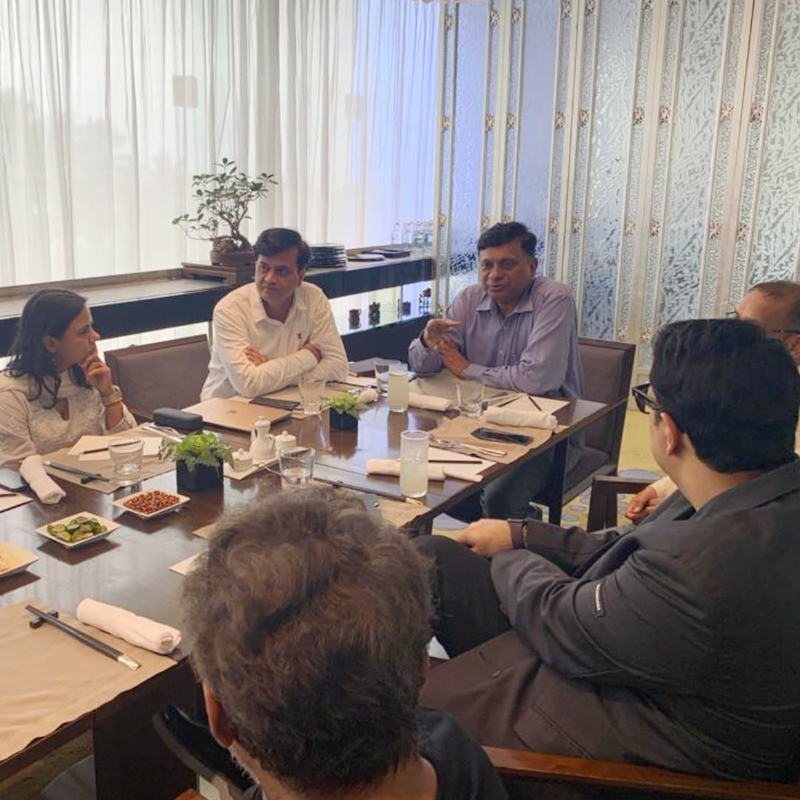
  • I&B discusses strategies for unleashing M&E’s potential with industry experts

    I&B discusses strategies for unleashing M&E’s potential with industry experts

    Mumbai: Development of the audio-visual sector requires industry-friendly policies, collaboration, and regular interaction between the government and industry stakeholders.

    On Monday, a meeting in Mumbai was organised by the National Film Development Corp. where acclaimed filmmakers and industry professionals marked their presence, namely, Maddock Films founder Dinesh Vijan, Dharma Productions CEO Apoorva Mehta, Ayan Mukerji, R. Balki, Abundantia CEO Vikram Malhotra, Amazon Prime Video’s Gaurav Gandhi and Aparna Purohit, Netflix’s Monica Shergill, PEN India chairman Jayanti Lal Gada, Balaji Motion Pictures CEO Bhavini Sheth, Producers Guild of India president Shibasish Sarkar, Nitin Tej Ahuja CEO Producers Guild of India, and producers Mahaveer Jain & Madhu Mantena.

    The deliberations centred around the strategic initiatives taken by the government to unleash the potential of the media and entertainment industries. The I&B ministry’s efforts at easing filming in India through the Film Facilitation Office and the onboarding of Invest India to expand its outreach to the domestic and international industry were highlighted.

    The recently launched incentive scheme for international productions and official co-productions was discussed in detail, including the benefits it would bring to content creation in India. The industry was urged to leverage the FFO ecosystem and their suggestions on the incentives were duly noted.

    The government’s efforts to make the forthcoming 53rd edition of the International Film Festival of India a success were emphasised, along with the opportunities being created for the industry. Feedback was sought on the amendments made in the Draft Cinematograph (Amendment) Bill, 2021. The feedback received from the industry participants was positive and they unanimously accepted the proposed amendments.

    The stakeholders were also apprised of the ministry’s recognition of the industry’s concern towards theatre density in India and the consequent development of a single window ecosystem and a model law for the ease of permission for construction of screens/theatres was in progress. The attention of the industry was drawn to many other interventions being made by the Ministry in the audio-visual sector.

    I&B secretary Apurva Chandra summed up the discussion as fruitful and said, “The engagement with industry served as a perfect opportunity to apprise the various stakeholders of the efforts being made by the ministry to give an impetus to the film industry. The response from the participants was encouraging and we have urged them to leverage these various platforms to support our endeavour to make India a global content hub.”

  • Govt. creates a conducive environment to attract foreign investments in M&E sector including visual effects & animation

    Govt. creates a conducive environment to attract foreign investments in M&E sector including visual effects & animation

    Mumbai: The government is continuously making efforts to portray India as an ‘incredible destination’ globally for filming. To make it a reality, the centre is focusing on various ways to ease out doing business in India, especially in the film and visual effects & animation sector. The ministry of information and broadcasting (MIB) has offered foreign filmmakers incentives, which will provide an impetus to the Indian media & entertainment sector in future. “Media & entertainment, including visual effects and animation, is one of the fastest growing industries in the country,” the I&B minister Anurag Thakur told the Lok Sabha recently.

    To boost the growth of the sector, Thakur further added that the government has set up the Film Facilitation Office (FFO) under the aegis of the National Film Development Corp.(NFDC), for providing a single window facilitation & clearance mechanism to accord online permissions for film shooting in India for both international & domestic filmmakers. In addition to this, NFDC organises “Film Bazaar” at the International Film Festival of India in Goa every year, which is the largest South Asian film market and attracts investors from around the world. The event encourages creative minds to come under one platform and collaborate with South Asian & international film communities.

    The minister also emphasized attracting investment from foreign filmmakers and promoting India as a preferred filming destination. The government announced in May two schemes i.e., an incentive scheme for audio-visual co-production and an incentive scheme for the shooting of foreign films in India to increase investment and boost the growth of the M&E industry.

    Currently, India has audio-visual co-production treaties with 15 countries, he mentioned and added, “This further enables international producers to invest in Indian projects.” Such collaboration helps in the effective contribution of technical, creative, and artistic personnel of the participant countries. Thakur mentioned that local IP creation and outsourcing work for foreign studios are key drivers of growth in the animation and visual effects industry.

    “The contribution of the Satyajit Ray Film & Television Institute and the Film & Television Institute of India via courses on animation and visual effects is providing skilled manpower in the industry,” he told Lok Sabha while answering a query.

    He mentioned that the government has also set up a task force earlier to unleash the potential scope of the animation, visual effects, gaming, and comics (AVGC) industry. The task force will monitor the development of progressive policies, promote growth and recommend incentives for increasing foreign direct investment in the AVGC sector. It will also help in developing world-class creative talent to meet domestic and global demand.

    The M&E ecosystem is a sunrise sector and is expected to generate revenue of Rs 4 lakh crore annually by 2025 and reach Rs 7.5 lakh crore (100 billion dollars) by 2030.

  • 53rd International Film Festival of India (IFFI) aims to promote cinema business, says I&B minister

    53rd International Film Festival of India (IFFI) aims to promote cinema business, says I&B minister

    Mumbai: The 53rd International Film Festival of India (IFFI) is scheduled to be held from 20-28 November 2022 in Goa. A steering committee has been formed to conduct this year’s event. The steering committee is deliberating the roadmap for the event.

    Information & Broadcasting (I&B) minister Anurag Singh Thakur said that his vision for IFFI is to work closely with the film fraternity from Indian Cinema and use their expertise as well as understanding to take the 53rd IFFI to the next level. Also, he said that IFFI is a festival that aims to promote the business of cinema for the benefit of the film industry by providing collaborations and networking in order to boost the ‘creative economy’ of India. He added that the creative economy has the potential & talent to create new entrepreneurs in the media & entertainment (M&E) sector which will help transform India into a content and post production hub for the world.

    The function of the steering committee is to support the ministry to finalise the IFFI programming which includes various sections of IFFI programme, master classes, workshops and cultural components.

    The steering committee deliberated over various components of IFFI and discussed ways to enhance collaborations with international film makers, participation of regional cinema, giving a platform to young filmmakers as well as showcase new trends in cinema along with emerging technology that enhances the experience of cinema lovers. The steering committee will hold a number of meetings in the run up to IFFI and ideate on content curation and explore partnerships. 

    Simultaneously, the festival aims at providing a common platform for filmmakers from across the globe to showcase their talent and put forth the excellence of cinema from all over. Bringing together film cultures, the festival aims to allow the understanding of various social and cultural ethos and appreciation of world cinema. The festival is conducted jointly by the directorate of film festivals (under the ministry of information and broadcasting, government of India) and the state government of Goa.

    With an aim of providing a common platform for the cinemas of the world to project the excellence of film art, IFFI  celebrates cinematic works every year from India and around the world.

  • Broadcasters cheer, as TRPs for news channels to resume after regulatory reboot

    Broadcasters cheer, as TRPs for news channels to resume after regulatory reboot

    Mumbai: After a year-long wait, the ministry of information and broadcasting (I&B) on Wednesday finally gave its go-ahead to Broadcast Audience Research Council (Barc) India to immediately resume ratings for TV news channels, giving broadcasters a reason to cheer in the new year.

    As per the order, Barc India will have to release ratings for news and niche genres on a ‘four-week rolling average concept’ with immediate effect. But first, it will be required to share the last three months’ data which is expected to give some direction to news channels, and advertisers who had been taking a shot in the dark.

    “I welcome the government’s decision to finally resume ratings for the news genre,” said TV9 Network CEO Barun Das, terming the monthly ratings as the need of the hour. “I have for long been advocating the need to restore ratings while questioning the suspension decision in the first place. News Broadcasters Federation’s (NBF’s) efforts in this direction have been exemplary.”

    In February 2021, over 50 TV news channels had written to the then I&B minister Prakash Javadekar questioning the decision to single out the news genre for suspension.  “News genre commands 12 per cent of the total viewership and 18 per cent revenue of the industry. So, why is that the rating system which is bad for roughly 12 per cent of the TV industry, good for the rest 88 per cent?” Das had written in a separate letter.

    Also read: “Lakhs of livelihood at stake,” TV9 urges MIB to resume TRPs

    Also read : Over 50 TV news channels write to MIB over suspension of TRPs

    In a bid to restore confidence in Barc ratings, the I&B ministry also assured channels that the TV measurement body has undertaken revision in its processes, protocols, oversight mechanism and initiated changes in the governance structure. “The reconstitution of the Board and the Technical Committee to allow for the induction of Independent Members have also been initiated by Barc.  A permanent Oversight Committee has also been formed. The access protocols for data have been revamped and tightened,” the ministry stated.

    Taking a step further, MIB has also set up a ‘Working Group’ under the chairmanship of the Prasar Bharti CEO Shashi Shekhar Vempati for the consideration of leveraging the Return Path Data (RPD) capabilities for the use of TRP services, as recommended by Telecom Regulatory Authority of India (Trai) and the TRP Committee Report. The group will submit its report in four months’ time.

    “Happy that exactly a year later, the recommendations of the TRP committee report have been accepted by MIB India. Thankful to fellow members of the committee for the hard work put in. Looking forward to achieving cross-industry consensus on the use of Return Path Data (RPD) for TRPs,” tweeted Prasar Bharati CEO.

    Also read: I&B ministry forms Joint Working Group for audience measurement sampling

    The announcement was also welcomed by the News Broadcasters Association (NBA). In a statement, one of the members of the association, who is CEO of a news channel said, “NBA’s stand is vindicated as ministry stamps the room for improvement, acknowledges the deficiencies, and puts a timeline to ratings’ release and systematic corrections.”

    The news broadcasters also gave a thumbs up to the transition from weekly to monthly ratings. “I’m very much in favour of monthly ratings. I think news channels’ content cannot be moulded on the basis of ratings, like the way GECs content can be moulded,” said a senior representative from a national news channel. “The sole purpose of ratings is to give a measuring base to advertisers, and they take a minimum of two to three months to establish a fair and equitable representation of true trends. So, we don’t need ratings on a weekly basis.”

    According to industry representatives, the new ‘four-week rolling average concept’ will also be better equipped to deal with inconsistencies related to inadequate sample size.

    While the decision to scrap out weekly ratings got a positive response, some industry veterans also suggested that releasing news ratings quarterly or twice in a year would be a better proposition. “The global news industry is transforming itself into a “news product” that people can pay for. Ideally, the news genre should be subscription-oriented, as most newspapers are now these days. Globally too, that’s the trend – shifting to an advertising-driven, pay-TV model,” he said.

    The ministry’s go-ahead comes just weeks ahead of an intense election season in five states, including an electoral battle for India’s most populous state. With news channels, all geared up to grab maximum eyeballs, it will be interesting to see how the latest system of news ratings will change the game, especially with several new channels entering the race. “We will have to see whether the scenario has actually changed over the last year or not. But, hopefully, it will only get better from here,” said a senior representative from a news channel.

    The overhaul in the television rating system in India kickstarted in October 2020 when Mumbai Police claimed in a press briefing that they probed a case of manipulation of TRPs and found some incriminating evidence. The police said the accused were allegedly bribing the households to keep a particular channel running, leading to several arrests, and FIRs against three news channels.

    The controversy had forced Barc India to temporarily suspend the publishing of weekly data for news channels, which remained in limbo for over 1.3 years. “A pause was necessitated to enable the industry and Barc India to work closely to review its already stringent protocols and further augment them,” the then Barc India chairman Punit Goenka had said.

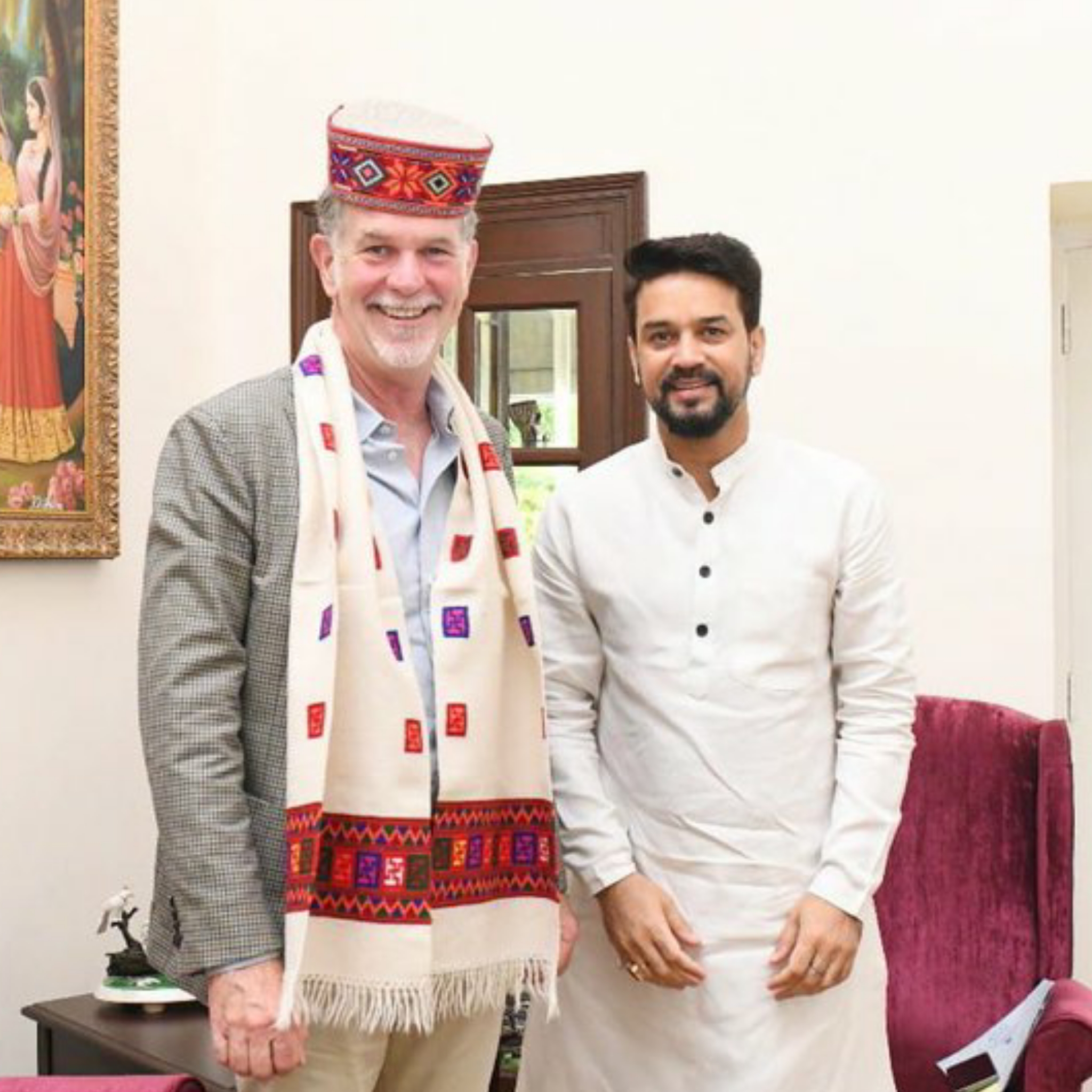
  • I&B minister Anurag Thakur meets Netflix chief Reed Hastings

    I&B minister Anurag Thakur meets Netflix chief Reed Hastings

    Mumbai: Minister of information and broadcasting Anurag Thakur met with Netflix co-founder and chief executive officer Reed Hastings for a discussion on Tuesday. Thakur presented Hastings with a copy of the holy book Bhagvad Gita during the meeting. 

    The minister shared photos of the meeting via his personal handle on Twitter.

    “Good discussion with Mr Reed Hastings (Co-Founder & CEO Netflix),” said Thakur in a tweet. “Today consumers of content are traveling the world through stories; India offers a variety of opportunities and ideas – in multiple languages,” he wrote.

    Hastings recently announced that Netflix would invest more in India after already pumping Rs 3000 crore in the past two years. In an interview with Business Today, the Netflix chief had said that India is one of its “top priorities” and that the streaming company will continue its commitment to the Indian market by simply “investing more” in content.

    In February, the government framed the Information Technology (Intermediary Guidelines and Digital Media Ethics Code) Rules 2021 that introduced a grievance redressal mechanism for news publishers, OTT platforms and digital media and a Code of Ethics that prescribe the guidelines to be followed by OTT platforms and online news and digital media entities.

  • DPIIT to issue clarification on capping FDI in digital media

    DPIIT to issue clarification on capping FDI in digital media

    MUMBAI: Amid certain stakeholders raise concern over government’s decision to allow 26 per cent FDI in digital media sector, the Department for Promotion of Industry and Internal Trade (DPIIT) is likely to issue a clarification soon on the same, Economic Times reported.

    According to some stakeholders, the idea to cap FDI (foreign direct investment) in digital media sector to 26 per cent must be clarified  by government as these stakeholders, who were looking to raise funds through FDI is now put on hold.

    There are two main concerns stakeholders have raised and sought clarification: 1) How the FDI policy of the sector would treat news aggregators, and 2) what would happen to those digital media companies where overseas investment is over 26 per cent

    Taking the views of the Information and Broadcasting Ministry on the issue, the DPIIT is expected to issue clarification shortly, Economic Times said quoting sources.

    In this regard, Deloitte India partner Jehil Thakkar had said that the clarity needed was on how to treat cases of television broadcasters that stream news online, but are allowed 49 per cent FDI.

    He questioned, “What happens to those, whether they qualify fewer than 26 per cent or 49 per cent (FDI)? What happens to news websites which are 100 per cent foreign entity?”

  • MIB mulls broadcast of DD News to 100 countries

    MIB mulls broadcast of DD News to 100 countries

    MUMBAI: The Ministry of Information and Broadcasting is contemplating its expansion of Doordarshan’s 24-hour news broadcast to around 100 countries with a view to reaching out to the world and putting forth India’s viewpoint on domestic and international issues, according to an Economic Times report. 

    Primarily, DD India is into producing various cultural and general entertainment programmes for broadcast in overseas countries. 

    The channel also produces 24-hour news and current affairs programmes that are limited to Nepal, Bangladesh, Sri Lanka, the UAE and China. 

    The decision to start broadcast of news in a particular country will depend on financial implications such as cost of engaging a local cable for carrying the Indian channel as well as stationing correspondents in that particular country, according to a senior official. 

    The factors that would also be considered for starting a news broadcast in a country include the percentage of the Indian diaspora in the total population of that nation, foreign direct investment inflow and outflow, remittance and tourists arrival from that country, the official said.

    The ministry will also look at whether India has strategic partnership with that nation, number of visits of the prime minister to that country, whether the Ministry of External Affairs has a joint secretary level officer there and proximity of that nation to multilateral agencies. 

    Also Read:

    MIB has no data on OTTs; not under regulation: Minister

    MIB, DoS nudge TV channel to use Indian satellites

    MIB categorises all non-Hindi and non-Eng TV channels as regional