Tag: Infonetics Research

  • Distribute antenna system market grows globally, says Infonetics

    Distribute antenna system market grows globally, says Infonetics

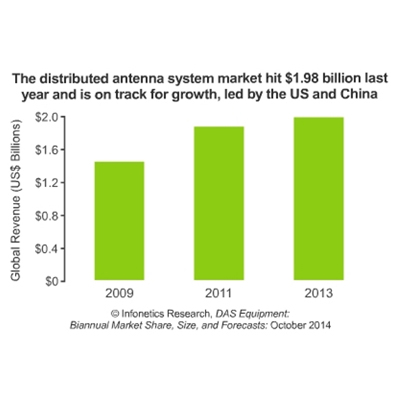
    NEW DELHI: The market for distributed antenna system (DAS) rose 11 percent in the first half of 2014 to $1.1 billion.


    Infonetics Research shows that the revenue in the first half of the year grew 19 per cent in North America. The report noted a slight pickup in the Chinese telecom market due to a shift from LTE 4G coverage deployments to coverage and capacity enhancement.


    DAS drivers include coverage, capacity, spectrum efficiency, interference mitigation, data support, scalability and adaptability.


    Axell Wireless, CommScope, Corning Mobile and TE Connectivity are some of the leading vendors in the global DAS market.


    “The US has reached its DAS spending peak for LTE coverage and capacity enhancement, posting double-digit year-over-year growth during the first half of 2014 and signaling an upcoming slowdown,” said Infonetics Research principal analyst for mobile infrastructure and carrier economics Stephane Teral.


  • USD 1 trillion to be spent on telecom and datacom over next 5 years

    USD 1 trillion to be spent on telecom and datacom over next 5 years

    NEW DELHI: The Asia Pacific region has shown major growth of six per cent year-over-year in the telecom/datacom equipment and software revenue as against 4.5 per cent by North America.


    This trend is expected to continue through at least 2018, Market research firm Infonetics Research says. It also projects a cumulative $1.01 trillion will be spent by service providers and enterprises on telecom/datacom gear and software over the five years from 2014 to 2018.
     

    Sales of telecom and datacom equipment and software came globally to $183 billion in 2013, three per cent above the previous year.
     

    According to research data from its 2014 Telecom and Datacom Network Equipment and Software report, Infonetics says the overall telecom and datacom network equipment and software market share leaders are in rank order: Cisco, Huawei, Ericsson, Alcatel-Lucent and ZTE – the same top five vendors with virtually the same shares as the year prior.


    Vendor share positions also held steady in the enterprise segment, with Cisco in the driver’s seat and followed distantly by tightly bunched Avaya, Brocade, HP, and Juniper (listed in alphabetical order).
          

    Infonetics Research principal analyst Jeff Wilson said: “Despite the fact that enterprises and service providers are in the middle of massive network upheavals due to the evolution of software-defined networking (SDN) and network functions virtualisation (NFV) technology, the telecom and datacom networking equipment and software market is on track to grow annually through 2018 with the fastest growth coming in 2015.”
     

    Infonetics co-founder and co-author of the report Michael Howard added: “Looking at just the service provider equipment space, we’re seeing a shakeup in vendor market share, with Huawei leapfrogging longtime number-one Ericsson to take the top spot in 2013. While Huawei’s been doing well in a number of regions, China’s economy is a key factor keeping Huawei’s growth so strong.”
     

    The report has compiled worldwide and regional market size, vendor market share, and forecasts through 2018 from all of its reports that track enterprise and service provider gear. It is the majority of all data networking and telecom equipment for service providers, cable companies, and small, medium, and large organisations, excluding consumer electronics.

    The 11 major categories of equipment and software tracked in Infonetics’ report include broadband aggregation; broadband CPE; pay TV; optical network hardware; carrier routing, switching, and Ethernet; service provider VoIP and IMS; service provider mobile/wireless infrastructure; service enablement and subscriber intelligence; security; enterprise and data center networks and enterprise communications. Companies tracked include Alcatel-Lucent, Avaya, Brocade, Ciena, Cisco, Ericsson, Fujitsu, HP, Huawei, Juniper, Motorola, NEC, Nokia, Samsung, Siemens, ZTE, and many others.

  • Mobile broadband revenue expected to grow at an 11.8% CAGR from 2013 to 2018: Infonetics Research.

    Mobile broadband revenue expected to grow at an 11.8% CAGR from 2013 to 2018: Infonetics Research.

    NEW DELHI: The largest growth in mobile broadband between 2012 and 2013 was in the Asia Pacific region, while it fell in Europe.


    According to a study by Infonetics Research, the growth in the Asia Pacific region came close to $300 billion last year.


    The study said Mobile broadband revenue will grow at an 11.8 per cent compound annual growth rate (CAGR) from 2013 to 2018.


    Growth in Asia Pacific was 5 per cent, the Caribbean and Latin America 4 per cent, and North America 3 per cent, while there was a high single-digit decline in Europe.


    While mobile broadband in Europe fell further from around $ 250 billion but is still just above $200 billion, it rose marginally in North America and but remains lower than $225 billion.


    Mobile services revenues were just above $100 billion in 2012 and showed only a marginal increase, last year.


    LTE services are expected to account for half of total mobile broadband service revenue in 2018, with North America making up the majority.


    Mobile broadband has helped overall mobile service revenue growth in 2013, offsetting year-over-year decreases in voice and SMS revenue.


    Despite the rise of mobile data, blended ARPU continues to fall or stay flat in every region except developing Asia Pacific, where it rose slightly in China.


    Mobile broadband subscribers will pass postpaid voice subscribers by the end of 2014, said Infonetics. Voice services are expected to stay above 50 percent of total mobile service revenue through 2016.


    Telecom operators’ 2013 revenue rose 1 per cent to $800 billion — from mobile services including mobile voice, SMS/MMS, and broadband.


    Europe dragged global mobile service revenue in 2013, mainly due to mobile saturation and weak consumer spending. The research said price-based competition in markets including Belgium, France, Italy, Spain, and The Netherlands had also contributed to the decline.


    Infonetics Research principal analyst for mobile infrastructure and carrier economics Stephane Teral said: “CEOs of European telecoms Deutsche Telekom, Orange, Telecom Italia, Telefonica and Vodafone are pushing the European Commission for more consolidation to reduce the number of operators in each country, from four or five to just three.”

  • VoIP services market revenues to rise to $88 billion by 2018: Infonetics

    VoIP services market revenues to rise to $88 billion by 2018: Infonetics

    NEW DELHI: The global business and residential VoIP services market rose eight per cent in 2013 to $68 billion and are expected to yield a revenue of $88 billion by 2018.


    According to Infonetics Research, SIP trunking increased 50 per cent in 2013 from the prior year, driven predominantly by activity in North America.


    Infonetics Research says EMEA is expected to be a strong contributor for SIP trunking business in 2014.


    “Business VoIP services have moved well beyond early stages to mainstream, strengthened by the growing adoption of SIP trunking and cloud services worldwide. Hosted unified communications are seeing strong interest up market as mid-market and larger enterprises evaluate and move more applications to the cloud, and this is positively impacting the market,” said Infonetics Research principal analyst for VoIP, UC, and IMS Diane Myers.


    Sales of hosted PBX and unified communication (UC) services increased 13 per cent in 2013, and seats grew 35 per cent due to continued demand for enterprise cloud-based services, the report said.


    Global residential VoIP subscribers increased eight per cent to 212 million in 2013.


    Infonetics Research says managed services are benefitting from the continued adoption of IP PBXs: Roughly 10 per cent–20 per cent of new IP PBX lines sold are part of a managed service or outsourced contract.

  • India is driving Pay TV growth: Infonetics Research

    India is driving Pay TV growth: Infonetics Research

    MUMBAI: The emerging markets are driving growth in the pay-TV market. That is what a recent paper released by Infonetics Research says. Markets such as India, China and Latin America are the ones adding to the pay-TV growth.


    The research that was conducted by tracking the cable TV, satellite TV and IPTV subscribers of over 150 service providers across the globe states that India and Latin America are adding satellite and cable subscribers while China is experiencing an increase in IPTV subscribers.


    Infonetics Research principal analyst for broadband access and pay TV Jeff Heynen says, “Latin America’s economy, in particular, is performing well, with companies investing in Brazil ahead of the FIFA World Cup and consumers signing up for pay-TV services to the tune of 9% growth in the third quarter of 2013 from the year-ago period.”


    India’s Tata Sky, which has close to 11 million subscribers, finds a place in the top five satellite providers by subscribers list at number four just behind DirecTV US, DISH Network and DirecTV Latin America. The world’s leading provider of cable TV services Comcast lost out on 3,55,000 subscribers over a year, retaining 21.6 million subscribers as of Q3 2013.


    India is in its last two phases of digitisation. In the first two, about 25 million subscribers from analogue switched to digital. Another 75 million will be added to the list by the end of 2014 adding more to the growth of pay-TV.


    Hopefully by the end of the year, India would have more reasons to make its mark on the global map.

  • Broadcasting and video equipment to show sizable increase in 2013

    Broadcasting and video equipment to show sizable increase in 2013

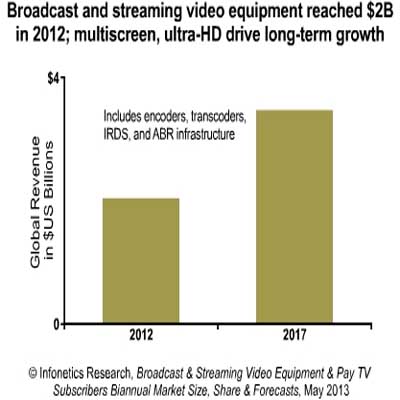
    NEW DELHI: Broadcast and streaming video equipment market is likely to grow 12 per cent in 2013 from two billion dollars in 2012.


    According to Infonetics Research, the market is projected to grow by more than 1/3 by 2017, and adaptive bitrate (ABR) origin and packaging servers are key components in the efficient delivery of over-the-top (OTT) content, especially as more pay-TV providers and content delivery networks move to ABR streaming.


    More and more, transcoders are being used to prepare linear broadcast and file-based content for distribution directly to subscribers.


    Telco IPTV subscribers have the highest 2012-2017 CAGR (17 per cent) of any pay-TV subscriber segment.


    With competition and content heating up, pay-TV providers are transitioning their traditional, broadcast-focused video processing environments to ones that can ingest, process, deliver, and decode video content from multiple sources.


    Jeff Heynen, principal analyst for broadband access and pay TV at Infonetics Research, said: “Content owners and studios are also adjusting their workflow and video output to support multiscreen and streaming services.”


    Infonetics Research noted that the net result of these transitions is steady investment in the platforms necessary to optimise video streams for a growing list of end devices and formats.