Tag: Influencers

  • Bengaluru’s hoardings go missing in action with wives at the centre

    Bengaluru’s hoardings go missing in action with wives at the centre

    MUMBAI: Bengaluru is having a missing persons crisis on hoardings, not in homes. Over the past few days, the city has been plastered with giant posters screaming, “Atul’s wife is missing”, “Senthil’s wife is missing”, “Ravi’s wife is missing” and the list keeps growing. The stark black-and-white designs, with no logos, hashtags or explanations, have thrown the city into a frenzy. Commuters stuck at signals, social media scrollers, and even seasoned ad-watchers are scratching their heads. What started as a handful of sightings has snowballed into a full-blown urban mystery, with new “missing wives” appearing every passing day.

    Famed photographer Atul Kasbekar joined the fun on Instagram, posting the hoarding with a tongue-in-cheek plea for help and a “suitable reward.” Influencers including Eshwar Go, Haripriaa Kulkarni, and Sariflog have also jumped into the conversation, their posts amplifying the intrigue to thousands of followers.

    From Koramangala to MG Road, speculation is rife: is this a cheeky ad campaign, a guerrilla social message, or a true-blue whodunnit? While Instagram threads and WhatsApp forwards are brimming with theories, nobody has cracked the code just yet.

    For now, Bengaluru’s skyline is dominated by the mysterious “missing wives” and the only thing multiplying faster than the hoardings is the curiosity. One thing’s for sure: until the reveal, the city won’t be missing this story.
     

  • Saregama snaps up more of Pocket Aces, goes all in on youth initiative

    Saregama snaps up more of Pocket Aces, goes all in on youth initiative

    MUMBAI: Saregama has snapped up a further 36.63 per cent of Pocket Aces for a cool Rs 127.47 crore. This latest splurge, a second tranche if you will, pushes Saregama’s ownership to a dominant 90.37 per cent, leaving little room for anyone else at the digital buffet.

    The deal, finalised on 29 March  2025, sees Saregama hoovering up a veritable smorgasbord of shares, from equity to an array of convertible preference shares. Pocket Aces, boasting a digital empire of 175 million followers across its FilterCopy, Dice Media, Nutshell and Gobble channels, and a talent roster of over 215 influencers via Clout, is now firmly under Saregama’s wing. The company declared this to the BSE through a regulatory filing on Saturday. 

    Pocket Aces, with a back catalogue of over 35,000 content pieces, from digital originals  to those ubiquitous reels, is a digital goldmine for Saregama, keen to woo the 18-35 demographic.

    Pocket Aces’ financials reveal a turnover of Rs 8859.17 lakhs for FY 24, a slight dip from the previous year’s Rs 10267.93 lakhs, but Saregama is betting on synergies, not just spreadsheets. The acquisition, which includes a related party transaction with a Pocket Aces director – all done “at arm’s length”, naturally – is being touted as a strategic masterstroke.

    “This isn’t just about owning content; it’s about owning the conversation,” an industry observer chirped, with the knowledge that  Pocket Aces’ vast network can be used by Saregama to turbocharge its music library.

    With influencers, long-form content, and snackable reels all under one roof, Saregama is clearly aiming to be the king of the digital jungle.

  • Creators vs. Influencers: Who Should Brands Work With?

    Creators vs. Influencers: Who Should Brands Work With?

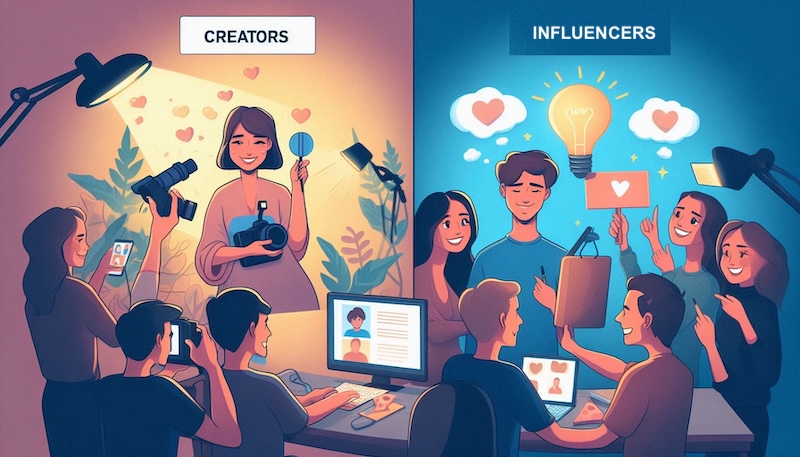
    MUMBAI: Let’s get one thing straight, not everyone with a camera and an audience is a creator.

    Over the past few years, brands have gone all-in on influencer marketing, pumping money into campaigns focusing on numbers, views, likes, and reach. But they’ve forgotten the essence of content creation somewhere along the way. The obsession with influencers has overshadowed the people who genuinely create, the ones who make content that audiences connect with.

    At Creators Network, we didn’t just pick the word Creator for the sake of it. We genuinely believe in the art of content, not just the commerce behind it. If you’re good at your craft, money follows as a by-product. But if you start with just the commercial intent, chances are you’ll struggle to build real trust.

    The Difference Between a Creator and an Influencer

    It’s simple.

    Influencers exist because of their audience. Their primary goal is to maintain engagement, grow numbers, and (let’s be real) sell products. And honestly? There’s nothing wrong with that, it’s a legit marketing model. But let’s call it what it is: a sales funnel in human form.

    Himanshu AroraCreators, on the other hand, exist even without an audience. Their focus isn’t on “how do I sell this?” it’s “how do I make something I love?” And when you love what you do, an audience naturally follows. That’s why creators build communities, while influencers build followers.

    Selling vs. Using – Why Gen Z Can See Through the BS

    Here’s the thing: Gen Z is the most ad-resistant generation ever.
    They don’t want to be told what to buy. They want to see how something fits into their life. Instead of “Here’s why this shampoo is the best,” they prefer “This shampoo saved me from a bad hair day before my date.” 

    See the difference?

    And that’s exactly why creators work better for long-term brand relationships. When a creator genuinely uses a product, it doesn’t feel like an ad. It feels like a recommendation from a friend.

    A great example:  Kusha Kapila. You’ve seen her brand collabs, they never feel like she’s selling something to you. They feel like an extension of her content, a natural part of the world she’s built. And because of that, people watch them instead of skipping through.

    Or take Bhuvan Bam. If he endorses a product, it doesn’t feel forced, because it’s seamlessly woven into his storytelling. He doesn’t push a brand, he makes it a part of his world. And that’s why it works.

    Brands Need to Think Long-Term, Not Just Viral

    Right now, most brands are still chasing short-term virality instead of long-term trust. They’ll work with an influencer for one campaign, squeeze out some impressions, and move on to the next. But the best brands, the ones that get it, invest in creators.

    Instead of thinking, “Who can get us one million views this week?” they think, “Who can represent our brand for the next three years?”

    Few brands have already started doing this, though. They choose long-term creator partnerships over one-off influencer deals because, ultimately, influence fades, but trust compounds over time.

    So, Who Should Brands Work With?

    It’s not about influencers vs. creators. It’s about short-term vs. long-term thinking. If you need quick clicks, sure, go with an influencer. But if you want brand advocacy that lasts, invest in a creator. Always  ask yourself:
    “Do we want an influencer for today or a creator for the future?”

    Your answer will define your brand’s story.

    Himanshu Arora is the  founder & CEO, Creators Network & BookYourCreator. The views expressed in this column are entirely the author’s and indiantelevision.com need not subscribe to them. 

  • Qoruz report highlights explosive growth of India’s influencer economy

    Qoruz report highlights explosive growth of India’s influencer economy

    MUMBAI: India’s influencer world never had it so good. Not only is their number growing, but their sphere of influence is also expanding by the day. The latest report from Qoruz, an influencer marketing intelligence platform, reveals a remarkable 322 per cent surge in India’s influencer ecosystem over the past four years. The number of influencers has grown from 962,000 in 2020 to 4.06 million by the end of 2024, underscoring the increasing reliance on creator-driven content for brand engagement.

    The report charts the evolution of India’s dynamic influencer landscape, with categories like gaming experiencing exceptional growth of 213 per cent between 2020 and 2022, reaching 467,000 influencers by 2024. Travel influencers rebounded strongly post-pandemic, witnessing a 212 per cent  surge in 2023, while parenting influencers steadily rose from 87,000 in 2020 to 362,000 in 2024, highlighting demand for relatable, family-focused content.
     

    Fashion maintained its leadership position with 470,000 influencers, while niche categories such as infotainment and finance also saw significant growth, reaching 203,000 and 232,000 influencers, respectively. Health and fitness influencers doubled their base to 295,000, while food influencers bounced back to 242,000 by the end of 2024.

    Looking ahead, the report projects fashion, arts and entertainment, and gaming to lead in influencer numbers in 2025, driven by evolving audience preferences.


    Top influencers

    Qoruz  co-founder &  head of brand alliances  Aditya Gurwara said, “Influencers have evolved from product endorsers to strategic partners for brands, creating authentic, context-driven content that resonates with audiences. Categories like gaming, travel, and lifestyle present incredible opportunities for brands to collaborate with creators who truly understand their audiences.”

    Qoruz co-founder & CEO Praanesh Bhuvaneswar noted, “The creator economy has grown from fewer than a million influencers in 2020 to over 4 million today. Influencers are no longer just content creators but cultural architects shaping trends and conversations. This is only the beginning of what the ecosystem can achieve.”
    Qoruz’s report underscores the transformative power of influencer-led marketing and highlights the immense potential for brands to engage meaningfully with audiences through long-term partnerships and data-driven insights.

  • Public relations’ role in the fast-evolving influencer world

    Public relations’ role in the fast-evolving influencer world

    MUMBAI: The role of influencers has witnessed major shifts within the evolving landscape of public relations. Once relegated as mere taste makers with a huge following, the influencers have turned into complex collaborators that create brand narratives, build deeper connections with audiences, or effect social commerce. Today, looking into this changing landscape of influencer partnerships requires more than just product promotion but rather an authentic and deeper-rooted relationship with audiences.

    As public relations embraces this new reality, it becomes essential to understand the trends that are transforming the influencer landscape, without which a brand will not be able to adjust in order to stay relevant, ethical, and effective in their campaigns.

    The shift from mega-influencers to micro and nano-influencers

    In its early days, influencer marketing was a channel where brands obsessed over superstars and mega-influencers with millions of followers, believing that a larger reach would translate into a greater impact on the customer. With a more sophisticated shift in the influencer marketing scenario, public relations professionals recognised that engagement is more significant than the number itself.

    Today, micro and nano-influencers are driving the most meaningful conversations and creating authentic connections with their very small, yet engaged, audience. Just as these smaller influencers concentrate on building niche followings based on the interests or values of their audiences, so do brands looking to target well-defined and loyal communities.

    This means a change for the PR, no longer searching for a name or a size but for brand-aligned truth speakers on issues concerning values, cultures, and messaging. Micro-influencers might not have the reach of celebrities, but because they have a closeness with their audience, they can deliver better RoI in terms of trust, loyalty, and long-term affinity for a brand.

    Aninditaa gupta

    Aniniditaa Gupta

    The rise of real and relatable influencers to finding out authenticity over perfection

    Gone are the days when influencers could simply post heavily curated pictures and hope for the audience to engage. Nowadays, consumers crave authenticity, and those influencers who share 100 per cent real and unfiltered experiences often succeed better than others who show what’s perceived as flawless.

    Audiences want to see influencers dealing with the little nitty-gritty of their difficult lives, talking about mental health talk, or sharing unfiltered moments that make him/her appear human. Brands reaping rewards from this shift have been giving collaborations with influencers who expose human vulnerabilities, honesty, and authenticity in their value.

    For PR teams, this means an end to the old-school traditional glossy campaigns in favor of a fresh and transparent approach to their activities. Brands need to learn to embrace the “imperfections” that come with influencer collaborations, allowing for content that resonates with honesty and relatability while still aligning with the brand’s values.

    Influencers contributing to social change

    The rise of socially conscious consumers has transformed influencer partnerships. Now, they’re social cause advocates raising awareness on matters of interest like the environment, mental health, and social justice. This pressure requires PR professionals to make sure influencers are a good fit with a brand’s values and are not just peddling pitch for that company. Consumers expect that brands should take a stand on serious issues. Influencers driving the conversation can bolster a brand’s reputation. For the PR team it is equally important to formulate authentic, purpose-driven partnerships that resonate with audiences, and not just opportunistically align themselves with trending causes.

    The impact of paid and organic content on authentic engagement and brand connection

    As influencer marketing grows, the difference between paid and organic content is becoming clearer. Consumers can spot inauthentic, overly promotional posts. Clear guidelines, like FTC rules for labelling paid posts, help with transparency. While paid content offers reach, organic posts feel more natural and connect better with audiences. Public relations account teams should permit influencers to create the content naturally, so that sponsored posts feel like a real part of their message, not just an ad.

    influencers

    Data driven PR

    In the past, measuring the success of influencer marketing was subjective-as brands would look at follower numbers, engagement rates, and sales figures. However, in today’s world, the more sophisticated the analytics tools that PR professionals utilize, the better they can gauge the correct level of influence an influencer possesses owing to data reliability.

    Insights driven by data now allow brands to track sentiment analysis, audience demographics, and long-term brand loyalty. With this, PR teams can find out the exact ROI of the influencer campaigns, refine their strategy, and ensure they partner with influencers who would positively resonate with their target audience.

    Moreover, relying on data can allow public relations professionals to better look towards the evolution of consumers and how that will allow them to keep ahead of trends and consider the types of influencers and content that would drive the most engagement.

    Building long-term partnership with influencers

    In the past, measuring the success of influencer marketing was subjective-as brands would look at follower numbers, engagement rates, and sales figures. However, in today’s world, the more sophisticated the analytics tools that PR professionals utilise, the better they can gauge the correct level of influence an influencer possesses owing to data reliability.

    Insights driven by data now allow brands to track sentiment analysis, audience demographics, and long-term brand loyalty. With this, PR teams can find out the exact ROI of the influencer campaigns, refine their strategy, and ensure they partner with influencers who would positively resonate with their target audience.

    Moreover, relying on data can allows public relations professionals to better look towards the evolution of consumers and how that will allow them to keep ahead of trends and consider the types of influencers and content that would drive the most engagement.

    Maintaining trust and understanding ethical challenges

    As the influencer market expands, there are emerging concerns about ethics and trust-building faults, especially regarding fake followers and undisclosed paid promotions. Brands must guarantee that their influencer partnerships are above-board, ethical, and aligned with their principles. The PR professionals should work with the influencers who maintain integrity and really have genuine connections with their followers. Brands, for their part, need to be proactive in the ethical world, like readily disclosing paid partnerships and avoiding partnering with questionable influencers to protect themselves.

    Conclusion

    The landscape of influencers is no longer confined to product endorsements. The modern-day influencer is like a storyteller, an advocate, a powerful partner that establishes a reputation and identity. In this new landscape, PR professionals need to adjust their approach and tasks, remain steadfast, and focus on building deeper, long-term productive relationships with influencers.

    In this fast-paced, rapidly-evolving environment, agility, trends-monitoring of overcoming all that distracts the audience in every wave of growing and engaging with them at every touchpoint is where success lies. With the right approach, influencer collaborations can ride to the very front of any brand’s PR strategy, paving the way to trust, engagement, and the long-term establishment of lasting connections amid the cacophonic world of digital innovations.

    (Aninditaa Gupta is  Scenic Communications founder. The views expressed in the article are entirely her own and indiantelevision.com need no subscribe to them.)

    (Picture for the main page created using Microsoft Image Designer. No copright infringement is intended)

  • Digital content creators and their reliance on fictional facts

    Digital content creators and their reliance on fictional facts

    MUMBAI: We have known it for a long time. And many have cautioned us about it as well. 

    Now here’s some data to support the fact that digital content influencers and creators are pretty inventive about the so-called information that they tout as facts.

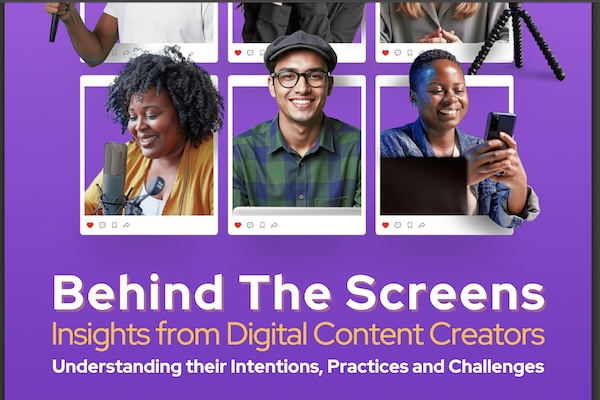
    A Unesco backed  Behind the Scenes survey  has revealed that 62 per cent of influencers do not carry out rigorous and systematic fact-checking of information prior to sharing it.  However,  73 per cent expressed the desire to be trained to do so. 

    The survey is the first global analysis of digital content creators’ motivations and practices, and of the challenges they face. It involved 500 influencers in 45 countries, with the expertise of a dedicated research team at US-based Bowling Green State University.

    The survey found that content creators have difficulty determining the best criteria for assessing the credibility of information they find online. 42 per cent of respondents said they used “the number of ‘likes’ and ‘shares’ a post had received” on social media as the main indicator. 21 per cent were happy to share content with their audiences if it had been shared with them “by friends they trusted,” and 19 per cent said they relied “on the reputation” of the original author or publisher of content. 

    Here’s more: mainstream news media is only the third most common source (36.9 per cent) for content creators, after their own experience and their own research and interviews.

    Clearly, a lot needs to be done to train digital content creators as well as followers who swallow any drivel  that’s dished out to them as a fact. Unesco has launched an online course to address this and educate them. More than 9,000 participants from 160 countries already registered to participate. 

    They will learn how to:
    * source information using a diverse range of sources
    * assess and verify the quality of information
    * be transparent about the sources which inspire their content
    * identify, debunk and report misinformation, disinformation and hate speech
    * collaborate with journalists and traditional media to amplify fact-based information.

    Can some more educational initiatives in India be instituted by educational institutes to educate the digital and social media crowd?

  • Sonic Lamb headphones breaking sound barriers

    Sonic Lamb headphones breaking sound barriers

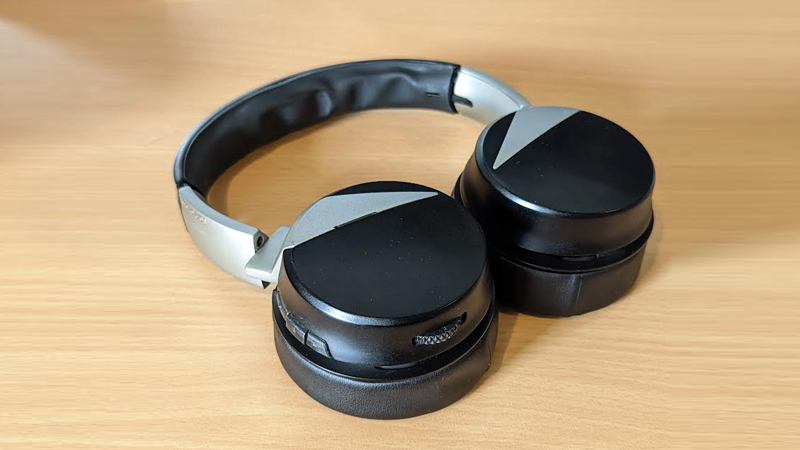
    Mumbai: In a heart-warming twist of fate, social media influencer Sohan Rai (@Zikiguy) demonstrated the transformative power of Sonic Lamb headphones, fostering inclusivity for the hearing impaired through the gift of music.

    Rai’s journey began with purchasing Sonic Lamb Headphones, an unusual headphone with unique hybrid driver technology that reproduces the physical experience of sound – you actually feel the music when listening to it on these headphones. Little did he know this choice would lead to a remarkable discovery at a restaurant? There he met Nandish, partially deaf, and Sohan’s curiosity sparked compassion. Sohan asked Nandish to try out Sonic Lamb headphones.

    To their amazement, Nandish could experience the music flow through him, and joy welled up as he described it as the “best listen ever.” The power of this experience fuelled a fervent wish to share it with his sister, Netra, who has been completely deaf since birth.

    Inspired and intrigued, Sohan approached Rapture Innovation Labs, the startup behind the Sonic Lamb headphones. Touched by the story, co-founder Navajith Karkera and his team embarked on a remarkable collaboration with Sohan. They customized a pair of Sonic Lamb headphones specifically for Netra by passing through bass and mid-range audio frequencies (vocals and instruments) through the Hybrid Driver technology, which reproduces through skin and bone conduction instead of just the sub-bass and bass as per their actual design, and they hoped for the best.

    Taking the modified headphones to Nandish’s village, the team witnessed an incredible moment as Nandish’s sister, Netra, was able to experience music and feel the beats and rhythms of music for the first time in her life. Her sheer joy and excitement were palpable. This heart-warming event highlighted the power of Sonic Lamb to reproduce the physical and sensory experience of feeling the music but also to bridge gaps and bring the gift of music to those who had never experienced it before.

    Sohan’s empathy and curiosity, coupled with Rapture Innovations Lab’s spirit of innovation, have woven a story of inclusivity and the transformative power of a single sound.

    Join the conversation online using #soniclamb, #Inclusivity and #MusicForAll.


    A post shared by Sohan Rai (@zikiguy)


  • Vertoz unveils sweet success with influencer marketing campaign for Bolas Dry Fruits and Sweets

    Vertoz unveils sweet success with influencer marketing campaign for Bolas Dry Fruits and Sweets

    Mumbai:  Vertoz digital advertising and technology Company recently celebrated a sweet collaboration with 50 key influencers for an enchanting Diwali campaign in partnership with Bolas Dry fruits and Sweets. Vertoz, known for its e marketing approaches, joined hands with 50 influential personalities across various domains to spread the joy of Diwali with Bolas Dry fruits and Sweets.

    The heart of this collaboration was the distribution of specially curated sweets boxes to the influencers, aiming to create an authentic and delightful experience. Influencers, in turn, showcased the delightful treats to their followers, endorsing the quality and joy associated with Bolas Dry Fruits and Sweets. The campaign, marked by visually appealing and shareable content, generated a significant buzz on social media platforms, amplifying brand visibility and creating positive sentiment among engaged audiences.

    Early metrics indicate a substantial increase in brand mentions and engagement rates, with a surge in inquiries about Bolas Dry Fruits and Sweets during the festive season. The personalized touch of sending Diwali Gift Boxes created a memorable and shareable experience, enhancing the campaign’s success and setting a unique precedent in influencer marketing.

    Vertoz Founder and Chairman Hiren Shah emphasized the success of the collaboration, stating that, ‘our partnership with Bolas Dry Fruits and Sweets for this Diwali campaign is a testament to the power of influencer marketing done right. By partnering with key influencers and delivering a taste of Diwali joy, we have successfully blended authenticity and celebration, creating a memorable brand experience.’

    Bola Bolas Director Rajat Kamath added, ‘the response to the influencer marketing campaign has exceeded our expectations. Our heritage series of gifting options resonated with influencers and their followers, forging a genuine connection that goes beyond the festive season.’ Both Vertoz and Bolas Dry Fruits and Sweets express enthusiasm for future collaborations, building on the success of this influencer marketing campaign, and highlighting the strategy of combining digital expertise with personalized brand experiences as a recurring theme in their future endeavours.

  • GUEST ARTICLE: How do small businesses get benefited through influencer marketing?

    GUEST ARTICLE: How do small businesses get benefited through influencer marketing?

    Mumbai: Influencer marketing is not always about celebrities endorsing goods and services for big brands. In fact, the new way of marketing in the digital world is accessible to anyone, regardless of the business’ size.

    Marketing and brand promotion are major factors, even for small businesses and start-ups. One of the most effective ways to do promotion on social media is to involve influencers. Some are still sceptical about influencer marketing as they think it’s costly, or they simply don’t know where to start or where to look for the best suitable influencer. The truth is that it’s the other way around: small businesses can actually benefit a lot from influencer marketing.

    How can micro-influencers contribute?

    Micro influencers are content creators with an online community of 10,000 to 100,000 followers. Their follower count might seem inadequate compared to celebrity influencers, but the dedicated social following of micro-influencers has proved to be quite effective, mainly for small businesses. Micro-influencers have a more active and focused audience. Promoting your brand or business with the suitable micro-influencer will provide adequate visibility and help improve business.

    1. Micro-influencers are the right choice for promoting small-scale businesses, as they are more effective than celebrity influencers.

    2. Micro-influencer campaigns are cost effective and easy to start or handle.

    3. They have a strong and focused niche audience, hence, the brand gets relevant social interactions.

    Why should small businesses partner with influencers?

    There are many reasons for start-ups to stake their claim in the creator economy. From increasing profits to accelerating brand awareness, the possibilities are endless.

    Make your brand stand-out and share your story

    It doesn’t matter if you have a lot of competition or lack proper brand awareness, social media influencers can help a lot in introducing your brand or business to the market and explaining the benefits of doing business with you.

    Influencers are excellent storytellers, that’s why people love their content. They can use the same storytelling skills to promote your business in a meaningful manner. People are able to retain more data when they receive it through stories. Influencers are the best option to share your brand story and make you stand-out among your competitors.

    Return on marketing investment

    Spending money on marketing and not acquiring increased sales is a hard time for every marketer and company. Influencer marketing, on the other hand, is a proven and effective strategy to reap the benefits of a return on marketing investment.

    When you are a small business, you lack the budget to try out different marketing strategies. Hence, trying a strategy (influencer marketing) that is already proven gives you a substantial return. It’s a worth trying strategy for small businesses when there is a promised return on marketing investment, or ROI.

    Brand Authenticity

    Brand authenticity is the kind of trust every business desires. For small businesses, it takes time to build trust. The best way to track trust-building is to ensure that your customers see your brand or business as authentic. Choosing any influencer isn’t enough. Partnering with the right influencer who aligns with your business niche will only make the brand authentic.

    People will no longer trust the influencer or brand if the endorsement seems inauthentic. Proper influencer marketing can help build third-party credibility and trust with an audience looking for resources from your market.

    Visible and Cut Through the Noise

    Traditional ads have become annoying for digital natives. That’s the reason most users block ads. Ad blocking makes surfing easier and more comfortable, but it’s not so comfortable for advertisers. Even if a consumer or user is interested in your product, they might never get to see the ad just because their ad blocker kicked it out or they are overloaded with content.

    Influencer marketing comes into play in this scenario. If the user sees an influencer they like promoting your product, they will definitely watch it. Social media is run by the opinions of its network, which includes influencers. So if you choose an influencer who loves your product, their customers will know that the product is worth checking out. When influencers share your brand story, their network of followers will get familiar with your business, and the more their content engages, the greater your customer acquisition.

    Influencer marketing is affordable, effective, and, moreover, worth the investment. You are bound to find impactful brand ambassadors and spokespersons when you start doing purposeful influencer research online.

    The author of this article is My Haul Store founder & CEO Abhishek Vyas.

  • Urban Indians are most likely to notice endorsements of mobile phones and clothes on social media

    Urban Indians are most likely to notice endorsements of mobile phones and clothes on social media

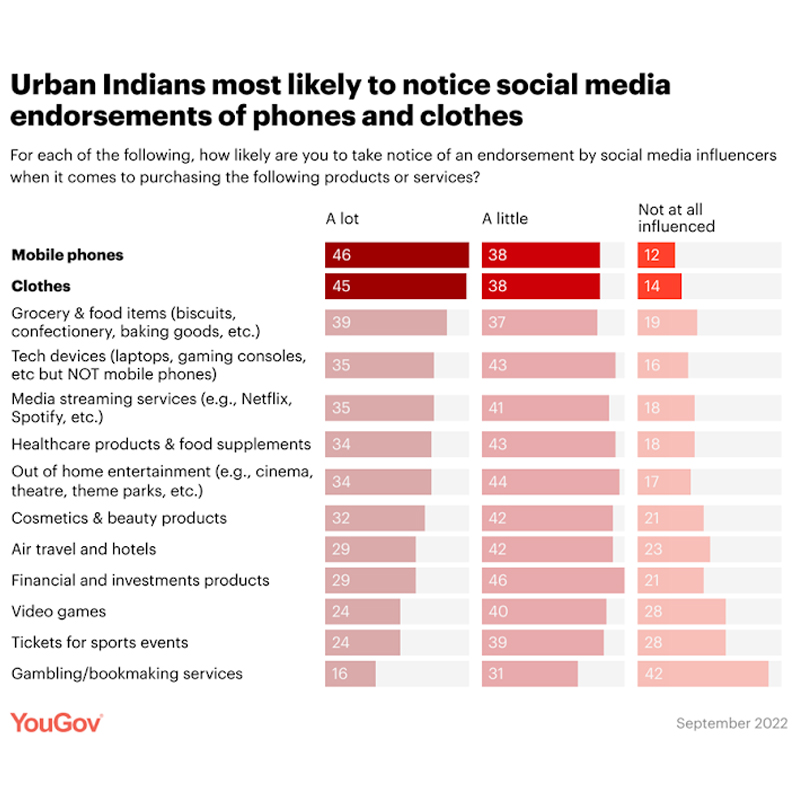
    Mumbai: Among the various categories of products and services endorsed by social media influencers, YouGov’s new research found that urban Indians are “a lot likely” to notice endorsements for mobile phones (46 per cent) and clothes (45 per cent).

    In comparison to this, each of the 38 per cent think they are a little likely to notice such endorsements, while 12 per cent and 14 per cent, respectively, think they are not at all influenced by such testimonials.

    25- to 34-year-olds are most likely among the different age groups to notice mobile phone endorsements by social media influencers (53 per cent); those in the age group of 35 to 44 years are most likely to take notice of endorsements for clothes (at 54 per cent).

    When it comes to groceries and food items, 39 per cent urban Indians claim they get influenced a lot by influencer endorsements, while for 37 per cent the influence is a little.

    For other categories, such as tech devices, media streaming services, healthcare products, out-of-home entertainment, cosmetics, air travel, and financial investments, the influence is more likely to be little than a lot.

    Data shows there is some polarity visible for categories such as video games and tickets for sporting events. While 24 per cent of urban Indians say they are very likely to notice such endorsements for each of the categories, just as many (28 per cent each) say they do not get influenced at all.

    Gambling and bookmaking services are the only categories where 42 per cent respondents are more likely to say they do not get influenced at all than the respective 31 per cent and 16 per cent say they get a little or a lot.