Tag: influencer marketing

  • GUEST ARTICLE: How is B2B influencer marketing emerging as a trend in the marketing space?

    GUEST ARTICLE: How is B2B influencer marketing emerging as a trend in the marketing space?

    Mumbai: Influencer marketing is extremely popular in the B2B arena, owing to the fact that customers trust experts more than advertisements. However, the worldwide pandemic has brought new challenges for B2B marketers. Marketing strategies have shifted as the customer and industry environments have changed post-Covid. Companies are also seeing lower marketing spending, which is expected to continue. In addition to such market dynamics, marketing teams are under growing pressure to continuously offer business value and significant outcomes.

    Gartner’s annual CMO Spend Survey has found global marketing budgets now equate to just 6.4 per cent of overall company revenue, down from 11 per cent previously. As a result, marketers must accomplish more with less. These challenging times create a compelling opportunity to redesign influencers in the B2B marketing strategy and think creatively, tactically, and comprehensively. Companies may establish high-impact, scalable, and long-term relationships that add value to the organisation. B2B influencer campaigns have greater reach and confidence with possible buyers, who are more receptive and accepting of information coming from a neutral and reputable source.

    Without a question, the B2B marketing sector will be quite fascinating in the next few years. The reliance on digital interaction, experience, and an increasing tendency toward B2B e-commerce will undoubtedly continue. Data from Salesforce’s seventh annual State of Marketing report shows that 44 per cent of B2B marketers have ‘completely changed’ their marketing channel mix since the pandemic began to meet new challenges. Furthermore, content will continue to play a prominent role, experiences will be everything, and the function of influencers in digital media will become much more significant. B2B marketers must shift away from brand-centric marketing experiences and toward customer-centric marketing experiences.

    Advertisers are increasingly looking for experiences that can attract, engage, and transform the buyer in the driver’s seat. Some B2B marketers are already successfully leveraging partnerships with the industry’s most trusted voices, aka influencers. The reach and efficacy of B2B influencer marketing in obtaining brand awareness and buyer attention are now significantly greater than traditional marketing tactics. 84 per cent of B2B marketers work with influencers to create brand awareness and 69 per cent of B2B marketers work with influencers to help generate new leads (according to the State of B2B Influencer Marketing Research Report). This is why, as part of their brand marketing, prominent businesses from a wide range of industries are partnering with leading industry influencers across both digital and traditional platforms.

    Due to the significant digital change in B2B buying choices, the relevance of engaging influencer marketing has grown in the industry. Buyers rely on these trustworthy sources to educate and influence their purchasing decisions. The B2B marketing business anticipates a stronger focus on digital engagement, experience, and growth in the next few years. Content will continue to play an important part in this area, and experience and impact will be more prominent than ever. Considering this trend, B2B companies must leverage influencer relationships to build experiences that attract, engage, and convert customers in a way that promotes long-term trust and loyalty.

    People have shown an interest in learning more about influencer marketing during the last several years. B2B marketers should be on the lookout for this possibility because it will be a trend in the near future. As the primary source, it will be one of the fastest-growing client acquisition strategies. Working with recognized influencers in the company may give considerable prospects for promoting to prospective buyers.

    People have raised an interest in learning more about influencer marketing during the last several years. B2B marketers should be on the lookout for this possibility because it will be a trend in the near future. As the primary source, it will be one of the fastest-growing client acquisition strategies. Working with recognized influencers in the company may give considerable prospects for promoting to prospective buyers.

    The author of the article is The Girlfriend Box co-founder Vaibhav Pathak.

  • PRCAI launches first edition of PRologue on completing 20 years

    PRCAI launches first edition of PRologue on completing 20 years

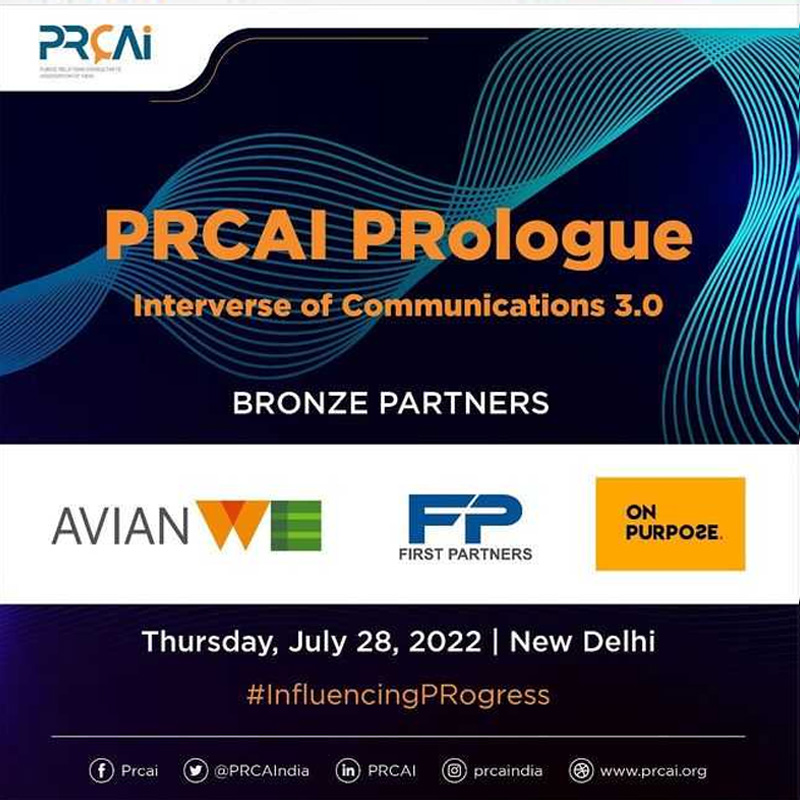
    Mumbai: The most influential PR professional body, Public Relations Consultants Association of India (PRCAI) celebrated two decades of leadership on Thursday.

    Marking the occasion, the communication body has unveild it’s new brand identity, felicitated AIPR winners and launched first edition of a much neeeed PR dialogue ‘PRologue’.

    PRCAI PRologue bringing together leaders from the communications industry under one roof to charter the future of the PR industry, taking it into a new era of Interverse of Communications 3.0.

    The first edition of PRCAI PRologue included a surfeit of influencers, industry experts, opinion leaders representing diverse companies, brands & start-ups to discuss the course of new age communications.

    PRCAI PRologue captured the pulse of new trends such as ‘Tech-ing It to the futureverse’, ‘Weaving trends with zillenials’ and ‘Re-powering ethics in communications’ through a day-long conference.

    PRCAI PRologue presented an extraordinary forum with a diverse and exemplary list of guests & panelists from renowned companies, including a keynote address by MG Motor India’s president & managing director Rajeev Chaba, and SHEROES founder Sairee Chahal.

    The speakers came from all across the country to contribute to compelling ideas and thoughts.   

     Sharing his enthralling thoughts on the occasion, PRCAI president Atul Sharma said, “PRCAI is constantly striving to create a more professional, ethical, and prosperous PR industry. In the past year through various initiatives, we have been able to bring the industry together, push our learning and development initiatives and also evangelise the profession across quarters, and the results are nothing short of remarkable. I am delighted with the focus and vision that the new team has brought to life.”

    PRCAI CEO Deeptie Sethi said, “PRCAI as an entity is reinventing itself and driving relevance for our audiences and stakeholders who are both impacting and impacted by our highly skilled industry. The launch of PRCAI Prologue, new collaborations, research driven insights are a true reflection of our new brand identity that is will take it’s members, practitioner, academicians together to #influencingPRogress into the new era of Communications leadership.” 

  • Zeel to create cross-platform content solutions for brands with Zee Brand Works

    Zeel to create cross-platform content solutions for brands with Zee Brand Works

    Mumbai: Zee Entertainment Enterprises Limited (Zeel) on Thursday announced the launch of  its brand solutions vertical Zee Brand Works.

    Zee Brand Works team will work with brands for their branding, sales augmentation, customer acquisition, new launches, content creation, influencer and integration solutions. It will provide brands and marketers with offers to enhance their reach, connect and engage with the right audience through Zee’s portfolio of TV channels, OTT platform Zee5 and social media platforms.

    Zee Entertainment Enterprises Limited chief growth officer Ashish Sehgal said “As a pioneer in the Indian Media landscape, we have always had a finger on the pulse of the Indian viewer. This has helped us to develop a deep understanding of the myriad mini-Bharat’s which exist within this great nation, each with its own set of norms, sensibilities and traditions. Blending this understanding of the Indian consumer with the marketing requirements of our clientele to develop bespoke brand solutions has always been a hallmark of ZEE.”

    Zee Brand Works chief operations officer – revenue Rajiv Bakshi expressed, “Consumers are also increasingly rewarding authenticity and personalization along with purpose-driven brand alignment.”  

    He further said, “Forging a deep emotional connect and occupying a greater share of the mind is a primary challenge for both existing and emerging brands. Zee Brand Works will further boost our endeavor to build brands’ resonance and sales in Hindi-speaking markets (HSM) and regional market clusters by employing the team’s ingenious creativity and inherent consumer understanding. With the onset of this journey, we are excited to partner with like-minded marketers and augment their growth strategies.”

    Zee Brand Works has also introduced new programs keeping audience reach across brands. It will focus on designing product launches that offer brands visibility, importance, and traction leveraging Zee’s network robustness across linear TV, OTT, on-ground and social.  

    It will also focus on offering creative solutions to young entrepreneurs to give exposure to their key successes, and contribution to companies’ success and growth.

    Zee Brand Works’ work for clients such as Pedigree, Dabur Honey Fitness, Ultra Tech Baat Ghar Ki, etc. has won accolades and it is working with advertisers such as GSK India, Pedigree, P&G, UltraTech Cement, Perfetti Van Melle, Philips India, Maruti Suzuki India Limited, Mankind Pharma, MTR Foods, Asian Paints, Swiggy and Amazon amongst others.

  • Sandu Pharma partners with Vavo Digital for digital influencer campaign

    Sandu Pharma partners with Vavo Digital for digital influencer campaign

    Mumbai: The leading name in the Ayurveda sector, Sandu Pharma, has collaboarted with India’s holistic digital marketing agency, Vavo Digital. The main objective of the digital campaign is to go beyond Sandu Pharma’s traditional set of audience of senior citizens and reach out to the younger generation and millennials by using modern mediums of advertising & influencing.

    Receiving encouraging response for the already deployed two campaigns for Sandu Pharma’s signature products – Makarprash and Gulkand, Vavo Digital is now planning to design campaigns delivering impactful key messages of the brand through collaboration with a relevant set of 15 micro and macro influencers. The key message is that the science of ayurveda has an array of options for immunity building supplements with minimal side effects yet extremely cost effective. The designing of the campaign comprises identifying the appropriate influencers that matches the image of a brand like Sandu Pharma, and who own a significant, pertinent yet real followers.

    Speaking on the collaboration, Vavo Digitq CEO & founder Neha Puri shared, “It is a matter of honour to not only be associated with a brand like Sandu Pharma but also be a catalyst for their marketing campaign with a fresh outlook. We have the advantage of working with the pioneers of the Ayurveda industry and help propagate the ideology and benefits of the age old ethnic medicinal practice to the current generation of our nation. We look forward to creating and designing effective campaigns for Sandu Pharma and delivering the key message to the end user.”

    Sandu Pharma marketing head Shivani Sandu said on the partnership, “Our interaction with VavoDigital helped us explore a new form of marketing on the social media platform Instagram. The proposed plan was to undertake influencer marketing via influencers appropriate to the brand and the product at hand. The research behind the campaigns were detailed and noteworthy. The target brand values and target audience were in tandem and thus helped achieve desired results. The team at VavoDigital is young, eager to put out the best possible campaign and values time.”

  • GUEST COLUMN: The changing dynamics of influencer marketing in a digital era

    GUEST COLUMN: The changing dynamics of influencer marketing in a digital era

    Mumbai: Influencer Marketing has evolved significantly over the past few years. As opposed to 2017, influencer marketing involves much more than finding people with the highest social media followings to promote the products. Today it’s performance and purpose-driven – that needs both art and science.

    Influencer marketing is projected to touch 2.85 billion by 2025 growing at a CAGR of eight per cent. Creator economy market size is estimated to reach $104 billion in 2022. The Indian market is becoming fairly regulated as well as digital marketing budgets are growing significantly. Having operated an influencer marketing company for the last four years, I have gathered the following insights and learnings in order to keep up with the rapidly changing dynamics of today’s influencer marketing:

    Setting the wrong goal for influencer marketing

    Most new marketers who get into influencer marketing sometimes consider it as a conversion play. It’s not. Influencer marketing is a brand awareness play. Obviously, this isn’t the ultimate goal, but if you compare the campaign to getting a return on every dollar spent, no purpose-driven impact will be achieved.

    Pursue long-term influencer partnerships

    A short-term, one-off social post is a thing of the past. Partnerships that are long-term and authentic are getting more traction right now. Treating influencers as brand ambassadors builds more trust between the brand, the influencer, and their followers. You get better audience engagement, more creative content, and your marketing budget works harder. As an influencer’s audience grows, your brand gets promoted continuously.

    Shifting from influencers to content creators

    Discovering the 20-30 top influencers is very easy, and brands with good budgets are all in to spend money on them. Basically, you’re treating these influencers like a newspaper or television show or a TV spot between IPL matches, but finding your niche is really important.

    Create open-ended briefs with lot of ideas

    The most unsuccessful influencer marketing campaigns are those in which brands force their thoughts onto influencers. Although influencers do that for money, the end result is a boring sponsored post on their feed. It’s not about telling the influencer what to do, but about giving them a detailed brief that helps and educates them about the brand. The ideas should be open-ended so that influencers can get something out of them that suits their audience, since not all influencers are great creatives.

    Focus on videos. Not always short form videos. Do what suits you

    Today, everything is snackable, but don’t we binge a long-form show with 10 episodes? Short forms are great, but it depends on the message you want to convey and what type of influencer you want to reach. It has to be entertaining, if not educational. When someone consumes the content, either of these works well.

    Using Influencers in co-creation

    Brands such as Zomato and Groww have had great success co-creating with influencers on their own channels. a no-brainer that we are living in 2022, where children these days want to become YouTubers rather than astronauts. Hiring influencers to create content that gets published on your own YouTube channel or Instagram feed gets your audience to consider you cool and progressive.

    Purpose driven influencer marketing are on the rise

    Today, our favourite influencers are those who stand for something, who just do not talk about how beautiful their life is but provide us with some value that is relevant to ourselves. Brands need to understand this well and keep this in mind while creating their influencer marketing strategy.

    Engagement metrics and comments quality dictates success

    While doing prospecting, it’s really important that we focus on engagement metrics more than followers. It is very important to inspect the comments on the last sponsored post so that we can ideally get a pattern of how sponsored posts perform on the feed of the influencer. Marketers often focus on the size of the influencer rather than the engagement they have.

    Affiliate marketing is abused and misunderstood

    Many brands are thinking that sharing revenue will lure influencers to work with them, but if your fundamental idea is that influencers’ audiences buy everything they promote, then that is a wrong assumption. It is the audience that can tell if an influencer is promoting something that generates no value and will instead push the brand down rather than up.

    Influencers in the Podcast Industry are going to be popping up more

    Audio is a great medium in today’s world because of the passive nature of it. We are all always busy, and influencer marketing in podcasts will be important for brands seeking a more meaningful long-term association with a large listening audience.

    LinkedIn is going to be the new home for a lot of content creators

    Writing is the next big thing, and LinkedIn as a platform has been really impressing a lot of professionals. It used to be a platform to seek new jobs, but now, along with the story features and great mobile experience, the infotainment content space is really serious on LinkedIn. Brands would ideally like to work with this set of influencers.

    Influencer marketing is the greatest invention for the advertising and marketing industry and we are heading towards an interesting decade where videos, NFTs, creator economy tools, etc. are going to change the way we promote our products. Every company will become a media company that creates content of their own and partners more with the creator side of influencer marketing.

    The author is Pulpkey founder Amit Mondal.

  • Marketers underspending in media campaigns affecting ROI: Nielsen report

    Marketers underspending in media campaigns affecting ROI: Nielsen report

    Mumbai: Nielsen released its first-ever ROI report, which identified gaps in marketers’ budgets, channels and media strategies that are compromising returns on investment (ROI) on media plans. The global report reveals data and delivers insights on what drives returns on ad spends, how to measure the returns, and how to improve on the metrics brands already have, with content unique to advertiser, agency, and publisher audiences.

    According to the report, about half of marketers are not spending enough in a channel to get maximum ROI. While a poor ROI might cause brands to pull back on spending, Nielsen found that spend often needs to be higher to break through and drive returns. Nielsen’s “50-50-50 gap” states that while 50 per cent of media plans are underinvested by a median of 50 per cent, ROI can be improved 50 per cent with the ideal budget.

    Beyond budgeting, the ROI report delivers key insights and recommendations to deliver higher ROI across multiple marketing areas including:

    ● Full funnel marketing: It’s rare for channels to deliver above average returns for both brand and sales outcomes, with 36 per cent of media channels faring above average on both revenue and brand metrics. To grow ROI, brands should pursue a balanced strategy for both upper and lower funnel initiatives. Nielsen found that adding upper funnel marketing to existing lower and mid funnel marketing can grow overall ROI by 13-70 per cent.

    ● Emerging media: It’s difficult for brands to spend big amounts without proof that the new media works, but spending small amounts can make it hard to see if the media is working. Nielsen found that podcast ads, influencer marketing and branded content can deliver over 70 per cent in aided brand recall, and that influencer marketing ROI is comparable to ROI from mainstream media.

    ● Ad sales growth strategy: Ultimately, ROI will inform publisher pricing power. Publishers are not just competing against others in their channel, but also against other channels, so comparing channel ROIs can help set pricing strategy. The ROI report uncovered that social media delivers 1.7x the ROI of TV, yet social gets less than one-third of TV ad budgets.

    ● Audience measurement: Campaigns with strong on-target reach deliver better sales outcomes. However, only 63 per cent of ads across desktop and mobile are on-target for age and gender in the US, meaning that on the channels with the most exhaustive data coverage and quality, over one third of ad spend is off-target. To capitalise on opportunity and drive impact, advertisers should prioritise measurement solutions that cover all platforms and devices, with near-real-time insights. 

    “Nielsen’s 2022 ROI report serves as a guide for brands, agencies and publishers. In a time when there are more channels than ever to reach desired audiences, it’s critical that insights on ROI are attainable and easy to understand,” said Nielsen vice president, media & advertiser analytics Imran Hirani. “Brands can’t afford to waste valuable ads on the wrong audiences. By investing wisely and having a balanced strategy of both upper-funnel and lower-funnel initiatives, brands can reach the right audiences and maximise their ROI.” 

    This is the first ROI report produced by Nielsen. The ROI report findings were generated by Nielsen using a wide range of measurement methods including marketing mix models, brand impact studies, marketing plans and expenditure data, attribution studies, and Ad ratings collected in recent years. In most cases, Nielsen’s findings were organised into normative databases or meta-analyses across a sample of studies to produce insights that are representative of Nielsen’s experience, providing marketers, agencies and media sellers a more complete view of media effectiveness compared to a single company drawing from its own experience.

    Check the Full Report here: https://global.nielsen.com/insights/2022/roi-report/

  • GOZOOP group bags integrated marketing mandate for Fit AF

    GOZOOP group bags integrated marketing mandate for Fit AF

    Mumbai: GOZOOP group has bagged an integrated marketing mandate for Fit AF, a homegrown whey protein brand. The brand aims to bridge the manufacturing and flavour gap existing in the Indian health & fitness industry.

    As part of the mandate, GOZOOP group will be enhancing the brand’s positioning among the target audience with strategic communication. They will be responsible for optimizing the brand search engine results and digital media capabilities as well as maintaining a consistent voice across media platforms through PR strategies. Leveraging the new age vision and mission of the brand, GOZOOP Group will also ideate and manage influencer led communications to reach out to a larger set of audiences.

    With a unique blend of protein and distinguished flavors, the aim is to offer a wholesome fitness regime and be the preferred partner for enthusiasts that live, breathe and speak fitness in a truly Indianised way. Fit AF operates under the parent company Fitride Labs Pvt. Ltd.

    Fitride Labs chief executive officer & director Aman Lalwani shared, “We believe that it is an impeccable communication strategy that helps a brand set itself apart in a populated market. It helps in the establishment of a truly distinct image that consumers can relate to. With GOZOOP Group’s experience along with their passionate & creative workforce, we are positive that it will be a victorious partnership.”

  • GUEST COLUMN: Influencer marketing trends to keep on your radar in 2022

    GUEST COLUMN: Influencer marketing trends to keep on your radar in 2022

    Mumbai: There is no denying that digital marketing in the modern era is an essential part of brand building and expansion. Not only does digital marketing open doors for brands to connect personally with their customers, but it also enables interactions across countries and cultures. Ad spending in the digital advertising market is projected to reach $565.20 billion in 2022. While digital marketing has several effective techniques that have made it the most influential form of promotion, one particular branch that stands out is influencer marketing. 

    Influencer marketing is a form of marketing where brands choose certain ambassadors or people, who are not celebrities in the actual sense but have a high social media following, to promote their products or services. Due to the boom of social media in recent years, this form of marketing has seen a tremendous rise with every brand, little or large, opting for influential people on social media to promote their products and services. According to the Digital Marketing Institute, an online forum that teaches various digital marketing techniques, around 70 per cent of the younger audience worldwide tend to trust influencers while making purchases.

    Findings by the research firm MarketsandMarkets reveal that influencer marketing is set to become a $24.1 billion industry by 2024, globally. Seeing this exponential growth it is only fair for brands to know the latest trends in the sector in order to expand their reach and generate higher revenues. 

    Rise of nano & micro-influencers

    The rise of nano & micro-influencers is a trend that seems to be at an all-time high in recent times. As per the Financial Express, high-end celebrities accounted for only about 27 per cent of the influencer marketing spend while the remaining 73 per cent was spent entirely on micro and nano influencers in India. The primary reason for this is that the engagement that comes with micro-influencers exceeds that of high-end celebrities by about seven times. 

    Nano and micro-influencers have a smaller base, generally one that they are familiar with and interact quite frequently with their followers. This makes the customers feel a personal connection with the figure causing building of trust. Through these influencers, brands can execute focused campaigns cost-effectively.

    Short-form videos will continue to rule social: 

    As attention spans shift from minutes to seconds, short video promotions will always remain the king of social media. Features like Instagram’s Reels and YouTube Shorts are made to cater to the short attention span of the modern world. 

    Brands tell their stories via a number of video formats, including product teasers, explainer videos, behind-the-scenes and user-generated content. Connecting with Bharat by partnering with creators on Indian short-form video platforms is a big opportunity that is yet to be tapped on.

    Regional content will thrive: 

    In recent months, there has been an exponential rise in the regional content that brands generate for promotional purposes. As per a report published by Financial Express, there are about 210 million monetizable internet users who speak vernacular languages in India.

    This demand for vernacular content has caused regional content-creators to carve out a strong niche for themselves. Consumers feel a strong connection with the influencer and the familiarity of the lingo gives the influencers a high trust and reliability index. 

    The shift from ‘one-off’ campaigns to ‘always on’ strategy

    The industry is shifting from experimental influencer marketing spending to planned budgets. Brands are more focused on building long-term partnerships with creators who can be the voice of the brand across all stages of the marketing funnel. 

    Rise of B2B influencer marketing

    B2B influencer marketing is one dominant trend that will emerge in the influencer marketing sphere in the times that lay ahead. In a recent article carried out by Garner, it was reported that around 80 per cent of sales in the B2B spaces are now being made digitally.

    B2B brands are for sure to leverage key opinion leaders and content-creators on platforms such as LinkedIn & Twitter in order to shape and spread their brand narrative.

    Given that now, a national advertising regulator like ASCI is issuing guidelines for influencers, the industry is being given its due and influencer marketing is being treated as a force to be reckoned with. Going forward, influencer marketing will only become a stronger part of digital marketing strategies for brands.

    The author is Opportune Ventures founder Kanishk Kanakia.

  • How do the new TDS rules impact influencer marketing in the country?

    How do the new TDS rules impact influencer marketing in the country?

    Mumbai: If you are a social media influencer, then, come July, you will have to take a tax cut on the gifts or freebies received from brands for the sales promotions of their products. The Central Board of Direct Taxes (CBDT) recently announced that gifts, samples and other promotional stuff that is given to a social media influencer will be treated as an “income” for the influencer and will attract TDS (or tax deducted at source). As per the new income tax rules, a 10 per cent TDS will be mandatory on “benefits received in cash or kind in a business or profession.” The new TDS Rules will come into effect from 1 July.

    In recent years, influencer marketing has been growing by leaps and bounds. What was a $1.7 billion industry in 2016 has since grown to become a $9.7 billion industry in 2020. In 2021, it grew to $13.8 billion and this year, the market is projected to expand to a whopping $16.4 billion industry.

    IndianTelevisionDotCom spoke to various stakeholders from the industry to find out how the new tax rules will impact the burgeoning influencer marketing industry in the country.

    While a lot of intricacies in terms of the legalities involved and how exactly it will function need to be figured out, some industry players quantified that the guidelines issued by the CBDT for social media influencers is a step in the right direction that will have a positive impact in the long run. Several believe that it will lead to a more regularised industry in the long run, but that its implementation, perhaps, requires more thought.

    According to Langoor co-founder & CEO Venugopal Ganganna, the new guidelines are an effort at bringing a greater degree of reliability and accountability to the products being promoted since the influencers will now be forced to collaborate only with those products and services they believe in.
    “Today, an influencer’s fee depends wholly on the size of their audience and following. The influencer economy is also largely driven by the promotion of free products. Taxing this freebie forces both the brand and the influencer to be more intentional about their partnership making it a win-win-win not just for the both of them, but also for the end customer,” stated Ganganna.

    TheSmallBigIdea associate director – new business Kruthika Ravindran believes the new guidelines come with its own pros & cons. “There definitely is going to be an inflation in the rates since influencers would look at paid deals with brands where they can recover their money, as compared to barter deals”. However, she adds, this will also lead to the influencers being more credible & accountable for the brands they represent and the products they endorse.

    Pointing out the challenges related to the guidelines’ implementation, Alpha Zegus founder & director Rohit Agarwal said, “The guideline requires people who are benefiting from sales promotions to ‘report’ the same in their tax returns and pay 10 per cent TDS. Problem 1 – How do you ensure that everyone reports every freebie that they have received? .

    He further added, “Many social media influencers are young, and receive products from various brands quite regularly. Some of them don’t even fall under the taxable age, while some don’t have the funds to pay TDS out of their pockets (since the product does not have a liquid monetary value).

    A lot of electronic gadgets (and similar products) have a certain MRP, but are actually sold at a much lower value than the MRP, he said. “Is the influencer expected to pay 10 per cent TDS on the MRP, or on the in-store value? All in all, the move is understandable but comes with a lot of challenges in terms of opportunities and execution.”

    On the new CBDT guidelines for social media influencers, Mirum India joint CEO Hareesh Tibrewala marked that TDS is not a new concept and when payments are made to another person, TDS is deducted and the recipient of the payment can claim a TDS credit while filing his return of income.

    Tibrewala was more scathing in his criticism of the move, however, calling it a “bit of a retrograde measure” listing out three reasons for the same: The revenue that the govt generates will be extremely minimal. Secondly, it is going to increase paperwork for the brand and the influencers. And, lastly, he feels the gifts given to an influencer are not really an income for the influencer.

    “A social influencer is able to promote a product (say a new shampoo launch) or a service (promoting a hotel) only if he is able to ‘experience’ the product or service,” he said. “Hence the product or promotional material that is given to a social influencer is not in lieu of his professional fees for doing the promotion (unlike in the case of saying the medical fraternity where the doctors are given gifts and gratification as a part of compensation for their services).”

    In the realm of influencer marketing, free goodies sent to the influencers indeed generate substantial PR for the brand. But they’re also a little one-sided, with the influencers having less to no say on whether they would be interested in receiving the freebies.

    The new rule, says SoCheers director – digital marketing Rajni Daswani, will allow for a more respectful and understanding relationship to be fostered between the brands and the influencers. “It will now require a two-way conversation when it comes to sending free packages, where both the parties can agree from the very beginning. This will also lead to setting more clear expectations between the two,” she mentioned.

    According to Tonic Worldwide director strategy Ankita Chauhan, as social media and related businesses continue to grow, the changes in the regulations and policies are going to be inevitable. Just like the past regulations of declaration of sponsored content, this too will become a part of the working process between the parties, she believes.

    Last year in June, the Advertising Standards Council of India (ASCI) issued guidelines making it mandatory for influencers to label all kinds of promotional content they post, in order to create a distinction between user-generated content and promotional advertisements. 

    According to Scrollin’ Media co-founder Samridhi Goel, the government sees as much potential in this industry to grow as much as it sees in crypto and hence they are taking steps to generate more revenue from such streams. However, she added, it should phase out in a more structured way so that it does not impact the earnings and businesses of either of the parties involved.

    Socxo CMO Ajit Narayan said that Influencer marketing is an abused channel, where influencers, be it celebrities, macro or micro-influencers are all in the game of leverage. So, if they are a business by itself, should they be exempt from taxes, he asks. “On one side is the monetary remuneration. Which is directly proportional to their fees which already is within the ambit of TDS. And why not, this is income and should be treated so.”

    However, this blanket tax on products is ‘taking it too far’. “It would have been a more thought-through approach if there were limits on freebies,” adding that the most affected will be micro and nano influencers for whom this business might be a side hobby or a corporate program. Not a good move for this segment, he concluded.

    IPLIX Media founding member & head- talent management & client servicing Arpan Soni is in agreement with Narayan, noting, “The new TDS rule will undoubtedly have an impact on the revenue of nano and micro-influencers as most of their associations are barter. However, it will not impact macro influencers to such an extent as they majorly undertake paid collaborations only.”

    The best strategy for aspiring and budding creators will be to charge a nominal fee for the amount they’ll have to pay later on, Soni adds. “While we’ll definitely have to wait and watch to see the real impact it will have, at this juncture, creators, brands, and even agencies are waiting for more clarity.”

    On the other hand, influencer marketing startup ClanConnect co-founder and COO Kunal Kishore Sinha believes that there will be minimal impact on micro and nano influencers, who will continue to work on barter and paid collaborations on a scale that isn’t taxable.

    He stated, “The only big difference, then, will be that brands that currently offer such freebies will minimise making payments in kind and prefer cash transactions. Simply put, this is a positive move and will only lead to the growth and evolution of the influencer marketing ecosystem with no major change in influencer activities and opportunities.”

    He also agrees that the government recognising the influencer marketing space as a mainstream business worthy of regulation is a positive development for the entire industry.

    Gaming talent management agency 8bit Creatives founder and CEO Animesh Agarwal too believes it to be a logical step. “Given that influencers receive the products, in exchange for providing the promotional service, it is income for them, and liable to tax, as per the fundamental principles of income tax. This move is also one of the first few official recognitions of the creator economy by the tax department, which is important for any industry to grow.”

    “The 20K threshold is a welcome exception because it spares smaller creators and numerous modest home brands the hassle. Additionally, this TDS is not applicable in the case of returnable products, which is also logical. All in all, I feel the move is an indication of how bullish the government is on the creator economy, and how far we have come,” he further says.

    Several of the influencers themselves while being sceptical about the impact of the move believe the new guidelines will definitely lead to a drop in barter deals being undertaken, making it slightly difficult for new influencers to enter the market.

    Social media influencer Cherry Mardia shared, “A lot of influencers are lured by corporate freebies like vacations & gadgets. Since there will be a tax on this, both parties now- the brand & the influencer being taxed, both will be equally involved & mindful while promoting it vs an influencer being a passive consumer of a free gift.”

    Content creator, podcaster, entrepreneur, and author Varun Duggirala added that while the idea comes from the right place, the system needs to be thought through. “For any regulation to work the system or process needs to be in line with how these transactions happen in reality, and therein lies the concern with this announcement. The creator space is still largely chaotic and this can very easily add to the chaos rather than help in systematising it.”

    According to another influencer, The Bajis, “Collaborations like this foster the relationship between the creator and the brand and thus, help both of them grow parallelly. Therefore, eradicating them from the picture completely might become an obstacle to the growth of small and medium businesses along with creators.”

    Aaliya Ilyasi, another influencer with a sizeable following, states that the problem arises because the creator now has to pay tax on a good/ service that they are not getting paid for in the first place! “Small-scale influencers and even small businesses start with barter collaborations to build a portfolio and it helps them get recognised by other creators and brands which then leads to more monetary gigs for these influencers and low-cost high return sales for the brands.”

    On the bright side, several of them feel that this also recognises ‘being an influencer’ as ‘an actual job’, and dignifies the hours that they put into content creation as work, which will essentially translate into growth and progress for the industry.
  • GUEST COLUMN: Influencer marketing in ‘new normal’ digital domain

    GUEST COLUMN: Influencer marketing in ‘new normal’ digital domain

    Mumbai: Influencer marketing (IM) has made a big mark in the social media space. It has become a serious business and reached the multi-billion-dollar mark like any other industry and is estimated to surpass $37 billion by 2027, according to Statista report.

    IM platforms track these numbers with the help of analytical and influencer relationship management tools.

    Influencer marketing on the rise

    At the nascent stage about a decade ago, influencer marketing was all about celebrity names. Fast forward to today, influencers are not limited to only celebrities; they have become brands themselves with their appealing content. The authenticity and uniqueness of the content make influencers stand out among the crowd. The influencer marketing space has become competitive like never before, with brands’ adopting IM as an integral part of their digital marketing strategies.

    Brands calculated metrics like Return on Investment (ROI) in traditional marketing. When it comes to influencer marketing, the most effective way is to understand the influencer’s role on the conversion path, which goes way beyond the number of ‘Likes’ and ‘Shares.’

    Introducers introduce the brand in the consumers’ mind space

    Contributors ensure to create an impressive brand recall and are at the top-of-the consumer’s mind while they contemplate a purchase decision. Closers are the real deal closers and persuaders who drive the purchase decision.

    Influencers are often introducers and contributors, so evaluating their contribution is critical during the complete attribution plan. They are media partners who help the brand spread the message aloud.

    Creativity and social media are becoming one collaboration

    Creativity is prized above all, and influencers combining their creativity with social media reach is an incredible amalgamation. Collaborating with an influencer who is a celebrity with a massive following to create brand awareness or a micro-influencer targeting a specific audience depends on the brand’s ultimate goal.

    The lifestyle and fashion industry are at the forefront leveraging the benefits of influencer marketing. MAC Cosmetics India’s makeup tutorials, live sessions, and stories on social media platforms were instant hits among millennials.

    Daniel Wellington, the luxury watch brand, roped in influencers from all tiers to spread its brand awareness. The brand has successfully implemented this strategy for new product launches and upcoming sale seasons.

    The creative collaborations have helped brands monetise their marketing strategies and are gaining momentum in other sectors as well.

    Meta influencer – the new age influencers

    Creativity is set to reach another level with meta influencers in action. There were over 150 virtual influencers identified in 2021. The war between real and virtual influencers will be a tough one to watch out for in the future.

    Meta influencers have the might to identify the latest trends and share quantifiable results with Artificial Intelligence (AI) and Machine Learning (ML) techniques. Every part of the world is creating its meta influencers army.

    The first Indian meta influencer – ‘Kyra’ engages customers with her virtual avatar. She is an intelligent meta influencer who can create and publish her content. Kyra can be integrated with metaverses, music videos, 3D films, and so on.

    The real influencers are giving a tough fight with their digital doubles – a replica of real influencers to promote specific events and spur the excitement level. Amazon sponsored Justin Bieber’s virtual avatar to release a music album in November 2020.

    With the meta fever catching up, it will be fun to watch bespoke content in the metaverse.

    Inclusive marketing strategy

    An inclusive marketing strategy can create a 360-degree impact. Ethically it helps to imbibe inclusivity in the brands’ culture as the new normal, and strategically, it builds sustainable long-term growth. Brands must choose influencers that relate to the audience and a marketing plan reflecting their ideology. Influencer integration for inclusive marketing is the road ahead, whether in the real or the metaverse world.

    (About Author: Shuchi Sethi is an influencer marketing expert with over six years of experience in influencer marketing. She currently leads Anymind Group’s AnyTag’s influencer programme in India)