Tag: Indonesia

  • AsiaPac leads global ad growth: Nielsen

    AsiaPac leads global ad growth: Nielsen

    MUMBAI: Global advertising expenditures were up 3.2 per cent in the third quarter of 2013 for year-over-year period, driven largely by Asia Pacific’s expanding powerhouse ad market, as well as a bottoming out of Europe’s contracting ad market.


    According to Nielsen’s latest Global AdView Pulse report, Asia Pacific ad revenues surged seven per cent in the first nine months of 2013. China was up 16.7 per cent, Indonesia 22.1 per cent and Malaysia 15.7 per cent. The gains offset declines in Australia and South Korea.


    Television continues to be the favourite medium through which advertisers attempt to reach their consumers, commanding a 57.6 per cent share of all spending and growing 4.3 per cent. Display Internet, though representing a smaller share of spends at 4.5 per cent grew significantly by 32.4 per cent.


    Macro sectors contributing to the growth include FMCG, which saw a 5.9 per cent increase in ad spending for the year-to-date, and Industry & Services, which grew 11.3 per cent.


    The period also saw a slight improvement in Europe, with the market down just 0.4 per cent in Q3. Nielsen notes that the region’s ad market appears to be bottoming out. Indeed, Italy and Spain, among the hardest hit, may have the worst behind them, the report notes, and Greece saw its ad revenues gain 10.3 per cent.


    In the US the market was up 1.7 per cent by the end of September, even though it fell 1.3 per cent in the third quarter itself. And in Latin America, the year-on-year change was 13 per cent.

  • ZEEL expands to Indonesia, launches Zee Bioskop

    ZEEL expands to Indonesia, launches Zee Bioskop

    MUMBAI: Of late, Zee Entertainment Enterprises Limited (ZEEL) has been making headlines for its expansion plans the world over. It isn’t just taking the existing channels from India to the international market but is also coming up with new channels to cater to the local people of the countries they want to reach out to. In the present case, they have done just that.


    In order to expand in the south East Asia market, it has launched a movie channel in Indonesia, aptly titled Zee Bioskop (Bioskop means cinema in Bahasa, the local language of the country). The last time Zee introduced a channel in this region was five years ago – Zee Variasi in Malaysia, again a local Bollywood movie channel.


    Zee Bioskop, which has been launched today, is currently available only on Aora TV as a pay channel and is beaming off satellite Measat 3a. With the tagline – ‘Bollywood Banget’, which means ‘bollywood excessively’, the channel will showcase the best of Bollywood movies dubbed in Bahasa Indonesian.


    An official announcement about the launch will be made in January in Jakarta, the capital, where the office of Zee Bioskop is located. As of now, the officials are working on increasing the distribution of the channel.


    Since Indonesia is the world’s fourth most populous country with not too many movie theatres showing Bollywood movies, the company is trying to cash in on the situation. “Our focused study group showed that Indonesians wanted to watch Bollywood movies and with Bioskop we are targeting the local audience and not the Indians in Indonesia,” says a highly placed source from Zee.


    Bioskop will air comedy, action, thriller, drama and romantic movies. Activities on Facebook and Twitter have already started to promote the channel. “This initiative is going to make not just Zee but also Bollywood movies popular in the Indonesian market,” says the source.


    Movies like Delhi 6, Shaitan, Aa Dekhen Zara, Oh My God, Vivaah, Love Story 2050 etc are in the current line-up. The channel will come under the APac area and will be headed by Asia-Pacific business head Sushruta Samanta. There are other Zee channels already present in the region since many years.

  • Global ad spend goes upward in the first half of 2013

    Global ad spend goes upward in the first half of 2013

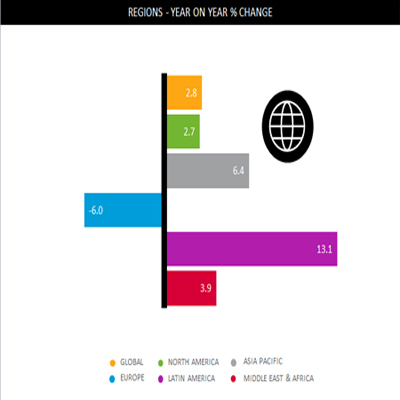
    NEW DELHI: Ad spends grew by a substantial 6.4 per cent in the first half of 2013, making it the largest growth among different regions of the world.


    Marketers continue to gradually increase their global ad spending, as expenditures grew 3.5 per cent in the second quarter of 2013 and 2.8 percent on a year-over-year basis for the January-June periods of 2013 and 2012, according to Nielsen’s quarterly Global AdView Pulse report.


    Although many marketers remain conservative with advertising budgets, those in Latin America continue to buck the norm, increasing their expenditures by 13.1 percent (to $13.5 billion) for the January-June period.


    All regions contributed to global growth for the first half of the year except Europe, where marketers remain modest with their ad budgets amid the regions’ continued fiscal crisis, resulting in a six percent decline for the period. Ad spend continued to recover after slumping during the economic downturn, with growth of 3.9 percent in the Middle East and Africa, and 2.7 percent in North America.


    Argentina contributed significantly to growth for the Latin America region with nearly 30 per cent growth. Indonesia, China and the Philippines all contributed to double-digit ad growth in Asia-Pacific for the first half of 2013, with expenditures reaching $51 billion. In Europe, ad spend increased in Norway, Switzerland, and Greece (2.5 per cent, 0.6 per cent, and 7.4 per cent respectively), while expenditures declined in all other countries in the region.


    Nielsen Global AdView Pulse measures ad spending for TV, newspapers, magazines, radio, outdoor, cinema and Internet display advertising. Ad spend is based mainly on published rate-cards. Some markets may exclude select media due to data availability.


    The external data sources for the other countries included in the report are:


    Argentina: IBOPE
    Brazil: IBOPE
    Croatia: Nielsen in association with Ipsos
    Egypt: PARC (Pan Arab Research Centre)
    France: Yacast
    Greece: Media Services
    Hong Kong: admanGo
    Japan: Nihon Daily Tsushinsha
    Kuwait: PARC (Pan Arab Research Centre)
    Lebanon: PARC (Pan Arab Research Centre)
    Mexico: IBOPE
    Pan-Arab Media: PARC (Pan Arab Research Centre)
    Portugal: Mediamonitor
    Saudi Arabia: PARC (Pan Arab Research Centre)
    Spain: Arce Media
    Switzerland: Nielsen in association with Media Focus
    UAE: PARC (Pan Arab Research Centre)

  • Nielsen: Global ad spend up in first half of 2013

    Nielsen: Global ad spend up in first half of 2013

    MUMBAI: Global ad spend has hiked 2.8 per cent on a year-over-year basis for the first half of 2013, according to Nielsen’s Global AdView Pulse report, which finds that marketers in Latin America had the highest increase in spending for the period.


    For the second quarter of 2013, expenditures grew 3.5 per cent.


    All regions contributed to the global growth, except Europe, where there was a six per cent decline for the period from January to June. Latin America was booming, with gains of 13.1 per cent to $13.5 billion. There was a quarterly growth of 3.9 per cent in the Middle East and Africa. The Asia Pacific had growth of 6.4 per cent and North America of 2.7 per cent.


    Within Latin America, Argentina contributed significantly to the growth in the region, with a nearly 30 per cent increase in ad spending. Indonesia, China and the Philippines all contributed double-digit growth in the Asia Pacific for the first half of the year, with expenditures reaching $51 billion. In Europe, ad spending was up in Norway (2.5 per cent), Switzerland (0.6 per cent) and Greece (7.4 per cent), though all other countries in the region saw a decline.

  • Social Media is Important to Majority of Indians: Ipsos Study

    Social Media is Important to Majority of Indians: Ipsos Study

    MUMBAI: Majority (58 per cent) of Indians say social media is important to them; compared to 42 per cent globally, according to a new poll of online respondents conducted by Ipsos OTX – the global innovation center for Ipsos, the world’s third largest market and opinion research firm.


    “As Mahatma Gandhi rightly said – ‘action expresses priorities’, social media is well on its way to being a priority as majority of Indians who have access to the internet claim social media is important in their lives,” said Ipsos India head of marketing communication Biswarup Banerjee.


    “With proliferation of mobile internet in India, social media has become a part of everyone’s life, it influences people’s daily life and how they interact with each other. Social media has now become a mainstream way of communicating – for individuals as well as businesses,” added Banerjee.


    The big social media story is told in the demographics, especially age. Age appears to be the strongest demographic driver of placing importance on social media in India. Indeed, a big majority (62 per cent) of those under the age of 35 rate social media as important vs. 58 per cent for those aged 35-49 and 44 per cent for those aged 50-64. Women (64 per cent) seem more likely than men (54 per cent) to rate it highly.


    The countries with the highest proportions those indicating social media is important to them are from: Turkey (64 per cent), Brazil (63 per cent), Indonesia (62 per cent), China (61 per cent), Saudi Arabia (59 per cent), India (58 per cent), Mexico (54 per cent) and South Africa (52 per cent). This group of social media lovers is followed by Argentina (45 per cent), Russia (44 per cent), Spain (42 per cent), Poland (37 per cent), Hungary (36 per cent), Sweden (35 per cent), Germany (33 per cent), Great Britain (33 per cent) and the United States (32 per cent). The lower group includes: Australia (30 per cent), Italy (30 per cent), Belgium (29 per cent), Canada (28 per cent), South Korea (28 per cent), Japan (24 per cent) and France (17 per cent).


    Ipsos conducted this study among 18,002 people in 24 countries in the month of July.

  • 69% Indians feel SMS is an easier way to express than in person: Ipsos Study

    69% Indians feel SMS is an easier way to express than in person: Ipsos Study

    MUMBAI: Seven in ten (69 per cent) Indians admit they say things in that they would not say voice-to-voice or person-to-person; compared to 43 per cent globally, finds a new poll conducted by Ipsos OTX – the global innovation center for Ipsos.


    “Text or Email is comparatively an impersonal medium and people feel less hesitant to speak their mind. Perhaps that is the reason why majority of Indian would rather avoid saying things in person or over phone,” said Ipsos – head marketing communication Biswarup Banerjee.


    “For example people prefer to share sensitive comments like – “I love you.” “Our relationship is over.” “You are fired.” “I failed in exam.” in writing rather than saying over the phone or face-to-face to avoid embarrassment when they are physically involved,” added Banerjee.


    Demographically in India, age appears to be the most significant variable as those under the age of 35 (75 per cent) are considerably more likely than those aged 35-49 (67 per cent) and those 50-64 (52 per cent) to text/email things they won’t say out loud. Education is also a significant factor as seven in ten (69 per cent) of those with a high level of education say they do so compared with 100 per cent among those with low education. Both Indian women (70 per cent) and men (68 per cent) feel more comfortable texting or emailing sensitive subject rather than voicing it out.


    Strong majorities in China (90 per cent) and South Korea (80 per cent) say they text or email things they would not say over the phone or in person. Seven in ten of those in Indonesia (76 per cent), India (69 per cent) and Saudi Arabia (67 per cent) say so. Following next are Turkey (58 per cent), Brazil (48 per cent), Japan (46 per cent), South Africa (45 per cent), Argentina (42 per cent), Mexico (42 per cent) and Russia (39 per cent). Only three in ten or less in most of the countries surveyed say they reserve some communication for text or email: Canada (34 per cent), Australia (33 per cent), France (33 per cent), Great Britain (32 per cent), Poland (32 per cent), Belgium (31 per cent), Italy (31 per cent), United States (30 per cent), Germany (25 per cent), Hungary (24 per cent), Spain (24 per cent), Norway (22 per cent) and Sweden (22 per cent).


    Ipsos conducted this study among 18,502 adults in 25 countries in the month of August.

  • Zee Cafe to exclusively broadcast Miss World in India for the sixth year in a row

    Zee Cafe to exclusively broadcast Miss World in India for the sixth year in a row

    MUMBAI: The English general entertainment channel from the Zee stable, Zee Cafe will yet again showcase Miss World 2013 Live, as stunning women from across the globe fight it out at Indonesia for the esteemed title.

    Zee Cafe will exclusively telecast Miss World 2013 Live in India on 28 September in the early hours at 5:00 am with a repeat telecast at 7:30 pm on the same night. Miss World will additionally be simulcast on Zee Studio. India’s very own Miss India World Navneet Kaur Dhillon will by vying for the crown with the most beautiful women for the title of Miss World 2013.

    “I was a child, and when Aishwarya Rai won miss world – my father was watching that show on TV and he said when my daughter grows up she will become miss world. So after that whenever anyone asked me about what I wanted to be I always said ‘I want to become Miss World when I grow up!” said a very excited and nervous Navneet who will represent India at the pageant on Saturday.

    The Miss World pageant is the oldest surviving major international beauty pageant. The dazzling contestants from all across the globe compete for a month in a series of events including top model and beach fashion before the winner is crowned on the day of the grand finale. The winner spends a year travelling to represent the Miss World Organisation and its various causes. The Miss World Organisation owns and manages the annual Miss World Finals; a competition that has grown into one of the world’s biggest.

    Speaking on the occasion, Zee Network business head – niche channels Anurag Bedi said, “After the success of the Live and exclusive telecast of the recent Emmys we aim to further raise the bar by bringing the 63rd Miss World pageant to our viewers. Zee Cafe is proud to be associated with the legacy of Miss World which is one of the most prestigious pageants in the world – sixth consecutive year in a row. Miss World has always generated a huge amount of interest amongst Indian viewers and is one of the flagship events that they look forward to on our channel.”

  • New Adventure travel series ‘Freedom Riders Asia’, Celebrating man and motorcycle on the move, debuts on ESPN India on 19 may

    New Adventure travel series ‘Freedom Riders Asia’, Celebrating man and motorcycle on the move, debuts on ESPN India on 19 may

    MUMBAI: Well-known motorcycle adventurer Charley Boorman rides onto screens in Asia with the debut of Freedom Riders Asia, a six-part adventure travel series celebrating man and motorcycle on the move across six Asian countries. A premiere screening held today in Kuala Lumpur, Malaysia, showcased the first episode of the series that was shot in Malaysia, which will be aired on Sunday 19 May 2013 on ESPN India at 2100 HKT.

    Conceptualised and developed by FOX One Stop Media, the integrated sales arm of FOX International Channels (FIC), News Corporation’s international multi-media business, in close collaboration with global lubricants brand Shell Advance Motorcycle Oil, Freedom Riders Asia sees Charley Boorman, one of the world’s most renowned and recognised bikers, embark on a journey to explore the colourful biking landscapes of Malaysia, Indonesia, India, Vietnam, Thailand and the Philippines.

    From picking tea leaves on the hillside plantations of India, to surfing the legendary waves of Bali’s black sand beaches, Charley meets local biking communities and incredible personalities along the way who show him the delights of each city and the way of life from the back of a motorcycle. In each episode, Charley immerses himself in each country’s unique biking culture, quite often with surprising results.

    In the debut Malaysia episode, viewers will get to see Charley learn the important role the motorcycle plays for many individuals in their daily lives along with taking on a challenge with a well-known local biking personality that will see him fighting for his very reputation!

    Kar-Tai Koh, Shell Advance Global Brand Manager, said: “After six months of hard work and a truly collaborative effort, I am extremely proud of the outcome of Freedom Riders Asia. We really wanted the series to be about celebrating and connecting bikers around Asia; and who better to help us achieve this than Charley Boorman? This is part of Shell Advance’s efforts to empower bikers to experience more freedom on the road in their day-to-day lives and enjoy every ride. I would like to thank FOX for this great working opportunity, our featured local guests as well as all relevant parties involved in making this show possible.”

    Simeon Dawes, Senior Vice President, Advertising Sales and Partnerships, Asia Pacific & The Middle East, FOX One Stop Media said, “One of the objectives of this unique programme is to showcase the diversity of Asia through its different motorcycling cultures, and I believe Freedom Riders Asia has done exactly that, while shedding light on how integral the motorcycle is to the daily lives of so many. This truly has been an exciting collaboration with Shell Advance, and I hope that audiences across Asia will enjoy watching this series as much as we had in making it!”

    He continued, “FOX SPORTS is committed to bringing motor sports fans across Asia the most comprehensive line-up of premier action from around the globe and the region with the live coverage of events such as MotoGP and Superbike World Championships. Freedom Riders Asia is another such initiative that provides fans a unique dimension about motor sports from beyond the motorcycle racing scene.”

    Charley Boorman said: “What I loved most about the Freedom Riders Asia experience was the opportunity to meet locals with larger-than-life characters and ride with passionate bikers in a completely different part of the world. This is indeed a bike trip of a lifetime that I will always remember. The first episode is as exciting as the next, and I hope that the audience in Asia will stay close and enjoy the series as they experience Asia with me!”

    The airing schedule* is as follows:

    Episodes
    Date
    ESPN India
    Ep 1    Malaysia    19 May    16:00
    Ep 2    Philippines    25 May    16:00
    Ep 3    Indonesia    2 June    16:00
    Ep 4    India    9 June    16:00
    Ep 5    Vietnam    16 June    16:00
    Ep 6    Thailand    23 June    16:00
    *Note that there will be three repeats for each episode. Refer to http://tv.foxsportsasia.com/ for repeat schedule.

    Keeping in mind fans desire to deep dive into their favorite sports, a special digital initiative in form of the Shell Advance YouTube page (http://www.youtube.com/user/shelladvance) has been set up where fans can catch exclusive content such as very interesting behind the scenes clips as well as catch up on any missed episodes.

    To reach out to a larger audience base across different demographics and genres, Freedom Riders Asia is being promoted extensively across Fox International Channels Asia’s family of channels such as FOX, National Geographic and FX


  • Facebook launches Messenger app on Android

    Facebook launches Messenger app on Android

    MUMBAI: Facebook has launched a new messenger app for Android phones which will allow mobile users to sign up for a messenger account with name and phone number and send messages to their phone contacts instantly.

    The app has been launched on Messenger for Android, first in India, Australia, Indonesia, Venezuela and South Africa, and then to countries soon.

    "Users can now sign up for a messenger account with just their name and phone number, so they can send messages to their phone contacts instantly," Facebook said in a statement. "The goal is to make the new messenger experience better by expanding its reach and giving its users the ability to connect with all of their phone contacts."
     
    The Messenger will allow anyone with a phone number, and not just those on Facebook, to send and receive messages. While an update to Messenger for Android is available today, the Messenger accounts will become available over the next few weeks. It is a stand-alone mobile application and is free to download. It will use customer‘s existing data plan.

    People who do not have the Messenger app on their phone will receive chats and messages sent to them wherever they log on to Facebook.

  • India more lenient towards media’s coverage of economic downturn: Study

    India more lenient towards media’s coverage of economic downturn: Study

    MUMBAI: While the world stands to blame the media for keeping them blindsided to the severity of the economic crisis, about a third of Indian respondents do not rest all blame on media, reveals the latest 52-nation online survey conducted by The Nielsen Company.

    India figures ninth on the list of countries who disagree with the view that news media did not do a good job of informing them of issues that led to the economic downturn in India.

    The general consensus among consumers across much of the world is that the media did a poor job informing the public about the issues leading up to the current financial crisis. In India too, 45 per cent of the respondents agreed that media coverage was inadequate but the number of people who disagree is also quite large.

    The two regions where consumers were most dissatisfied were Europe and North America. Not surprisingly, these were the areas hit the most by the current economic crisis. On the other hand, consumers in many Asia Pacific nations, where the impact on the economy hasn’t been as harsh, were generally less critical of the media.

    “In the recent Nielsen Global Consumer Confidence study India was ranked third on confidence levels. The comparatively high level of confidence that Indians have in their economy might be a reason why Indians have shown more mercy towards media coverage during the downturn than the rest of the world. Also the fact that India didn’t face a full blown downturn helped the media to save itself from consumers’ ire,” said The Nielsen Company India associate director – consumer research Vatsala Pant.

    The study states that not only do fewer Indians blame media for its past coverage of the downturn, but with 70 per cent votes, India is ranked third in the list of countries who think that the current media is doing a good job in helping them understand the issues affecting the global economy. Indian respondents also agree that media is helping them to better understand what the governments are doing to solve the economic problems at hand (61 per cent – 6th highest globally).

    Attitudes about early media coverage were most positive in the Philippines, Pakistan, Indonesia, Venezuela and India, all of which scored above the global average.

    Factors that drove the failure to communicate were varied.

    Some critics have argued that the financial media was too close to those it covered. Moreover, the speed of negative events following the Lehman Brothers bankruptcy filing caught not only journalists by surprise, but also economists and government officials.

    Globally, many of the 25,000-plus consumers polled believe media performance has improved over time. In much of the Asia Pacific region, the public thought the media was doing a good job in providing information about what the issues are and what governments are doing to address them.

    57 per cent Indian respondents think that the amount of current news coverage of the global financial crisis is just about right for them, 23 per cent think it’s not enough for them and 20 per cent think there is too much coverage.