Tag: indiantelevision.com

  • Ten Sports’ Arun Poddar appointed Zee Turner CEO

    Ten Sports’ Arun Poddar appointed Zee Turner CEO

    MUMBAI: It’s all happening at Subhash Chandra’s Zee Group as the network aims to move up a gear on all fronts. Even as Zee Telefilms moves to split its broadcasting business into three entities — news operations, broadcast and content creation, and Siti Cable — there is also action on corporate hierarchy front.

    The Zee Turner distribution bouquet has appointed a new CEO in Arun Poddar, currently vice-president (distribution), Ten Sports. Poddar, who has already put in his papers at the Dubai-based sports channel, is expected to take up his new assignment by the second week of April.

    Poddar’s move to Zee was confirmed to Indiantelevision.com by a senior executive in the company who said, “Arun Poddar is a fine professional and we expect that he will take Zee Turner to greater heights.”

    As regards the present Zee Turner CEO Siddharth Jain, it is not clear at this juncture but the expectation is that he will likely be reassigned to a different position within the group.
    Poddar cut his teeth in the distribution business with ESPN Star Sports. From there he moved on to news channel India TV as vice-president (distribution). He joined Ten Sports as head of distribution in April 2005.

  • Amitabh Srivastava quits Walt Disney India

    Amitabh Srivastava quits Walt Disney India

    MUMBAI: The Walt Disney Television International (India) director affiliate relations Amitabh Srivastava is quitting the company in search of news challenges.

    Today, was his last day in office.

    A company spokesperson confirmed the same to Indiantelevision.com, citing that no replacement had been found as yet.

    As director affiliate relations, Srivastava was mandated with the task of working with Disney India’s distribution partner, Star India, to manage all aspects of cable and satellite distribution and network development.

    For the last couple of months however, Srivastava was working closely with Disney India director business development Shantanu Nalavadi in strategising and executing Disney’s growth initiatives for India across television, licensing and merchandising, radio, on-line gaming, mobile and broadband content, studio, home video, publishing and animation.

    Srivastava joined Disney in January 2005 from the TV Today Network where he was head of distribution and network development. He was an integral part of the team at TV Today, which helped in launching Aaj Tak and Headlines Today.

    Prior to his stint with TV Today, Srivastava was with BBC World’s Indian operation and has also held senior management positions at MTV and The Times of India.

    On being queried as to where his next destination would be, Srivastava said, “I’m taking a break right now and have not yet decided where I am going.”

  • Sahara One firms up Hindi music channel launch timeline

    Sahara One firms up Hindi music channel launch timeline

    MUMBAI: Sahara One Media and Entertainment Limited is all set to launch its Hindi music channel. “We are launching the channel in the next few weeks,” said Sahara One Media and Entertainment CEO Shantonu Aditya.

    Indiantelevision.com had earlier reported that Sahara would be launching a music channel to expand its bouquet of entertainment businesses.

    The music channel will be encrypted but free-to-air. “We are big in Bollywood. A music is a natural extension for us. It will be a free-to-air channel at this stage,” Aditya said.

    The name of the channel has yet to be finalised. The company launched its movie channel Filmy in February.

    Sahara One head Shailendra Singh said, “I am delighted to inform that we will soon be launching our next channel, which will be a Hindi music channel. It will cater to millions of music lovers across India and worldwide. Along with Sahara One Television and Filmy, our music channel will complete the genres of mass Hindi entertainment from Sahara One, and will strengthen our bouquet immensely.”

    According to a statement issued by the company, Sahara One’s forthcoming Hindi music channel will showcase the best of Hindi music from Bollywood films and non-film albums, along with music events and original programming.

    Aditya said, “As a genre, music channels have tremendous potential for mass acceptance and popularity, and we will try to give the same kind of innovativeness to our music channel’s programming that is seen on Filmy and Sahara One Television.”

    He further added, “The new channel will also provide excellent synergy to the motion pictures business, which produces several films each year, thereby creating a lot of fresh content for our television businesses. In fact, Sahara One Motion Pictures, Sahara One Television, Filmy and our music channel will all be mutually supportive of one another and will enable us to deliver tremendous value to viewers and advertisers alike.”

  • Dish TV MD Sunil Gupta on way out

    Dish TV MD Sunil Gupta on way out

    MUMBAI: Zee’s DTH service Dish TV, which will soon be demerged as part of a major overhaul to streamline Subhash Chandra’s broadcasting business, is also seeing changes in its top management.

    Sunil Gupta, who joined Dish last November as managing director from Coke India where he was VP external affairs, South Asia, is leaving what is currently India’s only private DTH operator.
    Chandra confirmed to Indiantelevision.com that Gupta, whose initial responsibilities when he came aboard included increasing Dish TV’s subscriber base and penetration of the service across the country, would soon be leaving the company.

    Gupta was working along with Dish TV CEO Sunil Khanna in leading New Era Entertainment Network Limited (NEENL), which manages the affairs of Dish TV. Zee Telefilms holds 20 per cent stake in the company.

    Gupta has earlier worked with The Times of India as well as had a stint at Jain TV as COO.
    Dish TV is close to 1 million subscribers and is signing up around 3,000 customers a day. The average revenue per user (ARPU) is reportedly running at Rs 200 per month with services subsidised through the provision of a free annual subscription after a one-time charge of Rs 4,000.

  • ‘Organising a fashion event is a question of management – order, discipline, logistics, delivery’ : Simon Lock – IMG Fashion Asia Pacific managing director

    ‘Organising a fashion event is a question of management – order, discipline, logistics, delivery’ : Simon Lock – IMG Fashion Asia Pacific managing director

    IMG Fashion Asia Pacific MD Simon P Lock, the man who thrust Australian fashion onto the world stage, is in town for the Lakme Fashion Week, which kicks off tomorrow in Mumbai and runs till 1 April 2006.


    Lock, the founder and former CEO of Fashion Innovators (AFI), as too the region’s premier fashion event, Mercedes Australian Fashion Week, took over as head of IMG Fashion AsiaPac after his company was bought out by IMG in October 2005. The acquisition by IMG also included the management and production of the Mercedes-Benz Start Up program in Australia and New Zealand, the Mercedes-Benz Asia Fashion Award program that is currently held in six countries throughout Asia, the Singapore Fashion Festival and other fashion events around the Asia Pacific region in development, including events in India, China and Japan.


    Indiantelevision.com’s Ashwin Pinto caught up with Lock to find out more about IMG Fashion and its plans.

    How has IMG expanded its presence in the fashion world in the past five years?

    Quite significantly! Here in the Asia Pacific they acquired my company in Australia AFI which produces the Mercedes Fashion Week in Sydney. It also produces the Singapore Fashion Festival. So that has become a part of IMG Fashion family. In India we have the Lakme Fashion Week. New fashion weeks have started in many cities including Los Angeles and Miami. IMG Fashion is also involved closely with a number of Fashion Weeks in Europe.

    Anything else?

    IMG Fashion also has IMG Models. I am involved with developing that sphere as well and we are doing a lot of work in the Asia Pacific region. IMG Models represents some of the leading models in the world. They include Kate Moss, Heidi Klum and Giselle Bundchen. My role is to look for opportunities for those girls in Asian markets. My job is also to spot new talent who can become a part of the IMG fold globally.

    In what way has the business model evolved along with the industry?

    The business model of IMG Fashion is primarily based on the ownership and the development of fashion events. They can be trade events for the industry or events for the public who are fans of fashion. The revenue model revolves around contributions fro m designers to participate in these events and also sponsorship to drive the events.

    How difficult is it to find sponsorship?

    It is always a challenge. You are competing with other parts of the marketing spend. This is the advertising spend, public relations spend. IMG has vast opportunities because it has such good significant properties around the world.


    So if you are an international brand like Lakme or Olympus or Mercedes Benz and looking to create an association with the fashion industry and therefore reach consumers then IMG Fashion can be a valuable partner for you.

    How has the takeover of the takeover of IMG by investment company Forstmann Little & Co impacted the company?

    It has added value to both management and the operational structure. Forstmann has great vision which they have been able to transfer into the development of IMG Fashion. They are bringing in some new things like a focus on the internet and new media.

    We are seeing designers images going up on the Internet straight away and retailers copying them. Many designers are considering pulling out of online galleries

    How is IMG Fashion looking to leverage the Internet and new media?

    New York is the best example of what we are looking to do. Recently we created a partnership with Microsoft and Sprint to deliver fashion show content online.


    This is the first time it has been done live anywhere in the world. It was successful. The site imgfashionworld.com started to rank alongside other great event sites around the world like Wimbledon, US Open. It is a win win value proposition and allows us another window to showcase our collection.

    Is the mobile also an opportunity?

    Definitely. We are in discussion with a lot of operators. With the advent of 3G and mobile, TV people are coming to grips with what the consumer wants. Do they want five minutes edited highlights of fashion shows? Do they want to be able to see what is happening backstage? Do they want critiques? Do I want to watch it while traveling on a bus or while I am at work?


    As consumers we do not know what we want out of this new media. But IMG Fashion is well positioned to deliver the content in whatever manner it suits the consumer. It is a question how we apply content to the medium.

    How important a market is India for IMG from the fashion side compared to other Asian countries?

    It is significant and we have been here for six years already. India has a vibrant fashion industry that we are partners with. India has a huge growing consumer population. They are getting more involved with fashion.

    Could you talk about some of the learnings from other countries that you have applied for the Indian market?

    Lots! I have been running fashion Weeks for 10-12 years. We bring 20 years of running them and it benefits India. There is a lot of detail, procedure, information.

    What are the ways in which IMG is leveraging the synergies between fashion and the worlds of music and entertainment?

    We did an innovation recently in Singapore. This was a collaboration with MTV. We produced a special MTV Fashionably Loud. This the epitomy of live music rock concert married to a fashion show and developed into a brilliant television programme which will air across Asia, including India, on 9 April 2006.


    It stars top designers like John Paul Gautier, Gucci, Prada. We have an indirect relationship with the film world. Many designers who participate in our fashion Weeks dress film celebrities.

    The overall challenge is in fighting for the consumer dollar against different industries like cosmetics, entertainment, food etc

    What role do major events like the Oscar Awards play in increasing synergy between the world’s of entertainment and fashion?

    The first hour of a major film programme, whether it is the Oscar Awards, the Golden Globes, the Baftas, focus on what people are wearing. On the red carpet the interviewers are more interested in the outfits than on the films. This is a huge opportunity for designers to get noticed in a way that otherwise would not be possible.


    The downside is that some of the mystique is lost when viewers find out that the dress is being returned tomorrow along with the jewelry. This is something though that the industry has to learn to live with.


    When you have a celebrity for a fashion event the danger is that he/she might have their own aims. This need not be promoting their designers. When the relationship works well in terms of the celebrity talking about the designer and vice versa. It needs to be balanced though. A personal connection helps when a celebrity likes to wear a particular designers clothes, as it looks good on them. It does not always happen though.

    Could you talk about how IMG increases the brand equity of a fashion event through its expertise?

    We have a series of production partners who help us produce events. We have contractors around the world. IMG Fashion also has experienced executives who help manage sponsorships, marketing and bringing in international buyers and producing events. It helps create better outcomes for the participants. Designers will sell more clothes and the media coverage for Lakme Fashion Week will grow exponentially.


    So they know that the return on investment is strong. At the end of the day we bring measurable outcomes to participants. Without commercial outcomes we cannot commercially substantiate our involvement or their involvement.


    Our aim is never to create a homogenous Fashion Week circuit. In New York it has its own style and personality of showcasing sports wear. Los Angeles, Mumbai, Sydney are also distinctive. The inherent nature of the industry allows each event to be different. Indian designers have a certain, style, feel and way of doing business. We have no intention of taking this spirit away. We want to embrace and enhance that spirit. Lakme fashion Week has sense of community and that is the spirit.

    What is the main difference between organising a fashion event and a sports event?

    The basic principles are the same. You need organisational skills for both. However, a specific expertise a required to run fashion events. This means that you have to understand the industry. Organising a fashion event is a question of management – order, discipline, logistics, delivery.

    What are the ways in which IMG meets these challenges?

    It is about having a plan that will offer a successful outcome. You need to be very structured and focussed. You need great creativity and logistical execution. You need to balance both.


    There is no point in having a creative Fashion Week if the sets fall down. If it is not run on time or the media is not getting what is going on, then the event will be affected.

    Are you satisfied with how television channels cover the fashion industry or do you feel that there is a need for greater in-depth coverage? What I am trying to get at is that the genuine understanding of the fashion business is very low in India among journalists in particular and the media in general.

    It is a good point. Designers need to be more prepared to deal with the media. They need to be more educated. The media needs to understand the subject matter and then put it in an international context.


    If an Indian designer comes out tomorrow on the catwalk with a Gucci rip off then the journalist must be able to spot it. That is your responsibility to the consumer.


    To do that you have to take your journalism and research equity very seriously. We need to see more of that in India. What ultimately works is mutual respect between the two parties.

    On its part what efforts is IMG taking to make its fashion events more TV friendly?

    We have excellent lighting and sound. So the quality that we can get out of our events is good. We have great partnerships like with Zee here. We also did one with Microsoft in the US. IMG owns one of the largest television production companies in the world -TWI. So we have a lot of experience in this area.

    In India one problem that the fashion industry commonly faces is charges of copying of designs. What in your view is the solution and is this problem faced in other countries?

    This problem is faced everywhere. We are seeing it now with designers images going up on the Internet straight away and retailers copying them. Many designers are considering pulling out of online galleries. I am not sure of what the solution is to this problem.


    The overall challenge is in fighting for the consumer dollar against different industries like cosmetics, entertainment, food etc. Hopefully we will get our fair share and this can be done by providing people with the right products.

    Could you talk about IMG’s expansion plans globally on the fashion side?

    We have development plans for new events across the Asia Pacific region. We can talk about this when the time is right.

    What are the plans that IMG has for India going forward?

    The way forward is to grow and develop the Lakme Fashion Week. You grow it by getting more buyers and more media to attend. They write for more orders, the designers get bigger. Both parties come back. It is cyclic.


    The event has to be of a high quality so that designers want to participate. So content has to grow.

    Then again there is no good having great content if you do not tell people about it. Our job is to tell people globally what is going on here.

  • IL&FS acquires 26% in E-City Entertainment for Rs 1 billion

    IL&FS acquires 26% in E-City Entertainment for Rs 1 billion

    MUMBAI: Subhash Chandra-promoted E-City Entertainment has diluted 26 per cent stake to Infrastructure Leasing & Financial Services Ltd (IL&FS) for Rs 1 billion.

    The funds will be used for real estate development in two new projects which will require a total investment of Rs 2 billion. “IL&FS has acquired 26 per cent stake in E-City for Rs 1 billion. We will be investing Rs 2 billion in two projects, for which we are also raising a debt of Rs 1 billion,” E-City Ventures CEO Atul Goel tells Indiantelevision.com.

    E-City hived off its multiplex business into a company called Fun Multiplex Pvt Ltd last year, Goel said. The real estate business is being handled by E-City Entertainment and is setting up malls. “We decided to hive off the multiplex and real estate businesses into separate companies. We felt that the investors in real estate would not necessarily want to take exposure to the multiplex business,” Goel said.

    E-City hived off its multiplex business into a company called Fun Multiplex Pvt Ltd last year, Goel said. The real estate business is being handled by E-City Entertainment and is setting up malls. “We decided to hive off the multiplex and real estate businesses into separate companies. We felt that the investors in real estate would not necessarily want to take exposure to the multiplex business,” Goel said.

    The company has already invested Rs 2.17 billion in developing five projects. E-City Entertainment has put in Rs 600 million for the Andheri property (130,000 sq ft) in Mumbai, Rs 750 million in Lucknow (400,000 sq ft), Rs 550 million in Ahmedabad (160,000 sq ft) and Rs 270 million in Chandigarh (90,000 sq ft). “Three of our properties are already operational while the one at Lucknow will stand up by July. In Coimbatore we have acquired 350,000 sq ft and it should be operational by the end of next year. We are yet to identify another property but it could preferably be in the southern region,” Goel said.

  • Zee to rejig; mulls Siti Cable hive-off

    Zee to rejig; mulls Siti Cable hive-off

    NEW DELHI: The Subhash Chandra-promoted Zee Telefilms, which is planning a restructuring of its businesses, is toying hiving off its distribution activities as a separate company.

    On being specifically asked whether Siti Cable, the distribution arm of the company and the country biggest MSO, would be hived off as a separate company, a senior executive of Zee Telefilms admitted, “There is a possibility.”

    However, the executive was quick to point out that such an initiaive would not be done overnight. “We’ll have to take the shareholders’ nod for any such restructuring,” he added.
    Yesterday, Zee Telefilms Ltd informed the Bombay Stock Exchange (BSE) that its board of directors would meet on 29 March 2006 to consider restructuring the company’s businesses.

    Few days back, Zee Telefilms finalised a deal for distribution of some family channels in Afghanistan where the flagship is now available on cable networks. Applications for landing rights in China too were made, but the chances are slim as China has stringent laws for non-Chinese broadcasting companies.

    According to information available with Indiantelevision.com, Zee Telefilms — India’s largest vertically integrated media company with its flagship Zee TV now inching back to the No. 2 position ahead of Sony — is toying a de-merger of its businesses.

    At the moment, all aspects of the broadcast business like content generation, marketing, distribution and syndication are carried out under the Zee Telefilms umbrella with different divisions.

    The DTH business of Subhash Chandra is carried out by another concern, ASC Enterprise, which has a content supply agreement with Zee Telefilms for country’s first private sector DTH service Dish TV.

    And, on Thursday Zee Telefilms announced at Ficci-Frames in Mumbai that the group’s digital media initiative will be carried out through a separate company called DMCL (Digital Media Convergence Ltd) that will facilitate the availability of digital content in India in association with Intel.

    In the past, Chandra has gone on record saying that the company would explore opportunities of unlocking shareholders’ value by hiving off Siti Cable as a separate company and possibly listing it also.

    Zee Telefilms subscription revenue (mainly garnered through distribution of TV channels; in India, Siti Cable is the vehicle) has been on the upswing with the company clocking Rs 1,751 million for the third quarter ended 31 Dec, 2005, signifying an increase of 7.8 per cent as compared to the corresponding period last fiscal.

    Out of the total subscription revenue, domestic subscription amounted to Rs 716 million for the Q3 2006.

    Meanwhile, the senior executive of Zee Telefilms talking to Indiantelevision.com said that the company in 2006-07 hoped to do better than the annual average advertising industry growth of 9-11 per cent.

    Buoyed by good ad revenue (Q3 revenue: Rs 1,698 million, an increase of 12.3 per cent YoY), Zee Telefilms is set to increase ad rates across all channels by 30-40 per cent from the next financial year starting 1 April 2006.

    In the last one month, shares of Zee Tele have been heading northward rising to over Rs. 250 during the intra-day trading on 23 March from being quoted at Rs 168.15 on 22 February on the BSE.

    On Thursday, the Zee Tele scrip closed at Rs 242.70 after opening the day at Rs. 238.50.

  • Zee looks for a winner in Rs 110 mn ‘Business Baazigar’

    Zee looks for a winner in Rs 110 mn ‘Business Baazigar’

    NEW DELHI: Now Mumbai denizens need not worry about cleaning their countless shoes at home or go looking for the friendly neighbourhood cobbler. A shoe laundry, like a dry cleaner’s shop for clothes, will take care of all the shoe needs.

    The shoe laundry is a dream come true for a young woman entrepreneur who was in need of funding the idea. Zee Telefilms came to her help with the initial money. Though the girl and her idea failed to make it to the last round of Zee TV’s soon-to-start reality show Business Baazigar, she is busy shaping her business venture.

    “The shoe laundry is already operational for about four months and the young woman will be coming back to us with a progress report,” Zee TV business head Punit Goenka told Indiantelevision.com on the sidelines of a press conference here, to announce the launch of Business Baazigar where the underlying theme is: “idea lao, paise le jao” (bring an idea and get funded).

    And, that’s the magic of the reality show, as Zee funds innovative ideas of people who have been eliminated during the show.

    Business Baazigar is a journey of 250 participants who will eventually be scaled down to 50 finalists. Among them, the final 20 will be put through gruelling tasks that will test their business acumen and team spirit.

    After every task, the jury, comprising Zee Telefilms non-executive chairman Subhash Chandra, himself a rags-to-riches success story, will decide the fate of the contestants. Eventually, one participant will emerge triumphant and will have Zee Telefilms funding his/her business venture.

    An expensive show with high-decibel marketing

    Business Baazigar is also one of Zee TV’s costliest shows to be mounted. At Rs 110 million, this 25 FPS-produced 24-episode programme attempts to what other game shows have failed to do for Zee Telefilms’ flagship channel, Zee TV — deliver ratings and viewer ship.

    “This show promises to entertain the audience with its intense reality drama and unique concept. We have given our best and hope the audience likes it,” said Goenka, the eldest son of Chandra.

    While admitting that an ongoing game show Kam Ya Zyada failed to live up to expectations, Goenka added that it’s Zee TV’s endeavour to give the audience what it likes, but “sometimes ideas click, while at other times they don’t.”

    “So, in deference to viewers’ preferences, we take off programmes that fail to tickle the viewers,” he added, hinting that Kam Ya Zyada will be phased out after its present run.

    However, the network is leaving very few stones unturned in promoting Business Baazigar, which is also hopeful of a second season.

    Apart from the traditional cross channel promotions on various Zee channels, which are likely to attract a diverse profile of audience, the new reality show will be promoted via outdoor, print and some innovative initiatives on the Internet. Cellular phones, too, would be extensively used for promotion.

    “We do have some new marketing initiatives (costing a packet) lined up that’ll unfold from Thursday. The aim is to arouse curiosity amongst viewers of all hues,” Goenka said.

    Concurring with Goenka was 25 FPS managing director Alankar Jain who said that marketing is an important tool to write a successful TV show. Especially one like Business Baazigar as the ramp up time is small.

    “We are hoping that the show connects with the people in its early episodes only as the whole series is time bound, ending with the 24th episode,” Jain added.

    Business Baazigar debuts on 31 March, airing one-hour episodes on Fridays and Saturdays at 8 pm.

    Apart from Chandra, the jury consists of Passionfunds CEO Mahesh Murthy and Prof. Anil Gupta of Indian Institute of Management. Cyrus Sahukar will host the series.

  • Telugu stars, Matrix Labs promoter to take 60% stake in Maa TV

    Telugu stars, Matrix Labs promoter to take 60% stake in Maa TV

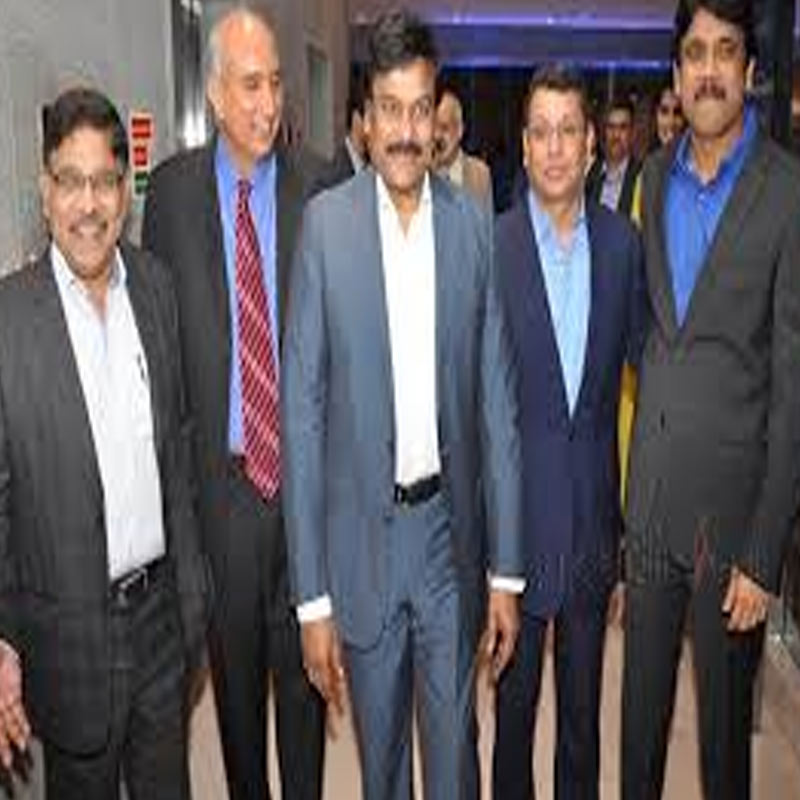
    MUMBAI: The Telugu television market is poised to become the new hot spot with superstars Nagarjuna and Chiranjeevi acquiring stake in Maa TV Network Ltd, the company which owns and operates a Telugu general entertainment channel.

    Along with Matrix Laboratories Ltd (a listed company), promoter N Prasad, Nagarjuna and Chiranjeevi will hold 60 per cent of Maa TV in a purchase deal worth Rs 400 million, a source close to the deal tells Indiantelevision.com. A formal announcement will be made soon.

    “In the revised capital structure of Maa TV, the three of them will have equal stake. The company will have a fresh infusion of Rs 500 million with the original promoter putting in Rs 100 million,” the source says.

    Maa TV founder-promoter Murali Krishna Raju’s holding will come down to 20 per cent after the restructuring. Raju, along with his associates, held around 80 per cent stake in the company. His individual holding was 50 per cent, the source adds.

    The fresh capital will be used to revamp the channel and fund other expansion programmes. “The whole business plan is being reworked. The company is finalising its strategies,” the source says.

    The restructuring will involve hiring of professionals including a chief executive. While Nagajuna and Chiranjeevi will also provide their creative inputs, Prasad has come in as a financial investor. “This will mark Prasad’s first investment into media,” the source says.

    Maa TV has been in search of funds for a long time and was earlier in talks with Star India and Sun TV. The entertainment channel was banking on movies, events and interactive mobile-based shows to drive in numbers but late last year introduced soaps in its programming lineup.

    Star India is planning to launch a Telugu channel in January, a market which is dominated by Sun Group’s Gemini TV and ETV Telugu. Zee made its entry in the South market with its Telugu entertainment channel in May 2005.

  • IPTV still at seeding stage

    IPTV still at seeding stage

    MUMBAI: Even as the framework of the digital landscape is being drawn by the various industry stakeholders, the most prepared seem to be cable TV and direct-to-home (DTH) service providers.

    Telecom operators who have plans to offer IPTV are grappling with last mile and technology issues at this stage.

    IPTV is at the seeding stage and will take 1-2 years for a serious rollout in India, according to Bharti Tele-ventures new technologies head Sriram TV.

    “Broadband has just begun. IPTV can be used as one often acquisition tools for increasing broadband penetration,” Sriram said while speaking at FICCI-Frames 2006 on TV NexGen.

    Though IPTV still lacks large subscriber base across the world, the technology for its mass deployment is in place. Telecom giants like Verizon, British Telecom and SBC are in various stages of deployment.

    “IPTV is the horse that we are backing,” said Microsoft TV group product manager Hemang Mehta.

    Elaborating on the advantages of IPTV, Mehta said the delivery platform had the ability to offer personalised content. Unlike cable TV and direct-to-home (DTH), consumers could select devices rather than be forced to buy set-top boxes (STBs) from the service operators. “The next generation of TV sets will be enabled for IP and broadband. Consumers need not buy the STBs,” he pointed out.

    On being queried by Indiantelevision.com on whether IPTV STBs were expensive, Mehta said they were available at below $100.

    As for big daddy Reliance Infocomm, the bet is on mobile TV around which the digital story will ultimately converge. This was the view expressed by Reliance Entertainment president Rajesh Sawhney.

    Speaking at the session, HTMT executive vice president Ashok Mansukhani said cable TV was well geared to meet the challenge from DTH and IPTV with its digital service. “Cable TV will offer the lowest cost digital platform. It also has the ability to offer over 300 channels,” he pointed out.

    Zee Group vice chairman Jawahar Goel said new delivery platforms were emerging which would provide choice to consumers.