Tag: indiantelevision

  • Jaane Anjaane Hum Mile: Inside the twists and turns of Zee TV’s new fiction drama

    Jaane Anjaane Hum Mile: Inside the twists and turns of Zee TV’s new fiction drama

    Mumbai: In an era of rapidly evolving entertainment, Zee TV’s latest offering, Jaane Anjaane Hum Mile, is set to make waves with its intriguing storyline, nuanced characters, and an emotional core centered around family. Set to premiere with a star-studded launch, the show features Ayushi Khurana, Bharat Ahlawat, and Jayati Bhatia, promising audiences a unique journey through love, loyalty, and sibling bonds. At the heart of this venture are producers Goldie Behl and Sonnal A. Kakar of Rose Audio Visuals Pvt. Ltd., who bring their combined strengths to create a refreshing new take on the Indian family drama.

    The launch event, held at the Westin Mumbai Garden, buzzed with excitement as Behl and Kakar shared heartfelt reflections on their creative journey. Both expressed gratitude to Zee TV and shared insights into the unique storyline of Jaane Anjaane Hum Mile, which delves into the complexities of the ‘Aata Saata’ tradition—a cultural practice involving the reciprocal marriage of siblings, adding depth and layers to the narrative.

    Kakar expressed, “I would really like to thank Zee TV for their trust and faith in us for this show and special thanks to the entire Zee TV team. My journey began with Zee TV back in 2006 as a media professional, so it feels only right that my first show as a writer-producer is on this platform. The concept of Jaane Anjaane Hum Mile revolves around the ‘Aata Saata’ tradition, an exchange marriage involving siblings, where the second girl is often seen as a guarantee. This dynamic brings two strong-willed characters together: Reet Chaudhary, an investigative reporter from Gwalior, and Raghav Suryavanshi. The story explores whether a transactional marriage can bloom into true love.”

    Behl expressed, ” I would like to take this opportunity to thank Sonnal for this lovely concept she came up with, and, of course, Zee TV. I started my career on television with Zee and have had a very long association with them. Returning to daily shows after a long time, and with Zee again, feels amazing! We’re incredibly excited and motivated to give you a fantastic show.”

    We sat down with Goldie Behl at the glitzy launch event at the Westin Mumbai Garden for an exclusive look behind the scenes, exploring the inspiration, vision, and journey that have brought Jaane Anjaane Hum Mile to life.

    With Goldie Behl, producer of Jaane Anjaane Hum Mile

    What inspired the concept of Jaane Anjaane Hum Mile? Can you tell us a bit about the story and what makes it unique from other shows currently airing?

    The major inspiration actually came from Sonnal Kakar, who envisioned the show. She brought this idea to the table, and I was more involved in handling the business aspects this time. It’s an exciting story—full of unexpected twists—that sets it apart from typical love stories on TV.

    How did you go about choosing Ayushi Khurana, Bharat Ahlawat, and Jayati Bhatia for the lead roles? What qualities in them convinced you they were perfect for these characters?

    The selection process was straightforward; it was our usual process of auditioning. The actors fit the roles well, and we could see they had the chemistry and talent required for the story.

    Could you share any behind-the-scenes moments or challenges faced while producing this show?

    Honestly, there weren’t any major challenges this time. Everything went smoothly, which is a testament to the team’s hard work and planning.

    How do you envision the show connecting with audiences? What aspects of the storyline do you think will resonate most?

    It’s not just another love story—this show has many twists and turns. We’ve focused on keeping the audience engaged by adding layers of suspense and complexity to the characters. That’s what we believe will make it stand out.

    How was your experience working with co-producer Sonnal A. Kakar on this project? What unique strengths did each of you bring to the production?

    Usually, I’m more of a “lone ranger.” But this time, working with Sonnal was great. We each brought our expertise to the table, and everything went smoothly. It was a collaborative effort that brought out the best in both of us.

    What are your hopes for Jaane Anjaane Hum Mile and its place within the Zee TV lineup? Are there any particular milestones you’re looking forward to achieving with this show?

    Honestly, my main goal is for it to be the number one show on Zee TV and any other platform where it airs. That’s the milestone we’re all aiming for.

    With constantly evolving viewer preferences, how do you plan to keep the audience engaged over the course of the show?

    Like I mentioned, this isn’t just another love story. There’s a lot of suspense and twists that will keep viewers hooked. In most stories, you’d expect a typical romance that ends in marriage, but here, it’s almost the opposite. We’re flipping the script to keep things fresh.

    What do you personally find most rewarding about producing shows like Jaane Anjaane Hum Mile? Is there any specific message or takeaway you hope viewers will gain?

    The message really centers around siblings and the love they share. It’s about how far you’d go for the sake of your sibling. That’s a theme I think will resonate with a lot of people—it’s heartfelt and grounded in reality.

    Jaane Anjaane Hum Mile promises to be more than just another television drama, with a storyline rich in surprises, sibling love, and intricate character dynamics. Behl’s vision, combined with the creative spark brought in by Sonnal A. Kakar, suggests that Zee TV audiences have much to look forward to in this new show.

  • Welingkar Institute and indiantelevision.com partner on career guidance seminar

    Welingkar Institute and indiantelevision.com partner on career guidance seminar

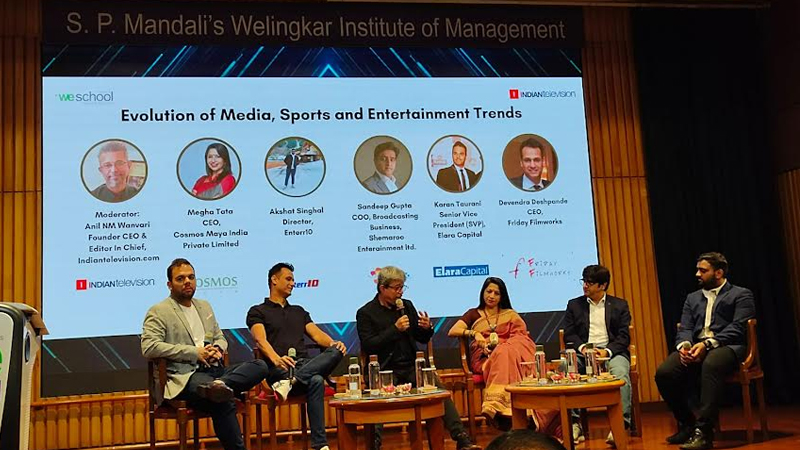
    Mumbai: There’s a tremendous opportunity for new entrants in the media and entertainment sector, despite the transformation it is undergoing and the pressure of revenues it has been facing. That was the conclusion of senior industry leaders who were part of a half-day conclave We Communique that Mumbai-based MBA institute  We School  – aka Welingkar Institute of Management – organised in partnership with Indiantelevision.com  on 17 January for postgraduate students of the media and entertainment course.

    Among the leaders who took part in panel discussions and a fireside chat included:  Cosmos Maya India CEO Megha Tata, Enterr10 director Akshat Singhal, Shemaroo broadcast business head Sandeep Gupta, Elara Capital media analyst Karan Taurani, Friday FilmWorks CEO Devendra Deshpande, Madison Media Sigma COO Vanita Keswani,  Wavemaker general manager Sejal Lodaya, Lodestar UM IPG Associate vice-presidents Shrikant Shenoy and Bhavesh Shah,  Disney Star India’s Prashant Khanna and Carat India director integrated media planning  Swarali Halepati. Indiantelevision.com founder, CEO & editor in chief Anil Wanvari chaired all three sessions.

    The speakers were spread across two sessions  “Evolution of Media, Sports, and Entertainment Trends” and “Media and Marketing in 2024. ”

    Almost all the speakers agreed that students need not be demotivated by news reports of doom and gloom that the media and entertainment industry are facing. “Yes, 2024 is going to be a year of consolidation with mergers and acquisitions seeing the course of conclusion,” said Taurani.  “Jobs are evolving but you have to get the basics right,” said Shenoy in the marketing and media session. “Learn about viewership trends, GRPs, reach etc and continue keeping abreast of developments.”

    “There is no shortage of jobs in media,” said Shah. “We are always hiring in media,” added Lodaya.  According to Keswani, the media executive’s job is becoming more about numbers and this can be fun as well.  Both Lodaya and Halepati emphasised that longevity in an organisation works very well as far as an executive’s career progression is concerned. “You should not be hopping around every few years for that marginal increase in salary,” they opined. “As long as you are learning and growing stick to the job.”

    The television panel opined that even though there is a shrinkage in the broadcast sector on the advertising inventory front (read: ad revenues), the television industry has a lot of legs. “Free TV is growing,” said Singhal, “Though pay TV is  struggling..”

    “Yes, production budgets are also slimming down,” explained Deshpande. “As are OTT series budgets.”

    He added that producers have to thus work within these budgets, and extract profits without compromising on quality through efficient production pipelines.

    Gupta extolled the student and WeWork alumni audience to learn as many skills as they can, but they need to focus on only one.

    Most of the panellists concurred that animation, gaming, VFX, AI, and ML are the most promising verticals that students should keep an eye on. “VFX studios are popping up everywhere in India and they will need talented individuals to work with them,” highlighted Taurani.

    The conclave was extremely well received with students rating it high on the knowledge enrichment chart.

  • Zee Theatre brings the endless magic, innocence and wonder of ‘Peter Pan Live!’ to India

    Zee Theatre brings the endless magic, innocence and wonder of ‘Peter Pan Live!’ to India

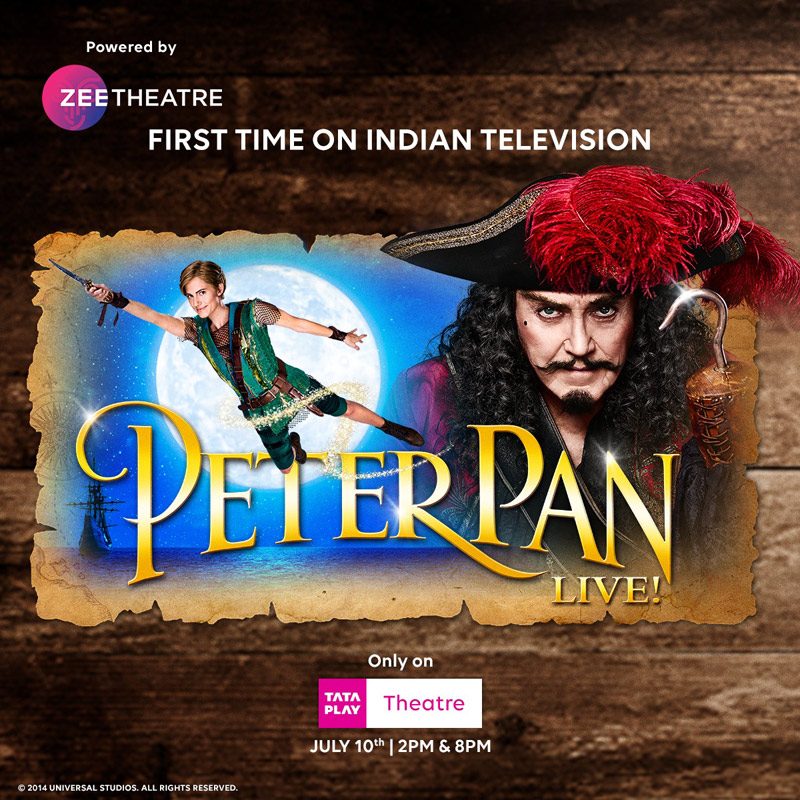
    Mumbai: Scottish novelist and playwright J. M.Barrie’s ‘Peter Pan’ is about a boy with eternal childhood who lives on a mythical island called Neverland. The narrative revolves around Peter’s quest to find stories that can entertain his co-inhabitants. Along the way, he faces many odds and blurs fantasy and reality to make us all realise that with imagination and courage, we can rewrite our destiny and defeat evil. This tale has lent itself to various adaptations across decades; from animation to live-action and theatrical interpretations at West End and Broadway. And now Zee Theatre brings to India, all the joy and magic of this tale via ‘Peter Pan Live!’ a production inspired by a 1954 Broadway musical. The delightful entertainer will be screened on 10th July on Tata Play Theatre at 2 pm & 8 pm

    ZEEL chief creative officer – special projects Shailja Kejriwal said, “There is a Peter Pan in all of us refusing to grow up. This story is a perfect respite from a world that tells us constantly to wise up, lose our naivety, and our sense of wonder. J.M. Barrie was a masterful storyteller and this version does full justice to the glorious world he created for all of us. I am sure that audiences of all ages will enjoy this family entertainer also for its rich musical score and much-loved songs like ‘Tender Shepherd,’ ‘Never Never Land,’ and ‘Distant Melody.’ Reality must be dealt with but Peter Pan reminds us to never stop dreaming, to hope and to rediscover our inner child.”

    In 1955, the Tony Award-winning musical attracted an audience of 65 million viewers and was then the highest-rated single television program in the history of television.  One major highlight of this current version is Christopher Walken, the winner of an Academy Award, a BAFTA Award, and a Screen Actors Guild Award. Walken plays Captain Hook with great flair while Critics’ Choice Award nominee Allison Williams stars as Peter Pan in this Rob Ashford and Glenn Weiss directorial.  

    The musical also stars Christian Borle, Kelli O’Hara, Alanna Saunders, Taylor Louderman, and Jake Lucas and will be screened on Tata Play Theatre.

  • Gone too soon: IndianTelevision’s Ravi Soni is no more

    Gone too soon: IndianTelevision’s Ravi Soni is no more

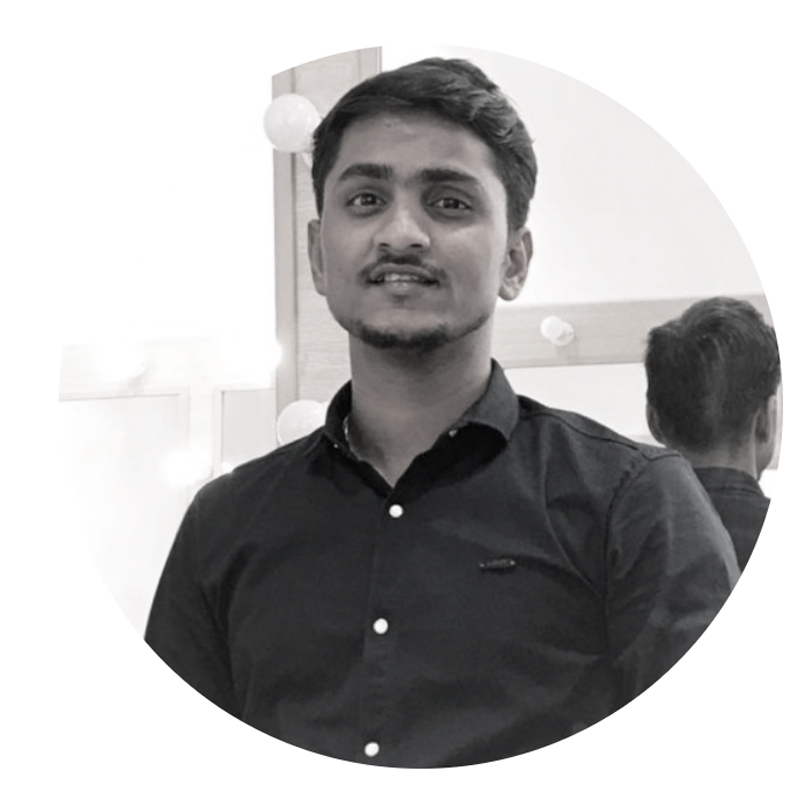
    Mumbai: It is with a heavy heart and profound grief that the Indian Television Dot Com team shares the news of the untimely demise of our colleague Ravi Soni on 10 April. He was all of 28 years old.  

    “Like a rainbow, fading in the twinkling of an eye, gone too soon…
    Like a comet, blazing ‘cross the evening sky, gone too soon…,” go the lyrics of a song “Gone Too Soon” by Michael Jackson.

    The words seem fitting to describe the passing away of a young, promising, liked-by-all colleague.

    Having joined ITV as production executive while still fresh out of college, Ravi would have completed exactly seven years in the organisation on this 13 April. Just three days short of his tragic, premature death.

    “To work with diligence and commitment, to provide possible solutions for issues that arise,” Ravi’s LinkedIn bio read.  

    And providing solutions he did. To every single production challenge or technical snag that arose, he had a single-word, swift response: “Done”

    And the issue was sorted, just like that – without any pressures mounting, temperatures rising or war-of-words in the heat of deadlines to be met in an online news organisation. It was all in a day’s work for Soni.

    Ravi’s responsibilities included managing archived content for the website, migrating content to the server, preparing newsletters, editing images and maintaining an image library for the site. He was also involved in the building, maintaining and updating of web-based applications. He worked closely with the creative and editorial teams at ITV and could always be counted upon to save the day when it came to any glitches or last-minute changes while publishing content on the website.

    Associated with the publication’s web production and day-to-day running, he was known to be a self-motivated, industrious, and proactive worker who ensured news was uploaded, updated and brought to readers instantaneously.

    To his colleagues, he was a gentle, cheerful, ever-helpful, and noble soul who loved cricket passionately. Tragically, it is also on the cricket field that he met his end, during a match on Sunday.

    All of us at IndianTelevision and everyone who has known him will miss him deeply and pray that his soul rest in peace. In this sorrowful time, we also extend our heartfelt condolences to his family and loved ones.

    Gone too soon…

  • Winners of Indian Telly Awards – Bangla 2021 announced

    Winners of Indian Telly Awards – Bangla 2021 announced

    Mumbai: Started in the year 2000, the Indian Telly Awards, often referred to as the Tellys are presented every year by Indiantelevision.com to recognise the exceptional talent from the Indian Television industry.

    The mega ceremony held in Mumbai is attended by thousands of TV actors, producers, writers and directors to celebrate the best performances both on-screen and behind-the-scenes of television in India every year. Considering the evolving situation of the pandemic, the winners of 2021 were announced virtually during an event on 28 January 2022

    This year, the Indian Telly Awards honoured the regional language television industry, beginning with the City of Joy- West Bengal. Watch the virtual ceremony here.

    Here are the winners:

  • Tele-Wise Marathi: Why TV still remains the best medium for advertising

    Tele-Wise Marathi: Why TV still remains the best medium for advertising

    Mumbai: The Marathi TV language landscape presents a stark contrast to the regional TV landscape in the southern states where the regional language is almost a necessity to communicate and connect with the viewers. Over 70 per cent of Maharashtra’s TV viewership overlaps with Hindi TV channels, while only 30 per cent of viewers opt for purely Marathi entertainment and news.

    Amid all this, is the vernacular language still the most important medium to communicate with the Marathi speaking, urban populace of television viewers in Maharashtra? This was one of the key questions debated at the recently concluded Tele-Wise Marathi, a virtual summit organised by Indiantelevision.com and presented by COLORS Marathi.

    “Most people in Maharashtra, not just Mumbai are multi-linguistic and comfortable watching Hindi entertainment also,” said Godrej Tyson Food Ltd CEO Prashant Vatkar. “So, there is not so much of a need to create Marathi-exclusive advertising content, as long as the consumer is comfortable.”

    Edelweiss Asset Management Ltd head -product, marketing & digital business- Edelweiss AMC, Niranjan Avasthi concurred. However, he added that one can definitely have a higher impact and reach if one customises the content in the local language. “The authenticity of the message being conveyed will also increase. So while it is not a necessity as far as Maharashtra is concerned, it definitely is an add-on, which can be an advantage for the marketers,” he added.

    Over 45 per cent of the Maharashtra population lives in urban areas, as against the national average of 31 per cent, observed Maruti Suzuki India Ltd, executive director – marketing & sales Shashank Srivastava, adding that the state also has several independent urban centres apart from Mumbai, such as Pune, Nashik, Kolhapur, Nagpur, Solapur.


    Recent data from Broadcast Audience Research Council (Barc) however, suggests that the ‘spillover’ viewership in Maharashtra has really reduced with regional channels seeing an uptick in numbers, especially in the last few months, as was pointed out by Madison Media Sigma- Madison World CEO Vanita Keswani, who was moderating the panel.

    “Even in the urban centers, the viewers’ market share for Marathi content is actually higher than the non-urban areas of Maharashtra. So, there is no way a marketer can afford to ignore it, especially when it comes to the auto sector TG, the affinity for local content is pretty high,” said Srivastava indicating the continued need for specific investments in regional content.

    Maruti continues to invest in regional markets along with Hindi and English content. The auto-maker uses digital for the lower end of the funnel, but television reigns supreme when it comes to brand building, reach and awareness and in TV it is the GEC and news genres, even in the vernacular belt, shared Srivastava.

    According to RamBandhu (ESFL) director, Anand Rathi, when it comes to genres within the Marathi content, more regional news was consumed, especially during the pandemic when people were more curious and anxious to know local news. “The pickle and papad brand has targeted audiences across all classes. Pre-Covid there was a leaning towards GEC content, but all that changed with the onset of the pandemic and regional news channels took precedence over regional GECs for hyper-local reach,” he added.

    Being more of an urban-centric brand selling to higher socio-economic class consumers, Godrej’s Vatkar shared that the brand uses more of digital and OTT to reach out to their specific and well-defined target audience. For this, they used experiential content by roping in celebrity chefs along with micro-influencers. The flexibility offered by digital platforms worked well for the brand, while regional language content did not play a big role since food is not so much language-oriented as much as it is an experiential concept, he pointed out.

    While agreeing to food being more experiential in nature, Rambandhu’s Rathi had a different point of view when it came to the importance of regional language in Maharashtra’s food segment. “Language plays a crucial role in Maharashtra, for me to have a strong connect with my consumer. If I’m able to talk in the language that my consumer wants to hear, he would probably give preference to my product,” Rathi said.

    The brand has recently launched a TVC campaign with celebrity brand ambassador Madhuri Dixit-Nene for its papad and pickle category, who’s the new face for the brand.

    Rathi said that the actor, for the first time, has done a commercial in the Marathi language, while stressing on the importance of the local language’s connect with the consumers.

    Srivastava agreed that if the integration with the local content is strong, the brand connect can be good. “Our internal research has found that consumers actually look at brands differently if they find that connect- and the connect need not be based on just the product characteristics or the message- it is also the language in which it is being conveyed,” he said.

    Marathi language channels have the highest viewership share in the HSM (Hindi Speaking Market) after Hindi language channels. Talking about the KPIs (Key Performance Indicators) when it comes to television as a brand vehicle, Srivastava shared that the reason the brand continues to spend heavily on the medium is that TV has performed convincingly on all its KPIs – both on the brand salience as well as the consumer conversion parts.

    Keswani noted that, interestingly, the bulk of Marathi TV advertising is occupied by national advertisers, and not regional players, as would be expected. One of the reasons for this, RamBandhu’s Rathi shared, could be the high costs of regional GECs today from an advertiser’s point of view. Talking about the brand’s advertising journey from scratch, he said that since their product targets households across categories, they felt TV was the way to go, right from the starting point. So, while other mediums like hoardings and OOH helped, the kind of reach that TV gives would be difficult to emulate on any other medium, said Rathi.

    With 115 million TV viewers, the Marathi TV language landscape is certainly not losing ground to newer kids on the advertising block, like digital. As per a Nielson study, television gives a whopping 83 per cent reach in Maharashtra, as against 51 per cent with digital. Television as a medium cannot be ignored when it comes to mass reach to a wider audience, regardless of the product category, it was roundly agreed by the panelists.

  • We are in the race to build a niche product, not to increase user numbers: Aditya Pittie

    We are in the race to build a niche product, not to increase user numbers: Aditya Pittie

    “We are not in the race of having x million DAUS or MAUS or active users. We are in the race of building a niche product.” IN10 Media Network managing director Aditya Pittie is pretty much clear about where he wants to position the network’s OTT business in an ever-growing market. Anand Mahindra- and Aditya Pittie-promoted IN10 Media has a bouquet of varied media offerings such as television (Epic TV), OTT platforms (Epic On and Docubay), and production house (Juggernaut).

    During a virtual fireside chat with Indiantelevision Group founder, CEO and editor-in-chief Anil Wanvari, Pittie asserts that Epic On and Docubay are not driven by number of users. They are rather driven by time spent, organic tractions, etc. Instead of increasing the number of users, the aim is to build a niche product as a vertical player. That is the OTT strategy the company is following. He is also bullish about Juggernaut, which is going to be one of the company’s key businesses going forward. He says that having an asset like Juggernaut will definitely be a big value addition. “We have the probably largest order book in the industry right now with more than 11 shows confirmed for production,” he states.

    Here he dwells at length on the network’s OTT business, strategy, etc.

    Excerpts:

    After the successful entry into the broadcast business, you launched Docubay. Tell us about it.

    Docubay came about because of our love for factual entertainment. We were very interested in documentaries and we believed that as a genre it is the most popular in the world. Prominent OTTs like Amazon have a good library of documentaries. A lot of people across the world enjoy watching them. Then we thought: why don’t we look at a dedicated platform for documentaries. Then we thought of going global, instead of making India-centric. Today, Docubay is a very powerful product; the experience of watching documentaries on Docubay is far superior than any other platform. And we don’t call our subscribers. We call them members, because the idea is to build a community. That’s why it has the tagline of ‘one tribe, many stories.’ The message is that there are many things to explore in this planet, but we are all one tribe. That is the message of Docubay. We just went live on Roku in North America.  And we are one of the very few companies – in the smaller media networks segment – in India that has its own OTT technology in-house. We spent almost a year and a half in building that technology. As an organisation we are really proud of both our OTT products.

    How are Epic On and Docubay faring in terms of pricing and number of subscribers?

    As regards the KPIs and metrics, Epic On and Docubay are not driven by number of users. They are driven by time spent, how many organic tractions, etc. We are not in the race of having x million DAUS or MAUS or active users. We are in the race of building a niche product.  The pricing of Epic On or Docubay is far higher than any of the horizontal or generic OTT. We are very clearly a vertical player. We have very specific offering and then charge a premium for that offering. That is the model we are working on. By no way we try to fret about how many users we have or how faster our user base is growing. We are not hungry just to drive traffic. We wanted quality traffic. Some of the conversion rates that we have in terms of install vs number of people who are subscribing is probably one of the best in the industry. Those are the kind of models we try to work on. Stickiness, higher paying members who are looking for a specific service as opposed to getting everybody to come on the platform and give what they like. That is not our strategy.  

    Since you are not looking at metrics, what is your business game plan to monetise?

    Profitability in the media business is about how much content you want to put out. We have a business plan in place. We believe in a direction we want to take. Going forward, 15 to 20 years from now, when OTTs become mainstream, there will be a big market for vertical OTTs where people will subscribe and pay you a premium for the kind of content you create and curate for them, which is dedicated to the genre they prefer focusing on. So the differentiation is that in horizontal you have all kind of content under one umbrella, whereas vertical is slightly more focused on niche. That is the base model behind our OTT strategy. There are various other vertical OTT players all over the world. They have less number of users, but very viable business model.

    But here you have entered a global space. So are you competing with Curiosity Stream?

    Curiosity Stream has a lot of short-form content and docu-series. Docubay is a feature platform. We only do films. We carry content that has minimum duration of 20-25 minutes. The product offering thus is very different. Theirs is a very knowledge-based, and about science, research, etc. On the other, we give perspective for you to form your own opinion. That is how the documentary genre should be. If you look at the content at Docubay you will realise that they give perspective but let you form your own opinion about the topic. While they are in some degree competition to us, we believe that we are a completely different platform than Curiosity Stream. And we don’t necessarily consider them to be a competition.  

    What is the thinking behind having own production company and forging partnership with Applause?

    I think we need to separate the Applause Entertainment deal from us being in production. While they are connected they are two separate business models. We were able to foresee last year that the demand for content for OTT platforms is going to skyrocket. Unfortunately, good content creators who understand what kind of content works for OTTs are limited in our industry. There are only a handful of players that are able to create good quality content. As an organisation we have created so many hours of content for our broadcasting business. We felt that we could leverage that knowledge and expertise to build successful production business for other platforms. In terms of scale, we felt that the business can be large enough to justify our resources, time, and energy. That’s why we hired Samar Khan to lead our production business for OTT. And Code M was a super-hit (which came on ZEE5 and Balaji).

    And we have the probably largest order book in the industry right now. We have more than 11 shows confirmed for production, with an order book of over Rs 100 crore for the next one year. Juggernaut is going to be one of our key businesses going forward. We are really excited about the ability to create content at scale. Samar and his team have really worked hard to build our good talent of writers and convince OTT platforms that we have the ability to deliver solid products. I am really excited about the Juggernaut business. Having an asset like Juggernaut in our portfolio will definitely be a big value addition.

    You work for local OTTs or big international ones like Amazon, Netflix, etc.?

    I won’t be able to divulge specific contract details because that will be breach of confidentiality with them. We have one or two shows with every Indian platform. We are obviously in conversation with international OTT players. While Samar has a very big pedigree of content creation, Juggernaut as a company is new. So we are building some traction. Our aim is to deliver some hits this year and then start working with OTTs like Netflix, Amazon, Hulu, HBO Max, etc. at some point as well.

    What genre is Juggernaut positioned in?

    We have seen the success of Code M and Samar as a content creator has been very good at certain shows, but we don’t want ourselves to be restricted to that. Content creation is a collective effort. Success in content creation happens by bringing the right people together for the right type of project. So we are not focussed on just doing thriller shows, fiction or non-fiction. The idea is to create good content that is in demand by platforms. OTT is such a fast-feedback medium. It is not like television. You come to know the feedback – whether it works or not – the same day of launching the show. And there is so much data. The platforms specifically know what they want, what kind of content works, and in which region. So rather than focusing on a particular genre like thriller or non-fiction, etc., we want to focus on knowing what works with audiences, learning from experiences in creating good content, working closely with the platforms, leveraging our relationships to pre-empt what kind of concepts and stories are going to work down the lane and prepare our content bank to cater to that need. That’s the broad strategy we are looking at. You can see that we are creating shows across genres.  

  • Cinema content producers still discovering audience taste

    Cinema content producers still discovering audience taste

    MUMBAI: The Indian movie industry is one of the richest in the world and its content has been gaining patrons worldwide. But producers still believe that the industry doesn’t have the pulse of audience preference.

    The point was raised at the third edition of Indiantelevision.com’s ‘The Content Hub’ during a panel discussion on how new Hindi film producers are making their mark and what business models they are drawing up. The panel included Essel Vision (Zee Studios) CEO Shariq Patel, Viacom18 Studios chief operating officer Ajit Andhare, Alliance Media and Entertainment owner Sunil Doshi and Fox Star Studios India CEO Vijay Singh. Moderating the panel was film reviewer at Film Companion Suchitra Tyagi.

    Singh said that though we do not have an absolute understanding, we are better informed than we were few years ago. "Let me just give you some facts. Theatrical in India was going single digit till last year, where it actually has its most record breaking year and the business has grown by 14 per cent. Correspondingly, even if you look at Hollywood, last year they have had their biggest theatrical year," he said.

    However, Patel was of the view that the reason behind this is the constantly emerging trends. He shared that it is not possible to foresee or sight the changes in what the audience deems popular.

    Reflecting similar thoughts was Andhare who said, “Trends and cinema are two terms which are not friends with each other, because the moment you try to say this is trend you will falter. You can safely say that yes content has to be taken more seriously, just the package film which used to a success few years ago may not work.”

    He further added, “Also from a purely film business point of view, if you see a movie goer base, it is actually divided in three major markets, Hindi is just one, and the other two big bases are down south. So if you really want to address the entire consumer base for cinema in this country, you have to address all these three and from that stand point regional becomes extremely relevant.”

    There is a great opportunity to be a content producer today. "There is a huge opportunity in OTT and I can tell you that in films there is equally large opportunity. What has happened in Hollywood over the last 10 years, because the contribution from outside America started going up. 10 years back international content contributed 30 per cent and today it contributes 70 per cent. That is the reason why studios are working on franchise films or the few films which have the ability to actually travel across the globe,” Singh concluded.

  • Indiantelevision.com’s VR news journalism workshop gives fresh insights

    Indiantelevision.com’s VR news journalism workshop gives fresh insights

    MUMBAI: “Immersive Journalism.” “The Use of VR in News Journalism”

    Indian broadcast news journalists have heard these terms being used either online or in conversations. But, apart from NDTV, Republic and Times Network, not many of them have explored the innovation that is currentl engaging TV news viewers worldwide.

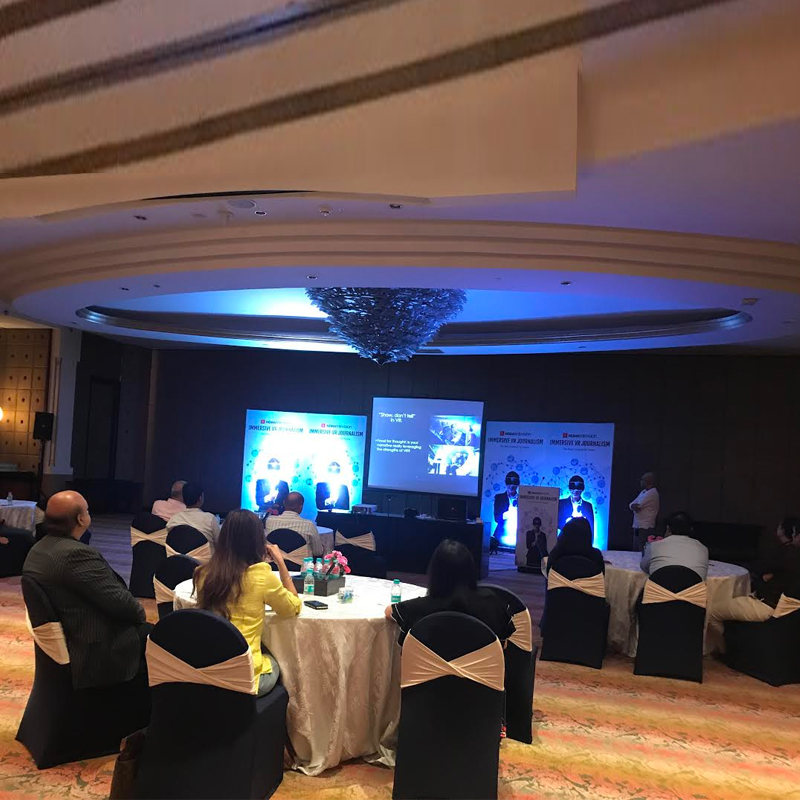
    To fill this gap, indiantelevision.com organised a half-day workshop in Noida’s Radisson Blu MBT Hotel on 26 September.

    In the house were a select group of tech professionals from news organisations such as NDTV, ABP News, India Today and News18 Television. The workshop was presented by  VR expert, the Dubai-based Clyde Desouza.

    Indiantelevision.com founder, CEO and editor-in-chief Anil Wanvari stated at the start of the workshop that VR journalism is not just in an experimental stage currently, it is a reality amongst many broadcasters worldwide. The reason for this is the falling prices of 360 VR cameras and VR headsets.

    public://Clyde DeSouza.jpg

    Clyde Desouza gives his take

    I’ve just completed a whirlwind initiative to bring awareness of Immersive Journalism to media organisations in India, thanks to the support and thrust provided by IndianTelevision.com.

    What started out as a series of discussions with the founder of IndianTelevision.com, Anil Wanvari, culminated in an exclusive, invite-only seminar on the future of factual storytelling – Virtual Reality and Mixed Reality Journalism at the Radisson Hotel, Noida, India.

    The top news and media organisations are headquartered in Noida, and CxO-level professionals from these organisations attended along with news editors and graphics teams to look into the future of news reporting and what I’d like to term as “Experiential Journalism.”

    The audience was informed and engaged. I won’t hesitate to say I’ve learned equally as much from the questions posed, as from the non-linear discussions that ensued well past the two-hour time allotted for the workshop.

    It was encouraging to see attendance from such prestigious organisations as E&Y, alongside respected NEWS and media organizations such as NDTV, ABP, and Network 18 in India.

    The seminar started with an overview of what Immersive Journalism is, with due credit given to the such luminaries as Noni De La Peña, but also the current state of the art in Virtual Reality news reporting and looking forward to Mixed Reality storytelling.

    As a tech / creative evangelist for VR, I was happy and impressed with the questions asked, and was genuinely excited to field queries ranging from Photogrammetry offer ideas on how CG “assets” could be created, and a library built for rapid Immersive Journalism pieces, with existing television CG packages and solutions such as VizRT and Wasp3D.

    There is certainly an appetite among the media and NEWS organisations in India, to take reporting beyond what’s possible on linear TV.

    While I’m currently bringing one of India’s leading news channels up to speed in VR, it was heartening to see almost all other major and emerging media organisations, aware that in order to build loyalty to their channel and brand, they need to engage their audiences on a level that goes beyond sensationalism and traditional news reporting.

    Twitter @cly3d

    Linkedin: https://www.linkedin.com/in/clydesouza

    www.realvision.ae/blog

    Many of the broadcasters are foraying into it because they want to get brand innovation credibility, apart from attaining a sense of future preparedness. Wanvari added that currently most of the players are actually producing a lot of 360 videos, rather than fully immersive ones.

    The early adopters apart, most news broadcasters are treading cautiously because the monetisation models have yet to be developed, and though prices have been heading southwards, the cost of VR gear – both at the producer end and at the consumer – still make it an elitist hobby, said Wanvari.

    He added that around three million headsets have been sold internationally.

    He urged the Indian news industry to get together under the NBA umbrella to work cohesively with tech partners, and platforms to increase awareness amongst its members as well as to negotiate on both production equipment and content standards.

    Desouza, on his part, began by explaining to the audiences what VR really seeks to achieve.

    “VR is not VR for VR’s sake,” he said. “It’s the experience that your brain feels.” 

    He explained the difference between VR and AR. “AR is when digital assets are added into the real world,” he said. “VR is when it’s entirely virtual and digital.”

    Desouza pointed out that care should be taken while filming 360-degree videos. “You have to keep the viewer in mind. You can’t pan and swish and zoom in like you would do with a normal camera. These kinds of motions give the VR viewer a headache.”

    He pointed out that many organisations are investing hundreds of thousands of dollars and producing videos that don’t really work as VR or immersive journalism.

    “The VR video has to draw the viewer into understanding that it is his point of view which he is experiencing,” he said.

    Desouza added that news brands internationally are using — and can use — VR to galvanise the audience into action.

    “For instance, a feature on haemophiliacs can be told from a victim’s point of view and the viewer should be able to feel and experience what the haemophiliac is feeling and going through and how we need to deal with them,” he explained.

    His view is that Indian news organisations would do well to keep aside budgets of about US$ 100,000 to start up their VR departments as well as a room with young, trained journalists so that costs can be kept under control.

    His talk was illustrated with the best and the worst examples of VR and immersive journalism videos from global studios.

    Desouza is currently consulting a leading Indian English news broadcaster to help steer it into VR journalism, and is in talks with a couple of others for the same.

    To read Clyde Desouza’s perspective on the workshop, click here.

  • R.K.Arora bids adieu to Zee Media

    R.K.Arora bids adieu to Zee Media

    MUMBAI: Executive director and CEO of Zee Media R.K. Arora has stepped down from his role. A source close to the development has confirmed this development to indiantelevision.

    Arora was appointed as an additional director and CEO of the company for a period of three years with effect from May 24, 2016 soon after the chairman of the Essel Group of companies Subhash Chandra resigned from the post of director and non-executive chairman of Zee Media Corporation Limited (ZMCL).

    Arora was responsible for the various news channels under ZMCL that included WION, Zee News, Zee Business, India 24×7, Zee Punjab Haryana Himachal, Zee Madhya Pradesh Chhattisgarh, Zee 24 Taas, 24 Ghanta, Zee Kalinga News, Zee Purvaiya, and Zee Rajasthan News.

    Before joining ZMCL, Arora was the CEO of News Nation. He earlier was with ITV Network where he managed the overall operations of its seven channels.

    Updates on Arora’s successor is still awaited.

    Meanwhile, the whole Essel/Zee group is undergoing a restructuring. The group recently appointed a new chief executive for Zee Entertainment’s domestic broadcast business in Punit Misra, while Amit Goenka continues to be the CEO-International for ZEEL. Zee’s parent Essel has formed a new entity, Essel Business Excellence, which will take care of many of the common responsibilities of the group companies.Another business unit, Zee Unimedia, will not only look after ad sales of Zee’s digital platforms but also its TV channels, while scouting around for outside work too in the long run, if media reports are to be believed.