Tag: Indian

  • #BigBillionDay sale blunder: Flipkart apologises, govt probes

    #BigBillionDay sale blunder: Flipkart apologises, govt probes

    MUMBAI: The sale that was touted as the biggest sale in India by shoppers across the country seems to have disappointed many. With a mile long complaint list which included everything from server errors to price issues, abrupt cancellations among others, the dissatisfied and disgruntled customers backlashed on social media, with hashtags branding them as ‘Flopkart’ trending.


    A day after the failure of the the Big Billion Day Flipkart founders Sachin Bansal and Binny Bansal apologised for the chaotic and unpleasant experiences faces by the customers on 6 October.


    “Yesterday was a big day for us. And we really wanted it to be a great day for you. But at the end of the day, we know your experience was less than pleasant. We did not live up to the promises we made and for that we are really and truly sorry,” the Bansals, wrote in a joint email to customers.


    The e-commerce firm said 1.5 million people shopped at its portal on 6 October to take benefit of the one-day sale scheme. The company claimed it sold products worth over Rs 600 crore in just 10 hours under the scheme. The company had announced deep discounts for products in over 70 categories.


    “And though we saw unprecedented interest in our products and traffic like never before, we also realised that we were not adequately prepared for the sheer scale of the event. We didn’t source enough products and deals in advance to cater to your requirements,” the founders said.


    They added that the load on server led to intermittent outages that impacted shopping experience on the website.


    Flipkart had deployed nearly 5,000 servers and had prepared for 20 times the traffic growth – but the volume of traffic at different times of the day was much higher than this, the mail revealed.


    Talking about the out-of-stock issues, the founders reckoned, “We had ensured availability, anywhere from hundreds to a few lakh units for various products, but it was nowhere near the actual demand. We promise to plan much better for future promotions and ensure that we minimise the out-of-stock issues.”


    The e-mail further stated, “We realise that this breaks the trust our customers have put in us. We are truly sorry for this and will ensure that this never happens again.”


    “Everything that we have achieved at Flipkart is purely on the basis of our customer’s trust and faith…We failed to live up to this promise and would like to apologise once again to every single customer for our failure,” the founders concluded.


    Not only customers complained against the Big Billion Day sale, the Confederation of All India Traders (CAIT) has also sought a probe into the business model and trade practices of e-commerce companies to find out how they are offering huge discounts during the ongoing festive season. It also demanded setting up of a special task force of experts to conduct an in depth probe of working of such companies.


    Also according to media reports, Union Minister of State for Commerce and Industry Nirmala Sitharaman expressed concerns over Flipkart flash sale controversy.


    “We have received many inputs regarding Flipkart episode. Lot of concern has been expressed and we will look into it,” Sitharaman said.


    After receiving many complaints regarding the Big Billion Day sale, Commerce and Industry Minister Nirmala Sitharaman commented, “We have received many inputs. Lot of concerns have been expressed. We will study the matter… Whether there is a need for a separate policy or some kind of clarification is needed, we will make it clear soon,” the reports added.

  • #BigBillionDay sale blunder: Flipkart apologises, govt probes

    #BigBillionDay sale blunder: Flipkart apologises, govt probes

    MUMBAI: The sale that was touted as the biggest sale in India by shoppers across the country seems to have disappointed many. With a mile long complaint list which included everything from server errors to price issues, abrupt cancellations among others, the dissatisfied and disgruntled customers backlashed on social media, with hashtags branding them as ‘Flopkart’ trending.


    A day after the failure of the the Big Billion Day Flipkart founders Sachin Bansal and Binny Bansal apologised for the chaotic and unpleasant experiences faces by the customers on 6 October.


    “Yesterday was a big day for us. And we really wanted it to be a great day for you. But at the end of the day, we know your experience was less than pleasant. We did not live up to the promises we made and for that we are really and truly sorry,” the Bansals, wrote in a joint email to customers.


    The e-commerce firm said 1.5 million people shopped at its portal on 6 October to take benefit of the one-day sale scheme. The company claimed it sold products worth over Rs 600 crore in just 10 hours under the scheme. The company had announced deep discounts for products in over 70 categories.


    “And though we saw unprecedented interest in our products and traffic like never before, we also realised that we were not adequately prepared for the sheer scale of the event. We didn’t source enough products and deals in advance to cater to your requirements,” the founders said.


    They added that the load on server led to intermittent outages that impacted shopping experience on the website.


    Flipkart had deployed nearly 5,000 servers and had prepared for 20 times the traffic growth – but the volume of traffic at different times of the day was much higher than this, the mail revealed.


    Talking about the out-of-stock issues, the founders reckoned, “We had ensured availability, anywhere from hundreds to a few lakh units for various products, but it was nowhere near the actual demand. We promise to plan much better for future promotions and ensure that we minimise the out-of-stock issues.”


    The e-mail further stated, “We realise that this breaks the trust our customers have put in us. We are truly sorry for this and will ensure that this never happens again.”


    “Everything that we have achieved at Flipkart is purely on the basis of our customer’s trust and faith…We failed to live up to this promise and would like to apologise once again to every single customer for our failure,” the founders concluded.


    Not only customers complained against the Big Billion Day sale, the Confederation of All India Traders (CAIT) has also sought a probe into the business model and trade practices of e-commerce companies to find out how they are offering huge discounts during the ongoing festive season. It also demanded setting up of a special task force of experts to conduct an in depth probe of working of such companies.


    Also according to media reports, Union Minister of State for Commerce and Industry Nirmala Sitharaman expressed concerns over Flipkart flash sale controversy.


    “We have received many inputs regarding Flipkart episode. Lot of concern has been expressed and we will look into it,” Sitharaman said.


    After receiving many complaints regarding the Big Billion Day sale, Commerce and Industry Minister Nirmala Sitharaman commented, “We have received many inputs. Lot of concerns have been expressed. We will study the matter… Whether there is a need for a separate policy or some kind of clarification is needed, we will make it clear soon,” the reports added.

  • Stand-up comedian Kapil Sharma is in Forbes India celebrity 100 list

    Stand-up comedian Kapil Sharma is in Forbes India celebrity 100 list

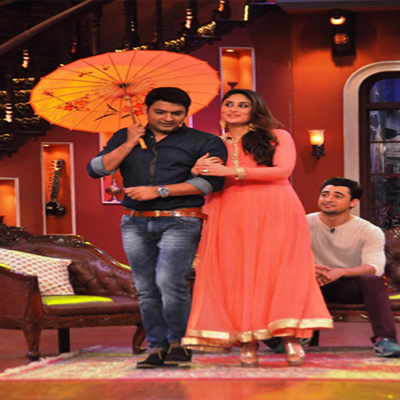
    MUMBAI: In a short span of time, stand-up comedian Kapil Sharma has made a place for himself in the industry and in the hearts of many Indians. Now, it is time for him to celebrate his success as the artiste whose show Comedy Nights With Kapil has kind of become a phenomenon in the country, has been listed in Forbes India’s “celebrity 100” list.


    Sharma has secured the 93rd position in the list while other popular TV stars like Ram Kapoor, Ronit Roy and Sakshi Tanwar have been placed below him, said the magazine’s official website.


    Kapil came in to the limelight after winning season three of the reality show The Great Indian Laughter Challenge. He has also featured in various seasons of Comedy Circus before starting his own production house K9 Productions under which he produces Comedy Nights with Kapil, aired on Colors.


    He has also been nominated alongside Shah Rukh Khan, Hrithik Roshan, Farhan Akhtar and Deepika Padukone for CNN IBN’s Indian of the Year (Entertainment).


    “Thank you god and my fans for making it possible…” Kapil posted on Twitter after the announcement.


    The show is India’s highest rated serial in the non-fiction category garnering viewership rating greater than reality flicks like KBC and Big Boss.

  • BARC meets today, set to appoint Mediametrie as its rating partner

    BARC meets today, set to appoint Mediametrie as its rating partner

    MUMBAI: The French audience measurement company Médiamétrie will be the ratings partner for the Broadcast Audience Research Council (BARC). Though multiple vendors, both Indian and international had thrown in their bids to be the one who would power BARC’s ratings, sources reveal that the council has opted for the French research agency. Apparently, the final decision was taken over the weekend wherein the — members of BARC met along with Mediametrie reps to sign on the dotted line.


    Mediametrie will be using audio watermarking tech to monitor TV consumption by its 20,000 strong panel. It involves inserting an identifying  mark inaudible to the human ear into the channel’s feed which is delivered to TV homes.. The technology enables different reception modes to be used to measure a TV programme’s audience.

    Médiamétrie features in the world’s top 25 market research firms’ list.


    The formal announcement is expected to be made later this month.  Sources have confirmed that deadline set by BARC such as launching the ratings service by mid-2014 will be met.


    The meeting which went on for two hours in the BARC office also discussed the financial aspects of the ratings, but another meeting is slated to be held for the same.


    BARC CEO Partho Dasgupta did not confirm the finalisation of the appointment of Mediametrie. Responding in an email he said:  “The board of BARC met today to decide on technology and the path ahead. There was unanimity in deciding on a leap in technology to be used in television measurement.  The board approved the management and the technical and commercial committees to go ahead and finalise with a couple of international companies for this. The team will be completing the pilots and will start deployments soon. The board also decided on the funding mechanism and is encouraged by the response received from banks for funding the project.”


    But sources indicate that it is indeed Mediametrie which will get the go ahead.


    According to sources, BARC will start the field trial of meters from January 2014. While the seeding of meters will start from June, the commercial data will be available in the market from October. While initially 20,000 meters will be seeded, BARC will seed 25,000 boxes by 2014 end.

  • Brand Integration grows in Indian Cinema

    Brand Integration grows in Indian Cinema

    MUMBAI: As the new Rs 200 crore club emerges in Bollywood, it’s also been a strong year for brand integrations in films. Krrish 3 has revolutionised Bollywood content with the most number of brands ever having been integrated in a film. Mates India, a well-known brand integration, film marketing and celebrity management firm, was behind weaving in five brands – Cadbury Bournvita, Flair pens, Tata Manza, Fortis Hospital and Forever Jewelry into the film. And the jobs of Sooraj and Darshana Bhalla don’t end there as post the integration; merchandising has also become an equally important marketing tool in today’s day and age.

    Cadbury Bournvita for example was not only the drink consumed by Rohit in the film while he works in his science lab but as consumers we soon saw special Krrish Bournvita packs on the shelves in our grocery stores. A fly with Krrish contest was implemented which would create a direct connect with the consumer and also allow for the winners to meet Hrithik Roshan one on one if they happen to be one of the lucky winners.  Such activities not only benefit the brands but also help the film maintain its shelf life beyond the first weekend.  Promotions and ads around the integrated products (ex: Krrish Flair pens) keep the buzz around the film alive and hence it becomes a mutually symbiotic relationship.

    Bridging the gap in this relationship is a firm like Mates, which finds the right synergies and creates opportunities for both the films as well as the brands.  Talking about the changing trends, CEO Sooraj Bhalla says, “It has been amazing to see how over the years content and advertsing are seeping seamlessly into each other and providing for a great viewer experience. Krrish 3 has been a very ambitious project for brands too. The belief and the vision has paid off.”  Besides Krrish, Mates has worked on integrating content in many other films such as Race 2 (Audi), Yeh Jawani Hai Deewani (MakeMyTrip.com and Jabong.com), Bhaag Milkha Bhaag (Birla Sun Life Insurance), etc.

    By Dolly Bhatter, publicist by profession (PR and CEO of a PR firm)

  • Why telecasting cricket hurts DD

    Why telecasting cricket hurts DD

    MUMBAI: It has been six years that India’s public broadcaster Doordarshan (DD) started showing cricket matches to the Indian audience for free, allowing even the underprivileged viewers to watch their favourite sport.

    Apparently the public broadcaster has to pay a price for citizens of India to watch cricket matches for free. And if you think it hardly matters, it’s about time to correct it. Let’s first understand how the whole process actually works.

     In 2007, the Sports Broadcasting Act was passed that stated that live signals of all cricket matches (ODI and T20) of national importance that are played in India must be shared with the public broadcaster DD and AIR (All India Radio). Post the formation of this law, any commercial sports channel needs to share its signals with DD for all such matches. In a recent ruling, it directed Star Sports to provide feeds without advertisements since Star Sports is currently the right holder of these matches.

    Before a series, both the commercial broadcaster and DD get together and bid for the Revenue Management Control (RMC).The highest bidder becomes the RMC and gets the rights to market the advertisements for the match. According to the Act, 75 per cent of the revenue will be with the main channel and 25 per cent will be with DD. All the money is pooled into an escrow account to maintain transparency over the dealings and revenue earned. If DD makes more than the bidding amount, it profits, but if it doesn’t meet the target then it has to shell out money from its pocket to give the 75 per cent of the bid amount to the other party.

    Mukesh Sharma feels that it it the well wishes of people that works for DD in the end

    When DD telecasts these important matches, it loses out the revenue that it generates from its daily soaps on the national channel. At the same time, the regional channels have terrestrial support between 8: 00 pm to 11: 00 pm from the national channel. So, while a match is aired on one channel, shows from several DD channels are cut off for hours.

    “For DD, this is a loss making exercise but the government wants to show cricket to even those who cannot pay for the commercial channels,” says DD Sahyadri additional director general Mukesh Sharma.

    DD has always battled to have at least a 50:50 deal along with suitable changes in the law. The revenue that DD makes through its shows, which would have been telecast in place of the cricket match, is called as the opportunity cost (OC). In order for DD to gain its OC, it has to earn four times the revenue from the cricket match. For example, if the OC is Rs 5 crore, then DD needs to make Rs 20 crore (excluding tax) so that Rs 15 crore is given to the channel that holds the rights and DD recovers Rs 5 crore.

    However, the possibility of this happening is nearly zero because of the difference in advertisers on board with DD and the commercial channel. Factors such as opponent country, type of match, time of viewing, audience demographics come into the picture. For an India vs Pakistan match, the ad rates may be high, the bid would be high too as compared to an India vs Zimbabwe one. “During prime time, we suffer huge losses and there isn’t much money in the market that can help us recover our opportunity cost,” adds Sharma.

    Had test matches also been included in the Act, probably the pubcaster would have been constantly stitching holes in its pocket. In fact, a recent letter by the Prasar Bharati to the Ministry of Information & Broadcasting  (I&B), DD said that although it had wanted to telecast Sachin Tendulkar’s  final match, restrictions in the Act and the possibility of a huge financial loss thwarted it from doing so. The OC for the two test matches would be Rs 10 crore as compared to the advertising revenue of just Rs 1 crore. That signals a loss of Rs 9.25 crore for it.

    The letter also highlighted how it was a huge financial loss for DD when the money allotted to Prasar Bharati was cut down. Therefore, another request to amend the act has been put forth that lets the pubcaster choose the matches it wants to telecast and the channel on which it wants to show it.

    The Sports Broadcasting Act of 2007 says, “No content rights owner or holder and no television or radio broadcasting service provider shall carry a live television broadcast on any cable or Direct- to- Home network or radio commentary broadcast in India of sporting events of national importance, unless it simultaneously shares the live broadcasting signal, without its advertisements, with the Prasar Bharati to enable them to re-transmit the same on its terrestrial networks and Direct- to- Home networks in such manner and on such terms and conditions as may be specified.”

    Prasar Bharati has asked for it to be changed to “its terrestrial networks or Direct- to- Home networks” or “on its FTA networks available on various platforms” so that they have flexibility on the channel they want to show it. The OC on DD Sports is negligible.

    Prasar Bharati has been asking for the revenue sharing to be changed to 40:60 in its favour. Since the initiation of the Act, 43 such matches have been telecast (ODIs and T20) till November 2012. Out of them, in 18 matches the bid amount quoted was not enough to meet the OC while for 25 matches it suffered a loss even when the OC was not realised. The demand for changes in the act, it says, will be consistent with its aim to provide viewers free viewing of the matches without having to subscribe to pay channels.

    “It needs to be re-emphasised that carriage of sporting events of national importance on DD National results in disruption of normal programmes and loss of precious revenue. The proposed amendment will help Prasar Bharati in realising optimally its existing revenue potential and enhancing it further,” reads a letter dated 17 September 2013 by Prasar Bharati finance member B B Pandit to the I & B ministry additional secretary J S Mathur.

    Star Sports is currently the channel that has the rights to broadcast all such matches and has to share the feed with DD. The channel refused to comment on this story saying the matter is sub-judice. In October this year, the Delhi High Court directed Star Sports to provide signals devoid of advertisements to DD, which it had earlier said it cannot do as they come embedded with the feed.

    DD is a public broadcaster so its main sources of revenue are public funds and advertising revenue. “Well, even if we don’t get any money, we make do with the well wishes of the people,” says Sharma.

  • DD strengthens its movie library; to screen acclaimed films twice a week

    DD strengthens its movie library; to screen acclaimed films twice a week

    NEW DELHI: The national broadcaster – Doordarshan – is launching a new slot for acclaimed Indian feature films in all languages that have either won national or international honours, featured in the Indian Panorama, or been part of competition sections of 16 renowned international film festivals.


    The films will be screened on Sunday and Monday nights at 11:00 pm from the coming weekend and will be subtitled in English. With revenue earnings of Rs 15 lakh per screening and holding the rights for three years; the pubcaster clarified that the rights were not exclusive.


    In the event of a film being offered for a premiere on DD, the amount to be paid will go up to Rs 25 lakh.


    Doordarshan Director General Tripurari Sharan told indiantelevision.com that the ‘Best of Indian Cinema’ initiative was part of the celebrations on the centenary of Indian cinema.


    Answering a question, he said a similar slot for such films in the eighties and early nineties had fizzled out for various reasons including the fact that the prime time was restricted to around 9:00 pm and viewers generally did not watch television after that. But the entry of the private channels had changed the scenario.


    He claimed that DD was the only channel showing such films. However, Lok Sabha TV also has a similar slot on Sundays, though the window for the kind of films it will take is not as large as the one DD is embarking upon.


    Sharan clarified that as most films had a U/A certification, they could not be shown before 11:00 pm.


    Initially, DD had decided to keep this slot for one year with a total of 104 films. He added that DD had decided to have a cut-off date, and so the slot will only screen films made post the year 2000.


    Sharan said that there was need to support these films as they are meant for niche audiences.


    However, this slot will mean that the popular Bioscope slot in which meaningful films are shown in three parts from Monday to Wednesday at 11:00 pm will now be curtailed to Tuesdays and Wednesdays.


    Answering questions at an informal press meet, he said that other time slots could be considered for these films in the event of viewers demand. Furthermore, DD could also consider increasing the frequency of the screening of such films from twice a week to more days. Referring to Sunday afternoons, he added that the slot was already reserved for retrospectives of eminent film personalities.


    On the marketing front, there are already print advertisements that would begin appearing from this weekend, e-flyers to several thousand persons on the list of DD, and social media like Facebook.


    The first four films in this slot are the Malayalam movie Nizhalkkuthu by the famed Adoor Gopalakrishnan on 10 November, the Marathi drama Deeol by Umesh Kulkarni on 11 November, the Konkani film Digant by Dyanesh Moghe on 17 November, and the Bangla Nisshabd by Jahar Kanungo on 18 November.

  • Debutante director Somshukhlla makes her global mark with Sandcastle

    Debutante director Somshukhlla makes her global mark with Sandcastle

    MUMBAI: Sandcastle, a simple film with a complex message, written and directed by Indian debutante director Shomshukhlla has been nominated at several International Film Festivals including the Tenerife and London International Film Festival and screening in Hollywood LA Femme Fest.


    The film is about the journey of a woman in modern India finding her identity. It will be screened at Hollywood’s LA Femme Film Festival at the Regal Stadium 14 La Live, and has been nominated in the Best Foreign Language Feature Film category at the London International Film Festival (LIFF) 2013. The film also had four nominations at the Tenerife International Film Festival 2013 in London on October 12, including nods for Best Feature Film, Best Actress, Best Supporting Actor and Best Cinematography.


    Some important and rather poignant messages are conjured up in this bright and beautiful journey of a woman building her life. The ending is settling and although the film has had its share of surreal moments, Sandcastle reads much like a wonderfully crafted manuscript.


    “The film addresses the unsatisfied longings of a seemingly comfortable middle-class Indian woman. India is waking up to good stories, with substance, new voices, ideas and perspectives, redefining the lost glory of story-telling. I am lucky that I am getting to be a part of it,” says Somshuklla.


    Sandcastle tells the story of Sheila, (Shahana Chatterjee) whose upper middle-class life in India isn’t as perfect as she hoped it would be. Sheila is a home-maker, an aspiring writer and loving mother. From an outsider’s perspective, it would seem like she has the perfect life. Her husband is a wealthy advertising maverick and she is part of the elite middle-class of Indian society. But like the shifting of the sands, is it all slipping through her fingers? How will she build her own dreams? In all that she has, does she really have a voice of her own?


    The story of Sandcastle reflects one’s belief in the ability to build a perfect life. But even in perfection there is emptiness and wanting. What is perfect to one person is misery for another. The film focuses on contemporary women in urban India and the changes in society that have moulded these women as an independent and self directing force of nature. Shomshuklla shows two colliding worlds of fateful acceptance and feminine Indian independence and individuality.

  • HUL joins twitter to reach out to its consumers

    HUL joins twitter to reach out to its consumers

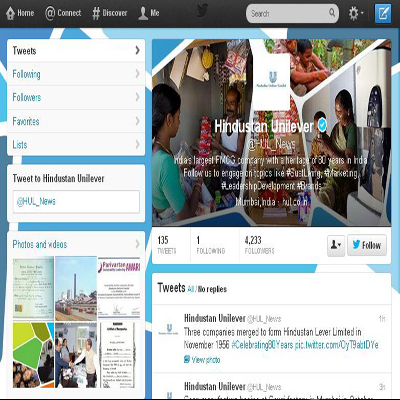
    MUMBAI: Hindustan Unilever Limited (HUL), the market leader in consumer products in the country, has joined twitter recently.


    The company which has presence in over 20 consumer categories such as soaps, tea, detergents and shampoos amongst others with over 700 million Indian consumers using its products joined the social media site with the handle @HUL­_News with a tweet saying “HUL, India’s largest FMCG company is now on Twitter. Join the conversation with us on topics like #Sustainability, Marketing & #Leadership.”


    When asked why did the company as a corporate brand chose to join twitter, the HUL spokesperson said: “Social media provides us an opportunity to reach out to our consumers and other stakeholders in an ongoing and engaging manner.”


    And with 4,233 followers already on the site in a short span is proof enough what the brand means to the country.


    Not to forget that HUL has been on social media for several years now through its various brands like Sunsilk, Surf Excel, Dove which the company boasts of having led digital marketing in India with some path-breaking work and innovations.

  • Social Media is Important to Majority of Indians: Ipsos Study

    Social Media is Important to Majority of Indians: Ipsos Study

    MUMBAI: Majority (58 per cent) of Indians say social media is important to them; compared to 42 per cent globally, according to a new poll of online respondents conducted by Ipsos OTX – the global innovation center for Ipsos, the world’s third largest market and opinion research firm.


    “As Mahatma Gandhi rightly said – ‘action expresses priorities’, social media is well on its way to being a priority as majority of Indians who have access to the internet claim social media is important in their lives,” said Ipsos India head of marketing communication Biswarup Banerjee.


    “With proliferation of mobile internet in India, social media has become a part of everyone’s life, it influences people’s daily life and how they interact with each other. Social media has now become a mainstream way of communicating – for individuals as well as businesses,” added Banerjee.


    The big social media story is told in the demographics, especially age. Age appears to be the strongest demographic driver of placing importance on social media in India. Indeed, a big majority (62 per cent) of those under the age of 35 rate social media as important vs. 58 per cent for those aged 35-49 and 44 per cent for those aged 50-64. Women (64 per cent) seem more likely than men (54 per cent) to rate it highly.


    The countries with the highest proportions those indicating social media is important to them are from: Turkey (64 per cent), Brazil (63 per cent), Indonesia (62 per cent), China (61 per cent), Saudi Arabia (59 per cent), India (58 per cent), Mexico (54 per cent) and South Africa (52 per cent). This group of social media lovers is followed by Argentina (45 per cent), Russia (44 per cent), Spain (42 per cent), Poland (37 per cent), Hungary (36 per cent), Sweden (35 per cent), Germany (33 per cent), Great Britain (33 per cent) and the United States (32 per cent). The lower group includes: Australia (30 per cent), Italy (30 per cent), Belgium (29 per cent), Canada (28 per cent), South Korea (28 per cent), Japan (24 per cent) and France (17 per cent).


    Ipsos conducted this study among 18,002 people in 24 countries in the month of July.